

Ireland produces far more food than its 5 million people can eat, so most of what our farms produce is processed here and sold abroad. This topic follows food from the farm gate through the factory to the label on the pack — who processes it, how, what it is wrapped in, and what the law makes the manufacturer tell you. For Leaving Certificate Higher Level Home Economics, you need to understand the economic structure of the Irish food industry, the role of small and artisan enterprises, the range of processed foods and their nutritional effects, four industrial processing profiles (flour, liquid milk, Cheddar cheese, and yogurt), packaging science, food chain contaminants, food legislation, and preventative safety systems such as HACCP and ISO 9000.
Structure and Sectors of the Irish Food Industry
The Irish food industry operates as an integrated supply chain across three economic levels: the primary sector produces raw commodities through farming and fishing; the secondary sector manufactures these into food products in creameries, mills, and meat plants; and the tertiary sector handles distribution, retailing, marketing, and regulatory enforcement.
Six Principal Sectors
Ireland's temperate maritime climate and long grass-growing season give it an advantage in pasture-based agriculture:
- Dairy: Ireland's most valuable agricultural sector, producing butter, Cheddar cheese, milk powders, casein, and infant nutritional formula.
- Meat and livestock: Specialises in grass-fed beef and pigmeat, with smaller sheep and poultry divisions.
- Beverages: Encompasses global exports such as Irish whiskey, cream liqueurs, and stout, alongside domestic craft brewing and mineral waters.
- Prepared consumer foods: A rapidly expanding sector producing convenience products such as chilled ready meals, pizzas, cooked meats, soups, and bakery items.
- Seafood: Produces wild pelagic catches (mackerel and herring) alongside farmed Atlantic salmon and rope-grown mussels.
- Cereals and bakery: Produces milled flour, breakfast cereals, artisan breads, and biscuits for domestic use and export.
Trade Profile: Exports and Imports
Because domestic supply far exceeds national population needs, roughly 90% of Irish beef and dairy output is exported. Major exports comprise dairy products, beef, whiskey, liqueurs, and seafood.
Climatic limits and consumer demand require Ireland to import substantial food volumes:
- Exotic and citrus crops: Bananas, citrus fruit, avocados, and warm-climate vegetables.
- Tropical commodities: Raw coffee beans, tea leaves, cocoa, rice, and spices.
- High-protein milling wheat: Damp autumn weather yields soft wheat with lower gluten, suitable for biscuits and animal feed; high-gluten hard wheat must be imported for breadmaking.
- Out-of-season produce: Field vegetables and soft berries imported during winter to maintain year-round retail supplies.
State Support Agencies
- Bord Bia (The Irish Food Board): Promotes Irish food, drink, and horticulture globally. It awards the Bord Bia Quality Mark to verify origin, traceability, and farm-to-fork processing standards, and runs Origin Green, the national food sustainability programme.
- Teagasc: Conducts scientific research, food technology advisory services, and agricultural training.
- Enterprise Ireland: Mentors indigenous food processors to help them scale production, innovate, and secure foreign export contracts.
Small Businesses, Artisan Enterprises, and Industry Careers
A small business is an independently owned firm with limited staff and financial turnover. A home enterprise operates directly from a domestic home or outbuildings. An artisan producer manufactures food on a non-industrial scale using skilled craft, traditional methods, and local ingredients, such as farmhouse cheesemakers, smokehouses, and small-batch preserve makers.
Economic and Social Contribution
- Rural employment: Small food firms generate manufacturing and administrative jobs in rural communities where industrial employment is scarce, keeping money circulating locally.
- Support for primary producers: They buy raw materials (such as single-herd cow's or goat's milk, fruit, and honey) from nearby farms, providing valuable local markets.
- Product diversity and niche markets: They supply distinctive goods that large processors overlook, serving specialised dietary segments such as coeliac-safe bakery goods or organic preserves.
- Culinary tourism and national image: High-calibre artisan foods underpin regional food trails, farmers' markets, and food festivals, strengthening Ireland's international reputation for quality.
- Innovation: Flexible production schedules allow small enterprises to develop, test, and adapt new formulations (such as sourdough breads or botanical drinks) far faster than large factories.
Commercial Obstacles and State Supports
Small producers face high unit production costs because they purchase ingredients in modest quantities. They also face difficulty securing and keeping supermarket shelf space, as well as paying for mandatory HACCP systems, hygiene compliance, and laboratory shelf-life testing.
State supports help bridge these gaps:
- Local Enterprise Offices (LEOs): Provide feasibility grants, business training, and financial capital to startup food businesses.
- Bord Bia Food Academy: A joint initiative between Bord Bia, the LEOs, and retail networks that mentors small producers and provides trial shelf space in major supermarkets.
Careers Across the Food Supply Chain
Entry routes into the industry include degrees in food science, human nutrition, or food business, as well as apprenticeships and PLC courses in food processing.
- Food scientist/technologist: Develops new recipes and reformulations in test kitchens and laboratory pilot plants.
- Quality control officer: Takes samples from the production line and tests them against chemical and microbial specifications.
- Environmental Health Officer (EHO): Inspects commercial food premises on behalf of the HSE to enforce hygiene law and protect public health.
- Packaging technologist: Selects, tests, and evaluates materials for durability, barrier performance, and transport suitability.
The Range of Processed Foods and Nutritional Impact
Food processing is any physical, chemical, or biological treatment applied to raw agricultural commodities to make them safe, edible, convenient, or longer-lasting.
Processing takes place at two broad stages:
- Primary processing: Converts a raw agricultural commodity into a basic food ingredient (e.g. milling wheat into flour, churning milk into cream, slaughtering livestock into carcass meat).
- Secondary processing: Converts basic ingredients into finished edible foods (e.g. baking flour into bread, making cream into butter, combining minced beef into a chilled lasagne).
The range of processed foods available on retail shelves includes:
- Minimally processed: Washed and bagged salad leaves, prepared carrot batons, vacuum-packed steak.
- Foods processed to extend shelf life: Pasteurised and UHT milk, frozen peas, canned pulses, dried pasta.
- Added-value and convenience foods: Cook-chill ready meals, part-baked baguettes, stir-fry kits, prepared soups.
- Fortified and functional foods: Calcium-enriched milk, plant-sterol spreads that lower cholesterol, probiotic yogurt drinks.
- Foods for modified diets: Gluten-free bread, lactose-free milk, reduced-salt soup.
- Extensively processed ingredients: White flour, refined vegetable oils, white sugar, modified starches.
Effect of Processing on Nutritive Value
When evaluating processed foods, marking schemes reward specific nutrients gained or lost rather than general statements:
- Wheat to white flour: Removing the bran and germ strips away non-starch polysaccharide (dietary fibre), B-group vitamins (thiamine, niacin), vitamin E, and iron. Starch and gluten proteins remain intact. Most commercial white flours are voluntarily or mandatorily restored with calcium, iron, thiamine, and niacin to replace milling losses.
- Raw milk to pasteurised milk: Protein, fat, calcium, and riboflavin survive pasteurisation largely undamaged. Roughly 10% of thiamine and vitamin B12 and up to 20% of vitamin C are lost during thermal treatment. When milk is skimmed, fat-soluble vitamins A and D are removed with the butterfat, which is why low-fat milks are frequently fortified.
- Milk to Cheddar cheese: The separation and draining of liquid whey removes most of the lactose, water-soluble B vitamins, and whey proteins (lactalbumin and lactoglobulin). The curd concentrates casein protein, butterfat, calcium, phosphorus, and vitamins A and D. As a result, 100 g of Cheddar provides significantly higher concentrations of protein and calcium than 100 ml of milk.
Industrial Food Profiles: Flour, Milk, Cheese, and Yogurt
Profile 1: Extensively Processed Food (White Wheat Flour Milling)
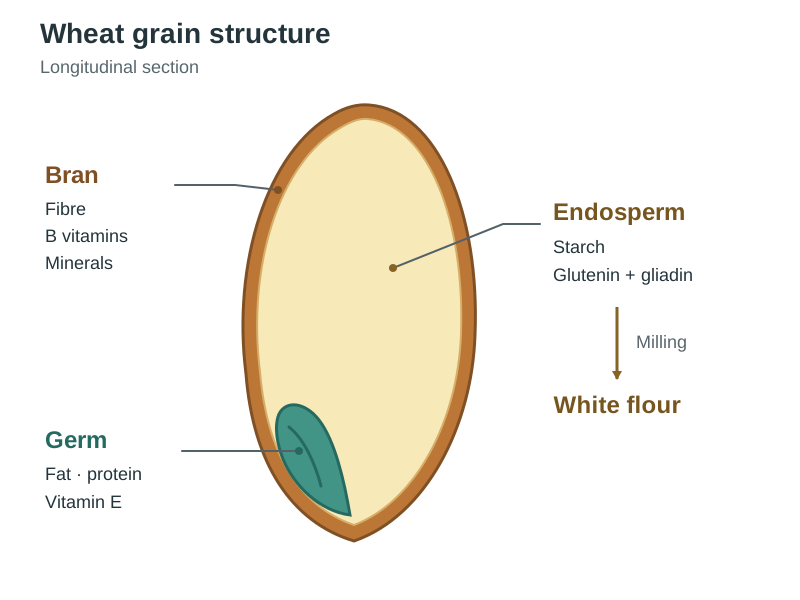
A wheat grain consists of three structures: the outer fibrous bran (rich in fibre, B vitamins, and minerals), the embryo germ (rich in fat, protein, and vitamin E), and the starchy endosperm (80–85% of the grain, containing starch and the gluten-forming proteins glutenin and gliadin).
- Cleaning: Vibratory screens, aspirators, and electromagnets remove foreign seeds, dirt, stones, and metal debris.
- Conditioning: Water is added to adjust grain moisture to 15–17%, then held in conditioning bins for 24–48 hours. This toughens the bran so it peels cleanly rather than splintering, and softens the starchy endosperm.
- Break rolling: Grooved, fluted steel rollers rotating inward at different speeds shear the grain open and scrape the endosperm away from the bran husk.
- Sifting and purification: Vibratory mesh sieves and upward air currents separate the bran particles and germ flakes from coarse endosperm particles (semolina).
- Reduction rolling: Smooth steel rollers progressively crush semolina particles into fine flour powder through repeated rolling and sifting steps.
- Additions and packaging: Ascorbic acid (flour improver) or raising agents are blended through, and flour is packed into breathable, multi-wall paper bags.
The extraction rate measures the percentage of the whole grain recovered as flour: wholemeal flour has a 100% extraction rate; brown flour has an 80–85% rate; and white flour has a 70–75% rate (starchy endosperm only).
Profile 2: Shelf-Life Extension (Liquid Milk Processing)
- Intake and screening: Chilled raw milk arrives in insulated road tankers and is tested for microbial load and antibiotic residues. Loads showing antibiotic traces are rejected.
- Clarification and standardisation: Centrifugal separators spin out somatic cells and debris. Fat content is standardised by blending cream back into skimmed milk (whole milk: 3.5% fat; low-fat: 1.5% fat; skimmed: 0.1% fat).
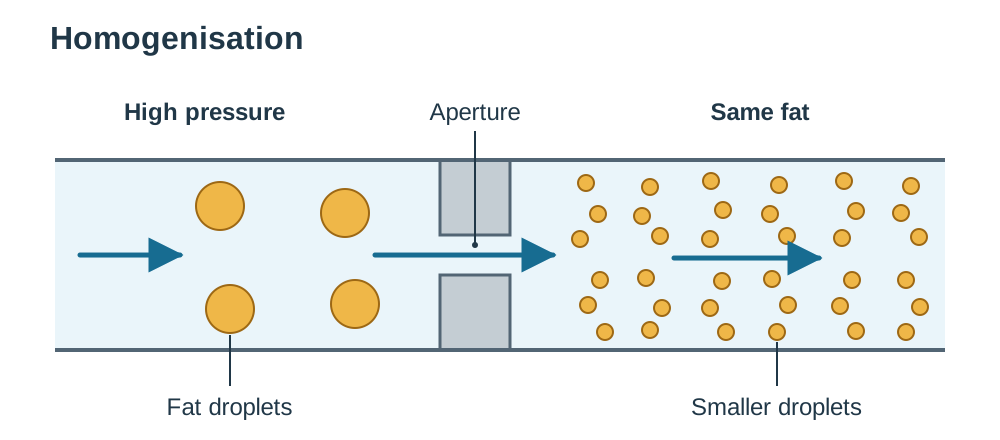
- Homogenisation: Milk is forced under high pressure through fine apertures to break large butterfat globules into tiny, evenly suspended droplets, preventing a cream line from rising.
- Heat treatment:
- Pasteurisation (HTST): Heated to 72°C–75°C for 15–25 seconds in a plate heat exchanger, then cooled rapidly below 5°C. This destroys pathogenic bacteria (such as Listeria and Salmonella) and most spoilage bacteria, but not bacterial spores. Dairies check efficacy using the phosphatase test; because the enzyme alkaline phosphatase is destroyed at pasteurisation temperatures, a negative result confirms proper heat treatment.
- UHT (Ultra-Heat Treatment): Heated to 135°C–150°C for 1–4 seconds, cooled quickly, and aseptically packaged into sterile composite cartons. This destroys vegetative cells and bacterial spores, achieving commercial sterility and allowing unopened ambient storage for up to 6 months.
- Packaging and chilling: Filled into gable-top waxed cartons or plastic milk bottles, date-stamped with a use-by date, and held below 5°C.
Profile 3: Added-Value Food (Cheddar Cheese Manufacture)
An added-value food is an agricultural commodity modified through processing, formulation, or culinary craft into a product that commands higher commercial revenue and consumer convenience. The term refers to commercial economic value rather than improved nutritional value.
- Standardisation and pasteurisation: Whole milk is pasteurised at 72°C for 15 seconds, then cooled to 30°C in a cheese vat.
- Acidification: A starter culture of lactic acid bacteria (Lactococcus lactis) is added to ferment lactose into lactic acid, lowering the pH to assist clotting.
- Coagulation: Rennet containing the enzyme rennin (chymosin) is stirred into the vat. Soluble caseinogen is converted into insoluble casein, which sets into a gel, trapping fat and separating the milk into solid curds and liquid whey.
- Cutting and scalding: Wire knives slice the curd gel into 5 mm cubes, exposing a large surface area to release trapped whey. The vat is gently heated (scalded) to 38°C–40°C while stirring to firm the curds.
- Whey drainage and cheddaring: Liquid whey is drained off. The curd slabs are cut, stacked on top of each other, and periodically turned. This stacking (cheddaring) squeezes out remaining whey and knits the curds into an elastic sheet.
- Milling and salting: Cheddared slabs pass through a rotary mill that cuts them into small chips. Dairy salt (roughly 2% by weight) is blended in to stop bacterial acid production, draw out moisture, suppress spoilage organisms, and add flavour.
- Pressing and ripening: Curds are packed into moulds and hydraulically pressed for 24 hours. The cheese is vacuum-sealed in plastic barrier film and matured in curing rooms at 8°C–10°C for 3 to 12 months.
Profile 4: Fermented Added-Value Dairy Food (Yogurt Manufacture)
- Standardisation: Milk fat levels are adjusted, and skimmed milk powder is blended in to raise total solids and create a thicker texture.
- Homogenisation: Milk is forced under pressure through fine apertures so fat droplets cannot separate.
- Pasteurisation: Heated to 80°C–90°C for roughly 30 minutes (or 95°C for 5 minutes) to destroy spoilage micro-organisms and denature whey proteins, which improves final gel firmness, then cooled to 37°C–43°C.
- Inoculation: Inoculated with a starter culture of lactic acid bacteria (Lactobacillus bulgaricus and Streptococcus thermophilus).
- Incubation: Held at 37°C–43°C for 6–8 hours. The bacteria ferment lactose to lactic acid; the pH drops to roughly 4.5, causing casein to coagulate into a smooth, thick gel.
- Cooling: Chilled rapidly to 5°C to halt fermentation and prevent excess sourness.
- Addition and packaging: Fruit purée, sweeteners, or natural flavours are folded in. The yogurt is filled into polystyrene or polypropylene pots, sealed with tamper-evident aluminium foil lids, coded, and distributed under refrigeration.
Packaging: Functions, Material Evaluation, and the Environment
Packaging performs seven distinct functions:
- Containment: Holds liquid, powdered, or particulate food without leakage.
- Protection: Shields food from mechanical damage, crushing, and vibration during transport.
- Preservation: Retards spoilage by blocking environmental oxygen, moisture, and light.
- Convenience: Offers ease of opening, resealable closures, portioning, or microwaveable trays.
- Safety and tamper-evidence: Shrink bands, breakable rings, and foil seals confirm the pack has not been opened or adulterated.
- Communication: Displays mandatory legal labelling, cooking guidelines, and nutritional panels.
- Merchandising: Attractive graphic design and branding draw consumer attention on supermarket shelves.
In an evaluation question, deal with each material in three moves: what it is good at for the specific food (barrier, strength, sealability), one functional drawback, and its environmental impact.
Material Evaluation
| Packaging Material | Functional Suitability | Limitations & Environmental Consequences |
|---|---|---|
| Glass (jars for jam, pasta sauce; bottles) | Chemically inert; does not react with acidic foods; impermeable to gases and moisture; transparent; withstands high-temperature heat processing. | Heavy, which increases transport fuel consumption and carbon emissions; brittle, risking dangerous shattering on automated filling lines. Glass can be recycled over and over again without any loss of quality, through bottle banks and kerbside collection. |
| Metals: Tinplate & Aluminium (canned foods, drinks cans, foil trays) | Physically robust; complete barrier to light, oxygen, moisture, and microbes; withstands high autoclave canning temperatures (121°C); aluminium is lightweight. | Acidic foods corrode bare metal unless an interior protective lacquer is applied; mining bauxite and smelting raw aluminium consumes huge amounts of electrical energy. Both metals are easily separated (magnetic sorting for tinplate) and efficiently recycled. |
| Paper & Cardboard (flour bags, egg cartons, outer boxes) | Low cost; lightweight; easily printed; made from renewable wood pulp. | Weak barrier against moisture and atmospheric gases; loses mechanical strength when damp; permeable to oils unless lined with wax or plastic (which stops standard paper recycling). Biodegradable and widely recyclable when clean. |
| Plastics & Polymers (PET bottles, HDPE milk containers, LDPE films) | Lightweight; shatterproof; easily heat-sealed into airtight packs; versatile barrier properties. | Derived from non-renewable petrochemicals; takes centuries to break down in landfills; risk of chemical plasticiser migration into fatty foods under heat; flexible films remain difficult to sort mechanically. Rigid mono-plastics (PET, HDPE) are widely recycled. |
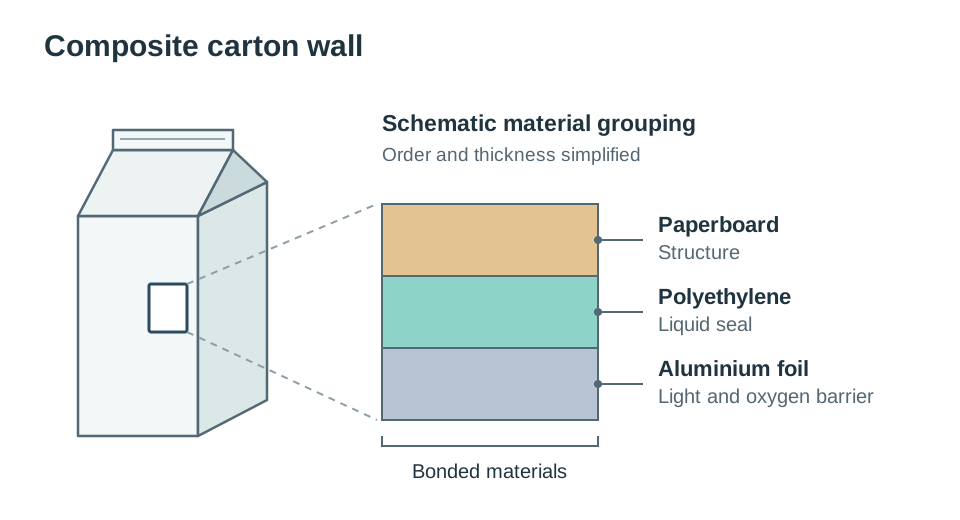
| Laminates & Composites (Tetra Pak cartons for UHT milk and juice) | Combines thin bonded layers of paperboard (structure), polyethylene (liquid seal), and aluminium foil (light and oxygen barrier) to provide sterile ambient storage. | Bonded layers can only be separated in specialised recycling plants, where the carton is pulped to recover paper fibre while plastic and foil are stripped off; many cartons still end up incinerated or in landfill. |
Advanced Packaging Technologies
- Modified Atmosphere Packaging (MAP): Normal air inside a pack is flushed out and replaced with a chosen mixture of gases tailored to the food: Carbon dioxide (CO2) acts as an active antimicrobial agent by dissolving into surface moisture to lower pH and inhibit aerobic bacterial respiration; Nitrogen (N2) is an inert, insoluble filler gas that prevents the pack from collapsing; Oxygen (O2) is kept at elevated levels in fresh red meat to preserve oxygenated myoglobin (oxymyoglobin) for bright cherry-red colour, or eliminated completely for cooked meats and salads to stop oxidative rancidity.
- Vacuum packaging: Air is mechanically evacuated from an impermeable plastic barrier pouch before heat-sealing. Removing oxygen deprives aerobic bacteria and moulds of the air needed for growth and prevents oxidative rancidity in fatty foods like bacon and cheese.
- Active and intelligent packaging: Modern packs actively extend shelf life or communicate quality. Oxygen scavengers and moisture absorbers inside sealed packs soak up residual gas or liquid. Antimicrobial films release food-grade preservatives slowly onto the product surface. Time–temperature indicator labels change colour if a chilled pack experiences temperature abuse during distribution.
Sustainable Packaging and Waste Management
- Source reduction ('light-weighting'): Thinning the walls of plastic milk bottles or removing unnecessary secondary cardboard sleeves from ready-meal trays to reduce material volume at source.
- Deposit Return Scheme (DRS): Consumers pay a refundable deposit when purchasing drinks in PET plastic bottles or aluminium/steel cans (150 ml to 3 litres) carrying the Re-turn logo, and get their money back when returning intact containers to reverse vending machines.
- Repak: An industry-funded, government-approved compliance scheme. Producers and retailers pay fees based on the type and weight of packaging they place on the Irish market. Repak uses these funds to subsidise commercial and household recycling under the Waste Management (Packaging) Regulations.
- Bio-based polymers: Plastics made from renewable resources like corn starch, such as Polylactic Acid (PLA). Although industrially compostable under controlled heat and humidity, PLA cannot be placed in household green recycling bins because it contaminates conventional PET recycling lines.
Food Chain Contaminants and Preventative Safety Systems
A food contaminant is any biological agent, chemical residue, or foreign matter not intentionally added to food that enters during production, processing, packaging, or transport, making food unsafe or unsuitable for eating.
| Entry Stage | Contaminant | Source & Route | Preventative Control |
|---|---|---|---|
| Farm Production | Antibiotic residues | Administered to treat sick livestock; milk or meat harvested before withdrawal periods finish. | Strict adherence to statutory animal withdrawal periods; rapid tanker testing at creameries; contaminated milk is dumped and the supplier fined. |
| Farm Production | Agrochemical residues (pesticides, fungicides) | Excessive spraying or harvesting crops before pre-harvest intervals pass. | Statutory Maximum Residue Limits (MRLs); regular Department of Agriculture sampling of harvested fruit, grain, and vegetables. |
| Environment | Heavy metals (methylmercury, cadmium, lead) | Industrial pollution of waterways; bioaccumulation up the marine food chain into large predatory fish. | EPA monitoring of industrial discharges; FSAI dietary advisories advising pregnant women to limit consumption of shark, swordfish, and fresh tuna. |
| Factory Processing | Chemical cleaning agents | Detergents or sanitisers left on stainless steel pipes through poor rinsing. | Standardised Clean-In-Place (CIP) automated rinse cycles; chemical indicator test strips; thorough staff hygiene training. |
| Factory Processing | Process-induced chemicals (acrylamide) | Formed during high-temperature baking, frying, or roasting (>120°C) via the Maillard reaction between reducing sugars and the amino acid asparagine. | Keep frying temperatures below critical thresholds; blanch potato strips in hot water before frying to leach out reducing sugars; store potatoes above 6°C (never in the fridge); fry to a golden rather than dark brown colour. |
| Factory Processing | Physical contaminants (metal shavings, glass, bone) | Machinery wear, broken light fittings, conveyor belt bolts. | Inline electromagnets, industrial X-ray inspection machines, and automated metal detectors placed over final packaging lines. |
| Packaging | Chemical migration (plasticisers, BPA) | Chemicals leaching from flexible films or unapproved can lacquers into fatty or hot foods. | Compliance with EU food-contact material regulations; mandatory use of certified food-grade plastics and BPA-free can linings; never microwave foods in non-microwave-safe cling film. |
HACCP: Hazard Analysis and Critical Control Point
HACCP is a statutory, preventative food safety management system that analyses production lines to identify biological, chemical, physical, and allergen hazards, setting controls at stages where safety can be guaranteed.
The Seven Principles of HACCP:
- Conduct a hazard analysis: identify potential hazards at every step of production.
- Determine critical control points (CCPs): find the steps where control is essential to prevent, eliminate, or reduce a hazard to a safe level.
- Establish critical limits: set measurable safety boundaries for each CCP (e.g. core temperature of 75°C).
- Establish monitoring procedures: observe and record CCP conditions (e.g. calibrated temperature probes, digital fridge logs).
- Establish corrective actions: decide what steps to take if monitoring shows a critical limit has been breached (e.g. continue cooking, discard the batch).
- Establish verification procedures: audit the system with microbial swabbing and thermometer calibration to prove it works.
- Establish documentation and record-keeping: maintain written logs of all monitoring, corrective actions, and reviews for inspection by the EHO.
Applied HACCP System: Hot Main Course Dish (Chicken Curry)
| Stage | Hazard | Control Measure (CCP) |
|---|---|---|
| Purchase | Contaminated, spoiled, or out-of-date chicken | Buy from approved, reputable suppliers; check that packaging is intact and the use-by date is valid. |
| Delivery / Transport | Bacterial multiplication if chicken warms above 5°C | Transport in insulated cool bags or refrigerated vans; place into chilled storage within 30 minutes. |
| Storage | Cross-contamination of bacteria onto cooked foods; bacterial growth | Store raw chicken covered on the bottom shelf of the refrigerator at 0°C–5°C below cooked and ready-to-eat foods. |
| Preparation | Cross-contamination of Salmonella or Campylobacter via knives and boards | Use dedicated red chopping boards and sanitised knives; wash hands in warm soapy water before and after handling raw meat. |
| Cooking | Survival of pathogenic food poisoning bacteria | Cook thoroughly until the core temperature reaches 75°C (or 70°C for 2 minutes) checked with a sanitised probe; ensure juices run clear. |
| Hot Holding / Serving | Bacterial multiplication in the danger zone (5°C–63°C) | Hold hot food above 63°C in a bain-marie and serve within 2 hours. |
| Cooling & Leftovers | Spore germination and toxin production during slow cooling | Cool leftovers rapidly within 90 minutes; refrigerate below 5°C; consume within 2 days; reheat once to a core temperature of 75°C. |
ISO 9000 Series
The ISO 9000 series is an internationally recognised family of quality management standards. HACCP is concerned only with food safety — it controls biological, chemical, physical and allergen hazards at critical control points. ISO 9000 audits the company's wider quality management system. It certifies that a manufacturing plant follows written quality assurance procedures, maintains batch-to-batch consistency, trains staff, and systematically tracks customer feedback.
Food Legislation and Consumer Labelling Regulations
Statutory Protection for the Consumer
- European Union (Hygiene of Foodstuffs) Regulations (giving effect to Regulation (EC) 852/2004): These regulations update historical provisions (such as the Food Hygiene Regulations 1950–1989). They require commercial food premises to be clean, pest-free, well-ventilated, and registered with the health authorities. They mandate staff training in food hygiene and make it legally compulsory for every food business operator to implement a permanent food safety system based on HACCP principles.
- Health (Official Control of Foodstuffs) Regulations (1991): Empower authorised officers (such as Environmental Health Officers) to enter food premises without prior notice, inspect manufacturing practices, take food samples for testing by Public Analyst Laboratories, and seize or destroy foodstuffs unfit for human consumption.
- Sale of Food and Drugs Acts (1875–1936): Protect buyers against food adulteration and fraud. Food sold must be of the nature, substance, and quality demanded by the purchaser (for instance, milk must not have added water, and bread must not contain unapproved fillers).
- General Food Law Regulation (Regulation (EC) 178/2002): Prohibits the sale of unsafe food. It mandates traceability, requiring every food processor and retailer to document the supply chain 'one step back and one step forward' so that contaminated ingredients can be traced to their farm source and recalled from retail shelves without delay.
- Enforcement: The Food Safety Authority of Ireland (FSAI) co-ordinates national food law enforcement. Environmental Health Officers (working via the HSE) inspect premises and can serve Improvement Notices, issue Closure Orders, or prosecute non-compliant operators.
Food Labelling: Regulation (EU) No 1169/2011 (FIC)
Governed by the Provision of Food Information to Consumers (FIC) regulations, mandatory label particulars on pre-packaged foods include:
- Name of the food: A precise name stating the food's true nature, along with physical state or processing descriptors (e.g. 'pasteurised', 'smoked', 'freeze-dried').
- List of ingredients: All ingredients listed in descending order of weight as measured at the mixing-bowl stage during manufacture.
- Allergen declarations: The 14 statutory EU allergens (cereals containing gluten, crustaceans, eggs, fish, peanuts, soybeans, milk, tree nuts, celery, mustard, sesame seeds, sulphur dioxide/sulphites above 10 mg/kg, lupin, and molluscs) must be emphasised within the ingredients list, for example in bold type, in italics, in capitals, or on a contrasting background.
- Quantitative Ingredient Declaration (QUID): Stated as a percentage where an ingredient appears in the name of the food (e.g. 'Beef Lasagne' displaying '% beef'), is pictured on the packaging, or is essential to characterise the food.
- Net quantity: Stated in metric units by volume (ml/l) for liquids or weight (g/kg) for solids. The 'e' mark beside the quantity is optional; it declares that the pack was filled under the EU average quantity system.
- Date stamp: A use-by date is mandatory on microbiologically perishable foods (e.g. fresh chicken, milk); eating food past this date risks food poisoning, and selling it past this date is illegal. A best-before date applies to shelf-stable foods (e.g. biscuits, canned beans); it indicates sensory quality, and food remains safe to consume after this date, although flavour or texture may decline.
- Storage conditions and instructions for use: Instructions required for safe storage ('Keep refrigerated 0°C–5°C') or proper cooking ('Cook from frozen for 30 minutes at 190°C').
- Name and address: Identifies the EU food business operator or importer responsible for the product.
- Country of origin: Mandatory where omitting it would mislead the consumer, and compulsory on fresh beef, poultry, pigmeat, sheepmeat, honey, and fresh fruit/vegetables.
- Nutrition declaration: Standardised table displaying values per 100 g or 100 ml for Energy (kJ and kcal), Fat, Saturates, Carbohydrate, Sugars, Protein, and Salt.
- Lot or batch number: A code (often preceded by 'L') that allows a faulty batch to be traced and recalled swiftly without pulling all products off shelves.
- Alcoholic strength: Mandatory on beverages containing more than 1.2% alcohol by volume (ABV).
Critical Evaluation of Food Labelling
Food labels protect consumer health by highlighting allergens, making it easy for coeliacs or people with nut allergies to screen foods quickly. Standardised nutrition panels per 100 g also allow direct, objective comparisons between competing brands.
However, labels have practical limits. The minimum legal font size (x-height of 1.2 mm) remains difficult for visually impaired or elderly shoppers to read. Furthermore, many consumers confuse best-before dates with use-by dates, leading to the unnecessary disposal of edible food. Front-of-pack portion sizes are also occasionally distorted by manufacturers to make sugar or fat numbers look lower than what people realistically eat.
Sensory Analysis in the Food Industry
Sensory analysis is the scientific evaluation of food through the five senses — sight, smell, taste, touch, and sound — carried out under controlled conditions using trained testers or consumer panels.
Common Sensory Analysis Tests
- Paired preference test: Testers compare two coded samples and state which one they prefer.
- Preference ranking test: Testers receive three or more coded samples and rank them in order of liking.
- Hedonic rating test: Testers rate how much they like a sample on a structured 5-point or 9-point verbal scale (ranging from 'dislike extremely' to 'like extremely').
- Triangle test: A difference test where testers receive three coded samples — two identical and one different — and must identify the odd one out.
Industrial Applications
- New product development (NPD): Evaluating trial recipe formulations before committing capital to full-scale commercial manufacturing.
- Benchmarking against market competitors: Comparing an own-brand supermarket product with the leading commercial brand.
- Quality control monitoring: Regularly checking line samples against the product specification to ensure batch consistency.
- Recipe reformulations and shelf-life testing: Checking whether reducing salt or sugar content, changing an ingredient supplier, or introducing new packaging alters consumer acceptability over time.
Key terms
- Added-Value Food
- A raw food commodity modified or formulated through processing, preparation, or packaging to increase its commercial market value and consumer convenience.
- Pasteurisation
- A thermal preservation process heating milk to 72°C–75°C for 15–25 seconds followed by rapid chilling below 5°C to destroy vegetative pathogens and most spoilage bacteria.
- Homogenisation
- The mechanical forcing of milk through minute apertures under high pressure to break large fat globules into tiny droplets that remain evenly suspended.
- Cheddaring
- A step in Cheddar cheese production where warm curd slabs are cut, stacked, and repeatedly turned to squeeze out whey and knit the protein into an elastic texture.
- Extraction Rate
- The percentage of the original whole wheat grain recovered as flour after milling (e.g. 100% for wholemeal flour, 70–75% for white flour).
- Modified Atmosphere Packaging (MAP)
- A preservation method where normal air inside a pack is replaced with a custom gas mixture (carbon dioxide, nitrogen, and oxygen) to suppress microbial growth.
- QUID
- Quantitative Ingredient Declaration: a statutory statement of the percentage of an ingredient used, required when that ingredient appears in the name or is highlighted on the packaging.
- HACCP
- Hazard Analysis and Critical Control Point: a statutory preventative food safety system that identifies, monitors, and controls biological, chemical, physical, and allergen hazards.
- ISO 9000
- An international series of audited quality management standards certifying operational consistency, formal manufacturing documentation, and customer specifications.
- Use-By Date
- A mandatory safety date stamp required on perishable foods indicating the date after which consumption poses an immediate risk of bacterial food poisoning.
- Best-Before Date
- A quality date stamp on shelf-stable foods indicating the timeframe during which the product retains optimal texture, flavour, and appearance.
- Traceability
- The legal obligation under EU General Food Law for food businesses to track and document every food, feed, and ingredient 'one step back and one step forward' through the supply chain.
- Repak
- An industry-funded, government-approved packaging compliance scheme that uses member fees to subsidise commercial and household recycling across Ireland.
- Origin Green
- Ireland's national food and drink sustainability programme run by Bord Bia, independently auditing farms and factories on carbon emissions, energy, water, and waste.
- Bord Bia Quality Mark
- An assurance certification mark proving that a food product was produced and processed to certified standards of safety, traceability, and origin in Ireland.
Check yourself
What are the standard time and temperature parameters for HTST pasteurisation of liquid milk, and how does a dairy test that it worked?
Milk is heated to 72°C–75°C for 15–25 seconds and chilled rapidly below 5°C. Efficacy is verified using the phosphatase test: because alkaline phosphatase is destroyed at pasteurisation temperatures, a negative result confirms proper heat treatment.
Explain the role of the enzyme rennin (chymosin) during Cheddar cheese manufacture.
Rennin converts soluble caseinogen protein into insoluble casein, setting the milk into a firm gel that separates into solid curds and liquid whey.
List six mandatory pieces of information that must appear on a pre-packaged food label.
Name of the food, ingredients list in descending order of weight, allergen declarations (emphasised in bold/italics), net quantity, date stamp (use-by or best-before), and the name and address of the food business operator.
Give one functional advantage and one environmental disadvantage of using glass jars for pasta sauce.
Advantage: glass is chemically inert and impermeable to oxygen, so it will not react with acidic tomatoes or alter flavour. Disadvantage: glass is heavy, which increases transport fuel consumption and carbon emissions.
State the difference between HACCP and ISO 9000.
HACCP is a statutory food safety system that identifies and controls biological, chemical, physical and allergen hazards at critical control points. ISO 9000 is an audited international management standard certifying general manufacturing consistency, documentation, and customer quality specifications.
Name two state supports available to a small Irish food producer and outline what each provides.
Local Enterprise Offices (LEOs) provide capital feasibility grants, training, and business mentoring. The Bord Bia Food Academy offers business development guidance and trial retail shelf space in major supermarkets.