

The Food Studies Coursework is worth 20% of the total mark in Leaving Certificate Home Economics. Four assignments share that 20%, so each is worth about 5% of your final grade. For the 2027 examination, the State Examinations Commission (SEC) sets five practical assignment briefs across four Areas of Practice. Candidates select, complete, and present any four of these assignments. All practical culinary work and written records must be completed during class time under teacher supervision and documented in the official SEC digital coursework booklet. All work must be completed no later than Monday 2 November 2026 and must be ready for submission from the week of 2 November 2026. Your teacher uploads the PDF through the Schools Portal; the SEC issues the exact submission dates separately.
Coursework Administration and SEC Regulations
Practical coursework carries a 20% weighting across all Leaving Certificate Home Economics courses. Candidates taking Social Studies or Home Design complete an 80% written paper and 20% Food Studies coursework. Candidates taking the Textiles, Fashion and Design elective complete a 70% written paper, 20% Food Studies coursework, and 10% Textile elective coursework.
Digital Journal Procedures and Setup
Before typing your research, enter your examination number and date of birth on the digital coursework booklet cover. Examination numbers are issued to candidates in October 2026. At the top of each assignment, write the area of practice (A, B, D, or E) and the assignment number exactly as given on the SEC brief. You must record your work under the prescribed Recording Criteria headings.
- Digital Booklet Formatting: Work must be typed directly into the official SEC digital template. Never alter its structure, margins, font specifications, or cell borders.
- PDF Conversion and Print Proofreading: Convert the completed booklet to PDF and print out a physical copy. Carefully proofread the printed copy. Examiners mark the coursework digitally on screen; any text, table row, or diagram that overflows margins and is cut off on the printed PDF cannot be seen or marked by the digital examiner.
- Submission Deadlines: All coursework must be completed no later than Monday 2 November 2026 and must be available for submission to the SEC from the week of 2 November 2026. School authorities upload the digital PDF through the Schools Portal, while a signed printed copy is retained in the school until appeals finish.
- Answering Through Irish: No bonus marks are awarded for coursework completed through Irish.
Supervision and Plagiarism Rules
All practical food work must be carried out in class under the direct supervision of your Home Economics teacher. Watching your teacher demonstrate a dish does not count. Practical work may be carried out in pairs, or in groups for Area of Practice E sensory testing. However, the written journal record must be entirely your own individual work.
Keep a running bibliography and end each assignment with a reference list. Record author or organisation, publication title, website address, and access date (for example: Safefood (2025) Healthy Eating for Older Adults, safefood.net, accessed 14 September 2026). You must cite publications, government reports, websites, and any material produced using AI software. Copying text without proper attribution is treated as plagiarism and risks loss of marks, loss of the subject, or debarment from the examination under the Education Act 1998.
Dish Selection Rules Across the Journal
Every dish chosen for practical preparation must emerge directly from your initial research. You must use a dish once only across the four completed assignments; dishes cannot be repeated or slightly modified. Plan your four practical sessions at the start so your recipes do not clash, prioritise fresh foods, and avoid convenience shortcuts.
Assignment Selection Planner for 2027
Candidates must select and complete any four of the five assignments set by the SEC. There is no Area of Practice C assignment prescribed for the 2027 examination.
| Assignment & Area | Topic Scope | Prescribed Brief Requirements | Sample Practical Dish |
|---|---|---|---|
| Assignment 1 (Area of Practice A) | Dietary needs of older persons | Analyse challenges faced by older people; research nutritional needs and meal planning guidelines; suggest a range of two-course menus; prepare and cook one main course; evaluate implementation and specific requirements. | Baked salmon fillet with broccoli florets, sweet potato mash, and dill sauce |
| Assignment 2 (Area of Practice A) | Iron deficiency risk | Analyse causes and effects of iron deficiency; research nutritional needs and meal planning factors; suggest a range of two-course menus; prepare and cook one main course; evaluate implementation and specific requirements. | Lean beef stir-fry with mixed peppers, broccoli, sugar snap peas, and brown rice |
| Assignment 3 (Area of Practice B) | Commercial filo and puff pastry | Research both pastries (brands, forms, ingredients, cost, sweet and savoury dishes for each); choose either filo or puff; analyse key handling points for success; prepare one sweet or savoury dish; evaluate implementation and pastry advantages/disadvantages. | Filo-wrapped salmon and spinach parcel, or chicken and leek puff pastry tartlet |
| Assignment 4 (Area of Practice D) | Properties of marinades | Research different marinade types with matching dishes; discuss benefits and scientific principles; analyse key points for marinating success; prepare, cook, and serve one marinated dish; evaluate implementation and marinade success. | Tandoori chicken skewers marinated in seasoned natural yoghurt and lemon juice |
| Assignment 5 (Area of Practice E) | Sensory descriptive rating (Granola) | Discuss industrial uses of descriptive rating tests; research commercial granolas (brands, ingredients, nutritional content, cost); choose two similar brands; agree six common attributes; carry out descriptive rating tests with star diagrams; compare profiles; evaluate implementation and test results. | Descriptive rating testing of Brand A versus Brand B commercial granola using a 5-member panel |
The SEC Recording Criteria and Implementation Writing
Every assignment in your digital journal must be laid out under the four mandatory SEC Recording Criteria headings.
1. Investigation, Analysis and Research / Menu Planning
Explore the background to the brief. Define all technical terms, explain underlying nutritional and food science principles, and compare commercial foods or dietary data. For Area of Practice A, present a range of balanced two-course menus (at least three varied menus) before naming and justifying the chosen main course.
2. Preparation and Planning
Plan the practical work systematically. Provide an itemised ingredients list using precise metric quantities (, ), list equipment, and produce a time plan in order of work. Your time plan must indicate timing for each step, pre-preparation steps (such as measuring ingredients, chopping vegetables, and preheating the oven), and safety checks called a critical control point (CCP) (for example: checking raw chicken storage below 5 °C and testing that the internal core temperature reaches at least 75 °C).
3. Implementation
Record the cooking or testing session exactly as it happened. Note down the cooking techniques used, manipulative skills applied, presentation details, and practical adjustments made to resolve unexpected problems.
- Weak Implementation Sentence: 'I made the marinade and cooked the chicken.'
- Strong Implementation Sentence: 'I cubed the chicken to 2.5 cm on the red raw-meat chopping board, sanitised my hands, knife, and board before prepping the vegetables, and coated the chicken in the yoghurt marinade in a covered glass dish, refrigerating it at 3 °C for three hours. When the skewers began to brown quickly on the grill, I lowered the shelf height, and verified that the core reached 75 °C on a digital probe before serving.'
4. Evaluation
Every evaluation must be split into two separate sections: (a) Implementation (judging time management, kitchen hygiene, manipulative control, and sensory qualities: appearance, aroma, flavour, and texture), and (b), which must address the specific wording of that brief.
Area of Practice A: Nutritional Principles (Assignments 1 and 2)
Area of Practice A examines how to apply human nutritional science to specific dietary groups.
Assignment 1: Dietary Needs and Challenges of Older Persons
As adults age, basal metabolic rate (BMR) slows down due to reduced physical activity and the progressive loss of skeletal muscle tissue, known as sarcopenia. Energy needs fall, but micronutrient requirements remain high, so meals must be nutrient-dense.
- Challenges Faced by Older Persons: Blunted taste and smell receptors tempt people to add excess table salt. Dental decay or ill-fitting dentures make tough meats and raw vegetables difficult to chew. The stomach produces less acid with age, so vitamin B12 and iron are absorbed less well. Reduced thirst sensation increases dehydration and constipation risks. Limited mobility, reduced hand grip, and low fixed pensions restrict grocery shopping and cooking.
- Nutritional Needs: High biological value (HBV) protein to repair body tissues and slow muscle wasting; calcium (adult RDA is 800 mg, rising to about 1200 mg for post-menopausal women and older people) alongside vitamin D to slow osteoporosis; dietary fibre (25–35 g daily) to stimulate sluggish bowel muscles; and lower sodium and saturated fat to maintain cardiovascular health.
- Meal-Planning Guidelines (Named Guidelines with Reasons):
- Serve small, nutrient-dense meals: A poor appetite cannot handle large plates; every mouthful must carry vitamins, minerals, and protein.
- Select soft, moist textures: Braised fish, minced meats, and vegetable purées are easy to chew with sensitive gums or dentures.
- Enhance flavour with herbs and citrus instead of salt: Taste blunts with age, but excess table salt drives up blood pressure.
- Include vitamin C with plant-based iron and vitamin D with calcium: Enhances absorption to protect against anaemia and bone fractures.
- Supply 1.5 to 2 litres of fluids daily: Thirst sensation falls, making regular warm drinks, soups, and water essential.
- Design practical, economical meals: Use single-portion recipes, batch cooking, and pre-chopped ingredients to suit low energy and fixed household budgets.
Assignment 2: Iron Deficiency and Haemoglobin Formation
Iron is an essential trace mineral needed to form haemoglobin in red blood cells, which carries oxygen from the lungs to active cells. It is also a key component of myoglobin in muscle tissue and cellular energy enzymes. The recommended dietary allowance (RDA) is about 14 mg daily for adolescent girls and women of childbearing age, and about 10 mg for adult men.
- Causes of Iron Deficiency:
- Inadequate dietary intake: Skipping meals, restrictive weight-loss regimes, poorly planned vegetarian diets, or over-relying on low-nutrient convenience foods.
- Poor intestinal absorption: Eating mostly plant iron without enhancers, drinking tea or coffee with meals (tannins bind iron), or consuming excessive bran (phytates), spinach (oxalates), or calcium supplements at mealtimes.
- Increased physiological requirement: Rapid adolescent growth spurts, pregnancy, or heavy endurance training.
- Elevated physical losses: Heavy menstrual blood loss, internal gastrointestinal bleeding, or major surgery.
- Effects of Iron Deficiency: Haemoglobin production drops, starving tissues of oxygen and causing iron-deficiency anaemia. Symptoms include fatigue, weakness, pale complexion, shortness of breath, dizziness, poor concentration, spoon-shaped brittle nails, and lowered immune resistance.
- Haem versus Non-Haem Iron Chemistry:
- Haem Iron (): Soluble ferrous iron found exclusively in animal flesh, offal, and poultry. It has high bioavailability (about 15–30% is absorbed) and passes directly into intestinal cells unaffected by dietary binders.
- Non-Haem Iron (): Insoluble ferric iron found in plant foods (pulses, beans, greens, whole grains), fortified breakfast cereals, and egg yolks (where it is bound to the protein phosvitin). It has low bioavailability (only 2–5% is absorbed).
- The Role of Ascorbic Acid: Ascorbic acid (vitamin C) donates an electron to reduce ferric iron into soluble ferrous iron () in the stomach, multiplying absorption.
Area of Practice B: Food Preparation Processes (Assignment 3)
Assignment 3 requires research on both commercially prepared filo and puff pastry before selecting one pastry to prepare in class.
Sequencing Assignment 3
- Research Both Pastries Side by Side: Compare retail brands (such as Jus-Rol and supermarket own-brands), pack formats (chilled rolled sheets, frozen blocks, frozen rolled sheets), pack ingredient lists, and unit costs. Calculate cost per 100 g alongside total pack price so the value comparison is objective.
- Identify Sweet and Savoury Dishes for Each:
- Filo Dishes: Savoury — spanakopita, salmon and spinach parcels, vegetable samosas, filo quiche cups. Sweet — baklava, apple and cinnamon strudel, custard tartlets.
- Puff Pastry Dishes: Savoury — sausage rolls, vol-au-vents, beef Wellington, chicken and leek pie, cheese straws. Sweet — apple turnovers, palmiers, cream slices, pear tart tatin.
- Select One Pastry: State clearly whether you have chosen filo or puff pastry, and analyse its rules for success.
Key Points for Successful Pastry Handling
- Puff Pastry (Laminated Dough):
- Defrost frozen pastry overnight in the fridge: Gentle thawing keeps butter layers solid and keeps dough out of the microbial danger zone (5 °C–63 °C).
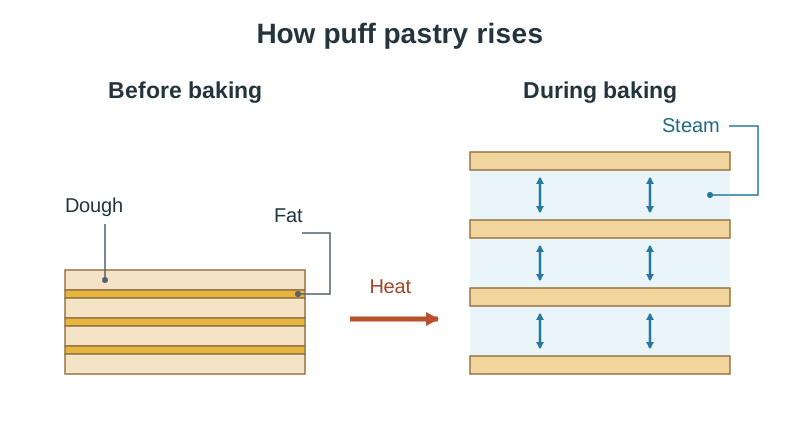
- Keep the dough cold and rest before baking: If fat warms, it melts directly into the dough; chilling keeps fat separate so alternating layers remain distinct.
- Roll lightly in one direction: Heavy rolling or stretching tears butter layers and causes uneven rising and pastry shrinkage.
- Cut with a sharp knife in a clean downward slice: Dragging a dull blade squashes and glues laminated cut edges together.
- Glaze the top surface only, avoiding cut sides: Egg wash dripping down cut sides glues layers together, preventing vertical expansion.
- Bake in a hot oven (200 °C–220 °C) on a preheated tray: High heat instantly flashes the water in the dough to steam, which forces the layers apart, while the heat coagulates the gluten and gelatinises the starch so the risen, flaky structure sets.
- Filo Pastry (Unleavened Dough):
- Keep unused sheets covered with a damp tea towel: Filo contains very little fat and water; exposure to air causes it to dry out and shatter within minutes.
- Brush each individual sheet thinly with melted butter or oil: The brushed fat separates the paper-thin sheets, crisping them as they bake. Filo contains no raising agent and relies on fat separation rather than rising in bulk.
- Layer at least 3 to 5 sheets: Multiple layers provide structural strength to support moist fillings without tearing.
- Bake at 180 °C–200 °C and monitor closely: Because sheets are tissue-thin, filo browns and burns rapidly once dry.
Area of Practice D: Properties of Food (Assignment 4 - Marinades)
Assignment 4 explores marinating: steeping food in a seasoned liquid to tenderise, flavour, and moisten it before cooking.
Classification of Marinade Types and Matching Dishes
| Marinade Type | Typical Ingredients | Underlying Science | Named Dish Example |
|---|---|---|---|
| Acid-based (wet) | Lemon juice, wine vinegar, white wine, herbs, olive oil | Acid lowers surface pH and causes protein denaturation, loosening outer fibres to absorb seasoning | Greek lemon-herb chicken souvlaki; escabeche of mackerel |
| Dairy-based | Natural yoghurt or buttermilk, crushed garlic, spices | Mild lactic acid tenderises meat slowly without turning outer flesh mushy; dairy fats hold spices against meat | Tandoori chicken skewers; buttermilk-marinated chicken |
| Oil and herb | Olive oil, rosemary, garlic, cracked black pepper | Oil dissolves and carries fat-soluble flavours, prevents surface drying, and stops sticking during grilling | Marinated lamb chops; grilled Mediterranean vegetable skewers |
| Enzymatic | Fresh pineapple, papaya, or kiwi purée | Proteolytic enzymes (bromelain, papain, actinidin) hydrolyse peptide bonds in tough collagen and muscle fibres | Hawaiian pork medallions; kiwi-marinated beef stir-fry |
| Soy / Sweet | Soy sauce, honey, minced ginger, sesame oil, rice vinegar | Salt draws water outward by osmosis; flavourful liquid diffuses inward; honey sugars caramelise during grilling | Teriyaki salmon fillets; glazed chicken drumsticks |
| Dry rub | Sea salt, brown sugar, smoked paprika, cumin, dried thyme | Salt draws out surface moisture to dissolve seasonings, which are slowly drawn back in to flavour meat | Cajun blackened chicken; spice-rubbed pork ribs |
Scientific Principles and Culinary Rules for Success
- Benefits of Marinating: Tenderises tougher or leaner cuts; enriches surface flavour; enhances colour through browning reactions; helps meat hold moisture during cooking; shortens cooking duration for thin cuts; and provides a slight short-term preservative effect on surface tissues (though it does not destroy foodborne pathogens).
- Enzyme Inactivation Rule: Always use fresh fruit juices for enzymatic tenderisation. Tinned juices undergo pasteurisation (heat treatment), which permanently denatures proteolytic enzymes, making them ineffective at breaking down meat proteins.
- Container Safety: Marinate food exclusively in non-reactive containers (glass, ceramic, or food-grade plastic) inside the refrigerator below 5 °C. Acid chemically reacts with metals like aluminium or copper, releasing metallic taints and toxic compounds. Discard marinade that held raw meat to prevent cross-contamination; never brush uncooked marinade onto cooked food.
Area of Practice E: Sensory Descriptive Rating (Assignment 5 - Granola)
Assignment 5 requires an objective sensory rating test comparing two commercial granola brands with similar ingredients (such as rolled oats, honey, seeds, and dried fruit).
Industrial Applications
Food manufacturers use a descriptive rating test to monitor quality control across manufacturing plants, evaluate recipe reformulation (such as reducing sugar or sodium), benchmark products against competing supermarket brands, and measure changes in texture and flavour over shelf life.
Research Requirements
Research commercially available granolas in Irish supermarkets. Record brand names, ingredient lists, unit costs, and compile a nutritional comparison table per 100 g (comparing energy in kJ/kcal, total fat, saturated fat, carbohydrate, sugars, fibre, protein, and salt). Relate these values to dietary guidelines (for example, comparing free sugars and dietary fibre levels).
Sensory Testing Practicalities and Controls
- Panel Organisation: Use an agreed panel of 5 assessors. Conduct testing in a quiet room free from kitchen smells and distractions.
- Sample Presentation: Serve samples in identical plain containers labelled with random 3-digit codes (e.g. Sample 418 and Sample 729) presented in random order. Provide water at room temperature to cleanse the palate between tastings.
- Standardised Scorecard: Assessors evaluate six agreed, objective sensory attributes (e.g. Oat Crunchiness, Sweetness Intensity, Nutty Aroma, Golden Brown Colour, Fruit Chewiness, Toasted Flavour) using a clear 0–5 numerical intensity scale (0 = undetectable, 5 = extremely strong). Descriptive tests measure intensity, never personal liking.
| Sensory Attribute | Panellist 1 | Panellist 2 | Panellist 3 | Panellist 4 | Panellist 5 | Mean Score |
|---|---|---|---|---|---|---|
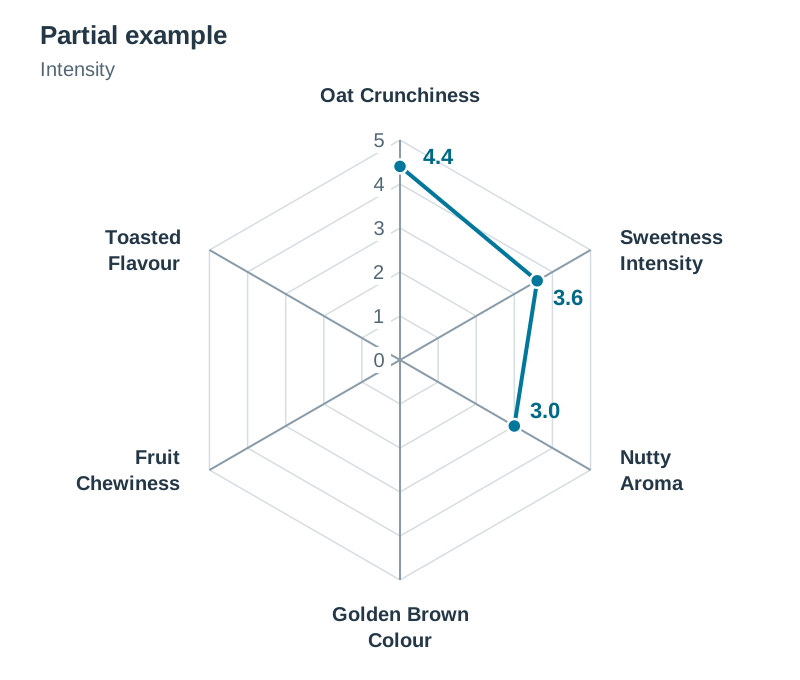
| Oat Crunchiness | 4 | 5 | 4 | 4 | 5 | 4.4 |
| Sweetness Intensity | 3 | 4 | 4 | 3 | 4 | 3.6 |
| Nutty Aroma | 3 | 3 | 2 | 4 | 3 | 3.0 |
Star Diagrams and Sensory Profiling
Calculate the mean score for each attribute across all five panellists. Construct a star diagram (spider plot) with six radiating axes graded 0 to 5. Plot the calculated mean scores and join the dots with a continuous coloured line. Superimpose both brands on the same diagram using different colours to compare their sensory profiles.
Structuring Evaluations: Part (a) and Tailored Part (b)
Examiners award marks across two distinct evaluation sections. Never combine these into a single narrative.
(a) Implementation
Evaluate your kitchen management objectively. Address time control against your original schedule, manual skills demonstrated, food safety and hygienic precautions taken, and provide a sensory appraisal of the completed dish (colour, aroma, flavour, and texture).
(b) Specific Requirements of the Brief
Part (b) is worded differently in each brief and must directly address that specific wording using a three-step structure: state your judgement, support it with observed evidence, and explain the scientific or nutritional reason.
| Assignment | Exact SEC Heading Focus for Part (b) |
|---|---|
| 1 (Older Persons) | Evaluate the specific requirements of the assignment: Did the dish meet the nutritional needs and meal planning guidelines of an older person? |
| 2 (Iron Deficiency) | Evaluate the specific requirements of the assignment: Did the dish supply iron in a bioavailable form alongside absorption enhancers for someone at risk of anaemia? |
| 3 (Pastry) | Evaluate the advantages and/or disadvantages of using commercially prepared filo or puff pastry when baking and cooking at home. |
| 4 (Marinades) | Evaluate the success of the marinade in achieving its intended purpose(s) (tenderising, flavouring, moisture retention, and colour). |
| 5 (Granola) | Evaluate the test results obtained: Compare the sensory profiles attribute by attribute, explaining the differences from the ingredients and processing. |
How Coursework Connects to the Written Paper
The principles explored in your coursework appear regularly in Section B written questions. Meat tenderising methods (mechanical pounding, acidic marinating, proteolytic enzymes, and slow moist cooking converting collagen to gelatine) are tested in meat questions. Pastry classifications and fat-to-flour ratios appear under baking processes. Sensory testing types and vocabulary appear under food processing and product development. Written questions award marks for named point + explanation + example.
Key terms
- Haem Iron
- Soluble ferrous (Fe2+) iron found in animal meat and offal, absorbed efficiently (15–30%) across the intestinal mucosa independent of dietary binders.
- Non-Haem Iron
- Insoluble ferric (Fe3+) iron found in plant foods, fortified cereals, and egg yolks, having low bioavailability (2–5%) and requiring reduction by ascorbic acid for absorption.
- Bioavailability
- The proportion of a nutrient in food that is digested, absorbed across the intestinal wall, and made available for physiological use by body cells.
- Ascorbic Acid (Vitamin C)
- A water-soluble vitamin that donates electrons in the stomach to reduce insoluble ferric iron (Fe3+) to soluble ferrous iron (Fe2+), enhancing absorption.
- Sarcopenia
- The progressive involuntary loss of skeletal muscle mass, quality, and strength that occurs with advancing age.
- Basal Metabolic Rate (BMR)
- The minimum amount of energy expended by the body at rest to maintain essential involuntary life processes such as breathing and circulation.
- High Biological Value (HBV) Protein
- Protein foods containing all essential amino acids in proportions suited to human repair and growth, primarily sourced from animal foods and soya.
- Lamination
- The technique of repeatedly folding and rolling butter into dough to produce hundreds of alternating fat and dough layers that puff up during baking.
- Unleavened
- Baked dough prepared without any biological, chemical, or physical raising agents, producing flat, thin sheets such as filo pastry.
- Denaturation
- An irreversible structural change in protein molecules caused by heat, acid, mechanical action, or enzymes, resulting in protein unfolding and moisture retention changes.
- Proteolytic Enzymes
- Natural enzymes (such as bromelain, papain, and actinidin) that chemically hydrolyse peptide bonds within muscle fibres and connective tissue collagen.
- Descriptive Rating Test
- An objective sensory analysis method where trained panellists rate the perceived intensity of predetermined sensory attributes on a structured numerical scale.
- Star Diagram
- A multi-axis graphical radar plot that visually illustrates the sensory profile of a food by plotting mean attribute scores on radiating scales.
- Critical Control Point (CCP)
- A distinct operational step in food handling where controls are applied to prevent, eliminate, or reduce a food safety hazard to a safe level.
Check yourself
What is the final completion date for the 2027 Food Studies Practical Coursework?
All coursework must be completed no later than Monday 2 November 2026, and must be available for submission from the week of 2 November 2026.
Why does non-haem iron need dietary vitamin C for effective intestinal absorption?
Non-haem iron exists in the insoluble ferric form (Fe3+). Vitamin C acts as a reducing agent, converting it into the soluble ferrous form (Fe2+) which the small intestine can absorb.
Name three different types of marinades and give one dish example for each.
Acid-based (Greek chicken souvlaki), dairy-based (chicken tikka skewers), and enzymatic (Hawaiian pineapple-marinated pork).
Why should egg wash never be brushed over the cut edges of puff pastry?
Egg wash glues the cut laminated dough layers together, stopping the trapped steam from pushing them apart and preventing an even rise.
Why is tinned pineapple juice useless as an enzymatic meat tenderiser?
Heat pasteurisation during the canning process permanently denatures the proteolytic enzyme bromelain, leaving it unable to break down meat proteins.
What four pieces of information must your granola research include for Assignment 5?
Commercially available granola brands, ingredient lists, nutritional content per 100 g, and retail cost.
Are bonus marks awarded for Food Studies coursework completed through Irish?
No. In line with examination rules for non-written components, bonus marks are not awarded for coursework completed in Irish.