

Environmental management is an essential pillar of Leaving Certificate Home Economics, bridging Core Consumer Studies (Unit 2.2.2) and Elective 1: Home Design and Management (Units 4.1 to 4.4). The syllabus explores how individual and household decisions affect local ecosystems and global climate stability. This guide covers core material first: the responsibilities of the consumer, renewable versus non-renewable resources, air, water, land, and noise pollution, recycling systems, waste management hierarchies, environmental organisations, and food packaging. It then covers Elective 1 requirements: environmental siting and house design, eco-friendly interior finishes, domestic fuel combustion emissions, structural heat loss, and home energy conservation.
CORE: Environmental Management and Consumer Responsibility (Unit 2.2.2)
In Home Economics, the environment is treated as a collective resource shared by individuals, families, and communities. Every purchasing decision, heating choice, and waste habit carries an environmental cost.
Environmental management means managing human activities and resource use so that ecosystems are protected from damage and degradation. When domestic and industrial management breaks down, four interrelated crises occur:
- Resource Depletion: Using up natural resources faster than they can replace themselves, leaving fewer raw materials for future generations.
- Pollution: Introducing harmful substances or disruptive energy (such as excess noise) into the air, water, or soil.
- Habitat Destruction and Biodiversity Loss: Clearing natural landscapes for housing, agriculture, or mining, which destroys wildlife habitats and threatens plant and animal species.
- Climate Change: Greenhouse gases released by human activity trap heat in the atmosphere, raising global temperatures and causing more extreme weather such as storms, floods, and droughts.
Sustainability means meeting our needs today without damaging the ability of future generations to meet theirs. A discerning consumer looks at the full life cycle of a product: where the raw material came from, how much energy went into manufacturing and transport, how efficiently it runs in the home, and how it is disposed of at the end of its useful life.
The Responsibilities of a Consumer
Under sub-unit 2.2.2, consumers have rights to information and redress, but they also have clear environmental responsibilities:
- Be informed: Read energy labels, ingredient lists, and care labels before buying to make low-impact choices.
- Buy only what is needed: Plan purchases and meals to prevent food waste and avoid impulse buying.
- Use products correctly: Follow manufacturer instructions so appliances run efficiently, use minimal water and electricity, and last longer.
- Consider the environment when choosing: Pick energy-efficient and water-efficient appliances, minimal packaging, and refillable or long-lasting goods.
- Dispose of waste responsibly: Segregate household waste into correct collection streams, compost organic material, and bring hazardous waste and electrical goods to designated collection facilities.
- Complain properly: Report misleading green claims, faulty appliances, or poor packaging design to retailers and manufacturers so environmental standards improve across the market.
CORE: Renewable versus Non-Renewable Resources
Natural resources are classified according to their natural availability and how quickly they replenish.
Renewable Resources
A renewable resource is a resource that is always available naturally and is not used up by constant use. Operational emissions from using these resources are minimal.
- Solar Energy: Captured using photovoltaic (PV) panels to generate electricity, or solar thermal collectors to heat domestic water.
- Wind Energy: Wind turns turbine blades to drive a generator that produces electricity.
- Hydropower: Flowing or falling water drives hydroelectric turbines to generate electricity.
- Geothermal Energy: Heat stored beneath the Earth's surface is extracted using ground-source heat pumps for domestic space heating.
- Biomass: Organic fuel such as wood pellets, miscanthus, or farm waste. Biomass is considered carbon-neutral only if replacement plants or trees are grown at the same rate, absorbing the carbon dioxide released during combustion. However, burning wood still discharges smoke and fine soot into the air.
- Timber: A renewable building and heating material provided forests are replanted sustainably.
Non-Renewable Resources
A non-renewable resource is a resource that is limited in supply and cannot be replaced once it has been used up. These resources formed over millions of years.
- Fossil fuels — coal, peat, oil, and natural gas: Formed from the compressed remains of prehistoric plants and animals. Burning them releases carbon dioxide, and coal and oil also release sulphur dioxide. Peat is often wrongly called renewable: it forms at only about 1 mm per year, so harvesting it permanently destroys bogs, which are irreplaceable wildlife habitats and carbon stores.
- Minerals and Metallic Ores: Non-energy minerals like bauxite (to make aluminium), iron, and copper. While metals can be recycled repeatedly, mining virgin ore destroys landscapes, consumes vast energy, and exhausts finite deposits.
Resource Classification Recall Grid
| Resource | Classification | Key Reason |
|---|---|---|
| Solar irradiance | Renewable | Naturally replenished daily by the sun; cannot be exhausted. |
| Wind power | Renewable | Natural atmospheric air currents continuously driven by solar heating. |
| Flowing water (Hydro) | Renewable | Continuously cycled through the natural hydrologic cycle. |
| Timber (sustainable forestry) | Renewable | Trees can be replanted and matured within human generational timeframes. |
| Geothermal heat | Renewable | Continuous thermal heat radiating from the Earth's core. |
| Agricultural biomass | Renewable | Organic crops can be regrown annually to replenish harvested fuel. |
| Coal | Non-renewable | Takes millions of years of geological heat and pressure to form. |
| Sod peat and briquettes | Non-renewable | Accumulates at only 1 mm per year; harvesting permanently exhausts the bog. |
| Crude oil (kerosene, petrol) | Non-renewable | Finite subterranean liquid hydrocarbon deposits formed in prehistoric eras. |
| Natural gas | Non-renewable | Trapped geological gas reserves that cannot regenerate once extracted. |
| Bauxite ore (aluminium) | Non-renewable | Finite mineral deposit that must be extracted from the Earth's crust. |
| Copper ore | Non-renewable | Finite subterranean mineral reserve with fixed global quantities. |
CORE: Pollution — Causes, Effects and What Consumers Can Do (Air, Water, Land, Noise)
To achieve full marks in examination questions on pollution, always provide three elements: name the household cause, explain the environmental mechanism or effect, and suggest a practical consumer action.
1. Air Pollution
- Household Causes: Burning smoky coal, sod peat, or unseasoned wet timber in open grates and stoves; fumes (volatile organic compounds, VOCs) given off by solvent-based paints, varnishes, and aerosol sprays; emissions from private car journeys.
- Effects: Ground-level smog and soot particles aggravate asthma, bronchitis, and cardiovascular conditions; smoke deposits coat buildings in soot; greenhouse gas emissions accelerate global warming.
- Consumer Actions: Comply with national clean air regulations by burning only authorised low-smoke fuels; switch to water-based, low-VOC emulsion paints; walk, cycle, or use public transport instead of driving for short local trips.
2. Water Pollution
- Household Causes: Flushing household chemicals, waste paint, engine oil, or medicines down sinks and toilets; using laundry detergents with high phosphate content; faulty domestic septic tanks leaking untreated effluent.
- Effects (Eutrophication): When excess synthetic phosphates and nitrates enter rivers and lakes, they act as plant nutrients, triggering rapid algal blooms across the water surface. These blooms block sunlight from reaching underwater vegetation. When the dense algae die, aerobic decomposing bacteria multiply rapidly and consume the water's dissolved oxygen during decay. The water runs out of oxygen, causing fish kills and the collapse of aquatic life.
- Consumer Actions: Use phosphate-free, concentrated laundry detergents; dose detergent accurately according to local water hardness; return unspent medicines to retail pharmacies for safe disposal; service and desludge domestic septic tanks regularly.
3. Land Pollution and Litter
- Household Causes: Illegal dumping (fly-tipping) of domestic rubbish, mattresses, and construction waste; litter dropped in public spaces; putting batteries, paint tins, and electronic equipment into general waste bins; overusing chemical weedkillers and pesticides in gardens; dumping food waste into landfill bins.
- Effects: Spoils the appearance of towns and countryside, harming tourism; plastic and broken glass injure farm livestock and wildlife; hazardous chemicals soak into the soil and wash into groundwater and drinking-water wells; rotting organic matter attracts vermin; landfill waste produces leachate (toxic liquid run-off) and methane gas.
- Consumer Actions: Use the three-bin kerbside system correctly; bring bulky goods and hazardous waste to a local civic amenity site; compost fruit and vegetable peelings at home; take litter home from outdoor amenities; buy peat-free garden compost. Under the Litter Pollution Act 1997, local authority litter wardens can issue on-the-spot fines for littering and illegal dumping.
4. Noise Pollution
- Household Causes: Noisy lawnmowers and hedge trimmers; washing machines or dishwashers run late at night; loud domestic audio systems; barking dogs; living beside busy roads or flight paths.
- Effects: Chronic stress, broken sleep, irritability, hearing damage over long periods, and disturbance to birds and wildlife that rely on sound to communicate and hunt.
- Consumer Actions: Fit double or triple glazing to insulate living rooms against exterior sound; run noisy appliances during daytime hours; plant dense evergreen hedging along site boundaries to absorb sound waves; select quiet appliances by checking decibel () ratings on the EU Energy Label.
CORE: Recycling, Waste Management and Environmental Agencies
Irish and EU waste policy follows the waste management hierarchy, ordering waste strategies from most desirable to least desirable:
[1] Prevention       -> Most favoured option: avoid creating waste entirely
  [2] Minimisation   -> Reduce packaging and material volume at source
    [3] Reuse        -> Use items repeatedly in their existing form
      [4] Recycling    -> Reprocess waste into new materials
        [5] Energy Recovery -> Incinerate waste to generate electricity and heat
          [6] Disposal -> Managed landfill: least favoured final resort
Benefits of Recycling
- Conserves non-renewable resources: Recycling paper saves forests, and recycling aluminium saves bauxite ore, making finite raw materials last longer.
- Saves energy and reduces emissions: Making an aluminium can from recycled metal uses roughly 95% less energy than producing it from raw bauxite ore, burning less fossil fuel and cutting carbon dioxide emissions.
- Reduces landfill: Less rubbish is buried, which saves valuable land space and reduces the production of toxic leachate and methane gas.
- Reduces litter and protects wildlife: Collecting and reprocessing plastics, cans, and glass prevents dangerous debris ending up in hedgerows, rivers, and oceans.
- Creates employment and income: Collecting, sorting, and reprocessing recyclable materials creates green jobs and provides valuable raw materials for manufacturing.
Domestic Recycling Services in Ireland
- Segregated Kerbside Bins: A three-bin system providing a blue/green bin for dry mixed recyclables, a brown bin for compostable food and garden waste, and a black/grey bin for general residual waste. Recyclable items placed in the recycling bin must be clean, dry and loose — dirty, wet, or bagged items contaminate the load and can cause an entire batch to be sent to landfill.
- Bring Banks: Unstaffed local collection points for glass bottles and jars (sorted by colour: clear, green, brown), aluminium beverage cans, and clothing.
- Civic Amenity Sites: Staffed local authority recycling centres that accept large or hazardous items including electrical appliances, timber, scrap metal, waste engine oil, paint cans, and bulky garden cuttings.
- Deposit Return Scheme (DRS): Consumers pay a small refundable deposit on plastic drinks bottles and aluminium/steel cans. Returning the empty, undamaged container to a reverse vending machine refunds the deposit, ensuring a clean, uncontaminated recycling stream.
- Retailer Take-Back (WEEE): Under WEEE regulations, electrical retailers must take back old household appliances and used batteries free of charge on a one-for-one purchase basis.
- Charity Shops and Textile Banks: Accept clean, reusable garments, footwear, and household items for resale or fabric shredding.
Environmental Agencies (Name and Function)
- Environmental Protection Agency (EPA): The statutory body that licenses and monitors landfills, waste facilities, and large industrial sites; monitors national air, river, and drinking water quality; and enforces environmental legislation, taking polluters to court.
- Local Authorities (County and City Councils): Manage and license domestic waste collection services, operate civic amenity sites and bring banks, employ litter wardens to enforce the Litter Pollution Act 1997, grant planning permission with environmental conditions, and inspect domestic septic tanks.
- Sustainable Energy Authority of Ireland (SEAI): Promotes energy efficiency and renewable energy, provides home retrofit grants for insulation and heat pumps, and oversees the Building Energy Rating (BER) system.
- Repak: The industry-funded body that licenses the Green Dot symbol in Ireland and finances the recovery and recycling of packaging waste.
- An Taisce: A non-governmental body that manages the Green-Schools environmental education programme, runs the Blue Flag beach award and the National Spring Clean, and works to protect built and natural heritage.
Environmental and Packaging Symbols
| Symbol | Visual Description | Meaning and Consumer Information |
|---|---|---|
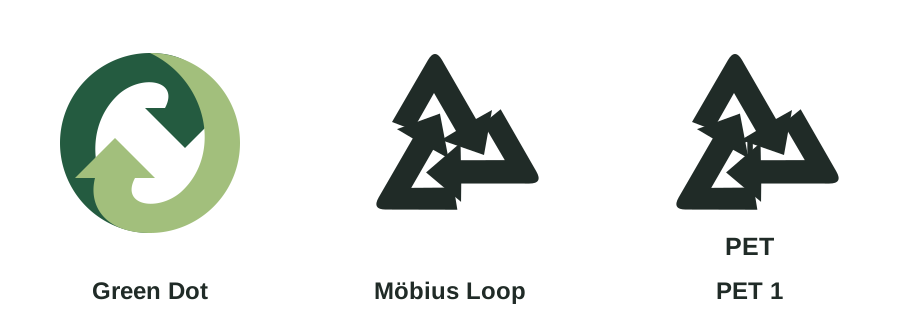
| Green Dot | Circle enclosing two interlocking curved arrows (one light, one dark). | Trademark licence symbol. Proves that the packaging producer has paid a financial levy to an authorised national packaging recovery scheme (Repak in Ireland). It does not mean the packaging is recyclable or made from recycled material. |
| Möbius Loop | Three chasing arrows forming a continuous triangle. | Indicates the material is technically capable of being recycled. If a percentage appears in the centre, it states the proportion of recycled content used to make it. Consumers should check local recycling lists and keep items clean, dry, and loose. |
| PET 1 | Triangle of chasing arrows enclosing the number 1, labelled PET. | Polyethylene Terephthalate. Clear, rigid plastic used for drinks bottles. Readily collected, sorted, and remelted into new bottles or polyester fleece. Fully accepted by the Deposit Return Scheme. |
| HDPE 2 | Triangle enclosing the number 2, labelled HDPE. | High-Density Polyethylene. Tough plastic used for fresh milk containers, bleach bottles, and shampoo containers. Widely collected in kerbside recycling bins. |
| WEEE Symbol | A wheelie bin crossed out with a bold X. | Waste Electrical and Electronic Equipment. Electrical appliances, batteries, and bulbs must not be thrown into household bins. Retailers must take them back free of charge for depollution and recycling. |
| EU Ecolabel | A flower whose petals are the twelve EU stars, with a stylised letter E at the centre. | Confirms that the certified product complies with strict environmental standards across its entire lifecycle, from raw material extraction to disposal. |
CORE: Food Packaging and Sustainable Consumer Choices
Packaging performs essential roles: it protects food from physical damage, preserves freshness to extend shelf life, enables hygienic transport and storage, informs consumers through statutory food labels, and markets the product.
Environmental Problems Associated with Packaging
- Depletes Non-Renewable Resources: Plastics are manufactured from crude oil, and cans require mined bauxite ore or iron.
- High Energy and Emissions: Refining raw materials, manufacturing containers, and transporting heavy packaging burns fossil fuels and releases large volumes of carbon dioxide.
- Over-Packaging: Packaging small products in multiple layers (e.g. biscuits in plastic trays inside foil wrappers inside printed cardboard boxes) wastes materials with no extra preservation benefit.
- Landfill Persistence: Most conventional plastics are not biodegradable and persist in landfill sites for centuries.
- Litter and Ocean Hazards: Discarded plastic wrappers break down into microplastics that contaminate soil and marine food chains.
- Difficult Sorting: Composite packaging made of bonded materials (such as plastic-lined cardboard or foil-laminated pouches) cannot be easily separated and often ends up in general waste.
Reducing Packaging Waste
- Buy loose, unbagged fruit and vegetables rather than produce pre-packed in plastic trays.
- Buy refill packs, concentrated products, and bulk sizes rather than multiple single-serve portions.
- Bring reusable canvas shopping bags and clean containers to deli counters and bakery displays.
- Choose products packaged in single, easily recycled materials like plain cardboard or glass jars that can be recycled indefinitely into cullet.
- Return eligible plastic bottles and drinks cans to reverse vending machines under the Deposit Return Scheme (DRS).
Everyday Actions in the Home
- Laundry: Wash full loads at 30°C to cut electricity consumption by up to 40% compared to hot cycles. Line-dry clothes on dry days instead of using an electric tumble dryer, cutting household electricity bills and reducing emissions from power stations supplying the national grid.
- Food Provisioning: Plan meals using a shopping list to prevent food spoilage. Buy local, seasonal produce to minimise food miles (the distance food travels from field to plate), cutting transport carbon emissions.
- Standby Electricity: Electrical appliances left in standby mode draw background power 24 hours a day. Turning appliances off completely at the wall socket eliminates standby electricity waste.
If home entertainment devices draw an aggregate standby power of () continuously for each day:
- Daily consumption: .
- Annual consumption: .
- At an electricity tariff of €0.35 per unit (): .
Switching devices off at the wall socket saves the household over €60 a year and reduces demand on the national grid.
ELECTIVE 1: Sustainable Housing Style, Site and Interior Design (Units 4.1.1, 4.2, 4.3)
Note: This section covers Elective 1 (Home Design and Management). Core-only candidates do not need these details for their elective section, but can use sustainable house choices as practical consumer actions in Section 2.
Environmental Factors in Choosing a House Style and Site
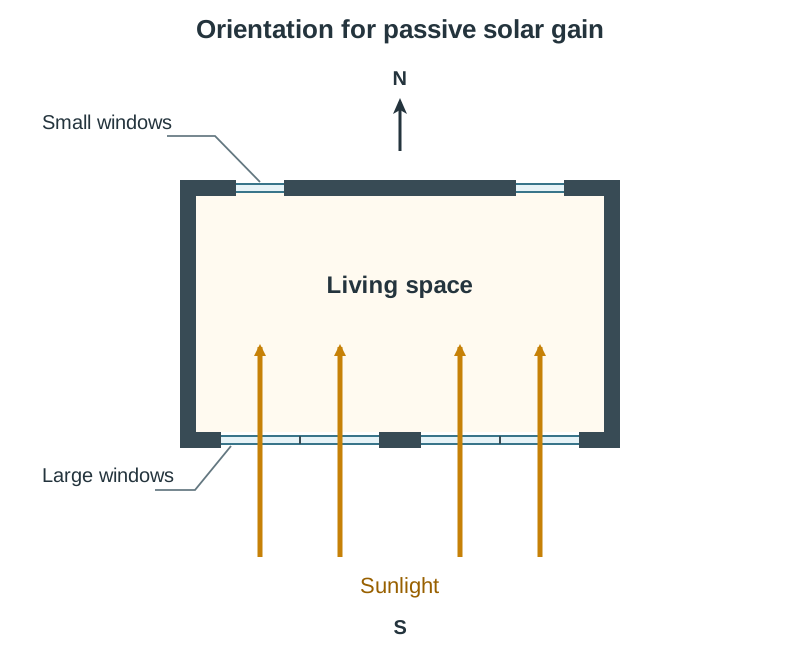
- Orientation and Passive Solar Gain: Orient the dwelling so that main living spaces and large windows face south or south-west. Capturing natural daylight and heat from the sun (passive solar gain) reduces domestic heating and lighting bills. Keeping windows small on the colder north-facing side minimises heat loss.
- Shelter and Landscaping: Retain existing trees, hedgerows, and slopes, or plant a shelter belt of trees on the prevailing windward side. This breaks wind speeds, cuts draught heat loss, and preserves natural wildlife corridors.
- Blending with Surroundings: The scale, roof pitch, render, and stonework should harmonise with the local landscape and neighboring architecture. One-off ribbon development along rural roads is discouraged because it breaks up rural landscapes, increases car dependence, and requires separate wastewater systems.
- Location and Infrastructure: Siting a home near schools, shops, and public transport reduces private car journeys and emissions. Developing infill or brownfield sites in towns reuses existing serviced land and prevents suburban sprawl into greenfield agricultural land.
- Water and Soil Protection: Avoid building on flood plains. On unserviced rural sites, install an approved wastewater treatment system and properly designed percolation area to filter domestic effluent safely and protect groundwater supplies.
- Materials and Durability: Select locally sourced, durable building materials to lower transport energy, and ensure all structural timber comes from certified sustainable plantations.
Environmentally Friendly Choices for a Room Interior
- Flooring: Choose solid timber or bamboo from certified sustainable forests, cork tiles, natural linoleum (made from linseed oil, wood flour, and jute), or wool carpets. These materials are renewable, durable, and biodegradable, unlike synthetic nylon carpets or vinyl flooring derived from crude oil.
- Wall Finishes: Use water-based, low-VOC emulsion paints that give off minimal solvent fumes; look for paints bearing the EU Ecolabel; calculate paint quantities accurately to avoid waste and bring leftover paint to a civic amenity site.
- Furniture: Buy well-constructed, durable furniture that can be repaired or reupholstered; choose upcycled or second-hand vintage pieces; avoid uncertified tropical hardwoods like mahogany and teak.
- Soft Furnishings: Use natural, renewable fabrics such as linen, wool, and organic cotton; hang heavy, floor-length thermal-lined curtains and close them at dusk to trap warm air and reduce window heat loss.
- Lighting: Install energy-efficient LED light fittings that use up to 80% less electricity than incandescent bulbs and last significantly longer; use pale wall colours to reflect daylight throughout the room.
ELECTIVE 1: Domestic Energy Supplies, Emissions and the Energy-Efficient Home (Unit 4.4)
Note: This section covers Elective 1 (Home Design and Management).
Domestic Energy Supplies and Sustainability
- Grid Electricity: An energy carrier generated from natural gas, wind, solar, and interconnectors. Its sustainability depends on national grid generation. As Ireland increases its renewable energy share, the carbon emissions per kilowatt-hour fall.
- Piped Natural Gas: A non-renewable fossil fuel composed mainly of methane (). It burns cleaner with fewer particulates and less carbon dioxide than coal or oil, but upstream gas leaks release unburned methane, an intense greenhouse gas.
- Home Heating Oil (Kerosene): A non-renewable fossil fuel refined from crude oil and stored in outdoor domestic tanks. Burning oil produces high carbon dioxide emissions, and damaged tanks pose severe soil and water contamination risks.
- Solid Fuels (Coal, Turf, Briquettes): Non-renewable and unsustainable fuels that produce high emissions of carbon dioxide, sulphur dioxide, and soot particles. Clean air regulations restrict the sale of smoky bituminous coal and harvested turf across Ireland.
- Solar Energy: Fully sustainable renewable energy. Photovoltaic (PV) panels generate clean electricity, while solar thermal collectors pre-heat domestic hot water.
Domestic Fuel Combustion Emissions
In the Leaving Certificate, questions on domestic fuel emissions require three elements: the named emission, its combustion origin, and its specific environmental effect.
- 1. Carbon Dioxide ():
- Combustion Origin: Produced by the complete combustion of carbon-based fuels (gas, oil, coal, peat, timber) in adequate oxygen.
- Environmental Effect: Acts as a major greenhouse gas. It traps heat given off by the Earth's surface, enhancing the greenhouse effect and driving global climate change, melting ice sheets, raising sea levels, and causing severe droughts and floods.
- 2. Sulphur Dioxide ():
- Combustion Origin: Formed when sulphur impurities present in solid fuels (coal) and heavy heating oil react with oxygen during burning.
- Environmental Effect: Rises into the atmosphere and dissolves into rain clouds to form sulphurous and sulphuric acid, falling as acid rain. Acid rain acidifies lakes and rivers, mobilising toxic aluminium that kills fish; strips nutrients from forest soils, damaging trees; and chemically corrodes limestone buildings and metal pipework.
- 3. Nitrogen Oxides ():
- Combustion Origin: Formed at high temperatures inside domestic oil burners, gas boilers, and vehicle engines when atmospheric nitrogen and oxygen chemically combine.
- Environmental Effect: Dissolves into moisture in clouds to form nitric acid, causing acid rain. It also reacts with sunlight and vehicle fumes to create ground-level photochemical smog, which damages plant leaves and inflames human respiratory systems.
- 4. Smoke Soot and Particulate Matter ( / ):
- Combustion Origin: Discharged from the incomplete combustion of solid fuels like coal, wet timber, and peat when air supply is restricted.
- Environmental Effect: Produces winter smog that blocks sunlight and slows plant photosynthesis. Inhaled fine particulates pass deep into the lungs, triggering asthma and cardiovascular problems.
- (Examiner note: Carbon monoxide () is produced by incomplete combustion in a restricted air supply. It is a lethal poisonous gas that stops blood carrying oxygen to the brain and heart. Because its impact is on human safety inside the home rather than broad outdoor environmental damage, keep CO for questions on domestic safety, ventilation, and boiler flues.)
Heat Loss in an Uninsulated House
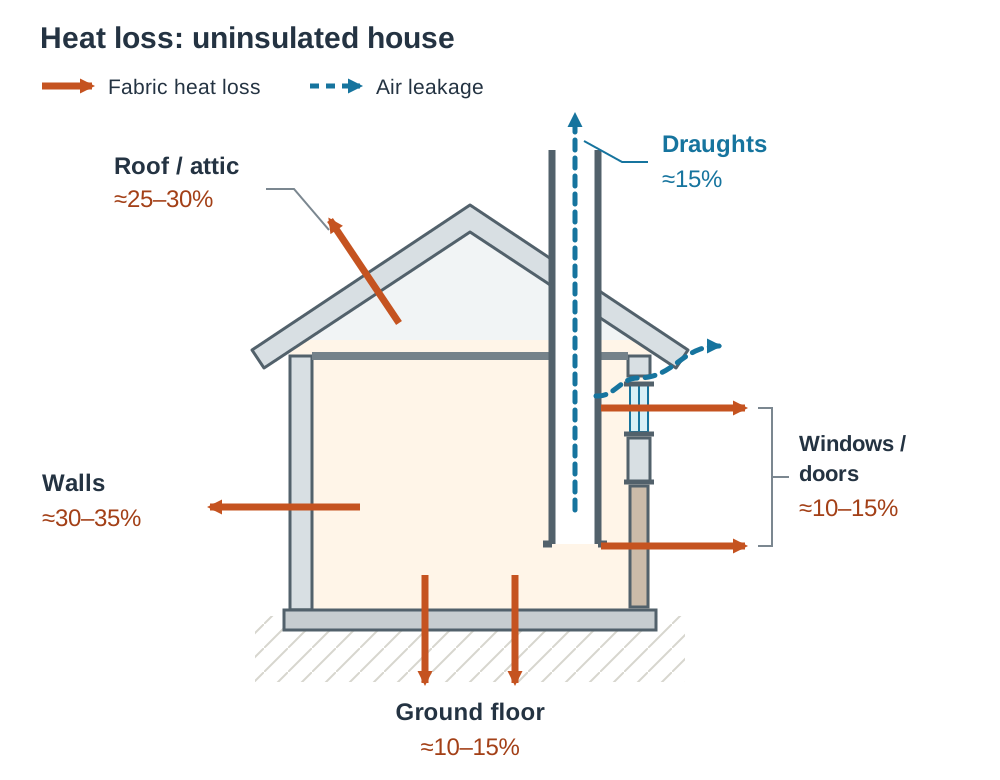
In an uninsulated house, heat escapes through the building fabric by conduction, convection, and radiation. The single largest loss occurs through the walls:
- External Walls: of total heat loss (conducted through uninsulated brick, block, or concrete).
- Roof / Attic: of total heat loss (warm air rises by convection and heat conducts through ceiling plasterboard into unheated attic space).
- Draughts and Air Infiltration: of total heat loss (unsealed gaps around doors, window frames, letterboxes, and open chimneys).
- Ground Floors: of total heat loss (downward conduction into uninsulated ground slabs or ventilated timber crawl spaces).
- Windows and External Doors: of total heat loss (conducted through single glazing and radiative escape).
Insulation and Energy Efficiency Strategies
- Attic Insulation: Laying of mineral glass wool, rock wool, or cellulose quilt between and across ceiling joists. The fibres trap air pockets, slowing conductive and convective heat transfer. The cold water storage tank and attic pipes must also be lagged to prevent freezing.
- Wall Insulation Methods:
- Cavity Wall Pumping: Pumping bonded polystyrene beads into the hollow cavity between outer and inner blockwork through drilled holes, stopping convective air currents.
- External Wall Insulation: Fastening rigid insulation boards to the exterior face of solid block walls and finishing them with protective weatherproof render. This preserves interior room sizes and covers thermal bridges.
- Internal Dry-Lining: Fixing insulated plasterboard to interior walls. This reduces room floor area and requires repositioning electrical sockets and radiators.
- Double / Triple Glazing: Installing argon-gas-filled multi-pane units with Low-Emissivity (Low-E) glass coatings that reflect radiant indoor heat back into the room.
- Controlled Ventilation: Use draught-stripping on door perimeters, but keep background trickle vents or mechanical ventilation systems clear. Sealing a house completely leads to condensation, black mould on walls and windows, and stale, stuffy air.
- Heating Controls:
- Thermostatic Radiator Valves (TRVs): Fitted to individual radiators to sense room air temperature and shut off hot water flow once the target temperature is reached.
- Thermostat Settings: Maintain living areas at 18–20°C, bedrooms at 15–18°C, and hallways at 16–18°C. Lowering the main thermostat by 1°C can cut annual heating fuel consumption by up to 10%.
- Zoned Heating: Motorised valves separate space heating into independent circuits (living rooms downstairs, bedrooms upstairs, and domestic hot water).
- Cylinder Insulation: Fitting a factory-foamed jacket or an lagging jacket to the hot water cylinder keeps water warm for hours.
- Building Energy Rating (BER) & The SEAI: A BER Certificate rates a home's energy performance from A1 (most energy-efficient) down to G (least efficient). It is legally required when selling or renting a residential property in Ireland. The Sustainable Energy Authority of Ireland (SEAI) provides home energy upgrade grants to subsidise attic insulation, wall insulation, solar PV systems, and heat pumps.
Key terms
- Renewable Resource
- A resource that is always available naturally and is not used up by constant use, such as solar energy, wind power, hydropower, or timber.
- Non-Renewable Resource
- A resource that is limited in supply and cannot be replaced once it has been used up, such as coal, peat, oil, and natural gas.
- Sustainability
- Meeting the needs of the present generation without compromising the ability of future generations to meet their own needs.
- Carbon Footprint
- The total amount of greenhouse gases, expressed as carbon dioxide equivalent, released directly and indirectly by the activities of an individual, household, or product.
- Food Miles
- The distance food travels from where it is grown or manufactured to the consumer who buys and eats it.
- Greenhouse Effect
- The natural process where atmospheric greenhouse gases absorb heat given off by the Earth's surface and radiate it back downwards, keeping the planet warm. Excessive emissions cause global warming.
- Acid Rain
- Rainfall made unnaturally acidic by sulphur dioxide (SO2) and nitrogen oxides (NOx) dissolving in atmospheric water droplets, damaging forests, freshwater lakes, and buildings.
- Eutrophication
- The nutrient enrichment of water by excess nitrates and phosphates, causing algal blooms. When the algae die, decomposing bacteria multiply and use up dissolved oxygen, causing fish kills.
- Leachate
- A toxic, contaminated liquid formed when rainwater filters down through waste in a landfill site, dissolving chemicals and heavy metals.
- Cullet
- Crushed, contaminant-free recycled glass that is melted in furnaces to make new jars and bottles, saving raw sand and furnace fuel.
- Green Dot
- A registered trademark licence symbol showing that the packaging producer has paid a financial levy to an authorised national recovery scheme (Repak in Ireland). It does not mean the package is recyclable.
- Möbius Loop
- An environmental symbol of three chasing arrows forming a triangle, indicating that the material is technically capable of being recycled.
- WEEE Symbol
- A symbol showing a wheelie bin crossed out with an X, indicating that Waste Electrical and Electronic Equipment must not be put in household bins and must be returned for recycling.
- EU Energy Label
- A mandatory label rating domestic appliances from A (most efficient) to G (least efficient), stating annual electricity use in kWh, capacity, and noise output in decibels.
- EU Ecolabel
- A voluntary label (twelve EU stars forming a flower around a letter E) certifying that a product meets high environmental standards throughout its lifecycle.
- Deposit Return Scheme (DRS)
- A scheme where consumers pay a small refundable deposit on plastic drinks bottles and cans, which is refunded when the empty container is returned to a reverse vending machine.
- Environmental Protection Agency (EPA)
- The statutory body in Ireland that monitors air and water quality, licenses waste facilities and large industries, and enforces environmental protection laws.
- Sustainable Energy Authority of Ireland (SEAI)
- The national agency that promotes energy efficiency, oversees the BER rating system, and administers domestic energy upgrade grants.
- Building Energy Rating (BER)
- An official certificate rating the energy efficiency and carbon emissions of a home on an A1 to G scale, legally required when selling or leasing a dwelling.
- Thermostatic Radiator Valve (TRV)
- A valve fitted to a radiator that automatically shuts off the flow of hot water when the room reaches the temperature set on its dial.
- Passive Solar Gain
- The free heat and light captured directly through south-facing windows from the sun, reducing the need for artificial space heating and lighting.
- Incomplete Combustion
- The burning of fuels in a restricted supply of oxygen, producing dangerous carbon monoxide gas, unburned hydrocarbon soot, and smoke.
Check yourself
What is the difference between a renewable and a non-renewable resource? Give one example of each.
A renewable resource is always available naturally and is not used up by constant use (e.g. solar energy, wind energy, timber). A non-renewable resource is limited in supply and cannot be replaced once used up (e.g. coal, peat, crude oil).
Which two domestic fuel combustion emissions cause acid rain, and what is one ecological damage caused by acid rain?
Sulphur dioxide () and nitrogen oxides (). Acid rain lowers the pH of lakes and streams, releasing toxic aluminium that kills freshwater fish, or leaches nutrients from forest soil, damaging trees.
Name two environmental impacts of illegal dumping and one proper facility a household should use instead.
Illegal dumping ruins the landscape, injures wildlife, and releases toxic leachate that contaminates soil and groundwater. Bulky household items should be brought to a local civic amenity site.
Name one statutory body concerned with environmental protection in Ireland and outline one of its functions.
The Environmental Protection Agency (EPA). It monitors air, river, and drinking water quality and licenses landfills and large industrial waste facilities.
How does the biological decomposition of dead algae lead to fish kills during eutrophication?
When dense algal blooms die, aerobic decomposing bacteria multiply rapidly to break down the dead organic matter, consuming the dissolved oxygen in the water until aquatic life suffocates.
In an uninsulated house, which structural area loses the largest percentage of heat, and how can this heat loss be reduced?
External walls lose the largest amount of heat (approximately 30–35%). This can be reduced by pumping bonded polystyrene beads into cavity walls or applying external wall insulation boards with render.
Calculate the electricity consumed in kWh and the cost to run a 2.5 kW immersion heater for 3 hours at an electricity rate of €0.35 per unit.
Energy = 2.5 kW × 3 hours = 7.5 kWh. Cost = 7.5 kWh × €0.35 = €2.63.
What legal obligation does the WEEE symbol place on retailers who sell electrical appliances?
Retailers must accept old, discarded electrical goods back from consumers free of charge on a one-for-one purchase basis for safe depollution and recycling.