

Elective 3 (Social Studies) examines how changing social, economic, and legal realities shape family life, work, and leisure in modern Ireland. You will learn how families where both parents work, and one-parent families, cope with the strain of too much to do (role overload) and clashing demands (role conflict); how to judge different childcare options; why leisure matters for health, friendships, and wellbeing; and how to compare two local leisure facilities on cost and value for money.
1. Social Change and the Family
Over the past century, Ireland has transformed from an agricultural society into an urbanised, service-driven economy. In early twentieth-century Ireland, large extended families were common in rural areas, where men worked the land as primary breadwinners and women carried out domestic duties in segregated conjugal roles.
On the Leaving Certificate paper, long-form questions on social and economic change are marked per developed point. Build every point the same way: name the change, explain in a sentence or two how it altered family life, and give a short Irish example.
| Aspect of Family Life | Early to Mid-20th Century | Contemporary Irish Society |
|---|---|---|
| Settlement & structure | Predominantly rural, agricultural; large extended or traditional nuclear families | Mostly urban and suburban; smaller nuclear, lone-parent, cohabiting, and blended families |
| Conjugal roles | Segregated roles (strict division: male breadwinner, female homemaker) | Integrated roles (shared breadwinning, domestic tasks, and caregiving) |
| Education & dependence | School-leaving age was 14; early entry into farming, trades, or domestic work | Free second-level and widespread third-level access; financial dependence extends into the twenties |
| Attitudes to marriage | Lifelong legal and religious institution; no divorce; marriage bar for women | Diverse relationships; civil divorce enacted in 1996; marriage equality in 2015 |
| State support | Heavy reliance on kinship, neighbours, and religious charities | Comprehensive statutory welfare safety net supplemented by formal community services |
The Syllabus List of Social and Economic Changes
A question may name any one of these changes directly, so have a named point, explanation, and Irish example ready for each.
Change in settlement patterns from rural to urban
Explanation: Industrialisation and the growth of commercial and technology services drew employment into cities and large towns. Families left rural areas, moving away from extended family networks. While urban living offers better access to services and jobs, it can isolate parents from the practical day-to-day help of relatives. Irish family example: A couple living in a commuter town in Kildare must pay for a private crèche and after-school care because both sets of grandparents live in rural Mayo.
Reduction in working hours and increase in leisure time
Explanation: A century ago, six-day weeks of long manual labour were standard, and paid holidays were almost nonexistent. Mechanisation, trade unions, and employment law gradually reduced working hours. Under the Organisation of Working Time Act 1997, the net working week is capped at an average of 48 hours, with mandatory daily rest periods and a statutory minimum of four weeks' paid annual leave. Domestic appliances have also shortened unpaid housework time, creating discretionary time for recreation, sports, and family holidays. Irish family example: A parent working a standard 39-hour week can coach an underage GAA team on Saturday mornings and take two weeks of family summer holiday, which would have been impossible for a farm labourer in the 1930s.
Improvements in the provision of education
Explanation: The introduction of free second-level education (1967), the school transport scheme, the raising of the school-leaving age to 16, the abolition of undergraduate tuition fees (1996), SUSI grants, DEIS school supports, and the free pre-school ECCE scheme have widened educational access. As a result, young people stay in education much longer, extending their financial dependence on parents into their early twenties and delaying marriage and childbearing. Irish family example: A student from a DEIS school progresses to third level with the help of a SUSI maintenance grant, while her parents continue to cover her accommodation and living costs until graduation.
Improvements in social welfare
Explanation: Targeted and universal state payments (such as Child Benefit, the One-Parent Family Payment, and the Working Family Payment) provide an economic safety net. These payments reduce child poverty and give individuals, such as lone parents or older adults, the financial means to maintain an independent household without relying on private charity. Irish family example: A lone parent uses the One-Parent Family Payment and the National Childcare Scheme to support her household budget while she completes a degree course.
Changing attitudes to marriage, parenting, and traditional roles
Explanation: Irish society has become more secular, pluralist, and child-centred. The constitutional ban on divorce was lifted following the 1995 referendum and enacted by the Family Law (Divorce) Act 1996. The 2015 Marriage Equality referendum gave same-sex couples the right to marry. Attitudes to parenting have shifted from strict parental authority towards open communication and children's rights. The Children First Act 2015 placed statutory reporting duties on professionals and abolished the common-law defence of reasonable chastisement, making physical punishment unlawful. Irish family example: Following a marital breakdown and civil divorce, parents establish joint custody, creating a blended family structure when one parent remarries.
Improved pay and conditions of work
Explanation: Workplace standards have risen through the National Minimum Wage Act 2000 (which sets an enforceable hourly floor), statutory sick pay, health and safety regulations under the Safety, Health and Welfare at Work Act, and workplace pension schemes. Higher and more secure earnings raise living standards and allow families to save and secure mortgages. Irish family example: A retail employee receiving the statutory minimum wage, paid annual leave, and statutory sick pay has the financial predictability needed to budget for family rent and utilities.
Legislation on equal pay and employment opportunities
Explanation: The abolition of the civil service marriage bar in 1973 removed the requirement that women resign from public jobs upon marriage. The Anti-Discrimination (Pay) Act 1974 established equal pay for equal work, and the Employment Equality Acts outlaw discrimination across nine grounds, including gender, civil status, and family status. The Maternity Protection Acts and the Work Life Balance and Miscellaneous Provisions Act 2023 help parents retain their careers while raising children. Irish family example: A woman takes 26 weeks of statutory maternity leave, returns to her managerial role at full salary, and later requests a flexible working pattern to manage school pick-ups.
Increased participation of women in the workforce
Explanation: Driven by higher education levels, equality laws, and the rising cost of living, female participation in the paid workforce has risen from roughly one in three women in the 1970s to around six in ten today. The dual-earner family has replaced the single male-breadwinner household as the standard Irish family type, increasing household income while requiring domestic work to be shared. Irish family example: Both parents work full-time in professional roles, sharing mortgage payments and splitting weekly grocery shopping and school runs.
Unemployment
Explanation: Economic downturns and industrial closures remove household income, causing financial hardship and dependence on social assistance like Jobseeker's Allowance. Long-term unemployment causes stress, lowers self-esteem, and can lead to involuntary role reversals where an unemployed partner takes on primary domestic work. The extra uncommitted time does not result in rewarding leisure because of financial strain and anxiety. Irish family example: Following a factory redundancy, a parent experiences severe household budget cuts, having to drop children's sports subscriptions despite having surplus free time at home. (Note: Causes and full effects of unemployment are studied in detail under subtopic 6.5).
2. Reconciling Employment with Family Responsibilities
As dual-earner families have become the norm, balancing workplace demands with home life has become a central challenge for Irish households.
Why Conjugal Roles Have Changed
Conjugal roles describe the division of labour and responsibilities between partners. Historically, Irish families operated with segregated conjugal roles, where the husband was the sole economic provider and the wife had exclusive responsibility for housekeeping and child-rearing. Modern households have shifted towards integrated conjugal roles, where wage-earning, domestic chores, and emotional childcare are shared. This change has occurred for several clear reasons:
- Educational attainment: Girls now complete second and third level at rates equal to or higher than boys, leading to long-term professional careers rather than temporary jobs.
- Equality legislation: The removal of the marriage bar (1973), the Anti-Discrimination (Pay) Act 1974, and the Employment Equality Acts protected women's workplace rights.
- Economic necessity: High housing and living costs mean most families require two incomes to service a mortgage and cover household bills.
- Family planning: Smaller family sizes and later childbearing shorten the total years dedicated to full-time infant care.
- Changing social attitudes: Secularisation and the feminist movement have challenged the assumption that domestic chores are exclusively female responsibilities.
- Household technology: Dishwashers, washing machines, and convenience foods have reduced the total hours required to run a home, making task-sharing practical.
- Parental leave rights: Statutory paternity, parent's, and parental leave encourage fathers to take an active, hands-on role in daily care from birth.
The Impact of Dual-Earner Families
When evaluating the dual-earner family model, you must address both the advantages and the strains.
Benefits of the dual-earner family
- Two incomes provide a higher standard of living, greater capacity to save, and financial security if one parent loses a job.
- Both partners build independent PRSI contribution records, guaranteeing personal pension entitlements.
- Both parents gain personal fulfillment, social contact, and professional self-esteem outside the home.
- Children grow up with egalitarian role models, observing both parents contributing to earning, cooking, and cleaning.
Strains: Role Overload and Role Conflict
- Role overload: This occurs when the cumulative volume of tasks across work, parenting, and home management is more than one person has the energy, patience, or hours in the day to manage. It results in chronic fatigue and burnout. It frequently affects working mothers who work a full day in paid employment only to face a second shift of cooking, laundry, and cleaning at home.
- Example of role overload: A parent works a 40-hour week in an office, cooks dinner every evening, helps with homework, washes clothes, and cleans until late at night, leaving them completely exhausted.
- Role conflict: This occurs when competing demands from two separate roles clash directly at a specific moment in time, making it impossible to satisfy one without letting down the other.
- Example of role conflict: An engineer scheduled to deliver a major client presentation at 9:00 am receives a call from the crèche at 8:45 am saying their child has developed a high fever and must be collected immediately.
Memory hook: Overload = too much altogether (the problem is the total volume). Conflict = two demands at once (the problem is the clock). If your example mentions a specific clash in time, it is role conflict.
Effects on Children
- Children in dual-earner homes may spend long days in formal childcare or after-school clubs. Older children may spend hours unsupervised after school as 'latchkey' children.
- Family mealtimes can become hurried, leading to higher reliance on convenience foods unless meals are planned.
- Conversely, children in dual-earner households often develop self-reliance, practical independence, and strong social skills earlier.
Statutory Leave Provisions in Ireland
| Leave Type | Statutory Entitlement & Conditions |
|---|---|
| Maternity leave | 26 weeks basic leave (eligible for PRSI Maternity Benefit) plus up to 16 additional unpaid weeks under the Maternity Protection Acts. |
| Paternity leave | 2 weeks of leave for the relevant parent within the first 26 weeks after birth or adoption, supported by Paternity Benefit. |
| Parent's leave | 9 weeks of paid leave for each parent of a child under two years of age (or within two years of adoption), supported by Parent's Benefit. |
| Parental leave | Up to 26 weeks of unpaid leave per parent for each eligible child up to age 12 (or age 16 if the child has a disability or long-term illness). |
| Work Life Balance Act 2023 | Gives employees the legal right to request remote or flexible working arrangements for caregiving, plus 5 days of unpaid leave for serious medical care needs. Employers must consider requests but can refuse based on business needs. |
3. Childcare Options: Requirements and Evaluation
Dual-earner and working lone-parent families rely on dependable childcare. When choosing an option, parents evaluate safety, staff qualifications, adult-to-child ratios, opening hours, proximity to home or work, and cost.
Childcare Options Available to Families
- Full-day care crèche or day nursery: Purpose-built facilities providing care from infancy through pre-school age, usually open from 7:30 am to 6:30 pm.
- Tusla-registered childminder: Self-employed individuals caring for a small group of children in the minder's private home.
- Informal care (grandparents or relatives): Family-based care, either in the child's or relative's home.
- Carer in the home (nanny or au pair): An employed individual providing one-to-one childcare within the child's home. It offers maximum convenience and keeps siblings together, but is costly, lacks state inspection, and turns the parents into employers responsible for tax and PRSI.
- Sessional pre-school, playgroup, or Montessori: Offers 2.5 to 3.5 hours per day of structured early learning, funded under the ECCE scheme. It aids peer socialisation but does not cover a standard working day.
- After-school and breakfast clubs: Provides care, homework supervision, and play before and after primary school hours, though places are competitive and clubs typically close during school holidays.
Detailed Evaluation of Two Primary Childcare Options
Option 1: Full-Day Care Crèche
- Advantages: Crèches are formally registered and inspected by Tusla under Child Care Act regulations, ensuring strict health, hygiene, and room-space standards. Staff hold certified qualifications in early childhood education. Activities follow Aistear (the early childhood curriculum framework) within the quality standards of Síolta (the national quality framework). Staff rotas ensure continuity of care if an individual worker is absent.
- Disadvantages: High monthly fees consume a large portion of household income. Opening and closing times are strict, with penalties for late collection. High child density increases exposure to childhood viruses, requiring parents to take emergency leave when an ill child is excluded.
- Reasoned judgement: Best suited for parents who need dependable, year-round care and structured socialisation, provided they can meet the monthly fees and manage occasional sick-day exclusions.
Option 2: Tusla-Registered Childminder (in the Minder's Home)
- Advantages: Provides care in a warm, domestic setting with a low adult-to-child ratio, giving children one-to-one attention and a consistent attachment figure. Childminders often offer flexible drop-off and collection arrangements, and can care for siblings of different ages together, including handling school runs.
- Disadvantages: If the childminder falls ill, takes annual leave, or has an emergency, no cover is provided, leaving parents without childcare. Socialisation is limited to a smaller peer group, and home play facilities may be less varied than in a purpose-built crèche.
- Reasoned judgement: Ideal for infants or children who thrive in a quiet home environment, provided parents have backup family arrangements if the childminder becomes unavailable.
State Childcare Schemes
- Early Childhood Care and Education (ECCE) scheme: Provides two years of free pre-school education (3 hours per day, 5 days per week, over 38 weeks of the school year) for children aged two years and eight months until they start primary school. Because it only covers 15 hours per week during term time, it is an early learning entitlement rather than a complete childcare solution for working parents.
- National Childcare Scheme (NCS): Provides both a universal subsidy (not means-tested, paid for children up to 15 years) and an income-assessed subsidy (sliding scale based on family income). Subsidies are paid directly to Tusla-registered childcare providers, reducing the hourly fees parents pay.
4. Leisure in Contemporary Society
Leisure is free or discretionary time—the time left over after work or school, household jobs, and essential biological maintenance (eating, sleeping, and washing) have been completed. It is time you choose how to spend, whether for rest, recreation, or personal development.
Calculating a Daily Time Budget
To find discretionary leisure time, subtract total committed hours from the 24 hours of the day:
Leisure time = 24 hours − total committed hours
| Daily Activity | Committed Hours (Typical School Day) |
|---|---|
| Sleep and rest | 8.0 |
| School attendance | 6.5 |
| Travel and commuting | 1.0 |
| Homework and study | 2.5 |
| Meals and personal hygiene | 2.0 |
| Household chores | 1.0 |
| Total committed time | 21.0 |
Discretionary leisure time = 24 hours − 21.0 hours = 3.0 hours.
Self-check task: Calculate your own discretionary leisure time on a weekday versus a Saturday. Identify two practical changes to make better use of that time, such as replacing 60 minutes of passive screen scrolling with an organised sport or creative hobby.
Developmental Value of Leisure
- Physical development: Active pursuits (such as camogie, soccer, running, and swimming) build cardiovascular fitness, improve motor coordination, maintain healthy bone density, prevent obesity, and improve sleep quality.
- Emotional and psychological development: Leisure provides a release from academic and work stress. Achieving personal goals (such as learning an instrument or completing a 5k run) builds self-confidence, emotional stability, and independence.
- Social development: Team sports and clubs teach communication, sportsmanship, and teamwork. Group involvement builds friendships outside of school or work and prevents feelings of loneliness.
- Family life-cycle development: Individual hobbies protect personal identity, while shared family leisure strengthens emotional bonds. For families with young children, recreation is often informal (playgrounds, walks). In adolescence, leisure shifts towards peer groups and sports clubs. In retirement, leisure time expands, and community groups (like Men's Sheds or active retirement associations) help maintain social connections.
Influences on Leisure Patterns
Syllabus 6.4 lists several key influences on how people spend their free time:
- Social and cultural influences: Irish traditions encourage participation in Gaelic games, traditional music, and dance. Religious routines or church youth organisations shape how weekends are structured. Family habits are influential; parents who are active walkers or readers generally pass those interests on to their children. Teenagers are heavily guided by peer groups, often leaving activities if friends quit. In addition, social media, streaming platforms, and gaming have increased sedentary screen time, while fitness influencers have popularised gym training and running clubs.
- Availability of local facilities: A town with a public swimming pool, playing pitches, and safe walking tracks offers wider choices than an isolated rural parish with no public transport, where non-driving teenagers are dependent on parents for lifts.
- Occupation and working hours: Heavy manual workers (such as builders or agricultural workers) often prefer relaxing, passive hobbies like reading or watching sport. In contrast, office workers who sit at desks all day often seek active exercise. Shift work and weekend rosters can make it impossible to play in regular sports leagues.
- Age: Physical capabilities and interests change over time. Children need energetic play, adolescents focus on peer-based sports and digital media, working adults often seek stress-relieving activities, and older adults frequently choose low-impact pursuits like walking, gardening, or bowls.
- Gender: While sports opportunities for women have expanded, mothers working outside the home often find their leisure interrupted by the domestic second shift, leaving them with fragmented free time compared to men.
- Income and socio-economic status: High-cost pastimes (such as golf club membership, equestrian sports, and skiing holidays) require significant disposable income. Low-income families rely on public amenities such as parks, beaches, greenways, and public libraries.
- Health and disability: Physical illness or a disability restricts leisure choices unless local facilities provide accessible entrances, hoist-equipped changing areas, and inclusive sports programmes.
5. Comparing Two Leisure Facilities: Cost and Value
The syllabus requires you to evaluate community leisure amenities through a cost and value comparison between two facilities. Cost is the actual money spent; value is the overall benefit, quality, safety, and suitability received in return.
Three Kinds of Leisure Provision
- Statutory (state or local authority): Council leisure centres, public parks, playgrounds, greenways, and public libraries.
- Voluntary or community: GAA and soccer clubs, athletics clubs, Scouts, Men's Sheds, and community halls.
- Commercial (private): Private gyms, cinemas, bowling alleys, and commercial dance or swimming academies.
Criteria for Evaluating Any Leisure Facility
When writing an evaluation on the exam paper, structure your points under these standard headings:
- Cost: Joining fees, ongoing subscriptions, pay-as-you-go rates, family discounts, and hidden extras (gear, locker tokens, parking).
- Location and access: Distance from home or work, availability of public transport, parking, and wheelchair accessibility.
- Opening hours: Availability before work, during lunch, late in the evening, and on weekends.
- Range and suitability: Variety of equipment, classes, and programmes suitable for beginners, advanced users, or families.
- Safety and supervision: Qualified gym instructors, certified lifeguards, first-aid equipment, and child-protection policies.
- Hygiene and maintenance: Cleanliness of changing rooms and showers, and the condition and upkeep of machines.
- Value for money: The quality, health benefit, and enjoyment received relative to the money spent.
Worked Comparison: Council Centre vs Private Health Club
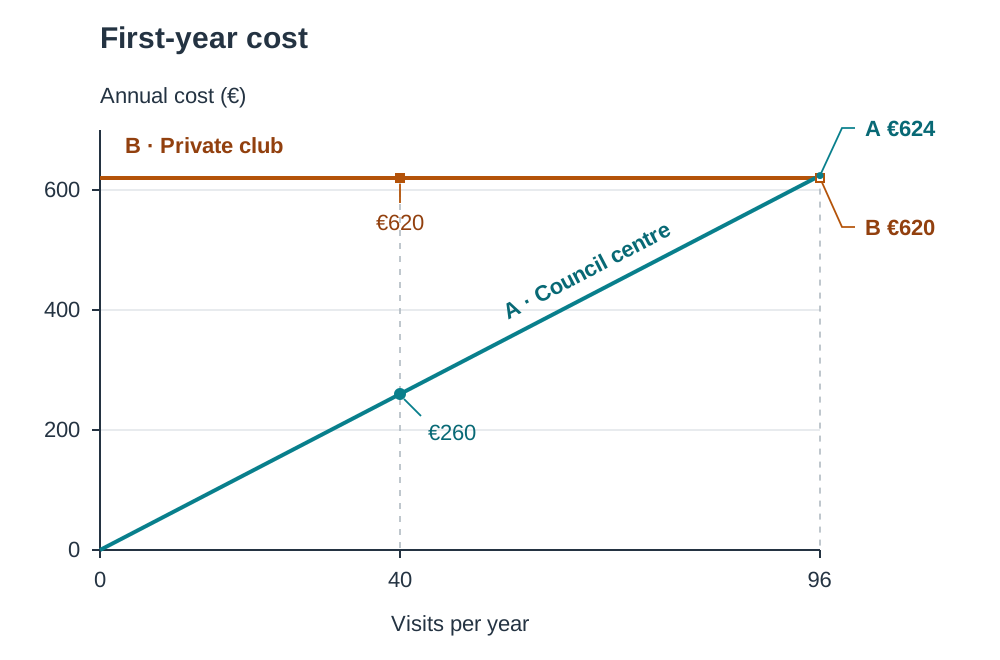
Scenario: Liam plans to exercise twice a week for 48 weeks of the year (96 visits in total). He is comparing two local facilities within walking distance (zero travel costs).
| Evaluation Criteria | Facility A: Council Leisure Centre | Facility B: Private Health Club |
|---|---|---|
| Upfront joining fee | €0.00 | €80.00 |
| Ongoing payment structure | €6.50 pay-as-you-go per visit | €45.00 monthly direct debit (annual contract) |
| Total annual cost (96 visits) | 96 visits × €6.50 = €624.00 | €80 + (12 months × €45) = €620.00 |
| Cost per visit (at 96 visits) | €6.50 per visit | €620.00 ÷ 96 visits = €6.46 per visit |
| Opening hours | Mon–Fri 7 am–9 pm; Sat–Sun 9 am–5 pm | Mon–Fri 6 am–10 pm; Sat–Sun 7 am–8 pm |
| Range of amenities | 25m public pool, sports hall, basic gym | Advanced gym, pool, sauna, steam room, free classes |
| Concessions & flexibility | Student, family, and OAP pay-as-you-go rates | No pay-as-you-go; fixed 12-month direct debit contract |
| Risk of reduced attendance | If he attends 40 times: 40 × €6.50 = €260.00 | If he attends 40 times: still pays €620.00 (€15.50/visit) |
Weighed Value and Reasoned Recommendation
- Comparing the costs: If Liam attends all 96 planned sessions, the private club is slightly cheaper over the year (€620 vs €624), giving a lower cost per session (€6.46 vs €6.50).
- The usage risk: If Liam gets injured or his work schedule changes so that he attends only 40 times, Facility A costs €260.00 (still €6.50 per visit), whereas Facility B still costs the full €620.00 under the contract, driving his real cost up to €15.50 per visit. Facility A carries zero financial risk for an irregular user.
- Judging the value: Facility A provides good community access and flexibility with no contract. Facility B offers superior value for money for a dedicated user due to longer opening hours, free studio fitness classes, and recovery amenities (sauna and steam room).
- Recommendation: If Liam is certain he will train twice every week and will use the classes and longer opening hours, Facility B offers better overall value. If his schedule is unpredictable, Facility A is the safer, more sensible choice.
Key terms
- Dual-earner family
- A household where both adult partners work in paid employment outside the home.
- Role overload
- A state of exhaustion that occurs when the cumulative volume of responsibilities across work, parenting, and home management is too much for one person to manage.
- Role conflict
- A direct clash between the competing demands of two separate roles occurring at the exact same moment in time.
- Integrated conjugal roles
- A family arrangement where partners share wage-earning, domestic chores, and childcare responsibilities equally.
- Segregated conjugal roles
- A traditional domestic division where partners have distinct, separate duties: usually the male is the sole breadwinner and the female is the homemaker.
- Second shift
- The accumulation of unpaid domestic chores and childcare carried out by an individual (disproportionately women) after completing a day of paid employment.
- Discretionary time
- Free time left over after paid work, school, essential domestic chores, and physiological needs (sleeping, eating, personal hygiene) have been met.
- ECCE scheme
- The Early Childhood Care and Education scheme, which provides two years of free sessional pre-school (3 hours daily, 38 weeks per year) to eligible children before primary school.
- National Childcare Scheme
- A statutory scheme providing universal and income-assessed subsidies paid directly to Tusla-registered childcare providers to reduce fees for parents.
- Tusla
- The Child and Family Agency in Ireland, responsible for inspecting, registering, and regulating early years childcare providers and pre-schools.
- Cost and value
- The balance between the actual monetary expense paid for a service (cost) and the overall benefit, quality, safety, and suitability received in return (value).
- Work Life Balance and Miscellaneous Provisions Act 2023
- Irish employment legislation giving workers the legal right to request flexible or remote working arrangements for caring duties, along with unpaid leave for serious medical care.
Check yourself
What is the difference between segregated and integrated conjugal roles?
Segregated roles divide work strictly along traditional gender lines (e.g. male breadwinner, female homemaker). Integrated roles involve partners sharing wage-earning, housework, and childcare duties equally.
A parent misses their daughter's school play because an emergency work meeting was scheduled at the exact same time. Is this role overload or role conflict?
Role conflict, because two distinct roles (employee vs parent) clash directly at a specific moment in time.
How did the Organisation of Working Time Act 1997 affect family leisure?
It capped the average working week at 48 hours, established mandatory daily and weekly rest periods, and guaranteed a minimum of four weeks' paid annual leave, giving employees protected discretionary time for family and recreation.
Name two pieces of Irish legislation that helped make long-term careers possible for married women.
The Anti-Discrimination (Pay) Act 1974 (equal pay for equal work) and the Employment Equality Acts (outlawing workplace discrimination on grounds of gender, civil status, and family status).
State two clear benefits of the dual-earner family structure.
Higher household income with greater financial resilience if one partner loses work, and equal role modelling for children who see both parents sharing wage-earning and home care.
List three criteria you should use to evaluate a community leisure facility.
Cost (joining fee, per-visit charge, and value for money), location and access (distance, public transport, and disabled access), and safety/supervision (qualified instructors, lifeguards, and first-aid provision).
A gym charges a €60 upfront registration fee plus a €35 monthly fee. If Chloe visits 120 times in a year, what is her exact cost per visit?
Total annual cost = €60 + (12 × €35) = €60 + €420 = €480. Cost per visit = €480 ÷ 120 = €4.00 per visit.