

Education forms a major part of Elective 3 (Social Studies) in Leaving Certificate Home Economics. This elective explores why our society provides schooling, what drives differences in academic achievement, how the Irish education system is structured from early childhood through third level, and how the State tackles educational disadvantage. In the Leaving Certificate exam, Elective 3 appears in Section C of the written paper. It carries 80 marks (20% of your Home Economics grade) and has no coursework component, so high marks depend on precise sociological definitions, up-to-date knowledge of Irish educational supports, and balanced evaluations.
How Elective 3 is Examined and How to Structure Answers
Elective 3 makes up 20% of your Home Economics grade. Unlike the Textiles elective, Social Studies does not include a practical project or sewing component. The entire elective is assessed through the final written paper in June.
On the exam paper, you will find this material in Section C as Question C3, worth 80 marks. The question is usually split into parts (a), (b), and (c), each broken down into smaller sub-parts carrying between 10 and 25 marks each. That means you are dealing with five or six distinct tasks in total. Aim to spend 35 to 40 minutes on Section C. A sub-part asking for four factors is usually worth 20 marks, which translates to five marks per point. For each one, give a clear heading, write two or three sentences explaining how the factor works, and finish with a realistic Irish example.
Pay close attention to command words. If a question asks you to 'state' or 'name', a precise term gets the mark. If it asks you to 'describe' or 'discuss', you must explain how the process works and illustrate it with an example. When a question asks you to 'evaluate', examiners will dock marks if you only write praise. You need to give the target group, state two strengths, explain at least one real limitation, and provide a short concluding judgement.
Notice how this elective ties into core Section B material. Education links directly to the educational function of the family in Core Subtopic 3.1.4 and to social change in Subtopic 6.1. Learning these definitions thoroughly pays off across both sections of the exam paper.
Purposes and Functions of Education
Education is a formal social institution that passes on culture, knowledge, values, and skills from one generation to the next. In the Leaving Certificate syllabus, the purposes of education are grouped into three main areas.
1. A Method of Socialisation
Socialisation is the lifelong process where an individual learns the norms, values, behaviour, and social skills needed to live acceptably in society. Sociologists divide this process into two distinct stages:
- Primary socialisation: This happens in early childhood inside the home. Parents and guardians teach children basic spoken language, emotional bonds, manners, and core household values.
- Secondary socialisation: This begins in childhood and runs right through life outside the family home. School is the main formal agency of secondary socialisation. It teaches young people how to interact with strangers, follow institutional authority, and cooperate in large groups.
Schools carry out secondary socialisation through two distinct paths. The first is the formal curriculum, which consists of planned, timetabled subjects examined in state tests, such as Home Economics, Irish, and Mathematics. The second is the hidden curriculum, which refers to the unwritten, unofficial lessons and values that students absorb from everyday school routines. For instance, when a school sanctions students for turning up late, it does not just enforce school rules; it teaches the workplace necessity of punctuality. In the same way, lining up for class or waiting for a teacher to finish speaking teaches patience and respect for organisational hierarchy.
2. Holistic Development of the Individual
State exams frequently ask how schooling develops the whole person. You should address four distinct areas:
- Physical development: Schooling develops gross and fine motor skills, stamina, and spatial awareness. Physical education classes, school sports teams, and active playground breaks build healthy exercise habits and give young people a healthy release from desk work.
- Emotional development: Spending six hours a day away from parents fosters personal independence and self-reliance. Learning to make friends, handling exam nerves, and dealing with disappointment when an assignment goes poorly builds resilience and self-worth. Guidance counsellors and Wellbeing classes provide structured guidance when problems arise.
- Moral development: School rules, disciplinary codes, and the school's general ethos teach personal accountability and respect for others. Subjects like SPHE and Religious Education encourage students to explore ethical dilemmas, celebrate cultural diversity, and stand up against injustice.
- Intellectual development: Structured classes train cognitive powers like critical thinking, problem-solving, literacy, numeracy, and memory. Students learn how to read data, build written arguments, and apply scientific principles, which helps them reach their academic potential.
3. Preparation for the World of Work
Education provides the credentials and skills modern workplaces demand:
- Recognised qualifications: State exams like the Junior Cycle, the Leaving Certificate, and college degrees act as objective screening tools for employers and college admissions tutors.
- Transferable skills: Classroom work builds digital literacy, verbal communication, time management, and group problem-solving skills that apply to almost any career.
- Vocational training and careers guidance: Programmes like Transition Year, the Leaving Certificate Vocational Programme (LCVP), and the Leaving Certificate Applied (LCA) use work-experience placements, enterprise tasks, and CV drafting to bridge the gap between school and adult work.
- Supporting social mobility: Social mobility means the movement of an individual or family from one socio-economic group to another. High educational qualifications give young people from low-income backgrounds the ticket they need to enter well-paid, skilled careers, which helps break the cycle of poverty.
For example, a student who misses out on the CAO points for an honours degree can take a one-year QQI Level 5 PLC course, use the Higher Education Links Scheme to enter a Level 7 degree at a technological university, and finish with an honours degree. Describing practical pathways like this shows an examiner that you understand how education opens doors.
Factors Influencing Educational Achievement
Educational achievement refers to the academic standard, exam grades, and formal qualifications a person attains. A student's performance is never decided by native intelligence alone. It depends heavily on family, financial, and environmental circumstances.
- Parental attitudes and home environment: Parents are the primary educators, and their view of schooling sets the tone at home. When parents read to young children, check homework, stay in touch with teachers, and attend parent-teacher meetings, they show their child that school matters. That active interest builds study discipline. On the other hand, ongoing domestic conflict, overcrowding, or chaotic home routines make revision very difficult and hurt school attendance.
- Socio-economic status of the family: Tuition in state-funded schools is free, but the indirect expenses of schooling are steep. Better-off parents easily afford private grinds, modern laptops, fast home broadband, school tours, and third-level student accommodation. In lower-income households, money worries often force senior cycle students into long retail or hospitality shifts on school nights, which eats directly into homework and revision time.
- Parents' own education level: Parents who went through college understand the CAO points system, subject levels, and study routines, and they pass that know-how down to their children. Parents who had to leave school early may feel uneasy helping with advanced homework or find it daunting to navigate college grant applications.
- School climate and teacher expectations: The physical condition of school labs, libraries, and computers influences what teachers can deliver. Teacher expectations also shape student outcomes through the self-fulfilling prophecy. When a student is labelled as weak or disruptive, they often take that label to heart, lose heart, and stop working until the prediction comes true. High teacher expectations and mixed-ability teaching tend to keep student effort high.
- Peer group influence: In adolescence, peer approval matters deeply. A friendship group that values good grades and college plans encourages its members to study. A peer group that mocks hard work or encourages truancy can drag down an otherwise capable student who is desperate to fit in.
- Personal ability, motivation, and attendance: Natural aptitude helps, but self-discipline and consistency matter far more. A student with clear career goals will stick with a revision timetable, whereas a student who sees no value in school easily switches off. Attendance is vital. Missing just one day of school a fortnight adds up to almost a full year of lost education across a child's school life.
- Geographical location: Students in remote rural communities often face long bus rides and limited school choice, and relying on rural school buses makes it difficult to stay behind for after-school study or extracurricular sports. Urban students usually have a wider choice of schools nearby, though schools in disadvantaged neighbourhoods may battle higher staff turnover.
- Family size and birth order: In large families, household income, quiet desk space, and parental attention have to stretch across more children. Older siblings often take on minding younger brothers and sisters. First-born or only children often receive more one-to-one reading time and study help during their early primary school years.
Structure and Provision of the Irish Educational System
Under the Education (Welfare) Act 2000, school attendance is compulsory in Ireland for all children between the ages of 6 and 16, or until they have completed three years of post-primary education. In practice, most children start primary school at age 4 or 5.
To keep your exam revision orderly, work through the system in chronological order: Preschool, Primary, Second-level, Further and higher education, Adult and second-chance, and Special needs education.
1. Pre-School Education (Early Childhood)
Preschool provides play-based early learning before formal primary school begins.
Under the Early Childhood Care and Education (ECCE) Scheme, the State provides two free preschool years (3 hours a day, 5 days a week, over 38 weeks per year) for children from age 2 years 8 months until they start primary school. Participating preschools follow Aistear, the national early childhood curriculum framework built around play, communication, and exploration. The Access and Inclusion Model (AIM) supplies specialised equipment, staff training, and extra helpers so children with disabilities can join in mainstream preschool rooms.
2. Primary Education
Primary school is an eight-year cycle for children aged roughly 4 to 12, running from Junior Infants up to Sixth Class. State-funded primary schools operate under several patronage models:
- Denominational schools: Run under the patronage of a particular religious body, mostly Catholic, along with Church of Ireland, Presbyterian, Muslim, and Jewish schools.
- Multi-denominational schools: Run by bodies like Educate Together or local Education and Training Boards (as Community National Schools), where all religious and non-religious traditions are treated with equal respect.
- Gaelscoileanna: Teach all curriculum subjects through the medium of the Irish language.
- Special schools: Offer dedicated education for children with complex intellectual, physical, or sensory disabilities, working with very small class groups.
3. Second-Level (Post-Primary) Education
Second-level schooling lasts five or six years, usually between ages 12 and 18. Schools fall into three main brackets: voluntary secondary schools (privately owned by religious trusts or boards of governors, but state-funded; most operate in the free scheme, though a small group charge private fees), vocational or community colleges (run by local Education and Training Boards), and community or comprehensive schools (managed by joint boards representing religious trustees and ETBs).
The post-primary cycle breaks down into three stages:
- Junior Cycle (3 years): A broad general education leading to the Junior Cycle Profile of Achievement (JCPA), which combines written state exam papers with classroom-based assessments.
- Transition Year (TY - optional 1 year): A non-exam year focused on personal maturity, work placements, enterprise projects, and community action.
- Senior Cycle (2 years): Students take one of three programmes:
- Leaving Certificate (Established): A broad academic programme where students generally sit six or seven subjects to compete for CAO college points.
- Leaving Certificate Vocational Programme (LCVP): The Established Leaving Certificate combined with two mandatory Link Modules on enterprise education and preparation for the world of work.
- Leaving Certificate Applied (LCA): A practical, modular course assessed through continuous tasks and terminal exams, designed for students who prefer vocational learning and direct preparation for adult working life over standard CAO university courses.
4. Further Education and Training (FET) and Third-Level
Further Education and Training is coordinated by local ETBs under SOLAS. It includes Post-Leaving Certificate (PLC) courses, which offer QQI Level 5 and Level 6 qualifications, and modern apprenticeships, which combine paid on-the-job work with off-the-job college study.
Third-level education includes traditional universities, technological universities (TUs), and teacher training colleges. Qualifications sit on the National Framework of Qualifications (NFQ), running from Higher Certificates at Level 6 up to Doctoral degrees at Level 10. Undergraduate admissions are managed through the Central Applications Office (CAO).
Adult, Second-Chance, and Special Needs Education
Adult learning and special needs provision appear very frequently as standalone sub-questions in Section C. Be ready to explain specific schemes and use accurate legislative titles.
Adult and Second-Chance Education
Adult education covers any learning an adult takes up later in life for personal interest, community development, or career upskilling. Second-chance education is a specific branch that supports people who left formal school early without qualifications, offering them a clear path back to basic certificates. Most of these courses are run locally by Education and Training Boards (ETBs) under SOLAS.
- Youthreach: A full-time, out-of-school programme for early school leavers aged 15 to 20 who have no formal qualifications. Centres provide basic education, vocational training, work placements, personal counselling, and a small weekly training allowance, leading to QQI Level 3 and Level 4 awards.
- VTOS (Vocational Training Opportunities Scheme): Full-time second-chance education for unemployed adults aged 21 and over who have been on a qualifying social welfare payment for at least six months. Students keep their social welfare income while studying for the Junior Cycle, Leaving Certificate, or QQI Level 5 awards.
- BTEI (Back to Education Initiative): Flexible, part-time courses that let adults return to the classroom around family, care, or part-time work commitments.
- Adult literacy and numeracy services: Free, confidential tutoring run in small groups or one-to-one by ETBs, backed by the National Adult Literacy Agency (NALA), covering reading, writing, practical maths, and everyday digital skills.
- Springboard+: Free or subsidised higher education conversion courses in career areas facing skills shortages, aimed at jobseekers and workers looking to retrain quickly.
- Mature student entry: Adults who are at least 23 years old on 1 January of their application year can apply for third-level courses through the CAO based on their life and work experience and an interview, rather than Leaving Certificate points.
When exam questions ask about the value of adult education, explain that it improves career options and income, rebuilds self-esteem, and combats social isolation. It also has a positive knock-on effect on children, because parents who return to education are better able to support their children's homework, helping break the intergenerational cycle of educational disadvantage.
Special Educational Needs Provision
A special educational need is an enduring restriction in a student's capacity to participate in and benefit from education due to a physical, sensory, mental health, or learning condition.
Irish schools organise special educational provision across three main settings:
- Mainstream classes with extra support: This is the most common model. Schools receive allocations of Special Education Teachers (SETs) who give one-to-one or small-group instruction. Students with significant physical, medical, or behavioural care needs are assigned Special Needs Assistants (SNAs). SNAs provide non-teaching care support, such as helping with mobility, feeding, personal hygiene, and classroom safety.
- Special classes within mainstream schools: Small classes (such as autism classes) that allow students to receive specialised support while staying in their local school community and joining mainstream classes for selected subjects.
- Special schools: Dedicated schools with very small pupil-teacher ratios and on-site specialists (like speech therapists and occupational therapists) for children with severe or complex disabilities.
Key supports and legal frameworks include:
- Assistive technology grants: State funding for laptops, speech-to-text software, and sensory equipment.
- RACE scheme (Reasonable Accommodations at the Certificate Examinations): Exam accommodations like a reader, a scribe, a recording device, a quiet room, or spelling and grammar waivers so exams test a student's knowledge rather than their disability.
- Summer Programme: School-based or home-based tuition during summer weeks to prevent learning and behavioural regression.
- The NCSE (National Council for Special Education): Manages school support through local Special Educational Needs Organisers (SENOs), who process school applications for extra teaching hours and SNAs.
- The EPSEN Act 2004: The Education for Persons with Special Educational Needs Act establishes that children with special educational needs should be educated in an inclusive mainstream setting unless doing so would not serve the child's best interests or would harm the education of other students in the room. A useful critical point to raise in an evaluation is that key parts of this legislation, including mandatory Individual Education Plans (IEPs), have never been formally commenced by ministerial order.
Educational Inequality and Marginalised Groups
Equality of opportunity means every person has a fair chance to access schooling and fulfil their academic potential, regardless of their family background, income, gender, or disability.
Sociologists distinguish between equality (treating all students identically by handing out the same resources) and equity (giving extra resources to those who start with disadvantages so outcomes become fair). Targeted schemes like DEIS, SNAs, and the HEAR route are equity measures designed to level an uneven playing field.
1. Socio-Economic Background
Progression to third level, especially into competitive courses like Medicine, Dentistry, and Law, remains strongly tied to family wealth. In affluent areas, third-level progression rates often exceed 90%, whereas in areas marked by high unemployment, progression rates can drop below 40%. Wealthy parents can pay for private grinds, buy high-end digital devices, provide a private study bedroom, and cover the cost of expensive third-level accommodation and the annual student contribution charge. In low-income households, cramped housing and tight household budgets leave young people facing an uphill struggle.
2. Disadvantaged and Vulnerable Groups
- Traveller and Roma students: Historically face low rates of senior cycle completion and third-level entry due to past discrimination, inadequate living sites, and feelings of exclusion from the school culture. Targeted measures include Traveller education strategies, dedicated school support workers, and higher education bursaries.
- Students with English as an Additional Language (EAL): Need targeted language tuition hours before they can comfortably handle dense exam texts in subjects like History or Home Economics.
- Homeless children: Families living in emergency accommodation or bed-and-breakfasts face noisy living conditions, no desk space, long journeys to school, and high rates of missing class.
- Students with disabilities: Face physical access hurdles or long public waiting lists to get the psychological assessments needed to secure classroom equipment and exam accommodations.
3. Early School Leavers
An early school leaver is a young person who leaves full-time schooling before completing the senior cycle Leaving Certificate or an equivalent qualification, and in some cases before reaching the legal minimum school leaving age of 16 or completing three years of post-primary education under the Education (Welfare) Act 2000.
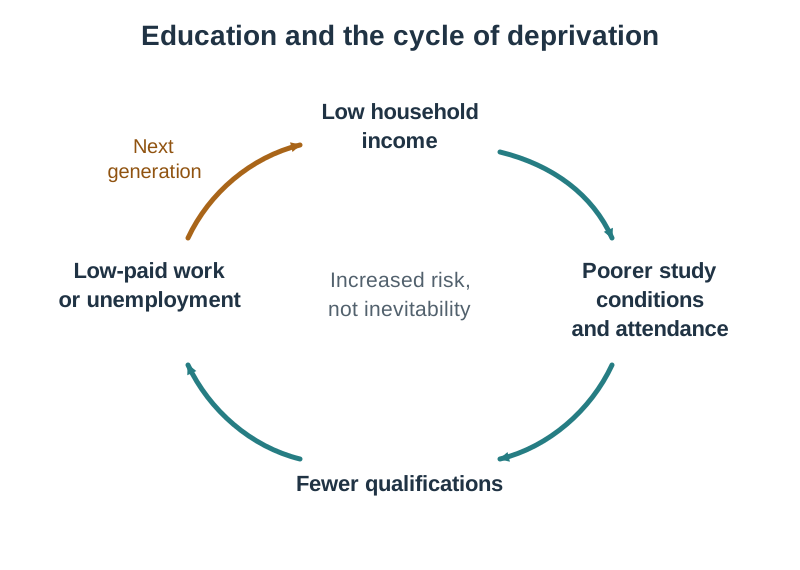
Young people drop out of school for several distinct reasons: unaddressed learning difficulties that cause continuous academic failure; ongoing disciplinary conflict or severe bullying; alienation from theoretical, exam-heavy curricula; and pressure to earn immediate cash through unskilled jobs. Leaving school early carries serious lifetime penalties. It sharply increases the risk of long-term unemployment, traps workers in insecure minimum-wage work, creates reliance on social welfare, and passes educational disadvantage on to their own children in what sociologists call the cycle of deprivation.
4. Gender Inequity
While overall exam attendance is balanced between boys and girls, clear gender patterns persist:
- Subject choice patterns: Male students make up the bulk of classes in engineering, construction studies, and physics, while female students still predominate in Home Economics, Art, and caring disciplines. This separation feeds directly into gender segregation in the workplace and contributes to the ongoing gender pay gap.
- Male underachievement: Statistically, boys are more likely to present with early reading difficulties, receive formal suspensions, and leave school without senior cycle qualifications.
Contemporary Initiatives Improving Educational Accessibility
Initiatives to improve access fall into two categories: targeted school supports and financial assistance schemes. In the exam, you need to state the target group, describe the practical support, explain the positive impact, and give at least one real limitation for each scheme.
In-School Supports and Targeted Programmes
- DEIS (Delivering Equality of Opportunity in Schools)
- Target group: Primary and post-primary schools in areas with high levels of socio-economic disadvantage.
- What it provides: Lower pupil-teacher ratios, extra school funding, Home School Community Liaison (HSCL) coordinators, access to the School Completion Programme, and free school meals.
- Strengths: Extra staff and resources improve literacy, numeracy, and school attendance, which has helped close the gap in Leaving Certificate completion rates.
- Limitation: The scheme is allocated to whole schools. A disadvantaged child attending a non-DEIS school gets none of these supports, and an achievement gap still exists in top Leaving Certificate grades.
- School Completion Programme (SCP)
- Target group: Children and teenagers in DEIS schools who are identified as being at high risk of dropping out.
- What it provides: Breakfast clubs, after-school homework clubs, holiday programmes, and one-to-one mentoring through education welfare services.
- Strengths: Helps vulnerable students arrive fed and ready to learn, gives them a safe space to finish homework, and keeps them connected to school.
- Limitation: Tight staffing and funding mean coordinators can usually help only students who are already in severe crisis.
- Home School Community Liaison (HSCL) Scheme
- Target group: Families in DEIS communities who feel alienated from the school system.
- What it provides: A designated teacher visits parents at home, runs adult learning courses in the school building, and builds friendly links between parents and teachers.
- Strengths: Gets parents involved in their children's education, which improves student attendance and homework habits.
- Limitation: HSCL teachers carry very heavy caseloads, often looking after hundreds of families across several feeder schools.
Practical Schemes That Reduce the Financial Burden
- Free Schoolbooks Scheme: The State supplies core schoolbooks, workbooks, and classroom resources at no charge, starting in primary schools and extending into post-primary years. This lifts an expensive upfront bill from parents every September and removes the stigma of attending class without books. However, it does not cover uniforms, digital devices, school trips, or voluntary contributions.
- School Meals Programme: State funding pays for healthy breakfasts and hot lunches in participating schools, making sure children have the energy to concentrate in class while trimming weekly grocery bills for parents.
- Back to School Clothing and Footwear Allowance: A means-tested cash payment from the Department of Social Protection that helps low-income families buy school uniforms and shoes.
- School Transport Scheme: Subsidised bus travel for students living beyond set distance limits from their nearest school. It is an essential lifeline for rural families, though route closures and seat limits cause recurring problems each autumn.
- Historical baseline: The rollout of free post-primary education and free school transport in 1967 was the most transformative accessibility measure in modern Irish history, dramatically increasing post-primary retention and opening professional careers to all social classes.
Post-School and Higher Education Routes
- HEAR (Higher Education Access Route)
- Target group: School leavers from low-income and socio-economically disadvantaged families.
- What it provides: College places on reduced Leaving Certificate CAO points, along with personal mentoring, extra tuition, and college orientation courses.
- Strengths: Increases the number of working-class students studying competitive courses like Law and Engineering.
- Limitation: Applicants must still meet minimum matriculation and course entry grades, and the high cost of student rent in cities like Dublin and Cork remains a major obstacle.
- DARE (Disability Access Route to Education)
- Target group: School leavers whose exam results were affected by a long-term disability or chronic illness.
- What it provides: College places on reduced CAO points, plus assistive technology, exam supports, and campus orientation.
- Strengths: Compensates for school time and study lost through illness or therapy appointments.
- Limitation: Getting the medical or psychological assessments needed to apply is slow on public waiting lists and expensive through private clinics.
- SUSI (Student Universal Support Ireland)
- Target group: Eligible students taking approved further and higher education courses.
- What it provides: Means-tested student grants made up of a maintenance grant towards daily living costs and a fee grant that covers all or part of the student contribution charge.
- Strengths: Clears third-level registration fees for low-income families and provides regular monthly living support.
- Limitation: Income limits can disqualify families sitting just above the cut-off point, and maintenance rates fall far short of real commercial rents.
Connecting Education to Poverty, Unemployment, and Leisure
The Leaving Certificate Home Economics specification expects you to link elective topics together. In Section C, questions regularly link education with work, unemployment, poverty, or leisure.
Education and Unemployment
Educational attainment is the single most reliable predictor of whether a person will find and keep a job. Early school leavers face a severe risk of long-term unemployment because industrial automation and digital services have wiped out thousands of unskilled manual jobs. Training programmes like modern apprenticeships, PLC courses, and Springboard+ help prevent technical unemployment by teaching workers the technical skills modern employers need.
Education and Poverty
Educational failure is both a root cause and a direct symptom of poverty. In the cycle of deprivation, low household income hurts a child's school attendance and study conditions, leading to early school leaving and weak exam results. That lack of qualifications restricts the person to low-paid, precarious jobs or welfare dependency, meaning their own children grow up in the same financial hardship. Targeted educational measures like DEIS, the Free Schoolbooks Scheme, and SUSI grants are the State's primary tools for breaking this generational trap.
Education and Leisure
School subjects introduce young people to sports, visual arts, music, languages, and literature, enriching their leisure time well into adult life. Community and adult education classes offer structured routines, personal challenges, and social connections, which are especially valuable for retired adults and unemployed workers coping with unwanted empty time.
Key terms
- Socialisation
- The lifelong process of acquiring the norms, values, behaviour, and social skills necessary to function acceptably in society.
- Primary Socialisation
- The foundational stage of social learning occurring within the home and family during early childhood, where basic speech, manners, and values are acquired.
- Secondary Socialisation
- Social learning that takes place outside the home through institutions such as schools, peer groups, and workplaces, teaching individuals how to operate in wider society.
- Hidden Curriculum
- The unwritten, unofficial lessons and values—such as punctuality, respect for authority, and conformity to rules—that students absorb from the school environment.
- Social Mobility
- The movement of individuals or families between different socio-economic groups, often achieved through educational attainment and professional qualifications.
- Self-Fulfilling Prophecy
- A sociological mechanism where a student internalises an academic or behavioural label applied by a teacher and alters their performance until the label becomes reality.
- Equality of Opportunity
- The principle that all students should have an equal and fair opportunity to access education and realise their full potential, regardless of wealth, background, gender, or disability.
- Early School Leaver
- A young person who leaves full-time education before completing the Senior Cycle Leaving Certificate (or equivalent), and in some cases before the statutory minimum leaving age of 16 or completing three years of post-primary education under the Education (Welfare) Act 2000.
- Cycle of Deprivation
- The recurring pattern where poverty and educational disadvantage in one generation are passed on to the children of the next generation.
- Education (Welfare) Act 2000
- Irish legislation establishing that school attendance is compulsory for children aged 6 to 16, or until three years of post-primary schooling are completed.
- EPSEN Act 2004
- The Education for Persons with Special Educational Needs Act, providing that children with special needs should be educated in inclusive mainstream environments unless contrary to the child's best interests or the effective education of others.
- DEIS
- Delivering Equality of Opportunity in Schools; the Department of Education's policy providing enhanced staffing, funding, and food programmes to schools in disadvantaged areas.
- ECCE Scheme
- Early Childhood Care and Education scheme; provides two years of state-funded preschool education to children from age 2 years 8 months until they enter primary school.
- Youthreach
- An out-of-school second-chance education and training initiative offering general education, vocational skills, work experience, and a training allowance to early school leavers aged 15 to 20.
- VTOS
- Vocational Training Opportunities Scheme; provides full-time second-chance education to unemployed adults aged 21 and over through ETBs while allowing them to retain their social welfare payment.
- HEAR
- Higher Education Access Route; an admissions scheme offering third-level places on reduced CAO points to students from socio-economically disadvantaged backgrounds.
- DARE
- Disability Access Route to Education; an admissions scheme offering college places on reduced CAO points to students whose second-level education was impacted by a disability.
- Special Needs Assistant (SNA)
- A non-teaching staff member allocated to schools to address the significant physical, medical, mobility, or care needs of students with disabilities.
Check yourself
What is the difference between the formal curriculum and the hidden curriculum?
The formal curriculum consists of the planned, timetabled subjects and syllabuses assessed in state examinations. The hidden curriculum refers to the unwritten, unofficial lessons and values (such as punctuality, obedience to rules, and respect for hierarchy) that students absorb from everyday school routines.
Name the four areas of individual development that education contributes to.
Physical development, emotional development, moral development, and intellectual development.
What is the compulsory age for education in Ireland, and what act establishes it?
Education is legally compulsory from age 6 to 16, or until three years of post-primary education are completed, under the Education (Welfare) Act 2000.
What does the EPSEN Act 2004 state regarding the education of students with special educational needs?
It provides that a child with special educational needs should be educated in an inclusive environment alongside children who do not have such needs, unless this would conflict with the child's best interests or the effective education of other children.
How does the ECCE scheme improve the accessibility of education, and what is one practical limitation of it?
It provides two years of free, state-funded preschool (3 hours a day using the play-based Aistear framework) so children develop early social, language, and cognitive skills before starting primary school. A key limitation is that it covers only three hours per day, so working parents on low incomes still face high costs for wrap-around childcare.
Name one scheme that supports an unemployed adult of 25 who left school after the Junior Certificate, and state what it provides.
VTOS (Vocational Training Opportunities Scheme); it provides full-time second-chance education through the local ETB while allowing the person to keep their social welfare payment, leading to the Leaving Certificate or a QQI Level 5 award.
Name three supports a second-level student with dyslexia might receive in the Irish school system.
Special education teaching (SET) in small groups, assistive technology (such as reading software or a laptop), and examination accommodations under the RACE scheme (such as a reader, a recording device, or a spelling and grammar waiver).
How does the Higher Education Access Route (HEAR) improve third-level accessibility?
It offers places in higher education courses on reduced Leaving Certificate CAO points to students from socio-economically disadvantaged backgrounds, backed by post-entry financial aid and academic mentoring.