

Elective 2 (Textiles, Fashion and Design) extends core textiles into contemporary fashion analysis, garment construction, the selection and modification of commercial patterns, fibre and fabric science, simple scientific tests, and the Irish clothing and textile industry. In Section C of the Leaving Certificate examination, candidates choosing this elective answer one 80-mark question. High marks require answering across the three core areas: justifying design choices using specific design principles and elements, linking fibre chemistry directly to fabric performance and garment care, and applying practical construction and pattern-adaptation techniques for specific wearer needs.
Textile Science: Fibres, Yarn Modification, and Profiles
Textile fibres are classified by their origin into natural, regenerated, and synthetic fibres.
Classification of Fibres
- Natural cellulose fibres: Cotton (from the seed boll) and linen (from the flax stem). Highly absorbent, breathable, and unusually, cotton is stronger when wet (roughly 25–30% stronger), which allows frequent hot-water washing. Both crease readily and shrink unless pre-treated.
- Natural protein fibres: Wool (sheep fleece keratin) and silk (silkworm cocoon fibroin). Natural crimp in wool traps air pockets to give high thermal insulation. Wool is vulnerable to felting when subjected to heat, moisture, and agitation, and both fibres are damaged by alkalis, biological detergents, and chlorine bleach.
- Regenerated fibres: Viscose, modal, and lyocell. Manufactured by chemically dissolving plant cellulose (wood pulp) and extruding the solution through a spinneret. Standard viscose loses much of its strength when wet and must be handled gently. Modal and lyocell are modified regenerated fibres developed to keep their strength when wet, so they wash and wear better than standard viscose.
- Synthetic fibres: Polyester, nylon (polyamide), and acrylic. Manufactured from petrochemicals by industrial polymerisation. These fibres are exceptionally strong, abrasion-resistant, hydrophobic (quick drying), and thermoplastic (soften and melt under heat). They hold oily soils and build up static electricity.
Why Fibres Are Blended
Fibres are blended so the strengths of one fibre compensate for the weaknesses of another:
- Improve performance: Polyester adds tensile strength, crease recovery, and quick-drying properties to cotton.
- Improve comfort: Cotton adds absorbency, coolness, and breathability to polyester.
- Reduce cost: A cheaper synthetic fibre blended with wool lowers fabric cost while preserving wool's handle and warmth.
- Add specific functionality: Blending 2–5% elastane with cotton creates stretch denim with high shape recovery.
Modifying Yarns and Filaments
Once fibres are produced, yarns can be modified to alter fabric appearance, texture, and performance:
- Amount of twist: High twist produces a firm, smooth, hard-wearing yarn with a crisp handle, as seen in worsted suiting. Low twist produces a soft, bulky, warmer yarn, as in knitting wool.
- Ply: Twisting two or more single yarns together produces a plied yarn with greater strength and evenness, such as 2-ply sewing thread.
- Texturising: Thermoplastic synthetic filaments (polyester, nylon) are heated and deformed with permanent crimps, coils, or loops. This traps still air, giving the yarn greater bulk, warmth, stretch, and a softer matte handle suitable for sportswear and fleece.
- Filament format: A monofilament is a single continuous strand used in sheer hosiery or nets. A multifilament yarn consists of many continuous filaments twisted together, giving smooth, lustrous fabrics like lining satin. Staple-spun yarn is produced by chopping filaments into short lengths and spinning them; this creates a softer, warmer, and less slippery yarn, as used in polycotton shirting.
Three Detailed Fabric Profiles
- Natural fabric: Cotton poplin
- Fibre and yarn: Cotton bolls are ginned to separate seeds, carded to align fibres, combed to remove short fibres, and spun with twist into staple yarn.
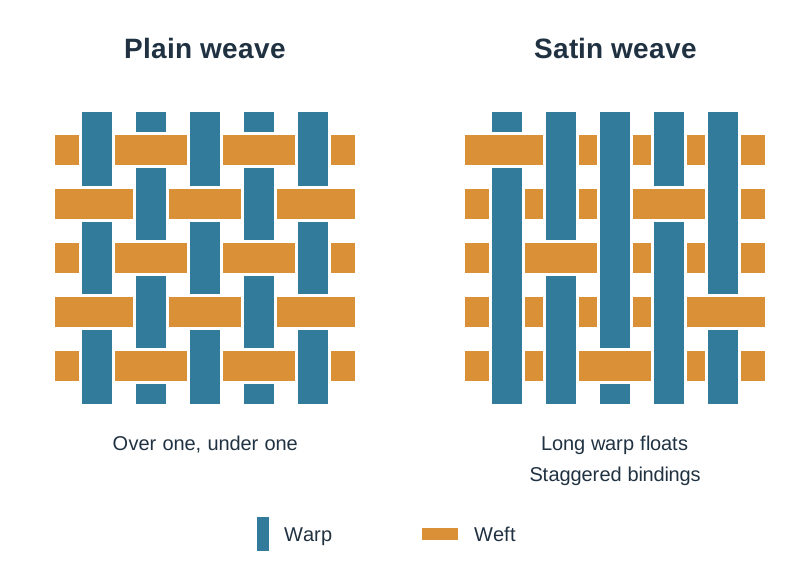
- Construction: Tightly woven in a plain weave with a fine warp and a slightly heavier weft yarn, creating a fine horizontal rib.
- Properties: Absorbent, breathable, non-static, hypoallergenic, and stronger when wet; prone to creasing unless given a finish.
- End-uses: School shirts, blouses, lightweight summer dresses.
- Manufactured fabric: Polyester satin
- Fibre and yarn: Petrochemical polymers are melt-spun through spinneret nozzles, cooled, and drawn to orientate polymer chains into continuous multifilament yarns.
- Construction: Satin weave with long warp floats over multiple weft threads.
- Properties: Smooth, high surface lustre, fluid drape, high tensile strength, non-absorbent, wrinkle-resistant; prone to static and snagging.
- End-uses: Formal evening gowns, bridal wear, jacket linings.
- Blended fabric: Polycotton (65% polyester / 35% cotton)
- Fibre and yarn: Combed cotton staple fibres and cut polyester staple fibres are blended together during drawing and spun into a uniform yarn.
- Construction: Plain weave.
- Properties: Combines the softness and absorbency of cotton with the strength, dimensional stability, crease resistance, and quick drying of polyester.
- End-uses: Everyday workwear, nurses' uniforms, bed linen.
Fabric Science, Identification, Care, and Household Safety
Fibre Identification Tests
Examiners mark fibre burning tests across three distinct observations: flame behaviour, odour, and residue.
| Fibre | In the flame | Odour | Residue | Under the microscope |
|---|---|---|---|---|
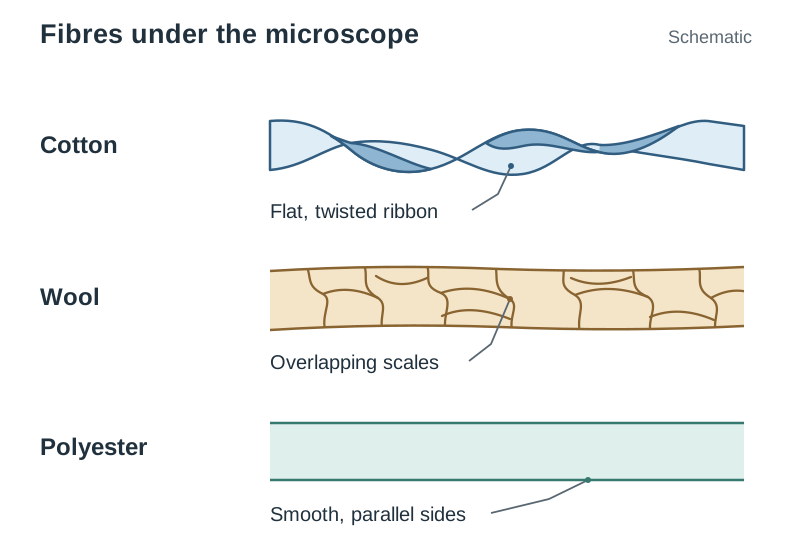
| Cotton | Catches fire quickly; burns steadily with yellow flame; continues burning when removed | Burning paper | Light grey, soft, powdery ash | Flat, twisted ribbon with irregular spiral turns |
| Wool | Curls away from flame; burns slowly with flickering; self-extinguishes when removed | Burning hair or feathers | Irregular, dark, brittle, crushable bead | Cylindrical rod covered in overlapping scales with a central medulla |
| Polyester | Shrinks and curls from heat; melts and burns slowly with dark, sooty smoke | Sweet, chemical odour | Hard, round, uncrushable black or dark brown plastic bead | Smooth, uniform, glass-like rod with parallel sides |
Scientific Principles of Fabric Care
Every care instruction directly reflects an underlying fibre property:
- Cotton and linen: Cellulose fibres are stronger when wet, so they tolerate hot machine cycles and high iron temperatures. However, when crushed, the hydrogen bonds between cellulose chains break and re-form in the new, creased position. Therefore, cotton must be ironed damp with steam to relax those bonds.
- Wool: Wool fibres are covered in overlapping scales. Combining heat, water, and mechanical agitation causes these scales to interlock irreversibly, a process called felting. Wool must be hand-washed or machine-washed on a dedicated wool cycle in lukewarm water using a neutral, non-biological detergent. It should never be wrung or tumble-dried; dry it flat because wet wool stretches under its own weight.
- Silk: Weakened by heat, strong sunlight, alkalis, and sweat. Wash in cool water or dry-clean, and iron on the reverse while damp.
- Viscose: Loses significant tensile strength when wet; wash on a gentle cycle, avoid wringing, and support its weight during drying.
- Synthetics: Thermoplastic fibres soften under high heat, which sets permanent wrinkles. Wash synthetics at low temperatures (30–40 °C) and iron on a cool setting. Because they are hydrophobic, they build static electricity that attracts dust, requiring fabric conditioner in the rinse.
The Care Label
Care labels use five international symbols. A cross through a symbol means 'do not', while a bar underneath denotes reduced mechanical action.
| Symbol | Process | Detail on Symbol |
|---|---|---|
| Washtub | Washing | Maximum temperature in °C inside the tub; a hand indicates hand-wash only; a bar beneath means a gentle cycle |
| Triangle | Bleaching | Empty triangle permits any bleach; crossed-out triangle forbids bleaching |
| Square | Drying | Circle inside square indicates tumble drying (one dot = low heat, two dots = medium heat); lines inside square mean line or flat dry |
| Iron | Ironing | Dots indicate maximum temperature: one dot = cool (synthetics), two dots = warm (wool/silk), three dots = hot (cotton/linen) |
| Circle | Dry-cleaning | Letter inside indicates the required chemical solvent; crossed-out circle means do not dry-clean |
Household Textiles and Safety
When selecting household textiles (curtains, upholstery, carpets, bed linen), apply five criteria: fitness for purpose, specific fabric properties (such as light-fastness for curtains or abrasion resistance for upholstery), total cost versus lifespan, ease of care, and aesthetic appeal.
Safety regulations are critical for domestic furnishings:
- The Fire Safety (Domestic Furniture) Order 1988 applies to domestic upholstered furniture, loose covers, foam fillings, and mattresses sold in Ireland. It requires coverings and fillings to resist ignition when exposed to a smouldering cigarette test and a match flame ignition test. Note that children's nightwear flammability is regulated under separate statutory nightwear standards, not by this 1988 furniture order.
- Required labels under the 1988 Order: A permanent label must be securely attached to the furniture item, detailing the manufacturer, filler material, cover material, and ignition resistance compliance. A display swing label must be visible at point of sale to allow consumers to inspect fire-safety compliance before purchase.
- Practical home precautions: Fit non-slip backing beneath loose rugs, avoid long drapery near hobs or open fireplaces, and secure blind cords out of the reach of small children.
Fabric Construction, Finishes, Colour, and Classroom Testing
Fabric Construction Techniques
- Weaving: The interlacing of vertical warp and horizontal weft yarns at right angles on a loom. Plain weave is an over-one, under-one structure that creates strong, balanced fabrics (poplin, calico). Twill weave forms distinct diagonal ribs, producing dense, hard-wearing cloths (denim, gabardine). Satin weave floats warp yarns over multiple weft yarns, producing high surface lustre with lower abrasion resistance.
- Knitting: Interlooping continuous yarns with needles. A weft knit is made from a single yarn looped across the fabric horizontally; it stretches significantly across its width, provides elasticity and comfort, but ladders readily if a loop breaks. A warp knit loops vertical parallel yarns simultaneously, producing a firm, flat, ladder-resistant fabric such as tricot.
- Non-woven: Sheets of fibres bonded mechanically (needle-punching), chemically, or thermally without spinning or weaving (such as felt or fusible interfacing).
Functional Finishes
- Flame-retardant finish: Chemical finishes (such as Proban) trap phosphorus compounds inside cellulosic fibres. When exposed to flame, the finish decomposes into non-combustible gases and forms an insulating carbon char that suppresses combustion.
- Crease-resistant finish: Synthetic resins are cross-linked between cellulose polymers, preventing molecular chains from sliding and re-bonding into creases.
- Water-repellent versus waterproof: Water-repellent finishes coat individual yarn surfaces with silicone or fluorochemical compounds, causing liquid water to bead and roll off while leaving the fabric pores open for air passage. Traditional waterproof finishes cover the entire fabric with an impermeable polyurethane layer that blocks both liquid water and air. Modern microporous membranes (such as Gore-Tex) contain microscopic pores that are small enough to block external raindrops yet large enough to allow internal perspiration vapour to escape, making the garment waterproof and breathable.
Colour and Design Application
- Dyeing: Immersing fibres, yarns, or woven cloth into an aqueous dye bath formulated for the fibre type (such as reactive dyes for cotton or disperse dyes for polyester), fixed by heat and chemical auxiliaries to ensure colourfastness.
- Screen printing: Pushing viscous coloured paste through open areas of a fine mesh stencil screen onto the fabric surface, followed by heat-setting to fix the pigment.
- Appliqué: Securing small decorative fabric shapes onto a base fabric using tight satin machine stitching along the raw edges.
- Embroidery: Stitching decorative lines and motifs directly onto cloth using decorative threads via hand stitching or computerised sewing machines.
Simple Scientific Tests on Fabrics
- Crease recovery (classroom method):
- Cut three test swatches (10 cm × 10 cm) along the straight grain of each fabric.
- Crumple one swatch firmly in a closed fist.
- Hold it under steady fist pressure for exactly one minute.
- Release the fabric, open it out, and lay it flat on a clean desk without stretching.
- Observe the number of residual wrinkles after two minutes, grading crease recovery on a 5-point scale (1 = heavily creased, 5 = fully smooth).
- Controls: Identical swatch size, straight grain orientation, identical holding time, identical pressure, and equal recovery duration.
- Fabric shrinkage test:
- Cut a 25 cm × 25 cm sample on the straight grain.
- Mark a 20 cm × 20 cm square in the centre with indelible ink.
- Launder and dry the sample according to its recommended care instructions.
- Press flat without stretching, measure the marked dimensions in both directions, and calculate:
- Absorbency drop test: Secure a fabric sample taut over a glass beaker with an elastic band. Using a medicine dropper or pipette held 1 cm above the cloth, place one drop of water onto the surface. Use a stopwatch to time how many seconds pass until the drop completely penetrates the fabric surface.
Elements and Principles of Design in Garment Evaluation
Evaluating outfits in Leaving Certificate examinations requires assessing three syllabus criteria: Function, Comfort, and Aesthetic Appeal.
Elements of Design
- Line: Structural lines (seams, darts, hemlines) establish shape; decorative lines (topstitching, piping) create surface interest. Vertical lines draw the eye up and down, giving an illusion of height and slenderness. Horizontal lines carry the eye across, broadening shoulders or hips. Diagonal lines lead the gaze across the body dynamically, while curved lines soften angular frames.
- Shape and silhouette: The overall outline of the garment. Standard silhouettes include A-line (fitted through waist, flaring at hem), hourglass (fitted waist balancing bust and hips), tubular/column (vertical, straight-falling profile), and oversized.
- Colour: Warm hues (reds, oranges, yellows) advance visually and make an area appear larger. Cool hues (blues, greens) recede, creating a slimming effect. Dark shades absorb light to reduce apparent volume; light tints reflect light and highlight bodily contours.
- Texture: The tactile and visual surface quality of cloth. Shiny, reflective textures (satin, sequins) and heavy, looped textures (bouclé, chunky knits) reflect light or add bulk, visually increasing size. Matte, smooth surfaces (wool crepe, cotton poplin) absorb light and streamline the silhouette.
- Pattern: Large, spaced motifs draw immediate attention and enlarge the body section they cover. Small, continuous prints disguise figure irregularities and flatter petite wearers.
Principles of Design
- Balance: Visual weight distribution. Symmetrical balance duplicates design elements identically on either side of a centre line (such as a classic tailored jacket with matched lapels and patch pockets). Asymmetrical balance establishes equilibrium using differing details (such as a one-shoulder gown or side-buttoning wrap coat).
- Proportion: The size relationship of individual parts to each other and to the whole body. Visually appealing garments frequently apply the golden ratio (roughly 3:5 or 5:8) rather than dividing the torso in half. For example, a cropped jacket worn over a midi skirt creates balanced proportion.
- Emphasis: A dominant focal point that captures attention first, such as an embroidered yoke, contrast buttons, or a colourful belt.
- Rhythm: Smooth, continuous eye movement across the garment, generated through repetition (a row of buttons), radiation (gathers spreading from a waist yoke), or gradation (pleats widening toward a hemline).
- Harmony: The overall unity created when all elements and principles work together to fulfil the garment's purpose.
Commercial Patterns, Alterations, and Specific Needs
Commercial pattern envelopes contain multi-sized tissue pieces graded to standard body measurement charts. Selecting the correct envelope size relies on body measurements: select tops, blouses, and jackets by bust/chest measurement, and select skirts or trousers by hip measurement (the waist is far simpler to adjust).
Reading Pattern Pieces and Markings
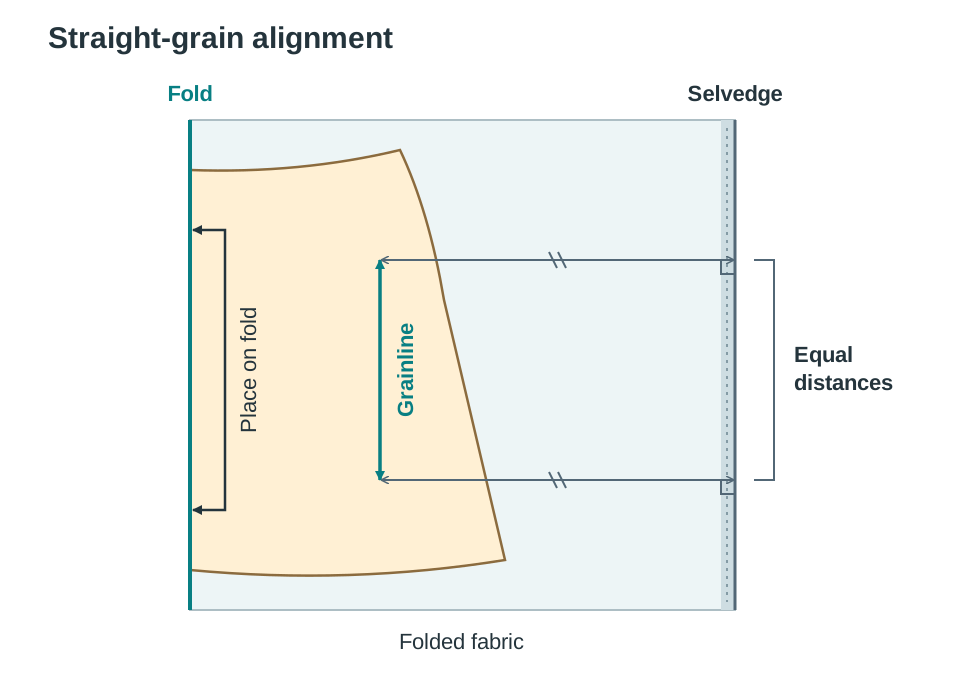
- Straight grain: A printed line with arrows at both ends that must run strictly parallel to the fabric selvedge. Measure from both arrowheads to the selvedge before pinning to guarantee alignment. Garments cut off-grain will twist around the body and hang unevenly.
- Place on fold: A bracketed line indicating that the paper pattern edge must align exactly along the folded fabric edge, cutting a symmetrical, seamless piece (such as a shirt back or skirt front).
- Notches: Small triangles or diamonds on cutting lines. Single notches denote the front; double notches denote the back. They ensure matching panels are joined accurately during assembly.
- Darts: Two converging lines marked with dots along their length and point. Fabric is folded and stitched along these lines to taper flat cloth smoothly over body curves.
- Lengthen/shorten lines: Parallel printed lines indicating the exact position to lengthen or shorten a piece without distorting armscye curves or hem circumferences.
- Wearing ease: The room deliberately added by pattern designers beyond actual body dimensions so the wearer can breathe, sit, bend, and move freely without tearing seams.
Altering a Commercial Pattern
- Lengthening: Slash across the printed lengthen/shorten lines. Separate the pieces by the required amount over backing paper, checking that the grainline remains continuous, tape securely, and true the side-seam lines.
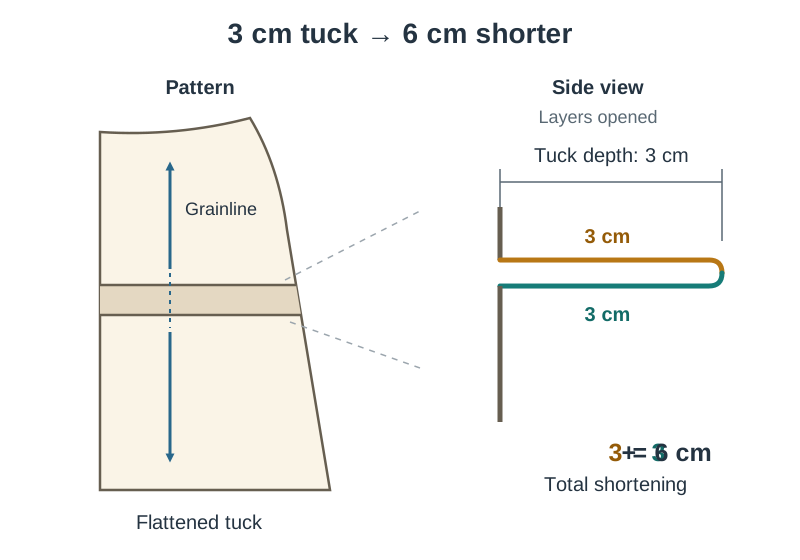
- Shortening: Fold a horizontal tuck across the lengthen/shorten line. Because a folded tuck removes double its depth, calculate the fold depth using:
To shorten a pattern by 6 cm, fold a 3 cm tuck, pin, tape flat, and redraw the stepped side seam.
- Modifying waist width: When front and back panels are both cut on the fold, the garment has four cut side edges (front left, front right, back left, back right). Divide the adjustment equally across all four edges:
To increase the waist by 4 cm, extend each side seam outward by 1 cm at waist level, then taper the line back to the hip notch.
Modifying Patterns for Specific Needs
Leaving Certificate examination questions regularly ask for pattern alterations tailored to specific wearers:
- Wheelchair user: Shorten the front jacket hem and lengthen the back hem so the garment sits level when the wearer is seated. Remove back patch pockets and eliminate bulky centre-back seams to prevent pressure sores against the seat back. Choose open-ended front zip closures and widen the armholes to permit free arm movement while pushing wheel rims.
- Person with arthritis or limited dexterity: Replace small buttons with Velcro strips, magnetic closures, or large toggles. Replace waistband zip closures with an elasticated waistband. Use front openings rather than back closures, and attach oversized ring pulls to zip sliders.
- Growing child: Cut deep hem allowances (5–8 cm) and wide sleeve cuffs that can be let down later. Incorporate an adjustable buttonhole elastic waistband, and choose raglan sleeves rather than fitted set-in sleeves to provide growth allowance across the shoulders.
Garment Construction, the Design Process, and Fashion Influences
Garment Construction Processes
Constructing an assessed garment involves an orderly sequence of assembly, with every seam pressed immediately after stitching:
- Plain seam: Stitched 1.5 cm from the cut raw edge on the wrong side of the fabric; the standard joining seam for woven cloth.
- Edge finishing: Raw allowances fray unless bound or overcast. Standard finishes include overlocking, machine zigzagging, and bias binding.
- Facings: Strips of fabric cut to match necklines or armholes. They turn raw seam allowances cleanly to the garment interior. Understitching is applied by stitching close to the seamline through both the facing and seam allowances, preventing the facing from rolling out into view.
- Darts: Folded and stitched from the seam edge to the apex point. Darts must be pressed downward or towards the centre front/back without creating a dimple at the point.
The Design Process Framework
Designing and making an original garment follows eight logical stages:
- Brief: Define the occasion, user requirements, season, and budget.
- Analysis: Break the brief down into what the garment must do — the season it is for, how it will be washed, how easily the wearer can manage fasteners, and which prescribed processes must be shown.
- Research: Gather fabric samples, study trend forecasting, review commercial pattern envelopes, and measure the wearer.
- Possible solutions: Sketch preliminary fashion designs and technical line drawings showing darts, seams, and fastenings.
- Chosen solution: Select and justify the best design against the constraints of the brief.
- Plan of action: Formulate cutting layouts, compile equipment and haberdashery lists, and plan a stepped sequence of assembly.
- Implementation: Construct a test toile in cheap calico to evaluate fit and proportion, alter paper patterns if necessary, cut the fashion fabric, stitch the garment, and press after every process.
- Evaluation: Appraise the finished garment under three headings: Function, Comfort, and Aesthetic Appeal.
Social, Economic and Industrial Influences on Clothing
Fashion trends reflect historical, economic, and technological developments across decades:
- 1920s: Shorter hemlines, dropped waists, and looser silhouettes emerged as women entered the workforce and gained greater social freedom.
- 1940s: Wartime fabric rationing led to utilitarian styles with minimal fullness, narrow skirts, and few trims.
- 1960s: Youth culture, the space race, and the introduction of synthetic fibres popularised the mini-skirt and bold, geometric designs.
- 1980s: More women entering executive corporate roles inspired power dressing, characterised by wide padded shoulders and sharply tailored suits.
- 2020s: The rise of hybrid working and home-based work expanded casual wear and athleisure, while environmental awareness spurred demand for sustainable fashion.
Industrial influences have also transformed clothing design and construction: mass production and factory sizing standardised garments and lowered prices; computer-aided design (CAD) and pattern grading speeded up development; new fibres, blends, and finishes (such as elastane, microfibres, and easy-care finishes) made new shapes and performance garments possible; and global sourcing shortened trend cycles.
Factors Influencing Clothing Requirements
An individual's clothing requirements are influenced by several key factors:
- Function: The job the garment must do, such as protection, warmth, school, sport, or work.
- Cost versus money available: Budget constraints, which can be judged using cost per wear.
- Availability: What local shops or online retailers actually stock in the size and colour needed.
- New fibres and finishes: Fabric innovations that offer stretch, comfort, easy care, or weather protection.
- The media and trendsetters: Styles popularised through advertising, celebrities, and social media influencers.
- Fashion: Current styles, popular silhouettes, and seasonal trends.
- Social and cultural influences: Dress codes, religious or cultural traditions, peer norms, and climate.
Evaluating Current Trends and the Role of Accessories
Evaluating current fashion requires appraising colour, silhouette, line, texture, pattern, social influences, and accessories (footwear, bags, belts, jewellery, headwear, scarves). Accessories allow consumers to update an outfit affordably, create a visual focal point (emphasis), and balance proportion (such as using a broad belt to define the waist).
- Current womenswear trend (the oversized tailored blazer): Features a boxy, dropped-shoulder silhouette that conceals body contours. Strong vertical lapel lines create an illusion of height. Proportion is balanced by pairing the voluminous jacket with slim-fitting trousers. Driven by the casualisation of office wear and hybrid working.
- Current menswear trend (wide-leg pleated trousers): Features a relaxed, fluid silhouette replacing skinny cuts. Constructed from soft wool or linen blends that drape comfortably. Influenced by 1990s retro styling on social media. Completed with leather loafers and a woven belt that creates visual rhythm and defines the waistline.
Sustainable Fashion and Consumer Responsibility
Fast fashion encourages rapid consumption of cheap, short-lived clothing made from non-renewable synthetic fibres that do not biodegrade. Washing synthetic garments releases microplastics into marine systems, while intensive cotton farming depletes water resources and uses high volumes of pesticides. Consumers can reduce this environmental impact by calculating cost per wear, supporting the circular economy (buying second-hand, altering and mending garments), selecting certified organic or recycled textiles, washing at 30 °C, and using textile recycling banks instead of landfill disposal.
The Irish Clothing and Textile Industry
Due to international competition and lower manufacturing costs abroad, mass clothing production in Ireland declined significantly from the late twentieth century onwards. Today, the Irish textile sector focuses on luxury heritage production, specialist craft studios, and high-end niche design.
Structure of the Industry
- Heritage natural-fibre mills: Ireland maintains a global reputation for traditional woollen and linen goods. Magee of Donegal and Studio Donegal produce world-renowned handwoven and power-loomed Donegal Tweed, characterised by flecked woollen yarns. Foxford Woollen Mills and Avoca specialise in premium woollen throws, apparel, and blankets. Emblem Weavers in Wexford and Baird McNutt weave traditional high-grade Irish Linen for luxury fashion and tableware.
- Small businesses and cottage industries: Independent Irish designers (such as Simone Rocha) and small sustainable brands (such as Grown Clothing) focus on bespoke collections, sustainable tailoring, and direct-to-consumer digital retail, providing regional employment and driving innovation.
Statutory and Enterprise Supports
- Enterprise Ireland: State agency providing grant aid, international trade mission access, and export development assistance to growing Irish apparel and textile manufacturers.
- Design & Crafts Council Ireland (DCCI): Fosters commercial growth and professional development for Irish craftspeople and designers through business mentoring, educational workshops, and trade fairs such as Showcase Ireland.
- Local Enterprise Offices (LEOs): Provide startup financial grants, mentoring, and training for local dressmakers, tailors, and textile craft businesses.
Career Opportunities
- Creative design: Fashion designer, costume designer, textile print artist, technical pattern cutter.
- Science and technology: Textile technologist, fabric quality inspector, dyeing specialist, sustainable materials researcher.
- Merchandising and commerce: Fashion buyer, retail supply chain manager, digital visual merchandiser, fashion journalist.
Key terms
- Straight Grain
- The lengthwise warp direction of a fabric running parallel to the selvedge; pattern pieces cut on the straight grain hang smoothly without twisting.
- Selvedge
- The self-finished, woven edge running down both lengths of a bolt of fabric that prevents threads from fraying.
- Wearing Ease
- The additional measurement added to a garment pattern beyond body dimensions to allow the wearer to sit, breathe, bend, and move comfortably.
- Regenerated Fibre
- A manufactured fibre made by chemically dissolving natural plant cellulose (such as wood pulp) and reforming it into filaments, as in viscose and modal.
- Synthetic Fibre
- A manufactured fibre synthesised entirely from petrochemical polymers, such as polyester, nylon, and acrylic.
- Thermoplastic
- A property of synthetic fibres that causes them to soften, melt, and hold a heat-set shape when exposed to elevated temperatures.
- Felting
- The permanent, irreversible interlocking of wool fibre scales caused by heat, moisture, and mechanical agitation, resulting in fabric shrinkage and hardening.
- Proban
- A chemical flame-retardant finish applied to cotton textiles where phosphorus compounds are trapped inside fibres to suppress flame spread and form an insulating char.
- Toile
- A test version of a garment sewn from inexpensive calico to check fit, silhouette, and construction details before cutting the fashion fabric.
- Understitching
- A row of machine stitching sewn through the facing and seam allowances close to the seamline to stop the facing rolling out onto the garment face.
- Fire Safety (Domestic Furniture) Order 1988
- Irish legislation requiring domestic upholstered furniture, fillings, and covers to resist cigarette and match ignition and carry permanent consumer warning labels.
- Weft Knit
- A knitted fabric made from a single yarn looped horizontally across the width, providing high crosswise stretch but susceptible to laddering if damaged.
Check yourself
Why must wool garments never be washed at high temperatures with heavy agitation?
Wool fibres are covered in overlapping scales. Combining heat, water, and mechanical agitation causes the scales to interlock permanently, resulting in irreversible felting and shrinkage.
A shirt is 65% polyester / 35% cotton. What ironing temperature setting should be selected, and why?
A cool to warm setting (one or two dots). Polyester is thermoplastic and will melt or glaze under high heat; care for a blend is always dictated by the more heat-sensitive fibre.
Name two pattern modifications you would make to a jacket pattern for a wheelchair user, giving a reason for each.
Shorten the front hem and lengthen the back hem so the jacket sits level when seated; remove back pockets and eliminate bulky centre-back seams to prevent painful pressure points against the seat back.
Describe the residue and odour produced during a flame test on 100% polyester fabric.
Polyester gives off a sweet, chemical odour and leaves a hard, round, uncrushable black or dark brown plastic bead.
A fabric square measures 25 cm before laundering and 23.5 cm after laundering. Calculate the percentage shrinkage.
Shrinkage = [(25 - 23.5) / 25] x 100 = (1.5 / 25) x 100 = 6% shrinkage.
What information is provided by a permanent fire safety label on domestic upholstered furniture?
The manufacturer or supplier details, a description of covering and filling materials, and a statement verifying that the item complies with cigarette and match ignition resistance tests.