

The 1916 Easter Rising was an armed insurrection organised by the secret Military Council of the Irish Republican Brotherhood (IRB) and James Connolly's Irish Citizen Army (ICA). Although militarily suppressed within a week, leaving central Dublin in ruins and provoking initial hostility from the public, the British response—characterised by martial law, mass internments, and the execution of key leaders—profoundly shifted Irish political opinion. This backlash decimated the Irish Parliamentary Party, propelled a reconstituted Sinn Féin to a landslide victory in the 1918 General Election, and made the pursuit of an independent Irish Republic the dominant aim of Irish nationalism.
The Road to Rebellion: IRB Conspiracy, Volunteers, and the Diaspora
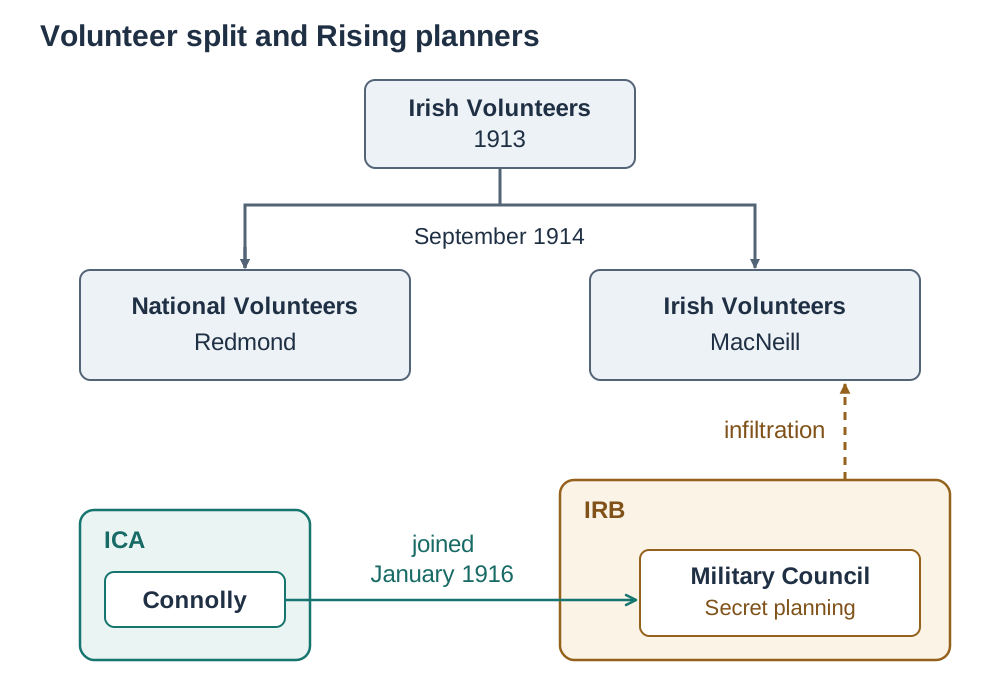
When World War I broke out in August 1914, the British government placed the Government of Ireland Act (Home Rule) on the statute book but suspended its operation until the war ended, leaving the exclusion of Ulster unresolved. John Redmond, leader of the Irish Parliamentary Party (IPP), pledged Irish nationalist support to the Allied war effort. The Irish Volunteers were founded at the Rotunda, Dublin, on 25 November 1913, as a nationalist response to the Ulster Volunteer Force, with Eoin MacNeill as their public leader; IRB men such as Bulmer Hobson held key posts from the start. At Woodenbridge, County Wicklow, on 20 September 1914, Redmond urged the Irish Volunteers to enlist in the British Army. This triggered an immediate split:
- The vast majority (roughly 170,000 men) followed Redmond as the National Volunteers.
- A dedicated minority of 10,000 to 13,000 retained the name Irish Volunteers under Eoin MacNeill, committed to remaining in Ireland to defend national rights.
This smaller organisation proved far easier for the secret Irish Republican Brotherhood (IRB)—a secret, oath-bound society founded in 1858 and committed to winning an independent Irish republic by physical force—to infiltrate. (During the War of Independence, the Irish Volunteers became known as the Irish Republican Army, or IRA.) Revived after 1907 by veteran Fenian Tom Clarke, the IRB operated on the traditional physical-force maxim: 'England's difficulty is Ireland's opportunity'. In May 1915, the IRB established a secret Military Committee comprising Patrick Pearse, Joseph Plunkett, and Éamonn Ceannt. Clarke and Seán Mac Diarmada joined that autumn, turning it into the Military Council. To prevent rival insurgent schemes, they co-opted socialist leader James Connolly of the Irish Citizen Army (ICA) in January 1916, followed by Thomas MacDonagh in April.
The conspiracy drew essential funding and logistical support from abroad. In the United States, Clan na Gael leader John Devoy acted as the vital conduit between the IRB and the German government, securing arms. At the funeral of the old Fenian Jeremiah O'Donovan Rossa at Glasnevin Cemetery on 1 August 1915, Pearse delivered a stirring oration that served as a public rallying call for revolutionary nationalism: 'The fools, the fools, the fools! – they have left us our Fenian dead, and while Ireland holds these graves, Ireland unfree shall never be at peace.'
The Eve of the Rising: Subterfuge, the Aud, and the Countermand
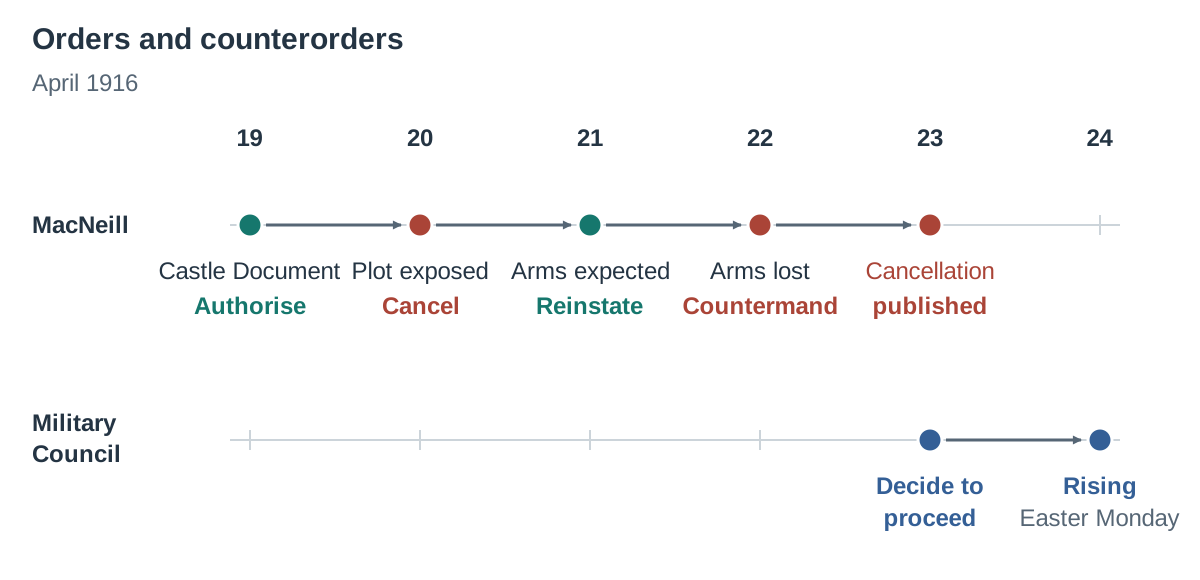
The Military Council fixed the rebellion for Easter Sunday, 23 April 1916, disguising mobilisation as routine Volunteer manoeuvres. Realising that Volunteer Chief of Staff Eoin MacNeill would not support an unprovoked rebellion without a clear defensive justification, the conspirators engaged in careful deception. On Wednesday 19 April, they circulated the Castle Document, an alleged Dublin Castle order indicating imminent British plans to arrest nationalist leaders and suppress the Volunteers. Though largely forged or doctored by Plunkett and Mac Diarmada, it convinced MacNeill to authorise mobilisation.
On Thursday evening, 20 April, Bulmer Hobson alerted MacNeill that the Military Council was planning an offensive insurrection behind his back. MacNeill confronted Pearse and initially cancelled all mobilisation orders. However, on Friday morning, 21 April, Mac Diarmada persuaded MacNeill to reinstate the orders by revealing that a German arms shipment was arriving in County Kerry.
The external plans collapsed almost immediately:
- The German arms ship Aud, carrying 20,000 rifles, 10 machine guns, and one million rounds of ammunition, failed to rendezvous with local Volunteers in Tralee Bay. Intercepted by the Royal Navy, its captain scuttled the ship outside Cork Harbour on Saturday 22 April, sending the weapons to the sea floor.
- Sir Roger Casement landed separately from a German submarine (U-19) at Banna Strand on Good Friday, 21 April, hoping to call off the insurrection due to insufficient German aid. Weakened and ill, Casement was quickly arrested by the RIC.
Upon learning that the arms were lost and discovering the Castle Document was fabricated, MacNeill acted decisively on Saturday evening to avert slaughter. He dispatched messengers across the country and placed a countermanding order in the Sunday Independent, cancelling all Volunteer movements for Easter Sunday.
The Military Council assembled at Liberty Hall on Sunday morning. Knowing their conspiracy was exposed and arrests were imminent, they resolved to strike the next day, Easter Monday, 24 April, accepting that operations would be largely confined to Dublin.
Focus on Key Personalities: Patrick Pearse and Countess Markievicz
Focus on: Patrick Pearse (1879–1916)
Patrick Pearse was a Dublin-born barrister, educator, and Gaelic revivalist who edited the Gaelic League's newspaper, An Claidheamh Soluis. In 1908, he established St Enda's (Scoil Éanna), an experimental bilingual school designed to foster cultural pride and civic duty in young boys. Although he supported the Third Home Rule Bill on a public platform in 1912, Pearse radicalised rapidly as unionist opposition mounted, joining both the Irish Volunteers and the IRB in late 1913.
Pearse became the Volunteers' Director of Military Organisation and the chief ideological spokesperson of the Military Council. He embraced the concept of blood sacrifice, arguing in late 1913 that 'bloodshed is a cleansing and sanctifying thing' and that the voluntary offering of lives would redeem Ireland from political decay. Appointed President of the Provisional Government and Commander-in-Chief in 1916, he read the Proclamation outside the GPO and signed the surrender on 29 April. He was executed by firing squad at Kilmainham Gaol on 3 May 1916.
- Contemporary attitudes: In April 1916, many Dubliners viewed Pearse as a reckless fanatic whose rebellion brought devastation to the city. Within months, his execution elevated him to the status of a national martyr, making his writings central to Sinn Féin's post-Rising appeal.
- Current historical perspectives: For decades after 1922, Pearse was uncritically revered as the founding father of the state, celebrated during the 1966 golden jubilee. From the 1970s onwards, revisionist historians such as Ruth Dudley Edwards (Patrick Pearse: The Triumph of Failure, 1977) and Fr Francis Shaw scrutinised his romantic glorification of political violence. Modern historiography adopts a balanced view: Pearse proved ineffective as an operational military commander, but he was exceptionally successful as an educational pioneer and an inspirational propagandist.
Focus on: Countess Constance Markievicz (1868–1927) and the Role of Women
Women played an active operational role in 1916. Cumann na mBan, founded in 1914 as the women's auxiliary to the Volunteers, deployed between 200 and 300 members as couriers, field nurses, dispatch carriers, and cooks. Some women, particularly within Connolly's egalitarian Irish Citizen Army, carried arms as combatants. Prominent figures included Winifred Carney (Connolly's secretary, who remained in the burning GPO), Dr Kathleen Lynn (chief medical officer at City Hall), and Elizabeth O'Farrell, who carried the white flag of surrender through British lines.
Countess Markievicz, born into the Anglo-Irish aristocratic Gore-Booth family of Lissadell, County Sligo, was a suffragist, socialist, and republican. In 1909, she co-founded Na Fianna Éireann, the republican youth movement, and became a commissioned officer in the ICA. In 1916, she served as second-in-command to Michael Mallin at St Stephen's Green and the Royal College of Surgeons. Condemned to death by court-martial, her sentence was commuted to life imprisonment 'solely and only on account of the prisoner's sex'. Released in the general amnesty of June 1917, she stood for Sinn Féin in the 1918 General Election, winning Dublin St Patrick's to become the first woman elected to the British Parliament (though upholding abstentionism, she did not take her seat). In 1919, she was appointed Minister for Labour in the First Dáil, making her one of the earliest female cabinet ministers in the Western world.
Easter Week: Combat, Key Garrisons, and Unconditional Surrender
At midday on Easter Monday, roughly 1,200 Volunteers and 200 ICA fighters mobilised across Dublin. Patrick Pearse, flanked by James Connolly and Tom Clarke outside the General Post Office (GPO) on Sackville Street, read the Proclamation of the Irish Republic. This document announced a Provisional Government and articulated core republican principles:
- Sovereignty: It asserted the 'unfettered control of Irish destinies, to be sovereign and indefeasible'.
- Continuity: It claimed that the Irish people had asserted their right to national freedom in arms 'six times during the past three hundred years'.
- International dimension: It acknowledged assistance from 'her exiled children in America and by gallant allies in Europe' (Germany).
- Equality and democracy: It guaranteed 'religious and civil liberty, equal rights and equal opportunities to all its citizens', cherishing 'all the children of the nation equally', and promised universal franchise for all men and women.
Rebel battalions secured strong defensive garrisons across Dublin:
- The General Post Office (GPO): Rebel headquarters, held by Pearse, Connolly, and Clarke (with Michael Collins serving as Plunkett's aide-de-camp).
- Boland's Bakery and Mills: Commanded by Éamon de Valera, securing the southeastern railway approach.
- The Four Courts: Held by the 1st Battalion under Edward Daly, seeing ferocious street fighting in North King Street.
- Jacob's Biscuit Factory: Commanded by Thomas MacDonagh and John MacBride.
- South Dublin Union: Held by Éamonn Ceannt, Cathal Brugha, and W. T. Cosgrave.
- St Stephen's Green and the Royal College of Surgeons: Commanded by Michael Mallin and Countess Markievicz.
The rebels adopted static defensive positions, failing to seize Dublin Castle, the Beggar's Bush barracks, Trinity College, or the central telephone exchange. The Lord Lieutenant, Lord Wimborne, proclaimed martial law in Dublin on Tuesday 25 April (extended nationwide on 29 April). Brigadier-General William Lowe directed local British military operations, rapidly swelling his forces from 2,500 to over 12,000 soldiers. On Wednesday 26 April, the patrol vessel Helga sailed up the Liffey and shelled Liberty Hall. Simultaneously, field artillery and incendiary shells caused widespread infernos along Sackville Street.
The bloodiest tactical clash occurred at Mount Street Bridge on Wednesday, where seventeen Volunteers from de Valera's battalion held off the advancing 2/7th and 2/8th Sherwood Foresters, inflicting roughly 230 casualties.
By Friday 28 April, General Sir John Maxwell arrived in Dublin with plenary powers to crush the insurrection. With the GPO on fire, the headquarters garrison evacuated through walls into 16 Moore Street. Confronted by civilian casualties and mounting devastation, Pearse decided to halt the fighting. On Saturday 29 April, Elizabeth O'Farrell delivered Pearse's offer of surrender to Lowe. Over the weekend, all rebel outposts laid down their weapons.
The British Military Reaction and the Shift in Public Revulsion
The initial reaction of Dubliners was one of open fury. The fighting claimed about 485 lives, more than half of them civilians (roughly 260, including 40 children), along with 126 British soldiers, 82 rebels, and 17 police officers. Over 2,600 were wounded, and £2 million worth of property was ruined. Slum residents and 'separation women' (wives of soldiers serving in the British Army) jeered, spat at, and pelted the captured insurgents as they were marched under armed guard to Richmond Barracks.
This hostility was rapidly overturned by the punitive actions directed by General Maxwell:
- Secret courts-martial: Operating in secret under martial law, without defence counsel, military tribunals condemned 90 rebels to death.
- The executions: Between 3 and 12 May 1916, fourteen leaders were shot by firing squad in the stone-breakers' yard at Kilmainham Gaol. The piecemeal, protracted nature of the executions horrified the public. Outrage surged when Joseph Plunkett was shot hours after marrying Grace Gifford in the prison chapel, and when the severely wounded James Connolly, unable to stand, was strapped to a chair on 12 May. In Cork Military Barracks (Victoria Barracks), Thomas Kent was executed by firing squad on 9 May, bringing the total executed in Ireland to 15.
- Roger Casement: Tried separately in a civilian court in London for high treason, Casement was hanged at Pentonville Prison on 3 August 1916, making 16 executions in total.
- Mass arrests and internment: British forces arrested 3,430 men and 79 women nationwide. Over 1,800 were deported without trial to internment camps in Britain, principally Frongoch in Merionethshire, Wales. This spread resentment into every county, as families across Ireland saw sons and brothers deported without trial. At Frongoch, known as the 'University of Revolution', prisoners including Michael Collins organised administrative networks and studied guerrilla strategy.
On 11 May 1916, IPP MP John Dillon delivered an impassioned address in the House of Commons, warning Prime Minister H. H. Asquith that the government was 'washing out our whole life work in a sea of blood'. Alarmed by mounting domestic fury and diplomatic unease in the United States, Asquith travelled to Ireland on 12 May and halted further executions.
Political Realignment: Was Ireland 'Changed Utterly'?
In his famous poem Easter, 1916, W. B. Yeats wrote: 'All changed, changed utterly: / A terrible beauty is born.' Historians assess the extent to which Ireland was indeed transformed solely by the Rising, weighing it against long-term political shifts.
The Argument for Decisive Transformation
British authorities and newspapers mistakenly branded the insurrection the 'Sinn Féin Rising'. Arthur Griffith's party had actually favoured passive resistance and a dual monarchy, and Griffith did not participate in the fighting (though he was interned). However, the label caused public sympathy to flow directly to Sinn Féin. Following the release of internees in 1916 and 1917, radical republicans took over the party machinery.
Sinn Féin demonstrated its rising strength by capturing four crucial parliamentary by-elections in 1917:
- Count George Noble Plunkett (father of the executed Joseph Plunkett) in North Roscommon (February).
- Joseph McGuinness, elected while imprisoned in Lewes under the slogan 'Put him in to get him out', in South Longford (May).
- Éamon de Valera in East Clare (July).
- W. T. Cosgrave in Kilkenny City (August).
At the Sinn Féin Ard Fheis in October 1917, Arthur Griffith stepped aside, allowing Éamon de Valera to be elected president of both Sinn Féin and the Irish Volunteers, uniting the political and military movements behind complete national sovereignty.
The Counter-Arguments and Other Causes of Sinn Féin's Ascent
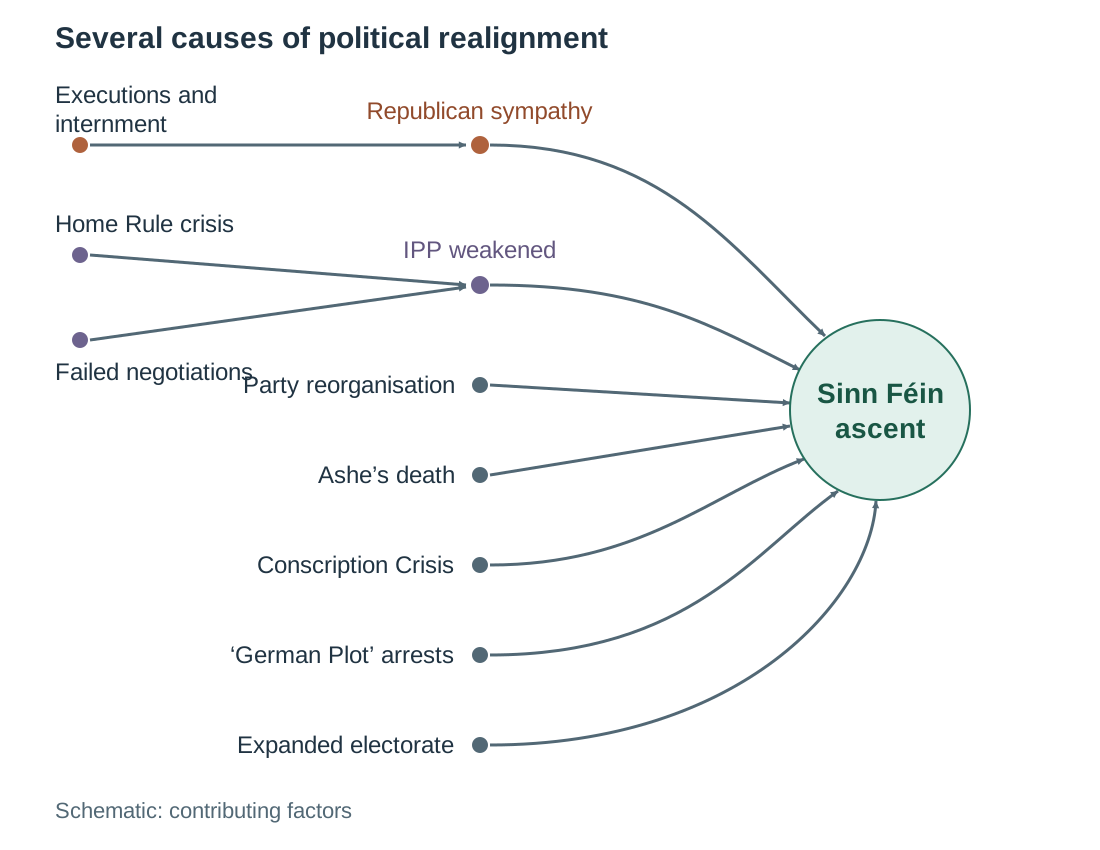
The shift away from constitutional nationalism was not caused solely by the 1916 executions; earlier grievances and subsequent British blunders played major roles:
- Home Rule in crisis: By 1914, the Home Rule movement was already compromised by unionist armed resistance and the impending exclusion of Ulster.
- The Lloyd George negotiations (June–July 1916): David Lloyd George attempted to negotiate an immediate settlement by privately assuring Carson that the exclusion of six Ulster counties would be permanent, while telling Redmond it was strictly temporary. When the deception collapsed, Redmond was left looking weak, partitionist, and discredited.
- The death of Thomas Ashe (September 1917): Ashe died after being force-fed while on hunger strike in Mountjoy Prison. His funeral, marshalled by Volunteers in uniform and addressed at the graveside by Michael Collins, served as another massive propaganda demonstration.
- The Conscription Crisis (April 1918): When the British parliament passed the Military Service Act enabling conscription in Ireland, John Dillon's IPP walked out of Westminster. By withdrawing, the IPP implicitly endorsed Sinn Féin's policy of abstention. Sinn Féin led a unified national campaign alongside the Catholic hierarchy and trade unions (who staged a one-day general strike on 23 April). Conscription was never enforced, giving Sinn Féin the credit for stopping it.
- The 'German Plot' (May 1918): Dublin Castle arrested 73 Sinn Féin leaders, including de Valera and Griffith, on unsubstantiated allegations of plotting with Germany, generating further electoral sympathy.
- Electoral expansion: The Representation of the People Act 1918 roughly tripled the Irish electorate, enfranchising all men over 21 and women over 30. This brought in hundreds of thousands of younger voters with no historical allegiance to Redmond's IPP.
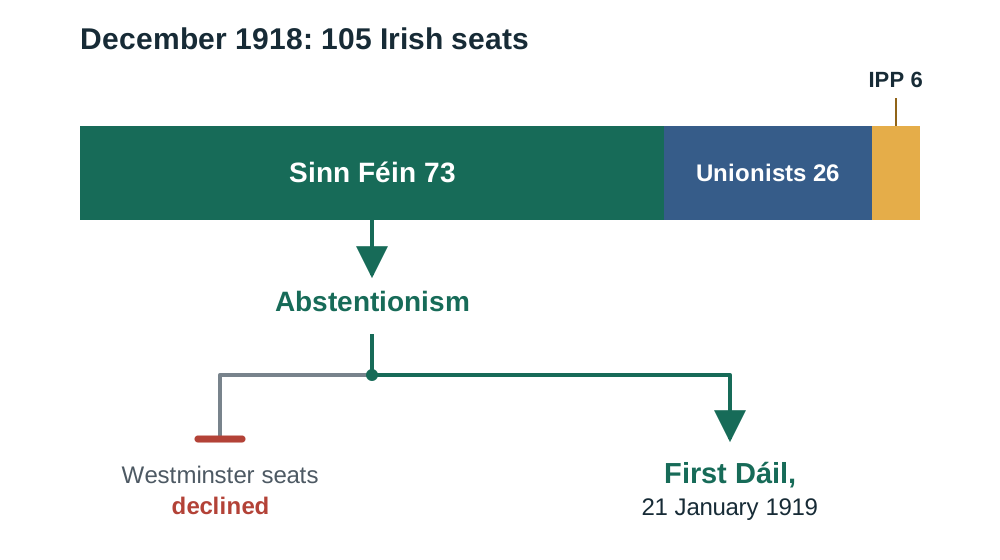
In the December 1918 General Election, Sinn Féin won a decisive landslide of 73 out of 105 Irish seats, reducing the IPP to just 6 seats (with Unionists taking 26). Implementing their policy of abstentionism, the elected Sinn Féin MPs refused to sit at Westminster. Instead, they convened at Dublin's Mansion House on 21 January 1919 as Dáil Éireann, ratifying the 1916 Proclamation and officially establishing the Irish Republic.
Key terms
- Military Council
- The secret executive sub-committee within the IRB (initially Pearse, Plunkett, and Ceannt; later joined by Clarke, Mac Diarmada, Connolly, and MacDonagh) that planned the 1916 Rising behind the back of the Volunteer leadership.
- Blood Sacrifice
- The romantic nationalist concept, championed by Patrick Pearse, positing that the voluntary death of patriots in armed revolt would morally reawaken the Irish people and revive the struggle for sovereignty.
- Physical Force
- The republican tradition maintaining that Irish political sovereignty could never be achieved through parliamentary debate alone, requiring armed insurrection.
- Sovereignty
- Supreme, absolute, and independent self-governing authority over national affairs, demanded by republicans in 1916 rather than subordinate, devolved Home Rule.
- Republic
- A state governed by the elected representatives of the people rather than a monarch; in the 1916 context, an independent all-Ireland egalitarian commonwealth.
- The Castle Document
- A document produced by the IRB in April 1916, ostensibly leaked from Dublin Castle, detailing orders to arrest Volunteer leaders and suppress their organisations; used to deceive Eoin MacNeill into mobilisation.
- Countermanding Order
- The official instruction published by Eoin MacNeill in the Sunday Independent on 23 April 1916 cancelling all Irish Volunteer manoeuvres after he discovered the IRB's deception and the loss of the Aud.
- Martial Law
- The temporary suspension of ordinary civil law and constitutional liberties, placing administrative, policing, and judicial authority entirely under direct military control.
- Frongoch
- A disused distillery and internment camp in Merionethshire, Wales, where over 1,800 suspected Irish rebels were detained without trial in 1916; known as the 'University of Revolution'.
- Abstentionism
- The political policy of running candidates for election to the British Westminster Parliament while refusing to take their seats, establishing an independent domestic assembly instead.
- Cumann na mBan
- An Irish republican women's paramilitary organisation founded in Dublin in April 1914 as an auxiliary to the Irish Volunteers, providing combat, medical, and courier service in 1916.
- Allegiance
- Political duty and loyalty owed by citizens; in this period, the clash between loyalty to the British Crown and the Home Rule movement versus allegiance to an independent Irish Republic.
Check yourself
Name the four candidates who won parliamentary by-elections for Sinn Féin in 1917.
Count George Noble Plunkett (North Roscommon), Joseph McGuinness (South Longford), Éamon de Valera (East Clare), and W. T. Cosgrave (Kilkenny City).
Give two reasons why Eoin MacNeill issued his countermanding order, and state one military consequence.
MacNeill discovered the Castle Document was fabricated and that the German arms ship Aud was lost. Consequence: It threw rebel coordination into disarray, reduced insurgent numbers significantly, and confined the Rising largely to Dublin starting a day late.
On what grounds was Countess Markievicz's death sentence commuted?
The court-martial recommended mercy 'solely and only on account of the prisoner's sex', and Maxwell commuted the sentence to life imprisonment.
How many individuals were executed in Ireland under General Maxwell's courts-martial, and where were they shot?
Fifteen men in total: 14 at Kilmainham Gaol in Dublin and one (Thomas Kent) at Cork Military Barracks.
Give two arguments that Ireland was not transformed ('changed utterly') solely by the 1916 Rising.
1. Home Rule was already damaged by unionist resistance and the 1916 Lloyd George partition talks. 2. Sinn Féin's victory was propelled by the 1918 Conscription Crisis and the tripling of the electorate under the Representation of the People Act 1918.