

Partition, Allegiance, and the Conscription Crises
Northern Ireland entered World War II automatically when the United Kingdom declared war on Germany on 3 September 1939. Prime Minister James Craig (Lord Craigavon) pledged the province's total loyalty and resources to Westminster. For Craig and the Ulster Unionist Party, participating fully in the British war effort was a way to cement partition and prove Northern Ireland's unshakeable British identity.
Reactions across the community split along established sectarian divides. For the unionist majority, the war was a test of allegiance to the Crown. Thousands volunteered for the forces, joined the Local Defence Volunteers (later the Home Guard), or took up civil defence work. In contrast, the nationalist minority viewed the conflict as 'England's war'. Guided by the Nationalist Party and Cardinal Joseph MacRory, Catholics felt little loyalty toward a Stormont state where they faced systematic political and social discrimination.
Although Westminster passed the National Service Act introducing conscription in Britain, it excluded Northern Ireland in 1939. The British cabinet feared provoking armed nationalist resistance, inflaming Anglo-Irish relations, and disrupting Belfast's skilled workforce. In May 1941, following the devastation of the Blitz, Prime Minister J.M. Andrews pressed Winston Churchill to extend conscription to Northern Ireland to demonstrate Ulster's commitment. The proposal provoked immediate resistance. Cardinal MacRory and Catholic bishops condemned it, nationalist MPs organised mass rallies, and Éamon de Valera formally warned London that drafting northern nationalists would be treated as an act of aggression against the Irish nation. Churchill dropped the proposal in late May 1941, concluding it would cause 'more trouble than it was worth'. As a result, Northern Ireland remained the only UK region exempt from compulsory military service throughout the war.
Strategic Value and Industrial Mobilisation
Northern Ireland's strategic importance grew immensely following the 1938 Anglo-Irish Agreement, under which Britain surrendered the 'Treaty Ports' of Berehaven, Cobh, and Lough Swilly. With southern anchorages closed to the Royal Navy, Belfast Lough and Derry became the primary naval and air bases protecting Allied convoys during the Battle of the Atlantic.
Belfast's heavy industries became critical to Britain's survival:
- Harland & Wolff: Queen's Island built roughly 140 warships—including six aircraft carriers, cruisers, and destroyers—and repaired over 3,000 vessels. At its peak in 1944, the shipyard employed more than 30,000 workers.
- Short Brothers: The Sydenham aircraft factory built approximately 1,200 Stirling heavy bombers and manufactured Sunderland flying boats, which provided vital long-range patrol cover against German U-boats. In 1943, following industrial disputes, the British Ministry of Aircraft Production intervened directly to take over plant management.
- Munitions and textiles: The Sirocco Engineering Works manufactured gun mountings and radar gear; linen mills turned out two million parachutes alongside uniform canvas; and Gallaher's factory supplied millions of cigarettes for soldier rations.
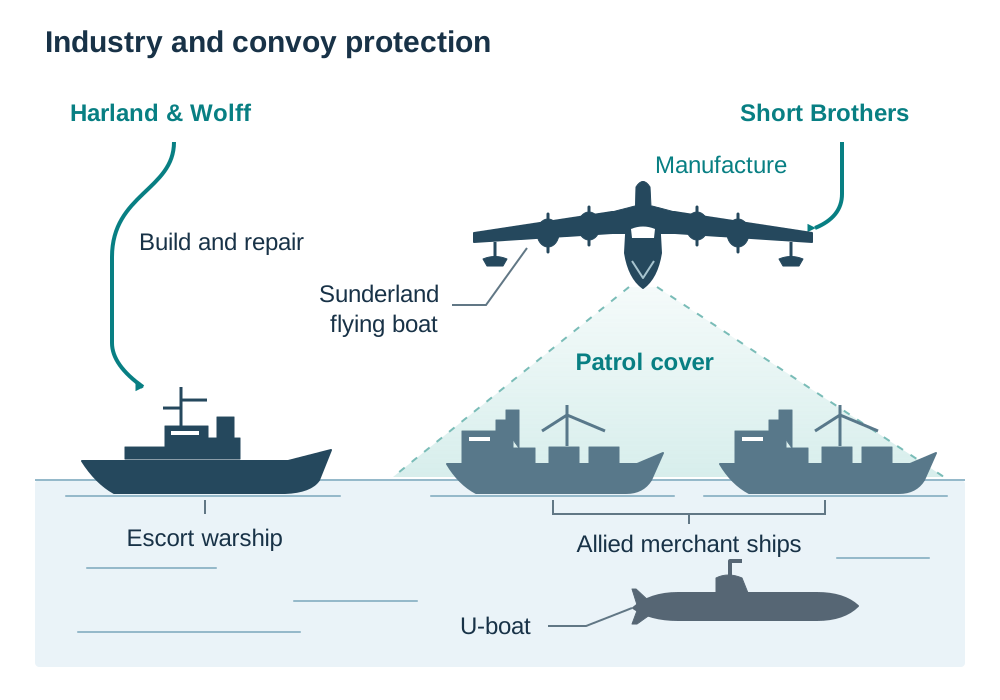
This industrial drive was slow to take off. In mid-1941, insured unemployment in Northern Ireland remained stuck near 20%, well above the British average, because Stormont was slow to win supply contracts. Only from 1942 did orders surge, cutting unemployment to around 5% by 1944. Thousands of women entered assembly lines, while the Women's Voluntary Service (WVS) coordinated welfare centres, clothing distribution, and canteen support.
Complacency, ARP Deficiencies, and Ministerial Failures
Despite Belfast's strategic value, the Northern Ireland government left the city shockingly unprotected. Cabinet ministers assumed German bombers lacked the range to reach Ulster. Even the Fall of France in June 1940, which gave the Luftwaffe bases along the French coast, failed to shatter Stormont's complacency.
Much of the early blame fell on the Minister of Home Affairs, Sir Richard Dawson Bates. Bates, who was elderly and hostile to administrative reform, delayed implementing mandatory Air Raid Precautions (ARP) and left preparation to local councils without central funding. In June 1940, Craigavon established the Ministry of Public Security under John MacDermott to take charge of civil defence. While MacDermott worked energetically, he inherited an acute shortfall in supplies and organisation that could not be repaired before the spring of 1941.
Belfast's defences were severely compromised:
- The city had only about 20 heavy anti-aircraft guns, roughly half the recommended defensive allocation.
- There were no permanent RAF night-fighter squadrons stationed in Northern Ireland, virtually no searchlights, and only a thin ring of barrage balloons.
- Public shelters accommodated only a small fraction of the population. Most working-class families lived in poorly built Victorian terraces adjacent to shipyards and docks without adequate domestic shelters or escape routes.
The 1941 Belfast Blitz: Four Raids
Between April and May 1941, the German Luftwaffe launched four distinct air raids against Belfast, exposing the city's defensive vulnerabilities:
| Raid Date | Raid Name | Casualties | Damage and Significance |
|---|---|---|---|
| 7–8 April 1941 | The Dockside Raid | 13 killed, 81 injured | A small reconnaissance-in-force hit docks and factories; sirens sounded late, but Stormont insisted defences were adequate. |
| 15–16 April 1941 | The Easter Tuesday Raid | ~900–1,000 killed, 600+ injured | Massive assault by roughly 180 bombers dropping 76 parachute mines and heavy explosives; devastated dense residential terraces. Highest death toll in a single night outside London. |
| 4–5 May 1941 | The Fire Raid | 150–200 killed, hundreds burned | Heavy incendiary assault (~100,000 firebombs) focused on industry; two-thirds of Harland & Wolff damaged, halting full production for six months. |
| 5–6 May 1941 | Follow-up Raid | Light casualties | Final harassing raid causing fires across city centre before German aircraft were redeployed east. |
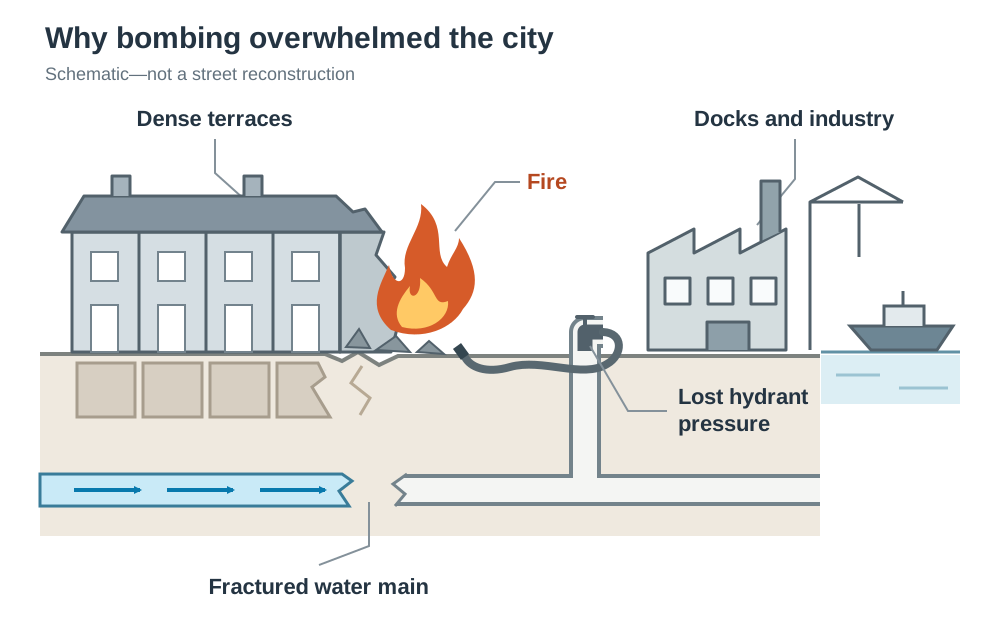
During the Easter Tuesday Raid, fires overwhelmed the city. Water mains fractured under high explosives, knocking out hydrant pressure. Terraced streets in the New Lodge, Antrim Road, and Shankill Road collapsed on residents trapped in cellars. City morgues overflowed immediately, forcing authorities to lay out hundreds of unidentified victims in St George's Market and the Falls Road public baths.
Cross-Border Humanitarian Aid
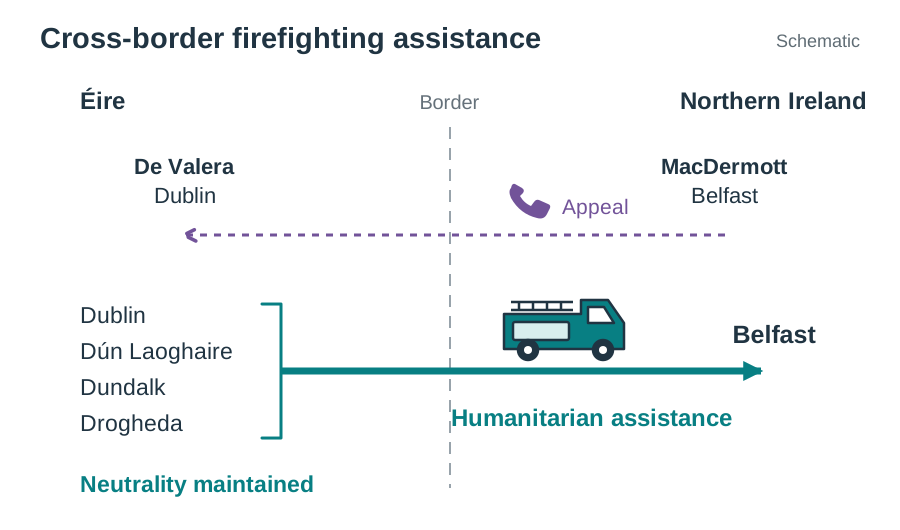
During the height of the Easter Tuesday Raid, Minister of Public Security John MacDermott realised Belfast's fire services were completely overwhelmed. With flames spreading uncontrollably through commercial and residential districts, MacDermott placed an urgent telephone call to Dublin appealing for civil defence assistance.
Taoiseach Éamon de Valera acted at once. He authorised southern fire brigades to cross the border as an emergency humanitarian act, operating strictly within Éire's policy of neutrality. Seventy-one southern firemen and 13 fire engines from Dublin, Dun Laoghaire, Dundalk, and Drogheda drove through the night without military escorts. They worked alongside northern crews for three days, pumping seawater from Belfast Lough to suppress major fires.
Speaking at Castlebar on 20 April 1941, de Valera publicly defended the decision: 'They are our people – we are one and the same people – and their sorrows in the present instance are also our sorrows.' Dublin repeated the assistance during the Fire Raid of early May. This cross-border solidarity briefly transcended partition and showed practical cooperation between North and South in a humanitarian crisis.
US Troop Presence and Long-Term Legacy to 1949
On 26 January 1942, the first contingent of United States troops landed at Dufferin Quay in Belfast. Over 300,000 American personnel passed through Ulster training camps before D-Day. Éamon de Valera immediately issued an official protest, stating that stationing foreign troops in the North without Dublin's consent implicitly endorsed partition and breached Irish sovereignty. London and Washington ignored the statement.
The American military presence brought substantial social changes: swing bands, dancehalls, high-grade rations, and encounters with African American soldiers, whom northern civilians generally treated with warmth despite the segregation rules imposed by US military police. Roughly 2,000 local women emigrated after 1945 as 'GI brides'.
The war permanently influenced the constitutional and social landscape of Northern Ireland:
- The Welfare State: The Blitz's exposure of slum housing prompted Stormont to establish the Northern Ireland Housing Trust (1945) and enact British post-war welfare reforms, including the National Health Service (NHS) and the 1947 Education Act.
- Constitutional Security: In his victory broadcast on 13 May 1945, Winston Churchill celebrated Northern Ireland's loyalty and blasted Dublin's neutrality. De Valera delivered a measured broadcast reply on 16 May. Ulster's wartime role was rewarded in the Ireland Act 1949, which gave a statutory guarantee that Northern Ireland could not be detached from the UK without the consent of the Stormont parliament.
The Fall of Stormont and the Imposition of Direct Rule (1972)
By early 1972, security in Northern Ireland had broken down. The introduction of internment without trial in August 1971 alienated the Catholic minority, sparked intense street violence, and acted as a major recruiting sergeant for the Provisional IRA. On 30 January 1972, British paratroopers shot dead 13 unarmed civil rights marchers in Derry, and a fourteenth died later from his injuries. Bloody Sunday convinced British Prime Minister Edward Heath that the unionist administration at Stormont could no longer manage law and order.
Heath met Northern Ireland Prime Minister Brian Faulkner on 22 March 1972 and demanded that all security, police, and justice powers be transferred from Belfast to London. Faulkner refused to accept this demotion and resigned on 24 March 1972 alongside his cabinet. On 30 March 1972, the British Parliament passed the Northern Ireland (Temporary Provisions) Act. This measure prorogued the Stormont parliament, suspending it without abolishing it immediately. Direct Rule was now in force: law-making for Northern Ireland passed to Westminster, mainly through Orders in Council, while the executive duties of government were handed to a new British cabinet minister, the Secretary of State for Northern Ireland. William Whitelaw was appointed the first Northern Ireland Secretary.
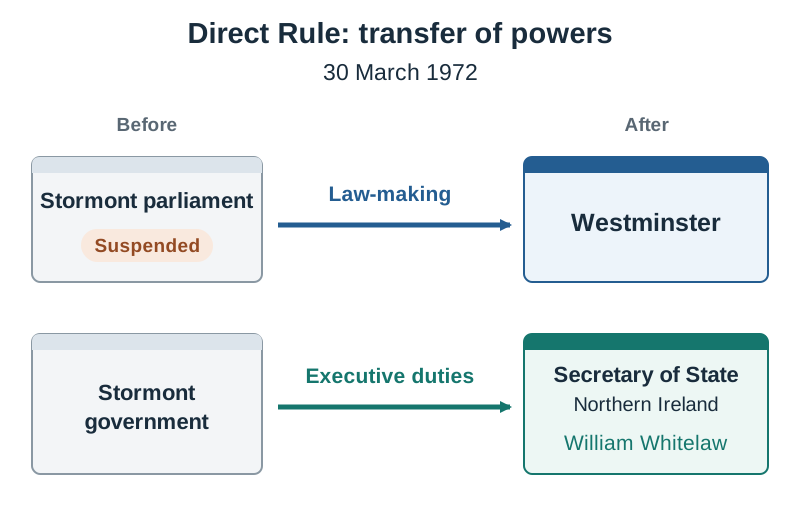
Direct Rule was planned as a temporary emergency measure. Except for the five months of the power-sharing Executive in 1974, it remained the system of government in Northern Ireland until powers were devolved under the Good Friday Agreement in December 1999. The response divided the community sharply:
- Nationalists and republicans welcomed the fall of the Unionist Party regime that had governed Northern Ireland since 1921. However, the Provisional IRA insisted that Direct Rule changed nothing fundamental, because British sovereignty remained in place.
- Unionists and loyalists felt betrayed and abandoned by London. William Craig set up the Ulster Vanguard movement to organise resistance. At a rally in Belfast's Ormeau Park in March 1972, Craig warned that Vanguard might have to mobilise and that 'it may be our job to liquidate the enemy'. Loyalist paramilitaries expanded alongside this political anger, uniting under the Ulster Defence Association (UDA).
Escalation: Bloody Friday, Operation Motorman, and the 1973 White Paper
Direct Rule brought no immediate peace. The year 1972 proved to be the bloodiest of the entire conflict, claiming 479 lives. On 21 July 1972, an afternoon remembered as Bloody Friday, the Provisional IRA set off 22 bombs across Belfast within 80 minutes, targeting bus stations, railway depots, and busy shopping streets. Although telephone warnings were telephoned in, the sheer number of devices overwhelmed emergency services. Nine people died, including two soldiers and seven civilians, and 130 people suffered injuries. The horror of the attack provoked public outrage and provided London with the justification to launch Operation Motorman on 31 July 1972. Using 22,000 troops, the British Army removed the barricades around republican 'no-go areas' in the Bogside and Creggan in Derry and across nationalist districts of West Belfast.
Alongside these military operations, the British government moved to construct a new political framework:
- The Border Poll (8 March 1973): Heath organised a referendum asking voters if Northern Ireland should remain part of the UK or join the Republic of Ireland. Nationalist parties boycotted the poll. While 98.9% voted to remain in the UK, overall turnout was just 58%, rendering the result incapable of bridging the sectarian divide.
- The Constitutional White Paper (20 March 1973): Titled Northern Ireland Constitutional Proposals, this document rejected simple majority rule. It proposed a 78-seat Assembly elected by proportional representation (Single Transferable Vote), compulsory power-sharing between unionists and nationalists on an Executive, and an institutional Irish Dimension to manage North–South cooperation.
Elections to the new Assembly took place on 28 June 1973. Faulkner led a faction of the Ulster Unionist Party (UUP) that backed the White Paper, securing 24 seats. The nationalist Social Democratic and Labour Party (SDLP) won 19 seats, and the cross-community Alliance Party won 8. Crucially, anti-White Paper unionists led by Ian Paisley of the Democratic Unionist Party (DUP) and William Craig of Vanguard won 27 seats, signalling strong resistance from much of the unionist community.
The Sunningdale Conference (December 1973)
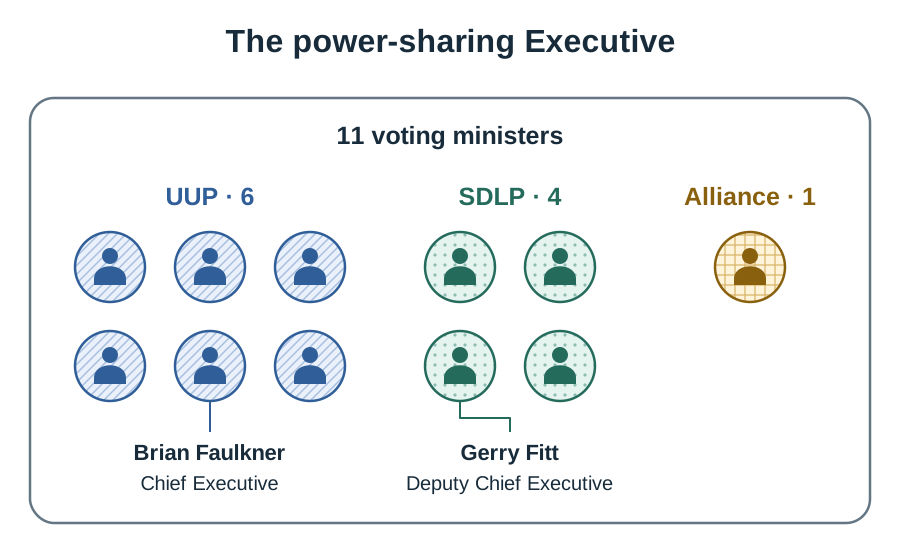
In November 1973, preliminary talks at Stormont Castle produced an agreement between Faulkner's UUP, Gerry Fitt's SDLP, and Oliver Napier's Alliance Party to form an Executive of 11 voting ministers: 6 UUP, 4 SDLP, and 1 Alliance. Brian Faulkner was designated Chief Executive and Gerry Fitt Deputy Chief Executive.
To finalise the remaining issues, Heath convened a tripartite conference from 6 to 9 December 1973 at the Civil Service College in Sunningdale, Berkshire. Tripartite meant three distinct interests were represented: the British government led by Heath, the Irish coalition government led by Taoiseach Liam Cosgrave, and the parties of the incoming Northern Ireland Executive. Northern Ireland Secretary Francis Pym, who had replaced Whitelaw on 2 December 1973, helped direct discussions. The agreed communiqué rested on three pillars:
1. The Power-Sharing Executive
The 11-member cross-community cabinet, agreed in November, was formally approved to assume devolved power on 1 January 1974. Gerry Fitt became Deputy Chief Executive and John Hume became Minister for Commerce.
2. Status and Consent
The agreement established the consent principle. The Irish government formally accepted that Northern Ireland's status as part of the United Kingdom could not change without the consent of a majority of its people. The British government affirmed that if a majority in Northern Ireland ever expressed a wish to join a united Ireland, London would support that decision.
3. The Council of Ireland
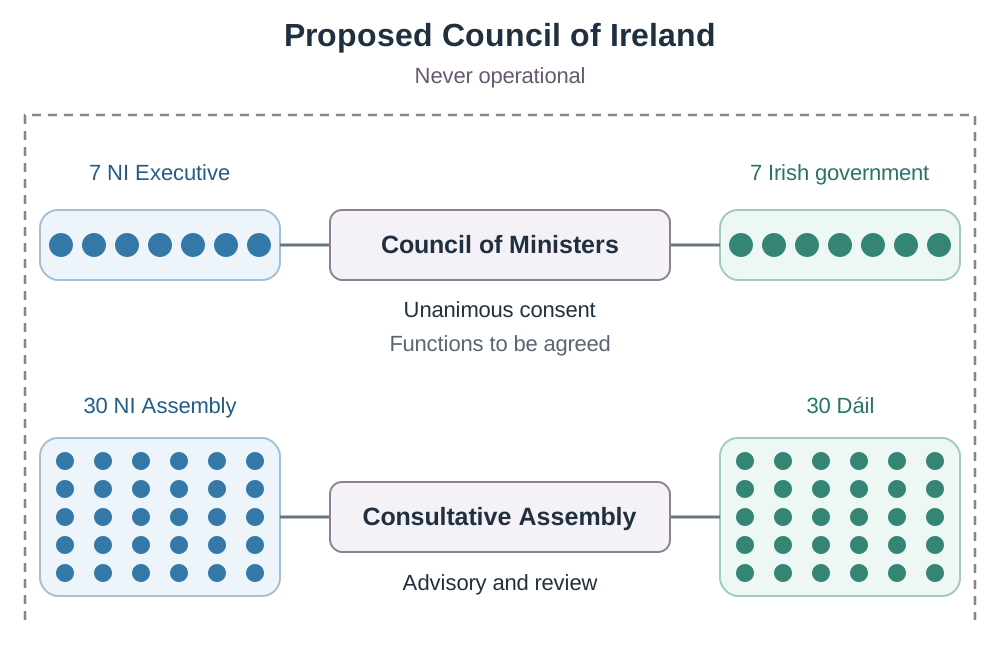
To give institutional form to the Irish Dimension, Sunningdale agreed to establish a Council of Ireland, but it never became operational. The proposed Council of Ministers would include seven ministers from each administration and act by unanimous consent, with executive and harmonising functions to be agreed. A separate 60-member Consultative Assembly, divided evenly between the Dáil and the Northern Ireland Assembly, would have advisory and review functions. Studies were to identify areas for cooperation, such as tourism, transport and electricity generation.
Security, Extradition, and the Boland Case
Unionists demanded that the Republic extradite fugitive IRA suspects to Northern Ireland. Taoiseach Liam Cosgrave and his Minister for Foreign Affairs, Garret FitzGerald, refused this request on the grounds that Irish law forbade extradition for political offences. Instead, the conference set up a joint Law Enforcement Commission to examine other legal mechanisms, such as trying suspects in the jurisdiction where they were arrested. Unionists felt Faulkner had conceded power-sharing while gaining almost nothing in return on security.
To make matters worse, Faulkner's request that Dublin delete Articles 2 and 3 of the Irish Constitution, which claimed jurisdiction over the whole island, was turned down by Cosgrave, who explained that an amendment referendum could not pass. Suspicions hardened when former minister Kevin Boland challenged the agreement in the Irish High Court. The court ruled that the Sunningdale declaration on Northern Ireland was merely an expression of government policy, leaving the constitutional territorial claim of Articles 2 and 3 fully intact.
Opposition: The Provisional IRA and Unionist Resistance
Opposition to Sunningdale came from both extremes of the political spectrum.
Republican Opposition
The Provisional IRA and Sinn Féin rejected the agreement entirely. They objected to the formal acceptance of Northern Ireland's constitutional status by Dublin, regarding the consent principle as southern betrayal and an endorsement of partition. Republicans dismissed the Council of Ireland as meaningless window dressing designed to prop up British rule. To destroy the settlement, the IRA kept up its bombing campaign in Northern Ireland and Britain throughout the life of the Executive, carrying out operations such as the M62 coach bombing in England on 4 February 1974. Furthermore, the British government kept internment in operation, which embarrassed the SDLP in front of its nationalist supporters and weakened enthusiasm for the Executive on the ground.
Unionist Backlash and the 1974 Election
For unionists, the Council of Ireland looked like an embryonic all-Ireland government. Their fears were stoked when, on 17 January 1974, SDLP assembly member Hugh Logue delivered a speech in Trinity College Dublin, describing the Council of Ireland as the vehicle that would 'trundle Unionists into a united Ireland'. Hardliners seized on the phrase as proof that Faulkner had sold out the Union.
Faulkner suffered a sequence of political blows across early 1974:
| Date | Event | Political Impact |
|---|---|---|
| 4 January 1974 | Ulster Unionist Council (UUC) Vote | The UUP's governing body rejected the Council of Ireland by 427 votes to 374. Faulkner was forced to resign as party leader, replaced by anti-agreement Harry West, though he stayed on as Chief Executive with a minority faction. |
| 22 January 1974 | Assembly Disruption | Anti-agreement unionists led by Ian Paisley physically took over the front benches in the chamber; the Royal Ulster Constabulary (RUC) had to enter the building and carry them out. |
| 28 February 1974 | UK General Election | Anti-agreement unionists formed the United Ulster Unionist Council (UUUC), uniting the DUP, Vanguard, and anti-Faulkner unionists under the slogan: 'Dublin is just a Sunningdale away'. The UUUC swept 11 of the 12 Westminster seats in Northern Ireland, taking 51% of the total vote. Gerry Fitt was the only pro-agreement MP elected. |
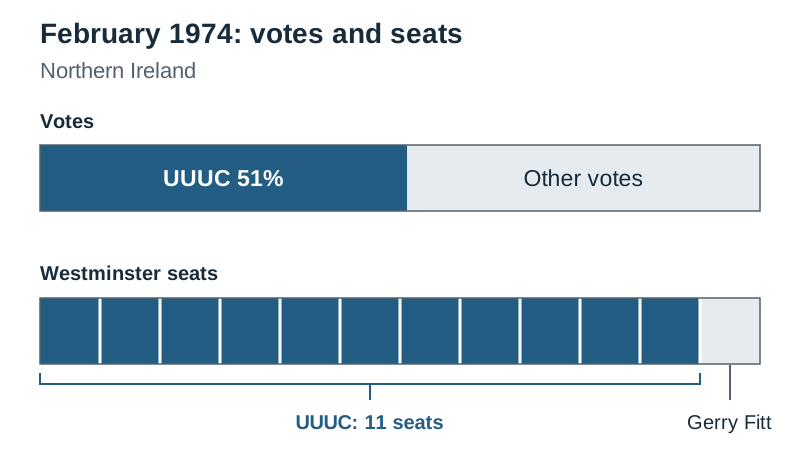
The February 1974 election destroyed any claim that the Executive held the support of the unionist majority. The election also brought Harold Wilson's minority Labour government into office in Britain. Wilson appointed Merlyn Rees as Northern Ireland Secretary. Hoping to draw paramilitaries towards constitutional politics, Rees de-proscribed the Ulster Volunteer Force (UVF) in April 1974, meaning it was no longer a banned organisation under British law. However, Rees adopted a passive approach and proved reluctant to deploy the security forces to support Faulkner.
The Ulster Workers' Council Strike and the Fall of the Executive (May 1974)
The final blow came through industrial and paramilitary action. In 1973, loyalist shop stewards established the Ulster Workers' Council (UWC). The group was led by shipyard shop steward Harry Murray. Its co-ordinating committee brought together loyalist politicians and paramilitaries: it was chaired by Vanguard assembly member Glenn Barr and included Andy Tyrie of the UDA.
On 14 May 1974, the Northern Ireland Assembly voted 44 to 28 to reject a motion condemning Sunningdale. That evening, Harry Murray announced an indefinite general strike, which began on 15 May.
Methods of the Strike
The Ulster Workers' Council strike brought Northern Ireland to a standstill through two tactics:
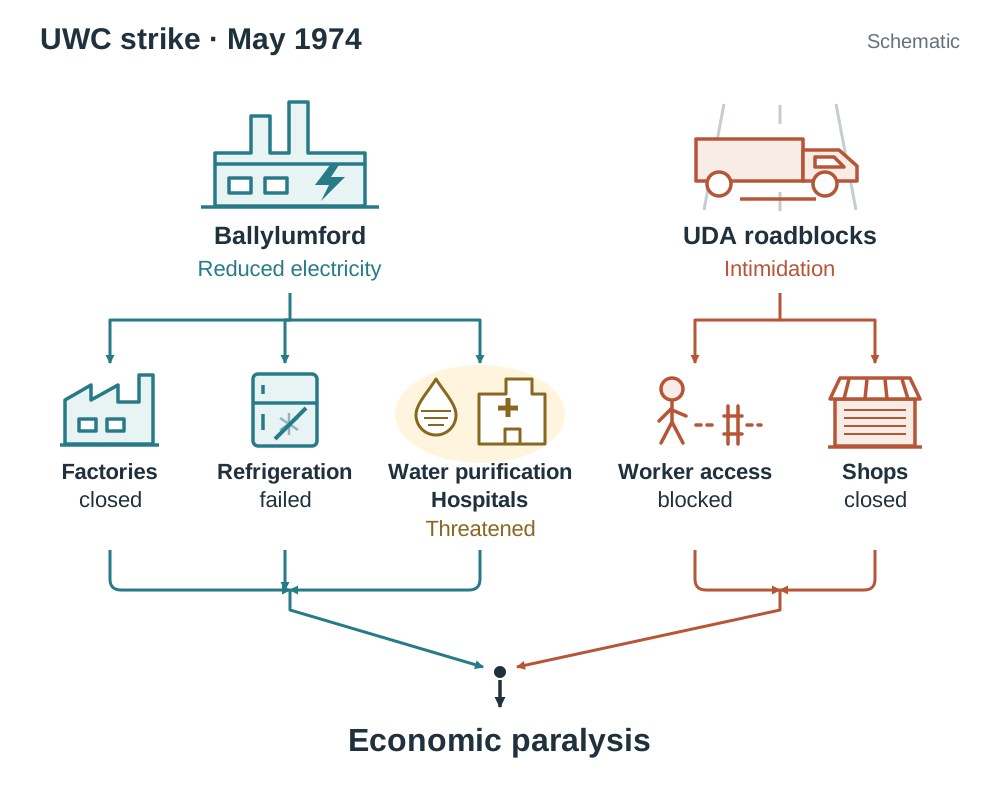
- Control of Essential Utilities: Workers at Ballylumford power station near Larne cut electricity generation drastically. Rolling blackouts closed factories, spoiled refrigerated goods on farms, and threatened water purification plants and hospitals. SDLP Minister for Commerce John Hume worked around the clock trying to keep basic fuel supplies moving, but had few resources.
- Paramilitary Enforcement: Masked UDA men erected roadblocks across Belfast and regional towns using hijacked lorries, buses, and felled trees. Intimidation was widespread; shopkeepers were ordered to pull down their shutters and workers were turned away from their jobs.
On 17 May 1974, the third day of the strike, the UVF detonated three car bombs in Dublin and one in Monaghan without warning, killing 33 civilians. It was the deadliest single day of the Troubles. Sammy Smyth, a spokesman for the UDA and UWC, remarked chillingly that he was happy with the bombings because they proved the North was at war with the Republic.
British Paralysis and Resignation
Faulkner and the Executive urged Merlyn Rees to use the army to clear the roadblocks and break the strike. Rees held back from a broad confrontation, fearing armed conflict with the Protestant working class. Troops did not clear the barricades or run Ballylumford. On 25 May, Prime Minister Harold Wilson delivered a televised address condemning the strike organisers as 'people who spend their lives sponging on Westminster and British democracy'. The insult backfired completely: insulted unionists wore pieces of sponge on their lapels in defiance, uniting moderate Protestants behind the stoppage.
On 27 May, the army did take over selected petrol stations to supply essential users. The UWC escalated the stoppage in response, threatening a complete shutdown of essential services. On 28 May, after Rees refused to meet UWC representatives, Brian Faulkner resigned as Chief Executive alongside his unionist colleagues. The power-sharing Executive collapsed immediately after just five months. The Assembly was prorogued, and Direct Rule returned.
Focus on: Brian Faulkner (1921–1977)
Brian Faulkner is a named key personality whose career highlights the dilemmas faced by moderate unionism.
Early Career and Rise
Elected as UUP MP for East Down in 1949 at the age of 28, Faulkner was the youngest member of the Stormont parliament. As Minister of Home Affairs (1959–1963) he built a reputation as a hardliner by effectively containing the IRA Border Campaign. Later, as Minister of Commerce (1963–1969), he demonstrated great administrative ability, travelling abroad to attract manufacturing investment to Northern Ireland. In January 1969 he resigned from Terence O'Neill's cabinet over the Cameron Commission into civil rights violence, a move that confirmed his image as an ambitious political rival.
Prime Minister (March 1971 – March 1972)
Faulkner succeeded James Chichester-Clark as Prime Minister in March 1971. He introduced token reforms, offering opposition MPs chairmanships of parliamentary committees. However, on 9 August 1971, he gambled on internment without trial. Over 340 men were arrested in the opening sweep; all were from the nationalist community, and many had no links to terrorism because of outdated intelligence provided by the RUC Special Branch. Internment proved a catastrophe, provoking Catholic outrage, an immediate surge in violence, and the civil rights march in Derry that led to Bloody Sunday. When Heath demanded control of law and order in March 1972, Faulkner resigned, ending half a century of devolved unionist government.
Chief Executive and Later Years
Faulkner showed remarkable ideological flexibility between 1973 and 1974. He accepted compulsory power-sharing with the SDLP and negotiated the Sunningdale Agreement, braving bitter insults from former colleagues. Yet he failed to secure changes to Articles 2 and 3 or genuine extradition from Dublin, exposing his flank to hardliners. After losing the Ulster Unionist Council vote on 4 January 1974, he resigned as UUP leader days later, but persevered as Chief Executive until the UWC strike forced him out. He later formed the Unionist Party of Northern Ireland (UPNI), which was crushed in elections. He retired from politics, received a life peerage, and died in a riding accident in March 1977.
Strengths, Weaknesses, and Historical Attitudes
- Strengths: A gifted administrator, an energetic campaigner, and a pragmatist willing to break unionist taboos to seek a negotiated peace.
- Weaknesses: The disastrous introduction of internment, underestimating the depth of unionist hostility to the Council of Ireland, and overestimating the willingness of the British government to stand by him during the strike.
- Attitudes: Contemporaries were divided. Nationalists in 1971 remembered him as the architect of internment, while loyalists in 1974 branded him a traitor who had sold out to Dublin. Historians today generally view him as a tragic, complex figure: a cautious traditionalist who grew into a brave reformer, only to find that his concessions came too late to save his career or the province.
Roles of Other Key Personalities: John Hume and Ian Paisley
Two other named syllabus personalities played critical, opposing roles throughout the Sunningdale experiment.
John Hume (SDLP)
John Hume was the intellectual force within the SDLP and a key negotiator at Sunningdale. He argued that no political settlement could endure unless it addressed two fundamentals: internal power-sharing between both traditions in the North, and an external Irish Dimension reflecting the nationalist community's Irish identity. Hume fought hard for the Council of Ireland, insisting on a Council of Ministers with meaningful executive potential. As Minister for Commerce in the Executive, he worked urgently to maintain electricity and food supplies during the May 1974 strike, repeatedly urging London to confront loyalist paramilitaries. Hume's two-pillar formula—power-sharing and cross-border institutions—ultimately formed the foundation of the 1998 Good Friday Agreement.
Ian Paisley (DUP)
Ian Paisley was the leading political opponent of the Sunningdale Agreement. Representing hardline evangelical Protestantism and militant unionism, he condemned power-sharing as a betrayal of the democratic majority and attacked the Council of Ireland as a Trojan horse for a 32-county republic. Paisley led protests inside the Assembly, leading to the dramatic scene on 22 January 1974 when RUC officers carried him from the chamber. He helped form the UUUC electoral alliance, which wiped out pro-agreement unionism in the February 1974 Westminster election. Paisley sat on the co-ordinating committee of the UWC strike, using his oratorical gifts to rally working-class loyalists. To his followers he was the uncompromising defender of Protestant heritage; to his opponents he was a destructive spoiler who brought down Northern Ireland's best chance for peace.
Assessing the Agreement: Why It Collapsed and Its Significance
An essay on this topic requires a clear, balanced evaluation of why the agreement failed and what it accomplished historically.
Five Causes of the Executive's Collapse
- Unionist Hostility to the Council of Ireland: Mainstream unionists believed the cross-border body compromised British sovereignty, a fear deepened by the Boland case and Hugh Logue's 'trundle' speech.
- The February 1974 Election: The UUUC won 11 of 12 Westminster seats, which stripped the Executive of its democratic mandate within the unionist community.
- Republican Opposition and IRA Violence: Continued car bombings in Northern Ireland and Britain destroyed public confidence in the promise that power-sharing would bring security, while internment alienated Catholic opinion.
- The UWC Strike: Industrial action at Ballylumford and paramilitary roadblocks set up by the UDA paralysed the province's economy within a fortnight.
- British Inaction: Prime Minister Harold Wilson and Secretary of State Merlyn Rees refused to order the army to dismantle roadblocks or run power stations, leaving Faulkner with no choice but to resign.
Historical Significance and Legacy
Although Sunningdale collapsed after five months, its key ideas – power-sharing, the consent principle and a North–South dimension – influenced later initiatives. Consent and the Irish Dimension reappeared in the 1985 Anglo-Irish Agreement and the 1993 Downing Street Declaration, and all three were combined again in the 1998 Good Friday Agreement. This continuity prompted SDLP deputy leader Seamus Mallon to make his famous observation that the Good Friday Agreement was simply 'Sunningdale for slow learners'.
Working with Evidence: The Sunningdale Case Study and the DBQ
The documents-based study (DBQ) topic is prescribed by the State Examinations Commission and rotated periodically among the Later Modern syllabus topics. When Topic 5 is the prescribed topic, the Sunningdale case study can be examined through primary extracts, such as the reporting of Robert Fisk (Point of No Return) on the May 1974 strike. At other times, Sunningdale appears as an essay question.
When working with primary documents on the strike, candidates must show four specific skills:
- Comprehension: Extracting factual detail directly from the text (for example, identifying barricades of hijacked lorries, fires, or blackouts in Belfast).
- Comparison: Examining two documents to find points of agreement and disagreement. For example, a candidate might compare a British Army report claiming the strike was maintained purely through paramilitary terror with a loyalist leaflet insisting the stoppage was a spontaneous working-class protest.
- Criticism: Evaluating the strengths and limitations of a source by questioning its provenance, purpose, and language. Eyewitness reporting offers immediate, detailed observation, but edited extracts can omit crucial context or display personal bias.
- Contextualisation: Connecting the source to the wider historical picture. Contextualisation carries a higher weighting at Higher Level than at Ordinary Level. Candidates must link descriptions of silent factories and unpoliced barricades to the wider political realities: Merlyn Rees's fear of confronting loyalists, Wilson's 'sponging' broadcast, and Faulkner's final resignation.
Key terms
- Belfast Blitz
- The four German air attacks on Belfast during April and May 1941, which killed approximately 1,100 people and damaged over half the city's housing stock.
- Easter Tuesday Raid
- The devastating air assault of 15–16 April 1941 involving roughly 180 Luftwaffe bombers; it claimed up to 1,000 lives, the highest UK death toll outside London in a single night.
- Fire Raid
- The incendiary air attack on 4–5 May 1941 in which roughly 100,000 firebombs crippled industrial targets, damaging two-thirds of the Harland & Wolff shipyard.
- Air Raid Precautions (ARP)
- Civil defence arrangements meant to protect the public from aerial bombardment, including blackout discipline, gas masks, blast shelters, and rescue personnel.
- Ditching
- The nightly evacuation by up to 100,000 Belfast residents who fled into open countryside, ditches, and barns to escape nighttime bombing.
- Ministry of Public Security
- The Northern Ireland government department formed in June 1940 under John MacDermott to take civil defence responsibilities away from Dawson Bates.
- Harland & Wolff
- Belfast's Queen's Island shipyard, which constructed approximately 140 naval ships, repaired over 3,000 vessels, and employed over 30,000 workers during the war.
- Short Brothers
- Belfast aircraft manufacturer that built roughly 1,200 Stirling heavy bombers and Sunderland flying boats used for Atlantic submarine patrols.
- Conscription
- Compulsory enlistment for military service; Westminster excluded Northern Ireland in 1939 and 1941 due to strong nationalist and southern opposition.
- Sir Basil Brooke
- Minister of Commerce who helped force J.M. Andrews's resignation in April 1943, becoming Northern Ireland's third Prime Minister on 1 May 1943.
- Allegiance
- A key concept describing the political loyalty felt by the unionist majority toward Britain, contrasted with northern nationalist detachment.
- Ireland Act 1949
- Westminster legislation confirming Northern Ireland's UK status would not change without the consent of the Stormont parliament, cementing partition after the South declared a republic.
- Direct Rule
- The system introduced on 30 March 1972 by which Northern Ireland was governed from London through a Secretary of State, suspending the devolved Stormont parliament.
- Internment
- Arrest and detention without trial, introduced by Brian Faulkner on 9 August 1971, which targeted Catholics and caused an escalation in violence.
- Bloody Sunday
- The shooting dead of 13 unarmed civil rights marchers (a fourteenth dying later) by British paratroopers in Derry on 30 January 1972.
- Power-Sharing
- A system of cross-community government where unionist and nationalist politicians hold ministerial office together, introduced in the 1974 Executive.
- Irish Dimension
- The policy principle that any political settlement in Northern Ireland must recognise its links with the Republic of Ireland through formal North–South institutions.
- Consent Principle
- The rule that Northern Ireland remains part of the UK unless a majority of its population votes for change, accepted by Dublin and London at Sunningdale.
- Council of Ireland
- A proposed cross-border body agreed at Sunningdale, with a 14-member Council of Ministers and a 60-member Consultative Assembly. It never became operational.
- Articles 2 and 3
- Articles in the 1937 Irish Constitution claiming legal jurisdiction over the entire island of Ireland, which unionists demanded Dublin remove during talks.
- Ulster Workers' Council (UWC) Strike
- A 14-day loyalist general strike in May 1974 combining industrial action and paramilitary intimidation that forced the collapse of the power-sharing Executive.
- UUUC
- The United Ulster Unionist Council, an electoral coalition of anti-agreement unionists that won 11 of 12 Westminster seats in February 1974.
- Bloody Friday
- The afternoon of 21 July 1972 when the Provisional IRA detonated 22 bombs across Belfast within 80 minutes, killing 9 people and injuring 130.
- Operation Motorman
- A British Army operation on 31 July 1972 using 22,000 troops to dismantle barricades around republican 'no-go areas' in Derry and Belfast.
Check yourself
Why did the British government abandon its renewed plan to introduce conscription to Northern Ireland in May 1941?
Fierce opposition from Catholic bishops, nationalist MPs, and public protests, along with a formal diplomatic protest from de Valera, led Churchill to decide it was more trouble than it was worth.
Which Northern Ireland minister placed the emergency telephone call to Dublin asking for fire brigades during the Blitz?
Minister of Public Security John Clarke MacDermott.
What public statement did Éamon de Valera make to justify sending southern aid to Belfast?
"They are our people – we are one and the same people – and their sorrows in the present instance are also our sorrows."
What term describes the mass movement of up to 100,000 citizens fleeing Belfast every night to sleep in open country?
Ditching.
How did unemployment figures in Northern Ireland change between mid-1941 and 1944?
Unemployment stood high at roughly 20% in mid-1941 due to slow war contracts, but fell to about 5% by 1944 as industrial orders peaked.
How did de Valera react to the arrival of US forces in Northern Ireland in January 1942?
He formally protested that stationing foreign troops in the North without Dublin's consent implicitly endorsed partition and ignored Irish sovereignty.
What guarantee did the Ireland Act 1949 provide for Northern Ireland?
It guaranteed that Northern Ireland could not cease to be part of the UK without the consent of the Parliament of Northern Ireland.
On what date did the Northern Ireland (Temporary Provisions) Act come into force, introducing Direct Rule?
30 March 1972.
What was the party composition of the 11 voting members of the 1974 Power-Sharing Executive?
6 Ulster Unionists (Faulkner faction), 4 SDLP members, and 1 Alliance Party member.
Give two reasons why unionists fiercely opposed the proposed Council of Ireland.
They feared it was an embryonic all-Ireland parliament, a fear reinforced when Dublin retained Articles 2 and 3 and Hugh Logue claimed it would 'trundle' unionists into a united Ireland.
How did the Provisional IRA react to the Sunningdale Agreement?
They rejected it because Dublin accepted Northern Ireland's status within the UK, and they continued their bombing campaign in Northern Ireland and Britain.
How many Westminster seats did the anti-agreement UUUC coalition win in the February 1974 UK general election?
11 out of 12 seats, securing 51% of the popular vote.
What phrase used by British Prime Minister Harold Wilson in his 25 May 1974 broadcast alienated the unionist population?
He described the strike organisers as people 'sponging on Westminster and British democracy'.
Social Shock, 'Ditching', and the Fall of J.M. Andrews
The Blitz killed roughly 1,100 people, wrecked or damaged over 56,000 houses (about 53% of the city's housing stock), and left over 100,000 citizens homeless. The failure of ARP triggered public panic. Every evening, between 70,000 and 100,000 residents abandoned urban streets to sleep in ditches, barns, and open fields along the slopes of Cave Hill and around Lisburn in a phenomenon termed ditching.
By June 1941 around 220,000 people had left Belfast, at least for a time. Some went through official evacuation schemes, which gave priority to mothers, young children and the sick, but many left on their own. Billets in farming communities exposed stark class disparities, revealing severe child malnutrition, poverty, and skin ailments that the Stormont government had ignored for decades.
Public anger damaged the political standing of the Ulster Unionist government. Prime Minister J.M. Andrews, who had replaced Craigavon in November 1940, appeared tired and out of touch. Electoral backlash followed: Harry Midgley of the Northern Ireland Labour Party won the Stormont seat of Belfast Willowfield in December 1941, while Jack Beattie won the Westminster seat of West Belfast in February 1943. Labour unrest escalated, including an autumn 1942 wildcat strike by 10,000 aircraft machinists over wages.
Facing rebellion from backbenchers and losing the confidence of senior colleagues—including Minister of Commerce Sir Basil Brooke—Andrews resigned in late April 1943. Brooke took office as Prime Minister on 1 May 1943. He brought in younger ministers and appointed Labour MP Midgley as Minister of Public Security to signal cross-party resolve, but he pointedly refused to include any Catholic nationalists in government.