

Later Modern Europe Topic 1 examines how nationalism and industrialisation reshaped European politics, society, and culture between the defeat of Napoleon in 1815 and the proclamation of the German Empire in 1871. Following Waterloo, Prince Clemens von Metternich anchored an autocratic, conservative order through the Congress of Vienna and the Concert of Europe, designed to suppress revolution and maintain a dynastic balance of power. Over six decades, that settlement collapsed under relentless pressure from liberal, radical, and nationalist movements, culminating in the Revolutions of 1848. While the 1848 uprisings were defeated in the short term, they permanently altered European governance. Giuseppe Mazzini's romantic, bottom-up republicanism gave way to hard-headed pragmatism and Realpolitik, enabling Count Camillo di Cavour and Otto von Bismarck to forge unified nation-states in Italy and Germany through diplomacy and war. Alongside these political transformations ran deep socio-economic upheavals: the expansion of industrialisation and trade unionism, mass migration and rapid urban growth, the rise of mass politics and Chartism, the abolition of Russian serfdom, Robert Owen's model factory community at New Lanark, Georges-Eugène Haussmann's rebuilding of Paris, and groundbreaking scientific advances led by Charles Darwin and Louis Pasteur.
The Restoration Era, Metternich's System, and Autocracy in the East (1815-1848)
Following the defeat of Napoleon at Waterloo in 1815, the victorious Great Powers (Austria, Great Britain, Prussia, and Russia) convened at the Congress of Vienna (1814-1815). Chaired by the Austrian Foreign Minister and later Chancellor, Prince Clemens von Metternich, the settlement sought to secure long-term European peace through dynastic legitimacy, territorial containment of France, and an international balance of power.
To preserve this settlement, Metternich established the Concert of Europe (the Congress System), coordinating collective intervention against domestic revolutions. At the Congress of Troppau (1820) and the Congress of Laibach (1821), Metternich secured mandates for Austrian armies to crush constitutional uprisings in Naples and Piedmont. In 1823, a French expedition under Concert approval restored the absolute rule of Ferdinand VII in Spain. Britain, however, refused to accept a general right of intervention. Foreign Secretary Lord Castlereagh set out this objection in his State Paper of May 1820, keeping Britain out of the Troppau Protocol. His successor George Canning went further, boycotting the Congress of Verona's mandate for French intervention in Spain and recognising the independence of the breakaway Spanish American republics.
Within the Germanic lands, the more than 300 states of the old Holy Roman Empire, abolished by Napoleon in 1806, were reduced to the 39 members of the German Confederation (Deutscher Bund), dominated by Austria and meeting at a permanent Diet in Frankfurt. When nationalist student fraternities (Burschenschaften) gathered at the Wartburg Festival in 1817 demanding constitutional liberty and national unity, Metternich moved to crush them. Following the 1819 assassination of the conservative playwright August von Kotzebue by a radical student, Metternich persuaded the confederation Diet to issue the Carlsbad Decrees (1819). These dissolved student fraternities, placed universities under official inspectors, dismissed liberal academics, and imposed strict press censorship across all 39 states.
Autocracy in Practice: Russia
In Eastern Europe, the Russian Tsar ruled as an autocrat without a constitution, parliament, or legal limit on his power. When liberal army officers staged the Decembrist revolt in December 1825, Tsar Nicholas I (1825-1855) suppressed the coup and constructed an uncompromising police apparatus. He established the Third Section (secret political police), enforced rigorous press censorship, and promoted the official doctrine of 'Orthodoxy, Autocracy, Nationality' framed by Education Minister Sergei Uvarov. Acting abroad as the 'gendarme of Europe', Nicholas I crushed the Polish national uprising of 1830-1831 and dispatched 200,000 troops to Hungary in 1849 to help Austria extinguish Lajos Kossuth's revolution.
Balkan Nationalism: Serbia and Greece
Nationalist revolts in the Ottoman Balkans delivered the first successful territorial breaches in the Vienna settlement:
- Serbia: Following the crushed First Serbian Uprising (1804-1813) led by Karađorđe Petrović, Miloš Obrenović launched the Second Uprising in 1815. Combining military resistance with shrewd diplomacy, Obrenović compelled the Sultan to grant concessions. The Treaty of Adrianople (1829) required the Ottoman Empire to concede Serbian self-government, and by 1830 Serbia had established internal autonomy under Obrenović as hereditary prince, while remaining under formal Ottoman suzerainty.
- Greece: Nourished by the Orthodox Church, merchant networks, and the secret society Philike Hetairia (founded in Odessa in 1814), the Greek revolution broke out in 1821 under Alexander Ypsilantis and local Peloponnesian chieftains. The Ottoman massacre of Greeks on the island of Chios (1822) and the prolonged siege of Missolonghi (1825-1826) horrified western opinion, inspiring the philhellenism movement (symbolised by the death of Lord Byron at Missolonghi in 1824 and Eugène Delacroix's paintings). When Egyptian reinforcements under Ibrahim Pasha threatened to extinguish the rebellion, Britain, France, and Russia intervened directly. Their joint naval squadron destroyed the Ottoman-Egyptian fleet at the Battle of Navarino in October 1827. After Russia defeated Ottoman armies on land, the Treaty of Adrianople (1829) and the London Protocol (1830) established Greek sovereignty. In 1832, Prince Otto of Bavaria, who became King Otto of Greece in 1832, was placed on the throne of Europe's first newly recognised independent nation-state.
The 1848 Collapse and Conservative Recovery Across Europe
In early 1848, revolutionary upheavals toppled Metternich's order. In Vienna, student and worker demonstrations forced Metternich to resign and flee to London on 13 March 1848, while Emperor Ferdinand I promised a constitution. In Hungary, Lajos Kossuth established an autonomous government through the 'April Laws' before declaring full independence. In northern Italy, Milan and Venice rose against the Habsburgs, prompting Piedmont to declare war.
Yet the conservative recovery was swift because the dynasties retained command of their professional armies while revolutionary coalitions fractured along class and national lines. Field Marshal Radetzky routed the Piedmontese at Custoza (1848) and Novara (1849); Field Marshal Windischgrätz bombarded Prague into surrender and retook Vienna in October 1848; the feeble Ferdinand abdicated in December 1848 in favour of eighteen-year-old Franz Joseph, guided by the ruthless Prime Minister Prince Felix von Schwarzenberg; and Russian military intervention crushed Hungary in August 1849. This conservative resurgence meant that by spring 1849, the traditional monarchs had regained the upper hand across Central Europe.
Case Study 1: The 1848 Revolution in Germany
The revolutionary impulse of 1848 in the German lands grew from severe agrarian distress (the potato blight and harvest failures of 1845-1847) coupled with commercial recession and middle-class demands for constitutional liberties (Märzrevolution).
The Outbreak and the March Days
In March 1848, popular demonstrations swept Baden, Württemberg, Bavaria, and Saxony. In Berlin, fighting erupted at barricades on 18 March between civilians and the royal garrison. Shaken by the violence, King Frederick William IV withdrew his troops, saluted the civilian dead, appointed a liberal cabinet, and proclaimed that 'Prussia is henceforth merged into Germany'.
The Frankfurt Parliament in Session
German liberals met at Heidelberg on 5 March 1848 and convened an informal Vorparlament (pre-parliament) of 500 delegates at Frankfurt to organise nationwide elections. About 585 elected deputies took their seats in St Paul's Church (Paulskirche) on 18 May 1848 (over 800 men sat at some point during its existence). Dominated by academics, lawyers, civil servants, and clergymen, it was dubbed the 'professors' parliament'. Led by its president, Heinrich von Gagern, the assembly established a Provisional Central Power in June 1848 headed by Archduke John of Austria as Imperial Regent (Reichsverweser). However, this executive lacked tax revenues, an administrative apparatus, and an army of its own.
The parliament's work was crippled by three fundamental issues:
- The Territorial Question: The assembly divided between supporters of Grossdeutschland (a Greater Germany incorporating Austria and its German-speaking populations) and Kleindeutschland (a Lesser Germany excluding Austria entirely, united under Prussian leadership). Because Vienna refused to dismantle its multinational empire to let only its German provinces join, the delegates adopted the Kleindeutschland model.
- The Schleswig-Holstein Crisis: When King Frederick VII of Denmark attempted to absorb the duchy of Schleswig into the Danish kingdom, the Frankfurt Parliament asked Prussia to intervene on behalf of the Confederation. Under British and Russian pressure, Frederick William IV signed the Armistice of Malmö with Denmark in August 1848 without consulting Frankfurt. When the assembly reluctantly ratified the armistice in September by a narrow vote of 257 to 236, radical crowds stormed the Paulskirche, and Prussian troops had to be summoned to protect the deputies.
- Prussian Counter-Revolution: In December 1848, Frederick William IV dissolved the separate Prussian National Assembly in Berlin and imposed his own royal constitution. The following year, the electoral law of 30 May 1849 introduced an unequal three-class voting system weighted by direct tax contributions, so that the wealthiest 5% of voters chose one third of the electors; it was written into the revised Prussian constitution of January 1850.
The Collapse and Significance
In March 1849, the assembly completed the Frankfurt Constitution, incorporating the 'Basic Rights of the German People'. In April 1849, a parliamentary delegation travelled to Berlin to offer the imperial crown to Frederick William IV. Grounded in divine-right monarchy, he refused, dismissing it privately as a 'crown from the gutter' offered by an elected popular body rather than fellow ruling princes.
With Prussia's refusal, Austria and Prussia recalled their deputies. A radical rump parliament fled to Stuttgart before being dispersed by Württemberg cavalry in June 1849. Insurrections in Baden, the Palatinate, and Saxony (where Mikhail Bakunin manned the barricades at Dresden) were extinguished by Prussian troops. The 1848 revolution failed because middle-class delegates feared social disorder, lacked military force, and could not impose their will on the traditional dynasties. Yet it proved that Kleindeutschland was the only viable path to unification and demonstrated that German unity would require state military power rather than parliamentary resolution.
1848 Germany Retention Grid
| Element | Core Historical Details |
|---|---|
| Causes | Crop failures and potato blight (1845-1847); trade slump; middle-class demands for constitutions; news of revolutions in Paris and Vienna. |
| Key Events & Dates | Berlin barricades (18 March 1848); Frankfurt Parliament opens (18 May 1848); Armistice of Malmö (August 1848); Frankfurt Constitution completed (March 1849); Imperial crown refused (April 1849). |
| Reasons for Failure | No army or tax base; division over Grossdeutschland vs Kleindeutschland; liberal fear of working-class radicalism; monarchies retained their armies; Austrian and Prussian counter-revolution. |
| Consequences | Dissolution of the assembly; thousands of radicals exiled ('Forty-Eighters'); Prussian three-class franchise established; lesson that unity required military power. |
The Germanic Lands: From Confederation to Empire (1815-1871)
While Austria held political pre-eminence within the 1815 Confederation, Prussia established economic leadership across the Germanic territories. In 1834, Prussia launched the Zollverein (Customs Union), which dismantled internal customs barriers across participating German states and instituted a common external tariff, while deliberately excluding Austria. The Zollverein linked regional manufacturing in the Rhineland, Silesia, and Saxony directly to Berlin, promoting rail networks and heavy industry.
Prussia's attempt to organise an 'Erfurt Union' of German princes was blocked when Austria, backed by Russian diplomatic pressure, forced King Frederick William IV to sign the Punctation of Olmütz (November 1850). This agreement restored the Austrian-led Confederation Diet, leaving Prussian conservatives determined to reverse what they saw as an intolerable national humiliation.
Otto von Bismarck and Realpolitik
In September 1862, King William I of Prussia appointed Otto von Bismarck as Minister-President to break a constitutional crisis. The liberal majority in the Landtag had refused to approve funding for military reforms proposed by War Minister Albrecht von Roon and Chief of the General Staff Helmuth von Moltke. Bismarck bypassed parliament, raised taxes without legislative approval for four years, and modernised the army. Addressing the Landtag budget committee on 30 September 1862, Bismarck declared:
'The great questions of the day will not be settled by speeches and majority decisions—that was the great mistake of 1848 and 1849—but by iron and blood.' (usually quoted as 'blood and iron').
Bismarck practised Realpolitik: pragmatic statecraft based on state interest and physical power rather than ideological doctrines. Over eight years, he orchestrated three short, calculated wars to achieve Prussian hegemony.
The Three Wars of German Unification
| War | Year | Opponents | Decisive Battle | Diplomatic Preparation & Outcomes |
|---|---|---|---|---|
| Second Schleswig War | 1864 | Prussia & Austria vs Denmark | Battle of Dybbøl (April 1864) | Denmark attempted to incorporate Schleswig into its constitution. Bismarck allied with Austria to defeat Christian IX. The Treaty of Vienna surrendered the duchies to joint Austro-Prussian rule. Under the Gastein Convention (1865), Prussia administered Schleswig while Austria governed Holstein, creating built-in friction that Bismarck exploited when ready. |
| Austro-Prussian War (Seven Weeks' War) | 1866 | Prussia & Italy vs Austria & German States | Battle of Königgrätz (July 1866) | Bismarck secured French neutrality through vague territorial hints at Biarritz (1865) and allied with Italy by promising Venetia. Moltke used railway mobilisation and the breech-loading needle gun to rout Austria in seven weeks. The Treaty of Prague dissolved the German Confederation and expelled Austria from German affairs. Prussia annexed Hanover, Hesse-Kassel, Nassau, and Frankfurt, forming the North German Confederation (1867). Bismarck deliberately offered Austria generous peace terms, avoiding annexations, so Austria would not seek revenge in future conflicts. |
| Franco-Prussian War | 1870-1871 | Prussia & German States vs Second French Empire | Battle of Sedan (September 1870) | A diplomatic dispute arose over Prince Leopold of Hohenzollern's candidacy for the vacant Spanish throne. When French Ambassador Vincent Benedetti approached King William I at Bad Ems, Bismarck edited the Ems Telegram to make the exchange appear mutually insulting before releasing it to the press. French public outrage forced Napoleon III to declare war. The southern German states (Bavaria, Württemberg, Baden) rallied behind Prussia. The French army was encircled and captured at Sedan, Napoleon III was taken prisoner, and Paris surrendered in January 1871 after a four-month siege. |
On 18 January 1871, in the Hall of Mirrors at Versailles, King William I was proclaimed German Emperor (Kaiser). Under the Treaty of Frankfurt (May 1871), France surrendered Alsace and eastern Lorraine and agreed to pay an indemnity of 5 billion francs. This altered the European balance of power and established the German Empire as the dominant industrial and military force on the Continent.
Italy Moves Towards Unity (1815-1871)
In 1815, Metternich described Italy as a 'geographical expression'. The peninsula remained splintered between Austrian-ruled Lombardy-Venetia, the Bourbon Kingdom of the Two Sicilies, the Papal States, and the Kingdom of Piedmont-Sardinia.
The Ideological Phase: Mazzini and Young Italy
Early resistance led by the Carbonari secret societies produced isolated risings in Naples (1820) and central Italy (1831), all quickly suppressed by Austrian garrisons. In 1831, the Genoese lawyer Giuseppe Mazzini founded Young Italy (La Giovine Italia). Mazzini believed that Italian unification (Risorgimento) had to come from a popular moral awakening and armed insurrection by ordinary citizens to establish a free, democratic republic. During 1848-1849, Mazzini governed as Triumvir of the short-lived Roman Republic (1849), defended by Giuseppe Garibaldi, before French forces intervened to restore Pope Pius IX. While Mazzini's conspiracies consistently failed, his passionate writings gave Italian nationalism its emotional and moral appeal.
Cavour, Garibaldi, and the Monarchy
Following the 1848 defeats, Italian patriots recognised that revolutionary enthusiasm alone could not eject the Austrian military. Political initiative shifted to Piedmont-Sardinia under King Victor Emmanuel II and his Prime Minister from 1852, Count Camillo di Cavour:
- Modernisation and Diplomacy: Cavour built railways, encouraged industry, reorganised the Piedmontese army, and joined Britain and France in the Crimean War (1853-1856) to bring the Italian Question before the Congress of Paris.
- The War of 1859: At the secret Plombières meeting (July 1858), Cavour secured French military support against Austria in return for ceding Savoy and Nice. Following bloody Franco-Piedmontese victories at Magenta and Solferino (June 1859), Napoleon III became alarmed by Prussian mobilisation on the Rhine, mounting casualties, and unrest in central Italy. He signed a separate armistice with Austria at Villafranca (July 1859) without consulting his ally. Austria ceded Lombardy to France, which passed it to Piedmont, but retained Venetia. Feeling betrayed, Cavour resigned as Prime Minister, returning to office in January 1860 after popular plebiscites in Tuscany, Parma, and Modena voted for union with Piedmont.
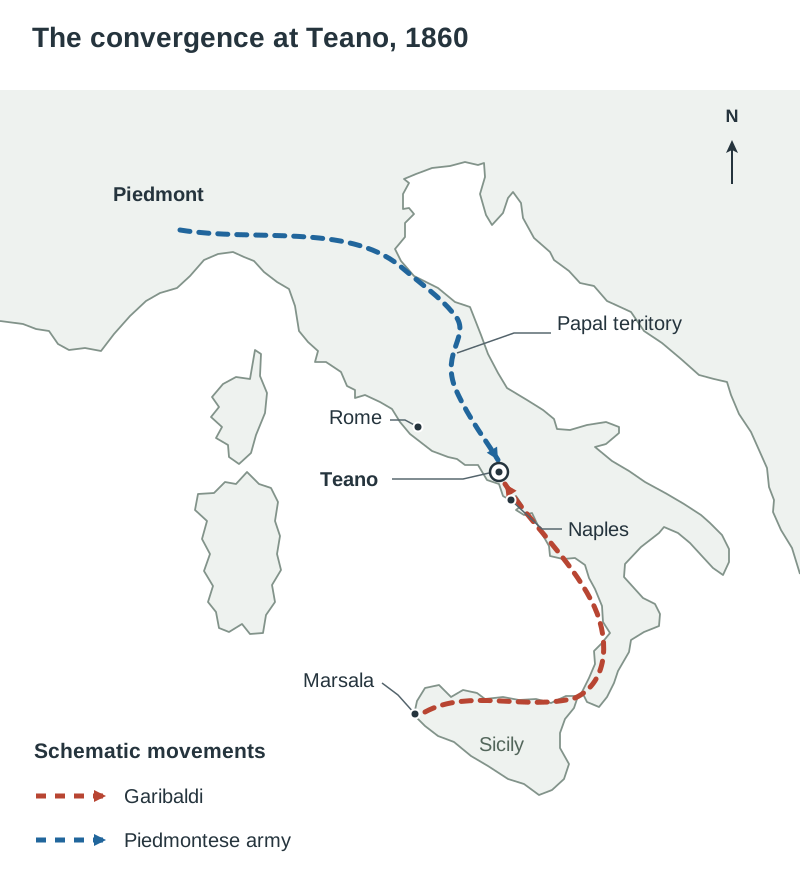
- Garibaldi's Expedition of the Thousand (1860): In May 1860, Garibaldi landed at Marsala, Sicily, with 1,000 volunteer 'Redshirts'. Routing Bourbon troops, he crossed to the mainland and entered Naples. To prevent Garibaldi from marching into Rome, which would trigger French intervention, Cavour marched the royal Piedmontese army south through papal territory. At Teano in October 1860, Garibaldi met Victor Emmanuel II and handed over his southern conquests, subordinating his republican ideals to the practical reality of national unity.
The Kingdom of Italy was proclaimed on 17 March 1861 with Victor Emmanuel II as constitutional monarch. Venetia was added in 1866 following Italy's alliance with Prussia in the Austro-Prussian War. In September 1870, when the Franco-Prussian War forced Napoleon III to withdraw the French garrison protecting Rome, Italian troops entered through the Porta Pia. Rome was declared the capital of Italy in 1871, completing unification not as Mazzini's democratic republic, but as a centralised constitutional monarchy under the Piedmontese crown.
The State in France: Monarchy, Republic, and Empire (1815-1871)
Between 1815 and 1871, France experienced four distinct constitutional regimes:
- The Restored Bourbon Monarchy (1815-1830): Louis XVIII ruled under the Charter of 1814, establishing a constitutional monarchy with an electorate restricted to wealthy landowners. His reactionary brother, Charles X (1824-1830), sought to restore absolute royal prerogative and indemnify emigré nobles. When Charles issued the July Ordinances (1830) suspending press freedom, dissolving the Chamber of Deputies, and disenfranchising the middle class, Parisian workers and students erected street barricades during the 'Three Glorious Days' (27-29 July 1830), forcing Charles X into exile.
- The July Monarchy (1830-1848): Louis-Philippe, Duke of Orléans, became 'King of the French'. Portrayed as the 'Citizen King' who walked Parisian streets carrying an umbrella, his regime catered exclusively to the wealthy banking and industrial bourgeoisie. His chief minister, François Guizot, refused to widen the franchise, telling those who wanted the vote to 'Enrichissez-vous par le travail et par l'épargne' ('enrich yourselves by work and thrift'). Because the vote depended on paying a high property tax, this amounted to telling workers that they could not have it. Rural crop failures, rising bread prices, and a ban on opposition reform banquets sparked revolution on 22-24 February 1848, forcing Louis-Philippe to abdicate.
- The Second Republic (1848-1852): A provisional government introduced universal male suffrage, expanding the electorate from 250,000 to over nine million. Under socialist pressure from Louis Blanc, the government opened National Workshops to provide relief for unemployed workers. However, when the conservative-dominated National Assembly voted to dissolve the workshops in June 1848, the working class rose in revolt. During the bloody 'June Days' (23-26 June 1848), General Cavaignac led the regular army in crushing the insurrection, leaving thousands dead. Terrified of socialism, the French electorate overwhelmingly elected Louis-Napoleon Bonaparte as President in December 1848, trading democratic liberty for stability.
- The Second Empire (1852-1870): In December 1851, barred by the constitution from seeking a second term, Louis-Napoleon launched a military coup d'état, dissolved the assembly, and crushed republican resistance. Exactly one year later, after a plebiscite approved the change by an overwhelming majority, he was proclaimed Emperor as Napoleon III (2 December 1852). His regime combined authoritarian surveillance, press censorship, and patronage with state-directed economic modernisation: establishing investment banks (Crédit Mobilier), expanding the national rail network, and commissioning Baron Haussmann to reconstruct Paris. In the 1860s, facing growing liberal opposition, Napoleon III liberalised his regime, granting workers the right to strike in 1864 and easing censorship. The empire collapsed following his capture by Prussian forces at the Battle of Sedan on 2 September 1870, leading directly to the proclamation of the Third Republic.
Society and Economy: Agriculture, Peel, Serfdom, Industrialisation, and Mass Politics
Between 1815 and 1871, European society adjusted to massive structural change across agriculture, heavy industry, and labour organisation.
The Changing Agricultural Economy in the West
Western European farming shifted towards commercial, market-driven production. In Britain, parliamentary enclosure consolidated open fields into compact farms. Landlords adopted 'high farming', using the Norfolk four-course crop rotation, underground clay drainage pipes, selective livestock breeding, and commercial fertilisers such as Peruvian guano and John Bennet Lawes's superphosphate (1843). Mechanised equipment, including McCormick's mechanical reaper, spread from the 1840s.
Patterns differed across the Continent. In France, the French Revolution had established a vast class of small peasant proprietors; mechanisation was slower, but these conservative smallholders formed the electoral backbone of Napoleon III's regime. In Prussia, the Stein-Hardenberg reforms (1807-1821) freed peasants from personal bondage but required them to surrender land to compensate their former masters, enlarging the grain-exporting estates of the aristocratic Junkers east of the Elbe. The worst agrarian crisis was the Great Famine in Ireland (1845-1849), where potato blight destroyed the staple food of the rural poor, causing roughly one million deaths and driving another million to emigrate. The catastrophe served as the direct catalyst for British Prime Minister Sir Robert Peel to challenge agricultural protectionism and push through the repeal of the Corn Laws in 1846, committing Britain to free-market laissez-faire and cheap imported grain for urban factory workers.
Serfdom and Reform in Tsarist Russia
In the Russian Empire, over twenty million peasants remained tied to feudal bondage as private serfs, bound to noble estates without civil rights, freedom of movement, or property ownership. Russia's defeat in the Crimean War (1853-1856) exposed the industrial and military backwardness caused by this feudal system. In response, Tsar Alexander II (1855-1881) declared it was better to abolish serfdom from above than wait for it to abolish itself from below, signing the Emancipation Edict of 1861.
While personal serfdom was ended, true economic independence remained blocked. Peasants were allocated land at inflated valuations and had to repay the state through redemption payments stretching over 49 years. Land was held collectively by the village commune (mir), which controlled agricultural rotations and withheld internal passports, tying peasants to their villages. Alexander II supplemented emancipation with wider administrative reforms: establishing elected district councils (zemstva) in 1864 to manage roads, primary schools, and healthcare; overhauling the judiciary with public trials, juries, and an independent legal bar (1864); and reforming military service into universal conscription (1874). However, Alexander retained autocratic authority and refused to establish an elected national parliament, leaving educated reformers frustrated and radical populist movements increasingly militant.
Industrialisation and Trade Unionism
Industrialisation transformed Western Europe from an agrarian economy of household craftsmanship into a machine-based system powered by coal, steam engines, iron, steel, and railway networks. Spreading from Britain to Belgium, northern France, and the Prussian Ruhr, industrial growth generated an urban wage-earning working class alongside severe factory exploitation.
Workers organised trade unions to negotiate wages, working hours, and safety conditions. In Britain, the Combination Acts (1799-1800) had banned trade unions; they were repealed in 1824-1825 through campaigns led by Francis Place and Joseph Hume, though strike picketing remained restricted:
- Robert Owen helped launch the Grand National Consolidated Trades Union (GNCTU) in 1834. It enrolled hundreds of thousands of members across various trades but collapsed within a year due to employer lockouts, internal strikes, and depleted funds.
- In 1834, six Dorset agricultural labourers, the Tolpuddle Martyrs led by George Loveless, were sentenced to seven years' penal transportation to Australia for administering an unlawful oath while forming a friendly society. Public protests won their pardon in 1836, illustrating the state's hostility to organised labour.
- From 1851, the New Model Unions altered labour tactics. Led by the Amalgamated Society of Engineers (ASE, founded in 1851 by William Allan), these unions enrolled only skilled craftsmen, charged high membership dues, paid sickness and unemployment benefits, and avoided strikes in favour of arbitration. Their London-based leadership became known as the 'Junta'.
- Following the Hornby v Close court decision (1867), which left union funds vulnerable to embezzlement, the Trades Union Congress (TUC) was established in 1868. William Gladstone's government subsequently passed the Trade Union Act of 1871, granting unions formal legal recognition and protecting their funds.
On the Continent, industrial organising developed more slowly under police supervision. In France, Napoleon III granted workers the right to strike in 1864, though unions were not fully legalised until 1884. In the German states, labour organising grew directly alongside political parties, including Ferdinand Lassalle's General German Workers' Association (ADAV, 1863) and August Bebel and Wilhelm Liebknecht's Social Democratic Workers' Party (SDAP, 1869).
Chartism, Socialism, and Mass Politics
Working-class political action expanded rapidly between 1838 and 1871:
- Chartism (1838-1848): British workers, frustrated by their exclusion from the 1832 Reform Act and angry at the New Poor Law of 1834, rallied behind the People's Charter. The movement was divided between a 'moral force' wing led by William Lovett, which relied on educational campaigns and mass petitions, and a 'physical force' wing led by the Irish orator Feargus O'Connor, editor of the widely read Northern Star. Chartists demanded six reforms: universal male suffrage, equal electoral districts, no property qualifications for MPs, annual parliaments, secret voting, and salaries for MPs. Following the rejection of their 1839 petition, the armed Newport Rising in South Wales was crushed by troops. Parliament rejected further national petitions in 1842 and 1848. While Chartism collapsed after the Kennington Common rally in April 1848, five of its six points (all except annual parliaments) were gradually enacted into British law.
- Socialism and Marxism: In 1848, Karl Marx and Friedrich Engels published The Communist Manifesto, presenting 'scientific socialism'. Marx argued that human history was driven by material class struggles between the bourgeoisie (owners of industrial capital) and the proletariat (wage labourers), predicting that workers would overthrow capitalism. In London, Marx helped organise the First International (1864), where he clashed with the Russian anarchist Mikhail Bakunin, who rejected all central state power and favoured spontaneous armed revolts.
- Mass Politics: Mass politics developed through expanded electorates, political party machinery, and popular newspapers. Cheap print and rising literacy fed the mass-circulation political press (exemplified by Feargus O'Connor's Northern Star and spurred by the repeal of the British newspaper stamp duty in 1855), underpinning working-class political organisation. France introduced universal male suffrage in 1848, while Napoleon III deployed national plebiscites (1851, 1852, 1870) to validate authoritarian rule. Britain expanded its electorate through Disraeli's Second Reform Act of 1867, which doubled the voting roll to two million men by enfranchising urban male householders, followed by the Secret Ballot Act of 1872. In Germany, the 1867 North German Confederation and the 1871 imperial constitution established an elected Reichstag based on universal male suffrage, though the Chancellor answered solely to the Kaiser.
Primary Education and Increased Literacy
Across Europe, state-supported elementary schooling spread steadily between 1815 and 1871, driving a marked rise in literacy that transformed public life. Prussia maintained the Continent's most advanced system, with compulsory primary education dating from the eighteenth century producing adult literacy rates above 80% by mid-century. In France, the Guizot Law of 1833 required every commune to maintain a boys' primary school and provide a teacher's residence, significantly raising literacy before the Falloux Law of 1850 expanded religious oversight. In Great Britain, the state initially left schooling to voluntary religious societies, providing annual treasury grants from 1833 before William Forster's Elementary Education Act of 1870 created locally elected school boards to establish non-denominational elementary schools in areas lacking provision. In sharp contrast, Tsarist Russia neglected popular schooling, leaving peasant literacy below 15% and relying on the newly formed zemstva (1864) to open basic rural classrooms. Rising literacy and cheap print fed the mass-circulation political press (such as the Northern Star and papers launched after the repeal of the British newspaper stamp duty in 1855), which fundamentally underpinned 19th-century mass politics.
Urban Growth and Migration
Industrialisation triggered rapid urban migration across Europe. London expanded from roughly 1.4 million residents in 1815 to over 3 million by 1871; Paris grew to 1.9 million by 1870; Berlin expanded from 200,000 to over 800,000; and Essen grew into a major steel city centred on the Krupp works.
Overcrowded tenements, cellar dwellings, and polluted water supplies brought recurrent cholera epidemics (Britain in 1831-1832, 1848-1849, 1854; Paris in 1832 and 1849). Edwin Chadwick's 1842 Report on the Sanitary Condition of the Labouring Population prompted Britain's Public Health Act of 1848, and the 'Great Stink' of London in 1858 spurred Joseph Bazalgette to construct the capital's modern intercepting sewer network (1859-1875). Simultaneously, rural poverty and political repression drove transatlantic emigration: over five million Europeans crossed the Atlantic between 1815 and 1871, including one million Irish during the Great Famine and thousands of German 'Forty-Eighters' after the failed 1848 revolutions.
Experiences of Women
Women formed a significant share of the early factory workforce, particularly in textile production. In Britain, parliamentary investigations into industrial conditions led to the Mines Act of 1842, which barred women and girls from working underground, and the Factory Act of 1844, which restricted women in textile mills to twelve hours of work per day. Most working women remained in low-paid, unregulated domestic service, piecework sewing, or agriculture. Haussmann's newly opened Parisian department stores, such as the Bon Marché (founded in 1852), created white-collar retail employment for young women. In politics, women established female Chartist associations and took to revolutionary barricades in 1848, yet remained excluded from the franchise. In France, the feminist campaigner Jeanne Deroin edited L'Opinion des Femmes and attempted to stand for the National Assembly in 1849 before women's political clubs were banned; in Germany, Louise Otto-Peters founded the Frauen-Zeitung in 1849 until muzzled by conservative press laws.
Case Study 2: Robert Owen's Model Village at New Lanark
During the early Industrial Revolution, cotton spinning relied heavily on child labour, dangerous machinery, and unhygienic mill housing. In 1785, the Scottish entrepreneur David Dale and inventor Richard Arkwright founded the cotton mills at New Lanark along the Falls of Clyde. In 1799, the Welsh manufacturer Robert Owen, Dale's son-in-law, purchased the mills in partnership with English merchants, taking over direct management in January 1800. In 1813, Owen formed a new partnership that included the philosopher Jeremy Bentham and several Quaker philanthropists, agreeing to cap commercial dividends at 5% to reinvest surplus profits into community welfare.
Owen's Philosophy: Environmental Determinism
Owen set out his social philosophy in A New View of Society (1813). He rejected the doctrine of original sin, arguing that human character is not innate but is entirely shaped by physical, social, and educational environments. Owen summarised this view by asserting that a person's character 'is made for him, not by him'. By providing clean housing, shortened working hours, and rational schooling, an employer could eliminate crime, drunkenness, and social misery while maintaining high industrial profits.
Practical Reforms at New Lanark
New Lanark housed between 2,000 and 2,500 people, including roughly 500 pauper apprentice children acquired from Glasgow and Edinburgh workhouses:
- Child Welfare and Working Hours: Owen ceased purchasing pauper apprentices and prohibited the factory employment of children under the age of ten. He reduced adult daily working hours from fourteen to ten and a half hours, eliminated corporal punishment inside the mills, and installed modern ventilation.
- The 'Silent Monitor': To maintain workshop discipline without violence, Owen mounted a four-sided wooden block above each worker's post. Each side was painted a different colour: white (excellent), yellow (good), blue (indifferent), and black (bad). Each worker's daily rating was logged in a 'book of character'. Owen relied on peer approval and personal self-respect rather than physical intimidation to maintain factory discipline.
- The Institute for the Formation of Character: Opened in 1816, the Institute housed Britain's first infant nursery school, alongside primary classrooms and an adult lecture hall. Children attended school until age ten, studying reading, natural history, geography, singing, and dance without exams or physical punishments. In the evenings, the building served as a community centre offering music, lectures, and social gatherings for adult workers.
- Community Amenities and Fair Retail: Owen constructed multi-room stone tenements, paved the village streets, and established regular refuse collection. In 1813, he founded the New Lanark cooperative village store, purchasing bulk flour, tea, clothing, and fuel, and selling them to mill workers at near-wholesale prices. The store's operating profits funded the village infant school.
Contemporary Reception and Historical Legacy
Between 1815 and 1825, more than 20,000 visitors signed the New Lanark guestbook, including politicians, industrial owners, and the future Tsar Nicholas I of Russia. Owen's parliamentary evidence helped secure the Factory Act of 1819 (which prohibited children under nine from working in cotton mills and limited children aged 9 to 16 to twelve hours of work daily), although Owen considered the final measure far too weak.
New Lanark also attracted criticism. Local Presbyterian clergymen complained that the school prioritised dancing and secular geography over orthodox religious instruction, while Owen's commercial partners objected to the vast capital expenditure on non-productive social amenities. Furthermore, New Lanark was fundamentally an exercise in paternalism: Owen operated as an absolute industrial master who regulated his workers' curfews, alcohol consumption, and personal conduct. When Owen attempted to build communitarian, money-free cooperatives without private property (such as New Harmony in Indiana, 1825-1828), the settlements rapidly splintered into bankruptcy. Nevertheless, New Lanark provided practical inspiration for the British cooperative movement (formalised by the Rochdale Pioneers in 1844) and early factory reform legislation.
Case Study 3: Haussmann's Paris and City Planning
When Emperor Napoleon III established the Second French Empire, he determined to modernise Paris. Having lived in London during his exile, where he admired its royal parks and wide thoroughfares, Napoleon III resolved to transform the French capital into an imperial showpiece. In June 1853, he appointed Baron Georges-Eugène Haussmann as Prefect of the Seine to execute the project.
The Problems of Pre-Haussmann Paris
By 1850, Paris contained over one million residents crowded into dark, unpaved medieval quarters. Squalid tenements lacked fresh water and domestic sanitation, causing devastating cholera epidemics in 1832 and 1849 that claimed over 30,000 lives. In addition, the narrow, winding alleys provided ideal ground for urban insurrections: working-class rebels had erected cobblestone barricades to topple regimes in 1789, 1830, and 1848.
Haussmannisation in Operation (1853-1870)
Over seventeen years, Haussmann reshaped the city through massive, state-directed engineering:
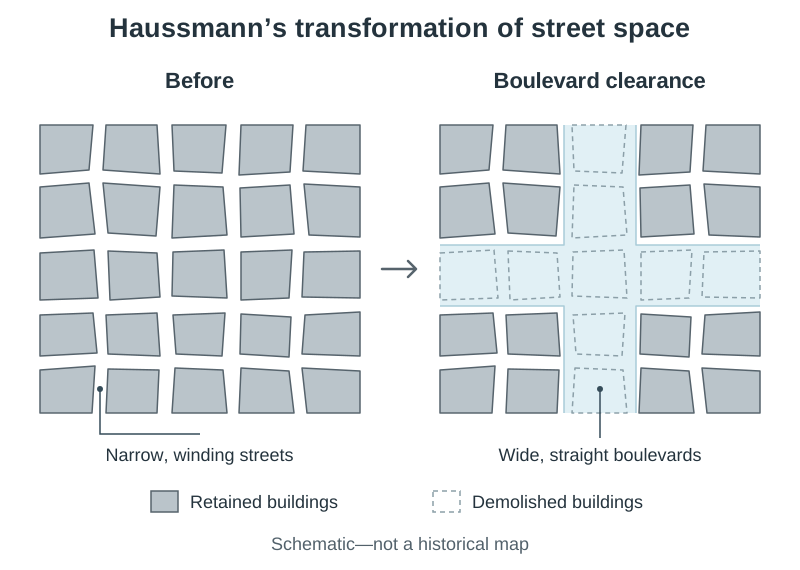
- The Boulevards and Strategic Arteries: Haussmann drove wide, straight boulevards through the city centre along a grand north-south and east-west axis (la grande croisée). Key completions included the Boulevard de Sébastopol, Boulevard Saint-Michel, Boulevard Saint-Germain, and the extension of the Rue de Rivoli, linking central markets (Les Halles) directly with the new railway termini (Gare du Nord and Gare de l'Est). Militarily, these broad avenues prevented rebels from throwing up barricades and enabled the army to deploy cavalry and artillery quickly. Avenue de l'Opéra was designed and cleared under Haussmann's administration, though finished after his fall, along with Charles Garnier's Opéra (1861-1875).
- Neoclassical Uniformity: Haussmann enforced strict municipal building regulations on private developers. Buildings fronting the new boulevards were constructed from cream Lutetian limestone, matched to street widths, capped with 45-degree zinc mansard roofs, and fitted with continuous wrought-iron balconies on the second and fifth floors, giving central Paris its uniform architectural appearance.
- Sewers and Clean Water Supply: Working with the civil engineer Eugène Belgrand, Haussmann modernised the city's sanitary infrastructure. Belgrand constructed 600 kilometres of underground vaulted stone sewers, isolating municipal waste from drinking water, while aqueducts brought clean water from the Dhuys and Vanne rivers into the city, eradicating water-borne cholera.
- Parks and Civic Amenities: Haussmann created expansive public green spaces, turning the Bois de Boulogne and the Bois de Vincennes into large landscaped parks, constructing the Parc des Buttes-Chaumont and Parc Montsouris in working-class areas, and opening twenty public squares. The installation of tens of thousands of gas streetlamps secured Paris its title as the 'City of Light' (Ville Lumière).
Social Consequences and Downfall
Haussmannisation cost roughly 2.5 billion francs, financed through speculative municipal loans and private credit companies (such as the Pereire brothers' Crédit Mobilier) that bypassed parliamentary supervision. In 1867, republican lawyer Jules Ferry published a scathing critique titled Les Comptes Fantastiques d'Haussmann ('Haussmann's Fantastic Accounts', a pun on Offenbach's opera The Tales of Hoffmann), exposing how the works were financed by concealed debt rather than approved taxation. Facing mounting political pressure, Napoleon III dismissed Haussmann in January 1870.
Haussmann's demolitions levelled approximately 20,000 historic houses and displaced over 100,000 poor citizens from the city centre to neglected outer suburbs (banlieues) like Belleville and Ménilmontant. This geographical segregation between a wealthy bourgeois core and an impoverished radical periphery fueled the Paris Commune (March-May 1871), when working-class districts seized control of the city before being crushed during the 'Bloody Week' (Semaine Sanglante).
Haussmann's Paris: Balance Sheet
| Achievements and Benefits | Social and Financial Costs |
|---|---|
| Built 600 km of modern sewers under Belgrand; wiped out water-borne cholera epidemics. | Demolished 20,000 historic buildings; destroyed medieval Parisian heritage. |
| Brought fresh water via Dhuys and Vanne aqueducts; piped water to upper floors. | Displaced over 100,000 poor residents to peripheral banlieues (Belleville, Ménilmontant). |
| Relieved traffic congestion; linked city markets to Gare du Nord and Gare de l'Est. | Rents doubled; deepened geographical and class segregation between rich and poor. |
| Created parks (Bois de Boulogne, Buttes-Chaumont), 20 squares, and gas lighting. | Incurred 2.5 billion francs of debt; exposed by Jules Ferry's pamphlet; fuelled the 1871 Commune. |
City Planning Elsewhere in Europe
Haussmann's work was part of a broader European trend driven by public health, imperial prestige, and political control:
- Vienna's Ringstrasse: In 1857, Emperor Franz Joseph ordered the demolition of Vienna's medieval city walls. In their place, the Austrian state constructed a grand, circular boulevard lined with monumental public buildings designed in historical revival styles: the Parliament, City Hall, State Opera, Burgtheater, and the University, physically projecting Habsburg authority.
- Barcelona's Eixample: In 1859, Catalan engineer Ildefons Cerdà designed a modern extension (Eixample) beyond the demolished city ramparts, using a regular grid pattern with wide streets, chamfered corner intersections for visibility, and internal courtyard gardens to ensure light and air for all social classes.
- London's Engineering Infrastructure: Following the 'Great Stink' of 1858, Sir Joseph Bazalgette built 82 miles of underground brick intercepting sewers and the Thames Embankments (1859-1875), focusing on utility and public health rather than broad boulevards.
- Model Industrial Villages: Industrialists also designed planned communities, such as Sir Titus Salt's textile village of Saltaire in Yorkshire (from 1853), which provided stone family cottages, baths, schools, and a dining hall, while prohibiting public houses.
Culture, Religion, and Developments in Science (1815-1871)
Between 1815 and 1871, European culture, religious institutions, and scientific thinking experienced deep transformations linked to the political and social struggles of the era.
Romanticism and Cultural Nationalism
Romanticism arose as an artistic, literary, and philosophical reaction against Enlightenment rationalism and industrial mechanisation. Romantics celebrated strong emotion, wild nature, heroic rebellion, and traditional folklore—the songs, stories, and language of the common people. This artistic current fed directly into cultural nationalism, which asserted that each distinct national people shared a unique national spirit (Volksgeist) that deserved preservation and sovereign political expression:
- Music: Giuseppe Verdi's operas became rallying symbols for Italian national liberation. The Chorus of the Hebrew Slaves (Va, pensiero) from Nabucco (1842) was adopted as an anthem of Italian yearning for freedom, while the slogan 'Viva VERDI' served as a coded call for Vittorio Emanuele Re D'Italia. In exile in Paris, Frédéric Chopin incorporated Polish folk rhythms into his piano polonaises and mazurkas to preserve national memory following the crushed 1831 Polish uprising.
- Literature and Language: In the German lands, Jacob and Wilhelm Grimm collected traditional folklore (1812-1815) and compiled a comprehensive German dictionary to foster linguistic unity. In Italy, Alessandro Manzoni published The Betrothed (I Promessi Sposi, 1827), using Tuscan Italian to establish a standardized national literary language. In France, Victor Hugo defended republican liberties and drew attention to urban poverty in romantic works including Notre-Dame de Paris (1831) and Les Misérables (1862).
- Visual Art: Eugène Delacroix captured national rebellion in Massacre at Chios (1824), rallying European public support for the Greek struggle against Ottoman rule, and in Liberty Leading the People (1830), commemorating the July Days in Paris.
The Churches and Social Change: France and Great Britain
Industrialisation separated millions of workers from traditional rural parishes, creating widespread working-class disaffection from organised Christianity:
- Great Britain: The 1851 Religious Census revealed that roughly half the population attended no Sunday church services, with non-attendance concentrated among urban factory labourers. In response, evangelical philanthropists like Lord Shaftesbury campaigned for child labour reform and factory acts. From 1848, Christian Socialists led by F.D. Maurice and Charles Kingsley established working men's colleges and promoted cooperative workshops. Methodism built strong working-class congregations, while William Booth founded the Christian Mission in London's East End in 1865, later renamed the Salvation Army.
- France: The Catholic Church aligned closely with conservative regimes. Under the Falloux Law of 1850, the French state gave religious orders extensive oversight over primary and secondary schools. However, secular republicans and radicals grew increasingly anticlerical, viewing the Catholic hierarchy as an arm of political reaction. Pope Pius IX hardened this divide in 1864 by issuing the encyclical Quanta cura accompanied by the Syllabus of Errors, explicitly condemning liberalism, religious tolerance, and modern civilisation. In 1870, the First Vatican Council proclaimed the dogma of Papal Infallibility, completing the division between orthodox Catholicism and the secular French republican movement.
Developments in Science and Medicine
- Biology and Evolution: In 1859, British naturalist Charles Darwin published On the Origin of Species, arguing that all organic life evolved through natural selection, where individuals possessing variations best adapted to their habitat survive and reproduce. Darwin's work challenged biblical creationism and ignited fierce controversy. At the famous Oxford British Association meeting in 1860, Thomas Henry Huxley defended the theory against Bishop Samuel Wilberforce, while Darwin remained at home due to illness. In 1866, the Austrian monk Gregor Mendel published his breeding experiments on garden peas, establishing the fundamental laws of genetic inheritance, though his findings went unrecognised until 1900.
- Germ Theory and Antiseptic Medicine: In the 1850s and 1860s, the French chemist Louis Pasteur proved that fermentation and food spoilage were caused by living airborne micro-organisms, disproving the theory of spontaneous generation. He patented pasteurisation (mild heating to kill harmful bacteria) in 1865, rescuing the French wine and silk industries. Pasteur's germ theory of disease established the foundations of modern bacteriology. In Scotland, surgeon Joseph Lister applied Pasteur's discoveries to surgical wards in Glasgow, using carbolic acid as an antiseptic from 1865-1867, dramatically reducing deaths from hospital-acquired infections.
- Electricity and Heavy Technology: In 1831, Michael Faraday discovered electromagnetic induction, showing that moving a magnet through a wire coil produced an electrical current, laying the groundwork for dynamos and electric motors. Practical application followed in 1866 when Werner von Siemens developed the self-exciting dynamo, enabling industrial electrical generation. In communications, the electric telegraph spread along rail corridors; by 1866, a transatlantic telegraph cable connected Europe and the United States. In metallurgy, Henry Bessemer patented the Bessemer converter in 1856, enabling the mass production of cheap, high-tensile steel for railways, bridges, and naval armour.
Evaluating the Key Personalities
At Higher Level, students must evaluate the contribution of each named key personality in relation to the syllabus elements, taking account of both contemporary and modern attitudes.
| Key Personality | Syllabus Element / Case Study | Core Historical Role | Contemporary Attitudes (1815-1871) | Current Historiographical Evaluation |
|---|---|---|---|---|
| Clemens von Metternich (1773-1859) | The Germanic lands; Congress System | Austrian Chancellor who orchestrated the Congress of Vienna and defended the conservative order until forced to flee in 1848. | Revered by monarchs as the defender of peace and social hierarchy; condemned by liberals and nationalists as the face of censorship and police repression. | Commended for diplomatic skill in maintaining a European balance of power and avoiding general war for thirty years, but criticised for failing to accommodate moderate constitutional reforms. |
| Giuseppe Mazzini (1805-1872) | Italy moves towards unity | Genoese prophet of the Risorgimento; founder of Young Italy (1831) and head of the Roman Republic (1849). | Hunted by Austrian police as a dangerous conspirator; idolised by republican youth; dismissed by Cavour as impractical and reckless. | Recognised as the indispensable moral and ideological driving force of Italian nationalism, though historians acknowledge his tactical weaknesses as a leader of armed insurrections. |
| Karl Marx (1818-1883) | Industrialisation, socialism, mass politics | Revolutionary socialist thinker; co-author of The Communist Manifesto (1848) and Das Kapital (1867); leader in the First International. | Monitored by police across Europe; expelled from France, Belgium, and Prussia; known primarily within radical immigrant labour circles. | Considered a towering intellectual figure whose materialist critique of capitalism transformed modern sociology and politics, though his prediction of inevitable proletarian revolution in industrial states did not materialise. |
| Mikhail Bakunin (1814-1876) | Industrialisation, socialism, mass politics | Russian revolutionary and theorist of collectivist anarchism; participant in 1848-1849 risings; Marx's rival in the First International. | Celebrated by young insurrectionary radicals as a passionate fighter on the barricades; denounced by Marx and trade unionists as an undisciplined conspirator. | Regarded as a pioneering figure in modern anarchism; historians frequently note the foresight of his warning that a Marxist 'dictatorship of the proletariat' would produce a bureaucratic dictatorship. |
| Feargus O'Connor (1794-1855) | Industrialisation, mass politics, Chartism | Irish-born radical leader of the 'physical force' wing of British Chartism; editor of the mass-circulation Northern Star. | Adored by hundreds of thousands of northern British factory workers; dismissed by MPs and distrusted by moderate 'moral force' leaders like William Lovett. | Evaluated as an effective pioneer of mass working-class communication who gave British workers a collective political voice, despite organisational errors and the collapse of his Chartist Land Plan. |
| Napoleon III (1808-1873) | The State in France; Haussmann's Paris | President of the French Second Republic (1848); seized absolute power in 1851; Emperor of the French (1852-1870). | Backed by rural peasants and the financial bourgeoisie; despised by republicans like Victor Hugo; mocked by Karl Marx as an authoritarian adventurer. | Viewed as an early practitioner of authoritarian modernisation who fostered railways, credit institutions, and urban renewal, but whose flawed foreign policy led to disaster at Sedan. |
| Victor Hugo (1802-1885) | Cultural nationalism; the State in France | French romantic novelist, poet, and republican deputy; lived in exile (1851-1870) for resisting Napoleon III's coup. | Regarded as France's leading literary figure; hero to republicans for his polemic Napoléon le Petit; received with a massive public welcome upon his return in 1870. | Seen as a literary giant who used romantic art to campaign for social justice and human rights, giving moral voice to the victims of poverty and political tyranny. |
| Charles Darwin (1809-1882) | Developments in science (biology) | British naturalist who formulated the theory of evolution by natural selection in On the Origin of Species (1859). | Provoked fierce scientific and theological controversy; attacked by conservative churchmen; defended in public debates by Thomas Henry Huxley. | Revered as the founder of modern evolutionary biology; historians distinguish his scientific work from the later distortions of 'Social Darwinism' used to justify imperialism and racial inequality. |
| Otto von Bismarck (1815-1898) | Confederation to Empire; 1848 in Germany | Prussian Minister-President and German Chancellor; unified Germany through 'blood and iron' (1862-1871). | Denounced by liberals in 1862 as an unconstitutional despot; celebrated across Germany after victories in 1866 and 1870 as the architect of national unity. | Viewed as a brilliant practitioner of Realpolitik and diplomatic calculation, though historians emphasise that his authoritarian constitutional structure undermined democratic development in Germany. |
| Sir Robert Peel (1788-1850) | Western agriculture; laissez-faire | British Prime Minister (1834-1835; 1841-1846); established the Metropolitan Police (1829); repealed the Corn Laws (1846). | Denounced as a party traitor by protectionist Tory landowners led by Disraeli; praised by manufacturing interests and urban workers for securing cheap bread. | Held up as the archetype of the principled, pragmatic conservative statesman who placed national interest above party unity, confirming Britain's turn to laissez-faire free trade. |
Key terms
- Nationalism
- The political ideology asserting that people sharing a common language, culture, and history form a distinct nation and possess the right to self-government within their own sovereign nation-state.
- Autocracy
- A system of government where absolute political authority is held by an individual ruler, unrestricted by a constitution, a parliament, or legal opposition, as seen in Tsarist Russia.
- Liberalism
- A 19th-century political ideology advocating personal civil liberties, freedom of the press, religious tolerance, the rule of law, and parliamentary government under a written constitution, typically supported by the property-owning middle classes.
- Democracy
- A system of governance based on popular sovereignty where political power is exercised by the entire adult population, represented in this period by campaigns for universal male suffrage.
- Realpolitik
- Pragmatic, hard-headed statecraft based on considerations of military power, national interest, and tangible leverage, rather than ethical, moral, or ideological theories; famously associated with Otto von Bismarck.
- Industrialisation / 'Industrial Revolution'
- The structural shift from an economy based on agriculture and manual craft to one based on machinery, coal-fired steam engines, iron, steel, factories, and railways, creating rapid urbanisation and an industrial wage-earning working class.
- Laissez-faire
- The free-market economic doctrine asserting that governments should not intervene in commerce through tariffs, subsidies, or price regulations, exemplified by Sir Robert Peel's repeal of the Corn Laws in 1846.
- Serfdom
- A feudal socio-economic system where agricultural labourers are legally bound to land owned by a noble master and required to provide unpaid labour and dues, abolished in the Russian Empire in 1861.
- Chartism
- A British working-class political movement between 1838 and 1848 that campaigned for democratic reform through the six points of the People's Charter, including universal male suffrage and the secret ballot.
- Socialism
- A political and economic doctrine advocating collective, cooperative, or public ownership of the means of production to achieve social equality, ranging from Robert Owen's model communities to Karl Marx's revolutionary scientific socialism.
- Romanticism
- An artistic and literary movement of the late 18th and early 19th centuries that reacted against Enlightenment rationalism by celebrating strong emotion, nature, heroic individualism, and national folklore.
- Zollverein
- The German Customs Union established under Prussian leadership in 1834 that abolished internal tariffs among participating states while excluding Austria, creating economic ties that paved the way for political unification under Berlin.
- Risorgimento
- Literally meaning 'resurgence', the 19th-century cultural and political movement that sought the liberation and political unification of the Italian peninsula into a single nation-state.
- Carlsbad Decrees
- A set of repressive measures introduced across the German Confederation by Metternich in 1819, banning student fraternities, establishing university surveillance, and imposing strict press censorship.
- Ems Telegram
- A diplomatic dispatch detailing an encounter between King William I of Prussia and the French ambassador, edited and published by Bismarck in July 1870 to provoke France into declaring war.
- Haussmannisation
- The large-scale reconstruction of Paris directed by Baron Haussmann between 1853 and 1870, characterised by wide boulevards, public parks, modern sewers, and uniform limestone facades.
- Environmental Determinism
- Robert Owen's core philosophy that human character and behaviour are not innate but are formed entirely by a person's physical, educational, and social surroundings ('character is made for him, not by him').
- Natural Selection
- The mechanism of biological evolution proposed by Charles Darwin in 1859, whereby organisms possessing variations best suited to their habitat survive and reproduce in greater numbers.
- Paternalism
- A style of industrial management or government where an authority provides housing, schooling, and welfare for workers while maintaining strict disciplinary control over their personal conduct and habits.
Check yourself
What were the Carlsbad Decrees of 1819, and why were they introduced by Metternich?
They were repressive measures introduced across the German Confederation following the murder of August von Kotzebue. They dissolved student fraternities, placed universities under state supervision, and enforced strict press censorship to crush nationalism and liberalism.
Name the six demands of the People's Charter and identify which one was never enacted into British law.
Universal male suffrage, equal electoral districts, abolition of property qualifications for MPs, annual parliaments, secret ballot, and payment for MPs. Annual parliaments was never enacted.
What was the Zollverein, and why was it vital in the process of German unification?
Established in 1834 under Prussian leadership, it was a customs union that abolished internal trade tariffs among member German states while excluding Austria, binding regional economies to Berlin decades before political unity.
Which three decisive wars did Bismarck orchestrate between 1864 and 1871 to achieve German unification?
The Second Schleswig War (1864 against Denmark), the Austro-Prussian War (1866 against Austria), and the Franco-Prussian War (1870-1871 against France).
What was the 'silent monitor' introduced by Robert Owen at New Lanark?
A four-sided wooden block hung above each worker's post with coloured faces (black, blue, yellow, white) indicating daily conduct, replacing corporal punishment with peer pressure.
Give two push factors and two pull factors behind European urban growth between 1815 and 1871.
Push factors: rural population growth, subdivided farm holdings, and crop failures (such as the Great Famine in Ireland). Pull factors: higher factory wages, railway construction employment, and domestic service for young women.
What did the Treaty of Adrianople (1829) decide for Greece and for Serbia?
It forced the Ottoman Empire to concede internal autonomy to Serbia under Miloš Obrenović and paved the way for the recognition of Greek sovereignty, finalised by the London Protocol of 1830.
Why did the New Model Unions, such as the Amalgamated Society of Engineers (1851), prove more durable than the GNCTU?
They restricted membership to skilled craftsmen, charged high dues that accumulated large financial reserves, provided sickness and unemployment benefits, and preferred arbitration to costly strikes.