

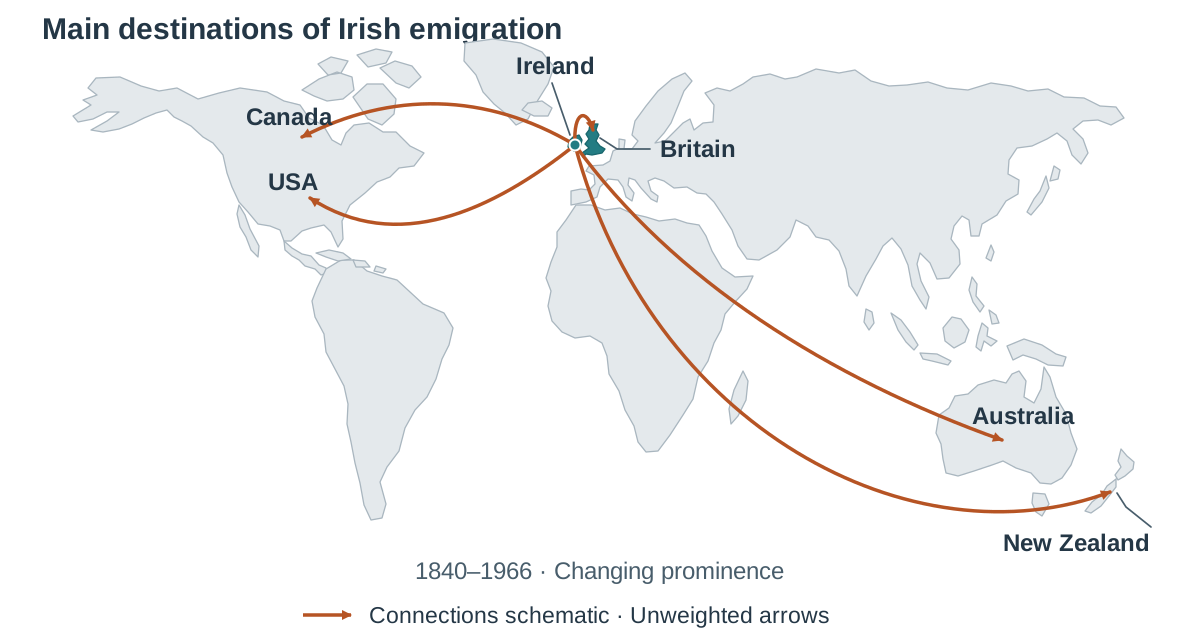
The Irish diaspora refers to the global dispersal and settlement of millions of Irish emigrants and their descendants between 1840 and 1966. In 1841 the island had roughly 8.2 million people; by 1961 the combined population had shrunk to around 4.25 million (roughly 2.8 million in the Republic and 1.4 million in Northern Ireland). Over that period about 6 million people left, turning emigration from an emergency into an expected life stage. Leaving Certificate Higher Level examines this topic across three perspectives: Economy and society (demographic waves, jobs, settlement, and state restrictions); Politics (anti-Irish prejudice, machine politics, transatlantic nationalism, anti-partition, and Ulster Unionist lobbying); and Culture and religion (the Catholic Church, the GAA, the Orange Order, missionaries, popular culture, and John F. Kennedy). Students must master three prescribed case studies: Grosse Isle (1847); Éamon de Valera in America (June 1919–December 1920); and the Holy Ghost mission to Nigeria (1945–1966).
1. Trends in Irish Emigration, Occupations, and Settlement (1840–1966)
Emigration was a permanent, structural reality of modern Irish life rather than a short-term crisis response. Between the Famine and the 1960s, outflow reshaped the island while anchoring overseas communities in North America, Britain, and Australasia.
| Period | Primary Destinations | Typical Demographic | Push and Pull Drivers | Typical Work and Where They Settled |
|---|---|---|---|---|
| Pre-1845 | Britain, Upper Canada, USA | Small farmers, artisans, labourers; substantial Ulster Protestant proportion | Rural poverty, collapse of domestic textile cottage industries, cheap Canadian timber-ship passages | Farm labour, canal digging (Erie Canal); settlement in Ontario, Maritime Canada, Pennsylvania, and New York |
| 1845–1855 (Famine decade) | USA (coastal cities), Canada (St Lawrence ports), Britain (Liverpool, Glasgow) | Entire destitute family units, cottiers, landless labourers; predominantly Catholic | Total potato crop failure, starvation, typhus, mass evictions, landlord clearance schemes | Unskilled manual labour, dock work, domestic service; Five Points (New York), North End (Boston), Liverpool cellars |
| 1855–1914 | USA (dominant), Britain, Australia, New Zealand | Single, young, unmarried adults; roughly equal numbers of men and women | Impartible inheritance (farm passed intact to one son), lack of rural employment, remittances | Men: railroads, building, Pennsylvania anthracite mines, Butte copper mines; Women: domestic service, textile mills |
| 1920–1966 | Britain (over 80% after 1930), USA (restricted by quotas), Canada | Unskilled labourers, tradesmen, healthcare staff | US quota laws, British post-war reconstruction, Irish economic stagnation | Men: building sites, motorways, London Transport; Women: NHS nurses, domestic work; Kilburn, Cricklewood, Birmingham |
The Mechanisms: Remittances, Passages, and Women Emigrants
After the Famine, departure settled into a self-funding routine. Emigrants' remittances (cash sent back by postal order) paid farm rents, cleared shop debts, and bought pre-paid passages (tickets purchased abroad and mailed home) for younger siblings. Chain-emigration meant people did not scatter at random: an early arrival from a parish found lodgings and work, then funded relatives and neighbours to follow. For instance, miners from the Beara peninsula in west Cork reassembled in the copper-mining city of Butte, Montana, creating tight townland networks and Irish-speaking neighbourhoods.
Ireland was unusual in Europe because women emigrated in roughly equal numbers to men, and often outnumbered them from the 1880s onwards. Under impartible inheritance, daughters who could not be provided with a dowry had few domestic options. American domestic service offered board, lodging, cash wages, and independent savings. Irish women became the primary source of remittances, funding the passage of brothers and sisters. Assisted schemes also moved women in organised batches: roughly 4,000 workhouse orphan girls were sent to Australia under the Earl Grey scheme (1848–1850), and philanthropist Vere Foster later helped fund tickets for tens of thousands of young women. Many also emigrated as religious sisters, running schools and hospitals abroad.
Life on the Ground: Two Emigrant Lives Compared
To understand change and continuity, consider two snapshots. In 1847, a destitute Connacht tenant family boarded a timber ship for Quebec, endured typhus at sea, arrived penniless, and never returned. In 1954, a single young man from Connemara took the mail train from Westland Row to Dún Laoghaire and the boat to Holyhead, found work on a civil engineering site in Northampton, sent home a postal order each Friday, and took the boat train home for Christmas. The labourer Domhnall Mac Amhlaigh captured this post-war world in his Irish-language memoir Dialann Deoraí (1960), detailing the physical strain, crowded lodgings, and social life of Irish navvies in Britain.
2. Increased Restriction and Regulation after 1920
Before the First World War, an emigrant needed little more than good health and the fare. After 1920, receiving countries and the Irish state closed down free movement.
American Immigration Restrictions
The US Emergency Quota Act of 1921 and the Immigration Act of 1924 (Johnson-Reed Act) set strict national quotas. Under the 1924 Act the Irish Free State received a separate annual quota of 28,567; when the national origins formula took effect in 1929 this was cut to 17,853. US consuls applied rigorous health checks and required financial affidavits proving the immigrant would not become a 'public charge'. Following the 1929 Wall Street Crash and the Great Depression, emigration to the United States plummeted, and in some years during the 1930s returnees outnumbered departures. The US Immigration and Nationality Act of 1965 abolished national quotas in favour of specific employment skills and close family reunification, which ended mass legal Irish migration to the US because most Irish-American families were generations removed.
British Redirection and Irish Wartime Controls
From 1923 an informal administrative arrangement—later called the Common Travel Area—permitted travel between Ireland and Great Britain without passports, making Britain the natural destination for over 80% of Irish emigrants after 1930. However, movement was not unrestricted. During the Emergency (1939–1945), both governments introduced tight controls. From 1940, anyone leaving Ireland for Britain required an official Irish travel permit and identity card. From 1942–1943, permits were granted only to individuals with a written offer from a named British employer, and the Irish government routinely refused permits to agricultural workers needed for harvest work at home. The British Ministry of Labour set up liaison offices in Dublin and regional towns to recruit labour directly, organising medical checks at Holyhead and Liverpool.
The Commission on Emigration (1948–1954)
In 1948 the inter-party government established the Commission on Emigration and Other Population Problems, which published its report in 1954. The commission found that net emigration was running at around 40,000 per year during the early 1950s, striking western rural counties hardest. The report identified poor living standards, low wages, and a lack of non-agricultural employment as the root causes. Its members divided over whether emigration was an indispensable social 'safety valve' or an indictment of independent Ireland's economic performance, and successive governments took little immediate action.
3. Prescribed Case Study 1: Grosse Isle Quarantine Station (1847)
Grosse Isle, an island in the Saint Lawrence River 48 km downstream from Quebec City, had served since 1832 as the British colonial quarantine station for Canada. In 'Black '47', it witnessed catastrophic scenes when Famine emigration overwhelmed the facility.
Administrative Neglect and Structural Failure
In February 1847, the medical superintendent, Dr George Douglas, warned colonial authorities that starving, disease-ridden Irish emigrants would overwhelm the island. He asked that the hospital capacity be expanded from 200 beds to at least 1,000. Colonial officials dismissed his warnings, voting funds for just two passenger sheds and thirty extra bunks. Emigrants booked Canadian passages because returning timber ships offered fares at roughly half the price of passages to New York or Boston, and passenger regulations on Canadian routes were rarely enforced. Steerage passengers endured foul, cramped conditions where epidemic typhus (spread by body lice) and relapsing fever spread unchecked.
The Crisis of 1847
The sailing season opened on 17 May 1847 with the arrival of the Syria, carrying 430 passengers, 84 of whom were ill, with nine dead at sea. Within a week, thirty more ships arrived. By late May, forty vessels formed a two-mile queue down the Saint Lawrence. The dead lay unburied on the beaches and in steerage berths because doctors and gravediggers were incapacitated. Landlord-assisted clearance schemes aggravated the horror: the Virginius, chartered by Major Denis Mahon to clear tenants from his Strokestown estate in County Roscommon, saw 158 of its 476 passengers die during the crossing or in quarantine (Mahon was assassinated in Roscommon the following November).
The Toll and Diaspora Remembrance
Over 5,000 Irish emigrants were buried in mass trenches on Grosse Isle in 1847. Over forty medical staff, hospital orderlies, and Catholic and Anglican clergy died of typhus contracted while attending the sick. Thousands more died inland in fever sheds at Montreal, Kingston, and Toronto. Many surviving orphans were adopted by local French-Canadian families, who preserved their original Irish surnames. In 1909, the Ancient Order of Hibernians erected a 46-foot Celtic cross atop the island's highest ridge, establishing Grosse Isle as a central site of diaspora memory.
Essay summary line to remember: Grosse Isle proved that mass Famine emigration was not a managed rescue, but an administrative catastrophe produced by cheap transport, landlord clearances, and official neglect.
4. Politics: Discrimination, Machine Politics, and Conflict
Irish Catholic emigrants encountered intense social, economic, and religious prejudice in both Britain and the United States.
Anti-Irish Sentiment in the US and Britain
In the United States, 1850s Protestant nativism coalesced into the 'Know-Nothing' party, which claimed Catholic arrivals took orders from Rome and undercut wages. Workplace notices carried the warning 'No Irish Need Apply' (NINA), while Thomas Nast's cartoons in Harper's Weekly portrayed Irishmen as ape-like thugs with low brows and shillelaghs. In Britain, hostility had three main sources: religious outrage following the restoration of the Catholic hierarchy in 1850 ('papal aggression'), which provoked the Stockport riots of 1852 and William Murphy's anti-Catholic riots between 1867 and 1871; economic competition, as Irish labourers were accused of depressing wages and breaking strikes; and political panic following the 1867 Fenian rescue in Manchester and the Clerkenwell prison explosion in London. Hostile depictions in Punch matched the American simian stereotypes.
Machine Politics: Tammany Hall
Irish-Americans had two political advantages: they spoke English, and they settled densely in major cities. They turned both into control of local branches of the Democratic Party, most famously New York's Tammany Hall. Under figures like Cork-born Richard 'Boss' Croker (leader from 1886 to 1902), Tammany ran a strict neighbourhood spoils system. In exchange for straight-party votes, precinct captains provided coal, food parcels, bail money, and municipal jobs in the police, fire brigade, and construction. While middle-class reformers and historians condemned Tammany for kickbacks and municipal graft, the machine gave working-class immigrants practical social protection and a route into public administration.
Industrial Conflict: The Molly Maguires
In the anthracite coal valleys of eastern Pennsylvania during the 1860s and 1870s, dangerous working conditions, poor wages, and company stores drove Irish miners to secret resistance. Operating under the cover of the Ancient Order of Hibernians, the Molly Maguires assaulted and killed mine superintendents. Franklin B. Gowen, president of the Philadelphia and Reading Railroad, hired the Pinkerton Detective Agency to break the network. Undercover detective James McParlan spent over two years infiltrating the society. In the 1876–1877 trials—prosecuted by Gowen and run amid anti-Irish press coverage—twenty Irishmen were convicted and hanged. The executions dismantled the network and reinforced nativist claims about Irish criminality.
5. Prescribed Case Study 2: Éamon de Valera in America (June 1919–December 1920)
In June 1919, having escaped from Lincoln Gaol, Éamon de Valera entered the United States as a stowaway aboard the SS Lapland. As President of Dáil Éireann, he had three aims: win official US recognition for the Irish Republic; sell External Dáil Loan certificates; and rally American opinion to pressure Britain during the War of Independence.
Publicity and the Loan Campaign
Accompanied by Harry Boland and Seán Nunan, de Valera staged major rallies, addressing 50,000 supporters at Boston's Fenway Park and filling Madison Square Garden in New York. He addressed state legislatures and was received with ceremony by state governors, giving his tour the look of a state visit, although the federal government never recognised him as head of state. Because the Irish Republic lacked diplomatic standing, it could not legally market foreign bonds; instead, it issued bond certificates, redeemable after the Republic achieved international recognition. The drive raised over $5 million, providing funds for the Dáil administration and IRA operations back home.
Diplomatic Deadlock and Party Conventions
De Valera failed in his main diplomatic goal. President Woodrow Wilson refused to receive him at the White House, prioritising the wartime partnership with Britain and worried that Irish agitation would sink Senate approval of the League of Nations Covenant. At the Republican National Convention in Chicago (June 1920) and the Democratic National Convention in San Francisco (July 1920), de Valera sought formal platform commitments recognising Irish independence. Both parties rejected the proposals.
The Split with Devoy and Cohalan
A bitter dispute broke out between de Valera and the leaders of Clan na Gael and the Friends of Irish Freedom (FOIF): veteran Fenian John Devoy and New York State Supreme Court judge Daniel Cohalan. The quarrel was fundamentally about control: de Valera insisted that all diaspora money and policy must submit to the elected Dáil government in Dublin, whereas Devoy and Cohalan maintained that Irish-Americans were American citizens who had to decide their own domestic political strategy. The rift widened in February 1920 when de Valera suggested in the Westminster Gazette that Britain could safeguard its security with Ireland under terms similar to the US-Cuban Platt Amendment (which allowed US intervention if Cuban independence was threatened). Devoy's newspaper, the Gaelic American, attacked this Cuban analogy as an abandonment of pure republicanism. In November 1920, de Valera formed a rival body, the American Association for the Recognition of the Irish Republic (AARIR), taking the bulk of the membership with him. When he departed aboard the SS Celtic in December 1920, he left Irish-American nationalism divided.
Essay summary line to remember: De Valera came to America for recognition and money; he got the money and the headlines but not the recognition, and in the process split Irish-America in two.
6. Transatlantic Nationalism, Anti-Partition, and the Protestant Diaspora
From the Famine onward, the diaspora was a regular supplier of money, arms, and lobbying for competing political movements in Ireland.
Revolutionary and Constitutional Nationalism
Founded in New York in 1858 by John O'Mahony, the Fenian Brotherhood funded rebel work, including the 1866–1870 border raids into British Canada. Its successor, Clan na Gael, led by John Devoy, organised the 1876 Catalpa rescue of six Fenian military prisoners from Fremantle, Western Australia. In 1879 Devoy negotiated the New Departure, backing Charles Stewart Parnell's constitutional party and Michael Davitt's Land League with American funds. In early 1880 Parnell and John Dillon toured over sixty US cities, raising around £70,000 and addressing the US House of Representatives. Patrick Ford's New York newspaper, the Irish World, raised Land League subscriptions and promoted radical land reform. Clan na Gael funds later helped finance the 1881–1885 dynamite campaign in British cities and covertly funded the 1916 Easter Rising via Tom Clarke and Patrick Pearse. In Britain, Irish voters elected Athlone-born journalist T. P. O'Connor as MP for Liverpool Scotland from 1885 to 1929, the only Irish nationalist to sit for a British constituency.
The Anti-Partition Campaign (1945–1951)
After the Second World War, nationalists mobilised the diaspora to oppose partition. The Anti-Partition League was founded in Dungannon in November 1945. In 1949, an all-party committee in Dublin collected funds outside Catholic church gates across the country for anti-partition candidates in Northern Ireland. Following his defeat in the 1948 Irish general election, Éamon de Valera, now leader of the opposition, carried out a world tour through the US, Britain, Australia, New Zealand, and India to rally opinion against partition. In New York, Mayo-born labour lawyer Paul O'Dwyer led the American League for an Undivided Ireland, lobbying Congress to attach anti-partition conditions to Marshall Aid. The campaign made little progress: during the Cold War, Washington would not pressure Britain, and Ireland's refusal to join NATO in 1949 due to partition undercut its influence. The British parliament responded by passing the Ireland Act 1949, guaranteeing Northern Ireland's constitutional place in the UK unless its own parliament consented otherwise.
Ulster Unionist Overseas Lobbying and Protestant Networks
The diaspora was not exclusively Catholic or nationalist. During the third Home Rule crisis (1912–1914), Ulster unionists appealed to kinship across the British Empire, circulating the Ulster Solemn League and Covenant (September 1912) for signature by Ulster emigrants in Britain, Canada, and Australia. Their key contact was Andrew Bonar Law, a Canadian-born politician of Ulster Presbyterian stock who led the British Conservative Party from 1911 and became Prime Minister in 1922. Bonar Law placed the British Conservatives behind armed Ulster resistance, giving unionism direct leverage in Westminster.
Presbyterian congregations carried an Ulster-Scottish or 'Scotch-Irish' identity in North America, particularly across Pennsylvania and the Appalachian region, celebrating figures like Andrew Jackson and Woodrow Wilson's grandfather while distinguishing themselves from later Catholic arrivals. In Canada, Australia, and New Zealand, the Orange Order formed strong fraternal networks. In Ontario, the Order exercised enormous municipal power; Toronto was nicknamed the 'Belfast of Canada', with Orange lodges dominating city politics, police appointments, and civic parades for decades.
7. Culture, Religion, and 'Ireland's Spiritual Empire'
Shared cultural and religious institutions sustained emigrant identity and eased integration into host societies.
The Catholic Parish and the GAA
In Britain, North America, and Australia, the Catholic parish provided community support alongside spiritual life, building parochial schools, orphanages, and mutual-aid societies. This network protected arrivals from sectarian hostility and gradually fostered assimilation, helping the children of emigrants move into the civil service, law, and education. Established in 1884, the Gaelic Athletic Association (GAA) followed emigrant routes to London, New York, Boston, and Chicago. County clubs offered arriving emigrants practical assistance in finding lodgings and jobs. In September 1947, the All-Ireland Football Final between Cavan and Kerry was played at the Polo Grounds in New York before 34,000 spectators, linking domestic sporting life with the diaspora.
Archbishop Daniel Mannix in Australia
Mannix arrived in Melbourne in 1912 as coadjutor archbishop and succeeded to the see of Melbourne in 1917. He became a prominent spokesman for Irish-Australian Catholic workers. Mannix spoke against conscription during the 1916 referendum campaign and emerged as its leading opponent in the second referendum of 1917; both were defeated. When he sailed for Europe in 1920 during the War of Independence, the Royal Navy intercepted his ship off the English coast and prohibited him from landing in Ireland. Loved by Irish-Australian Catholics, Mannix was attacked by Protestant loyalists as a sectarian agitator.
'Ireland’s Spiritual Empire' and Overseas Missions
By the early 1960s, between 6,000 and 7,000 Irish Catholic priests, brothers, and nuns were serving overseas. The enterprise was funded at home by mission boxes in schools and parish magazines. Major bodies included the Society of African Missions (SMA), St Patrick's Missionary Society (Kiltegan, founded 1932), and the Columban Fathers (founded in 1916 by Cork priest Bishop Edward Galvin, who worked in China until his expulsion by the Communist government in 1952). Religious sisters played a central part: Mother Mary Martin founded the Medical Missionaries of Mary in 1937, training sisters as certified doctors and midwives to work in African hospitals after Rome eased its prohibitions on religious sisters practising medicine.
8. Prescribed Case Study 3: The Holy Ghost Mission to Nigeria (1945–1966)
The Holy Ghost Fathers (Spiritans) operated in eastern Nigeria among the Igbo people, building one of the largest Catholic missionary networks in Africa.
The Education-Led Strategy
Tipperary-born Bishop Joseph Shanahan (vicar apostolic from 1920 to 1931) realised that conventional street preaching had little impact. Instead, he pioneered an education-first strategy, building bush primary schools across the region. Igbo communities welcomed Western schooling as an avenue to administrative and commercial posts in British colonial Nigeria. Shanahan linked baptism to school attendance, turning classroom literacy into an effective engine of Catholic conversion.
Post-War Expansion (1945–1966)
After 1945, the Irish Province sent hundreds of Spiritan priests trained at Kimmage Manor in Dublin to eastern Nigeria. Under Archbishop Charles Heerey, based in Onitsha, the mission expanded its educational system: by 1965 it ran well over a thousand primary schools, secondary colleges such as Christ the King College (CKC) in Onitsha, and teacher-training institutions. The Medical Missionaries of Mary ran maternity hospitals and clinics in places such as Anua, improving local healthcare.
Critical Evaluation
The schools educated an Igbo civil and political class that helped Nigeria gain independence in 1960. However, the mission had significant shortcomings. The Irish Spiritan leadership was slow to develop an indigenous Nigerian priesthood, keeping authority in Irish hands and prioritising primary schooling over seminaries. An Igbo priest, Francis Arinze, was not consecrated a bishop until 1965. When the Nigerian Civil War (Biafran War) broke out in 1967, the missionaries supported the Biafran humanitarian effort, leading the victorious federal government to expel foreign missionaries in 1970 and end direct Irish missionary leadership.
Essay summary line to remember: The Holy Ghost mission built an impressive education and healthcare system, but its reluctance to promote local clergy left it vulnerable when post-colonial politics turned violent.
9. Popular Culture, Heritage, and John F. Kennedy
During the mid-twentieth century, modern media, transatlantic aviation, and political milestones altered the diaspora's relationship with Ireland.
Film and Musical Images
Director John Ford's 1952 film The Quiet Man, shot around Cong, County Mayo, and starring Dublin-born Maureen O'Hara, created an enduring international impression of Ireland as pastoral and lyrical. While popular with contemporary audiences, critics noted that it relied on stage-Irish stereotypes of hard-drinking, belligerent country folk. Tenor John McCormack, Tin Pan Alley ballads, and the 1960s folk revival of the Clancy Brothers kept emotional ties alive abroad.
Tourism and Aviation
Transatlantic flights made return visits accessible. In 1947 Shannon Airport opened the world's first duty-free shop, turning the west of Ireland into a transit hub. State organisations like Bord Fáilte (established 1955) and the An Tóstal cultural festivals (beginning 1953) marketed genealogy, ancestral roots, and tourism to affluent Irish-Americans.
The Kennedy Presidency and the 1963 Visit
The political arrival of Irish Catholics in the United States was reflected in the Kennedy family. Joe Kennedy, grandson of a Famine emigrant, made a fortune in business and served as chairman of the Securities and Exchange Commission (1934) and US Ambassador to Great Britain (1938–1940), though his pre-war appeasement stance damaged his political prospects.
The election of his son, John F. Kennedy, as US President in November 1960 marked the high point of Irish-American assimilation. The victory was significant because of the anti-Catholic prejudice Kennedy had to overcome: in 1928, the Catholic Democratic candidate Al Smith had been defeated amid charges that a Catholic president would take orders from Rome. Kennedy confronted the issue directly, winning the Protestant West Virginia primary and delivering a major speech to the Greater Houston Ministerial Association on 12 September 1960, affirming his belief in the absolute separation of church and state. His visit to Ireland (26–29 June 1963)—including stops at New Ross, his ancestral homestead at Dunganstown, County Wexford, Cork, Galway, Limerick, and an address to the Oireachtas—drew massive crowds and affirmed the diaspora's pride in its heritage.
10. The Ten Key Personalities: How to Evaluate Them
Higher Level questions require candidates to evaluate key personalities by contrasting contemporary attitudes with modern historical judgements.
| Key Personality | Perspective and Role | Contemporary Attitudes (At the Time) | Modern Historiographical Evaluation |
|---|---|---|---|
| John Devoy (1842–1928) | Politics: Leader of Clan na Gael; editor of The Gaelic American; organised 1876 Catalpa rescue, 1879 New Departure, and 1916 Rising funding. | Revered by Fenians as the tireless organiser of Irish freedom; attacked by de Valera's followers after 1920 as stubborn and obstructive. | Evaluated as an indispensable transatlantic strategist who financed the Land War and 1916 Rising, though his autocratic manner split Irish-America. |
| Andrew Bonar Law (1858–1923) | Politics: Canadian-born British Conservative leader (1911–1921; 1922–1923) and Prime Minister; son of an Ulster Presbyterian minister. | Acclaimed by Ulster Unionists as their staunchest champion; condemned by British Liberals and Irish nationalists for endorsing armed Ulster resistance. | Demonstrates that the diaspora was not solely nationalist; shows how Ulster-Scots imperial networks directly shaped British policy against Home Rule. |
| Joe Kennedy (1888–1969) | Politics / Society: Financier; first SEC chairman (1934); US Ambassador to Great Britain (1938–1940); father of JFK. | Admired by Irish Catholics for breaking into the financial establishment; widely condemned in 1940 for defeatism and appeasement of Nazi Germany. | Assessed as a ruthless financial operator whose ambition helped break nativist barriers and established the foremost Catholic political dynasty in the US. |
| Richard 'Boss' Croker (1843–1922) | Politics: Cork-born head of New York's Tammany Hall Democratic machine (1886–1902). | Seen by immigrant Catholic workers as a practical friend who provided jobs and relief; condemned by Protestant reformers for graft and corruption. | Recognised as an effective machine politician whose patronage provided essential social security, even if sustained by systemic municipal kickbacks. |
| Archbishop Daniel Mannix (1864–1963) | Culture & Religion: Archbishop of Melbourne (1917–1963); anti-conscription leader and supporter of Irish independence. | Revered by working-class Irish-Australian Catholics as their defender; attacked by Protestant loyalists and PM Billy Hughes as a disloyal sectarian agitator. | Evaluated as a formidable civil-rights advocate who helped integrate Catholic workers into Australian politics, though his confrontational style sharpened sectarian divisions. |
| Domhnall Mac Amhlaigh (1926–1989) | Economy & Society: Kilkenny-raised building labourer and author of Dialann Deoraí (1960), translated as An Irish Navvy. | Praised in Irish-language literary circles for giving voice to the post-war emigrant generation in Britain. | Regarded by social historians as an indispensable primary witness to the working conditions, hardships, and community life of anonymous Irish navvies. |
| Paul O'Dwyer (1907–1998) | Politics: Mayo-born New York labour lawyer, civil rights defender, and anti-partition campaigner. | Respected by US trade unions and Irish republicans; regarded by mainstream politicians as a stubborn radical for his anti-partition stances. | Viewed as an effective progressive activist who linked traditional Irish anti-partition campaigning to the broader American civil rights movement. |
| Bishop Edward Galvin (1882–1956) | Culture & Religion: Cork priest; co-founder of the Columban Fathers (1916); Bishop of Hanyang, China. | Celebrated in Ireland as a courageous missionary pioneer who survived warlords and war; expelled by Chinese Communist authorities in 1952. | Regarded as a dedicated missionary of 'Ireland's spiritual empire', though working within the paternalistic assumptions of early twentieth-century Catholic missions. |
| Maureen O'Hara (1920–2015) | Culture: Dublin-born Hollywood actress; star of John Ford's The Quiet Man (1952). | Celebrated at home and abroad as an iconic Irish screen heroine; an international symbol of national pride. | Seen as a major cultural ambassador who raised Ireland's profile and boosted tourism, while acknowledging that her films entrenched romanticised stage-Irish tropes. |
| Mother Mary Martin (1892–1975) | Culture & Religion: Founder of the Medical Missionaries of Mary (1937); trained religious sisters as doctors and midwives for African missions. | Celebrated in Ireland as a pioneer of Catholic missions; her work became possible only after Rome's 1936 decree permitted sisters to practise medicine. | Evaluated as an innovative humanitarian reformer who modernised mission work by delivering professional maternity and hospital healthcare across Africa. |
Key terms
- Pre-paid passages
- Travel tickets purchased in destination countries (mainly the US and Britain) by established emigrants and mailed home so relatives could travel without cash.
- Chain-emigration
- The migration process whereby early settlers in an overseas town helped family members and parish neighbours join them in the same district and trades.
- Emigrants' remittances
- Money earned abroad and sent back to Ireland, used to pay agricultural rents, settle shop debts, and purchase tickets for younger siblings.
- Discrimination
- Sectarian, social, and economic prejudice experienced by Irish emigrants, seen in hiring bans like 'No Irish Need Apply', hostile cartoons, and nativist politics.
- Assimilation
- The process whereby an immigrant group adapts to the social, cultural, and political institutions of the host country, gaining mainstream acceptance.
- “Ireland’s spiritual empire”
- The global network of schools, hospitals, and missions established and staffed by Irish Catholic priests, brothers, and nuns across Africa, Asia, and Australasia.
- Nativism
- Political and social hostility by native-born citizens toward incoming immigrants, typified by the American Know-Nothing movement in the 1850s.
- Tammany Hall
- The New York County Democratic Party political machine, dominated by Irish-Americans from the 1870s through local patronage and municipal jobs.
- Molly Maguires
- A clandestine group of Irish anthracite coal miners in Pennsylvania in the 1860s and 1870s accused of carrying out violent attacks against mine bosses.
- AARIR
- The American Association for the Recognition of the Irish Republic, the diaspora group founded by Éamon de Valera in November 1920 after splitting with Clan na Gael.
- Orange Order
- A Protestant fraternal organisation founded in 1795 that established strong lodges in Canada and Australia, maintaining British imperial loyalty and opposing Home Rule.
- Navvy
- A manual labourer working on heavy civil engineering projects such as canals, railways, roads, and post-war reconstruction in Britain.
Check yourself
What main disease caused the deaths at Grosse Isle in 1847, and how did it spread?
Epidemic typhus, which was transmitted by body lice in the unwashed steerage quarters of passenger ships.
Why did de Valera's 'Cuban analogy' interview in the Westminster Gazette cause an open split with Devoy and Cohalan?
He suggested Ireland could accept security arrangements with Britain similar to the US-Cuban Platt Amendment, which Devoy and Cohalan attacked as compromising full republican sovereignty.
Name two ways the Irish government restricted emigration during the Emergency (1939–1945).
Requiring official travel permits and identity cards from 1940, and demanding a written job offer from a named British employer from 1942–1943 (while withholding permits from farm labourers).
What primary missionary method did Bishop Joseph Shanahan introduce in eastern Nigeria?
An education-first strategy, building bush primary schools and linking Catholic baptism to school enrolment.
Name two jobs Irish men and two jobs Irish women typically took up in post-war Britain, and two London districts where they settled.
Men worked in building/construction and transport; women worked in NHS nursing and domestic or service work. Common London districts included Kilburn and Cricklewood.
How did Canadian-born British Prime Minister Andrew Bonar Law influence diaspora politics?
He used his Ulster-Presbyterian diaspora connections to commit the British Conservative Party to supporting armed Ulster resistance against Home Rule between 1912 and 1914.
Who was Domhnall Mac Amhlaigh, and why is he a significant figure in this topic?
He was an Irish labourer whose memoir Dialann Deoraí (1960) provides first-hand primary evidence of the daily life and labour of Irish navvies in Britain.
How did John F. Kennedy address anti-Catholic prejudice during his 1960 US presidential campaign?
He won the Protestant West Virginia primary and addressed the Greater Houston Ministerial Association in September 1960, pledging his commitment to the absolute separation of church and state.