

Between 1945 and 1990, European overseas empires dissolved, ending centuries of direct imperial rule over one-third of the globe. Exhausted by the Second World War, European states confronted surging anti-colonial nationalism, financial bankruptcy, and the geopolitical reality of a Cold War dominated by the anti-imperialist United States and Soviet Union. This topic examines how colonies won independence through peaceful constitutional negotiation or protracted armed struggle, and how newly sovereign states coped with political fragility and economic dependence. It also explores how post-colonial migration transformed European societies, bringing colonial questions back to London and Paris. Three overarching questions organise this study: why did European empires collapse after 1945; why did the retreat take such radically different forms in different colonies; and what new economic, cultural, and political relationships emerged between former colonies and imperial metropoles?
1. Why European Imperial Rule Collapsed After 1945
In 1939, European empires governed vast swathes of Asia and Africa through contrasting colonial philosophies:
- Britain favoured indirect rule, governing through indigenous traditional elites, emirs, and princely rulers to reduce administrative overheads while preparing territories gradually for self-government.
- France pursued assimilation, operating on the theory that colonial subjects could become French citizens by adopting French language, secular republican values, and culture. In practice, full rights were granted to an elite minority, though Algeria was legally incorporated as three départements of metropolitan France.
- Portugal treated its territories as overseas provinces under António de Oliveira Salazar's Estado Novo dictatorship, refusing any constitutional path towards independence.
How the Second World War shattered imperial control
- Loss of prestige: Rapid Japanese victories in early 1942—taking British Malaya, Singapore, Burma, and the Dutch East Indies—demolished the myth of European military invincibility across Asia.
- Economic ruin: The war left European treasuries empty. Britain accumulated massive debts to the United States and was financially incapable of maintaining large standing armies to police restive colonies.
- Superpower opposition: Both the United States and the Soviet Union opposed classic European imperialism. The 1941 Atlantic Charter affirmed the right of all peoples to choose their own government, while the new United Nations provided an international forum for anti-colonial nationalists.
- Organised nationalism: Millions of African and Asian soldiers had served in Allied armies. Returning veterans joined trade unionists and Western-educated leaders such as Mohandas Gandhi, Ho Chi Minh, and Achmad Sukarno to demand immediate sovereignty.
2. Case Study: British Withdrawal from India, 1945–1947
India was Britain's most prized imperial territory. The speed and violent trauma of Britain's exit set a precedent for decolonisation across the globe.
Key Chronology: India 1945–1947
- July 1945: Clement Attlee's Labour government elected; commits to Indian self-government.
- February 1946: Royal Indian Navy mutiny in Bombay confirms British military weakness.
- Summer 1946: British Cabinet Mission's three-tier federal plan collapses.
- 16 August 1946: Direct Action Day leads to the Great Calcutta Killings.
- 20 February 1947: Attlee announces Britain will transfer power by June 1948.
- March 1947: Lord Louis Mountbatten arrives as the final Viceroy.
- 3 June 1947: Mountbatten unveils the Partition Plan, advancing independence to August 1947.
- 15 August 1947: Independence of India and Pakistan takes effect.
- 17 August 1947: Radcliffe Line border awards are published.
- 30 January 1948: Gandhi is assassinated by Hindu nationalist Nathuram Godse.
The Nationalist Division
By 1945, Indian politics was fractured between two competing movements:
- The Indian National Congress, led by Jawaharlal Nehru and Mohandas Gandhi, sought a united, secular, democratic India governed by majority rule.
- The All-India Muslim League, led by Muhammad Ali Jinnah, argued the 'two-nation theory'—that Indian Muslims formed a distinct nation requiring their own sovereign state, Pakistan. Jinnah feared Muslims would become a permanent, vulnerable minority in a Hindu-dominated central parliament.
The Decision to Partition and the Border Disaster
Wartime exhaustion, combined with the February 1946 naval mutiny, convinced Attlee's government that Britain could not hold India by force. When the Cabinet Mission failed to broker an agreement over the summer of 1946, Jinnah called for Direct Action Day on 16 August 1946. This unleashed the Great Calcutta Killings, leaving roughly 4,000 dead and triggering communal massacres across Bengal, Bihar, and Punjab.
Mountbatten concluded that preserving a unified India was impossible. To extricate Britain before order dissolved entirely, he advanced independence by ten months to 15 August 1947. This left British lawyer Sir Cyril Radcliffe barely five weeks to draw a border through Punjab and Bengal, two provinces where Hindu, Muslim, and Sikh communities lived side by side in the same towns and villages. Working with outdated census data and without field surveys, Radcliffe completed his line in secrecy. The Radcliffe Line was published on 17 August 1947, two days after independence had been declared.
The resulting chaos produced one of the worst humanitarian catastrophes of the twentieth century. Between 12 and 15 million people fled across the new frontiers in mutual terror. Communal militias attacked refugee trains and columns, killing between 500,000 and one million civilians. Gandhi refused to celebrate independence, using hunger strikes in Calcutta and Delhi to halt sectarian killings before being assassinated in January 1948.
3. Armed Decolonisation in Southeast Asia: Indochina and Indonesia
While Britain negotiated its departure from India, France and the Netherlands fought brutal colonial wars to re-establish control in Southeast Asia.
Indochina and Ho Chi Minh
In May 1941, Ho Chi Minh founded the Viet Minh (League for the Independence of Vietnam) to fight both Japanese occupation and French colonial rule, receiving Allied support during the war. On 2 September 1945, following Japan's surrender, Ho proclaimed the Democratic Republic of Vietnam in Hanoi. France refused to accept Vietnamese independence and deployed an expeditionary force, initiating full-scale war in December 1946.
The Viet Minh sustained rural guerrilla warfare under General Vo Nguyen Giap. After Mao Zedong's communist victory in China in 1949, the Viet Minh received heavy artillery and logistics. Viewing Indochina as a Cold War barrier against communism, the United States financed up to 80% of the French war effort. In May 1954, French forces were surrounded and decisively defeated at the siege of Dien Bien Phu. The July 1954 Geneva Accords ended French colonial rule and temporarily partitioned Vietnam at the 17th parallel, setting the stage for subsequent American involvement.
The Dutch East Indies and Sukarno
On 17 August 1945, nationalist leaders Achmad Sukarno and Mohammad Hatta proclaimed the Republic of Indonesia. The Netherlands attempted to reclaim the territory, launching two major military offensives (politionele acties) in 1947 and 1948 to recapture urban centres and valuable oil and rubber plantations.
Republican forces maintained tenacious guerrilla resistance in rural regions. The United Nations Security Council intervened, and the United States threatened to cut off Marshall Aid loans to the Netherlands. Recognizing the military stalemate and economic consequences, the Dutch conceded sovereignty to Indonesia on 27 December 1949. Sukarno became president, later establishing 'Guided Democracy' in 1959 before being displaced by General Suharto following the crisis of 1965–1967.
4. The Middle East: Palestine and the Suez Crisis (1945–1956)
The imperial retreat from the Middle East redrew boundaries, spurred ongoing conflict, and signalled the decline of European superpower status.
Palestine and the Creation of Israel
Britain governed Palestine under a League of Nations mandate, trapped between Zionism (the Jewish nationalist movement seeking a sovereign homeland) and Palestinian Arab demands for self-determination. Following the Holocaust, tens of thousands of Jewish survivors sought refuge in Palestine. Britain imposed strict immigration quotas to protect strategic ties with Arab oil-producing states, provoking armed Zionist underground resistance.
Paramilitary groups—the Irgun and Lehi—targeted British infrastructure. On 22 July 1946, the Irgun bombed the British administrative headquarters at the King David Hotel in Jerusalem, killing 91 people. With 100,000 troops unable to maintain order, Britain handed the mandate to the United Nations in February 1947.
In November 1947, UN General Assembly Resolution 181 recommended the partition of Palestine into separate Jewish and Arab states, with Jerusalem under international control. David Ben-Gurion, head of the Jewish Agency, accepted partition, while Palestinian Arab leaders and surrounding Arab states rejected it. On 14 May 1948, as the last British troops departed, Ben-Gurion proclaimed the State of Israel. Armies from Egypt, Jordan, Syria, Lebanon, and Iraq invaded the next day. Israel defeated the Arab forces, securing its territory and expanding beyond the UN partition lines, while Jordan took the West Bank and Egypt occupied the Gaza Strip. More than 700,000 Palestinian Arabs were displaced or fled during the war, an event remembered by Palestinians as the Nakba ('catastrophe').
The Suez Crisis, 1956
In Egypt, the Free Officers overthrew the pro-British King Farouk on 23 July 1952. Gamal Abdul Nasser, the driving force of the revolution, became Prime Minister in 1954 and President in 1956. Nasser negotiated the withdrawal of British troops from the Suez Canal zone (completed June 1956), secured Soviet-bloc weapons through the 1955 Czech arms deal, and emerged at the Bandung Conference of 1955, alongside Nehru, Sukarno and Tito, as a leading voice of non-alignment — the Non-Aligned Movement itself was formally founded at Belgrade in 1961.
When Britain and the United States cancelled funding for the Aswan High Dam in July 1956, Nasser nationalised the Anglo-French Suez Canal Company on 26 July. British Prime Minister Anthony Eden and French Premier Guy Mollet colluded secretly with Israel at Sèvres outside Paris in October 1956 (Protocol of Sèvres). Under the secret plan, Israel invaded the Sinai Peninsula on 29 October, allowing Britain and France to issue an ultimatum to 'separate the combatants' and land paratroopers at Port Said to seize the canal.
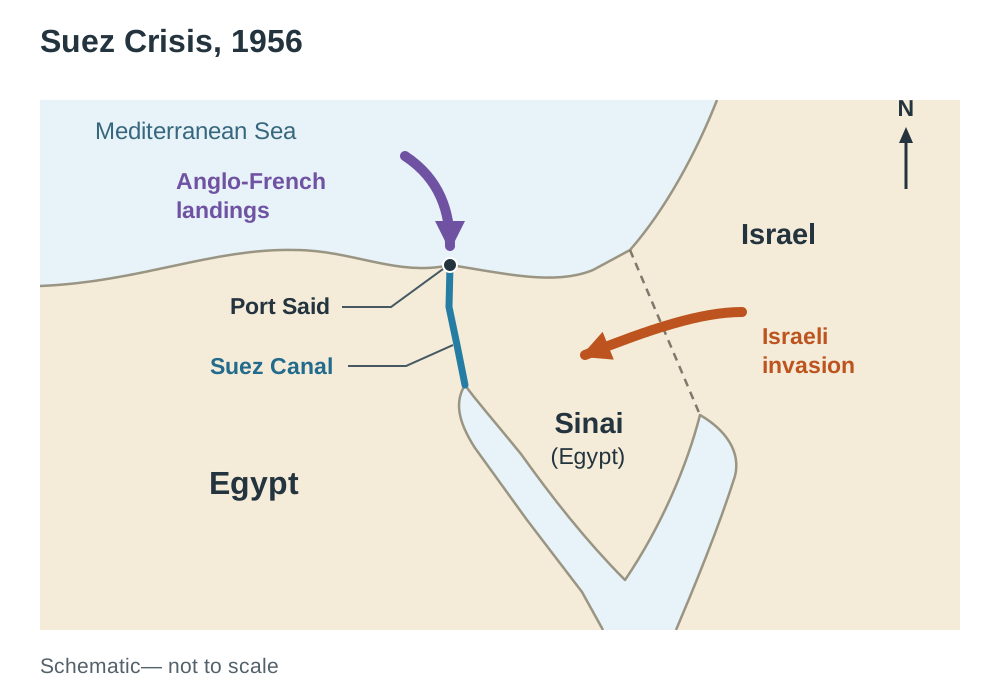
Militarily, the Anglo-French assault secured the canal corridor quickly. Politically and financially, it proved disastrous. US President Dwight D. Eisenhower refused to support the pound during a run on sterling and blocked Britain's access to an IMF emergency loan until it accepted a ceasefire; Washington also withheld emergency oil supplies after Arab states cut production. Chancellor Harold Macmillan warned the cabinet that British currency reserves would collapse. Eden accepted a ceasefire on 6 November. The crisis exposed British and French subordination to the United States and accelerated the dismantling of both empires.
5. Africa's 'Winds of Change': Algeria, Nigeria, Tanzania, and Angola
In February 1960, British Prime Minister Harold Macmillan delivered his 'Wind of Change' speech in Cape Town, recognising that African national consciousness was an unstoppable historical tide. The pathways to independence, however, varied dramatically across the continent.
Algeria: The War of Independence (1954–1962)
Algeria was not legally a colony at all. Since 1848 it had been governed as three départements—parts of France itself, with seats in the Paris parliament—and about one million European settlers (pieds-noirs) lived there alongside nine million disenfranchised Muslim Algerians. Giving Algeria up felt to many French people like abandoning French soil.
On 1 November 1954, the National Liberation Front (FLN) launched an armed insurrection. During the Battle of Algiers (January–September 1957), after FLN bomb attacks in the European quarter, General Jacques Massu and his 10th Paratroop Division were given full police powers. The paratroopers crushed the Casbah network using systematic torture and summary executions, which were exposed in France by journalists and officers like General Paris de Bollardière. France won the battle militarily but lost it politically, alienating domestic and international opinion.
Settler and army riots in Algiers brought down the Fourth Republic in May 1958, bringing Charles de Gaulle back to power. De Gaulle realised the war was unwinnable and offered Algerians self-determination in September 1959. A January 1961 referendum in France approved this policy by 75%, prompting the failed Generals' putsch in Algiers (April 1961) and a violent bombing campaign by the settler-led Secret Army Organisation (OAS). De Gaulle signed the Évian Accords on 18 March 1962. Algeria voted for independence in July 1962, prompting an exodus of roughly 900,000 pieds-noirs to France and the massacre of tens of thousands of harkis (Algerian Muslims who had served the French army).
Nigeria: Federalism and the Biafran Tragedy
Britain transferred sovereignty to Nigeria peacefully on 1 October 1960. The country was organised as a federation balancing three dominant ethnic groups: the Hausa-Fulani (North), Yoruba (West), and Igbo (East). Regional rivalries led to military coups in 1966, followed by massacres of Igbos in the North. In May 1967, Colonel Chukwuemeka Ojukwu declared the Eastern Region independent as the Republic of Biafra.
The Nigerian Civil War (1967–1970) saw the federal army encircle Biafra with an air and sea blockade. Mass famine killed up to two million civilians before Biafra surrendered in January 1970.
Tanzania: Independence by Negotiation
Tanganyika was governed by Britain after 1919 under a League of Nations mandate and, after 1946, as a United Nations trust territory, making Britain internationally accountable for political progress. In 1954, mission-educated schoolteacher Julius Nyerere turned the Tanganyika African Association into the Tanganyika African National Union (TANU), demanding independence by constitutional means.
TANU won overwhelming electoral mandates in 1958 and 1960, and Tanganyika gained independence peacefully on 9 December 1961 with Nyerere as Prime Minister (becoming President of the republic in 1962). Following the violent Zanzibar revolution in January 1964, Tanganyika and Zanzibar merged in April 1964 to create Tanzania. Nyerere retained Commonwealth membership but broke diplomatic ties with Britain in 1965 over its failure to crush the white-minority regime in Rhodesia.
Angola: Armed Decolonisation and Cold War Proxy Conflict
Portugal's Salazar regime insisted Angola was an integral overseas province, fighting a 13-year colonial war (1961–1974) against three rival nationalist factions: the Marxist MPLA, the FNLA, and UNITA. The human and financial drain provoked the Carnation Revolution in Lisbon in April 1974, when Portuguese army officers overthrew the dictatorship. Portugal withdrew in November 1975 without organising elections, and Angola plunged into a decades-long civil war with Cuban troops and Soviet weapons supporting the MPLA, while South Africa and the United States backed UNITA.
6. Case Study: The Secession of Katanga, 1960–1965
The Congo Crisis revealed how mineral wealth, imperial interference, and Cold War rivalries could cripple a newly independent state.
Key Chronology: The Katanga Secession
- 30 June 1960: Democratic Republic of the Congo gains independence from Belgium.
- 5 July 1960: Force Publique army mutinies against Belgian officers; Belgian troops intervene.
- 11 July 1960: Moïse Tshombe declares Katanga an independent state.
- 14 July 1960: UN Security Council passes Resolution 143, establishing ONUC.
- September 1960: Army Chief of Staff Mobutu seizes power; Lumumba is placed under house arrest.
- 17 January 1961: Lumumba is murdered in Katanga with Belgian and Katangan complicity.
- September 1961: Operation Morthor; Siege of Jadotville; Dag Hammarskjöld dies in plane crash.
- 28 December 1962: UN launches Operation Grand Slam against Katangan forces.
- 15 January 1963: Tshombe formally surrenders, ending the secession.
- 24 November 1965: Mobutu launches a second military coup, beginning a 32-year dictatorship.
The Breakaway of Katanga
Belgium ruled the Congo through strict paternalism, providing basic primary schooling but denying political rights, leaving the new state with only a handful of Congolese university graduates and not a single Congolese army officer—every officer in the Force Publique was Belgian. Independence arrived on 30 June 1960 with Patrice Lumumba as Prime Minister. Days later, the army mutinied, European administrators fled, and Belgian paratroopers intervened unilaterally.
On 11 July 1960, provincial governor Moïse Tshombe declared the mineral-rich southern province of Katanga independent. Katanga held massive copper, cobalt, and uranium deposits operated by the Belgian company Union Minière du Haut-Katanga (UMHK). The company diverted tax revenues directly to Tshombe's breakaway government and funded European mercenaries to defend the enclave, depriving the central government of more than 50% of its national revenue.
UN Peacekeeping, the Irish Role, and the End of Secession
Lumumba appealed to the United Nations. Under UN Security Council Resolution 143 (14 July 1960), which authorised the UN Operation in the Congo (ONUC) to help restore public order but barred it from intervening in internal political disputes, Secretary-General Dag Hammarskjöld initially refused to use military force against the secession. Desperate, Lumumba requested Soviet transport planes, prompting Western capitals to view him as pro-communist.
In September 1960, the army chief of staff, Colonel Joseph-Désiré Mobutu—the man who from 1972 called himself Mobutu Sese Seko, the name used on your course—seized power and arrested Lumumba. On 17 January 1961, Lumumba was flown to Katanga and murdered by Katangan gendarmes and Belgian executioners.
More than 6,000 Irish troops served with ONUC. In November 1960, nine Irish soldiers died in the Niemba Ambush. In September 1961, during UN Operation Morthor, 'A' Company of the 35th Irish Battalion under Commandant Pat Quinlan held out for five days against some 3,000 Katangese gendarmes and European mercenaries at Jadotville without losing a single man, before surrendering on 17 September when water and ammunition ran out. The next day, Hammarskjöld died in an air crash near Ndola while flying to negotiate with Tshombe.
Under new UN Secretary-General U Thant and with firm American diplomatic support, the UN adopted an aggressive posture. In late December 1962, ONUC launched Operation Grand Slam, crushing Katangese resistance and forcing Tshombe to surrender on 15 January 1963. After UN peacekeepers left in 1964, ongoing unrest gave Mobutu the opportunity to mount a second coup on 24 November 1965, establishing an authoritarian dictatorship. Backed by Belgium, France, and the United States as a staunch anti-communist Cold War ally, Mobutu consolidated personal rule. In 1971–1972, building on the renaming of cities in 1966 (Léopoldville had already become Kinshasa), the campaign of *authenticité renamed the country Zaire and the river, banned Western suits in favour of the abacost and Christian first names, and he took the name Mobutu Sese Seko*.
7. Post-Independence Relations with Former Imperial Powers
Formal independence rarely ended ties with Europe. Former colonial powers preserved influence through three distinct models:
1. Britain and the Commonwealth
The modern Commonwealth developed as a voluntary association of independent nations. Under the London Declaration of 1949, India was permitted to remain a member while becoming a republic, recognising the British monarch only as a symbolic 'Head of the Commonwealth'. New African and Asian states joined upon independence (Ghana 1957, Nigeria 1960, Tanganyika 1961). The Commonwealth gave Britain diplomatic reach and trade preferences, but no executive control: members condemned Britain over the 1956 Suez invasion and over its Rhodesia policy in 1965, while South Africa withdrew in 1961 due to criticism of apartheid.
2. France and Françafrique
France initially created constitutional federations—the French Union (1946) and the French Community (1958)—which reserved defence, foreign policy, and monetary policy to Paris. Even after full independence in 1960, France maintained a tight sphere of influence known as Françafrique. Fourteen newly independent African states retained the CFA franc, a currency pegged to the French franc and backed by the French Treasury. France signed bilateral military accords, stationed troops in bases across Senegal, Gabon, and Ivory Coast, intervened militarily in African crises dozens of times, and held regular Franco-African summits. Algeria was the sole exception: relations remained prickly, shaped by oil and gas contracts and the huge Algerian migrant community in France.
3. Rupture and Conflict
Where independence came through protracted military defeat, relations ruptured entirely. Indonesia expelled Dutch businesses and Dutch nationals in 1957 and fought over West New Guinea until the Netherlands surrendered the territory in 1962. France maintained no diplomatic ties with Ho Chi Minh's North Vietnam after 1954. Portugal abandoned Angola and Mozambique abruptly in 1975 without transition arrangements, leaving behind shattered economies.
8. Post-Colonial Economics: Lomé, Ujamaa, and Aid
Decolonised countries remained bound to former colonial powers through neo-colonialism and commodity dependence, exporting primary agricultural crops or raw minerals while importing high-cost European manufactured goods.
The Lomé Conventions
To structure trade with former colonies, the European Economic Community (EEC) signed the first Lomé Convention in Togo in 1975, covering 46 African, Caribbean, and Pacific (ACP) nations. Renewed in 1979, 1984, and 1989, Lomé provided:
- Tariff-free entry: Non-reciprocal access to EEC markets for most ACP agricultural and mineral exports.
- The STABEX system: A compensatory fund that reimbursed ACP countries when international market prices fell for critical cash crops such as cocoa, coffee, and groundnuts.
- Development assistance: Direct grants channelled through the European Development Fund for infrastructure.
Although Lomé softened price volatility, critics argued it locked post-colonial states into producing primary agricultural commodities rather than industrialising.
Julius Nyerere and Ujamaa in Tanzania
In Tanzania, President Julius Nyerere championed African socialism and self-reliance. Setting out his philosophy in the Arusha Declaration (1967), Nyerere introduced *ujamaa* (Swahili for 'familyhood'):
- Villagisation: Moving scattered rural populations into planned communal villages to supply primary schools, clean piped water, and health dispensaries efficiently.
- Nationalisation: Bringing foreign commercial banks, insurance firms, and plantations under state ownership.
Ujamaa delivered real social achievements, pushing adult literacy past 80% and fostering a united national identity free of ethnic strife. However, it collapsed economically. Communal farm yields dropped, state marketing boards became bureaucratic bottlenecks, and forced relocations after 1973 provoked widespread peasant opposition. The 1978–1979 war against Idi Amin's Uganda and soaring global oil prices forced Tanzania to turn to the IMF and World Bank, which demanded free-market cuts. Nyerere stepped down from the presidency in 1985.
Famine and the Development Worker
Post-colonial famines stemmed from drought, civil war, and agricultural disruption. The Biafran starvation of 1967–1970 and the Ethiopian famine of 1984–1985 generated massive public fundraising in Europe and expanded non-governmental organisations (NGOs). In Ireland, relief campaigns led to the creation of Africa Concern (1968, later Concern Worldwide), Trócaire (1973), and GOAL (1977). Catholic missionary orders—such as the Spiritans, Kiltegan Fathers, and Medical Missionaries of Mary—joined lay aid workers to run nutrition centres, health clinics, and emergency airlifts.
A key personality exemplifying this work was Fr Aengus Finucane (1932–2009), a Spiritan missionary from Limerick. During the Nigerian Civil War (1967–1970), Finucane organised feeding centres and coordinated emergency food distributions around the clandestine Uli airstrip in blockaded Biafra. His frontline reports on infant starvation helped prompt the establishment of Africa Concern in 1968. As chief executive of Concern Worldwide from 1981 to 1997, Finucane directed major international relief efforts during the 1984–1985 Ethiopian famine, expanding humanitarian logistics across the Horn of Africa, Bangladesh, and Sudan.
- Contemporary view: Celebrated in Ireland and across the international humanitarian sector as a compassionate, charismatic organiser who saved hundreds of thousands of lives through rapid emergency intervention.
- Modern evaluation: Modern historians and development economists praise his logistical courage and role in establishing Ireland's overseas aid reputation, but observe that emergency charity relief addressed immediate symptoms rather than the underlying structural causes of post-colonial poverty, such as international debt burdens, corrupt governance, and unequal global trade terms.
9. Post-War Migration to Britain and France
During the post-war economic boom, Britain and France recruited hundreds of thousands of workers from former colonies to overcome severe domestic labour shortages.
Multi-Racial Britain
Commonwealth migration began with the arrival of the Empire Windrush from Jamaica in June 1948. Under the British Nationality Act 1948, all Commonwealth citizens held British subject status and free right of entry. Immigrants from the Caribbean, India, and Pakistan took up essential employment in public transport, textile mills, and the newly established National Health Service (NHS).
Mounting racial hostility culminated in the 1958 Notting Hill riots in London. In response, Britain adopted a two-track strategy: restricting immigration while outlawing racial discrimination.
- Entry restrictions: The Commonwealth Immigrants Act 1962 restricted entry to employment-voucher holders. The Commonwealth Immigrants Act 1968 was rushed through Parliament in seven days to exclude Kenyan Asians holding British passports. The Immigration Act 1971 restricted right of settlement to those with a parent or grandparent born in the UK.
- Anti-discrimination legislation: Anti-discrimination law was built up in three stages: the Race Relations Act 1965 banned discrimination in public places, the 1968 Act extended this to employment and housing, and the 1976 Act outlawed indirect discrimination and set up the Commission for Racial Equality.
Flashpoints marked the post-war decades. On 20 April 1968, Conservative MP Enoch Powell delivered his 'Rivers of Blood' speech in Birmingham, warning that continued immigration would provoke civil conflict. Powell was sacked from the shadow cabinet, but dockers marched in his support. In autumn 1972, when Ugandan dictator Idi Amin expelled the country's Asian population, Edward Heath's government admitted roughly 27,000 Ugandan Asians. In April 1981, three days of rioting erupted in Brixton, south London, following aggressive police stop-and-search operations against young black men. The subsequent Scarman Report identified deep racial disadvantage in housing and jobs, recommending policing reforms.
Post-Colonial Migration to France
France recruited immigrant labour from Algeria, Morocco, Tunisia, and Portugal to work in car manufacturing, construction, and heavy industry. Workers were initially housed in makeshift shanty towns (bidonvilles) on city peripheries before moving into state housing estates (grands ensembles or banlieues).
Following the 1973 oil crisis, France suspended primary labour immigration in July 1974. However, through family reunification legislation (regroupement familial) in 1976, male workers brought their wives and children, transforming temporary migrant workers into permanent multi-generational communities.
10. Case Study: Race Relations in France in the 1980s
During the 1980s, the integration of post-colonial minorities became the centre of French political debate.
Key Chronology: France in the 1980s
- May 1981: François Mitterrand elected President; suspends deportations and legalises associations.
- September 1983: Front National achieves municipal breakthrough at Dreux.
- 15 October–3 December 1983: Marche des Beurs marches from Marseille to Paris.
- October 1984: SOS Racisme founded under Harlem Désir (Touche pas à mon pote).
- June 1984: Front National wins 11% in European Parliament elections.
- March 1986: Front National wins 35 seats in the National Assembly.
- October 1989: Three Muslim girls excluded from Collège Gabriel-Havez in Creil.
- 27 November 1989: Conseil d'État issues ruling on religious symbols in state schools.
The Banlieues and the Marche des Beurs (1983)
Second-generation North Africans, known colloquially as *Beurs (verlan slang for Arabes*), faced high youth unemployment, run-down housing, and police harassment. Socialist President François Mitterrand, elected in May 1981, regularised 130,000 undocumented migrants and granted foreign residents the legal right to form associations.
In summer 1983, violent police clashes occurred on the Minguettes housing estate in Vénissieux, a suburb of Lyon. Young residents responded by organising the Marche pour l'égalité et contre le racisme (Marche des Beurs). Inspired by Gandhi and Martin Luther King Jr., 32 young people left Marseille on 15 October 1983. By the time they arrived in Paris on 3 December, over 100,000 people joined the demonstration. Mitterrand met the marchers at the Élysée Palace and granted their main demand: a unified 10-year residence and work permit.
In October 1984, activists created SOS Racisme, led by Harlem Désir. Featuring an open hand badge with the slogan Touche pas à mon pote ('Hands off my mate'), the movement held mass rock concerts and won middle-class support, though grassroots Beur organisers complained that the Socialist Party had diluted their civil rights demands into superficial anti-racism.
The Front National and the Creil Headscarf Affair (1989)
At the same time, the far-right Front National (FN), led by Jean-Marie Le Pen, capitalised on rising anti-immigrant sentiment. The party achieved its first major breakthrough in September 1983 in a municipal by-election in Dreux, where the mainstream centre-right formed an electoral alliance with the FN. The FN won 11% in the 1984 European elections and secured 35 seats in the 1986 National Assembly election, putting immigration at the top of the political agenda.
In the autumn of 1989, the head teacher of the Collège Gabriel-Havez in Creil, north of Paris, excluded three Muslim pupils in early October for refusing to remove their headscarves (hijab) in class. The incident ignited a nationwide storm over *laïcité (the constitutional principle of strict secularism in state institutions). Traditionalists argued that visible religious emblems violated republican secular neutrality, while others argued that exclusion infringed individual freedom of religion. Education Minister Lionel Jospin referred the case to the Conseil d'État*, which ruled on 27 November 1989 that wearing religious symbols was acceptable provided it was not proselytising, ostentatious, or disruptive, leaving the decision to individual head teachers. The compromise pleased neither side and illustrated how French assimilation struggled to accommodate visible religious diversity.
11. Culture, Religion, and Language in the Post-Colonial Era
Decolonisation was not merely a transfer of political power; it sparked profound debates over cultural identity, religious allegiance, and national language across Africa and within Europe itself.
Cultural Tensions and Reversals After Independence
Newly sovereign nations sought to shed European cultural dominance and restore indigenous pride:
- In Senegal, President Léopold Sédar Senghor championed *Négritude*, an intellectual and artistic movement celebrating distinctive African cultural values and identity in direct defiance of French assimilation.
- In Tanzania, President Julius Nyerere established Swahili as the sole national language, using an indigenous tongue to transcend more than 120 ethnic divisions and build a unified national consciousness.
- In the Congo, building on the renaming of cities in 1966 (Léopoldville had already become Kinshasa), the 1971–1972 campaign of *authenticité renamed the country Zaire and the river, banned Western suits in favour of the abacost and Christian first names, and he took the name Mobutu Sese Seko*.
Religion in Post-Colonial Africa: Christianity and Islam
During the twentieth century, both Christianity and Islam expanded rapidly across sub-Saharan Africa. Colonial boundaries frequently enclosed diverse religious groups within a single state:
- In Nigeria, British indirect rule had preserved an Islamic emirate system in the north, while Christian missions spread rapidly through education in the south (among the Yoruba and Igbo). Following independence in 1960, this north/south religious and regional divide fuelled political instability, communal massacres, and the secession of Biafra in 1967.
- Across independent Africa, indigenous churches and local Islamic brotherhoods adapted world faiths to local cultures, creating powerful centres of moral and community authority outside state control.
Islam in Post-War Europe
Post-colonial labour migration transformed the religious landscape of Western Europe, making Islam the second-largest faith in both Britain and France. First-generation migrant workers initially worshipped in makeshift prayer rooms, but by the 1970s and 1980s, permanent communities established registered associations and constructed purpose-built mosques. This growing visible presence highlighted distinct national models of integration:
- In France, the autumn 1989 Creil headscarf controversy exposed the tension between traditional republican laïcité and visible Islamic religious practice in public schools.
- In Britain, the publication of Salman Rushdie's novel The Satanic Verses in late 1988 triggered widespread outrage among British Muslims, culminating in street demonstrations and book burnings in Bradford in January 1989. The Rushdie affair forced British society to confront multi-faith blasphemy laws and the realities of cultural diversity.
English as a World Language and Post-Colonial Literature
British imperial retreat left the English language entrenched globally as the medium of international trade, diplomacy, and higher education. However, African writers debated whether creating literature in a colonial language liberated or constrained African expression:
- Chinua Achebe (1930–2013): The Nigerian novelist chose to write in English to reclaim African history for a worldwide audience. In his masterpiece Things Fall Apart (1958), Achebe portrayed the richness and complex social order of pre-colonial Igbo society, demonstrating how British colonial administration and Christian missions fractured indigenous cohesion: the white man, wrote Achebe, "has put a knife on the things that held us together and we have fallen apart".
- Contemporary reception: Widely acclaimed across Africa and internationally for dismantling colonial stereotypes, though radical cultural nationalists criticised his reliance on the coloniser's language.
- Modern evaluation: Celebrated globally as the founding father of modern African literature in English, whose work restored dignity and agency to colonised peoples.
- In contrast, Kenyan writer Ngũgĩ wa Thiong'o argued in Decolonising the Mind (1986) that language was the carrier of culture, claiming that writing in European languages kept African minds culturally enslaved. He renounced writing novels in English to write exclusively in his native Gikuyu.
- Nadine Gordimer (1923–2014): The South African novelist used English to dissect the brutal psychological and social realities of the apartheid system in works such as Burger's Daughter (1979) and July's People (1981).
- Contemporary reception: Her unflinching depiction of racial injustice led the South African government to ban several of her books, while anti-apartheid movements revered her moral courage.
- Modern evaluation: Recognised as one of the twentieth century's most incisive political novelists, awarded the Nobel Prize in Literature in 1991 for writing that was "of very great benefit to humanity".
Key terms
- Colonial rule
- The direct political, administrative, and economic control of an overseas territory and its population by an imperial power.
- Assimilation
- The French colonial and domestic philosophy expecting colonised subjects or immigrants to fully adopt the French language, secular republican values, and culture.
- De-colonisation
- The historical process through which colonial powers withdrew control and subject nations secured political independence through negotiation or armed struggle.
- Zionism
- The Jewish nationalist movement founded in the late nineteenth century advocating for the establishment and defence of a sovereign Jewish homeland in Palestine.
- Terrorism
- The calculated use of violence against civilians or non-combatants to create fear and achieve political aims, such as the 1946 Irgun bombing of the King David Hotel.
- Tribalism
- A term used by colonial administrators to describe African ethnic identities. Modern historians prefer 'ethnicity', observing that colonial powers frequently manipulated or hardened these divisions.
- Racism
- Systemic hostility, discrimination, or prejudice directed against people on the basis of ethnic or racial origin, evident in the 1958 Notting Hill riots and the 1980s Front National campaigns.
- (British) Commonwealth
- A voluntary association of sovereign states comprising Britain and its former colonies, established in its modern form by the 1949 London Declaration.
- (French) Union and Community
- Post-war constitutional arrangements established by France in 1946 and 1958 attempting to maintain imperial ties by reserving defence, foreign policy, and finance to Paris.
- IMF
- The International Monetary Fund; an international financial body that provides emergency balance-of-payments loans, often attaching structural adjustment free-market conditions.
- World Bank
- An international financial institution that finances long-term infrastructure and development projects in developing countries.
- Transnational economy
- A globalised economic system where trade, capital investment, and corporate supply chains operate beyond the regulatory power of individual nation-states.
- NGO
- A Non-Governmental Organisation; an independent, non-profit body dedicated to humanitarian aid, emergency famine relief, or human rights work (e.g. Concern, Trócaire, GOAL).
- Cultural diversity
- The coexistence of different ethnic, racial, linguistic, and religious groups within one society.
- Identity
- How individuals and communities define themselves through language, religion, race, and nationality in the wake of decolonisation and migration.
- Neo-colonialism
- The indirect economic and financial control exercised by former imperial powers and multinational corporations over nominally sovereign developing states.
- Ujamaa
- The Swahili concept of 'familyhood' introduced by Julius Nyerere in Tanzania, based on rural villagisation, state nationalisation, and economic self-reliance.
- Lomé Convention
- A 1975 trade and aid agreement between the EEC and developing ACP nations, providing tariff-free access and export earnings guarantees via STABEX.
- Laïcité
- The principle of constitutional secularism in France requiring state institutions and public schools to remain strictly neutral regarding religious practice and emblems.
- Radcliffe Line
- The boundary demarcated in August 1947 by Sir Cyril Radcliffe partitioning the provinces of Punjab and Bengal between India and Pakistan.
Check yourself
What primary domestic crises compelled Clement Attlee's government to advance the Indian independence deadline to August 1947?
Mass communal massacres following Direct Action Day in August 1946, acute British financial exhaustion, and doubts over military reliability following the February 1946 Royal Indian Navy mutiny.
Which decisive 1954 siege brought an end to French imperial rule in Indochina?
The Battle of Dien Bien Phu, which led directly to the 1954 Geneva Accords.
What secret protocol was agreed between Britain, France, and Israel to coordinate the 1956 Suez military intervention?
The Protocol of Sèvres.
Why did the Belgian mining corporation Union Minière du Haut-Katanga finance Moïse Tshombe's secession in 1960?
To protect its copper and cobalt mining concessions and divert tax revenues away from Patrice Lumumba's central government in Leopoldville.
What economic mechanism under the 1975 Lomé Convention compensated ACP countries for sudden drops in agricultural commodity prices?
The STABEX (System for the Stabilisation of Export Earnings) scheme.
What major legal concession did President François Mitterrand grant following the 1983 Marche des Beurs?
A unified 10-year residence and work permit for foreign residents in France.
Which Kenyan writer argued in Decolonising the Mind (1986) that writing in English kept Africans culturally enslaved, and what language did he adopt?
Ngũgĩ wa Thiong'o; he renounced writing fiction in English in favour of Gikuyu.
What sweeping cultural changes did Mobutu introduce during his 1971–1972 authenticité campaign in the Congo?
Building on the renaming of cities in 1966 (Léopoldville had already become Kinshasa), the 1971–1972 campaign renamed the country Zaire and the river, banned Western suits in favour of the abacost and Christian first names, and he took the name Mobutu Sese Seko.
Which two 1989 controversies highlighted the growing debate over the place of Islam in modern Europe?
The Salman Rushdie affair in Britain and the Creil headscarf affair in France.
How did the 1949 London Declaration reshape the British Commonwealth for newly sovereign nations?
It allowed member states like India to remain within the Commonwealth as independent republics without swearing allegiance to the British Crown, accepting the monarch solely as symbolic Head of the Commonwealth.