

Leaving Certificate History Topic EUR2 explores Europe from the foundation of the German Empire in 1871 to the Paris Peace Settlement of 1919–1920. The emergence of a unified, industrialised Germany fundamentally altered the European balance of power. Otto von Bismarck managed this delicate equilibrium through a web of defensive alliances, but Kaiser Wilhelm II abandoned this caution for Weltpolitik, colonial expansion, and a naval arms race with Great Britain. Balkan nationalism turned Serbia into the fulcrum of Great Power rivalry, triggering the First World War in July 1914. The course traces the military deadlock on the Western Front, the mobilisation of home fronts, the collapse of imperial dynasties in Russia and Germany, the peace treaties, and sweeping changes in European society, culture, and technology. Higher Level students must master all three syllabus perspectives (Politics and Administration; Society and Economy; Culture, Religion, and Science), evaluate ten key personalities by contrasting contemporary and modern attitudes, apply nine key concepts, and understand the three prescribed case studies: the naval policy of Wilhelm II, women in the workforce during World War I, and the invention and early history of the motor car.
1. The Second Reich: Political Structure and Bismarck's Foreign Policy (1871–1890)
On 18 January 1871, King Wilhelm I of Prussia was proclaimed German Emperor in the Hall of Mirrors at Versailles following Prussia's victory in the Franco-Prussian War. Under the 1871 Treaty of Frankfurt, France ceded Alsace-Lorraine and was forced to pay an indemnity of five billion gold francs. This humiliation fostered a lasting French desire for revenge (revanche) and established Franco-German enmity as the central fault line of continental politics.
The Political Structure of the Second Reich
The German Empire was a federal state of 25 member states dominated by Prussia, which contained two-thirds of the empire's population and territory.
- The Kaiser served as head of state, held supreme command of the armed forces, directed foreign policy, and appointed or dismissed the Chancellor.
- The Chancellor answered solely to the Kaiser, not to parliament.
- The Reichstag was elected by universal male suffrage over 25 years of age. It voted on taxation and military budgets but could not appoint ministers, introduce major legislation independently, or unseat the Chancellor.
- The Bundesrat represented the individual state governments, with Prussia holding a veto over constitutional amendments.
- The Prussian military caste maintained direct access to the Kaiser, placing the army largely outside civilian legislative scrutiny.
Bismarck's Defensive Web (1871–1890)
The balance of power—the principle that no single power should dominate Europe—was upset by German unification. Otto von Bismarck declared Germany a 'satiated' power with no further continental territorial ambitions. His strategy rested on two axioms: keep France diplomatically isolated, and prevent a two-front war by staying on friendly terms with Tsarist Russia and Austria-Hungary.
| Year | Treaty or Event | Strategic Purpose and Terms |
|---|---|---|
| 1873 | Dreikaiserbund (Three Emperors' League) | Informal monarchical solidarity pact between Germany, Austria-Hungary, and Russia to isolate republican France. |
| 1878 | Congress of Berlin | Bismarck acted as 'honest broker' to defuse the Russo-Turkish War crisis. It averted war but left Russia resentful over Austrian gains in Bosnia. |
| 1879 | Dual Alliance | Secret, binding military pact: Germany and Austria-Hungary pledged mutual support if attacked by Russia, or neutrality if attacked by another power. Bedrock of German strategy to 1914. |
| 1881 | Revived Three Emperors' Alliance | Rebuilt ties with Russia, securing mutual neutrality if any signatory went to war with a fourth power. |
| 1882 | Triple Alliance | Italy joined Germany and Austria-Hungary, seeking protection after France occupied Tunisia. |
| 1887 | Reinsurance Treaty | Secret bilateral pact: Germany and Russia pledged neutrality unless Germany attacked France or Russia attacked Austria-Hungary. Avoided a Franco-Russian coalition. |
Key Personality Evaluation: Otto von Bismarck
- Contribution: Architect of the Second Reich; preserved continental peace for two decades through flexible diplomacy; launched the Kulturkampf and the Anti-Socialist Laws (1878–1890); created the world's first modern state welfare legislation (1883–1889).
- Contemporary Attitudes: Revered by German nationalists as the 'Iron Chancellor'; opposed by Catholics during the Kulturkampf and hated by the working-class left; admired yet feared by European diplomats; dismissed by the young Wilhelm II in March 1890 as overbearing.
- Current Historical Interpretation: Historians recognise his tactical brilliance in keeping France isolated and averting war, but point out that his alliance system was too intricate and personal to survive him. Domestically, his autocratic constitution stunted democratic development, and his domestic crusades ultimately strengthened both political Catholicism and the Social Democratic Party.
2. Structures of European Diplomacy, Anglo- and Franco-German Tensions, and Weltpolitik
How European Diplomacy Worked (1871–1914)
Diplomacy was managed by small political and social elites operating largely in secret:
- Foreign Ministries and Embassies: Foreign policy was directed by rulers, chancellors, and foreign ministers (the Wilhelmstrasse in Berlin, the Quai d'Orsay in Paris, the Foreign Office in London), executed by career diplomats in permanent foreign embassies.
- Secret Treaties: Clauses in the Dual Alliance (1879) and Reinsurance Treaty (1887) were concealed even from cabinet colleagues and allies. Italy never saw the secret text of the Austro-German core agreement. This secrecy bred profound international paranoia.
- Dynastic Ties: Wilhelm II, Tsar Nicholas II and King George V were closely related — George V was a first cousin of both — and royal visits and personal correspondence (the 'Willy-Nicky' telegrams) were used as diplomatic instruments, though family ties proved powerless against national rivalries.
- Congresses and Conferences: Great Powers gathered to resolve flashpoints peacefully: the Congress of Berlin (1878), the Berlin West Africa Conference (1884–1885), and the Algeciras Conference (1906). This multilateral approach worked for imperial partitioning but collapsed under Balkan ethnic nationalism.
- Military Timetables: From 1900, general staffs drafted rigid railway mobilisation schedules (Germany's Schlieffen Plan, Russia's Plan 19, France's Plan XVII). Once mobilisation began, military timetables superseded diplomatic negotiations.
- Press and Public Opinion: Mass-circulation newspapers and jingoistic pressure groups, such as the German Navy League and the British naval press, inflamed popular national rivalries and severely restricted diplomatic compromise.
Wilhelm II and Weltpolitik
In 1888, Wilhelm II became Kaiser. He dismissed Bismarck in March 1890 and dropped the Reinsurance Treaty, assuming dynastic ties with Russia were sufficient. Finding itself isolated, Russia signed the Franco-Russian Alliance in 1894, creating the two-front encirclement Bismarck had spent twenty years preventing.
In December 1897, State Secretary for Foreign Affairs Bernhard von Bülow (Chancellor from 1900) declared that Germany demanded its 'place in the sun'. This policy of Weltpolitik (World Policy) sought to transform Germany into an overseas imperial power. Weltpolitik fed directly into the New Imperialism—the scramble by European powers after about 1880 for colonies in Africa and Asia, driven by the hunt for raw materials and captive markets, the need for naval coaling stations, and national prestige.
Anglo-German and Franco-German Tensions
Causes of Anglo-German Friction:
- The Naval Race: Germany's battle fleet construction directly challenged Britain's island security and global maritime trade.
- Commercial Rivalry: German steel, chemical, and electrical goods undercut British exports, prompting Britain's 1887 law requiring imported goods to be stamped 'Made in Germany'.
- Imperial Friction: Wilhelm's Kruger Telegram (1896) cheered Boer resistance, and the proposed Berlin-Baghdad Railway stoked British fears over landward threats to the Persian Gulf and India.
- The Daily Telegraph Affair (1908): Wilhelm claimed the English were 'mad as March hares' and asserted his naval buildup was aimed at Japan, embarrassing his government and alienating British opinion.
- The Failed Haldane Mission (1912): Talks collapsed when Germany demanded British neutrality in any continental war in exchange for limiting fleet construction.
Franco-German Friction:
- The Annexation of Alsace-Lorraine (1871): Generated permanent French grievance (revanche).
- Diplomatic Intimidation: The 'War in Sight' crisis (1875) and the Schnaebele border incident (1887) were heavy-handed German attempts to keep France submissive.
- The Moroccan Crises: In the First Moroccan Crisis (1905), Wilhelm landed at Tangier to disrupt French influence. At the Algeciras Conference (1906), Britain and Italy backed France, leaving Germany isolated. In the Agadir Crisis (1911), Germany sent the gunboat Panther to claim compensation; British warnings forced Berlin to back down in exchange for useless strips of Congolese marsh.
Crucially, the Entente Cordiale (1904) and the Anglo-Russian Convention (1907) were diplomatic understandings resolving colonial friction, not binding military pacts. Britain was never legally bound to defend France in 1914; it entered the war because Belgian neutrality was breached.
Contrast: Bismarck vs. Wilhelm II
| Feature | Otto von Bismarck (1871–1890) | Kaiser Wilhelm II (1888–1918) |
|---|---|---|
| Strategic Aim | Preserve status quo; declared Germany 'satiated' | Weltpolitik; pursue global imperial power |
| Attitude to France | Isolate France diplomatically to stop revanche | Confronted France directly over Morocco |
| Attitude to Russia | Crucial partner; secured Reinsurance Treaty | Dropped Reinsurance Treaty; alienated St Petersburg |
| Attitude to Britain | Avoided friction; regarded Britain as an offshore partner | Challenged Britain through naval expansion and colonial rivalry |
| Outcome by 1914 | Germany anchored a dominant continental coalition | Germany was encircled by the Triple Entente, tied to a declining Austria-Hungary |
4. Serbia as the Fulcrum of Great Power Rivalry and the Outbreak of War (1914)
A fulcrum is the central pivot around which a larger mechanism turns. Between 1903 and 1914, the small Kingdom of Serbia served as the pivot of Great Power rivalry in south-eastern Europe.
South Slav nationalism pitted Austria-Hungary directly against Tsarist Russia. Serbia sought to unite the South Slavs (Yugoslavs), including millions of Serbs, Croats, and Slovenes under Habsburg rule, into an independent Greater Serbia. Russia backed Serbia to champion Pan-Slavism and project power towards the Mediterranean Straits. Austria-Hungary viewed Serbian nationalism as an existential threat to its multinational empire.
Four Balkan Flashpoints
- The 1903 Belgrade Coup: Serbian military officers murdered the pro-Austrian King Alexander Obrenović, installing King Peter Karageorgević, who aligned Serbian foreign policy with Russia.
- The 'Pig War' (1906–1908): Austria-Hungary banned Serbian livestock imports to crush its economy. Serbia secured French commercial loans and found alternative export routes, asserting its economic independence.
- The Bosnian Crisis (1908–1909): Austria-Hungary annexed Bosnia-Herzegovina in October 1908. Serbia and Russia protested, but backed down in March 1909 when Germany gave Vienna unconditional backing—Wilhelm II boasted he stood beside his ally 'in shining armour'. Humiliated, Russia resolved never to yield in the Balkans again.
- The Balkan Wars (1912–1913): Balkan states expelled the Ottoman Empire from most of Europe. Serbia nearly doubled its territory, prompting Austrian Chief of General Staff Franz Conrad von Hötzendorf to demand a pre-emptive war against Belgrade.
The July Crisis of 1914
On 28 June 1914, Archduke Franz Ferdinand, heir to the Austro-Hungarian throne, and his wife Sophie were assassinated in Sarajevo by Gavrilo Princip. Princip was a member of Young Bosnia, backed and armed by the Black Hand, a Serbian military conspiracy led by Dragutin Dimitrijević ('Apis').
- 5–6 July: Germany issued the unconditional 'blank cheque' to Vienna, guaranteeing military support.
- 23 July: Austria-Hungary delivered an ultimatum to Serbia with severe terms designed to be rejected.
- 28 July: Serbia accepted almost all demands, but Austria-Hungary declared war and shelled Belgrade.
- 30 July: Tsar Nicholas II ordered general Russian mobilisation to protect Serbia.
- 1–3 August: Germany declared war on Russia on 1 August, and on France on 3 August.
- 4 August: Germany executed the Schlieffen Plan, marching into neutral Belgium. Britain declared war under the 1839 Treaty of London.
5. The Conduct of War, War of Attrition, and Douglas Haig (1914–1918)
The Schlieffen Plan and Stalemate
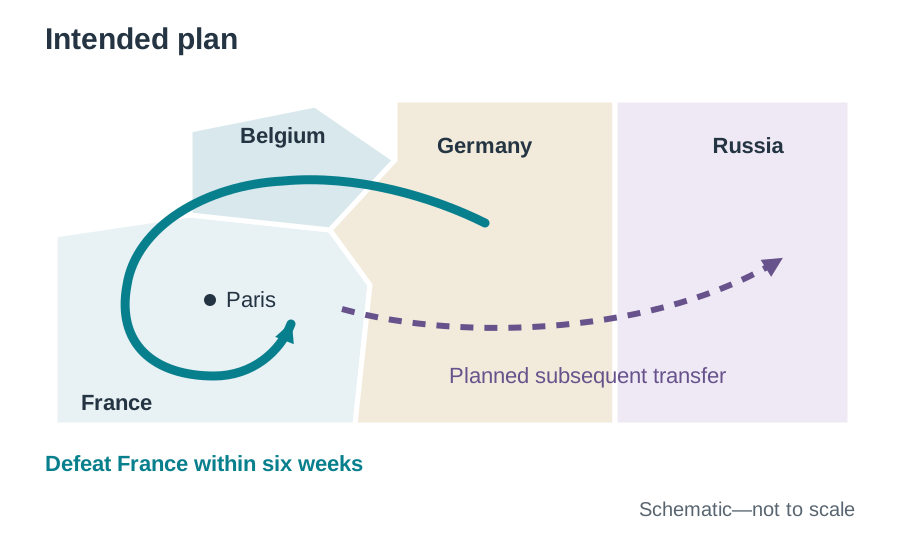
Drafted by Count Alfred von Schlieffen in 1905, the Schlieffen Plan aimed to solve Germany's two-front dilemma. Assuming Russia would take six weeks to mobilise, Germany planned to deploy its forces west, wheel through neutral Belgium and northern France, encircle Paris, defeat France within six weeks, and transfer troops east to face Russia. Helmuth von Moltke the Younger weakened the sweeping right wing to reinforce Alsace-Lorraine.
Consequences:
- Germany invaded Belgium on 4 August 1914, bringing Great Britain into the war.
- The Anglo-French armies stopped the German advance at the Battle of the Marne in September 1914.
- Lacking an alternative plan, both armies raced north to outflank each other ('Race to the Sea'), then constructed parallel trench lines from the Swiss border to the English Channel. The mobile war collapsed into a four-year stalemate.
Trench Warfare and the War of Attrition
The Western Front became a war of attrition—a struggle where operational manoeuvre was replaced by wearing down the enemy's reserves of manpower, materiel, and national morale. Bolt-action rifles, Maxim machine guns, barbed wire, and heavy artillery gave defending forces an overwhelming tactical advantage.
- Verdun (February–December 1916): Erich von Falkenhayn attacked the historic French fortress to 'bleed France white'. It produced over 700,000 total casualties without a decisive breakthrough.
- The Somme (July–November 1916): Launched by Britain and France to relieve pressure on Verdun. On 1 July 1916, the British army suffered 57,000 casualties, including 19,000 killed. Tanks were introduced in September 1916.
- Passchendaele / Third Ypres (July–November 1917): Heavy artillery bombardments ruined the local drainage systems, leaving soldiers fighting through deep mud for minor territorial gains.
To replenish armies, European states adopted military conscription. Britain abandoned voluntary recruitment in January 1916 under the Military Service Act.
New Weapons and Wider Fronts
- Chemical Weapons: Germany introduced chlorine gas at the Second Battle of Ypres in April 1915; phosgene and mustard gas followed, making gas masks mandatory equipment.
- Tanks and Aviation: Britain introduced the tank on the Somme (1916) and used it in mass formations at Cambrai (1917) and Amiens (1918). Aircraft moved from reconnaissance to aerial dogfights and strategic bombing; Zeppelin and Gotha raids struck London.
- Wider Fronts: The Gallipoli Campaign (April 1915–January 1916) attempted to knock the Ottoman Empire out of the war and open supply routes to Russia, failing with heavy Allied casualties (including the 10th Irish Division). Fronts also expanded in Italy (Caporetto, 1917), Mesopotamia, Palestine, and German colonies in Africa.
- The War at Sea: Britain's naval blockade cut off German food and fertiliser imports, leading to the 'Turnip Winter' of 1916–1917. Germany turned to unrestricted submarine warfare (sinking the Lusitania in May 1915, resumed February 1917), which prompted the United States to declare war in April 1917, while the British convoy system countered the U-boat threat.
Key Personality Evaluation: Field Marshal Douglas Haig
Douglas Haig served as Commander-in-Chief of the British Expeditionary Force (BEF) from December 1915 to the armistice.
- Contemporary Attitudes: Acclaimed in November 1918 as the victorious commander who broke the German lines; his state funeral in 1928 drew vast crowds, and his work founding the British Legion and the Poppy Appeal was praised.
- Post-War Criticism: David Lloyd George's War Memoirs (1933–1936) and military writer Basil Liddell Hart branded him 'Butcher Haig'—an obstinate cavalryman who squandered lives at the Somme and Passchendaele.
- Current Historical Interpretation: Most historians writing today argue Haig's army went through an institutional 'learning curve': it entered the war without modern weapons or tactics for trench combat and steadily integrated artillery, air reconnaissance, armour, and infantry, securing victory in the 1918 Hundred Days Offensive, which captured over 180,000 German prisoners.
6. The Second International, War, and Revolution
The Second International (1889–1914)
Formed in Paris in 1889, the Second International was a federation of socialist and labour parties committed to working-class solidarity. Influenced by Marxist thought, its members held that workers had no country and should refuse to fight one another in imperialist wars. At the Stuttgart (1907) and Basel (1912) congresses, the International resolved that socialist parties must oppose war credits, organise strikes against militarism, and use any crisis to overthrow capitalism.
In August 1914, this solidarity collapsed. Caught up in patriotic mobilisation, the German SPD voted for war credits on 4 August 1914, arguing that Germany needed defence against Tsarist autocracy. In France, following the assassination of anti-war leader Jean Jaurès, socialists joined the cross-party Union sacrée. National allegiance overrode class loyalty, as the parties were reformist in practice and feared being banned.
Wartime Division and Aftermath
Anti-war socialists met in Switzerland at the Zimmerwald Conference (1915) and Kienthal (1916), where Vladimir Lenin argued for transforming the imperialist conflict into a socialist civil war. The split became permanent after 1917: Lenin founded the Third International (Comintern) in Moscow in 1919 for revolutionary communists, while moderate socialists reformed the Labour and Socialist International.
Key Personality Evaluation: Rosa Luxemburg
Rosa Luxemburg was a Marxist theorist who led the revolutionary left wing of the German SPD.
- Contribution: Condemned the SPD's vote for war credits; co-founded the anti-militarist Spartacus League (Spartakusbund) with Karl Liebknecht; penned the Junius Pamphlet in prison, arguing European civilisation was descending into barbarism. While supporting the 1917 Russian Revolution, she warned against Bolshevik dictatorship ('freedom is always the freedom of the one who thinks differently'). In December 1918, she helped establish the Communist Party of Germany (KPD). Following the January 1919 Spartacist Rising, she was murdered by right-wing Freikorps soldiers on 15 January 1919.
- Contemporary Attitudes: Denounced by imperial authorities and the right wing as 'Red Rosa', a treasonous agitator; viewed by moderate SPD leaders as a dangerous revolutionary undermining the new republic.
- Current Historical Interpretation: Respected as an original Marxist thinker who combined commitment to revolutionary socialism with an insistence on democracy and free speech, and as an early critic of Lenin's centralisation.
War and Revolution (1917–1918)
The strains of total war brought down four imperial dynasties:
- Russia: Food riots and military disintegration caused the February Revolution of 1917, forcing Tsar Nicholas II to abdicate. In October 1917, Lenin's Bolsheviks took power and exited the war via the punitive Treaty of Brest-Litovsk (March 1918).
- Germany: Confronting defeat and naval mutinies, Kaiser Wilhelm II abdicated on 9 November 1918 and fled to the Netherlands. Friedrich Ebert became Chancellor, and SPD politician Philipp Scheidemann proclaimed a German Republic from the Reichstag. An armistice ended the fighting on 11 November 1918.
- Austria-Hungary and the Ottoman Empire: Both fractured along ethnic lines in late 1918.
7. The Paris Peace Settlement, the League of Nations, and Woodrow Wilson
The Paris Peace Conference convened in January 1919. It was directed by the 'Big Three': Georges Clemenceau (France), David Lloyd George (Britain), and Woodrow Wilson (USA). The defeated powers and Soviet Russia were excluded.
The Treaty of Versailles (Signed 28 June 1919)
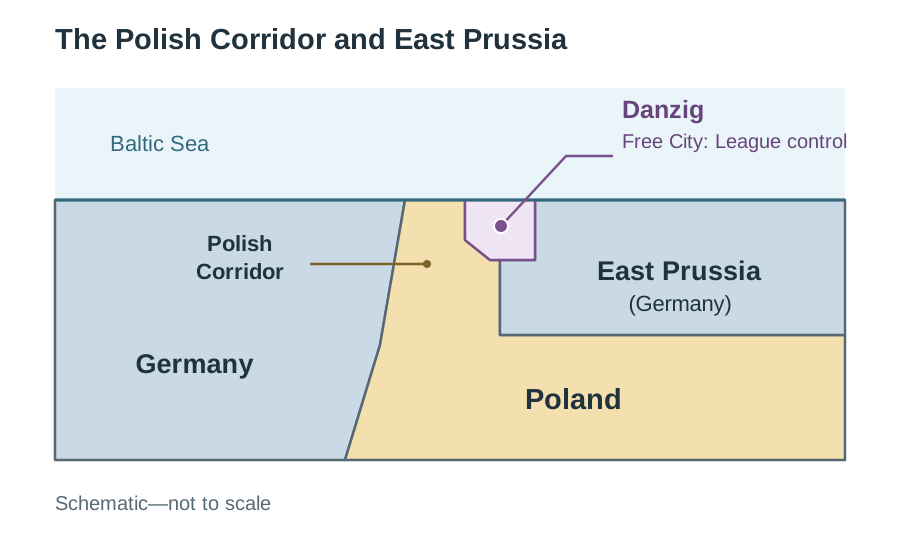
- Territorial Terms: Germany surrendered Alsace-Lorraine to France, Eupen-Malmedy to Belgium, and Northern Schleswig to Denmark. Posen and West Prussia were given to Poland to create the 'Polish Corridor', separating East Prussia from the rest of Germany. Danzig became a Free City under League control; the Saar coalfields were placed under League administration for 15 years; all German colonies were distributed as League mandates. Germany lost 13% of its European territory and six million citizens.
- Military Restrictions: The German army was limited to 100,000 long-service volunteers; conscription, tanks, military aircraft, and submarines were banned; the navy was restricted to six pre-dreadnought battleships. The Rhineland was permanently demilitarised and occupied by Allied troops for 15 years.
- Article 231 and Reparations: Article 231 stated Germany and its allies accepted responsibility for causing all loss and damage suffered by the Allies. While the text did not contain the word 'guilt', Germans labelled it the Kriegsschuldparagraph (the war guilt clause). It served as the legal justification for demanding reparations, fixed in 1921 at 132 billion gold marks.
Other Central Powers signed separate treaties: Saint-Germain with Austria (1919), Neuilly with Bulgaria (1919), Trianon with Hungary (1920), and Sèvres with the Ottoman Empire (1920). While new nation states were created across Central and Eastern Europe, self-determination was applied unevenly: millions of German speakers were placed in Czechoslovakia and Poland, and union (Anschluss) between Austria and Germany was prohibited.
The League of Nations
The Covenant of the League of Nations formed Part I of the Treaty of Versailles, with its seat in Geneva. It aimed to preserve peace through collective security (an attack on one member was treated as an attack on all), settle disputes by international arbitration, reduce armaments, and oversee former colonial mandates. It operated through an Assembly of all members, a Council of Great Powers, a Secretariat, the Permanent Court of International Justice, and the International Labour Organisation.
Weaknesses: The US Senate refused to ratify the Treaty of Versailles, so the League's primary sponsor never joined; Soviet Russia and Germany (until 1926) were initially excluded; it possessed no armed force and depended on moral pressure and economic sanctions; Council decisions required unanimity.
Key Personality Evaluation: Woodrow Wilson
- Contribution: US President 1913–1921; articulated the Fourteen Points (January 1918), championing self-determination, disarmament, open diplomacy, and the League of Nations; negotiated the Versailles treaty.
- Contemporary Attitudes: Received by cheering European crowds in late 1918 as an idealist peacemaker; criticised in Paris by Clemenceau ('God gave us Ten Commandments and we broke them. Wilson gives us Fourteen Points'); opposed at home by Republican Senators led by Henry Cabot Lodge, who rejected League membership.
- Current Historical Interpretation: Historians recognise his vision for international law and collective security, while noting his political inflexibility at home and his inconsistent application of self-determination outside Europe.
8. Society and Economy: Industrialisation and Crisis in Germany and Tsarist Russia
German Industrial Growth and Social Legislation
After 1871, Germany underwent rapid heavy industrialisation, surpassing Britain in steel, electrical equipment (Siemens, AEG), and synthetic chemicals (Bayer, BASF). Between 1871 and 1914, coal extraction grew fourfold and steel production surged twelvefold. Rapid urbanisation brought millions into industrial centres like the Ruhr, swelling the ranks of socialist trade unions and the SPD.
Bismarck responded with a twin-track approach: he suppressed socialist organisations via the Anti-Socialist Laws (1878–1890) while introducing social welfare measures to detach the working class from revolutionary socialism:
- Sickness Insurance Act (1883): Provided medical treatment and sick pay funded jointly by workers and employers.
- Accident Insurance Act (1884): Covered workplace injuries.
- Old Age and Disability Insurance Act (1889): Granted pensions to workers aged 70 and over.
Industrialisation and Economic Crisis in Tsarist Russia
Under Finance Minister Sergei Witte (1892–1903), Tsarist Russia pursued state-sponsored industrialisation financed by French loans, foreign investment, and high protective tariffs. Witte put Russia on the gold standard and built the Trans-Siberian Railway (started 1891). Industrial output rose in St Petersburg, Moscow, and the Donbas coal basin.
This rapid expansion brought recurring crises:
- The 1891–1892 Famine: Witte's policies relied on exporting grain while rural populations starved, killing roughly 400,000 peasants and discrediting the regime.
- The 1900–1903 Economic Slump: International financial contraction shuttered factories, throwing workers onto the streets.
- Peasant and Worker Unrest: Industrial labourers endured squalid factory barracks and 12-hour shifts. Following defeat in the Russo-Japanese War (1904–1905), social unrest erupted on 'Bloody Sunday' (22 January 1905), when imperial troops fired on Father Gapon's peaceful workers' procession at the Winter Palace. The resulting 1905 Revolution forced Tsar Nicholas II to issue the October Manifesto, promising a legislative Duma.
- Stolypin's Reforms: Prime Minister Pyotr Stolypin attempted to foster a class of conservative, land-owning peasants (kulaks) while suppressing dissent with military courts ('Stolypin's necktie'). His assassination in 1911 and renewed strikes in 1912–1914 highlighted ongoing instability.
9. Society, Economy, and War: The Krupp Family & Case Study: Women in the Workforce during WWI
The Impact of War on Society and Economy
Between 1914 and 1918, European states reorganised their societies for total war—the mobilisation of all economic resources, industries, and labour forces for military victory. Governments took control of railways, food supplies, and industrial factories. In Britain, the Defence of the Realm Act (DORA, 1914) granted the government sweeping powers of press censorship, land requisition, and liquor control.
Key Personality Evaluation: The Krupp Family
The Krupp enterprise, based in Essen, was Germany's largest armaments manufacturer, directed by Alfred Krupp, Friedrich Alfred Krupp, and Bertha Krupp alongside her husband, Gustav Krupp von Bohlen und Halbach.
- Contribution: Produced cast-steel artillery for Prussian victories in 1870–1871; manufactured armour plate for Tirpitz's fleet; cast the massive 420mm 'Big Bertha' siege howitzers that destroyed Belgian forts in 1914; operated company housing, healthcare clinics, and pensions to foster worker loyalty and prevent trade unionism.
- Contemporary Attitudes: Revered by German nationalists as the 'Forge of the Fatherland'; denounced by international pacifists and socialists as 'merchants of death' profiting from international tensions.
- Current Historical Interpretation: Historians view Krupp as the prototype of the modern military-industrial complex, illustrating how close links between private industry, the military, and the state accelerated European rearmament.
Case Study: Women in the Workforce during World War I
As male workers were conscripted, belligerent nations faced an acute industrial labour shortage. In Britain, following the 1915 'Shell Crisis' (an artillery shell shortage exposed by The Times), Minister of Munitions David Lloyd George initiated a national campaign to bring women into factory production, supported by Emmeline Pankhurst's 'Right to Serve' demonstration in July 1915.
- Dilution and Factory Work: Male trade unions initially resisted female employment, fearing it would lower skilled wage rates. Under the 1915 Shells and Fuses Agreement and the Munitions of War Act, unions accepted 'dilution'—the temporary division of complex craft tasks into simpler components that could be performed by unskilled women. By 1918, nearly one million British women worked in munitions plants. Those handling toxic chemicals like TNT and cordite absorbed fumes that turned their skin and hair bright yellow, earning them the nickname 'canary girls'; dozens died from explosions and toxic jaundice.
- Transport and Agriculture: Women worked as bus conductors, tram drivers, and railway porters. The British Women's Land Army mobilised over 20,000 women to work on farms, maintaining grain production in the face of German submarine attacks.
- Auxiliary Military Services: Women joined non-combat units including the Women's Army Auxiliary Corps (WAAC), the Women's Royal Naval Service (WRNS), and served near the front as Voluntary Aid Detachment (VAD) nurses.
- Continental Comparison: In France, hundreds of thousands of munitionnettes staffed arms factories. In Germany, the 1916 Auxiliary Service Act (Hindenburg Programme) directed all men aged 17–60 into war work, while a new women's labour department recruited women into munitions and heavy industry.
- Social and Political Impact: Industrial earnings provided working-class women with unprecedented financial independence and transformed social expectations. However, wage parity was not achieved; women were paid substantially less than men for identical work. Under the 1919 Restoration of Pre-War Practices Act, female industrial workers were dismissed to clear jobs for demobilised soldiers. Politically, wartime contributions made withholding the franchise untenable: the Representation of the People Act 1918 granted British women over 30 with property qualifications the vote, while the new German Weimar Republic introduced equal female suffrage in 1918–1919.
10. Culture, Religion, Science, and Case Study: The Invention and Early History of the Motor Car
National Identity in Literature and the Arts
Between 1871 and 1920, the arts reflected patriotic pride and nationalist movements. In Germany, Richard Wagner's opera cycle The Ring of the Nibelung (staged at Bayreuth in 1876) drew on Germanic mythology, and hundreds of Bismarck monuments were erected to celebrate national unity. In Britain, Rudyard Kipling's verse expressed imperial duty ('The White Man's Burden', 1899), while Edward Elgar's Pomp and Circumstance marches provided patriotic anthems. Stateless nationalities used music and literature to resist cultural assimilation: Bedřich Smetana's orchestral cycle Má vlast ('My Country', 1874–1879) and Antonín Dvořák's Slavonic Dances championed Czech cultural identity within the Habsburg Empire; Jean Sibelius composed Finlandia (1899) against Tsarist Russification; and Henrik Ibsen's plays accompanied Norway's peaceful separation from Sweden in 1905.
The Literature of World War I and Wilfred Owen
Wartime writing shifted from early romantic patriotism, such as Rupert Brooke's sonnet The Soldier (1914), to graphic realism depicting trench combat.
Key Personality Evaluation: Wilfred Owen
- Contribution: British infantry officer on the Western Front; treated for shell shock at Craiglockhart Hospital in 1917, where he was mentored by Siegfried Sassoon. His poems, including Dulce et Decorum Est and Anthem for Doomed Youth, depicted gas attacks, physical suffering, and psychological trauma, declaring his subject was 'War, and the pity of War'. He was killed in action on 4 November 1918, a week before the armistice.
- Contemporary Attitudes: Unknown to the general public during the war, with only four poems published before his death; later traditional critics like W.B. Yeats dismissed trench verse as passive suffering.
- Current Historical Interpretation: Viewed as one of the definitive poetic voices of the First World War, whose graphic imagery shaped modern perceptions of trench combat.
Church-State Tensions in Germany and Italy
- The German Kulturkampf: In the 1870s, Bismarck challenged the Catholic Church, claiming papal loyalty undermined the state. The Jesuit Law of 1872 expelled the Jesuits; the Prussian May Laws of 1873 placed seminary education and appointments under state supervision; and civil marriage was made compulsory in Prussia in 1874 and across the Reich in 1875. Bishops and priests who resisted were fined, jailed, or exiled. However, persecution rallied Catholic voters behind the Centre Party (Zentrum). By 1878, needing Catholic votes against socialism, Bismarck dismantled the anti-Catholic legislation.
- The Italian 'Roman Question': When Italian troops occupied Rome in September 1870, Pope Pius IX rejected the state's Law of Guarantees, retreated inside the Vatican as a self-declared 'prisoner', and issued the decree non expedit (1874), barring Italian Catholics from voting or holding parliamentary office. Tensions eased gradually under Pope Leo XIII, leading to the 1913 Gentiloni Pact, where Catholics backed government candidates who opposed anti-clerical laws.
Key Personality Evaluation: Pope Leo XIII
- Contribution: Head of the Catholic Church 1878–1903; settled the German Kulturkampf through compromise with Bismarck; encouraged French Catholics to accept the Third Republic (Ralliement); issued the encyclical Rerum Novarum (1891), which criticised unregulated industrial capitalism, supported workers' rights to a living wage and Catholic trade unions, while rejecting revolutionary socialism.
- Contemporary Attitudes: Secular liberals viewed him as a defender of traditional clerical authority; conservative industrialists feared his social encyclicals made concessions to organized labour.
- Current Historical Interpretation: Regarded by historians as an astute pontiff who modernised Church diplomacy and established modern Catholic social teaching.
Anti-Semitism in France and Russia
During the late nineteenth century, anti-Semitism shifted from religious prejudice into pseudoscientific racial discrimination and political nationalism.
- The Dreyfus Affair in France (1894–1906): In 1894, Captain Alfred Dreyfus, an innocent Jewish artillery officer, was falsely convicted of treason for selling military secrets to Germany and sent to Devil's Island. When counter-espionage evidence identified the real culprit (Major Ferdinand Esterhazy), the army high command forged evidence and suppressed the truth. In January 1898, novelist Émile Zola published J'accuse...! on the front page of L'Aurore, charging the General Staff with a cover-up. France split between Dreyfusards (radicals, socialists, intellectuals) and anti-Dreyfusards (clerical conservatives, royalists, and anti-Semitic leagues led by Édouard Drumont). Dreyfus was pardoned in 1899 and fully exonerated in 1906. The crisis led to the 1905 Law on the Separation of the Churches and the State, and inspired Theodor Herzl to launch modern political Zionism.
- Pogroms in Tsarist Russia: Jews were confined to the Pale of Settlement in the western provinces. Following the 1881 assassination of Tsar Alexander II, the regime encouraged violent anti-Semitic riots (pogroms). The May Laws of 1882 tightened restrictions within the Pale, barring Jews from buying land or living in rural villages. Separate decrees from 1887 imposed strict quotas on Jewish entry to secondary schools and universities. The Tsarist secret police (Okhrana) fabricated The Protocols of the Elders of Zion, a forged text alleging a Jewish plot for world domination. Deadly pogroms in Kishinev (1903) and Odessa (1905) provoked international condemnation and sparked the mass emigration of over two million Russian Jews to Britain and the United States.
Science, Technology, and Medicine
- Medicine and Public Health: Louis Pasteur developed the rabies vaccine (1885); Robert Koch discovered the tuberculosis bacillus (1882) and the cholera bacillus (1883); Joseph Lister advanced antiseptic surgery; Paul Ehrlich introduced Salvarsan (1909) as the first targeted chemical treatment for syphilis; Bayer marketed aspirin in 1899; Wilhelm Röntgen discovered X-rays in 1895. Wartime medicine accelerated mobile radiography, plastic surgery, and blood transfusions.
- Physics and Chemistry: Max Planck formulated quantum theory (1900); Albert Einstein published the Special Theory of Relativity (1905); Ernest Rutherford formulated the nuclear model of the atom; Fritz Haber developed a process to synthesise ammonia from nitrogen gas (1909), supplying Germany with agricultural fertilisers and chemical explosives during the wartime blockade.
- Communications and Power: Alexander Graham Bell developed the telephone (1876); Thomas Edison, Werner von Siemens, and AEG expanded electrical distribution grids; Guglielmo Marconi transmitted the first transatlantic wireless radio signal from Cornwall to Newfoundland in 1901.
Key Personality Evaluation: Marie Curie
- Contribution: Polish-born French scientist who pioneered research on radioactivity; discovered polonium and radium in 1898; awarded the Nobel Prize in Physics (1903, shared with Pierre Curie and Henri Becquerel) and the Nobel Prize in Chemistry (1911), becoming the first person to win two Nobel Prizes. During World War I, she developed 20 mobile radiography vehicles (petites Curies) and established hospital X-ray units, training operators to help surgeons locate shrapnel and bone fractures.
- Contemporary Attitudes: Faced xenophobia and gender discrimination from the French press and was rejected for membership by the French Academy of Sciences in 1911; celebrated by international scientific colleagues for her laboratory discoveries and wartime humanitarian service.
- Current Historical Interpretation: Celebrated as a transformative scientist whose research established nuclear physics and radiology; recognized as an inspiring pioneer for women in scientific disciplines.
Case Study: The Invention and Early History of the Motor Car
The practical automobile emerged from German internal combustion engineering:
- Karl Benz and the Motorwagen (1885–1886): In Mannheim, Karl Benz integrated a lightweight, four-stroke single-cylinder petrol engine into a three-wheeled tubular steel chassis with electric spark ignition. German Imperial Patent No. 37435, granted on 29 January 1886, is recognised as the patent of the practical petrol automobile.
- Bertha Benz's Long-Distance Journey (August 1888): Seeking to demonstrate the vehicle's commercial viability, Bertha Benz took the Motorwagen on a 106-kilometre journey from Mannheim to Pforzheim without her husband's prior knowledge. She cleaned a blocked fuel pipe with a hatpin, insulated an ignition wire with a garter, purchased cleaning solvent (ligroin) as fuel from a chemist in Wiesloch, and had a shoemaker line the wooden brake blocks with leather. The journey proved the automobile's practicality and produced valuable publicity.
- Gottlieb Daimler and Wilhelm Maybach: In Cannstatt, Daimler and Maybach built a high-speed vertical petrol engine (the 'Grandfather Clock') in 1885, mounting it on a four-wheeled carriage in 1886. In 1901, the Daimler company launched the Mercedes, designed by Maybach with a pressed-steel chassis, a honeycomb radiator, and a low centre of gravity, setting the standard layout for modern motor cars.
- Mass Production and Henry Ford: While European manufacturing focused on hand-crafted vehicles for wealthy motorists, Henry Ford applied assembly-line techniques in the United States. Perfecting the moving assembly line at Highland Park, Michigan, in 1913, Ford cut the assembly time of the Model T from 12 hours to 93 minutes. The retail price fell from 360 by 1916, turning the car into an accessible consumer product.
- Military and Logistical Impact by 1920: Motor transport transformed wartime supply logistics. In September 1914, General Joseph Gallieni requisitioned 600 Paris taxicabs to ferry 4,000 reserve infantry to the Marne front, helping halt the German advance. Motorised ambulances, lorries, and staff cars replaced horse draught across front-line operations, expanding the global oil, steel, and rubber industries.
Key Personality Evaluation: Karl Benz
- Contribution: Integrated the chassis, transmission, and internal combustion engine into a practical vehicle; founded Benz & Cie., which became the world's leading automobile manufacturer by 1900 with serial models like the Velo (1894).
- Contemporary Attitudes: Early observers viewed his three-wheeled vehicle with scepticism, dismissing motor cars as noisy, dangerous toys for the wealthy.
- Current Historical Interpretation: Regarded as the foundational inventor of the petrol-driven automobile whose engineering designs initiated the twentieth-century transport revolution.
Key terms
- Balance of power
- The diplomatic and military equilibrium among Great Powers that prevents any single state from dominating Europe, disrupted by German unification in 1871.
- Nationalism
- The political doctrine that distinct cultural and ethnic groups have the right to form independent, sovereign nation states, which destabilised the multinational Austro-Hungarian and Ottoman empires.
- The New Imperialism
- The rapid expansion of European colonial control across Africa and Asia between 1880 and 1914, driven by the search for raw materials, markets, naval bases, and national prestige.
- World war
- A large-scale military conflict involving multiple coalitions of major global powers, fought across multiple continents, oceans, and colonial territories.
- War of attrition
- A military strategy aimed at exhausting the enemy's reserves of manpower, industrial equipment, and domestic morale through sustained combat, exemplified by Verdun and the Somme.
- Conscription
- Compulsory military service for adult male citizens, maintained by continental powers before 1914 and introduced in Great Britain in January 1916.
- Self-determination
- The principle advocated by Woodrow Wilson that distinct national populations have the democratic right to choose their own government and establish independent states.
- War guilt
- Article 231 of the Treaty of Versailles, which required Germany and its allies to accept legal responsibility for causing the war's losses, serving as the legal basis for reparations.
- Anti-Semitism
- Prejudice, discrimination, and political persecution directed against Jewish people, seen in the French Dreyfus Affair and Russian state-sponsored pogroms.
Check yourself
What were Otto von Bismarck's two primary foreign policy objectives after 1871?
To keep France diplomatically isolated to prevent a war of revenge (revanche), and to avoid a two-front war by maintaining friendly diplomatic ties with both Russia and Austria-Hungary.
Name three operational structures through which European diplomacy functioned before 1914.
Secret bilateral treaties, permanent embassies managed by professional diplomats, dynastic family correspondence (such as the 'Willy-Nicky' letters), and international congresses (such as Berlin in 1878 or Algeciras in 1906).
What was the Schlieffen Plan and why did it bring Britain into the war?
A German military plan to knock out France within six weeks by sweeping through neutral Belgium before Russian forces deployed; the invasion of Belgium on 4 August 1914 breached the 1839 Treaty of London, triggering Britain's declaration of war.
What was Admiral Alfred von Tirpitz's 'Risk Theory' (Risikogedanke)?
The strategy of building a German battle fleet in the North Sea large enough that attacking it would expose the Royal Navy to such catastrophic losses that Britain would avoid war and grant Germany overseas diplomatic concessions.
Why was the Kingdom of Serbia described as the fulcrum of Great Power rivalry before 1914?
Serbia sat at the centre of Balkan tensions: its aim to unite South Slavs threatened the survival of multinational Austria-Hungary, while Tsarist Russia backed Serbia to project influence towards the Mediterranean Straits.
What was industrial 'dilution' in British munitions manufacturing during World War I?
The temporary wartime practice agreed between the government and trade unions to subdivide skilled engineering jobs into simpler tasks that unskilled female workers could perform.
What happened on 'Bloody Sunday', 22 January 1905, in St Petersburg?
Imperial Russian troops fired on a peaceful petition of workers led by Father Gapon at the Winter Palace, sparking the nationwide 1905 Revolution.
Identify two major structural weaknesses of the League of Nations.
The United States never joined after the Senate rejected the Versailles treaty, decisions required unanimous agreement, and the League possessed no standing military force to enforce its resolutions.