

How strong, ductile, hard, or conductive a metal is depends on how its atoms are bonded and arranged. This topic covers the periodic table and alloys, metallic bonding, unit cell structures (BCC, FCC, and CPH), the allotropy of iron, solidification and dendritic growth, ingot structures, crystal lattice defects, and the electrochemical mechanisms of corrosion and corrosion prevention.
The Periodic Table and Engineering Alloys
The periodic table arranges all known chemical elements in order of atomic number, which is the number of protons in an atom's nucleus. Horizontal rows are called periods, while vertical columns are called groups. Elements located in the same group share similar chemical characteristics because they possess the same number of outer-shell valence electrons.
Metals versus Non-Metals
Metals sit on the left and centre of the table, while non-metals sit on the right. A stepped line of metalloids, such as silicon, separates the two groups. Metals are shiny when cut, conduct heat and electricity well, have high melting points and densities, and are malleable and ductile. Non-metals are dull, brittle in solid form, have low melting points, and act as electrical insulators (with carbon in the form of graphite being a notable exception).
Key chemical symbols tested in engineering include iron (Fe), copper (Cu), aluminium (Al), zinc (Zn), lead (Pb), tin (Sn), nickel (Ni), chromium (Cr), silver (Ag), gold (Au), and carbon (C).
Why Alloys Matter
An alloy is a mixture of a metal with one or more other elements. Pure metals are often too soft, weak, or prone to chemical attack for heavy structural work. Mixing elements alters the crystal lattice and improves properties such as tensile strength, hardness, wear resistance, and machinability.
- Mild steel: iron with up to 0.3% carbon. It is much stronger and tougher than pure iron.
- Brass: an alloy of copper and zinc. It is harder than pure copper, resists corrosion, and is easy to machine.
- Bronze: an alloy of copper and tin. It provides high wear resistance and low friction, making it ideal for sleeve bearings.
- Stainless steel: iron alloyed with chromium and nickel. The chromium creates an invisible self-healing oxide film that resists rusting.
Atomic Structure and Metallic Bonding
Every solid material is held together by interatomic forces. In other materials, atoms bond either by a metal atom giving electrons to a non-metal atom (ionic bonds, as in sodium chloride) or by non-metal atoms sharing pairs of electrons (covalent bonds). Engineering metals, by contrast, bond through a collective electronic structure known as the metallic bond.
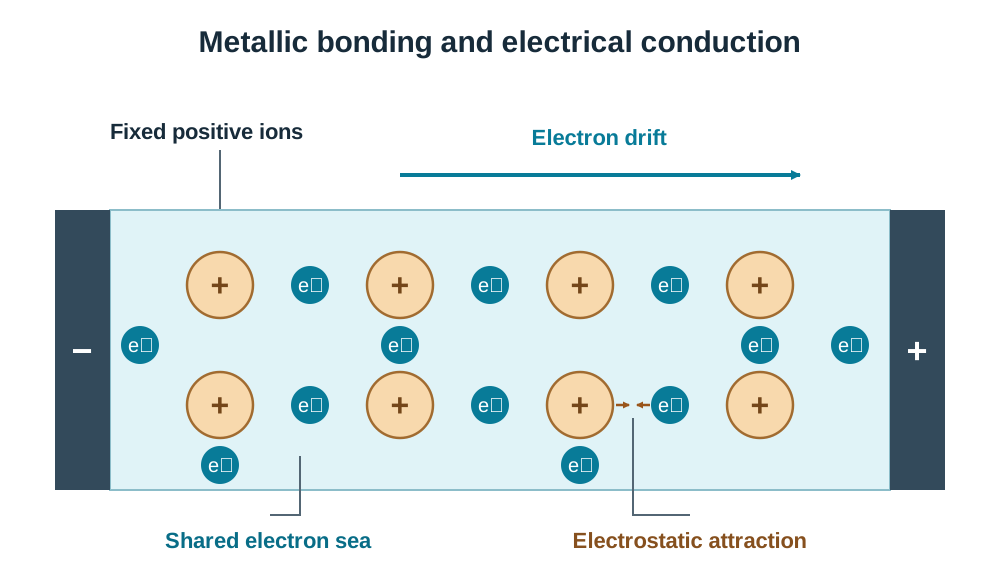
In metals, outer-shell valence electrons are held loosely by their parent nuclei. These valence electrons detach and form a freely circulating sea of delocalised electrons, leaving behind a rigid geometric framework of fixed positive metal ions (cations). Strong electrostatic attraction between the positive ions and the negative electron cloud binds the lattice together.
This bonding model explains two fundamental mechanical and physical properties of metals:
- Electrical and thermal conductivity: When a voltage is applied across a metal, the free electrons drift towards the positive terminal to create an electric current. The same free electrons also pick up heat energy at the hot end and carry it quickly through the metal, which is why metals are good conductors of heat.
- Plastic deformation: Metallic bonds are non-directional. When an applied shear load forces entire planes of atoms to slide past one another, the bonds break and immediately re-form with new neighbouring ions. The metal changes shape permanently without shattering.
Crystal Unit Cells: BCC, FCC, and CPH
When liquid metal solidifies, its atoms settle into ordered three-dimensional geometric frameworks called crystal lattices. The smallest repeating group of atoms that displays the full geometric symmetry of the lattice is the unit cell.
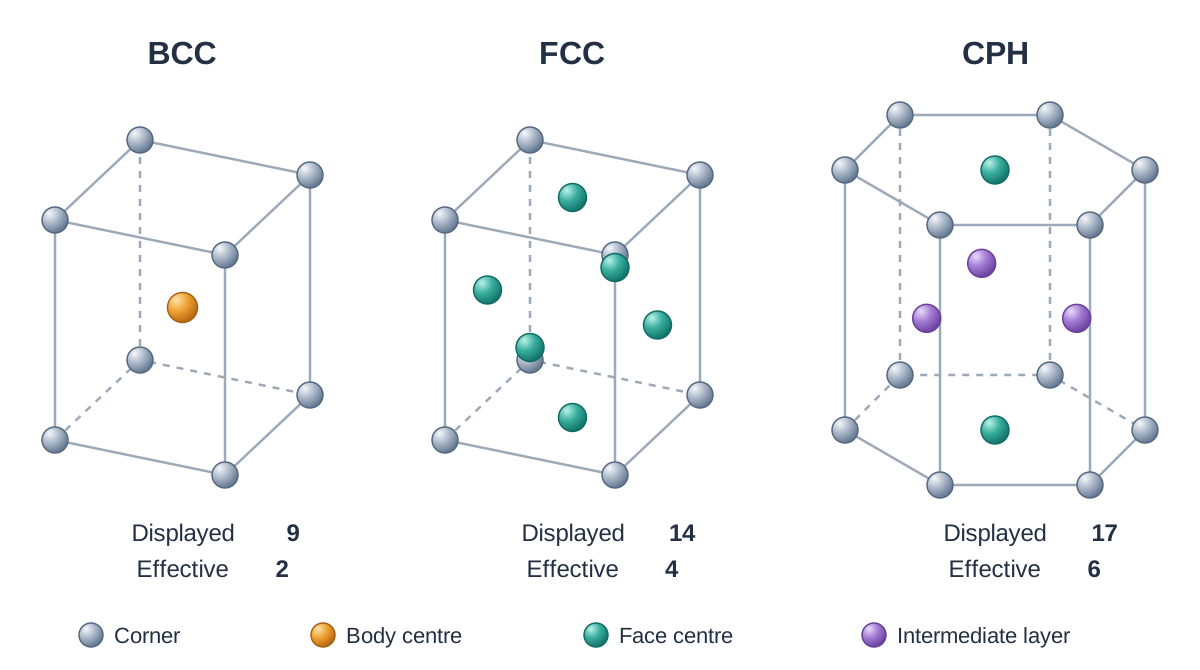
In school examination sketches, unit cells are represented by their visual atom models. A Body-Centred Cubic (BCC) cell is drawn with 9 atoms: 8 at the corners of a cube and 1 in the centre. A Face-Centred Cubic (FCC) cell is drawn with 14 atoms: 8 at the corners and 1 centred on each of the 6 faces. A Close-Packed Hexagonal (CPH) cell is drawn with 17 atoms: 12 corner atoms on two hexagonal end faces, 2 face-centre atoms, and 3 spacer atoms in a central layer.
If an examination question asks for the effective atom count belonging entirely to one cell (sharing corner atoms among adjacent cells), BCC contains 2 atoms, FCC contains 4 atoms, and CPH contains 6 atoms.
| Crystal Structure | Visual Sketch Count | Packing Efficiency | Typical Engineering Metals | Mechanical Character |
|---|---|---|---|---|
| BCC | 9 atoms | Looser packing (~68%) | Alpha-iron (ferrite), chromium, tungsten | Strong, hard, less ductile |
| FCC | 14 atoms | Close-packed (~74%) | Gamma-iron (austenite), copper, aluminium | Soft, highly ductile, easy to cold work |
| CPH | 17 atoms | Close-packed (~74%) | Zinc, magnesium, titanium, cadmium | Prone to rapid work-hardening, limited cold forming |
Why FCC is More Ductile Than BCC
Permanent bending and stretching occur through slip, which is the sliding of atomic layers over one another under shear stress. Slip occurs most easily along planes where atoms touch directly (close-packed planes) and in directions of closest atomic spacing.
An FCC lattice has 4 sets of close-packed planes with 3 close-packed directions in each, giving 12 active slip systems. Because atoms are closely packed along these planes, atomic planes glide over one another under moderate stresses. BCC has no truly close-packed planes. It requires significantly higher shear forces to initiate slip, making BCC metals like alpha-ferrite stronger and harder, but less ductile.
Allotropy and the Phase Changes of Iron
Allotropy is the ability of a pure element to exist in two or more different crystalline forms in the solid state depending on temperature and pressure.
Pure iron provides the classic engineering example of allotropy. Its structural changes form the foundation for the heat treatment and hardening of steels:
- Alpha-iron (Ferrite): Exists from room temperature up to 912°C. Iron takes a BCC crystal structure. In this phase, iron is magnetic up to 768°C (its Curie point). It is relatively strong, hard, and less ductile. Ferrite has small spaces between its iron atoms, allowing it to dissolve only a tiny amount of carbon (a maximum of 0.02% by weight at 723°C).
- Gamma-iron (Austenite): Exists between 912°C and 1394°C. The atoms rearrange into an FCC structure. Austenite is non-magnetic, soft, and ductile. Although FCC has a higher overall packing density than BCC, its empty space is grouped into fewer, larger gaps. This allows austenite to dissolve up to 2.14% carbon by weight.
- Delta-iron: At 1394°C the atoms change back into a BCC structure. Delta-iron is stable from 1394°C until pure iron melts at 1538°C.
Because austenite holds more than one hundred times as much carbon as ferrite, heating steel into the austenite range and quenching it rapidly in cold water traps the dissolved carbon before it can separate out. This lattice distortion creates martensite, the hard structure in quenched steel.
Solidification, Grain Size, and Ingot Structure
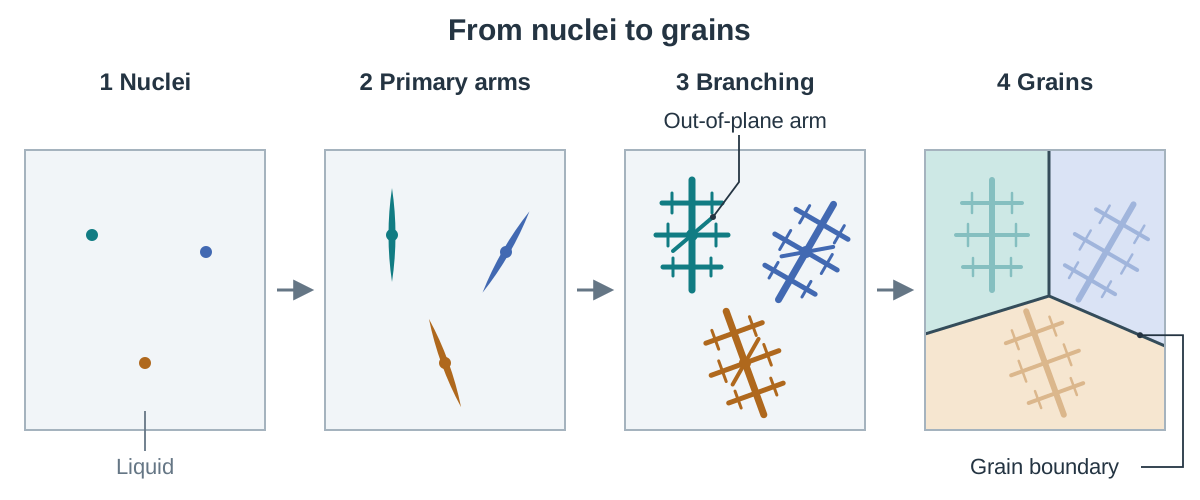
Solidification transforms molten metal into a solid crystalline mass through four clear stages:
- Nucleation: As molten metal cools to its freezing point, small groups of atoms slow down and bond into tiny solid crystal centres called nuclei.
- Primary arm growth: Heat leaves the cooling metal, and crystals shoot out rapidly along preferred directions, forming central spines or trunks.
- Secondary and tertiary branching: Secondary branches grow out at right angles to the central trunk, and tertiary arms branch off those, forming a three-dimensional tree-like crystal called a dendrite.
- Grain boundary formation: The remaining liquid freezes between the branches, thickening the dendrite arms until adjacent dendrites meet. The boundary surfaces where misaligned dendrites collide form permanent grain boundaries. Each solid dendrite becomes an individual grain.
Factors Controlling Grain Size
Fine-grained metals have more grain boundaries per unit volume. Grain boundaries block the movement of dislocations, making fine-grained metals stronger, harder, and tougher than coarse-grained metals of identical composition.
- Cooling rate: Rapid cooling (such as in a metal chill mould or die casting) forms many nuclei at once, producing fine grains. Slow cooling (such as in an insulated sand mould) creates fewer nuclei, leading to large, coarse grains.
- Nucleating agents: Adding small quantities of inoculants (such as titanium or boron in molten aluminium) provides extra solid particles for crystals to freeze around, refining grain size.
- Mechanical working: Hot rolling or forging crushes coarse cast grains, which then recrystallise into smaller grains.
- Heat treatment: Normalising refines grain size by heating steel above its critical temperature and cooling it in still air.
Structure of an Ingot or Casting
When molten metal is poured into a cold ingot mould, three distinct cooling zones develop across its cross-section:
- Chill zone: A thin outer skin of small, randomly oriented (equiaxed) grains formed immediately against the cold mould wall due to rapid heat loss.
- Columnar zone: Long, slender grains that grow inward from the chill zone, growing in the direction opposite to heat flow.
- Equiaxed zone: Large, rounded grains at the centre where cooling is slower and equal in all directions.
- Shrinkage cavity (pipe): A hollow funnel formed at the top centre of an ingot because molten metal contracts as it cools, and the top centre freezes last.
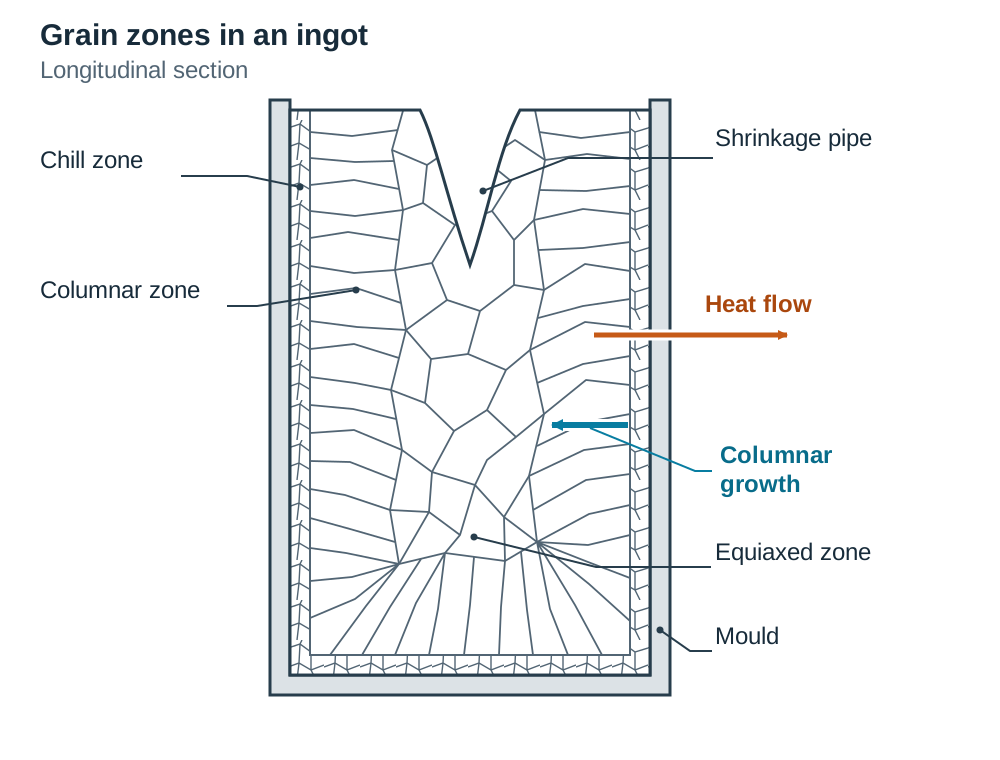
To carry out a macroscopic examination, technicians cut a cross-section of the ingot, grind and polish the surface smooth, and etch it with a mild acid. The acid attacks grain boundaries and crystal faces at different rates, revealing the three zones, pipe defects, and forging flow lines clearly to the naked eye.
Crystal Defects and How Alloys Form
Real engineering metals are never perfect crystals. Microscopic imperfections govern whether a metal is soft and malleable or hard and strong.
Point Defects (Zero-Dimensional)
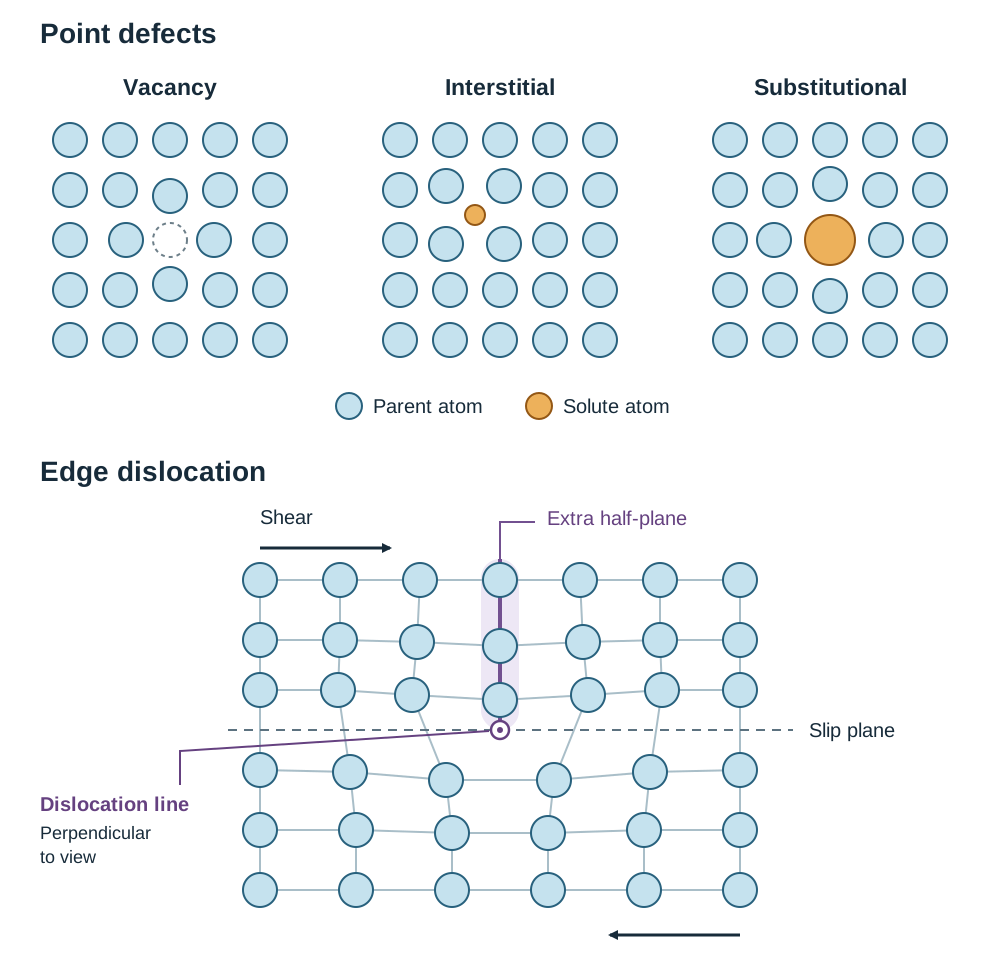
- Vacancy: An atom is missing from its normal position in the lattice. Neighbouring atoms pull inward, straining the surrounding structure.
- Interstitial defect: A small foreign atom (such as carbon in iron) wedges into the empty space between parent metal atoms, pushing the surrounding atoms outward.
- Substitutional defect: A foreign atom takes the place of a parent atom on a regular lattice site. A larger solute atom creates compressive lattice stress, while a smaller one creates tensile stress.
Point defects increase strength and hardness because the distorted lattice blocks the passage of dislocations. However, this distortion reduces ductility and lowers electrical conductivity, because the irregular lattice scatters flowing electrons.
Line Defects: Edge Dislocations (One-Dimensional)
The most common line defect is an edge dislocation, which consists of an extra half-plane of atoms squeezed partway into the crystal lattice. Dislocations allow metals to deform plastically without snapping. Instead of breaking every atomic bond across an entire plane simultaneously, bonds break and re-form one row at a time. This operates like pushing a small ripple across a carpet, requiring far less force than sliding the entire carpet at once.
Under repeated (cyclic) loading, cracks can start and spread from these defects, leading to fatigue failure even when the applied load is well below the material's normal tensile strength.
Ways Metals Combine to Form Alloys
- Substitutional solid solution: Solute atoms replace solvent atoms in the parent lattice, as seen in zinc dissolving into copper to make alpha brass.
- Interstitial solid solution: Small solute atoms fit into the voids between parent atoms, such as carbon dissolving into iron.
- Eutectic: An alloy liquid of one exact composition changes directly into an intimate mixture of two separate solids at one fixed temperature, which is the lowest melting point in that alloy system (for example, 62% tin / 38% lead solder freezing at 183°C).
- Eutectoid: A single solid phase transforms into two different solid phases at a single fixed temperature (such as solid austenite transforming into pearlite at 723°C in steel).
When cold-worked metal is heated, distorted grains reform into new, strain-free crystals. This process is called recrystallisation, and it forms the basis of annealing.
Corrosion Mechanisms and Influencing Factors
Corrosion is the progressive degradation of a metal caused by chemical or electrochemical reactions with its surrounding environment. The rusting of iron and steel requires both oxygen and water; remove either component, and rusting cannot occur.
The Electrochemical Corrosion Cell
Metallic corrosion in wet environments works like a miniature battery cell consisting of three parts:
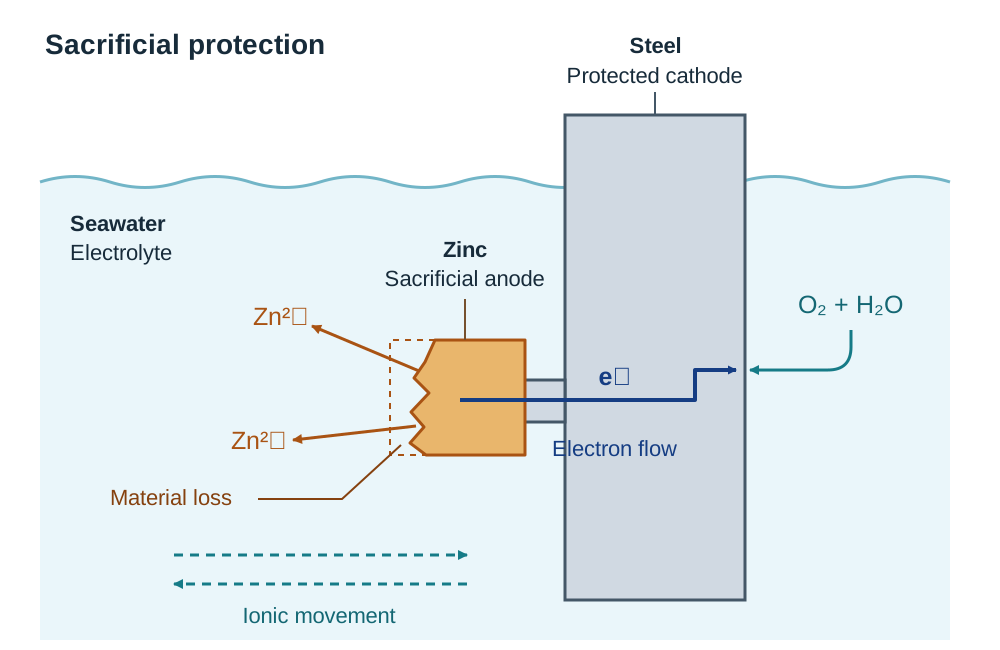
- Anode: The reactive site where metal atoms lose electrons (oxidation) and dissolve into the liquid as positively charged metal ions. The anode is the metal that corrodes away.
- Cathode: The protected site where electrons arriving through the metal react with water and dissolved oxygen. The cathode does not corrode.
- Electrolyte: A liquid solution containing dissolved ions (such as seawater, rainwater, or road salt) that conducts electrical charges between the anode and cathode.
The Galvanic Series
When two different metals are joined in the presence of an electrolyte, the more reactive metal becomes the anode and corrodes rapidly. The less reactive metal becomes the cathode and is protected.
In seawater, metals line up in order of reactivity (most reactive first): magnesium → zinc → aluminium → mild steel → lead → tin → brass → copper → stainless steel → silver → gold.
Factors That Accelerate Corrosion
- Dissimilar metals in contact: Joining metals that sit far apart on the galvanic series creates a strong cell voltage, causing rapid corrosion of the more reactive metal.
- Electrolyte acidity and salinity: Saltwater conducts electric current far better than fresh water, speeding up ionic transfer.
- Elevated temperature and humidity: Higher temperatures supply kinetic energy that accelerates oxidation reactions.
- Uneven oxygen supply: Low-oxygen pockets (such as gaps beneath washers or deep inside screw threads) turn into concentrated anodes, leading to localized crevice corrosion.
- Internal stress: Stressed, bent, or cold-worked zones in a component possess higher stored energy and act as anodes relative to unstressed sections.
- Anode-to-cathode surface area ratio: A small anode connected to a large cathode (such as a steel rivet holding large copper sheets) suffers rapid, concentrated attack.
Methods of Corrosion Prevention
Corrosion control involves breaking the electrochemical cell by isolating the metal from water and oxygen, applying electrical currents, or designing components to avoid moisture traps.
Barrier Coatings
- Paints and powder coatings: Provide a continuous protective film that seals the metal surface away from oxygen and moisture. If the film is scratched, moisture enters and rusting begins underneath.
- Grease and oil: Applied to unpainted machine ways and gear mechanisms to displace moisture and prevent rust during storage.
- Tin plating: Used on steel food cans. Tin provides a non-toxic barrier coating. However, tin is less reactive than steel. If the coating is scratched, the exposed steel becomes the anode and rusts faster than bare steel would.
- Electroplating: Uses direct electric current to deposit a thin layer of protective metal, such as chromium or nickel, over steel to improve corrosion resistance and surface appearance.
- Anodising: Used on aluminium components. The part is made the anode in an acid bath, which artificially thickens its natural surface oxide film into a tough, durable barrier that can also be dyed.
Cathodic Protection
Cathodic protection turns the steel structure into the cathode of an electrochemical cell so that it cannot dissolve:
- Sacrificial protection: Blocks of a more reactive metal (such as zinc or aluminium) are bolted or welded directly to structural steel, including ship hulls and offshore wind turbine foundations. The sacrificial anode oxidises and corrodes away, sending electrons through the steel to keep it acting as a protected cathode. These anodes are replaced during routine servicing.
- Galvanising: Steel is dipped into a bath of molten zinc at roughly 450°C. Zinc forms a physical barrier coating. If scratched, the exposed zinc corrodes sacrificially to shield the underlying steel.
- Impressed-current cathodic protection: An external DC power supply drives electrons directly into the steel structure using inert anodes. This system protects long underground pipelines and marine piling where sacrificial blocks would dissolve too quickly.
Design and Environmental Measures
Engineers eliminate moisture traps by incorporating drain holes in box sections, using rounded profiles rather than sharp corners, fitting insulating nylon washers between dissimilar metals, and adding chemical rust inhibitors to closed-loop heating systems.
Key terms
- Metallic bond
- The electrostatic attraction holding a rigid lattice of positive metal ions together through a shared cloud of mobile, delocalised valence electrons.
- Delocalised electrons
- Valence electrons in a metallic lattice that are not bound to any individual atom and move freely to conduct heat and electric current.
- Unit cell
- The smallest repeating group of atoms that displays the full geometric symmetry and atomic arrangement of a crystal lattice.
- Body-Centred Cubic (BCC)
- A crystal structure drawn with 9 atoms (8 corners and 1 central atom). BCC metals, such as alpha-iron, are strong and hard but less ductile than FCC metals.
- Face-Centred Cubic (FCC)
- A close-packed crystal structure drawn with 14 atoms (8 corners and 6 face centres). It contains 12 active slip systems, giving high ductility.
- Close-Packed Hexagonal (CPH)
- A crystal structure drawn with 17 atoms (12 corner atoms, 2 face-centre atoms, and 3 central spacer atoms), typical of zinc and magnesium.
- Slip
- The shearing movement of parallel atomic planes sliding past each other along close-packed directions during permanent plastic deformation.
- Allotropy
- The property of certain pure chemical elements, such as iron, to exist in two or more distinct crystalline forms in the solid state depending on temperature.
- Ferrite
- The BCC allotrope of pure iron (alpha-iron) stable up to 912°C. It is magnetic up to 768°C and dissolves a maximum of 0.02% carbon.
- Austenite
- The FCC allotrope of pure iron (gamma-iron) stable between 912°C and 1394°C. It is non-magnetic, ductile, and dissolves up to 2.14% carbon.
- Nuclei
- The initial microscopic solid particles that freeze out of a cooling liquid melt and act as starting centres for dendritic crystal growth.
- Dendrite
- A three-dimensional, tree-like branched crystal structure that forms as molten metal solidifies outward from a nucleus.
- Grain boundary
- The narrow boundary zone formed where adjacent, misaligned crystal dendrites collide and lock together during solidification.
- Vacancy
- A point defect in a crystal lattice where a normal atomic site is empty, creating local inward lattice distortion.
- Interstitial defect
- A point defect caused when a small foreign atom wedges into the void spaces between parent atoms in a crystal lattice.
- Substitutional defect
- A point defect occurring when a foreign solute atom replaces a parent solvent atom on a regular lattice site.
- Edge dislocation
- A one-dimensional line defect formed by an extra half-plane of atoms within a crystal lattice, whose movement facilitates plastic deformation under shear stress.
- Anode
- The electrode or reactive metal surface where oxidation occurs and metal atoms lose electrons to dissolve into the electrolyte.
- Cathode
- The protected metal surface where reduction occurs and electrons arriving through the metal are consumed, preventing metal loss.
- Electrolyte
- An electrically conductive liquid solution containing dissolved ions that allows electrical charge to flow between an anode and a cathode.
- Sacrificial anode
- A piece of an electrochemically active metal, such as zinc or aluminium, attached to a steel structure to corrode preferentially and protect the steel.
- Galvanising
- A corrosion protection process where steel is dipped in molten zinc to form a protective barrier that also provides sacrificial protection if scratched.
Check yourself
What is an allotrope, and what crystal structures does pure iron adopt below 912°C and between 912°C and 1394°C?
An allotrope is a distinct crystalline form of a pure element in the solid state. Pure iron exists as Body-Centred Cubic (BCC, alpha-ferrite) below 912°C, and Face-Centred Cubic (FCC, gamma-austenite) between 912°C and 1394°C.
Why is pure copper used for household electrical wiring instead of brass?
Zinc atoms in brass replace copper atoms on lattice sites, creating substitutional defects that distort the lattice and scatter flowing electrons, which lowers electrical conductivity.
Why does an aluminium component cast in a metal die have higher strength than the same component cast in a sand mould?
The metal die extracts heat rapidly, which forms many crystal nuclei at once and produces a fine-grained structure. A higher density of grain boundaries blocks dislocation slip, raising strength and hardness.
What are the three essential components required to establish an electrochemical corrosion cell?
An anode (where metal oxidises and dissolves), a cathode (where electrons are consumed), and an electrolyte (an electrically conductive liquid pathway).
How do sacrificial zinc anodes prevent steel wind turbine foundations from corroding in seawater?
Zinc is higher on the galvanic series than steel, so it acts as the anode and corrodes preferentially, supplying electrons to maintain the steel foundation as a protected cathode.