

Metallurgy is the study of how metals are extracted from their ores, alloyed, cast, and heat-treated to control their properties. For Leaving Certificate Higher Level Engineering, you need to understand commercial mining and ore concentration, the extraction of iron, steel, copper, and aluminium, atomic crystal lattices and solidification, thermal equilibrium diagrams (including solid solutions, eutectics, and the Lever Rule), the iron-carbon diagram, and industrial heat treatments.
Ore Extraction, Concentration, and Thermal Operations
Metals rarely exist in a pure state in the Earth's crust. They are found as minerals chemically bound in rocks called ores, surrounded by commercially worthless waste rock called gangue.
Learn the main ore of each common engineering metal:
- Iron: Haematite () and magnetite ()
- Aluminium: Bauxite ()
- Copper: Chalcopyrite or copper pyrites ()
- Lead: Galena ()
- Zinc: Zinc blende or sphalerite ()
- Tin: Cassiterite ()
Systems of Mining
The method used to extract an ore depends on its depth, shape, and geological setting:
- Open Cast Mining: Used for wide, flat mineral beds lying near the surface. Heavy machinery strips away the overlying topsoil and rock—known as overburden—to expose the ore.
- Open Pit Mining: Used when an ore deposit sits near the surface but extends deep into the ground. Excavation creates stepped horizontal terraces called benches. These benches prevent wall collapses, provide road access for heavy haul trucks, and let excavators extract ore from multiple levels at once.
- Shaft Mining: Used when high-grade mineral seams run deep underground. A vertical shaft with a surface hoist gives access to a network of horizontal working tunnels. It causes far less disruption to the surface landscape than open pits, but requires complex ventilation, drainage, and ground support.
- Dredging and Solution Mining: Dredging uses floating barges to scoop up water-sorted mineral deposits from riverbeds or shallow seabeds. Solution mining dissolves water-soluble minerals underground through an injection borehole and pumps the mineral-rich liquid back to the surface.
Ore Dressing (Mineral Concentration)
Raw ore contains too much gangue to smelt directly. Ore dressing is the mechanical separation of valuable mineral particles from waste:
- Magnetic Separation: Crushed ore passes on a conveyor belt over a magnetised roller. Magnetic minerals (such as magnetite) cling to the belt until carried past the drop-zone, while non-magnetic waste falls straight off under gravity.
- Froth Flotation: Used mainly for copper, lead, and zinc sulphide ores. The crushed ore is mixed in a water tank with chemical collectors that make the valuable mineral particles water-repelling (hydrophobic), while the gangue remains water-attracting (hydrophilic). Air is blown in to make bubbles. The water-repelling mineral particles stick to the bubbles and rise to form a froth on the surface, which is skimmed off.
Process Metallurgy: Common Thermal Operations
Depending on the ore, pyrometallurgical extraction uses different high-temperature operations:
- Calcining: Heating an ore below its melting point in the absence of air to drive off volatile gases or moisture. For example, zinc carbonate (calamine) is calcined to zinc oxide: . (Limestone is also calcined to produce lime flux).
- Roasting: Sulphide ores are heated in a good supply of air, without melting. This converts them to oxides and drives off sulphur as sulphur dioxide gas: .
- Smelting: A high-temperature reduction process where the charge melts into two separate liquid layers: molten metal and a lighter, floating slag formed by the reaction between flux and gangue.
- Refining: Purifying the crude metal using fire refining, chemical fluxes, or electrolysis.
Extraction of Iron, Steel, Copper, and Aluminium
The Blast Furnace (Making Pig Iron)
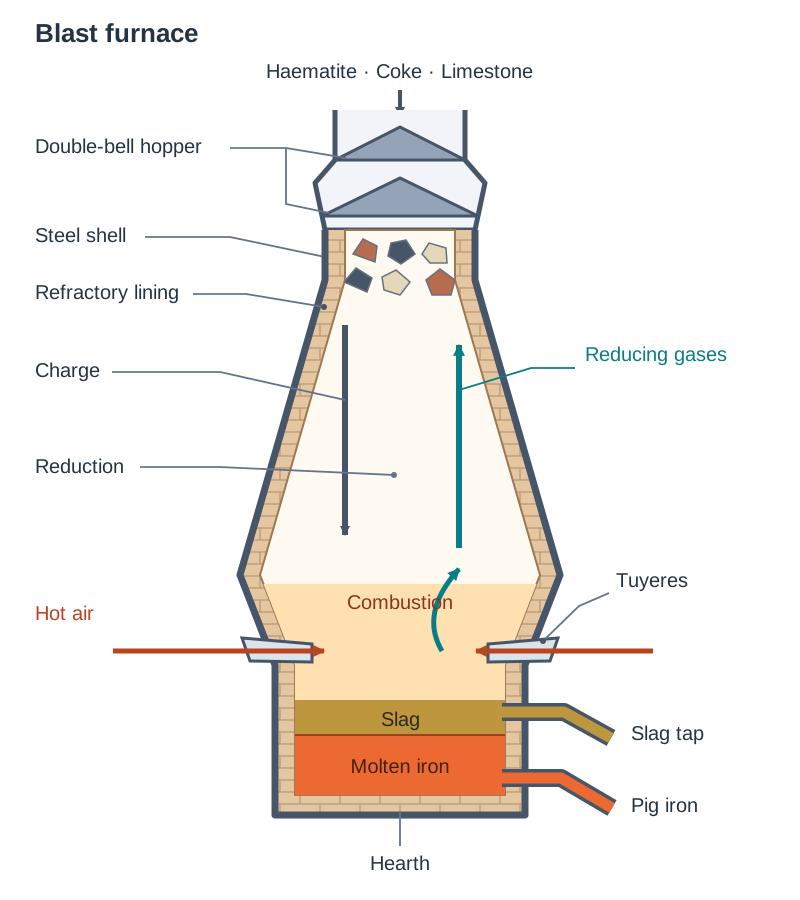
The blast furnace is a tall steel stack lined with heat-resistant refractory brick, operating continuously.
- The Charge: Haematite (), coke (fuel and carbon source), and limestone (flux) are loaded into the top through a double-bell hopper to stop furnace gases escaping.
- The Hot Blast: Air preheated to about 800–1000°C is blown in through water-cooled nozzles called tuyeres near the bottom.
- Combustion: Coke burns to produce carbon dioxide, which reacts with more hot coke to form carbon monoxide: , then . These reactions generate the intense heat needed.
- Reduction: Carbon monoxide reduces the iron oxide to molten iron: .
- Slag Formation: Limestone decomposes to calcium oxide, which reacts with silica gangue to form molten slag (calcium silicate): .
- Tapping: Dense molten iron collects in the bottom hearth, with the lighter molten slag floating on top. Both are tapped off separately.
- Product: Pig iron. It contains 3.5% to 4.5% carbon along with silicon, sulphur, and phosphorus. It is hard and brittle, and is either cast into ingots for remelting (producing cast iron) or transferred molten to a steelmaking plant.
Steelmaking Processes
Steel is made by oxidising and removing excess carbon and impurities from molten pig iron and scrap steel.
- Basic Oxygen Steelmaking (BOS): The pear-shaped converter is tilted and charged with 20–30% cold steel scrap followed by molten pig iron. Once upright, a water-cooled oxygen lance lowers into the furnace to blow pure oxygen at supersonic speed onto the melt surface. The oxygen rapidly burns off carbon (as CO gas) and oxidises impurities. Lime flux is added to form a basic slag with the oxidised silicon, manganese, and phosphorus. The blow takes about 20 minutes without needing any external fuel because the oxidation reactions are strongly exothermic. The furnace is tilted to tap refined steel into a ladle, where alloying additions are made.
- Electric Arc Furnace (EAF): The roof swings clear so the furnace can be charged almost entirely with recycled scrap steel. Three large graphite electrodes are lowered through the roof. Heavy electric current strikes arcs between the electrodes and the scrap, melting the charge with intense heat. Oxygen and lime are injected to form a slag and refine the melt. The EAF offers precise temperature and chemical control, making it ideal for producing high-grade alloy and stainless steels.
Extraction of Aluminium
Aluminium cannot be reduced with carbon because its chemical bond with oxygen is too strong. Extraction requires two stages:
- The Bayer Process (Bauxite to Pure Alumina): Bauxite ore is crushed and digested with hot caustic soda () solution under pressure. Alumina dissolves as soluble sodium aluminate, while insoluble iron oxide impurities remain as red mud and are filtered out. The liquid is cooled and seeded to precipitate aluminium hydroxide crystals, which are then heated (calcined) at 1100°C to yield dry, pure white alumina ().
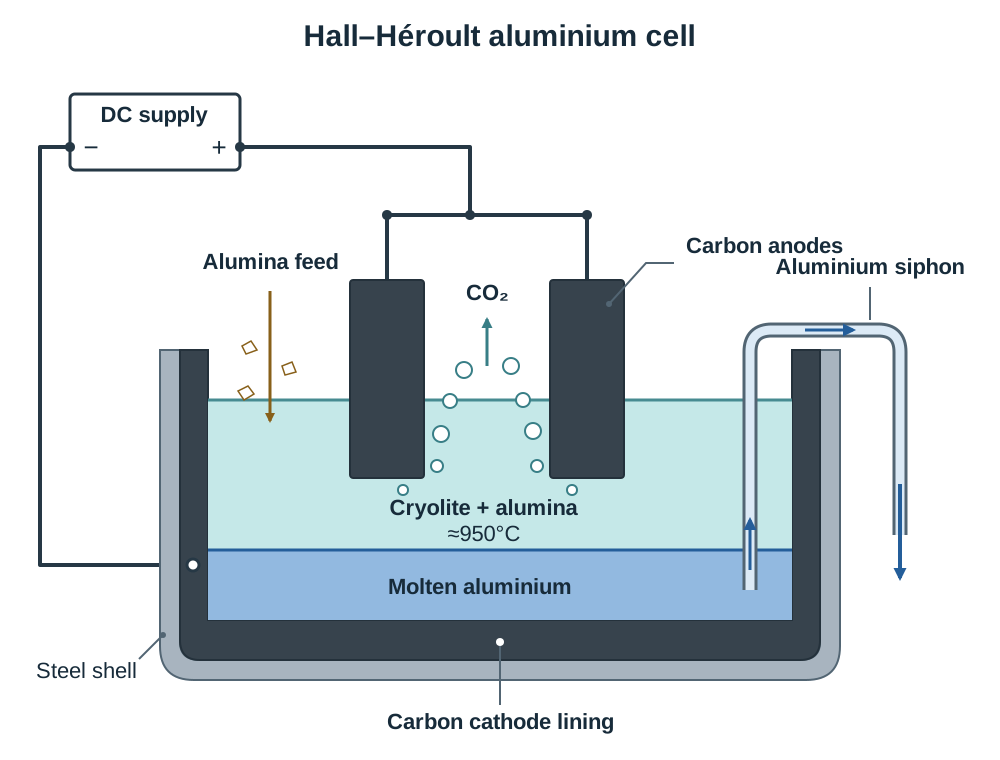
- The Hall-Héroult Electrolytic Process (Alumina to Aluminium): Pure alumina has a melting point over 2000°C, so it is dissolved in molten cryolite () at roughly 950°C to cut melting costs and conduct electricity. The electrolysis cell is a steel box lined with carbon, which serves as the cathode (negative terminal). Carbon blocks dipping into the electrolyte serve as anodes (positive terminals). Direct current splits the alumina: molten aluminium sinks to the cathode on the bottom and is siphoned off, while oxygen is released at the carbon anodes. The oxygen reacts with the anodes to form carbon dioxide, so the carbon blocks gradually burn away and must be replaced regularly.
Extraction of Copper
Chalcopyrite ore is concentrated by froth flotation, then extracted through smelting and refining:
- Roasting and Smelting: The concentrate is roasted to remove volatile sulphur, then smelted with silica flux in a reverberatory furnace. Iron impurities combine with silica into a slag, leaving molten copper matte (a mixture of copper and iron sulphides).
- Converting: Molten matte is transferred to a converter and blown with air. The remaining iron oxidises into a slag, and sulphur burns off as sulphur dioxide gas, leaving crude blister copper (roughly 98–99% pure), named for the rough blisters formed by escaping gas bubbles.
- Electrolytic Refining: To achieve the 99.9%+ purity required for electrical wire, blister copper is cast into heavy anode plates and placed in an acidified copper sulphate electrolyte bath opposite thin sheets of pure copper (cathodes). Electric current dissolves copper from the impure anode and deposits it onto the cathode. Valuable insoluble impurities (silver and gold) settle to the tank bottom as anode sludge and are recovered.
Crystal Lattices, Solidification, and Ingot Structure
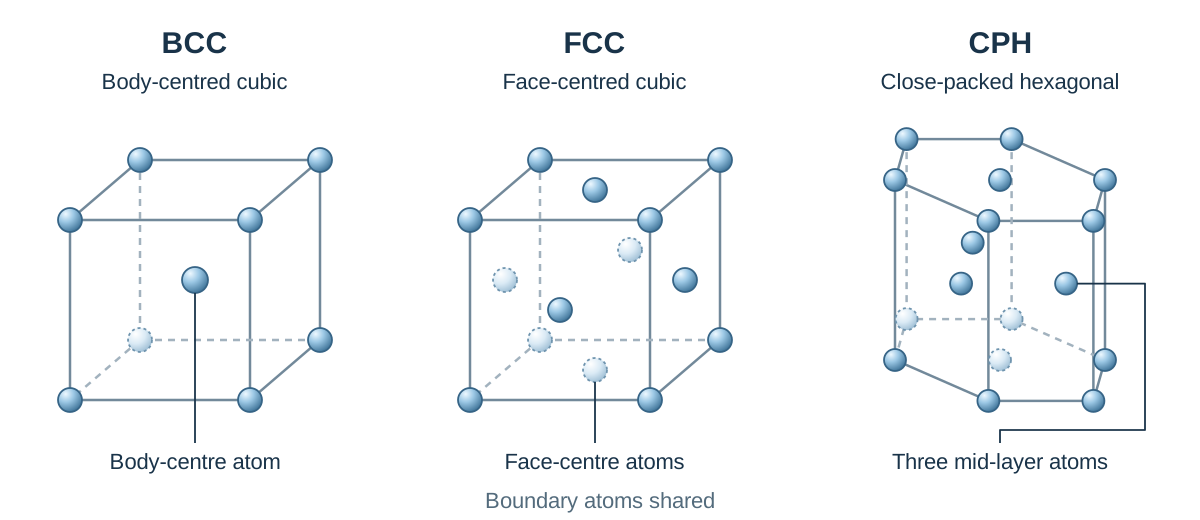
In solid metals, atoms arrange themselves into ordered, repeating three-dimensional patterns called space lattices.
| Crystal Unit Cell | Atomic Arrangement | Mechanical Behavior | Engineering Metals |
|---|---|---|---|
| Body-Centred Cubic (BCC) | Atom at each of the 8 corners, plus 1 atom in the centre of the cube. | Strong, hard, moderate ductility; no truly close-packed planes, so slip is harder. | Alpha iron (-iron below 912°C), chromium, tungsten, molybdenum. |
| Face-Centred Cubic (FCC) | Atom at each of the 8 corners, plus 1 atom in the centre of each of the 6 faces. | Highly ductile, malleable, easily worked; many close-packed slip planes, so atomic layers slide easily. | Gamma iron (-iron between 912°C and 1394°C), copper, aluminium, nickel, lead. |
| Close-Packed Hexagonal (CPH) | Hexagonal prism with top and bottom basal planes and 3 central atoms. | More rigid and brittle; only one close-packed plane (the base), so there are few slip directions. | Zinc, magnesium, titanium, cadmium. |
Allotropy of Iron
Allotropy is the ability of an element to exist in more than one crystal structure in the solid state depending on temperature. Pure iron undergoes clear allotropic changes on heating:
This property makes steel heat treatment possible. In BCC alpha ferrite, the atomic gaps are tiny, so it can dissolve less than 0.02% carbon. In FCC gamma austenite, the atomic spacing is larger, allowing iron to dissolve up to roughly 2% carbon.
Solidification and Dendrites
When molten metal freezes, solidification begins at cool surfaces (such as mould walls) at points called nuclei. Crystals grow rapidly along preferred directions, developing tree-like branches called dendrites. As dendrite arms expand and touch neighbours, growth stops and distinct grains form, separated by grain boundaries.
Structure of an Ingot
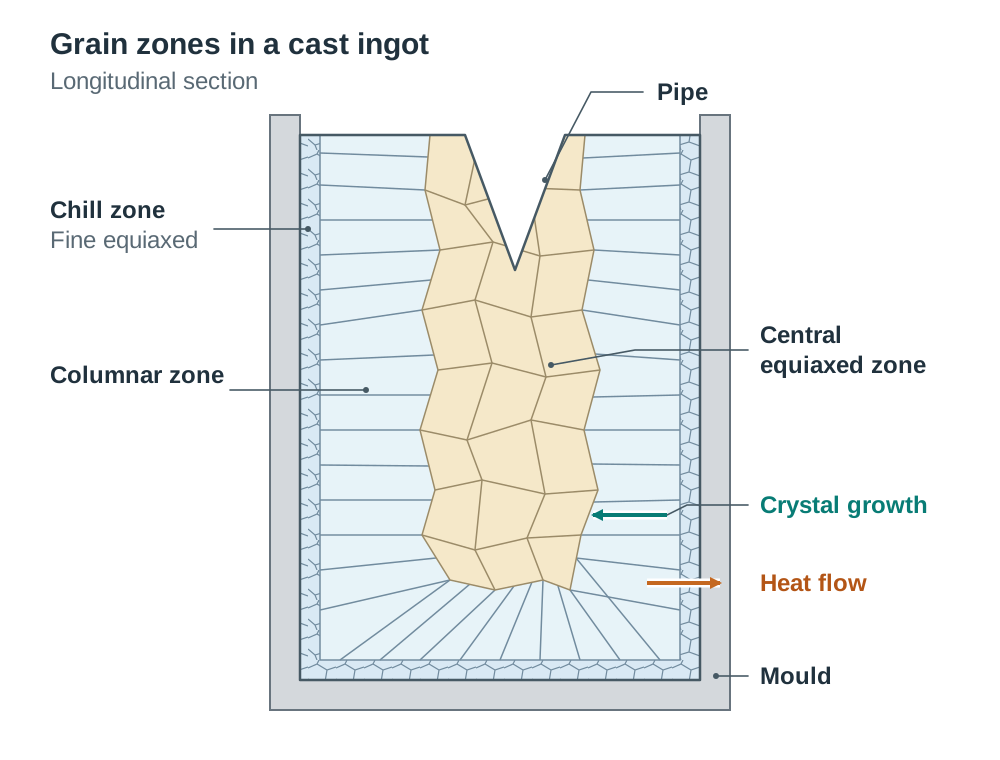
When liquid metal solidifies inside a mould, three distinct crystal zones develop:
- Chill Zone: A thin outer skin of tiny, randomly oriented equiaxed grains next to the cold mould wall where chilling is immediate.
- Columnar Zone: Long, needle-like crystals that grow inwards towards the center, perpendicular to the mould wall along the lines of heat flow.
- Central Equiaxed Zone: Large, randomly oriented grains in the warm centre where cooling is slow and uniform.
Common casting defects include pipe (a cone-shaped shrinkage cavity at the top of the ingot due to volume contraction) and segregation (uneven distribution of impurities pushed towards the center during freezing).
Grain Size and Recrystallisation
Fine-grained metals are stronger and tougher than coarse-grained metals because grain boundaries block dislocation slip. Grain size is controlled by:
- Cooling rate: Rapid cooling produces many nuclei and fine grains; slow cooling produces fewer nuclei and coarse grains.
- Cold working and heating: Cold working distorts crystal grains, causing work hardening. Heating cold-worked metal to its recrystallisation temperature triggers new, stress-free equiaxed grains that nucleate and grow, restoring ductility. Holding at excessive temperatures causes unwanted grain growth, which weakens the metal.
Alloy Systems, Equilibrium Diagrams, and the Lever Rule
An alloy is a mixture of two or more elements where at least one is a metal. Metals combine in solid states in four primary ways:
- Substitutional Solid Solution: Solute atoms take the place of solvent atoms in the host lattice. This requires atoms of similar size and the same crystal structure (such as copper and nickel).
- Interstitial Solid Solution: Very small solute atoms slip into the spaces between the host atoms (such as carbon dissolved in iron).
- Intermetallic Compound: Elements combine in fixed chemical proportions to create a distinct, very hard, and brittle compound (such as iron carbide / cementite, ).
- Eutectic Mixture: The metals dissolve fully as a liquid but are insoluble in the solid state. They freeze together at a single temperature as a fine, alternating mixture of two distinct solid phases (such as lead-tin solder at the eutectic composition).
Cooling Curves
- Pure metal: Cools steadily until its freezing point, where a distinct horizontal plateau appears. The temperature remains constant while the latent heat of fusion is released, resuming its drop only when completely solid.
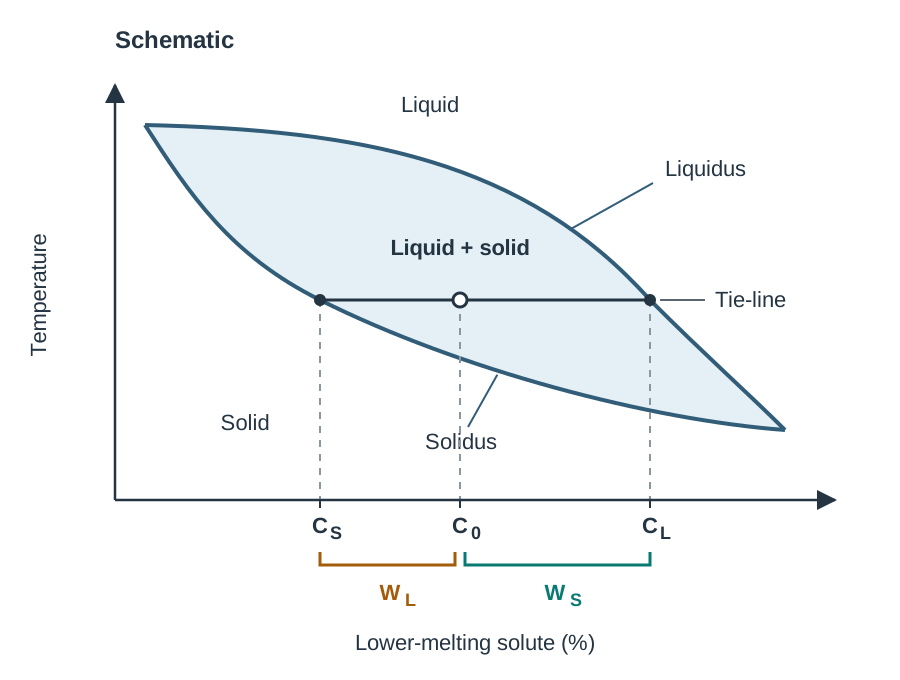
- Solid-solution alloy: Freezes over a temperature range. Solidification begins at the liquidus and ends at the solidus. Between these lines, the alloy exists as a slushy mixture of liquid and solid crystals, known as the pasty zone.
Solid-Solution Phase Diagram (e.g. Copper-Nickel)
Because copper and nickel are completely soluble in each other in both liquid and solid states, their phase diagram forms a lens or cigar shape. The upper curve is the liquidus and the lower curve is the solidus. There is no eutectic point; every composition freezes over a range, and the first solid crystals to freeze are richer in the higher-melting-point metal.
The Lever Rule
In any two-phase region of an equilibrium diagram, you can calculate the exact proportions of each phase present at a given temperature using a horizontal tie-line drawn across the field at that temperature:
- Let = overall alloy composition (% solute)
- Let = composition where the tie-line cuts the liquidus line (% solute)
- Let = composition where the tie-line cuts the solidus line (% solute)
Like a mechanical see-saw, the fraction of each phase is proportional to the opposite arm of the tie-line:
Always check that .
The Iron-Carbon System and Plain Carbon Steels
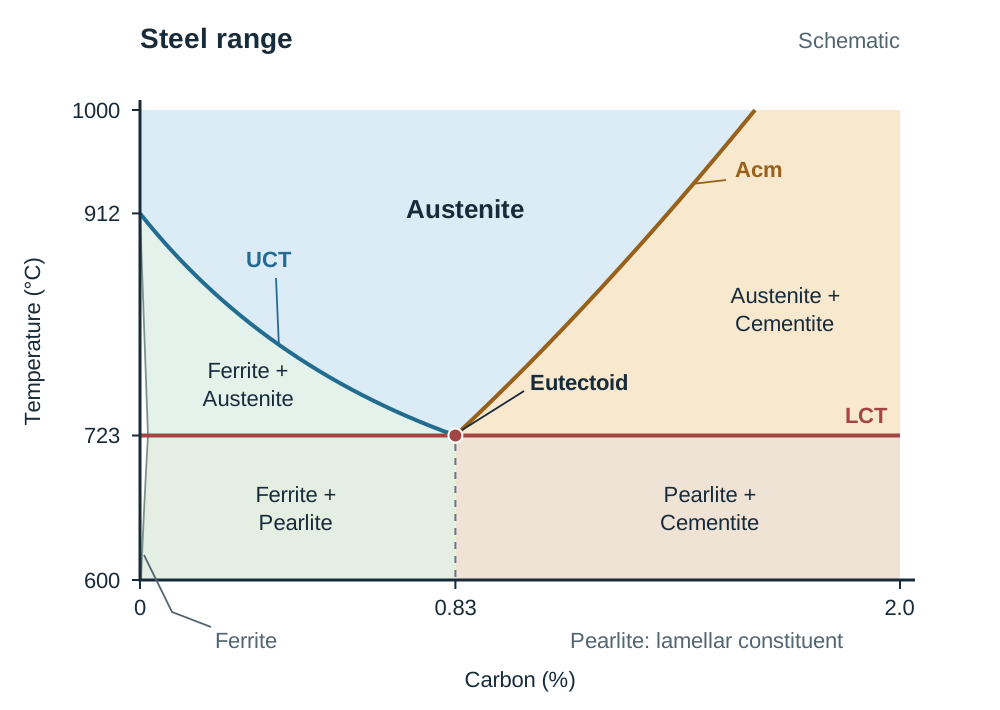
The iron-carbon equilibrium diagram charts the microstructures of steels and cast irons under slow cooling. Plain carbon steels occupy the region up to roughly 1.7% to 2.14% carbon. Always read boundary values from the diagram supplied in the examination paper.
Key Constituents
- Ferrite (): A solid solution of a tiny amount of carbon (up to 0.02%) in BCC iron. Soft, ductile, and magnetic.
- Austenite (): A solid solution of carbon in FCC iron. Ductile and non-magnetic. In plain carbon steels it is the only phase present above the Upper Critical Temperature line.
- Cementite (): An intermetallic compound of iron and carbon containing 6.67% carbon. Extremely hard and brittle.
- Pearlite: A layered (lamellar) structure of alternating soft ferrite (about 88%) and hard cementite (about 12%) plates. It offers a good balance of strength and toughness.
Diagram Structure and Invariant Points
- Lower Critical Temperature (LCT) Line: A horizontal line at 723°C across the steel range.
- Upper Critical Temperature (UCT) Line: Slopes down from 912°C for pure iron to meet the LCT line at 723°C.
- Acm Line: Rises upwards from the eutectoid point into the higher carbon region, separating austenite from austenite + cementite.
- Eutectoid Point (723°C, 0.83% C): Solid austenite decomposes directly into solid pearlite on cooling. Steels with less than 0.83% C are hypoeutectoid (microstructure: ferrite + pearlite). Steels with 0.83% to about 2.0% C are hypereutectoid (microstructure: pearlite + cementite network).
- Eutectic Point (1147°C, 4.3% C): Molten cast iron freezes directly at a single temperature into a solid mixture of austenite and cementite.
Classification of Plain Carbon Steels
| Steel Type | Carbon Content | Mechanical Properties | Common Engineering Uses |
|---|---|---|---|
| Low Carbon (Mild Steel) | 0.1% to 0.3% | Tough, ductile, easily welded and machined; cannot be hardened by direct quenching. | Nuts, bolts, RSJs, car body panels, angle iron. |
| Medium Carbon Steel | 0.3% to 0.7% | Greater strength and hardness, less ductile; responds well to hardening and tempering. | Axles, crankshafts, gears, hammer heads, railway rails. |
| High Carbon Steel | 0.7% to 1.4% | Very hard and wear-resistant, brittle; poor weldability. | Cold chisels, drills, taps and dies, files, springs, razor blades. |
As carbon content rises, tensile strength and hardness increase, while ductility, toughness, and weldability decrease.
Cast Irons, Non-Ferrous Alloys, and Alloy Steels
Cast Irons (Over ~2% Carbon, Typically 2.5% to 4.0% C)
Cast irons contain more carbon than austenite can dissolve, so excess carbon precipitates during solidification:
- Grey Cast Iron: Formed by slow cooling. Carbon precipitates as interconnected graphite flakes. These flakes absorb mechanical vibrations and break up swarf during machining. It has high compressive strength but poor tensile strength. Used for lathe beds, machine bases, and workshop vices.
- White Cast Iron: Formed by rapid cooling. Carbon does not have time to separate as graphite; it remains chemically combined as cementite. This makes white cast iron very hard, wear-resistant, brittle, and almost impossible to machine. Used for slurry pump liners, crusher jaws, and wear plates.
Non-Ferrous Alloys
Non-ferrous alloys contain no iron as their base metal. They offer good corrosion resistance, electrical conductivity, or low weight:
- Brasses (Copper + Zinc):
- Cartridge brass (70% Cu / 30% Zn): Highly ductile, ideal for cold working and deep drawing (such as ammunition shells and radiator tubes).
- Muntz metal (60% Cu / 40% Zn): Stronger, suitable for hot forging and casting (such as valve bodies and marine fittings).
- Bronzes (Copper + Tin):
- Phosphor bronze (copper-tin with added phosphorus): Resists wear, fatigue, and chemical corrosion. Used for heavy-duty bearings, pump impellers, and springs.
- Gunmetal (Copper + Tin + Zinc, e.g. 88/10/2): Strong, casts cleanly, and resists seawater corrosion. Used for valves, steam fittings, and marine pumps.
- Bearing Metals (White Metal / Babbitt): Tin- or lead-based alloys containing antimony and copper. Microstructure contains hard crystals embedded in a soft matrix, giving low friction and allowing the bearing to conform to a rotating shaft.
- Aluminium Alloys:
- Duralumin (approx. 4% Cu, 0.5% Mg, 0.5% Mn, balance Al): High strength-to-weight ratio, age-hardenable. Used in aircraft structures.
- Aluminium-silicon alloys: Excellent fluidity for casting thin-walled engine components.
- Zinc-Based Die-Casting Alloys (e.g. Mazak): Low melting point and high fluidity under pressure. Used for intricate castings like carburettor bodies and car door handles.
Alloy Steels
- 18/8 Stainless Steel: Contains 18% chromium and 8% nickel. Chromium forms an invisible, self-healing chromium oxide film that blocks corrosion. Used for food equipment and surgical cutlery.
- High-Speed Steel (HSS): Contains tungsten, molybdenum, chromium, vanadium, and cobalt. Maintains its cutting edge at red heat (hot hardness) up to 600°C. Used for lathe tool bits, drill bits, and power hacksaw blades.
Heat Treatment of Steels, Furnaces, and Temperature Measurement
Heat treatment uses controlled heating and cooling cycles to alter grain structure and mechanical properties.
How to answer a heat treatment question: always give (1) the temperature, (2) the soak, and (3) the cooling method, then state the purpose or outcome.
Core Heat Treatment Operations
- Full Annealing:
- Temperature: For hypoeutectoid steels (under 0.83% C), heat 25–50°C above the UCT. For hypereutectoid steels (over 0.83% C), heat 25–50°C above the LCT (heating above the UCT is unnecessary because the cementite already present is useful, and higher heat coarsens the grain).
- Soaking: Soak until the temperature is uniform throughout (a guide is about 1 hour per 25 mm of thickness).
- Cooling: Cool slowly inside the switched-off furnace.
- Purpose: Makes steel soft and ductile for machining, relieves internal stresses, and refines the grain.
- Normalising:
- Temperature: Heat 25–50°C above the UCT (for hypoeutectoid) or above the Acm line (for hypereutectoid to dissolve the brittle cementite network).
- Soaking: Soak to ensure complete conversion to uniform austenite.
- Cooling: Cool in still air.
- Purpose: Refines grain size and relieves stresses, leaving the steel stronger and tougher than an annealed component.
- Hardening:
- Temperature: Heat 25–50°C above the UCT (hypoeutectoid) or 25–50°C above the LCT (hypereutectoid).
- Soaking: Soak until fully transformed.
- Cooling: Quench rapidly in cold water, brine, or oil. Rapid cooling prevents carbon from diffusing out of the lattice, locking it into a strained, needle-like structure called martensite.
- Purpose: Produces maximum hardness and wear resistance, but leaves the steel brittle.
- Tempering:
- Temperature: Reheat hardened steel to between 200°C and 600°C (below the LCT). Cutting tools are tempered low (~230°C, pale straw colour) to retain hardness; springs and shock components are tempered higher (~300°C, blue colour) for greater toughness.
- Cooling: Cool in air or quench.
- Purpose: Relieves severe internal quenching stresses and restores toughness at the cost of some hardness.
- Stress Relieving: Heat steel below the LCT (typically 550–650°C), soak, and cool slowly in air. Removes internal stresses caused by welding or cold work without altering the crystal structure.
Quenching Media (Fastest to Slowest)
- Brine (salt water): Fastest, most severe quench; high risk of distortion and cracking.
- Water: Standard quench for plain carbon steels.
- Oil: Slower than water; chosen for high-carbon or alloy steels to prevent cracking.
- Air: Used for air-hardening alloy steels.
Alloy steels can be hardened using slower quenches (oil or air) because alloying elements slow down the breakdown of austenite, giving deeper hardening with less risk of cracking.
Heat Treatment Furnaces
- Muffle Furnace: Work is heated inside an enclosed refractory chamber (muffle) so heating elements or gas flames do not directly touch the parts, reducing surface oxidation.
- Salt-Bath Furnace: Components are lowered into molten chemical salts. This provides rapid, uniform heating and shields the steel surface completely from air, preventing oxidation and scaling.
Temperature Measurement
- Thermocouple Pyrometer: Two dissimilar metal wires (such as nickel-chrome and nickel-aluminium) are joined at a sensing tip. Heating this junction generates a small voltage (emf) that a digital meter reads directly in °C.
- Optical Pyrometer: Measures high temperatures without physical contact by matching the brightness of an internal glowing lamp filament to the glowing metal.
- Temper Colours: In the workshop, the thickness and colour of the oxide film forming on a cleaned steel surface indicate tempering temperature: pale straw (~230°C), dark straw (~250°C), purple (~275°C), and blue (~300°C).
Surface Hardening and Age Hardening
Many engineering parts, such as gears, camshafts, and gudgeon pins, need a hard, wear-resistant surface skin (the case) combined with a tough, shock-absorbing core.
Case Hardening of Mild Steel (Pack Carburising)
Mild steel contains too little carbon (0.1–0.2%) to harden by quenching. Carbon must be added to the outer skin first:
- Carburising: Pack the mild steel part in a sealed steel container surrounded by a carbon-rich compound (such as granulated charcoal mixed with barium carbonate energiser). Heat in a furnace to 900–950°C for several hours. Carbon diffuses into the outer surface, forming a high-carbon skin (around 0.8–1.0% C). Depth depends on time.
- Refining the Core: Because prolonged heating coarsens the grain, reheat the part to roughly 870°C (above the UCT of the low-carbon core) and quench in water or oil. This refines the core grain and gives it toughness.
- Hardening the Case: Reheat to 760–780°C (above the LCT of the high-carbon case, but below the UCT of the low-carbon core) and quench. The high-carbon case hardens into martensite while the core stays tough.
- Tempering: Reheat to roughly 150–200°C to relieve surface stresses.
Other Surface Hardening Methods
- Nitriding: The alloy steel component (containing aluminium, chromium, or molybdenum) is heated in a sealed chamber at about 500°C while exposed to ammonia gas (). The ammonia cracks, releasing nitrogen that diffuses into the surface to create hard iron and alloy nitrides. Because it requires no quenching, parts do not distort.
- Flame Hardening: High-temperature oxy-acetylene torches heat the surface of a medium-carbon steel (0.4–0.6% C) above its UCT. Water spray jets immediately follow behind the flame to quench the surface into martensite before heat reaches the core.
- Induction Hardening: High-frequency alternating electric current passes through an inductor copper coil wrapped around the steel component. Induced eddy currents heat the outer skin to austenite temperature within seconds, followed immediately by water quench jets. It is fast, clean, and easily automated for mass production of items like gear teeth and crankshaft journals.
Age Hardening (Precipitation Hardening)
Used to strengthen non-ferrous alloys such as aluminium-copper (Duralumin) and copper-beryllium springs. It involves three steps:
- Solution Treatment: Heat the alloy to dissolve the alloying elements into a uniform solid solution.
- Quenching: Quench rapidly in cold water to trap the solute atoms in a supersaturated solid solution at room temperature.
- Ageing: Hold the alloy at room temperature (natural ageing) or heat moderately (artificial ageing). Sub-microscopic precipitate particles separate out, distorting the crystal lattice and pinning dislocations. This raises tensile strength and hardness while retaining useful ductility.
Key terms
- Gangue
- The commercially worthless rocky and earthy waste material surrounding valuable minerals in a raw ore deposit.
- Overburden
- The surface layer of vegetation, soil, and rock that must be stripped away to expose an underlying mineral bed during open cast mining.
- Benches
- Stepped, terrace-like ledges cut into the walls of an open pit mine to prevent slope failure and provide haulage roads for transport trucks.
- Froth Flotation
- An ore concentration process where chemical collectors make valuable mineral particles water-repelling, allowing injected air bubbles to float them to the surface as a skimmed froth.
- Pig Iron
- The crude, brittle product tapped directly from the blast furnace hearth, containing 3.5% to 4.5% carbon along with silicon, sulphur, and phosphorus impurities.
- Slag
- A molten, non-metallic by-product formed when chemical fluxes combine with unwanted rocky gangue impurities during smelting.
- Allotropy
- The capacity of a pure chemical element to exist in more than one distinct crystal lattice arrangement in the solid state depending on temperature and pressure.
- Dendrite
- A branched, tree-like crystal skeleton that forms and spreads outwards from a nucleus as molten metal solidifies.
- Eutectic Point
- The composition on a phase diagram that freezes at a single, lowest temperature directly from liquid to a fine mixture of two solid phases without a pasty stage.
- Eutectoid Point
- An invariant solid-to-solid transformation point (723°C at 0.83% carbon in steel) where solid austenite decomposes directly into alternating plates of ferrite and cementite (pearlite).
- Martensite
- A hard, brittle, needle-like microstructure formed when austenite is quenched rapidly, trapping dissolved carbon inside a distorted lattice.
- Recrystallisation
- The growth of new, strain-free equiaxed grains in a cold-worked metal when heated above a specific threshold temperature, restoring ductility.
Check yourself
Name the point at 723°C and 0.83% carbon on the iron-carbon diagram, and identify the transformation that takes place there during cooling.
It is the eutectoid point. Solid austenite transforms directly into solid pearlite (a lamellar mixture of ferrite and cementite).
Why is coke added to the blast furnace charge alongside haematite and limestone?
Coke serves as fuel to generate heat and reacts to form carbon monoxide, the reducing agent that strips oxygen from the iron ore.
What is the key difference in cooling methods between annealing and normalising steel?
Annealing cools very slowly inside the furnace hearth (producing maximum softness), whereas normalising cools in still air (producing a finer grain structure and higher strength).
Why can mild steel not be directly hardened by heating and quenching?
Mild steel has too little carbon (under 0.3%) to form the distorted martensitic lattice needed for high hardness; carbon must first be added to the surface through case hardening.
What role does cryolite play in the electrolytic extraction of aluminium?
Cryolite dissolves alumina, lowering its melting point from over 2000°C down to about 950°C, which cuts energy costs and conducts electricity.