

Heat treatment controls the heating and cooling of metals in their solid state to change their strength, hardness and ductility without melting them or deliberately changing their shape. For Leaving Certificate Higher Level Engineering, you need to understand how heating and cooling cycles link directly to the iron-carbon equilibrium diagram, explain bulk treatments and surface hardening processes in ordered steps, understand the heat treatment of alloy steels and age hardening, and describe workshop furnaces, safety practices and pyrometers.
The Iron-Carbon Diagram and Steel Microstructures
Steels contain up to about 2% carbon, which is the maximum amount austenite can dissolve; most practical plain carbon steels contain less than 1.5% carbon. Above 2% carbon, the alloy is classified as cast iron. When steel heats and cools, iron undergoes allotropic transformations between body-centred cubic (BCC) and face-centred cubic (FCC) crystal structures, altering its ability to hold carbon in solid solution.
Key Equilibrium Phases
- Ferrite (-iron): A solid solution of a tiny amount of carbon (up to 0.02%) in BCC iron. Ferrite is soft, ductile and magnetic. It is found in all slowly cooled steels at room temperature, and in hypoeutectoid steels it also exists alongside austenite between the LCT (723°C) and the UCT (up to 910°C).
- Austenite (-iron): A solid solution of carbon in FCC iron. The FCC structure has larger spaces between atoms, allowing it to dissolve up to 2.0% carbon at elevated temperatures. It is tough, non-magnetic, and exists only above 723°C in plain carbon steels under equilibrium conditions.
- Cementite (): An iron carbide compound containing 6.67% carbon by weight. It is extremely hard and brittle, giving steel wear resistance.
- Pearlite: A lamellar structure made of alternating microscopic plates of soft ferrite and hard cementite. It forms when austenite cools slowly past 723°C, giving a balanced combination of strength and toughness.
Critical Lines and Transformation Points
- Lower Critical Temperature (LCT) Line (): The horizontal line at 723°C. On slow cooling, any remaining austenite transforms into pearlite along this line.
- Upper Critical Temperature (UCT) Line ( and ): For hypoeutectoid steels (under 0.83% C), the line slopes downwards from 910°C to 723°C, where austenite begins rejecting excess ferrite during cooling. For hypereutectoid steels (0.83% to 2.0% C), the line rises from 723°C to 1147°C, where austenite begins rejecting excess cementite.
- Eutectoid point: Located at 723°C and 0.83% carbon. At this point, solid austenite transforms directly into 100% solid pearlite.
- Eutectic point: Located at 1147°C and 4.3% carbon, where molten liquid solidifies simultaneously into a solid mixture of austenite and cementite (ledeburite).
Structure and Properties at Room Temperature (Slow Cooling)
| Steel Type | Carbon Content | Room-Temperature Structure | Mechanical Properties |
|---|---|---|---|
| Hypoeutectoid | Below 0.83% C | Ferrite + pearlite | Soft, ductile, tough, easily welded (e.g. mild steel at 0.2% C) |
| Eutectoid | 0.83% C | 100% pearlite | Strong and hard with reasonable toughness |
| Hypereutectoid | Above 0.83% C | Pearlite + cementite | Very hard and wear-resistant, but brittle; poor weldability (e.g. tool steel at 1.2% C) |
Carbon rule: As carbon content increases, hardness and tensile strength rise, while ductility, toughness and weldability fall.
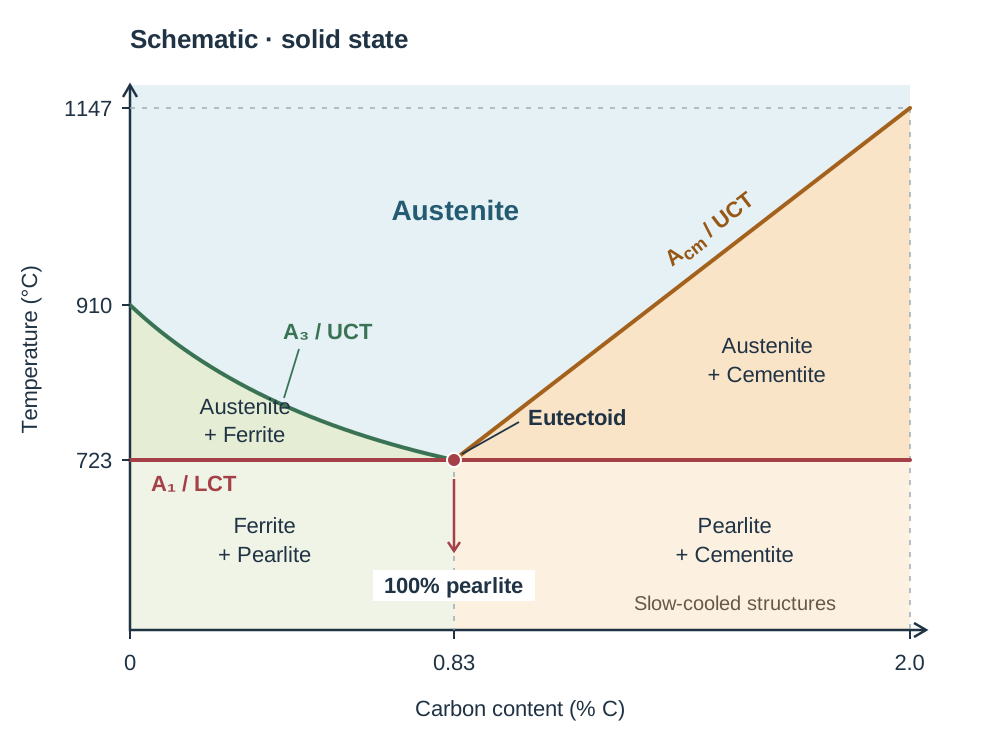
How to Sketch the Steel Portion of the Equilibrium Diagram
When sketching in an exam:
- Draw axes of temperature (°C) against carbon content (% C up to 2.0%).
- Draw the horizontal LCT line at 723°C.
- Draw the line sloping from 910°C at 0% C down to the eutectoid point at 0.83% C and 723°C.
- Draw the line rising from the eutectoid point to 1147°C at 2.0% C.
- Mark the liquidus and solidus boundaries above 1147°C showing the Liquid and Liquid + Austenite fields.
- Label the five core solid regions: Austenite, Austenite + Ferrite, Austenite + Cementite, Ferrite + Pearlite, and Pearlite + Cementite.
Bulk Heat Treatments: Annealing, Normalising, Hardening and Tempering
Bulk heat treatments change mechanical properties throughout the entire cross-section of a steel component. Each process follows three sequential stages: heating, soaking, and controlled cooling.
| Process | Heating Temperature | Cooling Method | Resulting Structure and Properties |
|---|---|---|---|
| Full Annealing | 25°C to 50°C above UCT (<0.83% C) or above LCT (>0.83% C) | Very slow cooling in the switched-off furnace | Coarse pearlite with ferrite below 0.83% C, or with cementite above 0.83% C; soft and ductile, suitable for machining or cold working. |
| Normalising | 25°C to 50°C above UCT for all plain carbon steels | Cool in still air at room temperature | Fine, uniform pearlite with ferrite (below 0.83% C) or with cementite (above 0.83% C); higher tensile strength and toughness than annealed steel. |
| Hardening | 25°C to 50°C above UCT (<0.83% C) or above LCT (>0.83% C) | Rapid quenching in water, brine, or oil | Needle-like martensite; maximum hardness and wear resistance throughout, but brittle. |
| Tempering | Reheat to between 200°C and 650°C (always below the LCT) | Cool in air, oil, or water | Tempered martensite; relieves internal quenching stresses and restores toughness. |
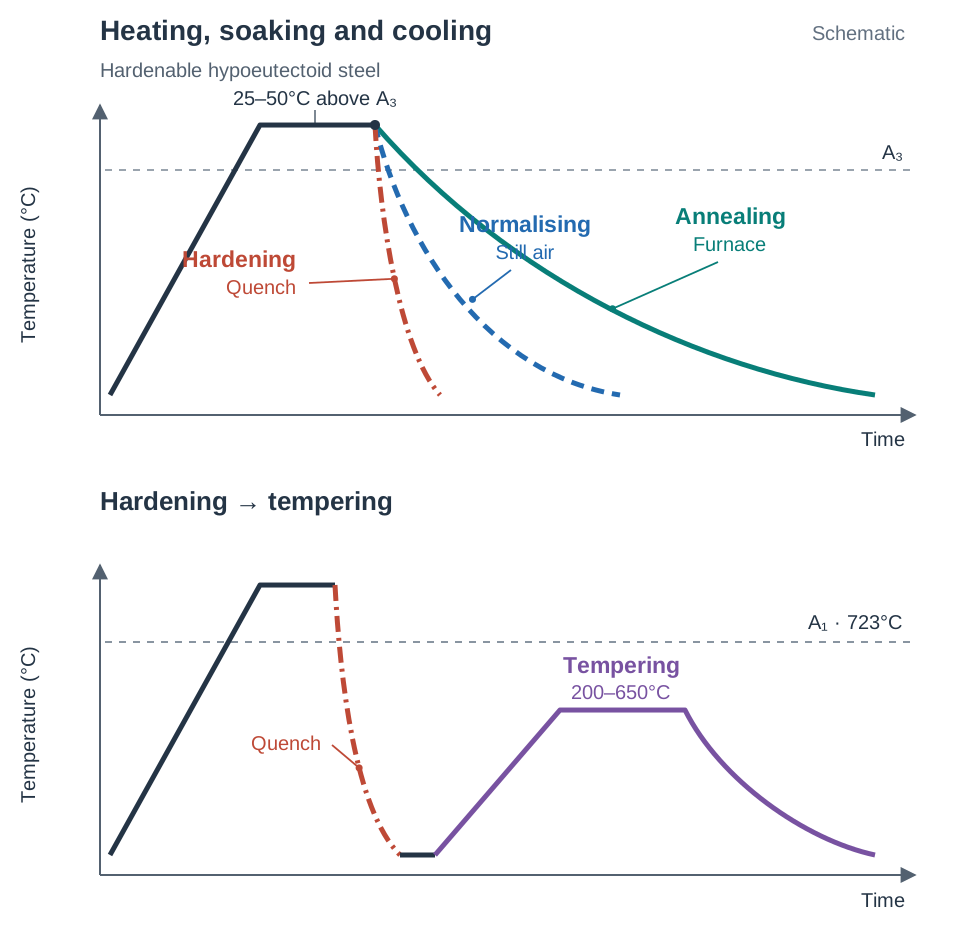
Full Annealing
Annealing produces maximum softness and ductility, making steel easy to machine or cold-form while removing internal residual stresses.
- Heating: Hypoeutectoid steels (<0.83% C) are heated 25°C to 50°C above the Upper Critical Temperature ( line) into the austenite region. Hypereutectoid steels (>0.83% C) are heated 25°C to 50°C above the Lower Critical Temperature ( line) to avoid forming a continuous, brittle network of cementite around grain boundaries.
- Soaking: The component is held at temperature (roughly 1 hour per 25 mm of thickness) so heat penetrates fully. Hypoeutectoid steel transforms into austenite; hypereutectoid steel heated between the LCT and UCT contains austenite and undissolved cementite.
- Cooling: Turn off the furnace and let the part cool very slowly in the furnace with the door closed.
- Result: Slow cooling allows full diffusion and grain growth, forming coarse pearlite with ferrite in hypoeutectoid steel, or with cementite in hypereutectoid steel.
Normalising
Normalising refines the grain structure to give a tough, shock-resistant component suitable for engineering forgings and structural beams.
- Heating: The steel is heated 25°C to 50°C above the Upper Critical Temperature (UCT) for all carbon contents, dissolving all existing grains into austenite.
- Soaking: Held at temperature to achieve uniform temperature and composition throughout.
- Cooling: The part is removed from the furnace and left to cool in still air at room temperature.
- Result: Air cooling gives less time for grain growth than furnace cooling, forming fine grains of pearlite with ferrite (or with cementite in hypereutectoid steels) that are stronger and tougher than annealed steel.
Hardening
Hardening makes the steel as hard and wear-resistant as possible throughout its cross-section by quenching it from the austenite region to form martensite. The steel must contain at least 0.35% to 0.4% carbon.
- Heating: Hypoeutectoid steels are heated 25°C to 50°C above the UCT; hypereutectoid steels are heated 25°C to 50°C above the LCT to avoid excessive grain coarsening and quench cracking.
- Quenching: The part is plunged rapidly into a quench bath. The FCC lattice changes towards BCC, but trapped carbon atoms distort it into a strained Body-Centred Tetragonal (BCT) structure called martensite. Under a microscope, martensite appears needle-like (acicular) and is extremely hard but very brittle.
- Types of quenching media: Brine (salt water) cools fastest by breaking down vapour bubbles quickly; water gives a standard rapid quench; oil cools more slowly to reduce distortion and cracking in delicate tools; still air or air blast is used for highly alloyed steels.
- Quenching technique: Plunge the component vertically to prevent uneven cooling and distortion, and move it in a figure-of-eight path to break up the insulating steam blanket that forms on the hot steel surface.
Tempering and Temper Colours
Immediately after quenching, steel is under severe internal stress and is too brittle for service. Tempering relieves these quenching stresses and restores toughness. Tempering reduces some hardness in exchange for toughness. The higher the tempering temperature, the more hardness is lost and the more toughness is gained.
The steel is cleaned to bare metal and reheated below the LCT (723°C). Low temperatures (220°C to 300°C) suit cutting tools and springs, indicated by oxide temper colours on clean steel:
- 220°C (Pale Straw): Lathe turning tools, scrapers (maximum hardness retained).
- 240°C (Dark Straw): Drills, milling cutters, reamers.
- 260°C (Brown): Taps, threading dies, shear blades.
- 280°C (Purple): Cold chisels, punches, axes.
- 300°C (Blue): Screwdrivers, springs (maximum toughness and flexibility).
Higher tempering temperatures (400°C to 650°C) are used for machine components like axles, crankshafts and connecting rods to produce high toughness and impact resistance.
Preheating and Postheating
- Preheating: The component is heated before welding or brazing, typically to 150°C to 300°C for medium- or high-carbon steels, and higher for cast iron. It slows the cooling rate of the weld zone, which prevents hard, brittle martensite forming next to the weld, reduces cracking and distortion, and drives off moisture.
- Postheating: The component is heated after welding, such as stress relieving at 550°C to 650°C followed by slow cooling. This relieves residual stresses caused by uneven contraction during welding and softens any hardened zones alongside the joint.
Stress Relieving and Age Hardening
Stress Relieving
Heavy machining, casting, welding and cold working (such as bending, rolling or drawing) set up severe internal stresses in steel. If left uncorrected, these stresses cause warping during machining or cracking during service.
- Procedure: Plain carbon steel is heated to between 550°C and 650°C, soaked at this temperature, and cooled slowly in still air.
- Mechanism: Because the temperature stays below the LCT (723°C), there is no phase change and no austenite forms. Internal stresses are relieved while the structure of welded, cast or machined parts is left largely unchanged. Cold-worked steel may also soften at these temperatures.
Age Hardening (Precipitation Hardening)
Age hardening strengthens non-ferrous alloys, particularly aluminium-copper alloys such as Duralumin (4% Cu, 0.5% Mg, balance Al). It relies on the decrease in solid solubility of copper in aluminium as temperature falls, carried out in three distinct steps:
- Solution treatment: The alloy is heated to about 500°C to dissolve copper completely into the aluminium, forming a uniform, single-phase solid solution.
- Quenching: The alloy is quenched rapidly in cold water. This traps copper atoms in a supersaturated solid solution at room temperature before they have time to separate.
- Ageing (precipitation): At room temperature over several days (natural ageing), or during gentle reheating to 150°C to 180°C for several hours (artificial ageing), copper combines with aluminium to precipitate extremely fine sub-microscopic particles of copper aluminide (). These dispersed particles lock the crystal planes, obstructing dislocation movement across the lattice and greatly increasing the alloy's tensile strength and hardness.
Surface and Case Hardening Methods
Many engineering components, such as gear teeth, camshafts and gudgeon pins, require a hard, wear-resistant outer skin alongside a tough, ductile core to withstand repeated impact loads without shattering.
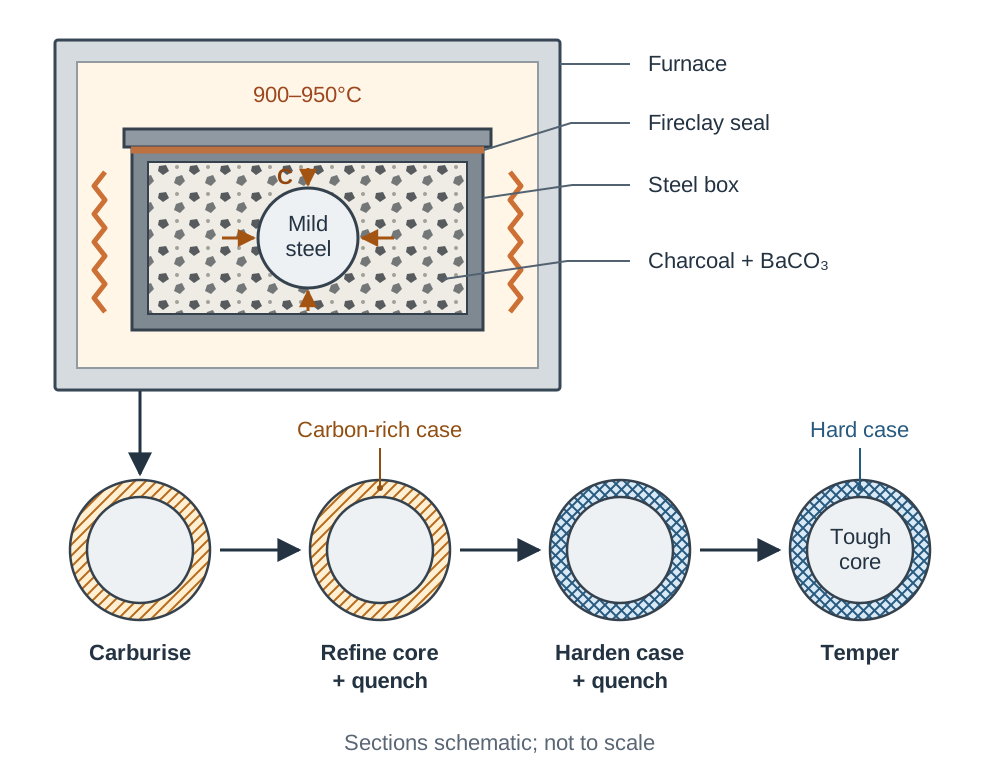
Pack Carburising (Low-Carbon Steels)
Mild steel (0.15% to 0.2% C) cannot be hardened directly by quenching because it lacks sufficient carbon. Carburising diffuses carbon into the outer skin:
- Chemistry: Charcoal reacts with limited oxygen inside the sealed box to form carbon monoxide (). The energiser, barium carbonate (), decomposes on heating to release carbon dioxide (), which reacts with the charcoal to produce more . At the hot steel surface, breaks down to deposit nascent carbon, which dissolves into the austenite.
- Full 5-step sequence:
- Pack: Place the mild steel part in a heat-resistant steel box, packed in granulated charcoal and barium carbonate energiser, and seal the lid with fireclay.
- Carburise: Heat the box in a furnace to 900°C–950°C for several hours to produce a high-carbon case (0.8% to 1.0% C) about 1 mm deep.
- Refine the core: Prolonged heating at 900°C coarsens the grains. Reheat the part to about 870°C (above the core's UCT) and quench in water or oil to produce a fine, tough core.
- Harden the case: Reheat to 760°C–780°C (above the case's LCT) and water quench. This transforms the high-carbon case into hard martensite without coarsening the core.
- Final temper: Reheat the component to about 200°C to relieve quenching stresses in the martensitic case without noticeably reducing its hardness.
- Result: A component with a hard case, tough core.
Flame Hardening (Medium- to High-Carbon Steels)
Used for localised surface hardening of medium-carbon steels (0.4% to 0.6% C), such as lathe bed guideways and large gear teeth.
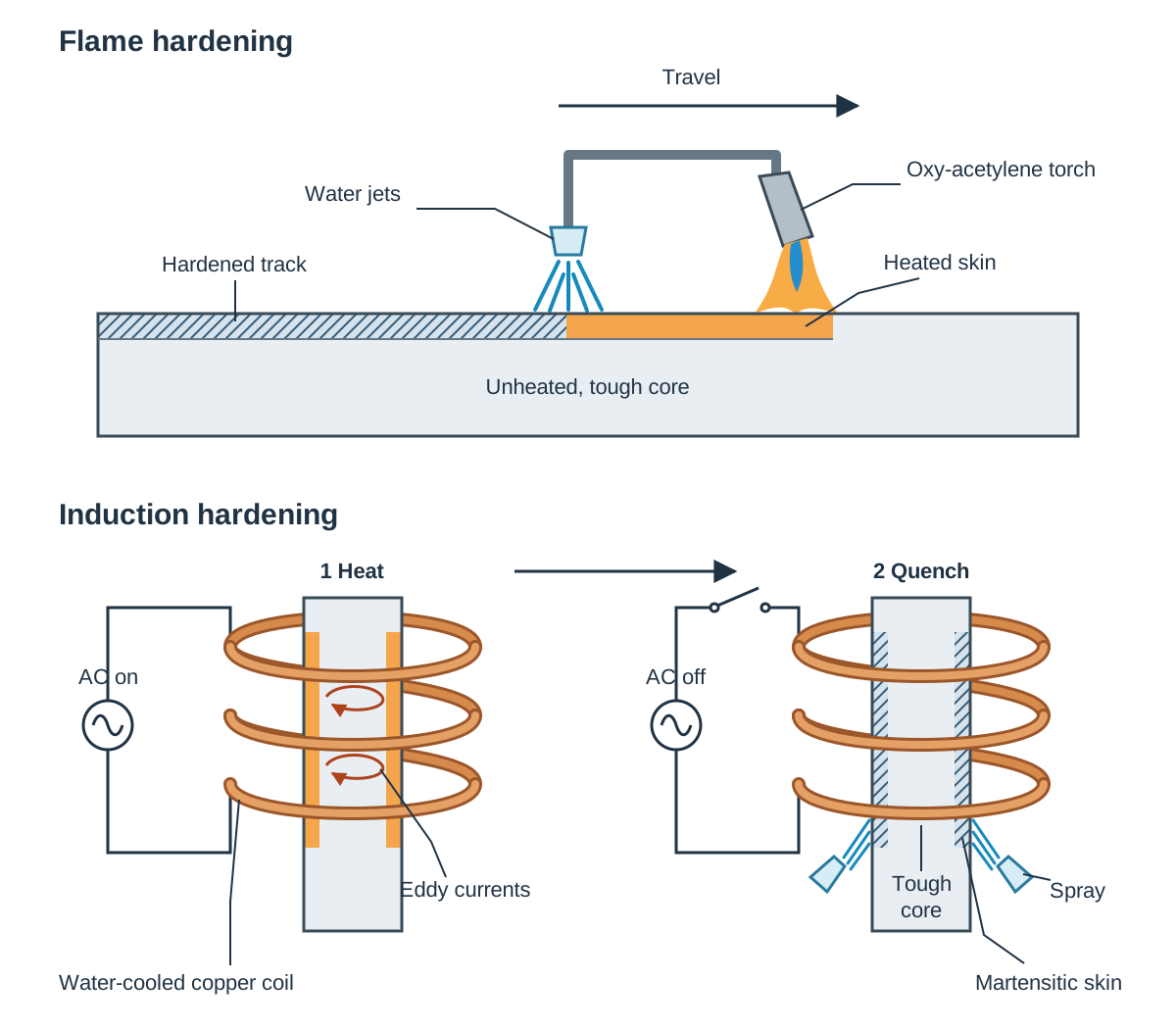
- Process: Oxy-acetylene burners heat the surface skin rapidly above the UCT into the austenite range. Water spray jets mounted directly behind the moving flame quench the heated surface instantly into martensite, leaving the unheated core unaffected.
- Diagram requirements in exams: Show the oxy-acetylene torch followed closely by the water spray jet moving across the steel surface, with arrows indicating travel direction, and the hardened surface layer clearly shaded over the unheated, tough core.
Induction Hardening
Used on medium-carbon steels for high-volume parts such as crankshaft journals, camshafts and sprockets.
- Process: High-frequency alternating current (10 kHz to 500 kHz) passes through a water-cooled copper coil shaped around the component. The alternating magnetic field sets up intense eddy currents in the steel. Due to the skin effect, these currents flow only through the surface layer, heating it into the austenite range within seconds. When current is switched off, built-in water spray jets quench the skin to martensite.
- Diagram requirements in exams: Show the component inside or beside a copper coil, the AC electrical supply connected to the coil, the shaded outer surface layer, water spray jets positioned below or around the coil, and arrows showing direction of movement.
Nitriding
Nitriding is a case hardening method for alloy steels containing aluminium, chromium or molybdenum.
- The pre-hardened and tempered part is placed in an airtight furnace container, heated to 500°C–530°C, and exposed to circulating ammonia gas () for 40 to 100 hours. Ammonia dissociates to release nascent nitrogen, which diffuses into the surface to form exceptionally hard alloy nitrides.
- Areas that must remain soft can be masked before treatment, typically by tin plating.
- Comparison with carburising: Nitriding operates at a lower temperature (500°C vs 900°C) and requires no liquid quenching. This eliminates quench distortion and cracking and produces a harder case, but it takes much longer and requires specialised alloy steels.
Heat Treatment Furnaces and Alloy Steels
Heat Treatment Furnaces
A furnace must heat components to an even, accurately controlled temperature. The main industrial types include:
- Muffle furnace: The work sits inside a refractory ceramic chamber called a muffle. Electric elements or gas burners heat the outside of the muffle, so combustion gases never touch the steel. This prevents surface scaling and decarburisation (loss of carbon). It is the standard furnace used in school workshops.
- Electric resistance furnace: Nichrome or silicon carbide elements line the refractory interior. It provides clean, silent, uniform heating and is easily linked to automatic temperature controllers.
- Gas- or oil-fired furnace: Burners fire directly into the heating chamber. Running costs are lower and it accommodates large components, but scaling is higher unless a protective muffle is fitted.
- Salt bath furnace: The part is immersed in a pot of molten salt. Heating is rapid and uniform, and because air is excluded from the metal surface, scaling and oxidation are eliminated. Molten salts are hazardous: any moisture causes explosive spitting, and toxic fumes require efficient exhaust ventilation.
- Controlled-atmosphere furnace: A protective gas (such as cracked ammonia, nitrogen, or endothermic gas) fills the heating chamber to displace oxygen and prevent surface oxidation and decarburisation.
- Pyrometric control: A thermocouple placed inside the furnace chamber sends a voltage signal to a temperature controller, which automatically switches heating elements on and off to maintain the set temperature.
Heat Treatment of Alloy Steels
Alloying elements like nickel, chromium, molybdenum, vanadium and tungsten change how steel responds to heat treatments:
- Increased hardenability: Alloying slows down the transformation of austenite to pearlite, allowing martensite to form at much slower cooling rates. Alloy steels can therefore be hardened by quenching in oil or still air instead of water, dramatically reducing distortion and quench cracking while allowing thick sections to harden right through.
- Higher hardening temperatures: Complex alloy carbides dissolve slowly into austenite. High speed steel (HSS), containing tungsten, chromium and vanadium, is preheated and then heated in stages up to 1250°C–1300°C before being quenched in oil or an air blast.
- Secondary hardening and tempering: HSS is tempered at 550°C–570°C (often twice). At this high tempering temperature, alloy carbides precipitate to produce secondary hardening, allowing HSS cutting tools to retain their cutting hardness even when glowing dull red at high machining speeds.
- Nitriding steels: Steels alloyed with aluminium, chromium or molybdenum are always hardened and tempered first to achieve core toughness, before undergoing surface nitriding.
Temperature Measurement and Workshop Safety
Heat treatment furnaces operate far above the range of mercury thermometers. Accurate thermal control requires pyrometers.
Thermocouple Pyrometer (Contact Method)
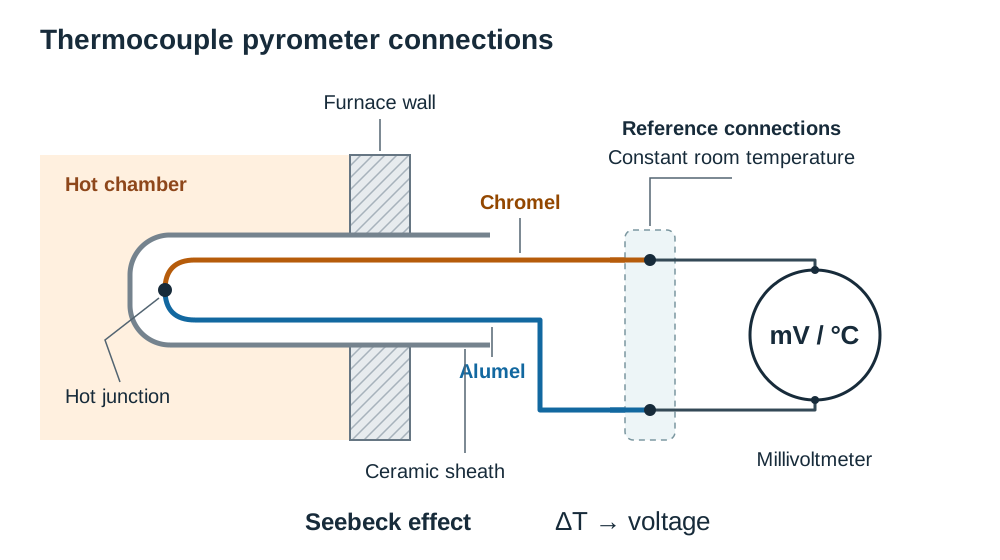
- Operating principle: Based on the Seebeck effect. When two wires of dissimilar metals are joined at one end to form a hot junction and heated, while the other ends (the cold junction) are kept at a constant room temperature, a small voltage (electromotive force) is produced that is proportional to the temperature difference.
- Construction: The hot junction is enclosed in a protective refractory ceramic sheath and placed inside the furnace. Base-metal wire pairs like Chromel-Alumel are used up to about 1100°C; noble-metal wire pairs like Platinum-Rhodium are used up to 1600°C. The cold junction outside connects to a millivoltmeter calibrated directly in degrees Celsius.
- Features: Robust, provides continuous electrical measurement, responds rapidly to temperature changes, and connects directly to furnace pyrometric controllers.
Optical Pyrometer (Disappearing Filament Type, Non-Contact)
- Operating principle: Based on the light intensity principle: as a body gets hotter, the light it gives off becomes brighter and its colour changes from dull red towards white.
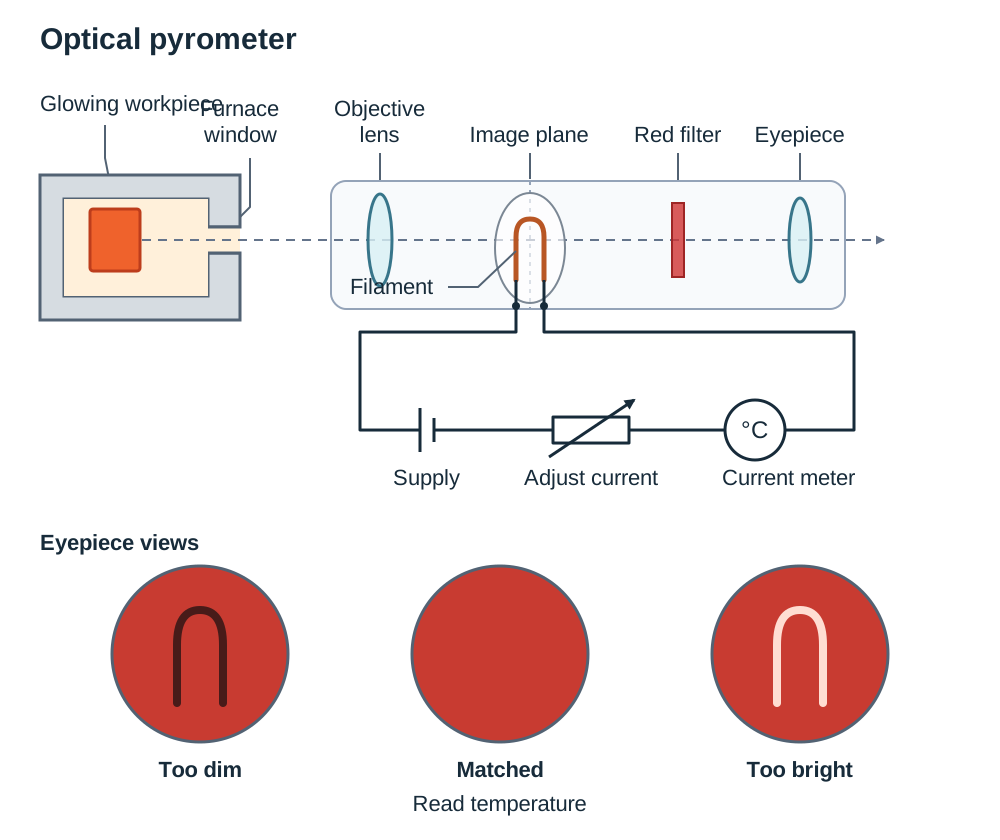
- Construction: A handheld optical telescope containing an objective lens, a red optical filter, an eyepiece, a small calibrated electric lamp bulb, and an adjustable potentiometer linked to a temperature scale.
- Measurement procedure:
- Sight the pyrometer through the furnace inspection window at the glowing workpiece.
- View through the eyepiece to see the lamp filament superimposed on the image of the hot workpiece.
- If the filament is cooler than the work, it appears as a dark line; if it is hotter, it appears as a bright line against the background.
- Adjust the potentiometer until the brightness of the filament matches the furnace background exactly, causing the filament to disappear.
- Read the furnace temperature directly from the calibrated electrical current scale.
Safety in Heat Treatment
- Wear protective equipment: leather apron, heavy heat-resistant leather gloves, and a full-face visor or safety goggles.
- Use long-handled tongs designed to grip the shape of the component securely.
- Position quench tanks immediately adjacent to the furnace door to minimise carrying distance of red-hot work.
- Plunge hot steel fully and rapidly into oil quench tanks to prevent surface oil vapour igniting. Always keep a close-fitting metal lid or fire blanket beside oil tanks to smother flash fires.
- Steel below red heat (under 500°C) looks cold but causes severe burns; always mark treated parts with chalk or place them in designated cooling areas.
- Ensure active exhaust ventilation is operating to extract fumes from quenching oils, salt baths and carburising compounds.
- Never allow moisture, damp tools or wet tongs to come into contact with molten salt baths, as water flashes to steam instantly and causes explosive spitting.
Key terms
- Austenite
- A high-temperature, Face-Centred Cubic (FCC) solid solution of carbon in iron, tough, non-magnetic, and able to dissolve up to 2.0% carbon.
- Ferrite
- A Body-Centred Cubic (BCC) solid solution of up to 0.02% carbon in iron; soft, ductile, magnetic, and stable at room temperature.
- Cementite
- An iron carbide chemical compound (Fe₃C) containing 6.67% carbon by weight; extremely hard and brittle.
- Pearlite
- A lamellar microstructure consisting of alternating microscopic plates of soft ferrite and hard cementite, formed upon slow cooling past 723°C.
- Martensite
- A supersaturated, needle-like Body-Centred Tetragonal (BCT) structure formed when austenite is rapidly quenched, trapping carbon atoms in the lattice.
- Upper Critical Temperature (UCT)
- The temperature line on the equilibrium diagram (A₃ or Acm) above which steel transforms completely into uniform austenite.
- Lower Critical Temperature (LCT)
- The horizontal line at 723°C (A₁) below which austenite cannot exist under equilibrium conditions, transforming into pearlite on slow cooling.
- Eutectoid Point
- The point on the iron-carbon diagram at 723°C and 0.83% carbon where solid austenite transforms directly into 100% solid pearlite upon cooling.
- Full Annealing
- A bulk heat treatment involving heating above the critical temperature, soaking, and cooling very slowly inside the furnace to produce maximum softness and ductility.
- Normalising
- Heating steel 25°C to 50°C above its Upper Critical Temperature, soaking, and cooling in still air to produce a fine, uniform grain structure with high toughness.
- Tempering
- Reheating a quenched, hardened steel to between 200°C and 650°C (below the LCT) to relieve internal stresses and restore toughness. Tempering reduces some hardness in exchange for toughness. The higher the tempering temperature, the more hardness is lost and the more toughness is gained.
- Case Hardening
- A process that produces a hard, wear-resistant outer surface (case) while keeping a tough inner core. In carburising, carbon is first added to the surface of low-carbon steel; in nitriding, nitrogen forms hard nitrides in alloy steels.
- Induction Hardening
- A surface hardening method using high-frequency alternating current in a copper coil to heat the steel surface by eddy currents and skin effect, followed by immediate quenching.
- Age Hardening
- A three-stage heat treatment for non-ferrous alloys (solution treatment, quenching, and ageing) that precipitates sub-microscopic particles like CuAl₂ to obstruct dislocation slip.
- Thermocouple Pyrometer
- A contact instrument measuring furnace temperature via the Seebeck effect, where two dissimilar metal wire junctions generate a voltage proportional to temperature difference.
- Optical Pyrometer
- A non-contact pyrometer that measures temperature by matching the brightness of an internal calibrated lamp filament against the glowing furnace background until it disappears.
- Preheating
- Heating a metal before welding or brazing (typically 150°C–300°C) to slow cooling, prevent brittle martensite formation in the heat-affected zone, and reduce cracking.
- Postheating
- Heating a metal after welding (typically 550°C–650°C) to relieve residual stresses and soften hardened zones adjacent to the weld.
Check yourself
Name the phase field that a 0.6% carbon steel occupies at 1000°C and at 750°C on the equilibrium diagram.
At 1000°C it is in the single-phase Austenite region; at 750°C it is in the two-phase Austenite + Ferrite region.
What are the temperature and carbon content values of the eutectoid point on the iron-carbon diagram?
723°C and 0.83% carbon.
State the full 5-step sequence for case hardening a mild steel component by pack carburising.
1. Pack in charcoal and barium carbonate; 2. Carburise at 900°C–950°C; 3. Refine core at ~870°C and quench; 4. Harden case at 760°C–780°C and water quench; 5. Temper at ~200°C to relieve case quenching stresses.
Why does austenite dissolve significantly more carbon than ferrite?
Austenite has a Face-Centred Cubic (FCC) lattice, which has larger interstitial spaces between iron atoms than the Body-Centred Cubic (BCC) ferrite lattice, allowing up to 2.0% carbon in solid solution compared to only 0.02% in ferrite.
Why is liquid quenching not required following the nitriding surface hardening process?
Nitriding forms hard alloy nitrides by reaction with nitrogen released from ammonia gas at 500°C–530°C, rather than by forming martensite through rapid cooling. With no liquid quench, there is no quench distortion or cracking.
What is the purpose of preheating a medium-carbon steel before welding?
Preheating slows down the cooling rate of the weld zone, which prevents hard, brittle martensite from forming in the heat-affected zone and prevents weld cracking.