
Engineering transforms scientific discoveries and mathematical principles into practical, reliable, and safe solutions that serve human needs. Within the Leaving Certificate Engineering course, Materials and Technology carries 300 marks at Higher Level (200 at Ordinary Level) on the written examination paper, while Workshop Processes carries 300 marks across the practical examination and project. This topic examines the five basic design functions, the outline history of technology and pioneering Irish engineers, the positive and negative impacts of technology on society, investigations of manufacturing industries and national institutions, and the distinct educational routes, branches, and ethical duties that define modern engineering careers.
Invention, Engineering, and Societal Sectors
To understand engineering in society, three related concepts must be clearly distinguished:
- Invention: The creation of a novel device, mechanism, or process that has not existed before.
- Engineering: The application of scientific principles, mathematical calculations, and practical workshop skills to design, manufacture, test, and maintain functional systems safely and economically.
- Innovation: The process of improving an existing concept or putting an invention into widespread, practical, and commercial use.
Technological eras overlap; older mechanical principles operate alongside digital controls and advanced materials. In the examination structure, this subject balances theory and practice: Workshop Processes accounts for 300 marks (150 for the practical exam and 150 for project and laboratory assessment), while Materials and Technology carries 300 marks on the Higher Level written paper. The design thinking taught in the written course directly supports the decisions you make in your workshop project.
Engineers work across many sectors — here are five of the biggest in Ireland:
- Construction and infrastructure: Civil and structural engineers design transport networks, bridges, water treatment schemes, and commercial structures. They make sure a structure is strong and stable enough to carry its own weight plus wind, traffic, and snow loads, without settling or cracking over its design life.
- Industry and manufacturing: Manufacturing engineers design production systems, tooling, robotic cells, and assembly lines to improve quality, output, and workplace safety.
- Technology and computing: Electrical, electronic, and software engineers develop microprocessors, sensor arrays, programmable logic controllers (PLCs), and control hardware.
- Medicine and healthcare: Biomedical engineers work with clinicians to design biocompatible implants, joint prostheses, surgical tools, and diagnostic systems such as MRI scanners.
- Energy and environment: Engineers develop renewable energy systems, manage electrical distribution grids, and design waste-reduction technologies.
Research and the Design Function
Engineering realisation is a structured, iterative problem-solving loop rather than trial and error. The syllabus explicitly names five basic functions in the design and making of a working model or prototype: research, development, design, production, and testing.
- Research — find out what already exists, what scientific principles apply, what materials and components are available, and what safety rules apply. Sources include existing products taken apart, manufacturers' catalogues and data sheets, standards (NSAI, EN, ISO), patents, textbooks, the internet, and talking to end users.
- Development — turn research into workable ideas. This involves sketching alternative solutions, experimenting with mechanisms, evaluating mechanical advantage, and refining the strongest concepts against the design brief and specification.
- Design — fix the final solution by deciding the four core factors named in the syllabus: materials, shapes, sizes, and processes. Produce detailed working drawings with exact dimensions, tolerances, and assembly details.
- Production — manufacture the prototype in a planned sequence of workshop operations (mark out cut machine drill bend join finish), with a clear technical reason for each step.
- Testing — load, run, or operate the prototype and measure its performance against the measurable targets in the design specification. Feed test data and evaluations back into earlier stages to refine materials, dimensions, or mechanisms.
The Four Design Decisions
Whenever an exam question asks you to explain the design function for a product, structure your response around the four syllabus headings:
- Materials: Choose specific alloys, polymers, or composites based on properties (for example, mild steel for toughness and weldability, 6063-T6 aluminium for high strength-to-weight ratio, or 316L stainless steel for corrosion resistance). Always pair the material with a precise mechanical property.
- Shapes: Select structural profiles (such as square hollow sections, I-beams, or tubular members) that resist bending and twisting forces by placing material far from the neutral axis while keeping mass down.
- Sizes: Calculate cross-sections using load and stress formulas, and apply an appropriate factor of safety to prevent mechanical failure, permanent deformation, or buckling.
- Processes: Choose practical manufacturing methods (such as centre lathe turning, milling, drilling, sheet metal folding, MIG welding, or CNC machining) suited to the material, workshop facilities, and production batch size.
Outline History of Technology and Engineering Pioneers
Technological progress follows a chain of cause and effect: societal need drives scientific discovery, which in turn demands stronger materials, more reliable machine tools, and more efficient power sources.
- Early developments: Smelting copper and tin into bronze, and later smelting iron ore, yielded tough, wear-resistant cutting tools. Waterwheels and windmills introduced early mechanical power for milling and mine pumping.
- The Industrial Revolution (c. 1760–1850): Thomas Newcomen (1712) built the first practical atmospheric steam pumping engine. James Watt (1769) did not invent the steam engine; he improved it by adding a separate condenser, so the working cylinder could stay hot all the time instead of being cooled and reheated on every stroke. This cut fuel consumption by roughly three quarters. Henry Maudslay developed the slide-rest lathe, making accurate, repeatable screw-cutting possible.
- Standardisation and machine tools: Joseph Whitworth introduced the standard screw thread (1841). Standardised threads, fits, and limits meant a nut made in one factory fitted a bolt made in another, creating the basis for interchangeable parts and mass production.
- Materials and mass manufacturing: Henry Bessemer (1856) developed the Bessemer converter, blowing cold air through molten pig iron to burn away excess carbon rapidly. This slashed steel production costs, unlocking long-span railway bridges, steam boilers, and steel-framed buildings. In 1913, Henry Ford introduced the moving assembly line, transforming automotive manufacturing.
- Power and control: Michael Faraday discovered electromagnetic induction (1831), leading to generators and electric motors that allowed each machine tool to have its own independent drive. The four-stroke petrol engine (Nikolaus Otto, 1876) and compression-ignition engine (Rudolf Diesel, 1892) provided compact, mobile prime movers. In the 20th century, the transistor (1947) and microprocessor (1971) replaced bulky mechanical relays with compact electronic control, opening the way for numerical control (NC), computer numerical control (CNC), CAD/CAM integration, robotics, and additive manufacturing (3D printing).
Pioneering Irish Engineers
The outline history of technology is a named syllabus item, and Irish engineers and their achievements are an obvious part of it — be ready to write in detail on at least three:
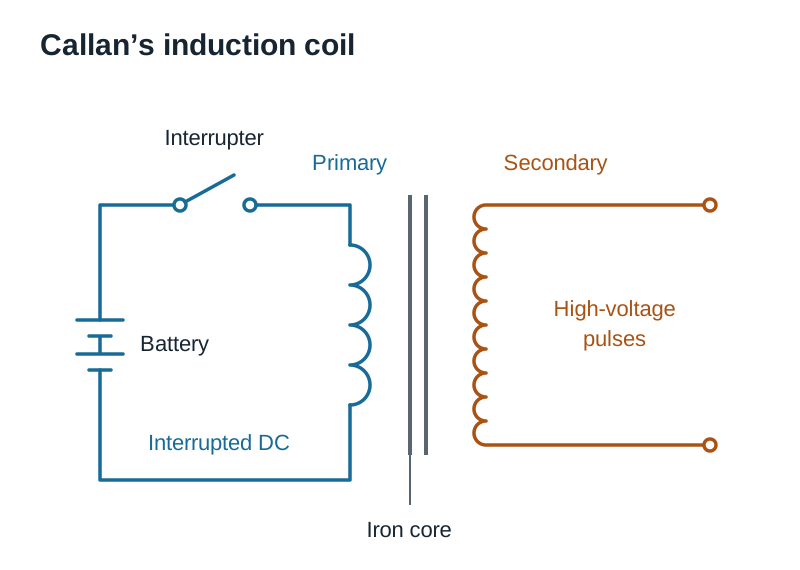
- Nicholas Callan (1799–1864): Professor of Natural Philosophy at St Patrick's College, Maynooth. In 1836 he invented the induction coil. By winding two insulated coils around a shared iron core and interrupting the direct primary current, he stepped up low battery voltages into high-voltage electrical pulses. This established the working principle behind modern electrical transformers and vehicle ignition coils.
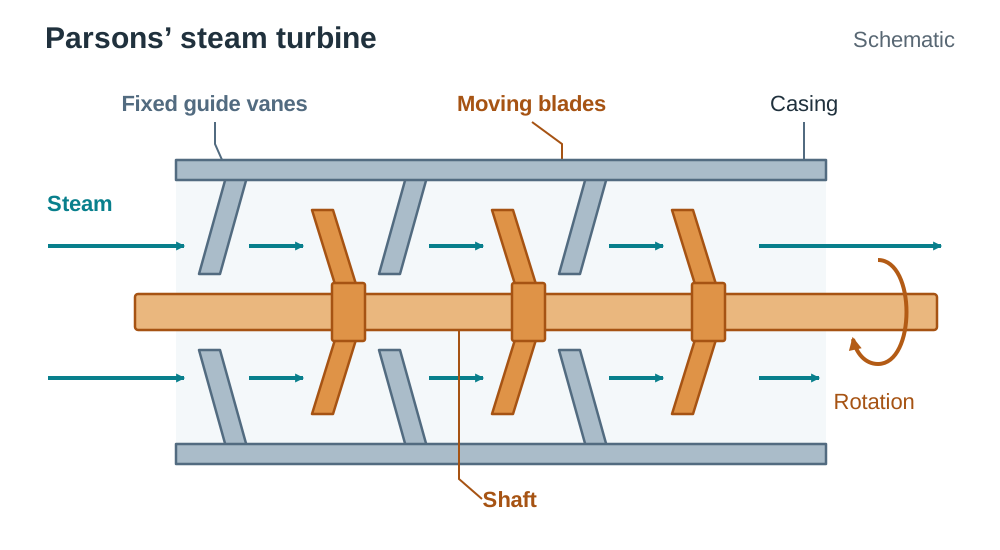
- Charles Parsons (1854–1931): Of the Parsons family of Birr Castle, Co. Offaly (born in London), he patented the multi-stage steam turbine in 1884. High-pressure steam expanded through alternate rows of fixed guide vanes and rotating angled blades, driving a shaft directly with minimal vibration. In 1897 his experimental vessel Turbinia reached 34.5 knots, revolutionising naval propulsion and electrical power generation.
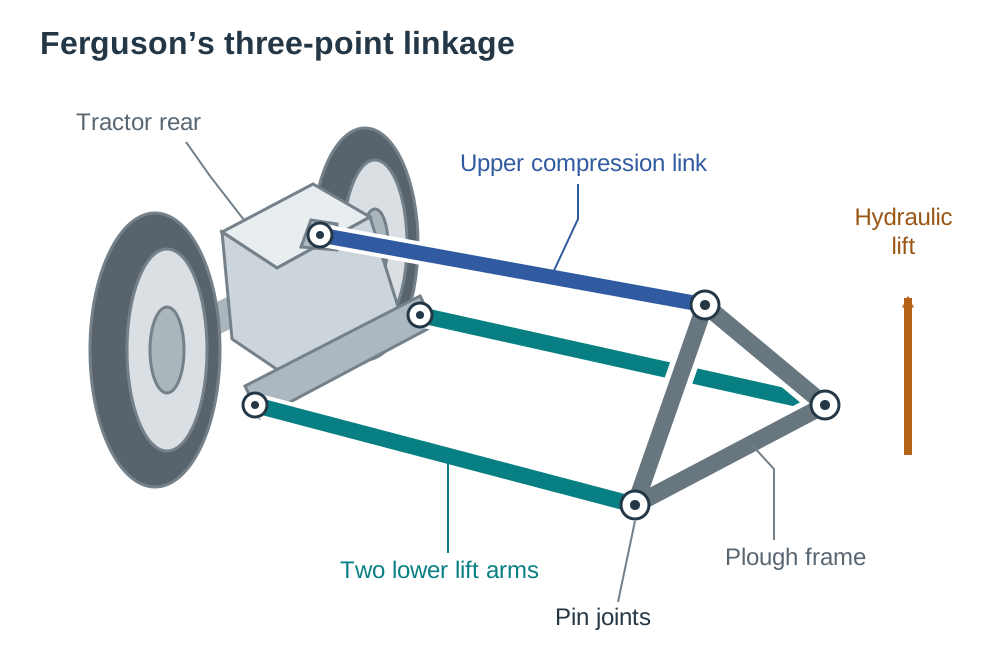
- Harry Ferguson (1884–1960): An engineer from Co. Down who invented the three-point linkage with hydraulic draught control. By pinning the implement to two lower lift arms and an upper compression link, tractor and plough became a single integrated unit. If the plough struck a buried rock or tree root, the hydraulic system automatically eased the load, preventing the tractor from rearing up and overturning backwards. In 1909, Ferguson also became the first person in Ireland to build and fly his own aeroplane.
- John Philip Holland (1841–1914): Born in Liscannor, Co. Clare, he developed the first practical modern submarines (Holland VI, 1900). He solved underwater trim and ballast control, pairing an internal combustion engine on the surface with electric storage batteries and an electric motor when submerged.
- Robert Mallet (1810–1881): Dublin engineer regarded as the founder of seismology. He coined the term 'epicentre', conducted controlled blast experiments to measure shock waves, and designed the foundation mountings for the Fastnet Rock lighthouse.
- Bindon Blood Stoney (1828–1909): Engineer to the Dublin Port and Docks Board. He developed massive 350-tonne pre-cast concrete blocks and built a custom diving bell to lay deep-water quay walls without building coffer dams.
- Aeneas Coffey (1780–1852): Patented the continuous column still (1830), which dramatically improved the speed, energy efficiency, and purity of industrial distillation.
- Louis Brennan (1852–1932): Born in Castlebar, Co. Mayo; invented the wire-guided mechanical torpedo and developed the gyroscopically balanced monorail.
- Ernest Walton (1903–1995): Born in Dungarvan, Co. Waterford; worked with John Cockcroft to split the atomic nucleus artificially in 1932 using a high-voltage particle accelerator, winning the Nobel Prize in Physics in 1951.
- James Martin (1893–1981): Born in Crossgar, Co. Down; co-founded the Martin-Baker aircraft company and developed the explosive aircraft ejection seat, saving thousands of aircrew lives.
Effects of Technological Development on Society
Technological developments rarely bring simple benefits alone; they produce complex social, economic, and environmental trade-offs. Higher Level answers require a balanced analysis of both sides.
Benefits of Technological Development
- Higher standard of living: Mass manufacturing and standardised interchangeable parts made motor cars, domestic appliances, tools, and medicines affordable and widely available.
- Improved public health: Biomedical engineering provides artificial joints, pacemakers, and MRI scanners. Clean water filtration and modern sewerage schemes eliminated water-borne epidemics like cholera and typhoid.
- Safer workplaces: Automated machine guarding, light curtains, and industrial robots take over hazardous, hot, noisy, and chemically toxic tasks, significantly reducing severe workplace injuries.
- Transport and global communication: Steam turbines, internal combustion engines, aviation, and fibre-optic networks connect distant regions, speeding up trade, emergency response, and information sharing.
- Accuracy and repeatability: CNC machining produces parts repeatably to tight tolerances, and coordinate measuring machines (CMM) then check those parts against the drawing, so errors are caught before material is wasted.
Costs and Drawbacks
- Worker displacement and reskilling: Automated production lines and CNC machines reduce the need for semi-skilled machine operators. Although jobs open up in maintenance, programming, and systems design, workers face redundancy if retraining is unavailable.
- Environmental pollution and greenhouse gases: Industrial energy consumption, mineral smelting, vehicle emissions, and plastic waste contribute to air pollution, acid rain, and climate change.
- Depletion of finite resources: Heavy manufacturing and digital electronics consume finite mineral ores, fossil fuels, and rare earth elements (such as neodymium for high-strength permanent magnets).
- High capital investment and line dependency: Automated manufacturing plant is expensive to purchase, install, and program. A failure in a single automated station can halt an entire factory assembly line.
- Product obsolescence and electronic waste: Rapid product release cycles lead consumers to discard functional equipment rather than repair it, generating large volumes of hazardous electronic waste.
Studying Industry and Engineering Institutions
The syllabus requires the study of both local and national industry and institutions. When investigating an industrial manufacturing plant or presenting a visit report, organise your information under seven standard headings:
- Company profile and product: Company name, location, and manufactured products (such as orthopaedic surgical implants, automotive linkages, or structural assemblies).
- Raw materials: Engineering materials entering the plant (for example, 316L stainless steel bar, structural hollow sections, or engineering polymers) with technical justifications for their selection based on mechanical and chemical properties.
- Ordered manufacturing processes: The step-by-step conversion of raw material into finished parts (e.g., cutting off CNC milling deburring ultrasonic washing heat treatment passivation).
- Quality control (QC): Inspection methods and testing instruments, such as coordinate measuring machines (CMM), optical profile projectors, digital vernier callipers, and material test certificates.
- Health, safety, and statutory rules: Safety measures including fixed interlocked guards, light curtains (beams of light across machine openings that immediately stop machine motion if broken), emergency trip switches, local exhaust ventilation (LEV), and mandatory PPE.
- Environmental management and waste: Recovery of scrap metal swarf, recycling and filtration of water-soluble cutting fluids, and energy monitoring.
- Workforce structure: The balance and collaboration between craftspeople, technicians, and professional engineers across production, maintenance, and design.
National Engineering Institutions
In addition to manufacturing factories, you must know about engineering institutions — bodies that regulate, standardise, support, or research engineering:
- Engineers Ireland: The professional body representing engineers across all disciplines in Ireland. It accredits third-level engineering degree programmes, establishes codes of professional ethics, delivers continuing professional development (CPD), and registers the professional title Chartered Engineer (C.Eng).
- National Standards Authority of Ireland (NSAI): The national body responsible for publishing and maintaining Irish Standards (I.S.) and harmonised European Standards (EN). Engineers use these standards to ensure components are safe, compatible, and tested to consistent benchmarks.
- SOLAS: The state agency overseeing the national craft apprenticeship system, managing both on-the-job employer training and off-the-job educational blocks leading to the Advanced Certificate Craft.
- Health and Safety Authority (HSA): The national statutory body that inspects workplaces and enforces safety legislation, including the Safety, Health and Welfare at Work Act, to prevent accidents and occupational illness.
- Enterprise Ireland and IDA Ireland: State agencies that support Irish engineering firms to expand and export (Enterprise Ireland) and attract foreign direct investment into high-tech manufacturing facilities (IDA Ireland).
- Technological universities and research centres: Third-level academic centres that carry out applied research in materials science, medical devices, robotics, and advanced manufacturing in partnership with industrial companies.
Engineering Career Pathways and Professional Ethics
Modern engineering projects depend on teams with complementary skills and qualifications. In Ireland, three distinct career tiers work alongside one another:
- Craftsperson (e.g., Toolmaker, Fitter, Welder, Electrician): Skilled workers who make, assemble, install, and service machinery and equipment. The qualification route is a SOLAS craft apprenticeship, combining on-the-job training with off-the-job phases at technological universities to achieve the Advanced Certificate Craft (NFQ Level 6).
- Engineering technician: Technical specialists who work between practical shop-floor production and theoretical design. Their responsibilities include CAD draughting, CNC machine setup and G-code programming, CMM quality inspection, materials testing, and PLC troubleshooting. Training is typically a Higher Certificate (NFQ Level 6) or Ordinary Bachelor's Degree (NFQ Level 7).
- Professional engineer / Chartered Engineer: Engineers who lead design, mathematical analysis, research, project finance, and regulatory compliance. Entry requires an accredited Honours Bachelor's Degree (NFQ Level 8) or Master's Degree (NFQ Level 9). After gaining several years of responsible professional experience, engineers can apply to Engineers Ireland to become a Chartered Engineer (C.Eng).
Branches of Engineering
- Mechanical: Machinery, power generation, engines, mechanisms, HVAC systems, and manufacturing plant maintenance.
- Manufacturing / Production: Designing, automating, and operating factory processes, tooling, quality control systems, and lean production lines.
- Civil / Structural: Roads, bridges, structural steelwork, water supply, drainage, and foundations.
- Electrical / Electronic: Power generation, high-voltage distribution networks, electric drives, electronic circuits, and microprocessors.
- Biomedical: Artificial joints, cardiovascular devices, prostheses, surgical equipment, and medical imaging systems.
- Chemical / Process: Chemical reactors, pharmaceuticals, food processing, fluid handling, and thermal heat exchange.
Personal Qualities and Ethical Duties
Engineers require strong mathematics and applied science skills, structured problem-solving abilities, proficiency in CAD and graphical communication, practical workshop appreciation, and the ability to communicate clearly in multidisciplinary teams. Their primary ethical duty is to protect public health and safety above all commercial pressures, maintain honest professional relationships, and carry out life cycle assessments (LCA) to minimise environmental harm over a product's entire lifespan.
The Prescribed Special Study Topic
The syllabus, under Materials and Technology Technology, includes an item for a specialised study of a prescribed topic. The only specific themes listed in the syllabus text are historical examples (photovoltaic and solar cells for 2008, hybrid vehicle technology for 2009). The syllabus text does not set out a permanent prescribed topic for 2027, so check with your teacher whether an official circular specifies a special study topic for your examination year before dedicating extensive study time to one.
When preparing any prescribed engineering topic, apply the standard analytical method:
- Research the underlying scientific and electrical or mechanical principles.
- Detail the exact materials, mechanical components, and control devices involved.
- Examine practical engineering applications and real-world operational challenges.
- Provide a balanced evaluation of its benefits and limitations for society and the environment.
Key terms
- Engineering
- The practical application of scientific and mathematical principles, materials knowledge, and workshop processes to design, build, test, and maintain safe, economical structures, machines, and systems.
- Invention
- The original creation of a completely new mechanism, device, or production process that did not previously exist.
- Innovation
- The practical or commercial improvement, development, and widespread adoption of an existing device, process, or idea.
- Induction Coil
- An electrical device invented by Nicholas Callan that produces high-voltage pulses from a low-voltage direct current source through magnetic induction using interrupted primary current.
- Steam Turbine
- A rotary heat engine patented by Charles Parsons that converts the thermal and pressure energy of expanding steam into continuous rotary shaft power via alternating rows of fixed and rotating blades.
- Three-Point Linkage
- A standardised agricultural tractor hitch invented by Harry Ferguson that uses two lower draft links and one upper link with hydraulic draught control to couple implements rigidly and prevent tractor rearing.
- Draught Control
- A hydraulic feedback mechanism developed by Harry Ferguson that automatically adjusts implement working depth to maintain uniform pulling resistance and tractor stability.
- Bessemer Converter
- A pear-shaped industrial furnace developed by Henry Bessemer that converts molten pig iron into steel by blowing cold air through the melt to burn away excess carbon and impurities.
- Factor of Safety
- The structural design ratio of material failure stress (typically ultimate tensile strength or yield stress) to the maximum allowable working stress: . Always state which failure stress is used.
- Prototype
- A full-scale, functioning physical model built to evaluate design integrity, operating mechanics, and manufacturing sequences prior to commercial production.
- Engineers Ireland
- The professional membership body representing engineers in Ireland under Royal Charter; it accredits engineering degrees, sets codes of ethics, and registers Chartered Engineers.
- Life Cycle Assessment (LCA)
- A systematic method for evaluating the overall environmental impact of a product across its entire life, from raw material extraction and manufacture through use to recycling or disposal.
Check yourself
What technical improvement did James Watt make to the Newcomen atmospheric steam engine, and what was its thermodynamic benefit?
Watt added a separate condenser so the main working cylinder could remain hot throughout the cycle. This avoided repeatedly cooling and reheating the cylinder on every stroke, cutting fuel consumption by roughly three quarters.
Which Irish scientist invented the induction coil in 1836, and what modern automotive device relies on the same principle?
Nicholas Callan of Maynooth University; the modern automotive ignition coil uses this same electromagnetic induction principle to produce high-voltage sparks.
State the four core decisions that make up the design function in the Leaving Certificate Engineering syllabus.
The selection of materials, shapes, sizes, and processes.
Name the five basic functions listed in the syllabus for the design and construction of a working model or prototype.
Research, development, design, production, and testing.
What safety hazard did Harry Ferguson's three-point linkage and hydraulic draught control solve on farm tractors?
It integrated the plough and tractor into a single unit, using hydraulic draught control to balance soil resistance and preventing the tractor from rearing up and flipping backward over its rear wheels when striking a buried rock or root.
Give one benefit and one drawback to society of introducing robotic welding cells into a manufacturing plant.
Benefit: consistent weld quality and removal of human operators from hazardous welding fumes and UV arc glare. Drawback: high initial capital investment, dependency on specialized programming and maintenance, and displacement of manual welders who require retraining.
Name two engineering institutions in Ireland and state the primary role of each.
Engineers Ireland (accredits engineering degrees, enforces professional ethics, and registers Chartered Engineers) and the National Standards Authority of Ireland / NSAI (publishes, monitors, and certifies compliance with national and European engineering standards).