

Health and safety spans both main strands of Leaving Certificate Engineering: practical execution in Workshop Processes and technical theory in Materials and Technology. Safe working practice is assessed during the coursework project and the practical examination as well as in the written papers. At Higher Level, you need to understand not only safe workshop routines, but also the mechanical, electrical, and legal reasons behind them. Key topics include basic first aid, machinery safeguarding and failure modes, single-phase and three-phase electrical protection, chemical storage, fire classification, Irish statutory law under the Health and Safety Authority (HSA), and standard calculations for fuse sizing, the Factor of Safety, and accident statistics.
Risk Management, the Hierarchy of Control, and Statutory Law
A hazard is anything with the inherent potential to cause harm, such as an exposed revolving chuck, an uncoiled cable, or an open container of acid. Risk is the likelihood that the hazard will cause injury combined with the severity of that injury. A pillar drill isolated from its electrical supply remains a potential mechanical hazard, but its operational risk is zero until powered.
Controlling risk in any engineering environment follows a strict hierarchy of control. You must always try to eliminate or substitute a hazard before relying on engineering barriers or protective gear:
- Elimination: Redesign the product or task so the hazard is removed entirely (for example, ordering steel bar pre-cut to size to avoid sawing operations).
- Substitution: Replace a hazardous material or process with a safer one (for example, swapping a toxic, volatile solvent degreaser for a water-based citrus cleaner).
- Engineering controls: Isolate people from the hazard using physical barriers, interlocks, or local exhaust ventilation (LEV).
- Administrative controls: Set up safe working routines, safety signs, exclusion zones, and operator training.
- Personal Protective Equipment (PPE): Provide individual protection (such as safety spectacles or leather gauntlets) as the final line of defence.
The Five-Step Risk Assessment
A risk assessment is the written process an employer carries out to identify hazards and implement controls. It forms the foundation of the workshop Safety Statement:
- Identify the hazards: Inspect the workshop and note every physical, electrical, and chemical hazard.
- Decide who might be harmed and how: Consider machine operators, maintenance staff, cleaners, and visitors.
- Evaluate the risk and decide on controls: Assess likelihood and severity, then apply the hierarchy of control, starting at the top.
- Record the findings: Document the hazards, existing controls, and required actions in the Safety Statement and make it available to all workers.
- Review and update: Re-evaluate the assessment regularly, whenever a new machine or process is introduced, or immediately following an accident or near miss.
Statutory Provisions in Ireland
Workplace safety is governed by the Safety, Health and Welfare at Work Act 2005 and enforced by the Health and Safety Authority (HSA):
- Employer duties: Provide safe plant and machinery; ensure safe systems of work; supply necessary PPE free of charge; provide competent instruction, training, and supervision; and maintain an up-to-date, written Safety Statement.
- Employee duties: Take reasonable care for the safety of themselves and fellow workers; cooperate with training; use guards, interlocks, and PPE correctly; report any equipment defects or near misses immediately; and never attend work under the influence of intoxicants.
- Safety representative: Employees have the legal right to select a safety representative from among themselves. The representative may inspect the workplace, investigate accidents, and present safety concerns to management and HSA inspectors.
- Enforcement notices: HSA inspectors have the power to enter premises without notice. They can issue an Improvement Notice (requiring an unsafe condition to be fixed within a set period) or a Prohibition Notice (ordering an immediate shutdown of a machine or process where there is serious risk of personal injury).
- Statutory accident reporting: An employer must report an incident to the HSA whenever a workplace accident prevents an employee from carrying out their normal work duties for more than three consecutive days (excluding the day of the incident).
Workshop Procedures: Housekeeping, Handling, and Emergencies
Order and cleanliness prevent slips, trips, and entanglement. Keep walkways completely clear, and mark clear operator zones on the floor around machines with yellow and black hazard lines. Ensure work space clearances remain unobstructed, particularly where moving components extend outward, such as the reciprocating ram of a shaping machine or bar stock protruding from the headstock of a lathe.
Manual Handling and Material Storage
Manual handling means lifting, carrying, putting down, pushing, or pulling a load by hand. Poor lifting technique causes back strains, disc damage, and hand crush injuries.
Carry out correct kinetic lifting in this order:
- Assess the load: Check its weight, balance, shape, and grip points. If it is too heavy or awkward, use a trolley, hoist, or a two-person lift.
- Plan the route: Ensure the route and the set-down area are completely clear before lifting.
- Position the feet: Place feet hip-width apart with one foot slightly forward for stability.
- Bend the knees and keep the back straight: Let the leg muscles do the lifting work rather than the spine.
- Secure a firm grip: Keep the load close to your body to minimise leverage on the lower back.
- Lift smoothly: Push up with the legs without jerking.
- Do not twist: Change direction by moving your feet rather than twisting your torso.
- Set down safely: Bend the knees with a straight back, ensuring fingers and feet are clear before letting go.
Store materials systematically in the workshop:
- Store heavy stock on low shelves and lighter materials higher up, so that heavy loads are never lifted above shoulder height.
- Store metal bar horizontally in sturdy cantilever racks. Store sheet metal on edge in vertical sheet racks with corner guards, because flat-stacked sheet steel can slide and cause severe cuts.
- Store flammable solvents and thinners in a lockable, fire-resistant steel cabinet fitted with an internal spillage sump.
- Keep gas cylinders upright, secured with chains or clamps, in an outdoor, ventilated storage compound away from heat sources.
Emergency Procedures and Workshop Switches
Every engineering workshop relies on two distinct emergency electrical switches:
- Emergency stop button: A red, palm-operated mushroom head on each machine that breaks that specific machine's control circuit.
- Master emergency isolation switch: A prominent red push-button, typically on a yellow backing box located beside the exit doors, which drops out the main workshop contactor and cuts electrical power to every machine in the room simultaneously.
Pressing an emergency switch isolates the drive, but the machine must never be restarted immediately. Investigate and clear the underlying cause first. Because machines are wired with a no-volt release mechanism, clearing the button will not cause the spindle to spin until the operator presses the dedicated green start button.
Before undertaking maintenance, such as changing a lathe chuck, replacing a grinding wheel, or tensioning a drive belt, always isolate the machine at the wall isolator and lock off the switch so nobody can energise the machine while your hands are inside.
Follow this sequence in a fire emergency:
- Raise the alarm immediately by shouting and breaking the nearest glass call point.
- Hit the master emergency isolation switch to cut electrical power.
- If the fire is small, you have an unblocked exit behind you, and you have the matching extinguisher, attempt to fight it using the PASS method: Pull the safety pin, Aim at the base of the fire, Squeeze the operating lever, Sweep from side to side.
- If the fire spreads, evacuate immediately via the nearest fire exit and report to the designated assembly point for roll call.
Basic First Aid in the Workshop
Always know the location of the first aid box, the eyewash station, and the name of the designated trained first aider, and ensure every injury is recorded in the accident book:
- Electric shock: Do not touch the casualty until the electrical supply is isolated at the emergency isolation switch or the plug is pulled, then check breathing and call for emergency help.
- Burns and scalds: Cool under cool running water for at least 20 minutes, because cooling stops trapped heat from continuing to damage tissue under the skin; never apply creams and do not burst blisters.
- Severe bleeding: Apply direct pressure with a clean dressing and raise the limb; never pull out a piece of metal embedded in a wound, because it may be holding back severe bleeding, so pad around it and bandage firmly over the padding.
- Eye injury or chemical splash: Irrigate the eye at the eyewash station with clean running water for at least 10 minutes and get immediate medical help.
Machine-Specific Safety and Hot Work Precautions
Exam questions frequently ask for three or four specific safety precautions for a named machine or process. Always give the physical precaution paired with its technical reason.
Pedestal and Bench Grinders
Grinding wheels rotate at high angular velocities and are brittle. A fractured wheel can burst violently, throwing fragments across the workshop:
- Ring-test new wheels: Suspend the wheel on a finger and tap it gently with a wooden screwdriver handle. A clear ringing tone indicates an intact wheel; a dull thud indicates an internal fracture, meaning the wheel must be discarded.
- Check speed ratings: Verify that the maximum safe operating speed printed on the wheel blotter exceeds the spindle speed stated on the machine data plate.
- Mount with blotters: Clamp the wheel between matching recessed steel flanges, with compressible paper blotters on both sides to distribute clamping pressure evenly without cracking the abrasive material.
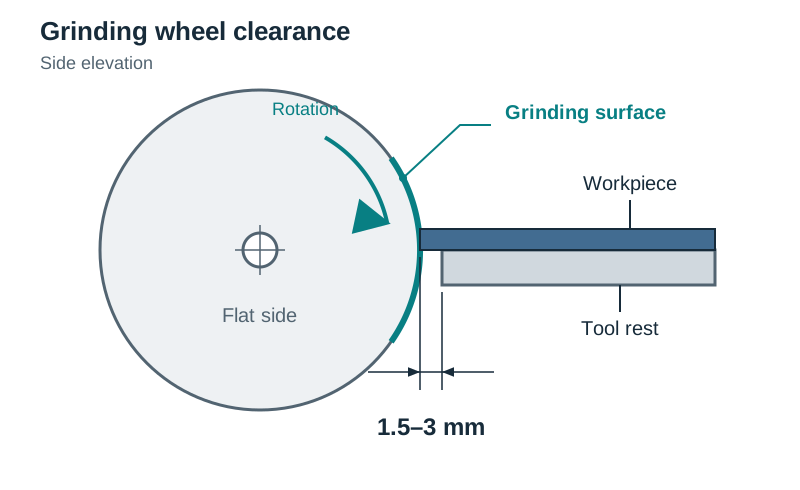
- Set tool rest clearance: Adjust the tool rest to within of the wheel face. A wider gap allows the workpiece to be dragged down between the wheel and the rest, which will jam and shatter the wheel.
- Position the spark guard and run-up: Set the clear eye shield close to the wheel, wear impact-rated safety goggles, and let the grinder run unloaded for one full minute while standing to one side before presenting work.
- Grind on the face only: Never grind on the side of a standard straight wheel, as lateral force can cause it to snap. Never grind soft metals like aluminium or brass on a standard wheel, as they clog the pores (loading), creating friction, overheating, and bursting.
Centre Lathes and Drilling Machines
- Chuck key rule: Always remove the chuck key from the lathe or drill chuck immediately after clamping. A key left in the chuck turns into a high-speed projectile the moment the motor starts.
- Secure clamping on the drill: Always clamp workpieces in a machine vice or bolt them to the table. Never hold work by hand; if the drill grabs as it cuts through, thin sheet metal will spin like a blade.
- Use chip breakers and swarf rakes: Lathe cutting tools are ground with chip breakers to curl continuous ribbons of ductile metal into discontinuous chips. Stop the lathe before clearing swarf, and always use a wire brush or swarf hook, never bare hands or waste rags.
Hot Work: Welding, Foundry, and Heat Treatment
- Electric arc welding: Wear a welding helmet fitted with the correct shade filter lens to protect against ultraviolet radiation, which causes corneal burns (arc-eye). Erect flame-retardant welding screens around the bay to shield bystanders from flash burn. Ensure local exhaust ventilation is active to remove metal oxide fumes.
- Oxy-acetylene welding and cutting: Keep gas cylinders upright and chained. Acetylene must never be used at a working pressure above 1 bar (15 psi), as it becomes chemically unstable and can explode without oxygen present. Keep all oil and grease away from oxygen fittings, as pure oxygen under pressure causes hydrocarbons to ignite spontaneously. Fit flashback arrestors and non-return valves to both regulators, and light the torch only with a flint spark lighter.
- Foundry and molten metal: Wear a full-face visor, leather apron, gauntlets, and spats over boots. Every ladle, skimmer, and mould must be thoroughly preheated and dry before contacting molten metal; any trace of water flashes instantly to steam, expanding over times and blowing molten metal out of the crucible.
- Heat treatment: Use long tongs to place work in and remove work from the furnace, never bare or gloved hands; keep the quench tank clear of the furnace door and provide extraction over it, because quenching oil gives off flammable vapour; never quench in a tank contaminated with water; and mark or segregate hot components, since hot steel and cold steel look identical.
Personal Protective Equipment and Machinery Safeguarding
The syllabus highlights special protection for the face, hands, and eyes, which face the highest exposure during metal cutting, forming, and heat treatment.
Gloves and Rotating Machinery
While heavy leather gauntlets are essential for handling raw sheet metal, arc welding, and foundry work, gloves must never be worn when operating rotating machinery such as the lathe, drill, pedestal grinder, or milling machine. If a glove catches on a revolving spindle, chuck jaw, or drill bit, the cloth will not tear away; instead, it drags the operator's entire hand directly into the mechanism, leading to severe crushing or amputation.
Workshop Failure Modes
Accidents and equipment breakdowns stem from three main categories of failure:
- Mechanical failure: A part breaks or wears out, such as a cracked grinding wheel, a snapped drive belt, or a worn chuck jaw; prevented by planned inspection and regular maintenance.
- Electrical failure: Damaged cable insulation, a loose earth connection, or an overloaded circuit; prevented by earthing, fuses/MCBs, RCDs, and testing of portable equipment.
- Human failure: The most common cause of workshop accidents, such as rushing a job, fatigue, lack of training, or deliberately defeating a guard or interlock; prevented by training, supervision, and safe systems of work.
Guard Classification
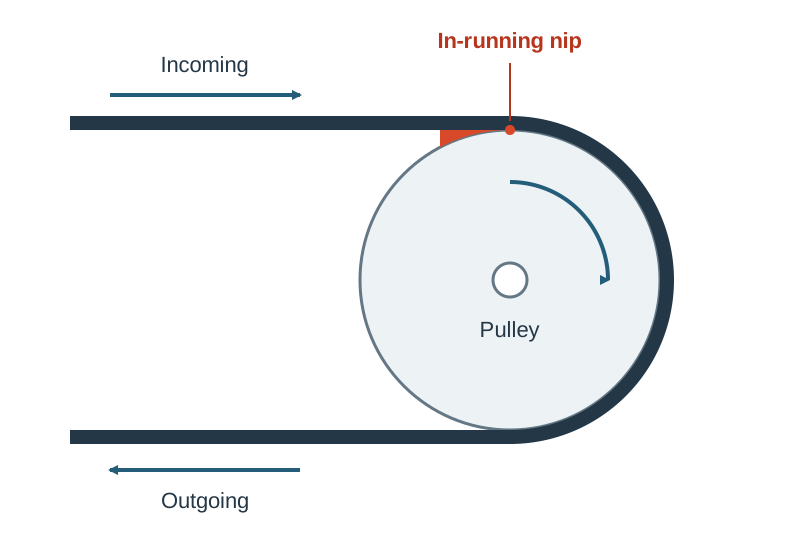
Machinery hazards occur at rotating shafts, reciprocating rams, cutting tools, and in-running nip points (where belts meet pulleys or gears mesh). Safeguards prevent operators from contacting these danger zones:
- Fixed guards: Permanent, solid barriers with no moving parts (for example, the sheet-steel casing over a pillar drill's belt pulleys). They can only be removed using a tool, such as a spanner or Allen key, during maintenance.
- Interlocking guards: Movable guards mechanically, electrically, or magnetically connected to the machine's drive circuit. Opening the guard trips an internal microswitch that cuts power to the motor and applies a brake, preventing the machine from running while the guard is open (for example, a lathe chuck guard or CNC enclosure door).
- Adjustable guards: Movable guards that can be set manually to suit different workpiece sizes while keeping the unused portion of the cutting blade or drill bit shielded (for example, the telescopic clear sleeve on a vertical drill).
- Trip and sensing devices: Light curtains, trip bars, or pressure mats that bring a machine to an immediate halt if an operator crosses a safe boundary.
Electrical Systems and Circuit Protective Devices
Workshops use two kinds of alternating current (AC) supply: single-phase (, ) for light portable tools and lighting, and three-phase ( between phases) for heavy machine tools like industrial lathes, milling machines, and shaping machines.
Wiring colour codes in fixed installations and flexible leads follow modern European standards: Brown is Live, Blue is Neutral, and Green/Yellow stripes designate the protective Earth conductor.
Circuit Protection Comparison
| Device | Operating Principle | Primary Protection Target |
|---|---|---|
| Earthing | A low-resistance copper path connecting the metal machine casing to ground. An internal live fault sends a massive surge down this conductor rather than through the operator. | Protects human operators from chassis electrocution |
| Fuse | A calibrated metal wire that melts and breaks the circuit when current exceeds its rating (, , ) over a sustained period. | Protects cables and equipment from overheating and fire |
| Miniature Circuit Breaker (MCB) | An electromechanical switch using magnetic coils for instant short-circuit trips and bimetallic strips for thermal overloads. Can be manually reset. | Protects fixed workshop wiring and motor circuits |
| Residual Current Device (RCD) | Continuously compares the current flowing out on the Live conductor against the current returning on the Neutral. If an imbalance as low as leaks to earth, it trips within . | Protects human life against fatal electric shock |
| No-Volt Release (NVR) | An electromagnetic contactor that opens if mains voltage drops or cuts out, preventing an unattended machine from abruptly restarting when power returns. | Protects machine operators from unexpected start-ups |
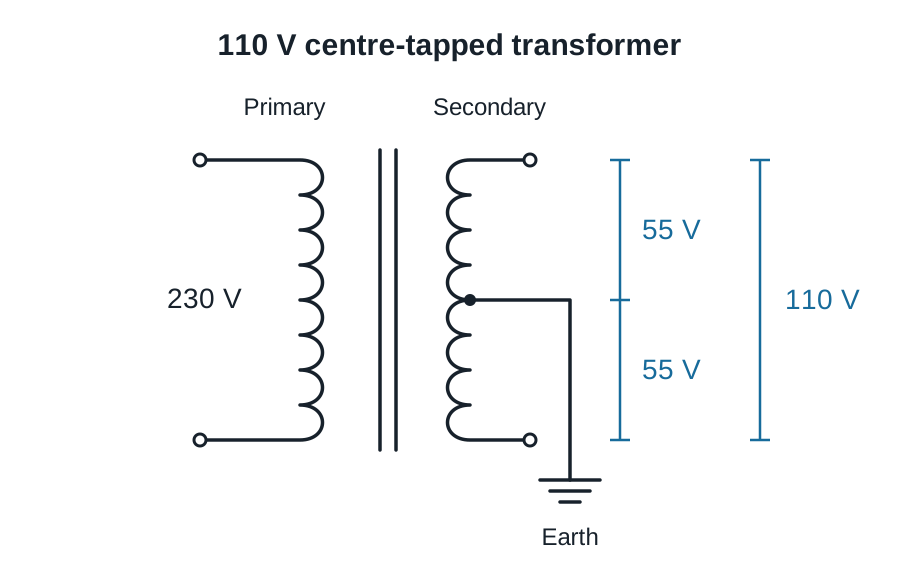
| 110 V Centre-Tapped Transformer | Steps down mains to with an earthed centre tap, ensuring the maximum potential between any live pin and earth is just . | Protects operators using portable power tools |
How Circuit Protective Devices Work Together
Consider a pillar drill with a damaged flex where the live wire touches the metal motor housing. The earthing wire carries the short-circuit current safely to ground. Because this path has low resistance, a large current surge flows, blowing the fuse or tripping the MCB to cut off the supply. If the earth wire were severed and an operator touched the live casing, current would leak through their body to ground; an RCD would instantly detect the tiny difference between the Live and Neutral currents and disconnect the power within , saving the operator from a fatal shock.
Chemical Classifications, Colour Codes, and Fire Safety
Workshops store and use hazardous chemicals that fall into four main syllabus categories. Every hazardous chemical supplied must come with a Safety Data Sheet (SDS) detailing its chemical properties, hazards, required PPE, safe storage, and spillage procedures:
- Poisonous (toxic): Substances that cause illness or organ damage when swallowed, absorbed, or inhaled (for example, zinc oxide fumes from welding galvanised steel, or cyanide salts). Use local exhaust ventilation and cartridge respirators.
- Corrosive: Liquids or vapours that attack and destroy living tissue and metals (for example, dilute sulphuric acid in pickling tanks or ferric chloride used for etching printed circuit boards). Wear chemical splash goggles, neoprene gauntlets, and a rubber apron. Always add acid to water, never water to acid; pouring water onto concentrated acid causes rapid, localised boiling that spatters acid out of the container.
- Combustible: Liquids or solids that ignite readily in air (for example, paraffin, acrylic dust, and solvent thinners). Store in yellow, fire-resistant steel cabinets away from ignition sources.
- Explosive: Chemicals that react violently under heat, shock, or pressure. Acetylene gas is dissolved in acetone within a porous cylinder mass and must never exceed a working pressure of 1 bar (15 psi).
Gas Cylinder and Safety Sign Colour Codes
Under European standards, industrial gas cylinders are identified by the colour painted on their shoulder (the curved top dome):
| Gas | Shoulder Colour | Fitting / Thread Direction |
|---|---|---|
| Oxygen | White | Standard right-hand thread |
| Acetylene | Maroon | Left-hand thread (indicated by a notched nut) |
| Argon | Dark green | Standard right-hand thread |
| Carbon dioxide | Grey | Standard right-hand thread |
The left-hand thread on fuel gases prevents anyone from connecting a fuel regulator or hose to an oxygen cylinder by mistake. Hoses are also colour-coded: blue for oxygen and red for acetylene.
Workshop safety signs combine standardised shapes and colours:
- Red circular sign with diagonal slash (Prohibition): Shows actions that are not permitted (for example, 'No Smoking').
- Red rectangular sign: Marks the location of fire fighting equipment and emergency stops.
- Yellow triangular sign with black border (Warning): Warns of an active hazard (for example, 'Caution: High Voltage').
- Blue circular sign (Mandatory): Instructs an action that must be taken (for example, 'Wear Eye Protection').
- Green rectangular sign (Safe Condition): Shows safety provisions and escape routes (for example, first aid kits, emergency eyewash stations, and fire exits).
Fire Safety and Extinguishers
A fire requires three elements to start and spread: Fuel, Heat, and Oxygen (the fire triangle). Extinguishing methods remove at least one element: cooling removes heat, smothering cuts off oxygen, and starving removes the fuel supply.
All modern fire extinguishers have a signal red body. The extinguishing agent is identified by a coloured label panel or band on the cylinder:
| Fire Class | Fuel Type | Extinguisher & Panel Colour | Extinguishing Mechanism |
|---|---|---|---|
| Class A | Solid organic materials: wood, paper, textiles | Water (red panel) or Foam (cream panel) | Cools burning material below its ignition temperature |
| Class B | Flammable liquids: oils, petrol, solvents | Foam (cream panel) or Carbon dioxide (black panel) | Smothers the fire by cutting off the oxygen supply |
| Class C | Flammable gases: methane, propane, acetylene | Dry powder (blue panel) | Isolates fuel supply first; powder smothers flame |
| Class D | Combustible metals: aluminium swarf, magnesium | Specialist metal powder (blue panel) | Smothers burning metal without releasing hydrogen |
| Electrical | Live electrical switchgear, motors, wiring | Carbon dioxide (black panel) | Smothers fire without conducting electricity or damaging circuits |
| Class F | Cooking oils and fats | Wet chemical (yellow panel) | Forms a soapy crust over the surface to smother and cool |
Key terms
- Hazard
- Anything with the inherent potential to cause harm, ill health, or damage.
- Risk
- The likelihood that a hazard will cause harm, combined with the severity of the resulting injury.
- Hierarchy of Control
- The legal sequence used to control hazards: Elimination, Substitution, Engineering controls, Administrative controls, and PPE.
- Safety Statement
- A legally required written document detailing how an employer manages safety through systematic risk assessment.
- Health and Safety Authority (HSA)
- The statutory body responsible for enforcing occupational health and safety law in Ireland.
- Manual Handling
- Any transporting or supporting of a load by hand or bodily force, including lifting, putting down, pushing, pulling, or carrying.
- Interlocking Guard
- A movable machine barrier fitted with a safety switch that disconnects electrical power to the drive motor when the guard is opened.
- Fixed Guard
- A permanent casing enclosing dangerous parts that can only be opened or removed using a dedicated tool such as a spanner.
- In-Running Nip Point
- A dangerous entrapment zone where rotating components turn toward each other or where a moving belt or chain meshes with a pulley or gear.
- Residual Current Device (RCD)
- An electrical safety device that detects current leaking to earth (down to 30 mA) and cuts power within 40 ms to prevent fatal electrocution.
- No-Volt Release (NVR)
- A safety contactor switch that disconnects power during an outage, preventing a machine from abruptly restarting on its own when supply returns.
- Earthing
- A low-resistance protective electrical conductor connecting metal machine casings to the ground to divert fault current and trip circuit breakers.
- Safety Data Sheet (SDS)
- A statutory chemical profile outlining substance hazards, handling rules, storage limits, PPE requirements, and spill responses.
- Chip Breaker
- A groove or step ground behind the cutting edge of a lathe tool to fracture long ductile metal ribbons into short, safe chips.
- Factor of Safety
- The ratio between the ultimate breaking load of a component and its maximum certified Safe Working Load in service.
- Accident Frequency Rate
- A standardised industrial safety statistic measuring the number of lost-time accidents relative to total hours worked.
Check yourself
Name two checks that must be carried out during a manual handling assessment before lifting a load.
Check the weight, size, and grip points of the load, and make sure the travel route and set-down area are completely clear.
What gap must be maintained between the tool rest and the grinding wheel on a pedestal grinder, and why?
A gap of 1.5 mm to 3 mm, to prevent the workpiece from slipping down into the gap and jamming, which would shatter the wheel.
What is the primary function of an interlocking switch on a machine guard?
It breaks the electrical circuit to the motor when the guard is opened, preventing the spindle from rotating while dangerous parts are exposed.
What immediate action should be taken upon discovering a fire in the engineering workshop?
Raise the alarm immediately by shouting and breaking the nearest call point, then hit the master emergency isolation switch to isolate electrical power.
Why is an RCD preferred over a 13 A fuse for protecting human life against fatal electric shock?
An RCD detects tiny current imbalances leaking to earth as low as 30 mA and trips within 40 ms, whereas a 13 A fuse requires several amps of overload current to melt.
What is the shoulder colour of an acetylene cylinder and why does its fitting have a left-hand thread?
The shoulder is maroon, and the left-hand thread prevents anyone from accidentally connecting a fuel regulator or hose to an oxygen cylinder.
Under the Safety, Health and Welfare at Work Act 2005, when must an accident be reported to the HSA?
When an employee is incapacitated from carrying out their normal work duties for more than three consecutive days, not counting the day of the incident.