
Corrosion Mechanisms and Influencing Factors
Corrosion is the progressive degradation of a metal caused by chemical or electrochemical reactions with its surrounding environment. The rusting of iron and steel requires both oxygen and water; remove either component, and rusting cannot occur.
The Electrochemical Corrosion Cell
Metallic corrosion in wet environments works like a miniature battery cell consisting of three parts:
- Anode: The reactive site where metal atoms lose electrons (oxidation) and dissolve into the liquid as positively charged metal ions. The anode is the metal that corrodes away.
- Cathode: The protected site where electrons arriving through the metal react with water and dissolved oxygen. The cathode does not corrode.
- Electrolyte: A liquid solution containing dissolved ions (such as seawater, rainwater, or road salt) that conducts electrical charges between the anode and cathode.
The Galvanic Series
When two different metals are joined in the presence of an electrolyte, the more reactive metal becomes the anode and corrodes rapidly. The less reactive metal becomes the cathode and is protected.
In seawater, metals line up in order of reactivity (most reactive first): magnesium → zinc → aluminium → mild steel → lead → tin → brass → copper → stainless steel → silver → gold.
Factors That Accelerate Corrosion
- Dissimilar metals in contact: Joining metals that sit far apart on the galvanic series creates a strong cell voltage, causing rapid corrosion of the more reactive metal.
- Electrolyte acidity and salinity: Saltwater conducts electric current far better than fresh water, speeding up ionic transfer.
- Elevated temperature and humidity: Higher temperatures supply kinetic energy that accelerates oxidation reactions.
- Uneven oxygen supply: Low-oxygen pockets (such as gaps beneath washers or deep inside screw threads) turn into concentrated anodes, leading to localized crevice corrosion.
- Internal stress: Stressed, bent, or cold-worked zones in a component possess higher stored energy and act as anodes relative to unstressed sections.
- Anode-to-cathode surface area ratio: A small anode connected to a large cathode (such as a steel rivet holding large copper sheets) suffers rapid, concentrated attack.
Methods of Corrosion Prevention
Corrosion control involves breaking the electrochemical cell by isolating the metal from water and oxygen, applying electrical currents, or designing components to avoid moisture traps.
Barrier Coatings
- Paints and powder coatings: Provide a continuous protective film that seals the metal surface away from oxygen and moisture. If the film is scratched, moisture enters and rusting begins underneath.
- Grease and oil: Applied to unpainted machine ways and gear mechanisms to displace moisture and prevent rust during storage.
- Tin plating: Used on steel food cans. Tin provides a non-toxic barrier coating. However, tin is less reactive than steel. If the coating is scratched, the exposed steel becomes the anode and rusts faster than bare steel would.
- Electroplating: Uses direct electric current to deposit a thin layer of protective metal, such as chromium or nickel, over steel to improve corrosion resistance and surface appearance.
- Anodising: Used on aluminium components. The part is made the anode in an acid bath, which artificially thickens its natural surface oxide film into a tough, durable barrier that can also be dyed.
Cathodic Protection
Cathodic protection turns the steel structure into the cathode of an electrochemical cell so that it cannot dissolve:
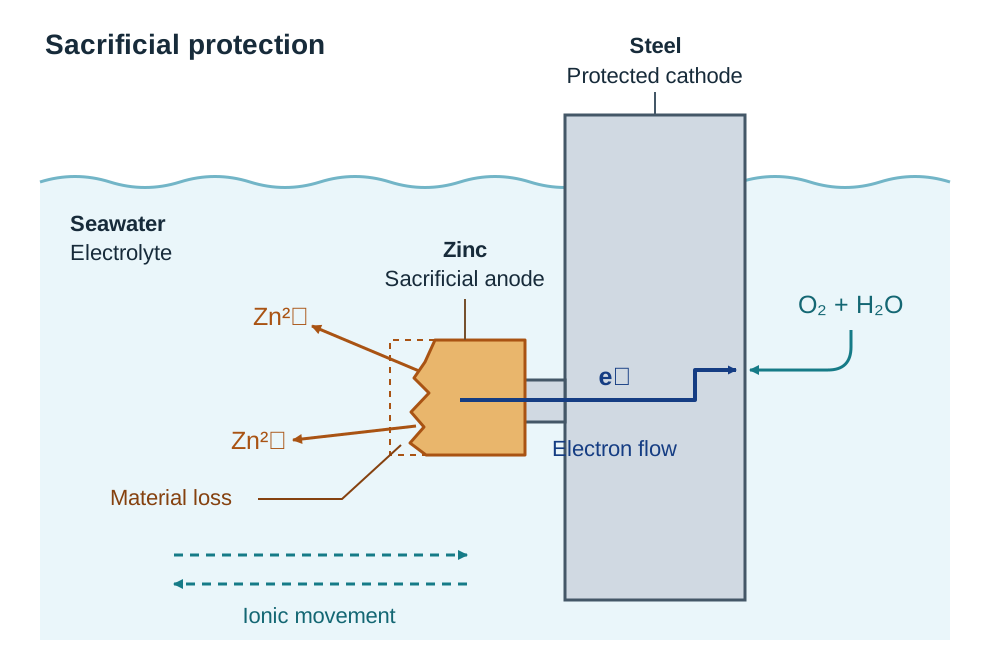
- Sacrificial protection: Blocks of a more reactive metal (such as zinc or aluminium) are bolted or welded directly to structural steel, including ship hulls and offshore wind turbine foundations. The sacrificial anode oxidises and corrodes away, sending electrons through the steel to keep it acting as a protected cathode. These anodes are replaced during routine servicing.
- Galvanising: Steel is dipped into a bath of molten zinc at roughly 450°C. Zinc forms a physical barrier coating. If scratched, the exposed zinc corrodes sacrificially to shield the underlying steel.
- Impressed-current cathodic protection: An external DC power supply drives electrons directly into the steel structure using inert anodes. This system protects long underground pipelines and marine piling where sacrificial blocks would dissolve too quickly.
Design and Environmental Measures
Engineers eliminate moisture traps by incorporating drain holes in box sections, using rounded profiles rather than sharp corners, fitting insulating nylon washers between dissimilar metals, and adding chemical rust inhibitors to closed-loop heating systems.