

A market economy is an economic system where the allocation of scarce resources is determined primarily by the decentralised decisions of consumers and producers interacting in markets. At its core, the price mechanism coordinates buyers and sellers through four key functions: signalling, rationing, incentivising, and allocating. In practice, Ireland and its European peers operate as mixed economies, where most goods are provided through markets, but the government also provides some services, regulates markets, and uses taxation to correct market failures.
The Price Mechanism and Resource Allocation
In a pure market economy, decisions regarding what to produce, how to produce, and for whom to produce are resolved without central state planning. Instead, independent consumer purchases and producer sales interact through the price mechanism.
The price mechanism performs four essential functions in allocating resources:
- Signalling: Prices act as signals: they tell buyers and sellers what is happening in the market. A rising price signals to producers that consumers want more of a good or that market supply is scarce. A falling price signals an oversupply or dwindling consumer interest.
- Rationing: Economic goods are scarce relative to unlimited human wants. The price mechanism rations these scarce goods by raising prices until the available quantity is restricted to those consumers who have effective demand—the willingness and ability to pay for them.
- Incentives: Price changes give consumers and producers a reason to change what they do. Higher market prices increase potential profits, encouraging suppliers to expand production. Lower prices encourage buyers to purchase while discouraging producers from supplying.
- Allocation: Over time, the price mechanism steers society's scarce factors of production away from goods that consumers want less (where prices and profits are falling) and towards goods consumers want more (where prices and profits are rising).
Ireland operates as a mixed economy. While private transactions govern most consumer goods, the State finances essential services such as primary education and healthcare, and regulates markets to protect consumers and the environment.
Market Equilibrium and the Shapes of the Curves
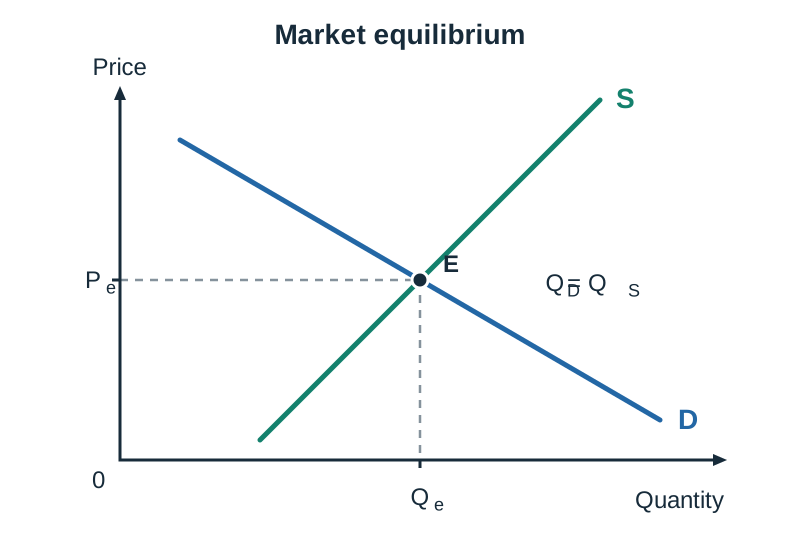
Market equilibrium occurs at the price where the quantity demanded by consumers matches the quantity supplied by producers (). At this clearing price (), the market clears: there is neither unsold stock nor unmet demand.
Why the Demand Curve Slopes Downward
The law of demand states that as price falls, quantity demanded rises, ceteris paribus. The demand curve slopes downward from left to right for three core reasons:
- Law of diminishing marginal utility: Each extra unit of a good consumed provides less additional satisfaction (utility) than the previous one. Therefore, a consumer is only willing to buy additional units at a lower price.
- Income effect: When the price of a good falls, the consumer's real income (purchasing power) increases, allowing them to buy more of the good with the same nominal budget.
- Substitution effect: When the price of a good falls, it becomes relatively cheaper compared to alternative goods, incentivising consumers to switch away from substitutes toward this good.
Why the Supply Curve Slopes Upward
The law of supply states that as price rises, quantity supplied rises, ceteris paribus. The supply curve slopes upward from left to right because:
- Higher market prices increase the profit earned on each unit sold, incentivising existing firms to expand output.
- Higher prices attract new firms into the industry.
- Producing additional units often involves rising marginal costs due to diminishing returns, so firms require a higher price to cover the higher cost of extra production.
Disequilibrium and Market Correction
- Excess supply (a surplus): If the market price is above equilibrium (), quantity supplied exceeds quantity demanded (). Competing sellers hold unsold stock and discount prices. This downward pressure on price causes quantity supplied to fall (a contraction along ) and quantity demanded to rise (an extension along ) until equilibrium is restored at .
- Excess demand (a shortage): If the market price is below equilibrium (), quantity demanded exceeds quantity supplied (). Unmet buyers bid prices upward. This upward pressure causes quantity demanded to fall (a contraction along ) and quantity supplied to rise (an extension along ) until the shortage disappears.
Determinants and Curve Shifts
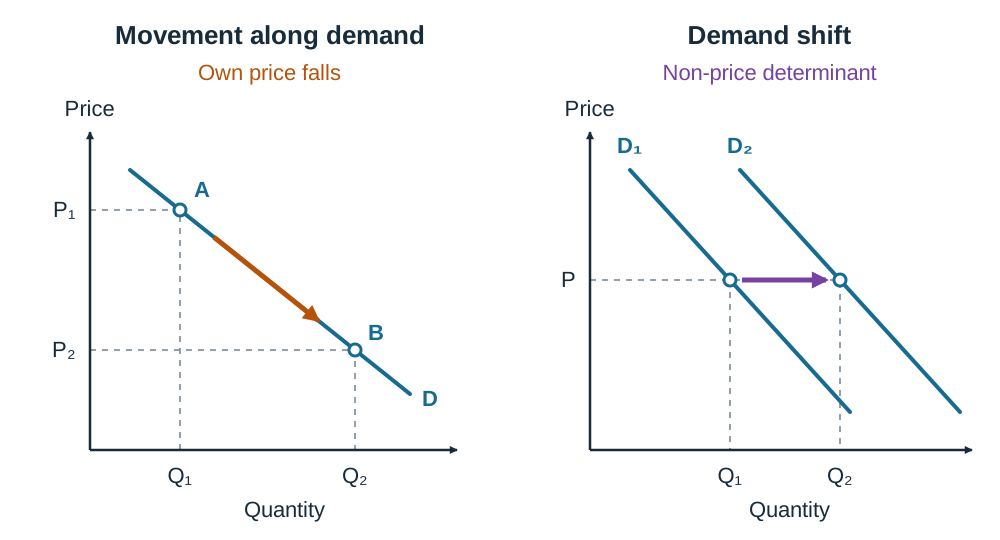
A vital distinction in economic analysis is separating a movement along a curve from a shift of the entire curve.
A movement along a curve happens exclusively when the price of the good itself changes. This changes the quantity demanded or quantity supplied along the existing line.
A shift of the curve occurs when a non-price determinant changes. Buyers or sellers now wish to trade a different quantity at every single price level, shifting the curve rightward (an increase) or leftward (a decrease).
| Determinants of Demand (Shift ) | Real-World Application | Determinants of Supply (Shift ) | Real-World Application |
|---|---|---|---|
| Consumer disposable income | A rise in Irish wages increases demand for new cars (normal goods) | Costs of production | Higher commercial electricity tariffs shift bakery supply leftward |
| Prices of related goods | A rise in Irish Rail fares increases demand for private bus travel (substitutes) | Advances in technology | Robotics in car assembly reduce unit costs and shift supply rightward |
| Consumer tastes and preferences | Health campaigns increase demand for oat milk | Indirect taxes and subsidies | An increase in excise duty shifts cigarette supply leftward |
| Expectations of future price changes | Anticipating higher VAT next month increases current demand for electronics | Climatic conditions | Heavy rainfall and poor harvests reduce the domestic supply of potatoes |
| Population and demographics | An ageing population increases demand for nursing home care | Number of sellers | New broadband providers entering the market shift total supply rightward |
When Both Curves Shift Simultaneously
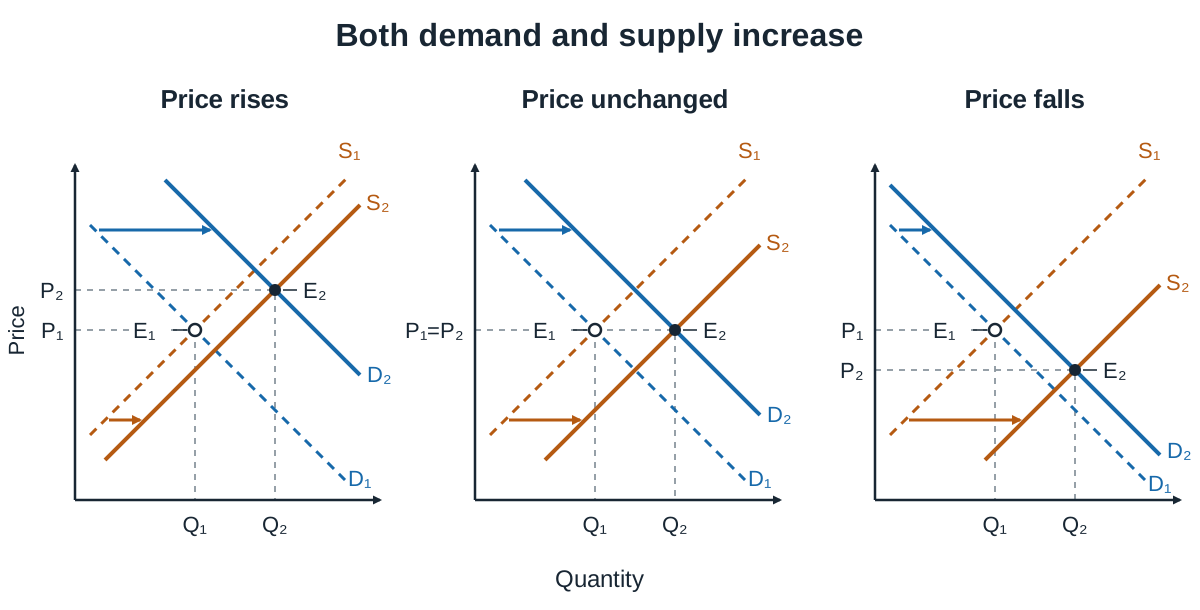
When both demand and supply shift at the same time, one outcome (price or quantity) can be predicted with certainty, while the other depends on the relative size of the shifts. For instance, if demand increases (shifts right) and supply increases (shifts right) together, equilibrium quantity will definitely rise. However, the final effect on equilibrium price depends on which curve shifted by a greater amount.
Fixed Capacity, Price Controls, and Welfare Measures
Fixed Capacity and Vertical Supply Curves
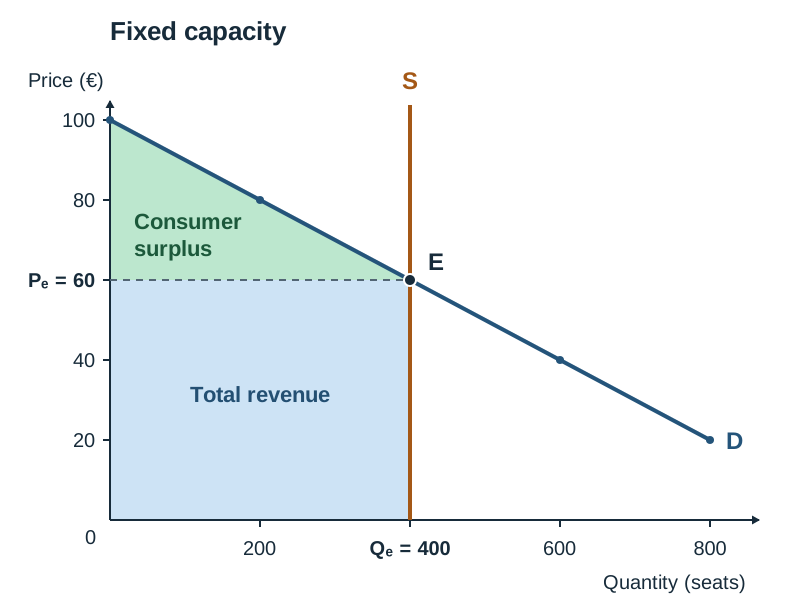
When the quantity of a good available cannot change regardless of price, supply is perfectly inelastic. The supply curve is drawn as a vertical line at that fixed quantity.
In sports and entertainment, venues have a fixed maximum capacity. For example, Croke Park has an 82,300 capacity, and a concert arena may hold exactly 400 people. The supply curve is a vertical line at that capacity because no matter how high ticket prices rise, no more tickets can be physically supplied. The equilibrium price is therefore determined entirely by the position of the demand curve.
Government Price Controls
Governments sometimes intervene directly in the price mechanism when free market prices are considered socially undesirable:
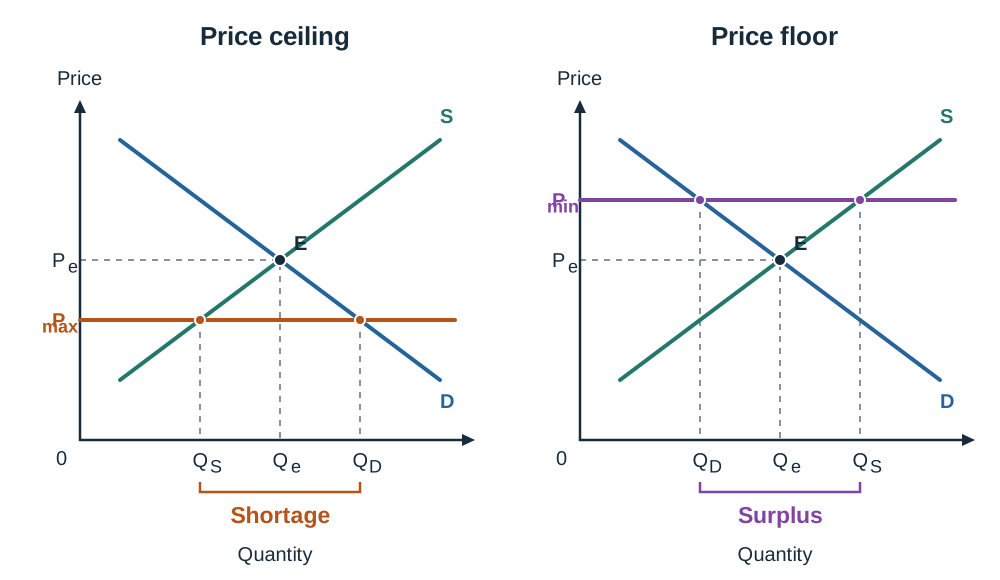
- A maximum price (price ceiling) is a legally established upper limit above which sellers cannot charge. To have any market effect, it must be set below the equilibrium price (). At this lower price, , creating a shortage (excess demand) that persists as long as the ceiling remains below equilibrium. Goods must be allocated through non-price methods like queues or rationing. Examples include rent controls (limits on rent increases) in the Irish rental market, or the proposed EU cap on wholesale electricity prices during the 2022 energy crisis.
- A minimum price (price floor) is a legally established lower limit below which buyers cannot pay. To have an effect, it must be set above the equilibrium price (). At this higher price, , resulting in excess supply (a surplus). Examples include the National Minimum Wage in the labour market, where labour supplied by workers exceeds labour demanded by firms at that wage rate, and minimum unit pricing on alcohol.
Consumer Surplus and Total Revenue
- Consumer surplus: The economic benefit derived by consumers when they pay a market price lower than the maximum price they were willing to pay. On a diagram, consumer surplus is represented by the triangular area below the demand curve and above the equilibrium price line, out to the equilibrium quantity ().
- Total revenue: The total monetary receipts a firm earns from selling output, calculated as . On a diagram, it is the rectangular area from the origin up to and across to .
The Impact of Advances in Technology
Technological advancement directly transforms product markets by altering production costs, market structures, and competitive behaviour.
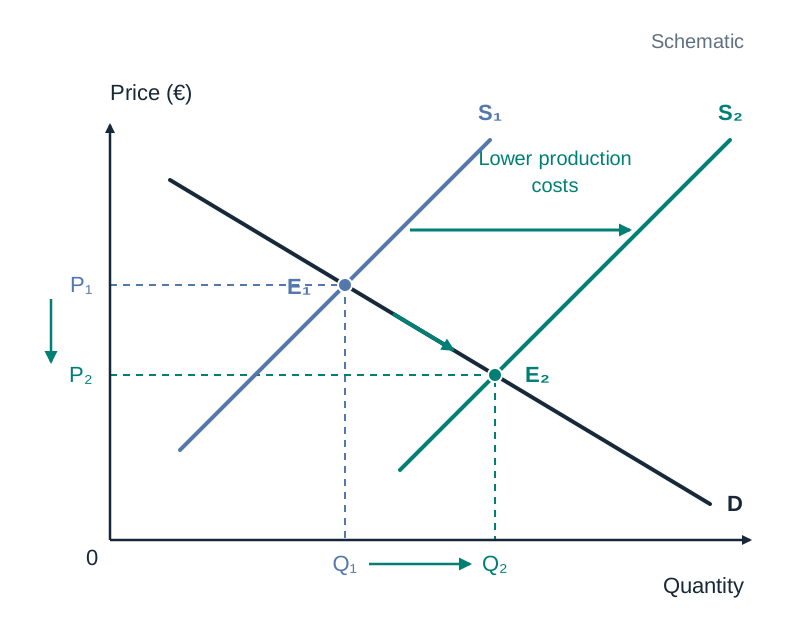
- Supply shifts and lower prices: Process innovations, automation, and software efficiencies reduce per-unit production costs. This shifts the supply curve rightward from to , lowering the equilibrium price and raising the equilibrium quantity traded. A clear example is the collapse in the production cost of solar panels over the past decade.
- Creation of new markets: Breakthroughs generate entirely new product categories and digital business models. Streaming platforms and cloud computing have largely replaced older physical markets such as DVD rental shops.
- Structural disruption: Rapid automation can render specific manual and clerical roles obsolete faster than workers can retrain, causing structural unemployment and requiring state investment in education and re-skilling.
- Market concentration: Many digital platforms benefit from powerful network effects, where a service becomes more valuable as more people use it. This can lead to markets dominated by a few global technology firms, creating strong market power that attracts regulatory scrutiny from bodies such as the Competition and Consumer Protection Commission (CCPC) and the European Commission.
Strengths and Limitations of the Market System
Strengths of the Market Economy
- Efficiency under competition: Where competition is strong, firms are pressured to keep costs down and produce what consumers want. In the long run under perfect competition, the market achieves both productive efficiency (producing at lowest average cost) and allocative efficiency (producing where price equals marginal cost). Where firms hold market power, this efficiency is lost.
- Consumer sovereignty: Through their spending choices, consumers cast 'dollar votes' that signal to firms what goods and services to produce.
- Incentive to innovate: The prospect of earning higher profits encourages entrepreneurs to take risks, invest in research and development, and improve product quality.
- Automatic adjustment: Markets adjust automatically without central planning, although this adjustment can be slow where supply takes time to respond, such as housing construction.
Limitations and Market Failures
- Inequality and exclusion: The price mechanism allocates goods strictly according to effective demand (ability to pay) rather than moral or human need. In housing and healthcare, market prices can exclude lower-income households from necessities, requiring state social housing supports and public healthcare provision.
- Externalities: Free markets ignore third-party spillover costs or benefits. For example, burning fossil fuels creates negative environmental externalities that private emitters do not pay for unless the State intervenes with corrective measures like Ireland's carbon tax.
- Public goods and merit goods: Pure public goods (such as street lighting and national defence) are non-excludable and non-rival. Because private firms cannot prevent non-payers from consuming them, these goods suffer from the free-rider problem; the market under-provides them, so they are usually financed by the State through taxation. Similarly, a merit good (such as education or vaccinations) confers greater social benefits than individuals realise and is under-provided by free markets, whereas a demerit good (such as tobacco or alcohol) imposes greater personal and social harm and is over-provided unless taxed or regulated.
Key terms
- Market Economy
- An economic system in which resource allocation, production, and consumption are guided primarily by the decentralised interactions of buyers and sellers through the price mechanism.
- Mixed Economy
- An economic system combining private market transactions with state provision of public services, regulation, and taxation to correct market failures.
- Price Mechanism
- The system through which the market forces of demand and supply determine prices and allocate scarce resources among competing uses.
- Effective Demand
- Consumer desire for a good or service backed by the willingness and financial ability to pay the market price.
- Law of Demand
- The economic principle stating that as the price of a good falls, the quantity demanded increases, assuming all other factors remain constant (ceteris paribus).
- Law of Supply
- The economic principle stating that as the price of a good rises, the quantity supplied increases, assuming all other factors remain constant (ceteris paribus).
- Market Equilibrium
- The situation where quantity demanded equals quantity supplied (), establishing a stable clearing price with neither excess demand nor excess supply.
- Excess Demand
- A market condition where quantity demanded exceeds quantity supplied () at the prevailing price, creating a shortage.
- Excess Supply
- A market condition where quantity supplied exceeds quantity demanded () at the prevailing price, creating a surplus.
- Ceteris Paribus
- A Latin phrase meaning 'all other things being equal', used in economic models to isolate the relationship between two specific variables.
- Normal Good
- A good for which demand increases as consumer income rises (positive income elasticity of demand).
- Inferior Good
- A good for which demand decreases as consumer income rises, as consumers switch to superior substitutes (negative income elasticity of demand).
- Substitutes
- Goods that satisfy similar needs; an increase in the price of one leads to an increase in demand for the other.
- Complements
- Goods that are used together; an increase in the price of one leads to a decrease in demand for the other.
- Consumer Surplus
- The difference between the maximum price a consumer is willing to pay for a unit of a good and the actual market price they pay.
- Maximum Price
- A legal upper limit on the price of a good (a price ceiling). It only has an effect if set below the equilibrium price, where it causes excess demand (a shortage).
- Minimum Price
- A legal lower limit on price (a price floor). It only has an effect if set above the equilibrium price, where it causes excess supply (a surplus).
- Public Good
- A good that is non-excludable (non-payers cannot be excluded) and non-rival (consumption by one person does not reduce availability for others), leading to the free-rider problem.
- Merit Good
- A good that yields greater long-term social and personal benefits than consumers recognise, leading to under-consumption in an unregulated free market.
- Demerit Good
- A good that is more harmful to the individual consumer and society than realised, leading to over-consumption in an unregulated free market.
Check yourself
What are the four primary functions of the price mechanism in a market economy?
Signalling, rationing, incentivising, and allocating resources.
Why is the supply curve for tickets to an All-Ireland Final at Croke Park vertical?
The stadium has a fixed physical capacity of 82,300 seats, meaning supply is perfectly inelastic and cannot increase regardless of ticket price.
If the equilibrium wholesale price of electricity is €600 per MWh and the government imposes a legal price cap of €200 per MWh, what market condition is created?
Excess demand (a shortage), because at the capped price below equilibrium, the quantity demanded by consumers exceeds the quantity supplied by generators.
How does an increase in consumer household income affect the equilibrium price and quantity of an inferior good?
Demand for the inferior good shifts to the left because consumers switch to higher-quality substitutes, causing both equilibrium price and quantity to fall.
Both demand and supply in a market shift to the right simultaneously. What can you state with certainty about the new equilibrium?
Equilibrium quantity will definitely increase, but the net effect on equilibrium price is uncertain without knowing which curve shifted by a greater amount.