

Fiscal policy is how a government uses public spending and taxation to guide aggregate demand, steer the business cycle, and pursue social priorities. In Ireland, public finances are divided into current and capital budgets. Because Ireland shares the euro, the European Central Bank sets monetary policy for the entire currency bloc. That leaves fiscal policy as our main national tool for stabilising domestic economic swings. At the same time, Irish budgetary choices must respect European Union fiscal rules and manage the unique risks of relying heavily on multinational corporation tax receipts.
The Budget Framework: Current and Capital Accounts
Every autumn, the Minister for Finance and the Minister for Public Expenditure deliver the national Budget to Dáil Éireann. Irish public finances are formally divided into two distinct accounts: the current budget and the capital budget.
The current budget covers the day-to-day running costs of public administration within a single financial year. Current revenue comes from recurring taxes, such as income tax collected through PAYE, the Universal Social Charge (USC), Value Added Tax (VAT), and corporation tax. Current expenditure pays for public services as they operate: salaries for teachers, nurses, and gardaí, social welfare payments, medicines for public hospitals, and interest charges on the national debt.
A current budget deficit means current spending exceeds current tax revenue. In plain terms, the state is borrowing money simply to pay for today's consumption. Economists view persistent current deficits as reckless because borrowing for wages or welfare leaves behind debt without adding any productive asset to help repay it. A current budget surplus occurs when routine revenue exceeds day-to-day spending, generating spare cash that can fund capital projects.
The capital budget deals with long-term investments in physical infrastructure. Capital revenue includes non-recurring windfalls, such as the sale of state-owned assets, repayments of loans made by the state, or capital grants from the European Union. Capital expenditure funds physical projects that last for decades: new school buildings, motorways, public housing developments, diagnostic equipment in hospitals, and public transport lines.
Borrowing for capital spending makes good economic sense. Infrastructure widens the productive capacity of the economy and expands the future tax base. Because a new rail line or secondary school benefits workers and households for forty or fifty years, borrowing spreads the cost fairly across the generations who actually use those assets.
Budget Positions, Deficit Management, and National Debt
The overall budget balance shows the net financial outcome when we compare total state revenue against total state expenditure over the calendar year.
When revenue equals expenditure (), the government runs a balanced budget. When total expenditure exceeds revenue (), the state records an overall budget deficit and must borrow by issuing sovereign bonds. When revenue exceeds total expenditure (), the state achieves an overall budget surplus.
Students often mix up the deficit and the national debt, but the distinction is straightforward. A budget deficit is a flow of new borrowing over twelve months. The national debt is the accumulated stock of all unpaid borrowing from past years. Every annual deficit adds to the national debt, whereas a budget surplus lets the government pay down that outstanding stock.
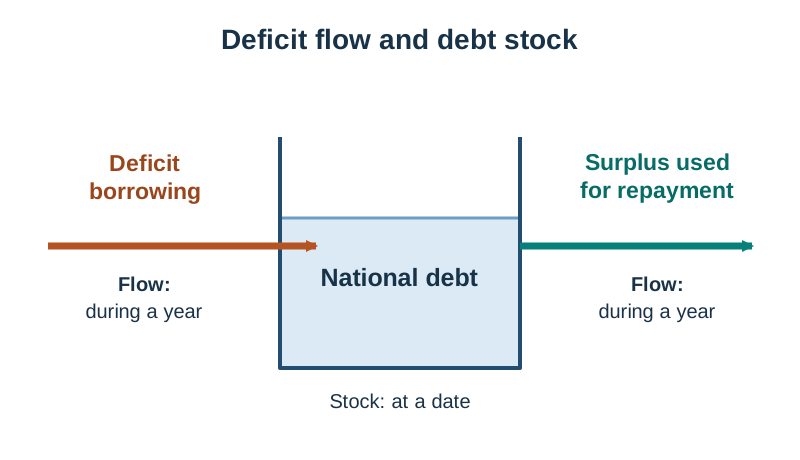
Measuring Ireland's debt requires caution. Gross Domestic Product (GDP) is distorted by multinational accounting practices, particularly contract manufacturing and intellectual property transfers. This makes Irish GDP appear enormous on paper and creates an artificially low debt-to-GDP ratio. To see the true picture, the Central Statistics Office and the Irish Fiscal Advisory Council (IFAC) use Modified Gross National Income (GNI). GNI strips out multinational distortions to measure the income actually available to domestic residents. Measured against GNI*, Ireland's debt ratio is roughly twice as high as the headline GDP figure suggests.
When tackling a budget deficit, a government can reduce departmental spending or raise tax rates. Both choices carry costs: spending cuts harm public services and lower domestic demand, while higher taxes reduce household take-home pay and weaken business incentives. Alternatively, policy makers can pursue structural reforms to stimulate economic growth, broadening the tax base organically.
When managing a budget surplus, the state can pay off high-interest sovereign debt, invest in housing and water infrastructure, or save the windfall. In recent years, Ireland established sovereign wealth funds, including the Future Ireland Fund, setting aside excess corporate tax receipts to meet rising pension and healthcare bills as our population ages.
Fiscal Stances and Business Cycle Stabilisation
Governments adjust their fiscal stance to smooth out the business cycle and prevent severe booms and slumps.
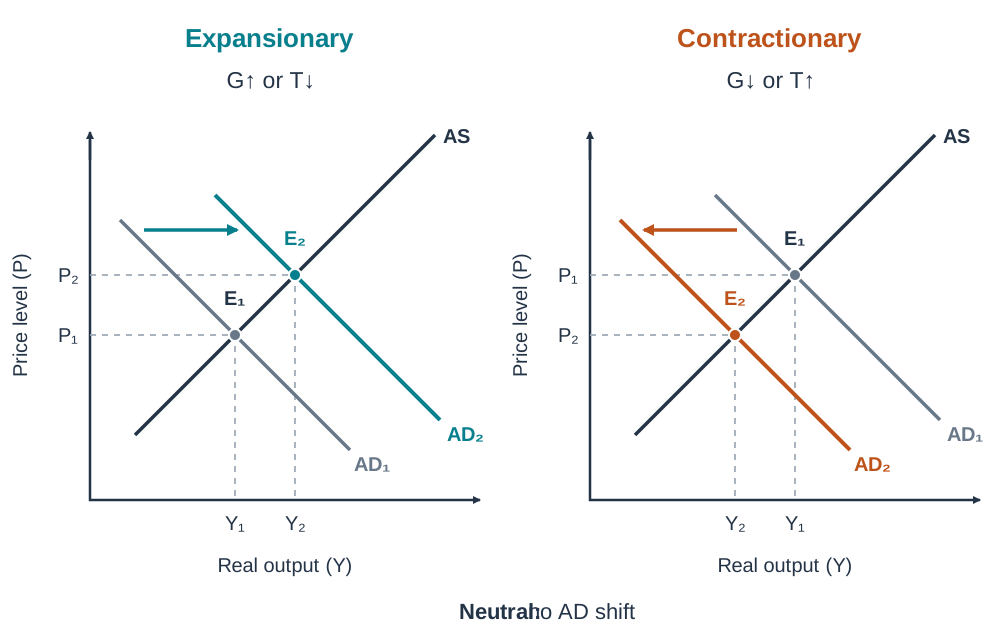
Expansionary fiscal policy helps fight an economic downturn or recession. The government either raises public spending () or cuts taxes (). In an Aggregate Demand and Aggregate Supply (AD/AS) diagram, the price level sits on the vertical axis and real output () on the horizontal axis. A fiscal stimulus shifts the aggregate demand curve outward from to . The new equilibrium delivers higher real national output and lower cyclical unemployment, though it may put upward pressure on the price level. Ireland used strong expansionary policy during the COVID-19 pandemic through the Pandemic Unemployment Payment (PUP) and wage subsidy schemes, protecting household incomes when businesses were forced to shut.
Contractionary fiscal policy is used when an economy is overheating and inflation is climbing. The government cuts expenditure () or raises taxes (), shifting aggregate demand back to the left. This cools down demand-pull inflation and curbs import spending. Running budget surpluses during rapid growth acts as a brake on overheating.
A neutral fiscal stance leaves aggregate demand largely unaffected. This approach suits an economy operating close to full employment with stable prices.
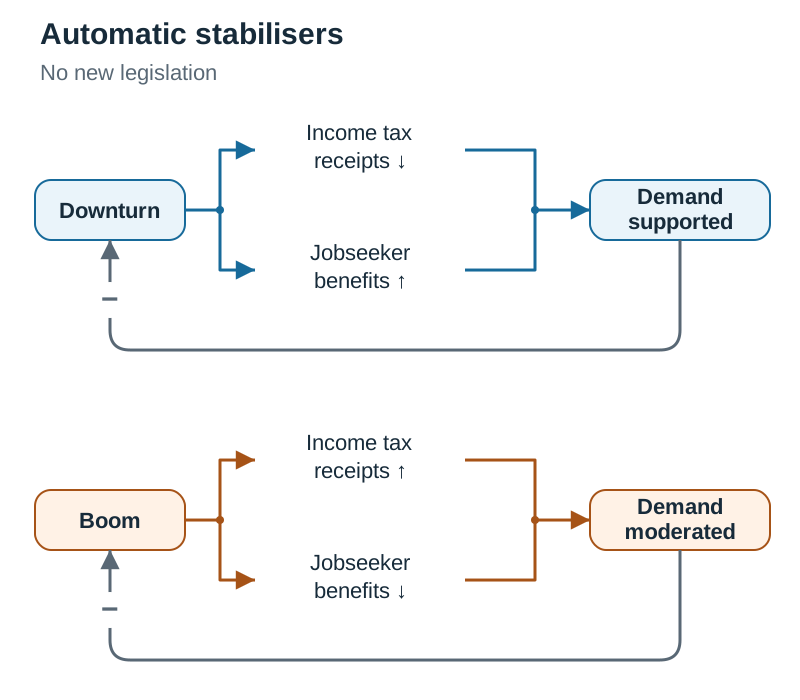
Economic stabilisation does not depend only on active ministerial decisions, known as discretionary fiscal policy. Built-in mechanisms called automatic stabilisers react to the business cycle without any fresh legislation. During a downturn, income tax receipts fall automatically as wages and hours drop, while state spending on jobseeker benefits rises automatically. These stabilisers put purchasing power back into the economy during a slump and withdraw it during a boom, cushioning the impact of shocks.
The Multiplier and Limitations of Fiscal Policy
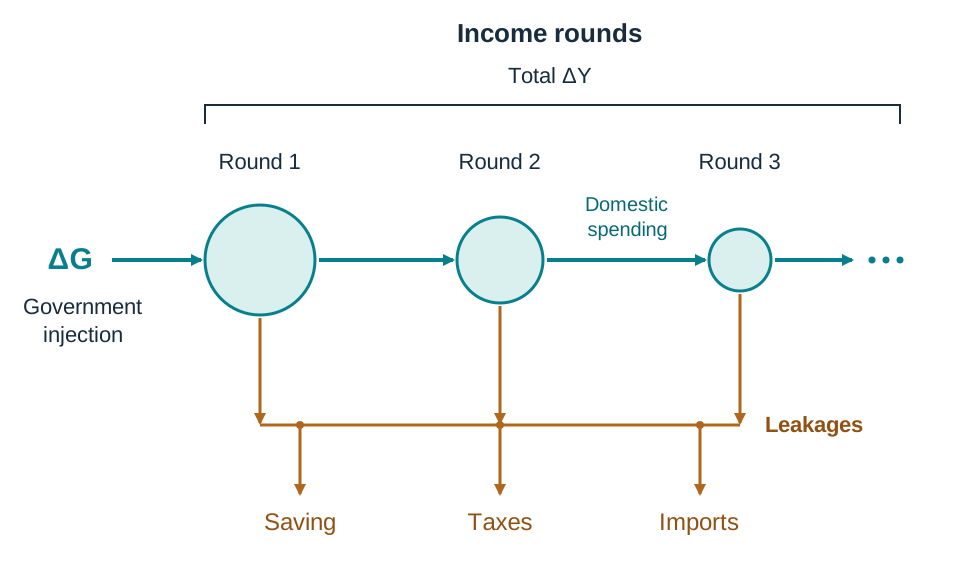
When the government injects money into the economy, the final increase in national income turns out larger than the original spending. This happens because of the multiplier effect. Every euro spent becomes income for a worker or business owner, who then spends a fraction of it in the next round.
Each extra euro of income is either consumed (including spending on imports) or saved, so MPC + MPS = 1. Imports and taxes are leakages that are measured separately, as MPM and MPT, in the multiplier formulas below.
In a closed economy without foreign trade, the multiplier formula depends only on saving:
In an open economy, money also leaks out through spending on foreign goods and services:
If we also account for direct taxes, the full open-economy multiplier becomes:
Every additional leakage shrinks the multiplier. Because Ireland is a small, open economy with a very high Marginal Propensity to Import (), extra public spending leaks quickly into purchases of imported cars, technology, and energy. That leaves the Irish multiplier much smaller than that of a large, closed economy.
Fiscal policy also faces practical limitations:
- Capacity constraints: If an economy is already operating close to full employment, the aggregate supply curve is nearly vertical. Pumping in more public spending cannot create real output and simply drives up construction wages, material costs, and consumer prices.
- Time lags: There are unavoidable delays. Recognising a downturn takes time (recognition lag), drafting and passing legislation takes months (implementation lag), and getting building projects started takes longer still (impact lag). By the time stimulus money hits the ground, the economic picture may have changed completely.
- Crowding out: Large state borrowing can compete with the private sector. While financial crowding out happens when state borrowing lifts interest rates, real resource crowding out is more common in Ireland. When the state hires vast numbers of construction workers, private developers struggle to source tradespeople and equipment.
- High national debt: Heavy existing debt means substantial tax revenues must go toward annual interest charges, limiting how much the government can borrow during a new crisis.
Taxation: Canons, Impacts, and the Irish Tax Base
Taxation raises money for essential public services, redistributes resources, and alters incentives across the economy.
Centuries ago, Adam Smith established four classic canons of taxation that remain central to good tax design:
- Equity: Taxes must be fair, requiring taxpayers to contribute in proportion to their ability to pay.
- Certainty: The timing, method of payment, and exact sum due should be clear to both the citizen and the state.
- Convenience: Paying the tax should cause minimal fuss, as seen with PAYE where tax is deducted directly from monthly wages.
- Economy: The administrative expense of assessing and collecting the tax should be small compared to the revenue collected.
Direct taxes fall directly on the incomes and wealth of individuals and businesses, such as PAYE income tax, USC, and corporation tax. Direct taxes are usually progressive, meaning they take a higher percentage of income as earnings rise. Progressive tax bands help narrow the gap between rich and poor.
Indirect taxes are placed on goods and services, such as VAT, excise duties on fuel and alcohol, and carbon taxes. Indirect taxes are regressive: a lower-income worker spends a much larger share of their total earnings on basic groceries and fuel than a wealthy executive does. To soften this impact, Ireland applies a zero rate of VAT to basic foods, children's clothes, and prescription medicines.
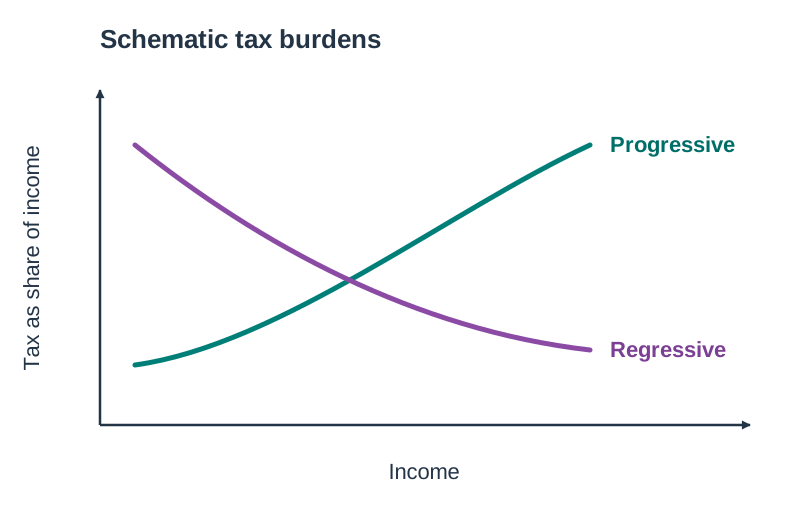
Tax policy carries clear economic trade-offs. Very high marginal income tax rates can discourage overtime, deter promotions, or encourage qualified graduates to emigrate. Indirect taxes push up the Consumer Price Index directly. At the same time, targeted environmental taxes, such as the carbon tax, place a price tag on harmful greenhouse gas emissions to encourage clean energy investment.
Ireland's tax base faces a notable concentration risk. Most corporation tax is paid by foreign-owned multinationals, and a small number of very large pharmaceutical and technology groups pay a large share of it. If their profits fall, Ireland's tax revenue could drop sharply.
Ireland in the EU and Eurozone: Policy Constraints
Ireland's membership in the European Union and the single currency shapes domestic fiscal policy in several distinct ways.
Because we use the euro, the European Central Bank in Frankfurt controls monetary policy and sets official interest rates for all euro area member states. Ireland cannot devalue its currency to help exporters or alter interest rates to cool down a domestic housing boom. With monetary policy out of national hands, fiscal policy becomes the main domestic tool the government has to manage local economic fluctuations.
Irish budgets must also respect European Union fiscal rules. Under the Stability and Growth Pact, member states are expected to keep their annual budget deficit under 3% of GDP and their gross government debt under 60% of GDP. Under updated EU governance frameworks, countries agree multi-year fiscal targets with the European Commission that set enforceable limits on the growth of net primary expenditure.
Every October, Ireland submits its Draft Budgetary Plan to the European Commission under the European Semester monitoring timetable. Domestically, the Irish Fiscal Advisory Council (IFAC) acts as an independent statutory watchdog, evaluating official budget forecasts and assessing whether government spending adheres to legal fiscal rules.
These rules are not completely rigid. Under the EU general escape clause, deficit limits were formally suspended from 2020 to 2023 so governments could borrow heavily to fund pandemic health measures and household supports. Furthermore, being inside the Eurozone gives Ireland access to deep bond markets with lower borrowing costs, alongside capital funding from EU initiatives such as the Recovery and Resilience Facility.
Key terms
- Fiscal Policy
- The use of government spending and taxation to influence the level of aggregate demand and economic activity.
- Current Budget Deficit
- When day-to-day government spending on running public services exceeds recurring revenue within a single year.
- Current Budget Surplus
- When day-to-day government tax revenue exceeds recurring operational spending within a single year.
- Budget Deficit
- The annual shortfall that occurs when total government spending exceeds total government revenue.
- Budget Surplus
- The excess funds available when total government revenue exceeds total government spending across a single year.
- National Debt
- The total accumulated stock of money owed by the central government from borrowing over previous years.
- GNI*
- Modified Gross National Income; an Irish economic indicator that adjusts for multinational accounting distortions such as intellectual property depreciation.
- Discretionary Fiscal Policy
- Deliberate ministerial choices to change tax rates or public expenditure levels to steer economic activity.
- Automatic Stabilisers
- Built-in tax and welfare responses that automatically cushion fluctuations in the business cycle without new laws.
- Progressive Tax
- A tax that takes an increasing proportion of income as the taxpayer's income increases.
- Regressive Tax
- A tax that takes a higher proportion of income from lower earners than from higher earners.
- Crowding Out
- When government borrowing or public resource consumption reduces investment and economic activity in the private sector.
- Stability and Growth Pact
- The EU framework requiring member states to keep annual budget deficits below 3% of GDP and debt below 60% of GDP.
- Irish Fiscal Advisory Council
- An independent statutory body that checks whether Irish budgetary plans are economically prudent and compliant with fiscal rules.
- Future Ireland Fund
- A state sovereign wealth fund that invests windfall corporate tax receipts to meet future demographic and pension costs.
Check yourself
In a closed economy with an MPC of 0.8, the government raises capital spending by €50 million. Calculate the resulting increase in national income.
In a closed economy, the multiplier is k = 1 / (1 - MPC) = 1 / (1 - 0.8) = 1 / 0.2 = 5. The change in national income is ΔY = k × ΔG = 5 × €50m = €250 million.
Categorise each item into the correct budget account: (a) building a new bypass, (b) paying teachers' salaries, (c) selling state-owned shares in a bank, (d) collecting corporation tax.
(a) Capital expenditure, (b) Current expenditure, (c) Capital revenue, (d) Current revenue.
Why does the Irish Fiscal Advisory Council focus on GNI* instead of GDP when judging whether Ireland's debt is sustainable?
Multinational accounting distortions such as intellectual property transfers inflate Ireland's GDP. GNI* removes these distortions to show the actual domestic income available to service national debt.
What two numerical deficit and debt ceilings are set by the EU Stability and Growth Pact?
The pact sets an annual general government budget deficit limit of 3% of GDP and a gross sovereign debt target of 60% of GDP.