

Ireland is a small, highly open economy where international trade drives national income, jobs, and living standards. Because our home market is small, domestic firms must sell abroad to achieve economies of scale, while Irish consumers and businesses rely on imports for energy, raw materials, and manufactured goods. This note covers the patterns of Irish trade, David Ricardo's Law of Comparative Advantage, the Balance of Payments framework, foreign exchange rates, national competitiveness, and trade policy.
Patterns, Benefits, and Risks of Irish Trade
Ireland's trade performance reflects its deep integration into global supply chains.
1. Merchandise (Goods) Trade
Irish goods exports are heavily concentrated in high-value manufacturing. Medical and pharmaceutical products are Ireland's largest merchandise export, accounting for approximately €100 billion (around 45% of goods exports), while chemicals as a whole exceed half of total goods exports. Global multinational corporations (MNCs) use Ireland as an international manufacturing hub. The remaining goods exports include agrifood (notably dairy and beef), computer hardware, and precision medical devices.
2. Services Trade
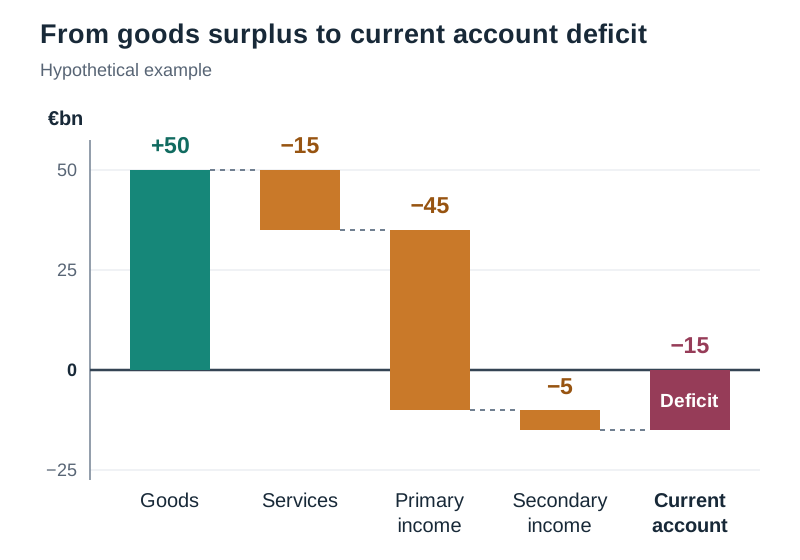
Ireland is a major exporter of services, especially computer services (anchored by the European headquarters of global tech firms), financial services, and aircraft leasing. However, Ireland also imports vast amounts of services, particularly royalties and licence fees for intellectual property used by multinationals. Consequently, the services balance swings between modest surpluses and deficits from year to year. Ireland's large goods surplus serves as the primary counterweight to the huge outflow of multinational profits in primary income.
3. Key Trading Partners and Post-Brexit Realities
Ireland's primary trading partners outside the euro area are the United States and the United Kingdom. Inside the EU, major partners include Germany, France, and the Netherlands. Following the EU-UK Trade and Cooperation Agreement, trade with Great Britain faces full customs declarations and sanitary and phytosanitary (SPS) agrifood checks, which create border friction and administrative expense for Irish exporters. By contrast, trade with Northern Ireland has held up better because, under the Windsor Framework, Northern Ireland continues to follow EU rules for goods, preventing a hard border on the island. To avoid the British 'landbridge', Irish exporters have expanded direct shipping routes to ports in mainland Europe.
4. Trade-Pattern Data Analysis
Examiners regularly ask students to evaluate multi-year trade data. For instance, if Irish exports grew from €112bn in 2015 to €152bn in 2019, the percentage change is:
5. Benefits and Disadvantages of Trade for Ireland
- Benefits: Access to large export markets brings economies of scale; foreign direct investment creates skilled employment; technology and management expertise spill over into domestic businesses; and consumers enjoy lower prices and wider variety.
- Disadvantages and Risks: Extreme vulnerability to external shocks (such as foreign tariff hikes or recessions in the US and UK); heavy concentration in a few sectors (biopharma and ICT); risk of structural unemployment in traditional sectors exposed to cheap imports; and exposure to imported inflation when global energy prices spike.
6. Distortions: CA and GNI
Standard GDP and Current Account figures are distorted by multinational activities such as contract manufacturing, global intellectual property depreciation, and aircraft leasing. To remove these artificial accounting flows and evaluate genuine national welfare, the Central Statistics Office (CSO) reports the *Modified Current Account ($CA^GNI^$)*.
The Law of Comparative Advantage
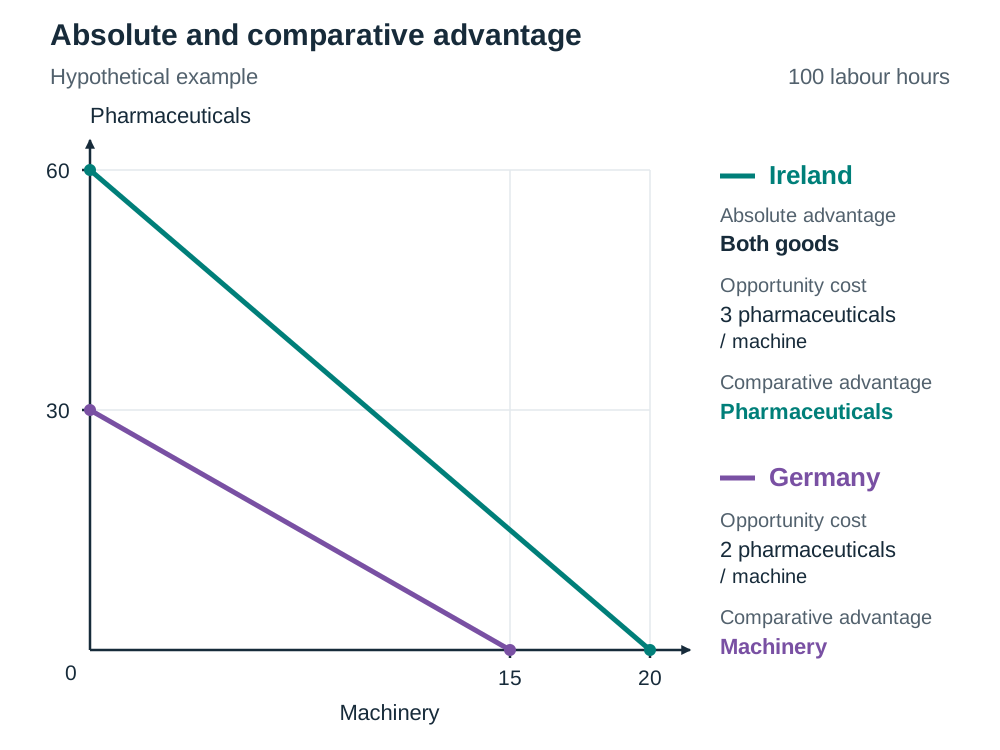
Classical trade theory explains why countries gain from exchanging goods, even if one country can produce everything more efficiently.
Absolute Advantage versus Comparative Advantage
- Absolute Advantage (Adam Smith): The ability of a country to produce more units of a good than another country using the same quantity of resources.
- Comparative Advantage (David Ricardo): The ability of a country to produce a good at a lower opportunity cost than another country. The Law of Comparative Advantage states that all nations gain if each specialises in producing the goods in which it has a comparative advantage, trading for other products.
Ricardian Model Assumptions
- Constant returns to scale (costs per unit remain constant regardless of output volume).
- No transport costs and zero trade barriers (no tariffs, quotas, or embargoes).
- Factors of production are perfectly mobile within a country, but completely immobile internationally.
- Resources are fully employed, and markets are perfectly competitive.
- Only two nations and two commodities are considered.
Terms of Trade
The Terms of Trade is the rate at which exports exchange for imports. For trade to be mutually beneficial, the international exchange price must fall strictly between the domestic opportunity cost ratios of the two trading partners. Across the macroeconomy, this is measured as an index:
If this index rises above 100, the terms of trade have improved: each unit of exports buys a larger volume of imports.
Link to Competitiveness and Model Limitations
A nation is most competitive in sectors where its domestic opportunity cost is lowest. Ireland has developed dynamic comparative advantage in pharmaceuticals, medical technology, and software through deliberate investments in tertiary education, research infrastructure, and competitive corporate tax regimes.
However, classical theory has clear limitations: transport costs reduce the real gains; diminishing returns raise unit costs as production expands; and labour cannot instantly retrain and relocate from declining traditional sectors to high-tech manufacturing.
The Balance of Payments Account
The Balance of Payments (BoP) is the systematic accounting record of all economic and financial transactions between the residents of an economy and the rest of the world over a specified time period.
1. Current Account
This account tracks trade flows and net factor earnings:
- Balance of Trade (Visible Trade): The value of visible (goods) exports minus visible imports. A positive balance is a trade surplus; a negative balance is a trade deficit.
- Balance of Services (Invisible Trade): Cross-border receipts for service exports (e.g. software licences) minus payments for service imports (e.g. foreign travel, patent royalties).
- Primary Income: Inflows minus outflows of factor rewards (profits, dividends, wages, and debt interest). In Ireland, this is heavily negative because foreign multinationals repatriate substantial profits back to overseas parent companies.
- Secondary Income: Unilateral current transfers where money changes hands without an exchange of goods or services (e.g. payments into the EU budget, overseas development aid, and remittances).
2. Capital Account
This records capital transfers, such as EU structural and cohesion funds or debt forgiveness, and transactions in non-produced, non-financial assets (e.g. government sales of mobile spectrum licences).
3. Financial Account
This records cross-border transactions involving financial claims and liabilities:
- Foreign Direct Investment (FDI): Capital invested in tangible enterprises, buildings, or production facilities where the foreign investor exercises lasting management influence.
- Portfolio Investment: Investments in foreign shares and government bonds without acquiring controlling interest.
- Other Investment & Reserves: Commercial bank deposits, international loans, and foreign currency reserves managed by the Central Bank.
Accounting Equality
Because every economic transaction involves a corresponding settlement, the balance of payments always balances overall. A combined surplus on the current and capital accounts matches an equivalent net build-up of foreign assets in the financial account, with statistical discrepancies captured as net errors and omissions:
Why Governments Target a Trade Surplus
- Employment: Higher export demand expands production and raises demand for domestic workers.
- Injection into the Circular Flow: Exports represent an injection of outside spending, while imports are a leakage. A trade surplus yields net injections, raising national income through the multiplier effect.
- Economic Growth and Solvency: Net exports () boost aggregate demand, accumulating foreign exchange earnings that prevent excessive overseas borrowing.
Competitiveness and Exchange Rates
Competitiveness is the ability of domestic producers to sell goods and services successfully in open international markets while sustaining living standards at home.
Determinants of Irish Competitiveness
- Unit Labour Costs (ULC): Total labour costs divided by real output. If domestic wages rise faster than labour productivity, ULC increases and export price competitiveness falls.
- Infrastructure and Housing: Commercial energy prices in Ireland rank among the highest in the EU. Shortages of affordable housing push up wage demands and make it difficult for employers to attract staff.
- Non-Price Factors: Product innovation, quality reliability, and branding. High-value Irish goods (such as medical devices) compete primarily on precision engineering rather than cheap production costs.
- Taxation and Regulation: Competitive corporate and income taxes attract high-value multinational operations.
- Harmonised Competitiveness Index (HCI): The Central Bank tracks the real effective exchange rate via the HCI. A rising real HCI means domestic prices are climbing faster than trading partners or the euro is appreciating, signalling eroding price competitiveness.
Exchange Rates
An exchange rate is the price of one currency expressed in terms of another currency (e.g. €1 = $1.10).
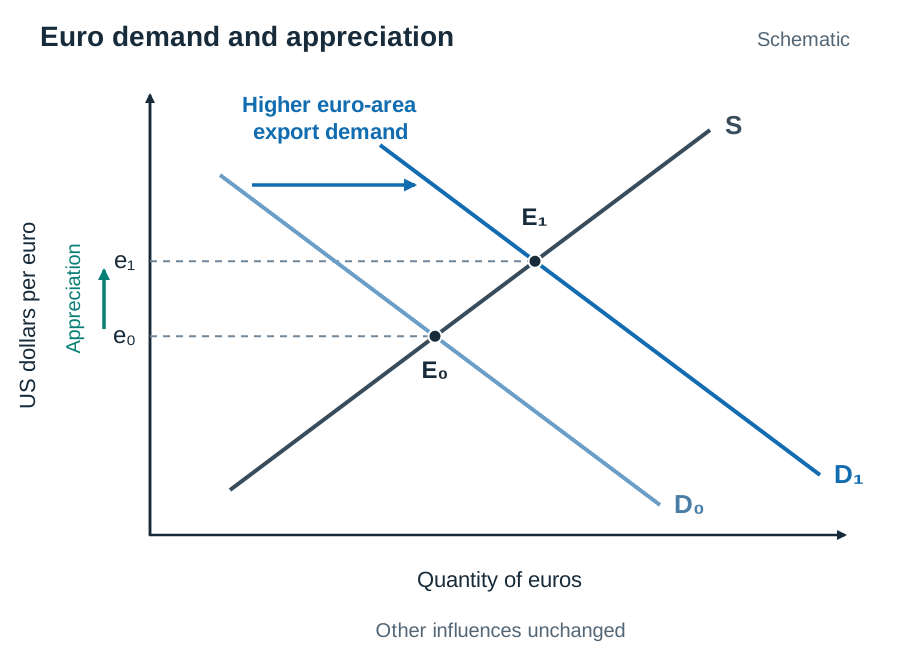
- Appreciation: The currency gains value, purchasing more units of a foreign currency (e.g. €1 moving from 1.20).
- Depreciation: The currency loses value, purchasing fewer units of a foreign currency.
Determinants of Exchange Rates
The external value of a floating currency like the euro is determined by supply and demand in foreign exchange markets, influenced by:
- Interest Rates: Higher European Central Bank (ECB) interest rates relative to other central banks attract foreign investment deposits ('hot money') into euro assets, pushing up the euro's value.
- Relative Inflation: Higher euro-area inflation makes euro-area goods less competitive, reducing export demand and weakening the euro, whereas lower relative inflation strengthens it.
- Trade and Current Account Flows: Strong global demand for euro-area exports increases demand for euros to pay for those goods, appreciating the currency.
- Speculation and Confidence: Investor expectations and positive economic outlooks boost demand for euros, driving up the currency's external value.
Because Ireland is part of the Eurozone, the Irish Government cannot independently devalue its currency to fix competitiveness problems. Monetary policy is set by the ECB for the broader euro area, but the euro's exchange rate is determined in global currency markets. Exchange rate changes only affect Irish trade with non-euro partners, mainly the US and the UK.
| Currency Movement | Impact on Irish Exports | Impact on Imports & Domestic Inflation |
|---|---|---|
| Euro Appreciation | Irish goods become dearer in the US and UK. Demand for exports and employment in price-sensitive exporting firms may fall. | Imports priced in US dollars or sterling become cheaper in euro terms. This lowers input costs and imported inflation. |
| Euro Depreciation | Irish goods become cheaper in non-euro markets, boosting export volumes, corporate turnover, and domestic jobs. | Dollar-invoiced commodities (such as crude oil) become dearer in euro terms, driving up domestic cost-push inflation. |
Trade Policy, Integration, and Global Institutions
Governments must decide how far to allow free trade and how far to protect domestic industries from foreign competition.
The Case for Trade Protection
Protectionism restricts free international trade using several policy instruments:
- Tariff: A tax placed on imported goods to make them more expensive than domestic alternatives.
- Quota: A physical quantitative limit on the volume of a specific good permitted into the country.
- Embargo: A total ban on trade with a particular nation or in a specific good, usually for political or security reasons (e.g. EU sanctions banning certain imports from Russia).
- Infant Industry Argument: New domestic industries receive temporary protection to establish economies of scale before competing with foreign incumbents.
- Preventing Dumping: Counteracts foreign firms dumping surplus output below cost price to wipe out domestic rivals (e.g. EU tariffs on Chinese steel and solar panels).
- Strategic Security & Employment: Retaining domestic manufacturing capacity in critical goods like food, medicine, and energy, or shielding local workers from sudden import shocks.
Disadvantages of Trade Protection
Protectionism raises prices for consumers because tariffs add direct costs and domestic firms face less competitive discipline. It reduces consumer choice, risks retaliatory tariffs from trading partners (damaging Irish exporters), and props up inefficient domestic firms.
Stages of Economic Integration
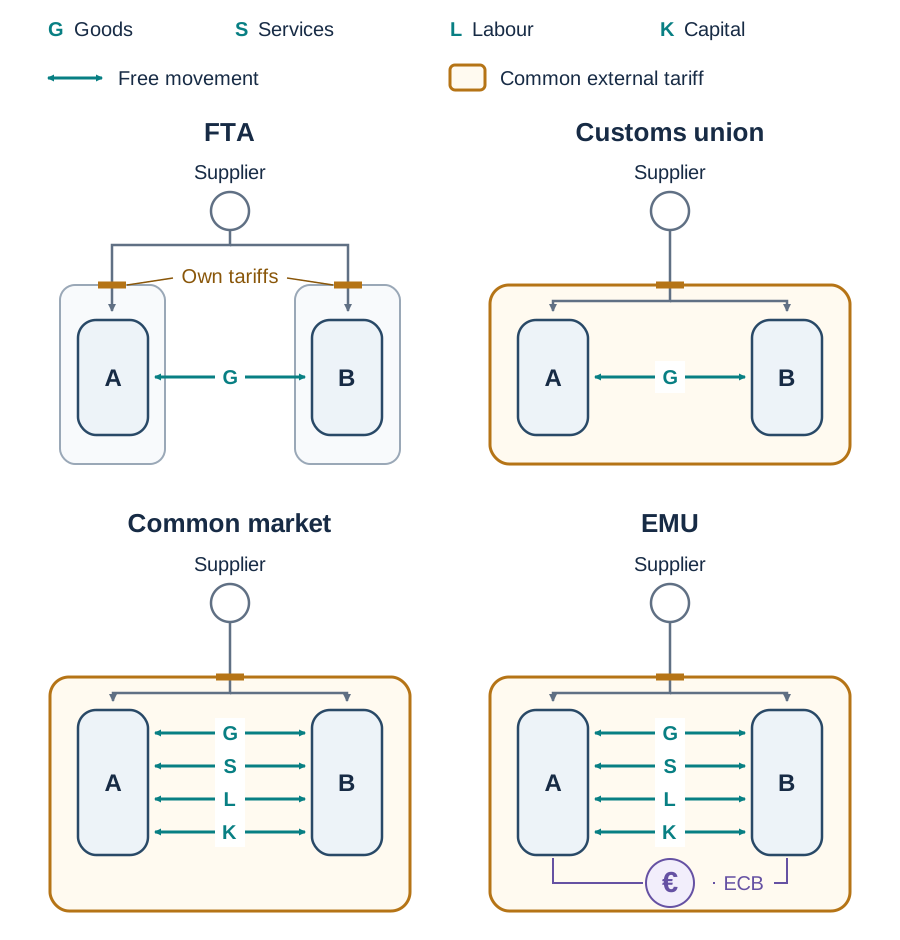
- Free Trade Area (FTA): Members eliminate all tariffs and quotas on trade between themselves, but each country sets its own independent tariffs on imports from non-members.
- Customs Union: Free internal trade among members, combined with an agreed Common External Tariff (CET) applied to all imports from third countries.
- Common Market: A customs union that also guarantees the free movement of goods, services, capital, and labour (the EU's 'four freedoms'). Labour and capital are the mobile factors of production.
- Economic and Monetary Union (EMU): A single market that shares a unified currency (the euro) and common monetary policy set by an independent central bank (the ECB).
Evaluating EU Membership and Global Institutions
- Benefits of EU Membership for Ireland: Free access to a Single Market of roughly 450 million consumers; high FDI inflows from US multinationals seeking an English-speaking base; EU agricultural and regional funding; and collective bargaining power in worldwide trade agreements (e.g. EU deals with Canada and Japan).
- Limitations of EU Membership: Ireland has no independent trade policy, cannot devalue its currency, and faces domestic pressure in sensitive sectors (such as beef farmers opposing the EU-Mercosur agreement).
- The World Trade Organization (WTO): The WTO establishes global trade rules, promotes the Most-Favoured-Nation principle, and settles international trade disputes. While it has lowered global tariffs over decades, its effectiveness has weakened because its Appellate Body has been blocked from hearing disputes, and large economies increasingly bypass its rules.
- The Fairtrade Movement: Fairtrade guarantees small-scale developing producers a minimum floor price to insulate them from volatile commodity markets, alongside a social premium for community schools and healthcare. However, higher retail prices limit market share, certification fees can exclude poorer farmers, and guaranteed prices may encourage over-reliance on basic cash crops.
Key terms
- Exchange Rate
- The price of one currency expressed in terms of another currency.
- Comparative Advantage
- The ability of a country to produce a good at a lower opportunity cost than another country.
- Absolute Advantage
- The ability of a country to produce a greater output of a good than another country using the same volume of productive resources.
- Balance of Trade
- The value of visible (goods) exports minus the value of visible (goods) imports over a given period. A positive figure is a trade surplus; a negative figure is a trade deficit.
- Tariff
- A customs duty or tax placed by a government on imported goods.
- Quota
- A direct physical restriction placed on the quantity of a specific good that may be imported into a country over a defined time period.
- Embargo
- A complete government ban on trade in certain goods or with a specific country, usually applied for political, legal, or security reasons.
- Dumping
- The practice of selling goods in a foreign export market at a price below their domestic market price or below their actual cost of production.
- Infant Industry
- A newly established domestic industry that has not yet achieved the economies of scale needed to compete against established foreign competitors.
- Appreciation
- An increase in the external market value of a floating currency, meaning one unit of the domestic currency buys more foreign currency.
- Depreciation
- A fall in the external market value of a floating currency, meaning one unit of the domestic currency buys less foreign currency.
- Modified Current Account (CA*)
- An adjusted current account measure calculated by the Central Statistics Office that strips out the distortions of multinational intellectual property imports and aircraft leasing.
- Unit Labour Costs (ULC)
- The average cost of labour per unit of real economic output, calculated by dividing total labour compensation by real domestic output.
- Customs Union
- A trading bloc that eliminates internal tariffs and trade barriers between member states and enforces an agreed Common External Tariff on goods from non-members.
- Common Market
- A stage of economic integration that combines a customs union with the completely unrestricted movement of goods, services, capital, and labour.
- Terms of Trade
- The ratio of export prices to import prices, measuring the quantity of imports an economy can purchase per unit of exports.
Check yourself
What is the core condition that determines which commodity a country should specialise in under Ricardo's Law of Comparative Advantage?
A country should specialise in the good it can produce at the lowest domestic opportunity cost relative to its trading partner.
The euro depreciates against the US dollar from €1 = 1.05. Explain one positive effect on Irish exporters and one negative effect on Irish consumers.
Irish exports become cheaper for US customers in dollar terms, boosting overseas sales and domestic employment. However, imports priced in dollars (such as crude oil) become more expensive in euros, increasing domestic imported inflation for consumers.
Outline two reasons why achieving a surplus on the Balance of Trade is an economic objective of the Irish Government.
1. Export sales generate domestic employment in manufacturing and agriculture. 2. Exports are an injection of outside spending into the circular flow of income, raising national income and GDP via the multiplier.
What key feature distinguishes a Common Market from a basic Customs Union?
Both abolish internal tariffs and apply a Common External Tariff. A common market goes further by also allowing free movement of the factors of production, labour and capital (and, in the EU, of services).
Why does Ireland record a large negative balance on the Primary Income section of its Current Account?
Foreign multinational corporations based in Ireland send large amounts of profits and dividends back to their parent companies abroad each year. These are outflows of factor income, recorded under primary income.