

National income is the total income earned by a country's factors of production in a year. It can be measured in several ways (GDP, GNP, GNI, GNDI), and each gives a different figure for Ireland. Understanding national income involves tracking how income circulates between households, firms, the government, and foreign trading partners. In Ireland, substantial foreign direct investment and multinational accounting practices significantly distort headline production measures such as GDP, making tailored metrics like Modified Gross National Income (GNI*) essential for evaluating genuine domestic living standards, national debt sustainability, and economic welfare.
The Circular Flow of Income
The circular flow of income is a macroeconomic model that shows how money, resources, goods, and services move between the main sectors of an economy.
Constructing the Model
To draw or describe the circular flow, picture households on one side and firms on the other:
- Real physical flows: Households own the four factors of production (land, labour, capital, and enterprise) and supply them to firms. In return, firms produce goods and services and supply them back to households.
- Monetary flows: Money moves in the exact opposite direction. Firms pay households factor incomes (rent for land, wages for labour, interest for capital, and profit for enterprise). Households spend this money on goods and services, returning consumer expenditure to firms as sales revenue.
Leakages and Injections
In a complete modern economy, money enters and leaves this central circle:
- Leakages (Withdrawals): Income diverted away from spending on current domestic output. These are Savings (), Taxation (), and spending on Imports ().
- Injections: Spending that enters the flow from sources outside domestic household spending. These are private Investment (), Government spending (), and revenue earned from foreign Exports ().
Macroeconomic Equilibrium
National income is in equilibrium (not rising or falling) when planned leakages equal planned injections:
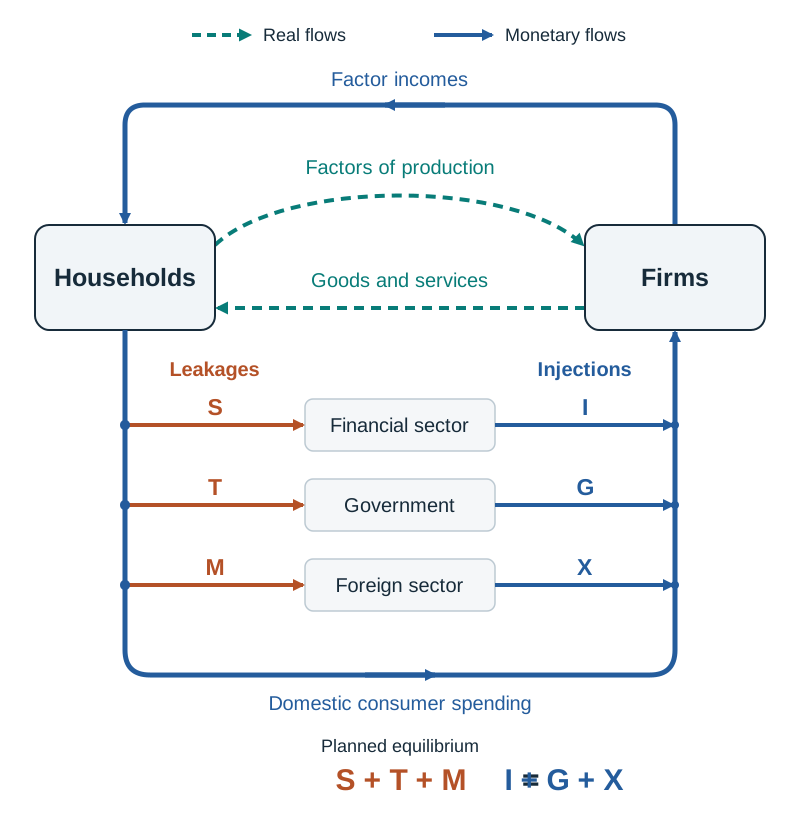
If total injections exceed total leakages (), additional spending enters the economy, driving up national income (), output, and employment. If leakages exceed injections (), purchasing power drains out of the domestic cycle, causing national income and employment to contract.
Measuring Output and National Aggregates
National income can be measured using three separate methods, all of which yield the same theoretical total because one person's spending becomes another person's income and equals the market value of output produced.
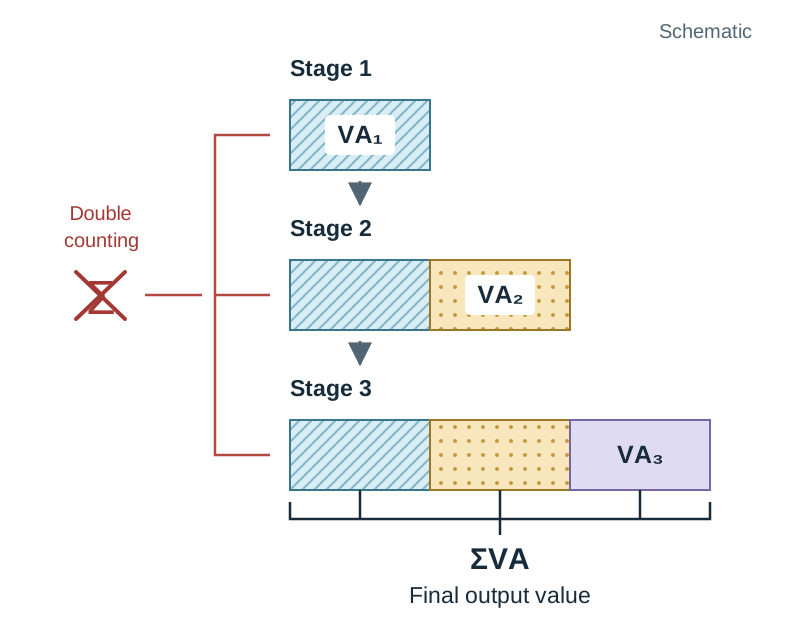
- The Output Method: Adds up the value added by each sector (agriculture, industry, and services). Value added equals the total value of a firm's output minus the cost of intermediate materials bought from other firms. Counting only value added avoids double counting, which means counting the same item more than once as it passes along the production chain.
- The Income Method: Sums all incomes earned by domestic factors of production (wages, self-employed earnings, trading profits, rent, and royalties). Transfer payments (such as jobseeker's allowance, child benefit, and state pensions) are excluded because they represent income transfers through the tax system rather than payments for new output.
- The Expenditure Method: Calculates total spending on final domestic output:
Here, is personal consumption, is private investment, is government spending, is exports, and is imports.
Accounting Adjustments
- Market Prices vs Factor Cost: Output valued at current market prices reflects the prices consumers actually pay. These prices include indirect taxes (such as VAT and excise duty) and are reduced by government subsidies. Valuing output at factor cost measures what factors of production actually received:
- Gross vs Net: Output figures described as gross are calculated before deducting depreciation (the physical wear and tear and obsolescence of capital goods during the year). Net figures subtract depreciation:
- Current vs Constant Prices: Figures at current prices are nominal and include the effect of inflation. Figures at constant prices are real, meaning the impact of price changes has been removed using a base year. To assess whether the physical volume of production has actually grown, economists compare constant price figures.
Measures of National Income: GDP, GNP, GNI, and GNDI
- Gross Domestic Product (GDP): The total value of all finished goods and services produced within the geographic borders of a country in a year, regardless of whether the producers are domestically or foreign owned.
- Gross National Product (GNP): The value of all goods and services produced by a country's own factors of production, whether located at home or abroad, in a year:
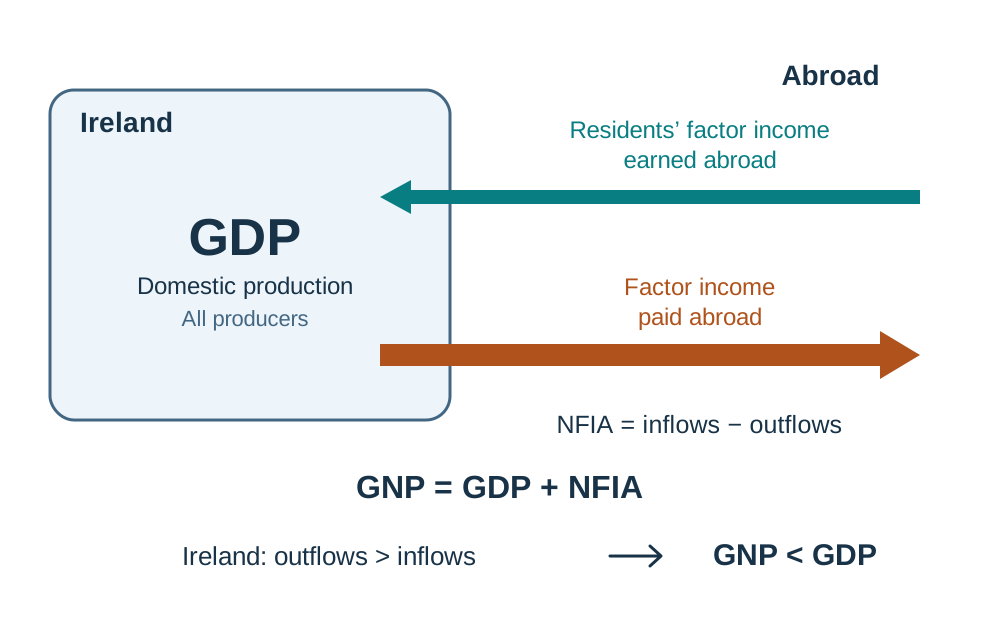
Net Factor Income from Abroad (NFIA) is factor income earned abroad by domestic residents and firms minus factor income earned domestically by foreign multinational firms and repatriated overseas. For Ireland, large multinational profit outflows make NFIA heavily negative, meaning GNP is significantly lower than GDP.
- Gross National Income (GNI): Adapts GNP to European Union accounting standards by including EU budgetary transactions:
- Gross National Disposable Income (GNDI): Measures the total spendable income available to residents for consumption and saving, adding net international current transfers (such as cross-border pensions, remittances, and international aid) to GNI:
Household Savings Ratio
The Central Statistics Office (CSO) tracks how much income households save rather than spend:
For example, if Irish household savings are €6.59bn and disposable income is €43.91bn, the savings ratio is . A rising savings ratio represents an increasing leakage from the circular flow, dampening domestic consumer spending.
The Irish Context: Globalisation and Modified GNI (GNI*)
Because Ireland hosts hundreds of large multinational corporations in sectors like pharmaceuticals, software, and medical devices, standard macroeconomic metrics distort the real size and performance of the domestic economy. Multinationals book large global profits in Ireland, but much of that profit is repatriated abroad to foreign parent companies, creating a massive negative NFIA.
In 2015, Irish real GDP jumped by 26% in a single year. The main causes were multinationals moving foreign-owned intellectual property (patents, software licences, and trademarks) onto their Irish balance sheets, alongside surges in contract manufacturing (goods manufactured abroad by third parties but recorded on the books of Irish-resident firms). Very little of this extra output generated direct domestic wages or local trade.
To strip out these multinational accounting flows, the CSO introduced *Modified Gross National Income (GNI\)**.
GNI* is GNI adjusted to remove three specific distortions:
- The depreciation of foreign-owned intellectual property located in Ireland.
- The depreciation of leased aircraft owned by Irish-resident aircraft-leasing firms.
- The net factor income of redomiciled public limited companies (firms that moved their legal tax residency to Ireland without establishing substantial domestic operations).
Why GNI* is the Preferred Indicator for Ireland
When an exam question asks which measure best reflects Ireland's economic performance or living standards, use these three points:
- GDP is inflated by multinational profits that are ultimately sent abroad.
- GNI* removes the depreciation of relocated intellectual property and leased aircraft, as well as income from redomiciled plcs.
- GNI* therefore reflects the actual income available to Irish residents and the State.
This distinction is critical for evaluating national debt. The National Treasury Management Agency (NTMA) manages Ireland's sovereign borrowing. Measuring national debt as a percentage of GNI* gives a realistic assessment of debt burden and repayment capacity, because government debt interest must be serviced from taxes paid by the domestic economy rather than mobile multinational accounting flows.
The Multiplier Effect in Open and Closed Economies
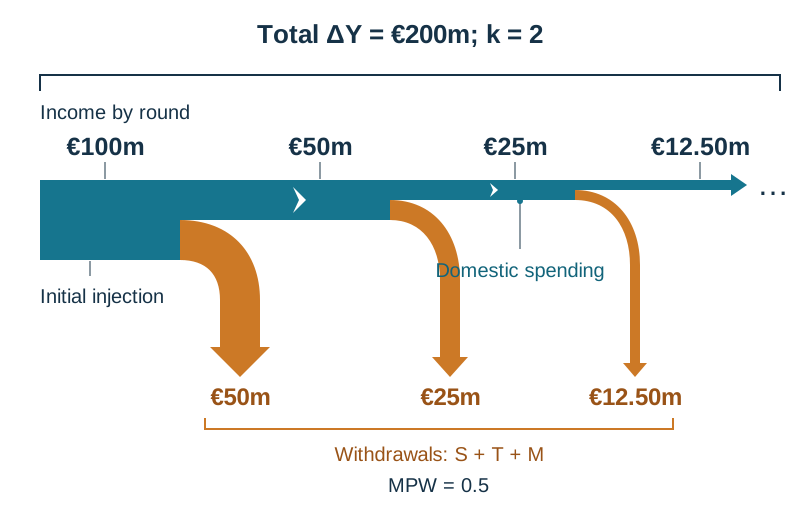
The multiplier effect demonstrates that an initial injection of spending into the economy leads to a final increase in national income that is larger than the starting injection itself. When new spending enters the economy, it becomes income for the recipients, who spend a fraction of it on domestic output, generating fresh income for others in successive rounds.
Round-by-Round Example
Suppose the government spends €100m building schools, and the Marginal Propensity to Withdraw () is 0.5:
- Round 1: Construction workers and suppliers receive €100m in income. They withdraw half (€50m in savings, tax, and imports) and spend €50m on Irish goods and services.
- Round 2: That €50m becomes income for retail staff and domestic producers, who withdraw €25m and spend €25m.
- Round 3: That €25m generates €12.50m of further spending, and so on.
- Total Expansion: €100m + €50m + €25m + €12.50m + ... = €200m ().
Marginal Propensities
The proportion of additional income diverted into spending or leakages is measured by marginal propensities:
- Marginal Propensity to Consume (MPC): The proportion of each extra unit of income spent on consumption ().
- Marginal Propensity to Save (MPS): The proportion of each extra unit of income saved (). Use the rule , because each extra euro of income is either consumed or saved. Apply this rule even when tax and import rates are given, then include all leakages in the multiplier formula.
- Marginal Propensity to Tax (MPT): The proportion of each extra unit of income paid in taxation ().
- Marginal Propensity to Import (MPM): The proportion of each extra unit of income spent on imports ().
Multiplier Formulas
- Closed economy without government (saving is the only leakage):
- Closed economy with government (no foreign trade, so saving and tax are leakages):
- Open economy with government and foreign trade (all three leakages present):
Calculation Rule: Include in the denominator only the specific leakages supplied in the question.
Try this: An economy has , , and . Find . First, . Then, .
Because Ireland is a small open economy that imports a large share of what it consumes, its MPM is high. As a result, much of any extra spending leaks abroad and Ireland's multiplier is relatively small.
Business Cycles and Irish Macroeconomic Experience
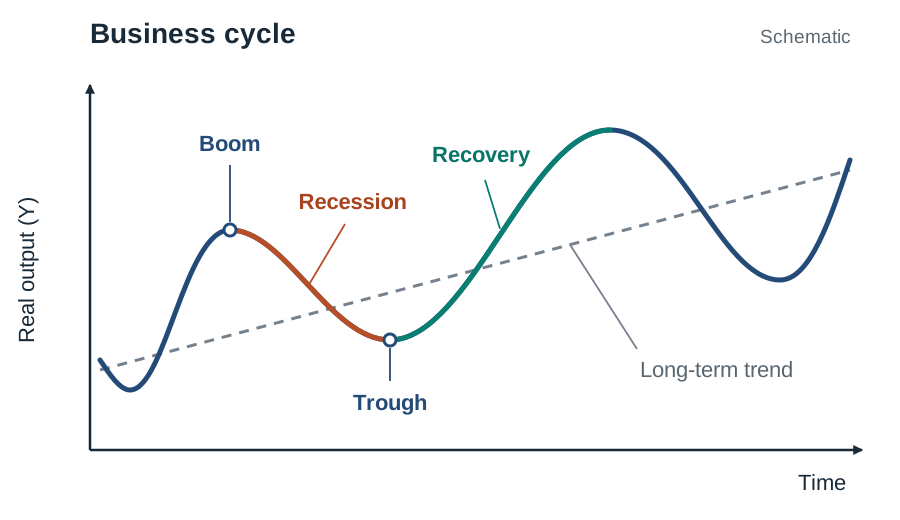
A business cycle traces the recurring fluctuations in economic output and employment around an economy's long-term growth trend line. It consists of four distinct phases:
- Boom: High consumer confidence, rapid growth in output, low unemployment, and rising inflation as the economy nears productive capacity.
- Recession: Output falls for at least two consecutive quarters, business investment drops, and unemployment begins to climb.
- Trough (Depression if very severe and prolonged): The lowest point of the cycle. Output and investment reach their lowest levels and unemployment is at its highest.
- Recovery: Output and retail sales pick up, business confidence returns, investment resumes, and unemployment starts falling.
Main Causes of Fluctuations in Irish Output
Fluctuations in Ireland's national output are primarily driven by four factors:
- Credit and Property Booms and Busts: Rapid expansion of bank lending inflates property prices and construction, while credit contractions trigger banking crises and sharp recessions.
- Global Demand for Exports: As a trade-reliant economy, changes in trading partner demand directly affect Irish manufacturing and service output.
- Energy and Commodity Price Shocks: Rapid increases in imported oil and gas prices raise business costs, erode real household incomes, and reduce aggregate demand.
- Fiscal Policy Choices: Government decisions on spending cuts, tax increases, or capital stimulus influence total domestic demand across the cycle.
Ireland's Modern Macroeconomic Record
- The Celtic Tiger (1995–2007): Rapid export-led growth fuelled by foreign direct investment and a low 12.5% corporation tax rate, which later degenerated into an unsustainable property bubble.
- The Financial Crisis (2008–2013): The collapse of domestic banks and construction wiped out tax receipts, pushed unemployment above 15% in 2012, and forced an international bailout.
- The Dual-Economy Shock (2020–2021): The COVID-19 pandemic froze domestic retail and hospitality, but multinational technology and pharmaceutical exports boomed, keeping headline GDP positive while domestic employment fell.
- The Inflation Shock (2022–2023): International energy price spikes pushed consumer price inflation (measured by the Harmonised Index of Consumer Prices, HICP) above 8%, eroding household purchasing power. Inflation later eased, while unemployment stayed low at under 5%.
Links to Earlier Crises
Earlier crises shaped modern Irish economic policy. The 1950s crisis of economic stagnation and mass emigration prompted the shift from protectionist tariffs to free trade and foreign direct investment, initiated by the 1958 First Programme for Economic Expansion. Internationally, the Great Depression of the 1930s proved that market economies could remain stuck in protracted underemployment, providing the theoretical foundation for using government injections to close a deflationary gap.
Key terms
- Circular Flow of Income
- A macroeconomic model tracking the continuous flow of payments, factor inputs, and finished output between households, firms, the government, and the foreign sector.
- Leakages
- Withdrawals of income from the circular flow not spent on current domestic output, consisting of savings (S), taxation (T), and imports (M).
- Injections
- Additions of spending into the circular flow from sources outside domestic households, consisting of investment (I), government spending (G), and exports (X).
- Double Counting
- The error of counting the value of the same goods or intermediate materials more than once as they pass through successive stages of production.
- Market Prices
- The valuation of goods and services at the actual prices consumers pay, which include indirect taxes and exclude government subsidies.
- Factor Cost
- The valuation of national output based on the actual earnings received by the factors of production, equal to market prices minus indirect taxes plus subsidies.
- Depreciation
- The reduction in the monetary value of capital goods over time due to wear and tear, usage, or technological obsolescence.
- Gross Domestic Product (GDP)
- The total monetary value of all finished goods and services produced within the geographic borders of a country during a year.
- Gross National Product (GNP)
- The value of all goods and services produced by a country's own factors of production, whether located at home or abroad, in a year, calculated as GDP plus NFIA.
- Net Factor Income from Abroad (NFIA)
- Factor income earned abroad by domestic citizens and firms minus factor income earned domestically by foreign factors and repatriated overseas.
- Gross National Income (GNI)
- GNP adjusted for European Union transactions, calculated as GNP plus EU subsidies minus EU taxes.
- Modified GNI (GNI*)
- An Irish macroeconomic aggregate created by the CSO that strips out distortions caused by intellectual property depreciation, aircraft leasing, and redomiciled plcs.
- Gross National Disposable Income (GNDI)
- The total income available to a country's residents for spending and saving, calculated as GNI plus net international current transfers.
- The Multiplier (k)
- The factor by which an initial injection of spending multiplies to create a larger final increase in equilibrium national income.
- Marginal Propensity to Consume (MPC)
- The proportion of each extra unit of income that is spent on consumption.
- Marginal Propensity to Save (MPS)
- The proportion of each extra unit of income that is saved rather than spent.
- Marginal Propensity to Tax (MPT)
- The proportion of each extra unit of income paid to the government in taxation.
- Marginal Propensity to Import (MPM)
- The proportion of each extra unit of income spent on imported goods and services.
- Deflationary Gap
- The amount by which current equilibrium national income falls short of full employment national income.
- Hidden Economy
- Lawful or unlawful economic activity deliberately concealed from public authorities to evade tax payments, avoid social insurance contributions, or bypass legal employment regulations.
- National Treasury Management Agency (NTMA)
- The Irish state body responsible for managing the national debt, government borrowing, and sovereign debt service costs.
Check yourself
State the macroeconomic equilibrium condition for the circular flow of income in an open economy with government intervention.
Planned leakages equal planned injections: Savings + Taxes + Imports = Investment + Government Spending + Exports ().
What three adjustments are made by the CSO to convert GNI into Modified GNI (GNI*)?
GNI* removes the depreciation of foreign-owned intellectual property, the depreciation of leased aircraft, and the net factor income of redomiciled PLCs.
If an economy has MPC = 0.8, MPT = 0.1, and MPM = 0.2, what is the value of the multiplier?
First find MPS = 1 - 0.8 = 0.2. Total leakages = 0.2 + 0.1 + 0.2 = 0.5. The multiplier is k = 1 / 0.5 = 2.0.
How do you calculate output at factor cost from output at current market prices?
Factor Cost = Market Prices - Indirect Taxes + Subsidies.
In a given quarter, household disposable income is €50bn and household savings are €6bn. What is the household savings ratio?
Savings ratio = (€6bn / €50bn) * 100 = 12%.
Which agency is responsible for managing Ireland's national debt and sovereign borrowing?
The National Treasury Management Agency (NTMA).