

Globalisation is the growing integration and interdependence of the world's economies through four flows across borders: trade in goods and services, capital (including foreign direct investment), labour, and technology and ideas. Ireland is a small open economy with a small domestic market, meaning a very large share of what we produce is exported and a high proportion of what we consume is imported. While multinational corporations (MNCs) provide substantial employment, productivity spillovers, and corporation tax revenue, deep integration creates significant vulnerabilities: fiscal concentration risk, vulnerability to external shocks, infrastructure bottlenecks, and severe national accounting distortions that require modified measures like GNI*.
Understanding Globalisation: Drivers, Dimensions, and Global Impacts
Globalisation connects modern economies through four cross-border flows: goods and services, capital, labour, and technology and ideas.
Why Globalisation Has Accelerated
Four main developments have driven international integration since the 1980s:
- Falling transport costs: Containerisation, larger cargo vessels, and bulk air freight mean manufactured parts can be shipped across the globe for a few cents per unit.
- Trade liberalisation: Successive tariff reductions under the General Agreement on Tariffs and Trade (GATT) and the World Trade Organisation (WTO), alongside the development of the European Union Single Market, dismantled tariffs, quotas, and customs frontiers.
- Technology and digital communications: High-speed internet, cloud infrastructure, and instant data sharing allow enterprises to coordinate complex global supply chains and trade white-collar services (software, design, accounting) internationally.
- Capital and labour mobility: The dismantling of exchange controls allows funds to flow freely between financial centres, while migration agreements and the EU free movement of labour give firms access to an international talent pool.
Global Implications Beyond Ireland
Globalisation affects developing and developed nations in starkly different ways:
Developing Economies: Gains and Trade-Offs
- Export-led growth: Access to global markets enables low-income economies to specialise where they possess a comparative advantage. For example, Vietnam, China, and South Korea lifted hundreds of millions out of extreme poverty by expanding manufacturing exports.
- Technology and capital transfers: Inward foreign direct investment (FDI) provides modern machinery, managerial know-how, and infrastructure that domestic savings could not finance.
- Uneven gains and primary product dependency: Nations dependent on exporting primary agricultural commodities or raw minerals (such as cocoa in Côte d'Ivoire) face volatile global commodity prices, capturing very little value compared to final processors in developed economies.
- The race to the bottom: Intense competition for mobile capital can incentivise host governments to keep wages low, overlook workplace safety, and weaken environmental enforcement.
Developed Economies: Structural Unemployment and Inequality Moving routine manufacturing to lower-cost nations creates structural unemployment among domestic industrial workers whose skills do not match emerging knowledge-intensive industries. Because capital owners and highly educated professionals capture the bulk of the economic gains from globalisation, domestic income inequality can widen.
Summary of Core Implications
| Positive Implications | Negative Implications |
|---|---|
| Global economies of scale and lower consumer prices | Structural unemployment in declining sectors |
| Rapid technology spillover and know-how | Exposure to global economic shocks and contagions |
| Foreign capital accumulation in host states | Risk of a race to the bottom on regulations |
| Higher living standards in developing exporters | Increased domestic income inequality |
| Wider product variety and consumer choice | Erosion of local retail and cultural identity |
Globalisation, Environmental Sustainability, and Deglobalisation
In modern economics, global integration cannot be evaluated without examining environmental sustainability and emerging geopolitical shifts.
Environmental Sustainability
Strand 1.3 emphasises that economic activity must balance economic, social, and environmental sustainability.
Environmental Costs
- Transport emissions: Long-distance maritime shipping, road haulage, and air freight burn fossil fuels, increasing greenhouse gas emissions per unit consumed.
- Carbon leakage: If one jurisdiction enforces stringent carbon taxes and environmental rules, energy-intensive manufacturing may relocate to countries with lax regulations. Global emissions do not fall; they simply move.
- Host economy resource strain: Rapid multinational expansion places enormous strain on domestic resources. In Ireland, the rapid growth of enterprise data centres has sharply increased electricity consumption, placing strain on the national grid and complicating legally binding climate targets.
Environmental Benefits
- Diffusion of clean technology: Open trade accelerates the international rollout of solar panels, wind turbine components, and energy-efficient manufacturing processes.
- Green standards and financing: Global firms often apply universal sustainability standards across their entire supply chain, while higher national income gives governments the tax base needed to invest in retrofitting, public transport, and renewable infrastructure.
Evaluation: Globalisation raises world output, but it does not automatically guarantee sustainable development. That outcome depends on whether governments price negative externalities through coordinated mechanisms like the EU Emissions Trading System and the Carbon Border Adjustment Mechanism (CBAM).
Is Globalisation in Retreat?
Since 2016, political and supply-chain pressures have introduced friction into global trade:
- Brexit: The departure of the UK from the EU Single Market reintroduced customs declarations, sanitary checks, and regulatory divergence, raising costs for Irish agri-food exporters and firms using the UK land-bridge.
- Protectionism and tariffs: Rising trade tensions between the United States, China, and the EU have led to retaliatory tariffs and export bans on strategic goods such as advanced semiconductors.
- Supply-chain resilience (reshoring and friend-shoring): Disruptions from the Covid-19 pandemic and the war in Ukraine demonstrated the vulnerability of lean, just-in-time supply chains. Many firms are now reshoring production to their home nation or friend-shoring to politically aligned trading partners.
Why Multinational Corporations Invest Abroad and in Ireland
A multinational corporation (MNC) is an enterprise that owns or controls productive operations in at least one country outside its home country. When an MNC builds a new production plant, expands a facility, or acquires a controlling interest (conventionally 10% or more of voting equity) in an overseas firm, it undertakes foreign direct investment (FDI). This is fundamentally different from portfolio investment, which is the passive purchase of foreign equities, bonds, or securities purely for a financial return without managerial control.
Motivations for MNC Investment
- Market access and tariff jumping: Establishing production inside a trading bloc allows a business to bypass common external tariffs and regulatory borders. For US tech and healthcare firms, an Irish plant provides direct, frictionless access to the EU Single Market of approximately 450 million consumers.
- Strategic assets, human capital, and industry clusters: Knowledge-intensive firms require skilled talent. Ireland provides a young, English-speaking, tertiary-educated workforce alongside mature industry clusters: Information and Communications Technology (ICT) in Dublin, biopharmaceuticals in Cork, and medical technology in Galway. These clusters allow new entrants to recruit experienced scientists, engineers, and specialised corporate advisers immediately.
- Cost efficiencies and productivity: Firms look at unit labour costs (wages relative to worker productivity) rather than headline wage rates alone. High worker productivity in capital-intensive sectors keeps Irish unit labour costs competitive.
- Policy predictability and taxation: Predictable institutions, an independent legal system, and an established 12.5% corporation tax rate on trading income historically provided long-term certainty.
The OECD Pillar Two Agreement: Ireland has implemented the OECD Pillar Two directive, which establishes a 15% minimum effective corporate tax rate for multinational groups with consolidated annual global revenues exceeding €750m. In an evaluation answer, treat Pillar Two as a structural challenge: it narrows Ireland's tax advantage over competitors, meaning future FDI must be won on non-tax fundamentals such as talent, infrastructure, and regulatory efficiency.
Named Multinationals Operating in Ireland
- ICT: Intel (semiconductors in Leixlip, Co. Kildare), Google and Meta (European headquarters in Dublin), Apple (Cork).
- Biopharmaceuticals and Medtech: Pfizer (Ringaskiddy, Co. Cork), Boston Scientific and Medtronic (Galway), Johnson & Johnson.
- International Financial Services: Citi and State Street (Dublin Docklands / IFSC).
- Indigenous Irish Multinationals (Outward FDI): Irish firms also invest directly abroad. Examples include Kerry Group, CRH, Glanbia/Tirlán, and Ryanair. Outward FDI earns foreign profits that flow back into Ireland as factor income inflows.
Why Multinationals Choose Ireland: Rapid Recall
- Frictionless, tariff-free access to the EU Single Market
- Highly educated, English-speaking workforce
- Deep, specialised industry clusters (pharma, medtech, ICT)
- Pro-enterprise policy environment supported by IDA Ireland
- Stable legal system under common law
Investigating Irish FDI Data: Stocks, Flows, and Volatility
Exam questions frequently require students to interpret FDI figures from the Central Statistics Office (CSO), calculate changes, and explain the underlying economic reality.
Flows versus Stocks (Positions)
- FDI flow: The net monetary value of capital transactions between foreign direct investors and resident enterprises over a specific time period (such as a quarter or a year).
- FDI stock (position): The total accumulated value of foreign direct investment assets held within the domestic economy at a specific point in time.
Understanding FDI Volatility
Irish quarterly FDI flows fluctuate wildly. For instance, quarterly inflows can plunge into deep negative territory in one quarter and rebound by tens of billions in the next. These swings do not mean factories are opening or closing overnight. In Ireland's open corporate landscape, FDI figures are heavily influenced by three balance-sheet mechanisms:
- Intellectual Property (IP) onshoring: When an MNC moves legal ownership of its patents, software copyrights, or licences onto its Irish balance sheet, the transaction is recorded as a massive capital inflow.
- Intra-group treasury operations: Multinationals route large volumes of liquidity, loans, and currency hedges between international subsidiaries to manage corporate finance, creating volatile financial flows.
- Profit reinvestment versus repatriation: Profits earned by an Irish subsidiary and retained in Ireland rather than sent home as dividends count as an inward FDI flow.
Note on Data: Quarterly FDI statistics are frequently revised by the CSO. In exams, focus on identifying the economic pattern rather than memorising volatile figures, and always take your data directly from the examination table provided.
Describing a Trend: A Four-Step Routine
When an exam question asks you to describe or interpret an FDI data series, work through these four steps:
- State the overall direction: State whether flows or stocks grew, declined, or fluctuated over the full timeframe, quoting the start and end values.
- Identify the peak and trough: Name the highest and lowest points with their specific years and values.
- Highlight the sharpest turning point: Identify which interval showed the fastest change, calculating the absolute change.
- Provide an economic explanation and a data limitation: Explain that paper transactions (such as IP movements or loan repayments) explain the volatility, and state clearly that capital flow data does not directly measure changes in employment.
Evaluating Foreign-Owned Industry and Government Policy
Evaluating foreign-owned enterprise in Ireland requires balancing substantial benefits against structural risks across three core dimensions, followed by reviewing policy responses.
1. Employment and Productivity: The Dual Economy
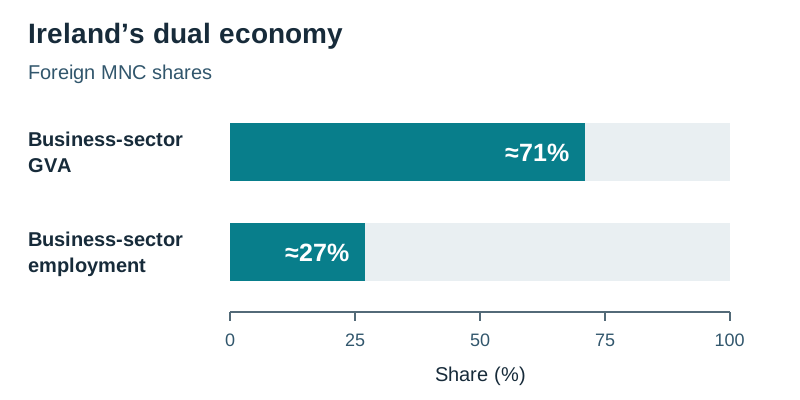
IDA Ireland client companies employ approximately 302,000 people (IDA Ireland, 2024), representing around 11% of national employment. MNCs pay high wages and generate significant income tax (PAYE and USC). However, CSO data reveals that foreign-owned MNCs generate roughly 71% of business-sector Gross Value Added (GVA) while accounting for only about 27% of business-sector employment.
This structural divide is called a dual economy: a highly productive, capital-intensive foreign export sector operates alongside a more traditional, labour-intensive indigenous sector. In practice, a biopharmaceutical plant in Cork produces billions of euro in output with several hundred specialised staff, whereas a local building contractor or hotel requires far more workers to produce a fraction of that measured output.
2. Public Finances and Fiscal Concentration Risk
Corporation tax receipts exceed €20bn annually and now account for roughly a quarter of total Irish exchequer tax revenue, making it the second-largest tax source after income tax. However, Revenue Commissioners data shows that foreign MNCs pay approximately 88% of all corporation tax, with the top 10 corporate taxpayers alone contributing roughly 57%. This extreme concentration exposes public finances to severe shock: if two or three global tech or pharma companies experience a drop in worldwide profits or shift assets, Ireland's tax revenue falls sharply.
3. Supply-Chain Linkages and Capacity Pressures
MNCs spend billions locally on services, utilities, and domestic suppliers. However, their rapid expansion also generates acute capacity bottlenecks. High corporate wages put upward pressure on domestic salaries, making it difficult for indigenous small and medium enterprises (SMEs) to recruit staff. Multinationals are also a footloose industry: because their core assets are mobile and their ultimate owners are based overseas, they can relocate if costs rise. In 2009, computer manufacturer Dell moved its manufacturing operations from Limerick to Poland, causing the loss of approximately 1,900 direct jobs.
Government Policy Responses
Attracting and Retaining Sustainable Investment
- IDA Ireland: Offers capital, employment, and R&D grants, and develops advance-built office and manufacturing parks across regional hubs to counter urban congestion.
- Skills and Education Policy: Directs funding into higher education, apprenticeships, and Skillnet to ensure a pipeline of skilled science, engineering, and tech graduates.
- National Infrastructure Investment: Funding under the National Development Plan targets grid capacity, water treatment, public transport, and housing supply.
Managing Vulnerabilities and Building Resilience
- Saving Windfall Receipts: In 2024, the government established two long-term reserve funds: the Future Ireland Fund and the Infrastructure, Climate and Nature Fund. These funds sequester windfall corporation tax receipts rather than using them to finance recurring day-to-day spending.
- Supporting Indigenous Enterprise: Enterprise Ireland and Local Enterprise Offices (LEOs) supply grants and export advice to domestic companies, helping build a resilient counterweight to foreign multinationals.
National Accounting Distortions: GDP, GNI, and GNI*
Because foreign MNCs locate substantial intangible assets in Ireland and repatriate profits to overseas parents, standard output metrics distort Ireland's true economic performance.
Where FDI Appears in the National Accounts
- Capital injection: When an MNC builds a plant, capital enters the financial account of the balance of payments. In the domestic economy, this physical construction represents an investment injection into the circular flow of income, generating a multiplier effect as wages and material payments circulate.
- Factor income leakage: When that plant generates profits, payments sent back to foreign parent companies count as a factor income outflow in the current account of the balance of payments. This outflow acts as a withdrawal (leakage) from the circular flow of income.
The Failure of GDP and the 2015 Distortions
Gross Domestic Product (GDP) measures the total value of all goods and services produced within the physical borders of a country. In Ireland, GDP includes the output of massive foreign multinationals, even when the resulting income leaves the country immediately.
This distortion reached extreme levels in 2015, when Irish GDP was initially reported to have grown by 26.3% (later revised to roughly 25%). Economists dubbed this phenomenon 'Leprechaun Economics'. The surge was not caused by an overnight boom in domestic consumer spending or job creation; it was caused by a small number of global MNCs moving balance-sheet assets—specifically intellectual property rights and aircraft leasing fleets—onto Irish corporate registers.
The CSO Solutions: GNI and GNI*
To measure the income actually available to Irish residents, economists turn to Gross National Income:
Because net factor income is deeply negative for Ireland (large multinational profit repatriations exceed the factor income sent back by Irish investments abroad), GNI is substantially smaller than GDP.
However, standard GNI is still distorted by MNC corporate accounting. To fix this, the CSO developed *Modified Gross National Income (GNI\)**:
Accounting Deductions Explained:
- Retained earnings of redomiciled PLCs: Foreign corporate groups that locate their legal headquarters in Ireland for tax purposes retain profits on their Irish balance sheets, inflating GNI even though the funds belong to foreign shareholders.
- Depreciation on foreign-owned intellectual property: GDP and GNI are gross measures, so they include the yearly wearing-out (depreciation) of the patents and licences that multinationals have located in Ireland. Because those assets belong to foreign owners, neither the assets nor the sums set aside to replace them are income available to Irish residents, so GNI* takes this depreciation out.
- Depreciation on aircraft leasing: Ireland hosts a global aircraft leasing hub. The depreciation of these foreign-owned aircraft fleets is likewise included in the gross figures, so GNI* removes it as well.
Scale of the Gap: In recent years, Irish GNI has been roughly half to three-fifths of headline GDP. Economists and policymakers also use Modified Domestic Demand (MDD)* to track underlying domestic consumption and investment while stripping out volatile multinational transactions.
Key terms
- Globalisation
- The deepening economic integration and mutual interdependence of world economies through cross-border flows of goods and services, capital, labour, and technology and ideas.
- Small Open Economy
- An economy with a relatively small domestic market that relies extensively on international trade and foreign capital flows, meaning domestic economic conditions are heavily influenced by global economic developments.
- Foreign Direct Investment (FDI)
- Cross-border investment where an enterprise resident in one economy acquires a lasting interest and a significant degree of influence (conventionally 10% or more of voting power) in an enterprise resident in another economy.
- Portfolio Investment
- Passive investment in foreign financial assets, such as shares or bonds, undertaken purely to earn a financial return and without any active managerial control over the issuing business.
- Multinational Corporation (MNC)
- An enterprise that owns or controls productive assets and operations in at least one country other than its home country.
- FDI Flow
- The net monetary value of cross-border capital transactions associated with direct investment recorded over a specified time period, such as a quarter or a year.
- FDI Stock (Position)
- The total accumulated monetary value of foreign direct investment assets located in a host economy at a specific point in time.
- Technology Spillover
- The informal diffusion of technological knowledge, production methods, and management skills from foreign multinational firms to local domestic suppliers, competitors, and workers.
- Dual Economy
- An economic structure characterised by the coexistence of a highly productive, capital-intensive foreign multinational sector alongside a lower-productivity, labour-intensive domestic indigenous sector.
- Footloose Industry
- An enterprise whose location choices are not tied to local raw materials or fixed natural advantages, making it free to relocate operations relatively quickly in response to changing costs or competitor incentives.
- Fiscal Concentration Risk
- The exposure of a government's public finances to shock when a disproportionately large share of national tax revenue relies on a tiny number of corporate taxpayers or a single economic sector.
- Modified Gross National Income (GNI*)
- An Irish macroeconomic metric designed by the CSO that adjusts standard GNI by deducting the retained earnings of redomiciled PLCs, depreciation on foreign-owned intellectual property, and depreciation on leased aircraft assets.
- Modified Domestic Demand (MDD)
- A macroeconomic metric that measures total domestic personal and government spending plus domestic investment, excluding volatile foreign multinational intellectual property transfers and aircraft purchases.
- Future Ireland Fund
- A sovereign wealth fund established by the Irish Government in 2024 to save windfall corporation tax receipts and build long-term state assets rather than funding recurring day-to-day spending.
- Infrastructure, Climate and Nature Fund
- A designated reserve fund established in Ireland in 2024 to secure capital funding for infrastructure projects and climate transition targets during future economic downturns.
Check yourself
What is the economic difference between Foreign Direct Investment (FDI) and portfolio investment?
FDI involves an investor acquiring a lasting interest and significant managerial control (typically 10% or more of voting power) over an overseas enterprise. Portfolio investment is the passive purchase of foreign equities or bonds purely for a financial return, with no managerial influence.
Identify two factors that have accelerated globalisation since the 1980s.
1. Falling transport costs driven by containerisation and bulk shipping. 2. Trade liberalisation through GATT, the World Trade Organisation (WTO), and the European Single Market (as well as advancements in digital communication and capital mobility).
Outline one positive and one negative implication of globalisation for developing economies.
A positive implication is export-led growth and technology transfer, which helped lift millions out of poverty in countries like Vietnam. A negative implication is vulnerability to volatile primary commodity prices and the risk of a 'race to the bottom' on wages and environmental rules.
Why did the CSO develop Modified Gross National Income (GNI*), and what is one item it removes from standard GNI?
The CSO developed GNI because standard GDP and GNI are distorted by multinational accounting practices and do not reflect true domestic living standards. GNI removes the retained earnings of redomiciled PLCs (or depreciation on foreign-owned intellectual property, or depreciation on leased aircraft).
What is 'fiscal concentration risk' in the context of Irish corporation tax?
It is the vulnerability of Irish public finances resulting from approximately 88% of corporation tax being paid by foreign-owned MNCs, with the top 10 companies contributing around 57% of total receipts.
If Inward FDI is +€17.2bn and Outward FDI is +€13.4bn in a quarter, calculate Net FDI.
Net FDI = Inward FDI - Outward FDI = +€17.2bn - (+€13.4bn) = +€3.8bn.
Name two policies used by the Irish Government to manage inward investment and its associated risks.
1. Providing capital, training, and regional infrastructure grants through IDA Ireland. 2. Depositing windfall corporation tax receipts into the Future Ireland Fund to avoid structural deficits.