
Sustainability in economics examines how societies can meet the needs of the present without compromising the ability of future generations to meet their own needs, a definition established in the 1987 UN Brundtland Report. Leaving Certificate Economics examines sustainability not as isolated environmentalism, but through three interconnected pillars: economic, social, and environmental. Mastering this topic requires evaluating the trade-offs and synergies across these pillars, understanding scarcity and opportunity cost over long time horizons, tracking progress using distinct indicators for growth, social cohesion, inequality, and the environment, and assessing how the transition to a sustainable economy changes the incentives facing individuals, businesses, and the government.
The Three Pillars of Sustainability and Intergenerational Equity
Economics explores how scarce resources are allocated among competing uses. Sustainable development extends this core question across time through the principle of intergenerational equity: the ethical rule that the current generation must not deplete the stock of physical, human, and natural capital to the detriment of future generations.
Economists analyse sustainability under three headings, or pillars. They are separate ideas, but they depend on one another:
- Economic sustainability: The capacity of an economy to maintain stable growth in real output and employment over the long term, supported by sound public finances, a diversified productive base, and continuing investment, so that growth can be sustained without recurring boom-and-bust cycles.
- Social sustainability: The capacity of a society to maintain fairness, equal opportunity, and human well-being over time. This requires strong social cohesion, equitable access to public services like health and education, and low rates of poverty and exclusion.
- Environmental sustainability: Using the environment at a rate it can withstand, so that clean air and water, healthy soil, forests, fisheries, and wildlife remain intact for future generations. It means keeping emissions, waste, and resource extraction within ecological limits. Natural capital represents the stock of natural resources and ecosystems that yields valuable ecosystem goods and services over time.
Economic Growth versus Economic Development
A central distinction in sustainability is the difference between growth and development:
- Economic growth is a quantitative increase in the real output of an economy over time, measured by the percentage change in real Gross Domestic Product (GDP) or, in Ireland, real *modified GNI (GNI)**.
- Economic development is a broader process comprising economic growth alongside qualitative improvements in living standards, such as improved life expectancy, higher literacy, reduced poverty, greater civil freedom, and environmental protection.
Growth can occur without development. If national output expands because of an asset boom, but the benefits accrue to a tiny minority while public services deteriorate and pollution increases, the country experiences growth without development. To capture well-being across borders, economists often look to the Human Development Index (HDI), a United Nations composite index scored from 0 to 1 that combines income (GNI per capita), health (life expectancy at birth), and education (mean and expected years of schooling). While HDI captures dimensions missed by GDP, its main limitation is that it omits income distribution and environmental degradation.
Economic and Social Sustainability: The Irish Experience
Ireland's modern economic history shows why economic growth without structural stability is unsustainable. During the Celtic Tiger era (1995–2007), headline national output surged. In its later years, this growth was driven by private-sector bank credit, speculative property construction, and temporary, transaction-based tax revenues such as stamp duty.
When the global financial crash hit in 2008, the domestic property bubble burst. The Irish banking system required a state bailout, tax revenues collapsed, and the government entered an international financial assistance programme. The crisis caused severe austerity, high unemployment, and soaring public debt. Growth that depends on excessive credit and unbalanced tax receipts is not economically sustainable.
Modern economic sustainability relies on three key mechanisms:
Fiscal Stability
Governments must keep public finances sustainable across economic cycles. Ireland's recent decision to channel volatile corporation tax receipts into the Future Ireland Fund and the Infrastructure, Climate and Nature Fund is a direct application of fiscal sustainability and intergenerational equity. By saving windfall corporate taxes today rather than using them for permanent day-to-day spending, the state protects public services from future shocks and funds long-term pension and climate obligations.
Productive Diversification
An economy must avoid over-reliance on a single sector. Ireland maintains a dual economy combining high-productivity multinational sectors (pharmaceuticals, medical devices, and ICT) with indigenous enterprises such as sustainable agri-food, engineering, and digital services.
Social Cohesion and Inclusion
Social sustainability requires social cohesion—the degree to which members of a society trust public institutions, share common values, and cooperate on collective goals. When inequality widens and essential needs become unaffordable, social cohesion frays. In Ireland, the Housing for All strategy, the National Minimum Wage, and the commitment to move it towards a living wage set at 60% of median hourly earnings aim to support social sustainability by reducing in-work poverty and maintaining living standards.
Environmental Sustainability, Externalities, and the Circular Economy
Traditional production follows a linear model: take raw materials, make products, and dispose of them as waste. Environmental sustainability requires a transition towards a circular economy, in which goods are designed for reuse, repair, refurbishment, and recycling, keeping materials in productive use for as long as possible.
Under the Climate Action Plan, Ireland has set a legally binding target to cut total greenhouse gas emissions by 51% by 2030 (relative to 2018 levels) and achieve net-zero emissions no later than 2050. Achieving these targets requires replacing fossil fuels with onshore and offshore wind, electrifying heating and transport, and cutting agricultural emissions.
Agriculture is Ireland's largest single emitting sector, accounting for roughly 38% of national greenhouse gas emissions, primarily methane from livestock enteric fermentation and nitrous oxide from fertiliser use (EPA national inventory). Because farming supports thousands of family-owned rural businesses and generates vital export earnings, reducing agricultural emissions involves a clear trade-off between environmental goals and regional economic livelihoods.
Market Failure and the Polluter-Pays Principle
Pollution is a classic negative externality: an unintended cost imposed on third parties not directly involved in the transaction, which is omitted from the market price. When a driver burns diesel, they pay for the fuel and vehicle, but third parties bear the health costs of air pollution and the long-term damage of climate change.
Because market prices omit these external costs, the free market produces more fossil fuels than is socially optimal. The polluter-pays principle asserts that the individual or business responsible for environmental damage should bear its full financial cost.
The Mechanism of a Carbon Tax
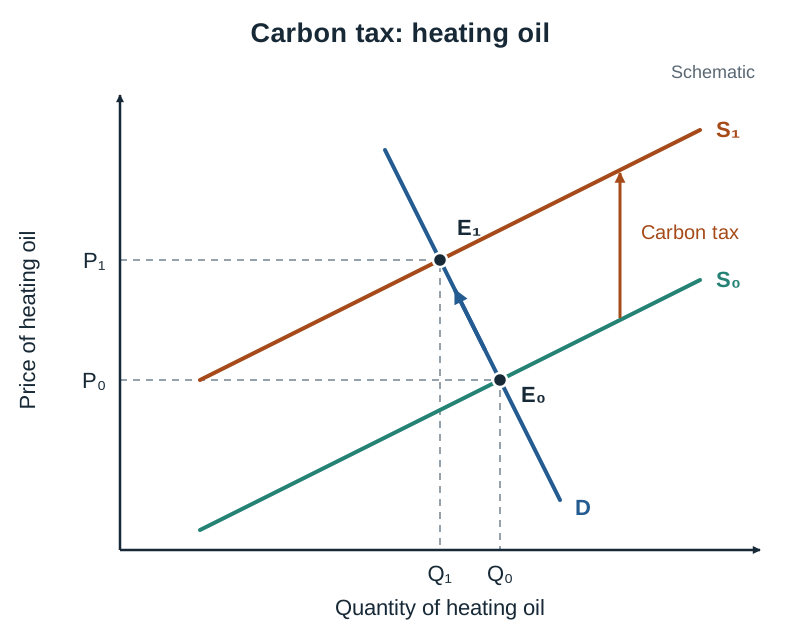
A carbon tax places a direct levy on fossil fuels proportional to the greenhouse gases released when they are burned. We can trace the market mechanism in words:
- Initial equilibrium: In a competitive market for heating oil, market demand slopes downward and supply slopes upward. The initial equilibrium price and quantity reflect private costs of production only.
- The shift: A carbon tax increases the cost of supply at every quantity. The market supply curve shifts upward (or leftward) by the exact amount of the tax per tonne of emissions.
- New equilibrium: The new intersection occurs at a higher market price and a lower equilibrium quantity. Higher prices discourage fossil fuel consumption and create an incentive for households and firms to switch to clean alternatives.
- The role of elasticity: In the short run, consumer demand for home heating and transport fuel is price inelastic because close substitutes are not immediately accessible. As a result, the tax generates substantial revenue and raises consumer prices, but quantity demanded falls only slightly. To overcome this limitation, governments must pair carbon taxes with capital grants and public transport infrastructure.
Interconnections, Trade-offs, and the Just Transition
Policies within one pillar create spillover effects across the other two. Economists classify these interactions as synergies or trade-offs.
Synergies across Pillars
- Economic to Social and Environmental: A strong tax base gives the state the fiscal space to fund retrofitting grants for low-income households and invest in clean public transport.
- Social to Economic: Equitable access to healthcare and education builds human capital, which boosts labour productivity and long-term output.
- Environmental to Economic: Investing in domestic renewable wind energy reduces national exposure to volatile global fossil-fuel prices.
Multi-Dimensional Trade-offs: The Housing Shortage
The Irish housing shortage illustrates how a single economic bottleneck impacts all three pillars simultaneously:
| Pillar | Impact of the Housing Shortage | Empirical / Policy Evidence |
|---|---|---|
| Economic | High housing costs generate upward wage pressure, harming enterprise competitiveness and making it harder for firms and essential public services to recruit staff. | Commercial recruitment surveys and public service retention shortages across urban centres. |
| Social | Severe affordability pressures push households into housing stress, delay household formation, and increase homelessness, directly eroding social cohesion. | Monthly Department of Housing homelessness reports and rising youth rental burdens. |
| Environmental | Urban housing shortages drive workers into car-dependent commuter belts (such as Meath, Kildare, and Westmeath), expanding urban sprawl and transport emissions. | Central Statistics Office (CSO) commuting data showing rising private car journeys into Dublin. |
Sustainability as an Opportunity-Cost Problem
Sustainability is fundamentally a resource allocation problem across time. Every public euro spent on climate mitigation carries an opportunity cost—the value of the next best alternative foregone. If the state spends €500 million on retrofitting local authority homes, the opportunity cost might be a new light-rail extension or 500 additional hospital beds. Economists evaluate these choices using cost-benefit analysis, assessing private and external costs against private and external benefits, accounting for time lags, and identifying who gains and who pays.
The Just Transition Framework
A Just Transition ensures that the social costs of environmental policies do not fall disproportionately on vulnerable workers, households, or regions. A concrete Irish example is the phase-out of commercial peat harvesting for electricity generation in the Midlands. Power plants in Lanesborough and Shannonbridge were closed, eliminating jobs for Bord na Móna and ESB staff. To protect social sustainability, the government established the Midlands Just Transition Fund, financing local enterprise hubs, worker retraining, and peatland restoration. By funding alternative local employment, the state achieved an environmental goal without abandoning the local community.
Carbon Leakage
A key limitation of unilateral national environmental regulation is carbon leakage. This happens when strict domestic carbon policies or taxes raise local production costs, causing energy-intensive businesses to relocate to countries with looser environmental standards. When this occurs, domestic output and jobs are lost, but global emissions remain unchanged or even rise. Carbon leakage highlights why production-based emissions measures can be misleading, and why the European Union has implemented policies like the Carbon Border Adjustment Mechanism (CBAM) to level the playing field.
Indicators: Measuring Sustainability and Decoupling
To measure progress, economists rely on specific quantitative indicators across four distinct families:
| Pillar | Indicator Family | Key Indicator | What It Measures |
|---|---|---|---|
| Economic | Economic Growth | Real GDP / Modified GNI (GNI*) | Volume of aggregate output adjusted for inflation. In Ireland, GNI* strips out multinational distortions like intellectual property relocation and aircraft leasing depreciation. |
| Macroeconomic Stability | Unemployment Rate / General Government Debt | The share of unused labour capacity, and the fiscal health of the public finances relative to national income. | |
| Social | Inequality | Gini Coefficient | Spread of income across the population from 0 (perfect equality) to 1 or 100 (complete inequality). |
| Relative Poverty | At-Risk-of-Poverty Rate (AROP) | Share of the population living with an equivalised disposable income below 60% of national median income. | |
| Deprivation | Deprivation Rate | Share of the population experiencing enforced lack of two or more essential items or activities. | |
| Social Cohesion | Employment Rate | Share of the working-age population (15–64) in work; employment is a primary pathway out of social exclusion. | |
| Homelessness Figures | Number of individuals accessing emergency accommodation, showing severe social exclusion. | ||
| Educational Attainment | Proportion of adults completing upper-secondary and third-level education, indicating equality of opportunity. | ||
| Life Expectancy / Healthy Life Years | Average length of life in good health, indicating whether economic prosperity delivers better wellbeing. | ||
| Trust in Institutions / Civic Participation | Public trust in the legal system, government, or voter turnout, showing societal solidarity. | ||
| Environmental | Emissions Volume | Total Greenhouse Gas Emissions (Mt CO₂ eq) | National emissions across energy, transport, heating, and agriculture measured in million tonnes of carbon dioxide equivalent. |
| Emissions Intensity | Emissions Intensity of Output | Ratio of emissions to real output ($$), measuring how cleanly an economy generates value. | |
| Energy Transition | Share of Renewable Energy | Proportion of gross final energy consumption sourced from wind, solar, and other renewables. |
It is essential to separate inequality from social cohesion. Inequality measures how financial income is distributed. Social cohesion measures whether citizens feel included in, trust, and participate in society. A country could theoretically experience a falling Gini coefficient while homelessness and social exclusion rise.
Absolute versus Relative Decoupling
When evaluating the relationship between economic growth and environmental damage, economists examine decoupling:
- Relative decoupling: Real output grows while greenhouse gas emissions increase at a slower rate. In this situation, emissions intensity falls, but total national emissions continue to rise.
- Absolute decoupling: Real output grows while total greenhouse gas emissions decline in absolute terms.
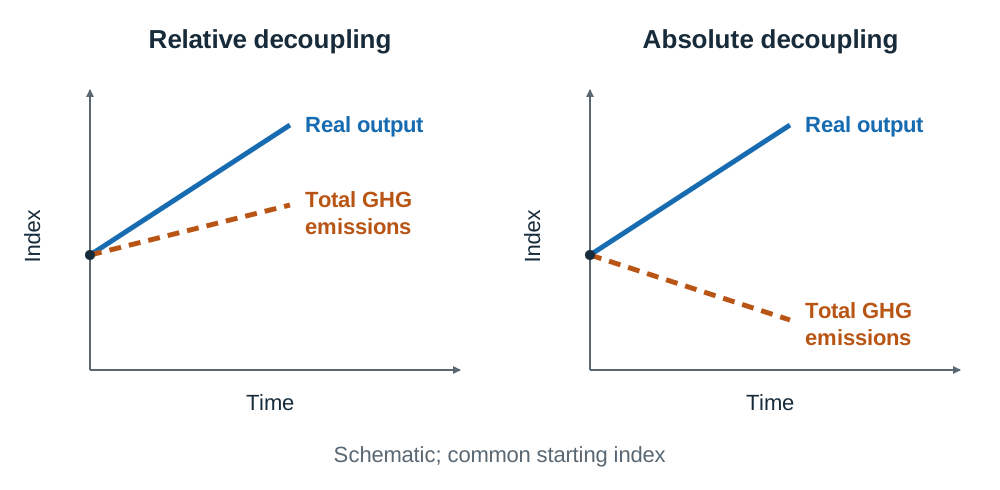
Only absolute decoupling actually reduces total annual emissions, which is what a binding target such as Ireland's 51% cut by 2030 requires. Relative decoupling means an economy is becoming more resource-efficient per unit of output, but total environmental pressure continues to climb.
Quick calculation check: If an economy produces 60 Mt CO₂ eq of emissions with a real output of €400 billion (€400,000 million):
Reliable Sources for Data
When compiling research or answering data-response questions, use authoritative data sources: the Central Statistics Office (CSO) for income, poverty, and GNI*; the Environmental Protection Agency (EPA) for greenhouse gas inventories and projections; the Sustainable Energy Authority of Ireland (SEAI) for energy data; Eurostat for EU-wide comparisons; and the Economic and Social Research Institute (ESRI) for economic modelling. Always note the source and reference year when citing figures.
Implications for Economic Agents
Sustainable development alters incentives and choices across all levels of economic decision-making.
1. Individuals: Habits, Values, and Budgets
Sustainable development affects consumer habits and values:
- Habits: Everyday routines shift towards waste segregation, energy conservation, cycling, taking public transport, and reducing meat consumption.
- Values: Citizens increasingly prioritize ethical and green credentials, showing a willingness to pay price premiums for certified sustainable products (such as Fairtrade or Bord Bia Origin Green goods) and demanding that pension funds divest from fossil fuels.
- Budget constraints: Making sustainable choices often requires high upfront capital (such as buying an electric vehicle or installing a heat pump). Lower-income households face credit constraints, leaving them vulnerable to higher carbon costs.
This highlights the link between positive and normative economics: "A €100 per tonne carbon tax will reduce domestic heating oil demand" is a positive statement that can be tested with empirical data. "The state ought to prioritise climate action over short-term consumption growth" is a normative statement based on value judgements.
2. Businesses: Regulations, Standards, and Stranded Assets
Businesses face shifting market demand and tighter regulations:
- Compliance costs: Carbon taxes and corporate sustainability reporting directives turn external costs into balance-sheet operating expenses.
- Market opportunities and verification: Irish food exporters participate in Bord Bia's Origin Green sustainability programme, undergoing independent audits of emissions, water conservation, and biodiversity to maintain shelf access in major European retail chains.
- Corporate Social Responsibility (CSR): Companies invest in CSR to maintain brand value and attract capital from ESG-focused investment funds.
- Stranded assets: Assets that lose value prematurely due to climate regulation or technological disruption (such as fossil-fuel exploration licences or inefficient commercial properties).
3. Government: Policy Instruments
The state balances long-term sustainability with social equity using four primary tools:
- Price mechanisms: Imposing carbon taxes to align private costs with social costs.
- Targeted capital subsidies: Offering SEAI retrofit and solar grants to help households bridge upfront capital hurdles.
- Infrastructural investment: Funding public transport networks, electric-vehicle charging points, and grid upgrades for offshore wind.
- Revenue recycling: Directing carbon tax revenues into the Fuel Allowance and social housing deep retrofits to prevent the tax from deepening fuel poverty.
Key terms
- Sustainability
- Meeting the economic, social, and environmental needs of the present without compromising the ability of future generations to meet their own needs.
- Economic Sustainability
- The capacity of an economy to maintain stable growth in real output and employment over the long term, supported by sound public finances, a diversified productive base, and continuing investment, avoiding boom-and-bust cycles.
- Social Sustainability
- The capacity of a society to maintain social cohesion, fair distribution of income, inclusion, and equal access to basic public services such as education, healthcare, and housing.
- Environmental Sustainability
- Using the environment at a rate it can withstand, preserving natural capital, biodiversity, and ecosystem services by keeping resource extraction, waste, and emissions within planetary limits.
- Intergenerational Equity
- The ethical principle that current economic activity must not deplete the natural, physical, or human resources needed by future generations to meet their needs.
- Natural Capital
- The stock of natural ecosystems, biodiversity, land, air, and water that provides valuable goods and services to society and the economy.
- Economic Growth
- A quantitative increase in the real output of an economy over time, measured by the percentage change in real GDP or real modified GNI (GNI*).
- Economic Development
- A sustained increase in living standards, combining real economic growth with qualitative improvements in health, education, poverty reduction, and environmental protection.
- Relative Decoupling
- A situation where real output grows while greenhouse gas emissions increase at a slower rate, causing emissions intensity to fall while total emissions continue to rise.
- Absolute Decoupling
- A situation where real output grows while total greenhouse gas emissions decline in absolute volume.
- Negative Externality
- A cost imposed on third parties as an unintended byproduct of an economic transaction, which is not reflected in the market price of the good or service.
- Polluter-Pays Principle
- The principle that the individual, firm, or organisation responsible for causing environmental damage should bear the economic costs of managing or remedying it.
- Carbon Tax
- An environmental tax levied on fossil fuels based on the volume of carbon dioxide equivalent emitted when burned, designed to internalise negative externalities.
- Just Transition
- A policy framework that protects workers, vulnerable households, and communities disproportionately affected by the economic shift away from carbon-intensive activities.
- Circular Economy
- An economic model that replaces the linear 'take-make-dispose' system by designing products to be reused, repaired, and recycled, keeping materials in use.
- Social Cohesion
- The strength of relationships, shared values, and mutual trust among members of a community or society, reflecting their willingness to cooperate for the common good.
- At-Risk-of-Poverty Rate
- The proportion of the population living with an equivalised disposable income below 60% of the national median income.
- Gini Coefficient
- A statistical measure of income inequality ranging from 0 (complete equality) to 1 or 100 (complete inequality, where one individual captures all income).
- Modified GNI (GNI*)
- An Irish macroeconomic indicator that removes the distorting effects of multinational firms, such as intellectual property transfers and aircraft leasing, from Gross National Income.
- Carbon Leakage
- The relocation of carbon-intensive production from a country with strict environmental regulations to one with laxer standards, leaving global emissions unchanged or higher.
- Revenue Recycling
- The practice of ring-fencing revenues collected from environmental taxes to fund compensatory social welfare transfers or green capital grants.
Check yourself
What is the UN Brundtland definition of sustainable development?
Development that meets the needs of the present without compromising the ability of future generations to meet their own needs.
Section A Drill: Explain the term 'decoupling'.
Decoupling breaks the link between economic growth and environmental damage. Under relative decoupling, emissions rise more slowly than output; under absolute decoupling, total emissions fall while output rises.
Section A Drill: State two indicators of environmental sustainability.
Total greenhouse gas emissions (in Mt CO₂ eq) and the share of renewable energy in gross final energy consumption.
Section A Drill: Outline one reason why an uncompensated carbon tax is regressive.
Lower-income households spend a larger proportion of their income on basic heating and transport fuels, meaning the tax absorbs a higher share of their disposable income than that of higher earners.
An economy records real GDP growth of +4% and greenhouse gas emissions growth of +1%. Has decoupling occurred? Explain your answer.
Yes, relative decoupling has occurred. Real output grew faster than emissions, so emissions intensity fell. However, because emissions still grew, it is not absolute decoupling, meaning environmental pressure increased.
Identify two distinct indicators of social cohesion (as opposed to income inequality).
The national employment rate (share of 15–64-year-olds in work) and official homelessness figures from monthly Department of Housing reports.
How did the phase-out of peat harvesting in the Irish Midlands illustrate a Just Transition?
Ending peat-fuelled electricity closed power plants in Lanesborough and Shannonbridge, eliminating Bord na Móna jobs. The Midlands Just Transition Fund financed local enterprise, retraining, and bog rehabilitation to protect the local community while achieving an environmental goal.