

In a mixed economy like Ireland, the price mechanism allocates many scarce resources, but market forces left alone do not always produce efficient or fair outcomes. Government intervention takes place when unregulated markets fail, resulting in pollution, underprovision of essential public services, monopoly abuses, or extreme income inequality. This topic covers why and how the state intervenes across five core economic roles, the fiscal tools used to alter market prices and quantities (indirect taxes, subsidies, price ceilings, price floors, quotas, and direct state provision), and the effectiveness and limits of sectoral regulation in Ireland.
The Role of Government and Economic Systems
How This Topic Is Examined
In Leaving Certificate Economics, the written examination accounts for 80% of your total marks (Section A short questions make up 20%, and Section B extended response questions make up 60%), with the research study providing the remaining 20%. For topic 2.4, Section A regularly tests precise definitions of terms like demerit goods, price ceilings, or progressive taxes. Section B typically asks you to draw a fully labelled diagram, carry out an elasticity or revenue calculation, and evaluate the trade-offs of an intervention using named Irish evidence.
Three Ways of Organising an Economy
Every society must decide what to produce, how to produce it, and for whom to produce it. Economists classify economic systems by how they answer these questions:
- Free-market (laissez-faire) economy: Resources are allocated entirely by the price mechanism through private buyers and sellers. The state limits itself to basic functions like national defence and the legal system. Adam Smith described how an 'invisible hand' leads individuals pursuing their own self-interest to unintentionally promote the welfare of society.
- Centrally planned economy: The state owns the factors of production and government planners decide what to produce, how to produce it, and what prices to set.
- Mixed economy: Most goods and services are produced by private firms responding to market prices, but the state intervenes to provide public and merit goods, redistribute income, regulate business conduct, and manage aggregate demand. Ireland is a prime example of a mixed economy, combining a large private and multinational sector with substantial state spending on healthcare, education, and social protection.
The Five Economic Roles of Government in Ireland
Modern mixed economies rely on the state to step in where the free market fails to deliver an efficient or equitable outcome:
- Providing pure public goods: A public good has two defining technical characteristics: it is non-rival (one person using it does not reduce the amount left for anyone else) and non-excludable (once provided, you cannot stop non-payers from using it). Because private firms cannot charge consumers at the point of use, people consume without paying. This free-rider problem means private firms would produce zero units. The state funds these goods out of general taxation. Examples include street lighting, flood relief schemes, lighthouses, and national defence.
- Correcting externalities (merit and demerit goods): A negative externality occurs when production or consumption imposes spillover costs on third parties that are not reflected in the market price (so marginal social cost exceeds marginal private cost). A demerit good, such as cigarettes or alcohol, is overconsumed in a free market because consumers underestimate the private harm to their health and ignore the spillover costs imposed on society. Conversely, a positive externality occurs when a third party enjoys an unpriced benefit. A merit good, such as primary education or preventative health screening, generates large positive spillover benefits (marginal social benefit exceeds marginal private benefit), but consumers undervalue these long-term gains, so the market underprovides them.
- Redistributing income and wealth: Left to itself, the market rewards people according to what they own, what skills they have, and how much bargaining power they hold. This produces very unequal incomes, and some people—children, the sick, the retired, and the unemployed—earn nothing at all from the market. The state steps in with a progressive tax system and direct welfare payments, such as Jobseeker's Allowance and Child Benefit, to reduce inequality and provide a safety net.
- Regulating markets and natural monopolies: The state sets up independent regulatory bodies to stop firms from abusing market power, cartelising prices, or exploiting consumers. For example, the Commission for Regulation of Utilities regulates energy network charges, while the Competition and Consumer Protection Commission oversees corporate mergers.
- Macroeconomic stabilisation: Market economies go through swings in employment and inflation. The Irish Government uses domestic fiscal policy (adjusting taxation and government spending) to support demand during downturns. A clear Irish example was the introduction of the Temporary Wage Subsidy Scheme and Pandemic Unemployment Payment in 2020 during the sudden collapse in economic activity. In contrast, monetary policy (setting base interest rates) is decided for the entire euro area by the European Central Bank (ECB) and cannot be tailored exclusively to Ireland.
The Case Against Intervention: Government Failure
An evaluation must examine both sides. State intervention does not automatically improve matters. Government failure happens when state intervention leaves society worse off than the market outcome it was meant to fix. The main economic arguments against intervention include:
- Weakened incentives and the shadow economy: High marginal rates of income tax can reduce the incentive to work extra hours, seek promotion, or take entrepreneurial risks. High indirect taxes on fuel or tobacco can push trade into the black market, where transactions go untaxed and unregulated.
- Opportunity cost and crowding out: Every euro spent subsidising an industry or providing a state service is a euro unavailable for healthcare, schools, or housing. Furthermore, heavy state borrowing can push up interest rates and compete for resources, crowding out private investment.
- Imperfect information and unintended consequences: The state rarely knows the exact socially optimal price or quantity. An intervention designed to help can easily misfire; for example, rent caps intended to protect tenants can cause landlords to sell up, shrinking the overall supply of rental housing.
- Administrative and compliance costs: Running state schemes, collecting taxes, and policing regulations consumes substantial administrative resources, which Adam Smith cautioned against in his Canon of Economy.
As a guiding rule for exam evaluations: state intervention is only economically justified where the cost of the market failure clearly exceeds the cost of the intervention itself.
Taxation and Subsidies: Fiscal Interventions
Classifying Taxes
Taxation is the primary fiscal tool used by the state to raise revenue and reshape private incentives. Examiners expect you to distinguish taxes by who pays them, how they scale with income, and how they are calculated:
- Direct tax versus Indirect tax: A direct tax is levied directly on the income or wealth of an individual or firm and paid straight to the Revenue Commissioners (for example, PAYE Income Tax, Universal Social Charge, Corporation Tax, and Capital Gains Tax). An indirect tax is levied on expenditure on goods and services, collected by the seller at the point of sale and passed on to Revenue (for example, VAT, excise duty, and carbon tax).
- Progressive, Regressive, and Proportional taxes: In a progressive tax, as an individual's income rises, the proportion of income paid in tax increases. Ireland's Income Tax system is progressive because it applies a standard rate band, a higher rate band, and tax credits. In a regressive tax, the tax takes a higher percentage of income from low earners than from high earners. Flat-rate excise duties are regressive: paying €2.00 duty on a packet of cigarettes takes a much bigger percentage of a low earner's weekly wage than of a high earner's. In a proportional tax, everyone pays the exact same percentage of their income, regardless of earnings.
- Specific tax versus Ad valorem tax: A specific tax is a fixed cash sum charged per unit of output (such as an excise duty of 50c per litre of fuel). It shifts the supply curve vertically upwards by the same cash amount at every quantity, keeping the new supply curve parallel to the original. An ad valorem tax is calculated as a fixed percentage of the selling price (such as standard VAT at 23%). Because the absolute tax per unit gets larger as the base price rises, the vertical gap between the supply curves widens, causing the supply curve to pivot upwards and to the left rather than shift in parallel.
Diagram Mechanics for an Indirect Tax
When illustrating an indirect tax on a diagram, follow these four steps:
- Draw and label the axes: Put Price (€) on the vertical axis and Quantity on the horizontal axis.
- Set up the initial equilibrium: Draw a downward-sloping Demand curve () and an upward-sloping Supply curve (), intersecting at price and quantity .
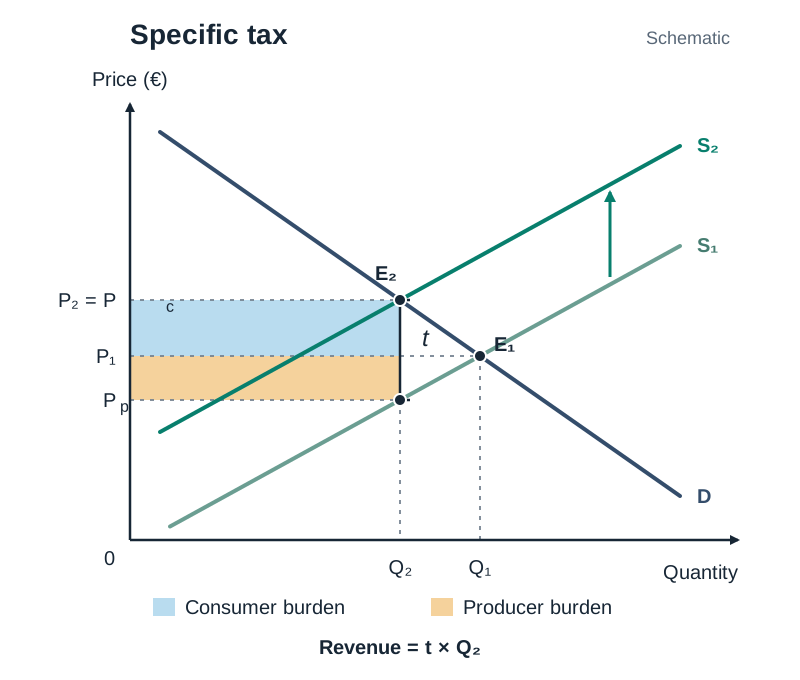
- Shift the correct curve: A specific tax of raises the firm's marginal cost of producing each unit. This shifts the supply curve vertically upwards from to by the exact amount of the tax per unit (). Demand does not shift because consumer preferences have not changed; consumers simply react to the higher price by moving along their existing demand curve.
- Identify the new equilibrium: intersects at a higher consumer price () and a lower quantity traded . The producer keeps the net price . The vertical gap between and is the tax per unit, and the total revenue collected by the Exchequer is the tax per unit multiplied by the new quantity traded: .
Tax Incidence and Relative Elasticity
The consumer price does not automatically rise by the full amount of the tax. Tax incidence describes how the burden of the tax is split between buyer and seller, and this division depends entirely on relative price elasticity:
- The elasticity rule: The side of the market that is less responsive to price changes carries the larger share of the tax.
- Inelastic demand (e.g. cigarettes): Because consumers are addicted, their quantity demanded falls very little when price rises. Suppliers can pass on almost the entire tax in higher shelf prices. Consumers carry most of the tax burden, which is why tobacco duties raise heavy tax revenue but reduce smoking volume only gradually.
- Elastic demand (e.g. restaurant meals): If the tax is raised on an elastic service, consumers will quickly cut back their spending or switch to substitutes. To prevent a catastrophic drop in sales, firms must absorb most of the tax by cutting their own margins. Producers bear the larger share of the tax burden.
A Pigovian tax is an indirect tax deliberately placed on a good that generates negative externalities, setting the tax equal to the marginal external cost so that consumers and firms face the true social cost of their decisions.
Adam Smith's Canons of Taxation
When evaluating any Irish tax in an exam, use Adam Smith's four benchmarks:
- Equity: Taxes should reflect ability to pay. Higher earners should pay more tax relative to their income than lower earners (vertical equity).
- Certainty: The timing, manner, and exact amount of tax owed must be crystal clear to the taxpayer.
- Convenience: Taxes should be collected when and how it is easiest for the taxpayer to pay, such as PAYE deducted directly at source from weekly or monthly payroll.
- Economy: The cost of collecting and policing the tax must be small compared to the revenue it brings into the state.
Production Subsidies
A subsidy is a direct government payment to a producer, which lowers production costs per unit and encourages higher output:
- Diagram mechanism: The subsidy reduces marginal costs, shifting the supply curve vertically downwards (to the right) from to by the subsidy per unit (). At the new equilibrium, consumer price falls from to , and market quantity expands from to .
- Total Exchequer cost: Calculated as the per-unit subsidy multiplied by the new post-subsidy quantity: .
- Irish applications: Sustainable Energy Authority of Ireland (SEAI) grants for home insulation, heat pumps, and solar PV installations, alongside EU Common Agricultural Policy (CAP) support payments to Irish farmers.
Price Controls and Quantity Interventions
Price Controls versus Curve Shifts
A price control does not shift either the demand or supply curve. Instead, it introduces a legal ceiling or floor, causing consumers and producers to move along their existing curves.
Maximum Prices (Price Ceilings)
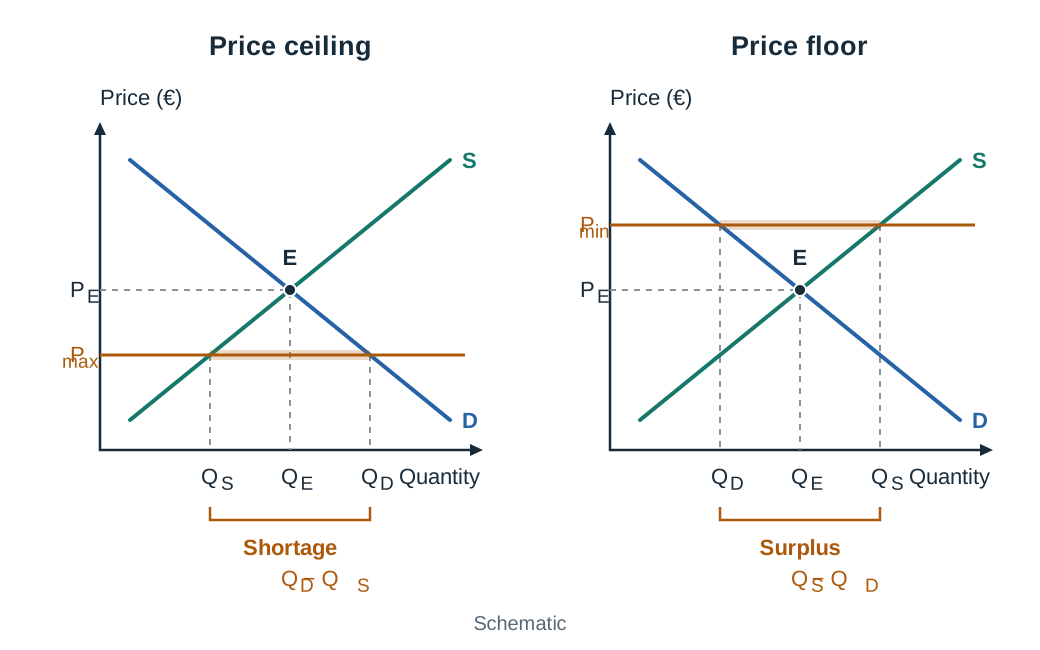
A price ceiling is a legal maximum price set below the free-market equilibrium price (). Setting a maximum price above equilibrium has no effect on the market because the equilibrium price is already legal.
- Market impact: At , the lower price encourages buyers, expanding the quantity demanded to . At the same time, the reduced price cuts profit margins, causing suppliers to contract quantity supplied to . Because , the market suffers persistent excess demand, known as a shortage ().
- Unintended side-effects: When prices can no longer ration goods, non-price rationing takes over (waiting lists, queues, or personal favoritism). Black markets often emerge, where desperate buyers pay unrecorded cash 'key money' above the legal cap. Property maintenance also declines, because suppliers cannot recover repair costs through higher rents.
- Irish context (Rent Pressure Zones): Introduced in 2016 to restrict annual rent increases in designated high-demand areas. The statutory cap limits annual rent increases to a specific percentage or the rate of general inflation, whichever is lower, and is enforced by the Residential Tenancies Board (RTB). While RPZs shelter existing tenants from steep rent hikes, economic evaluations show they have encouraged many small landlords to sell up and leave the market, reducing the supply of private rental housing. (Always date-stamp current legislative caps in your exam answer, as statutory limits are revised periodically).
Minimum Prices (Price Floors)
A price floor is a legal minimum price set above the free-market equilibrium price (). A floor set below equilibrium has no effect.
- Market impact: At , producers expand quantity supplied to to chase higher returns, while consumers cut back quantity demanded to . Because , the market creates persistent excess supply, known as a surplus ().
- Irish context (Minimum Unit Pricing on Alcohol): Introduced in 2022 under the Public Health (Alcohol) Act, Minimum Unit Pricing (MUP) sets a statutory price floor of 10c per gram of alcohol. Its target is cheap, high-strength supermarket alcohol, aiming to curb binge drinking and reduce alcohol-related hospital admissions. A crucial exam distinction: MUP is not an excise tax. Under an excise tax, the extra money goes straight to the Revenue Commissioners. Under MUP, any extra money paid by consumers stays with the retailers and drinks producers.
- The National Minimum Wage: A price floor in the labour market, setting an hourly legal minimum for low-skilled workers. Under current policy, it has been raised steadily each year to move towards a living wage benchmark of 60% of median hourly earnings. Its economic effects include:
- Higher living standards and stronger work incentives: disposable income rises for the lowest-paid workers, reducing in-work poverty and widening the gap between wages and welfare payments.
- Risk of unemployment: if the wage floor is set above the value of a worker's output, labour-intensive firms (such as cafes, retail shops, and creches) may cut staff hours or freeze hiring, creating excess supply of labour ().
- Cost-push inflation: firms may pass higher wage bills on to customers in higher retail prices.
- Loss of competitiveness: higher wage costs make domestic exporters dearer compared to international rivals.
Guaranteed Prices and Intervention Buying in Agriculture
In agricultural markets, governments historically set a guaranteed minimum intervention price above equilibrium to protect farm incomes. When price is fixed at , farmers produce while consumers buy only . To keep the price from collapsing, the state buys up the entire surplus (). In the past, this produced the notorious EU 'butter mountains' and 'wine lakes'. Taxpayers paid twice: once through higher food prices at the checkout, and again through taxes to fund the purchases and pay for cold storage. Because of this, modern EU farm policy has moved away from guaranteed market prices towards direct farm payments.
Quantity-Based Interventions and Deregulation
Governments also influence markets by controlling quantities directly:
- Quotas: A legal limit on the quantity of a good that may be produced, sold, or imported. On a supply and demand diagram, the supply curve becomes completely vertical at the quota limit. Quantity traded falls below the competitive equilibrium, and the market price rises. Examples include EU fishing quotas for Irish trawlers, and EU milk quotas (which restricted Irish dairy output until they were abolished in 2015, after which Irish milk production expanded rapidly).
- Licensing: The state restricts who can enter an industry by issuing licences only to operators who satisfy strict legal conditions (such as pub licences, pharmacies, and waste management permits). While licensing guarantees service quality and public safety, it acts as a barrier to entry that can keep consumer prices artificially high.
- Deregulation: The removal of state regulations or entry barriers to make a market more competitive. A famous Irish example is the deregulation of the taxi market in November 2000. Prior to deregulation, the number of taxi licences had been capped for decades, leading to severe shortages, long nighttime queues, and licence resale prices exceeding £80,000. Deregulation removed the limit on vehicle numbers. The taxi supply increased immediately, waiting times plummeted, and customer service improved—though existing drivers saw the market value of their purchased licences collapse. This case demonstrates that state intervention can sometimes protect producer cartels at the direct expense of consumers.
Quick Summary of Market Interventions
- Indirect tax: Supply shifts upwards/left Price rises, Quantity falls.
- Production subsidy: Supply shifts downwards/right Price falls, Quantity rises.
- Price ceiling (set below equilibrium): Creates excess demand Market shortage.
- Price floor (set above equilibrium): Creates excess supply Market surplus.
- Quota: Supply becomes vertical at the limit Quantity falls, Price rises.
Sectoral Regulation in the Irish Economy
Why Regulate? Natural Monopolies and Public Protection
Regulation is the process whereby independent state bodies set, monitor, and enforce statutory rules governing private firms. The strongest economic case for regulation occurs in a natural monopoly: an industry where economies of scale are so vast that a single firm supplying the entire market has lower average costs than two or more competing firms. Duplicating physical infrastructure—such as the national electricity grid, gas distribution pipelines, or municipal water networks—would be hugely inefficient. Because competition cannot function in these sectors, the state must either operate them directly or regulate them closely.
In natural monopolies, the regulator controls prices directly. The regulatory body sets the firm's allowed revenue to cover its operating costs plus a fair return on invested capital. This stops the monopolist from exploiting its market dominance, keeping prices lower and output higher than under an unregulated monopoly.
Key Regulatory Bodies in Ireland
| Regulator | Full Title | Core Economic Mandate |
|---|---|---|
| CCPC | Competition and Consumer Protection Commission | Enforces competition and consumer law, inspects corporate mergers to prevent market dominance, and prosecutes cartels and deceptive commercial practices. |
| Central Bank of Ireland | Central Bank of Ireland | Regulates commercial banks, credit unions, and insurance providers. Enforces macroprudential mortgage lending rules to prevent housing credit bubbles and polices conduct codes. |
| CRU | Commission for Regulation of Utilities | Regulates electricity, gas, and public water utilities. Sets allowed network revenues for EirGrid, ESB Networks, Gas Networks Ireland, and Uisce Éireann to ensure fair consumer pricing and security of supply. |
| ComReg | Commission for Communications Regulation | Regulates telecommunications, broadband networks, and postal services, promoting network investment and fair pricing. |
| EPA | Environmental Protection Agency | Issues environmental licences, monitors national air and water quality, and prosecutes polluters. |
| RTB | Residential Tenancies Board | Registers residential tenancies, mediates landlord-tenant disputes, and enforces Rent Pressure Zone caps. |
| WRC | Workplace Relations Commission | Enforces employment rights, investigates workplace disputes, and upholds compliance with the National Minimum Wage. |
Direct State Provision, Legislation, and Information Remedies
Beyond price controls and financial regulators, governments use three other tools to correct market failures:
- Direct state provision of goods and services: Where the private market fails to provide equitable access to essential services, the state operates as the producer and distributor. Examples include primary and secondary schooling, the Health Service Executive (HSE), and local authority housing. Direct provision guarantees access based on need rather than income, though it can create long waiting lists and high fiscal opportunity costs.
- Economic legislation and bans: Laws backed by criminal sanctions offer immediate compliance where price incentives are too slow. Examples include the workplace smoking ban, bans on the sale of smoky coal to protect urban air quality, and the 2024 Re-turn Deposit Return Scheme, which legally requires retailers to collect a refundable deposit on plastic bottles and cans to encourage recycling.
- Information remedies: To fix information gaps, the state makes product transparency mandatory. Examples include compulsory Building Energy Rating (BER) certificates on homes advertised for sale or rent, the mandatory EU nutrition declaration on packaged food (note: front-of-pack traffic-light labels remain voluntary), and compulsory plain packaging with graphic health warnings on tobacco products.
Evaluating Regulatory Effectiveness in Ireland
Strengths of Irish Regulation
- Financial stability: The Central Bank's macroprudential mortgage measures (limiting borrowing to 4 times gross income for first-time buyers and 3.5 times for second and subsequent buyers, with a 90% loan-to-value cap requiring a 10% cash deposit) have prevented runaway bank credit expansion and protected the banking sector from another domestic credit collapse.
- Consumer restitution: Following its tracker mortgage investigation, the Central Bank forced major retail lenders to return hundreds of millions of euro in compensation and refunds to wronged borrowers, alongside imposing enforcement fines exceeding €200 million across the banks involved.
- Preserving competition: The CCPC monitors commercial mergers, blocking acquisitions that would lead to excessive market concentration and higher consumer prices in grocery, fuel, and pharmacy retail.
Weaknesses and Regulatory Limitations
- Compliance costs: Administrative paperwork and reporting burdens fall heavily on small and medium enterprises (SMEs), functioning as a barrier to new entrants.
- Regulatory capture: A dangerous form of government failure where a regulatory agency becomes overly sympathetic to, or influenced by, the powerful corporate firms it is supposed to be supervising.
- Enforcement delays: Investigating complex cartels or digital market abuses can take years of costly legal proceedings, during which consumers continue to suffer harm.
- Unintended side-effects: While Central Bank mortgage caps safeguard banks, they also prevent some creditworthy buyers from securing mortgages, channeling demand into an already stretched rental market.
(Exam connection: Topics relating to government intervention and regulation—such as the carbon tax, housing rent caps, Minimum Unit Pricing, or market competition—are ideal areas of study for your 20% research study, as up-to-date data is easily accessed from the Central Statistics Office (CSO), Revenue, and regulators' published reports).
Key terms
- Market failure
- A situation where the free market, left to itself, fails to allocate resources efficiently or fairly, so the quantity produced is not the quantity that is best for society.
- Mixed economy
- An economic system combining private market enterprise and the price mechanism with state intervention to allocate resources, provide essential services, and redistribute income.
- Public good
- A good possessing non-rivalry (consumption by one person does not reduce availability for others) and non-excludability (non-payers cannot be prevented from consuming it).
- Free-rider problem
- A market failure where individuals consume a non-excludable good without paying for it, which prevents private firms from supplying it profitably.
- Negative externality
- A spillover cost imposed on a third party outside the market transaction without financial compensation, leading to market overproduction.
- Positive externality
- A spillover benefit enjoyed by a third party who does not pay for it, leading the free market to underproduce the good relative to the social optimum.
- Merit good
- A good whose long-term benefits are underestimated by consumers and which generates positive externalities, resulting in underconsumption if left to the free market.
- Demerit good
- A good whose harmful personal effects are underestimated by consumers and which creates negative externalities, leading to overconsumption in a free market.
- Direct tax
- A tax levied directly on the income or wealth of an individual or business and paid straight to the Revenue Commissioners.
- Indirect tax
- A tax levied on expenditure on goods and services, collected by the seller at the point of sale and remitted to the Revenue Commissioners.
- Progressive tax
- A tax where the proportion of income paid in tax increases as an individual's income rises, reflecting the ability-to-pay principle.
- Regressive tax
- A tax that takes a larger proportion of income from a low earner than from a high earner, such as flat per-unit excise duties.
- Specific tax
- A fixed cash amount of tax charged per unit of a good sold, shifting the supply curve upwards by an equal parallel amount at every price.
- Ad valorem tax
- A tax levied as a percentage of the selling price of a good or service (such as VAT), causing the supply curve to pivot upwards.
- Pigovian tax
- An indirect tax levied on a good generating negative externalities, designed to equal the marginal external cost and internalise the spillover harm.
- Tax incidence
- The manner in which the economic burden of an indirect tax is shared between buyers and sellers, governed by their relative price elasticity.
- Subsidy
- A direct financial grant paid by the government to a producer, lowering unit production costs and shifting the supply curve downwards to the right.
- Price ceiling
- A statutory maximum price set below the free-market equilibrium price, resulting in persistent excess demand or a shortage.
- Price floor
- A statutory minimum price set above the free-market equilibrium price, resulting in persistent excess supply or a surplus.
- Natural monopoly
- An industry where economies of scale are so extensive that a single firm can supply the entire market at a lower average cost than two or more competing firms.
- Government failure
- A situation where state intervention in a market leaves society worse off than the market failure outcome it was intended to resolve.
- Regulatory capture
- A form of government failure occurring when a regulatory agency ends up advancing the commercial interests of the sector it is supposed to be regulating.
- CCPC
- Competition and Consumer Protection Commission; the Irish statutory agency that enforces competition law, reviews corporate mergers, and defends consumer rights.
- CRU
- Commission for Regulation of Utilities; the Irish body that regulates electricity, gas, and public water network charges to ensure fair prices and supply security.
Check yourself
What two technical characteristics must a good have to be classified as a pure public good?
It must be non-rival (consumption by one person does not diminish availability for others) and non-excludable (it is impossible to stop non-payers from consuming it).
If demand is relatively price-inelastic while supply is price-elastic, who carries the greater share of an indirect tax?
Consumers carry the greater share, because their responsiveness to price changes is lower than that of producers.
A price floor of €1.20 per litre is introduced in a milk market where equilibrium is €1.00. What happens to quantity supplied and demanded, what is the resulting imbalance, and who pays if the state supports this price?
Quantity supplied expands while quantity demanded contracts, creating a market surplus (excess supply). The taxpayer pays for the purchase of the surplus output at the guaranteed price, along with any storage costs.
What is the key difference in who receives the additional money paid under Minimum Unit Pricing compared to an excise duty?
Under an excise duty, the tax revenue is paid directly to the Revenue Commissioners for the Exchequer; under Minimum Unit Pricing, the extra revenue is retained by retailers and producers.
What is the economic term for a situation where state intervention leaves society worse off than the market failure it was meant to resolve?
Government failure.
Which Irish regulatory body oversees corporate mergers to prevent anti-competitive market dominance?
The Competition and Consumer Protection Commission (CCPC).