

The financial sector acts as an intermediary, channelling surplus funds from net savers to net spenders to finance capital investment, housing, and day-to-day spending. This topic analyses four key areas: the money market (the demand for cash balances and the demand and supply of loanable credit funds), the credit creation process under fractional reserve banking, the determination and macroeconomic impact of interest rates across all sectors of the economy, and the roles and effectiveness of Irish and European financial institutions and regulators.
The Money Market: Cash Balances versus Credit Funds
To understand the financial system, we first need to distinguish between money, the money market, and the capital market.
Money is anything generally accepted in payment for goods and services or in settlement of debts. In practice, the money supply consists of cash in circulation plus balances held in current and short-term deposit accounts.
- Money Market: The market where short-term funds (generally repayable within one year) are lent and borrowed. This includes inter-bank lending, short-term overdrafts, and Treasury bills issued by the National Treasury Management Agency (NTMA). It sets short-term interest rates.
- Capital Market: The market where long-term finance (more than one year) is raised, including shares (equity) and long-term corporate and government bonds traded on exchanges such as Euronext Dublin.
The Demand for Cash (Liquidity Preference)
Cash balances earn little to no interest. Holding wealth as cash therefore carries an opportunity cost in forgone interest. John Maynard Keynes identified three motives explaining liquidity preference—why people and firms choose to hold liquid cash:
- Transactions Motive: Holding money to bridge the gap between receiving income and paying regular bills (such as groceries, transport, and utilities). Transactions demand rises when nominal national income, consumer spending, or the price level rises.
- Precautionary Motive: Holding liquid money as a reserve for unforeseen emergencies (such as sudden car repairs or medical bills). Precautionary demand rises during periods of economic uncertainty.
- Speculative Motive: Holding cash instead of purchasing financial assets (such as government bonds or shares) while waiting for asset prices to fall or interest yields to rise. Speculative demand has an inverse relationship with prevailing interest rates: when interest rates are high, the reward from holding bonds is high and the opportunity cost of holding cash is great, so speculative demand is low.
The spread of card, contactless, and phone payments has reduced the need to hold physical cash for everyday spending in Ireland, though people still hold large balances in current accounts they can spend from instantly.
The Demand for Credit Funds
Borrowers seek purchasing power today under an obligation to repay the principal with interest:
- Households demand consumer credit and residential mortgages for major purchases they cannot finance out of immediate income.
- Firms borrow to finance capital investment (machinery, premises, technology) and to cover day-to-day running costs when customers have not yet paid their bills but wages and suppliers must still be paid.
- The government borrows through the NTMA by issuing Treasury bills and sovereign bonds when public spending exceeds tax revenue.
Key determinants of credit demand include interest rates, consumer and business confidence, expected corporate profits, house prices, and state support schemes such as Help to Buy.
Supply of Funds and Credit Market Equilibrium
The Supply of Funds
The supply of loanable funds in the economy comes from several key sources:
- Household and corporate savings placed in commercial banks, credit unions, and pension funds.
- Commercial banks extending credit through the fractional reserve system.
- The European Central Bank (ECB), which provides euro liquidity to credit institutions.
- Foreign capital inflows, which are especially significant in Ireland, where international investors buy sovereign bonds and invest in domestic businesses.
- Institutional lenders such as the Strategic Banking Corporation of Ireland (SBCI), which channels lower-cost funding to small and medium enterprises (SMEs).
Market Equilibrium and Diagrammatic Analysis
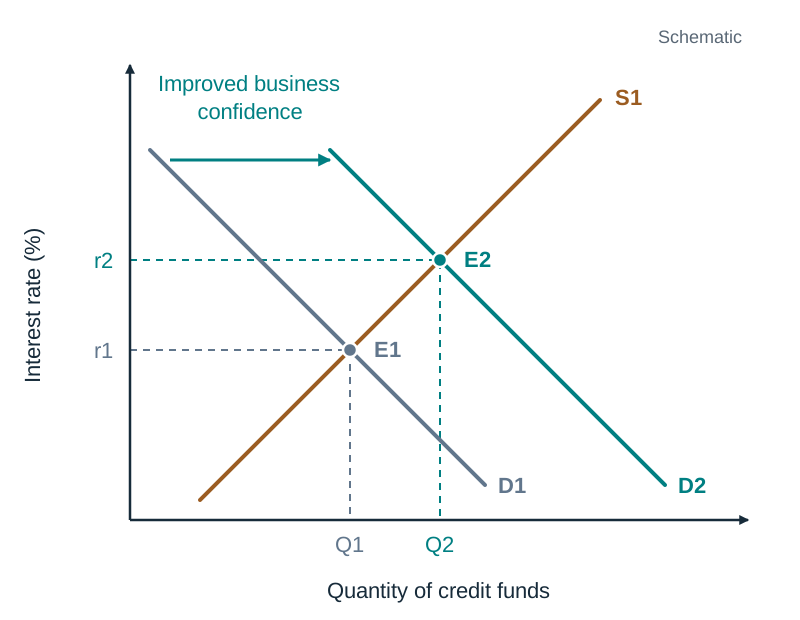
The market for loanable credit funds can be illustrated with a standard supply and demand diagram:
- The vertical axis measures the interest rate (%).
- The horizontal axis measures the quantity of credit funds.
- The demand curve (D) slopes downward from left to right: as the interest rate falls, the quantity of credit demanded rises, because loans are cheaper to repay. Note the wording carefully: a change in the interest rate causes a movement along the demand curve, while a change in confidence, income, or expected profits shifts the whole curve.
- The supply curve (S) slopes upward from left to right: higher interest rates offer savers a greater return and widen lending margins, increasing the quantity of funds supplied.
- The intersection of D and S determines the equilibrium interest rate and the equilibrium quantity of funds.
If asked to illustrate, draw interest rate (%) on the vertical axis and quantity of credit funds on the horizontal axis. Label the original curves D1 and S1 and mark the original equilibrium as r1 and Q1. If business confidence improves, draw D2 to the right of D1 and mark the new equilibrium r2 and Q2, stating clearly that both the interest rate and the quantity of funds have risen. Marks are given for labelled axes, labelled curves, and both equilibria marked.
Credit Creation and Fractional Reserve Banking
Commercial banks do not simply act as middlemen passing on saved cash. Instead, they actively create new deposit money whenever they issue a loan. When a bank approves a loan, it writes a new deposit into the borrower's account, and because bank deposits are accepted as payment, that new deposit is money.
The Three-Step Process of Fractional Reserve Banking
Fractional reserve banking works because banks know from experience that depositors never all withdraw their money at once. The process follows a simple chain:
- Step 1: A customer lodges 1,000 euro in cash into Bank A.
- Step 2: Bank A holds a fraction, say 10% (100 euro), in reserve to satisfy daily cash withdrawals, and lends out the remaining 900 euro (its excess reserves).
- Step 3: The borrower spends that 900 euro on goods or services. The seller receives the money and deposits it into Bank B. Bank B holds 10% (90 euro) and lends out 810 euro. The original 1,000 euro of cash gradually supports 10,000 euro of total deposits across the banking system.
| Round | New Deposit Received | Reserves Retained (10%) | Credit Extended (90%) |
|---|---|---|---|
| Round 1 | 1,000.00 euro | 100.00 euro | 900.00 euro |
| Round 2 | 900.00 euro | 90.00 euro | 810.00 euro |
| Round 3 | 810.00 euro | 81.00 euro | 729.00 euro |
| Later rounds | Each new deposit is smaller than the last | More reserves are set aside each round | Each new loan is smaller, until the process stops |
| System Total | 10,000.00 euro | 1,000.00 euro | 9,000.00 euro |
Credit Multiplier Formulae
- Credit multiplier = 1 / Reserve ratio
- Total deposits supported = Initial cash deposit * Credit multiplier
- Net new credit created = Total deposits supported - Initial cash deposit
(Note on exam questions: In practice, the ECB minimum reserve requirement is very low and banks are constrained primarily by capital and liquidity rules. In Leaving Certificate exam questions, the reserve ratio will always be stated in the prompt—use the exact figure supplied.)
Assumptions and Limitations
The maximum theoretical expansion is rarely reached in practice because of three real-world leakages:
- Cash Drain: Borrowers withdraw part of their loan as physical banknotes to spend outside the banking system, preventing those funds from being redeposited.
- Voluntary Excess Reserves: If banks perceive high default risks or need to meet strict regulatory capital targets, they hold back surplus cash rather than lending up to the statutory limit.
- Lack of Creditworthy Borrowers: Credit creation requires willing, creditworthy households and businesses. In a downturn, weak confidence reduces loan demand.
Consequences for the Economy
- ### Positive consequences
Credit creation finances business capital expansion, funds infrastructure, supports home ownership, and increases short-run aggregate demand and long-run productive capacity.
- ### Negative consequences
Excessive credit expansion fuels asset bubbles (such as the Irish property bubble from 2000 to 2007) and demand-pull inflation. If borrowers later default, accumulated bad debts threaten bank solvency and can require costly state intervention.
Interest Rates: Determination, Individual Loans, and Economic Impact
An interest rate is the price of borrowing money and the reward for saving it.
Macroeconomic Factors Determining Interest Rates
- ECB Key Policy Rates: In Frankfurt, the ECB sets three rates for the Eurozone: the Main Refinancing Operations (MRO) rate (cost of standard weekly bank borrowing), the Deposit Facility rate (interest banks earn on overnight funds placed with the ECB), and the Marginal Lending Facility rate (overnight emergency credit rate).
- Expected Inflation: Lenders demand higher rates to ensure their money retains purchasing power when repaid. The relationship is expressed as: Real interest rate = Nominal interest rate - Inflation rate.
- Competition in Banking: The exits of Ulster Bank and KBC Bank reduced competition in Ireland, allowing surviving lenders to keep borrowing rates higher and deposit rates lower than in more competitive European markets.
Factors Deciding the Rate Charged on an Individual Loan
Beyond ECB base rates, a commercial bank decides the rate it charges an individual borrower based on:
- Risk of default: The higher the chance of non-repayment, the higher the rate. Borrowers with poor credit histories on the Central Credit Register pay a risk premium.
- Security (collateral) offered: A mortgage is secured on property, which the bank can repossess if payments fail. Secured loans carry significantly lower rates than unsecured personal loans or credit cards.
- Length of the loan: Longer terms involve greater uncertainty over future interest rates and borrower stability, so longer-term loans generally carry higher rates.
- Size of the loan: Fixed administrative and underwriting costs mean very small loans carry a higher rate per euro borrowed.
- Supply and demand for credit: When loan demand is high relative to available savings, banks charge higher margins.
- Regulatory interest caps: Credit union loans are subject to statutory interest rate ceilings, and licensed moneylenders face legal caps on their APR.
Macroeconomic Impact and the Transmission Mechanism
When the ECB changes its policy rates, the effects filter through the entire economy:
ECB raises policy rates -> commercial banks face higher funding costs -> banks raise variable mortgage and business loan rates -> monthly debt repayments rise and disposable income falls, while borrowing for investment becomes dearer -> consumer spending (C) and investment (I) fall -> aggregate demand (AD = C + I + G + (X - M)) falls -> downward pressure on inflation, but economic growth slows and unemployment may rise.
Two further transmission effects are critical for exams:
- Government Debt-Servicing Costs: Ireland's national debt is managed by the NTMA. When rates rise, new Irish government bonds must offer higher yields to attract buyers. Maturing debt is rolled over at a higher cost, diverting tax revenue away from public services and capital projects.
- Import Prices and the Exchange Rate: Higher euro interest rates attract international investment, pushing up the value of the euro. A stronger euro makes imports cheaper in euro terms. Because Ireland imports most of its energy and much of its food, cheaper imports lower domestic production costs and reinforce the fall in inflation.
Key Qualifications: Time Lags and Uneven Impact
- Time Lags: It takes approximately 12 to 18 months for an ECB rate change to work fully through to spending, employment, and inflation. Policy makers are always reacting to past data, which means a rate rise can still be dampening the economy after inflation has already subsided.
- Uneven Impact: Borrowers on variable and tracker mortgages and small firms needing bank credit bear the heaviest burden when rates rise, whereas households with substantial savings gain through higher deposit interest.
Financial Institutions and Regulatory Supervision
Banks are regulated because a single bank failure can spread through the whole financial system: depositors lose confidence, withdraw their money in a run, and otherwise solvent banks can collapse. Regulation exists to protect depositors, keep banks solvent, and prevent taxpayers from having to fund costly bailouts, as happened in Ireland after 2008.
Key Financial Institutions in Ireland
- Central Bank of Ireland (CBI): Acts as the domestic prudential regulator and member of the Eurosystem. It monitors financial stability, enforces consumer protection codes, and sets macroprudential rules.
- European Central Bank (ECB): Manages Eurozone monetary policy and directly supervises major lenders (including AIB, Bank of Ireland, and PTSB) through the Single Supervisory Mechanism (SSM).
- Commercial Banks and Credit Unions: Commercial banks provide retail deposits and credit; member-owned credit unions provide community-focused, non-profit savings and personal loans.
- National Treasury Management Agency (NTMA): Borrows on behalf of the Irish State by issuing Treasury bills and government bonds, managing national debt and sovereign funds.
- Pension and Investment Funds: Ireland is one of the largest fund domiciles in the world. Pension funds collect household savings and invest them in long-term shares, property, and bonds, acting as a major supplier of capital.
- Consumer Protection Bodies: The Deposit Guarantee Scheme (DGS) protects eligible deposits up to 100,000 euro per person per institution, preventing bank runs. The Financial Services and Pensions Ombudsman (FSPO) resolves individual customer disputes.
Macroprudential Policy: Central Bank Mortgage Measures
In response to the 2008 crisis, the National Asset Management Agency (NAMA) was set up in 2009 to take over distressed commercial property loans from the banks at a discount. Ireland entered an EU/IMF financial assistance programme in November 2010, and the banking system had to be recapitalised at a cost of tens of billions of euro to taxpayers. To stop reckless lending from recurring, the Central Bank introduced macroprudential mortgage measures in 2015 (updated in 2023):
- Loan-to-Income (LTI) Ratio: Restricts mortgage borrowing to a maximum of 4 times gross annual income for first-time buyers, and 3.5 times gross income for second and subsequent buyers.
- Loan-to-Value (LTV) Ratio: Restricts the loan size relative to the property value. First-time buyers and subsequent buyers need a minimum 10% deposit (a 90% LTV limit), while buy-to-let investors need a 30% deposit (a 70% LTV limit).
- Flexibility via Allowances: These limits are not absolute bans. Banks are permitted to exceed the LTI and LTV limits for a small proportion of their total lending each year, accommodating borrowers with strong repayment capacity.
- Executive standards are also reinforced by the Individual Accountability Framework (IAF/SEAR).
Evaluation of Financial Regulation
- ### Strengths
Irish banks came through the COVID-19 pandemic and the recent inflation shock without needing to be recapitalised by the State, although broad government supports to households and firms, such as wage subsidies and credit guarantee schemes, helped keep loan losses low. LTV and LTI rules have stopped credit-fuelled housing price spirals and prevented households from taking on extreme debt.
- ### Weaknesses and Trade-Offs
Strict credit limits make it difficult for single earners and lower-income workers to buy homes, leaving them trapped in an expensive rental market. Critics also point out that credit rules manage only the demand side; they cannot solve the physical shortage of housing supply in Ireland. Furthermore, compliance costs are high, and historical scandals (such as the tracker mortgage scandal, where banks wrongly denied customers lower tracker rates) showed regulators were slow to intervene.
Key terms
- Money Market
- The financial market where short-term funds (generally repayable within one year) such as inter-bank loans and Treasury bills are borrowed and lent.
- Liquidity Preference
- The desire of households and firms to hold their wealth as liquid cash or demand deposits rather than in interest-bearing assets.
- Transactions Motive
- Holding money to pay for planned day-to-day purchases between income payment dates.
- Precautionary Motive
- Holding money as a financial cushion against unexpected emergencies and contingencies.
- Speculative Motive
- Holding cash instead of buying financial assets like bonds while waiting for asset prices to fall or interest yields to rise.
- Fractional Reserve Banking
- A banking system in which banks keep only a fraction of customer deposits as liquid cash reserves and lend out the remainder.
- Credit Creation
- The process by which commercial banks increase the money supply by granting loans, since each loan creates a new bank deposit that can be spent and re-lent.
- Reserve Ratio
- The percentage of total deposits that a commercial bank keeps in liquid reserves and central bank balances rather than lending out.
- Credit Multiplier
- The factor by which an initial cash deposit expands into total bank deposits, calculated as 1 divided by the reserve ratio.
- Real Interest Rate
- The nominal interest rate adjusted for inflation, measuring the actual change in purchasing power for savers and borrowers (Real rate = Nominal rate - Inflation rate).
- Main Refinancing Operations (MRO) Rate
- The benchmark interest rate the ECB charges commercial banks for regular weekly short-term loans of central bank reserves.
- Deposit Facility Rate
- The interest rate paid by the ECB to commercial banks on their overnight deposits, setting the effective floor for money-market interest rates.
- Marginal Lending Facility Rate
- The interest rate charged by the ECB to commercial banks for overnight emergency liquidity.
- Single Supervisory Mechanism (SSM)
- The European banking supervision system led by the ECB, directly supervising the largest credit institutions across the Eurozone.
- Macroprudential Policy
- Financial regulation designed to maintain the stability of the financial system as a whole and avoid systemic shocks, using tools like LTV and LTI limits.
- Loan-to-Income (LTI) Ratio
- A rule capping the maximum mortgage a borrower can receive as a multiple of their gross annual income.
- Loan-to-Value (LTV) Ratio
- The percentage of a property's purchase price funded by a mortgage, dictating the minimum cash deposit required from the buyer.
- Deposit Guarantee Scheme (DGS)
- A statutory safety scheme in Ireland protecting eligible bank, building society, and credit union deposits up to 100,000 euro per person per institution.
Check yourself
What are the three Keynesian motives for holding liquid cash balances?
The transactions motive (regular planned purchases), the precautionary motive (unexpected emergencies), and the speculative motive (waiting for asset prices to fall or interest yields to rise).
If an initial cash deposit of 15,000 euro enters a banking system with a 6% reserve ratio, what is the credit multiplier and the maximum total deposits supported?
Credit multiplier = 1 / 0.06 = 16.67 (correct to two decimal places). Maximum total deposits = 15,000 euro / 0.06 = 250,000 euro. (Tip: divide the deposit directly by the reserve ratio to avoid rounding errors).
Outline two factors, other than ECB base rates, that decide the interest rate a bank charges on an individual personal loan.
(1) Default risk: a borrower with a poor credit record pays a higher rate to compensate the bank for the risk of non-repayment. (2) Security: unsecured personal loans carry higher rates than mortgages because there is no underlying asset for the bank to repossess if repayments fail.
How do higher interest rates affect the cost of managing Ireland's national debt?
When interest rates rise, new Irish government bonds issued by the NTMA must offer higher yields, making it more expensive to refinance maturing debt and diverting tax revenue away from public services.
What are the Central Bank of Ireland's standard Loan-to-Income (LTI) limits for first-time buyers and subsequent buyers?
4 times gross annual income for first-time buyers, and 3.5 times gross annual income for second and subsequent buyers.
What is the compensation ceiling under the Irish Deposit Guarantee Scheme (DGS)?
Up to 100,000 euro per person per authorised credit institution.
Identify two reasons why the full theoretical credit multiplier is rarely achieved in practice.
Cash drain (borrowers withdrawing funds as currency rather than redepositing) and voluntary excess reserves (banks holding surplus cash due to default risks or regulatory rules).