

This topic explores how the price level changes across the macroeconomy and how central banks use monetary policy to achieve price stability. It covers the measurement of inflation and deflation using the Consumer Price Index (CPI) and Harmonised Index of Consumer Prices (HICP), the causes of price-level fluctuations, and their consequences for consumers, firms, and the government. It also examines the objectives and instruments of the European Central Bank (ECB) and the Central Bank of Ireland, the monetary transmission mechanism, and the distinct benefits and constraints facing Ireland as a member of the Eurozone.
1. Price-Level Dynamics: Inflation, Deflation, and Core Measures
Price stability is a primary objective of macroeconomic policy because unpredictable changes in the general price level disrupt long-term planning, wage agreements, and living standards. Economists distinguish between four price-level states:
- Inflation: A sustained increase in the general price level across the economy over a period of time. As general prices rise, the purchasing power of money falls; each euro buys fewer goods and services.
- Deflation: A sustained decrease in the general price level across the economy, meaning the inflation rate is negative. While cheaper goods might sound appealing, persistent deflation can cause severe stagnation. Consumers postpone spending expecting lower prices later, businesses see revenues fall and lay off staff, and the real burden of debt increases.
- Disinflation: A slowdown in the rate of inflation while it remains positive. Prices are still rising, but at a slower pace (for example, annual inflation dropping from 8% to 3%).
- Core inflation: A measure of price changes that strips out the most volatile items — typically energy and food (and sometimes alcohol and tobacco) — so that central banks can see the underlying, persistent price trend rather than short-lived swings in petrol or produce prices.
Why Low, Positive Inflation is Desirable
Central banks target low, positive inflation (around 2%) rather than zero inflation for four main reasons:
- Deflation buffer: It provides a safety margin so an ordinary economic downturn does not tip the economy into a falling-price spiral.
- Labour market adjustment: It allows firms to reduce real wages during slumps by freezing nominal pay, avoiding outright pay cuts or redundancies.
- Spending incentives: Mild price rises encourage households and businesses to spend and invest today rather than postpone purchases indefinitely.
- Debt erosion: It gradually erodes the real value of accumulated debt, easing the servicing burden on mortgage holders and the national debt.
The danger in macroeconomics is not mild inflation, but inflation that is high, volatile, or unanticipated.
2. Measuring Price Changes: CPI and HICP
In Ireland, the Central Statistics Office (CSO) measures price movements using the Consumer Price Index (CPI). The CPI tracks changes in the cost of a representative shopping basket of goods and services purchased by typical households.
Constructing the Consumer Price Index
The CSO constructs the CPI using a standard five-step sequence:
- Select a base year: A baseline reference year is chosen and assigned an index value of 100.
- Determine the basket and expenditure weights: The CSO conducts periodic Household Budget Surveys to record typical household spending. Each category receives an expenditure weight reflecting its share of total spending (housing and food carry far larger weights than recreation).
- Track prices: CSO price collectors record thousands of prices in shops, online, and from service providers around the country every month.
- Calculate price relatives: Current prices are divided by base-year prices and multiplied by 100 for each item.
- Aggregate using weights: Each category price index is multiplied by its expenditure weight (expressed as a decimal) and summed to generate the overall index.
The annual rate of inflation is the percentage change in the index between two periods:
CPI versus HICP
The crucial difference between the Irish CPI and the EU Harmonised Index of Consumer Prices (HICP) is how they treat owner-occupied housing. Ireland's CPI includes mortgage interest payments. Consequently, when the ECB raises interest rates, the Irish CPI is pushed up in the short run, because mortgage interest payments are included in the Irish basket but not in the HICP. The HICP excludes owner-occupied mortgage costs to allow consistent comparisons across all EU member states. The ECB anchors its 2% inflation target to the euro-area HICP.
Limitations of Price Indices
- Substitution bias: When certain goods become expensive, consumers switch to cheaper alternatives. A fixed basket assumes quantities stay the same, which overstates the true rise in the cost of living.
- Quality changes: If a phone costs 10% more but offers double the battery life and a better camera, part of the price increase reflects higher quality rather than pure inflation.
- New goods lag: New consumer goods and digital subscriptions take time to enter survey baskets.
- National average discrepancy: A national index reflects an average household. A rural family reliant on home heating oil and private motoring experiences a different inflation rate than an urban tenant using public transport.
3. Drivers and Causes of Inflation
Inflation is driven by distinct demand-side and supply-side pressures.
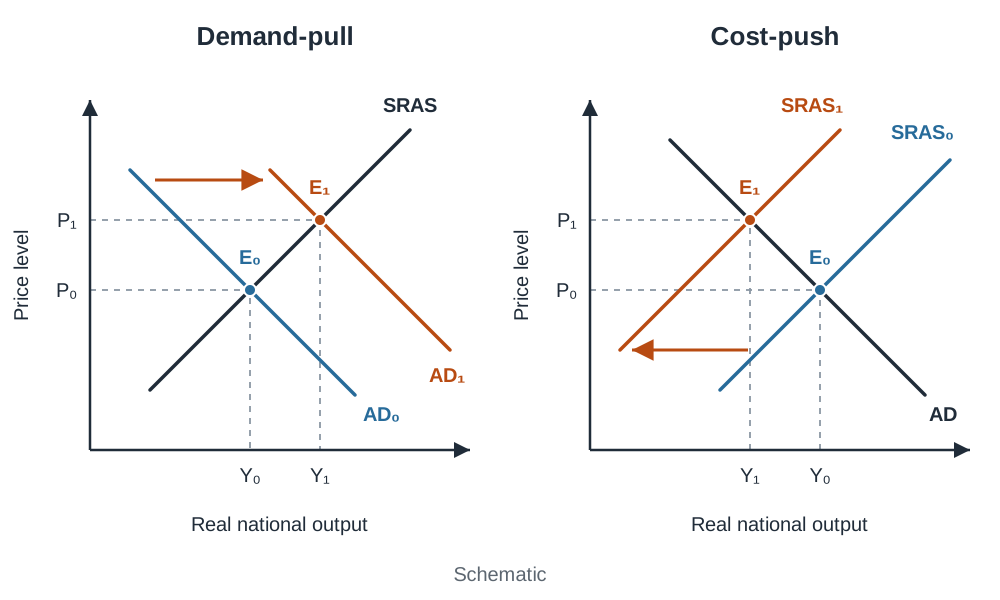
Demand-Pull Inflation
Demand-pull inflation occurs when aggregate demand grows faster than the economy's productive capacity ('too much money chasing too few goods'). Aggregate demand is the total spending on Irish goods and services in a year: , where is household consumption, is investment by firms, is government spending, is exports, and is imports. Drivers include rapid credit expansion, personal tax cuts, or surging export demand when the economy is near full capacity.
- Diagram in words: On an AD–AS diagram (Price Level on the vertical axis, Real National Output on the horizontal axis), the aggregate demand curve shifts rightwards from to along an upward-sloping short-run aggregate supply curve (). Equilibrium price level rises from to , and real output rises from to .
Cost-Push Inflation
Cost-push inflation occurs when production costs increase independently of aggregate demand. Causes include global energy price shocks, higher raw material prices, indirect tax increases (such as VAT or carbon taxes), and wage increases that exceed worker productivity. Productivity (output per worker per hour) is the buffer: if wages rise by 3% while productivity also rises by 3%, unit labour costs stay flat.
- Diagram in words: On an AD–AS diagram, the short-run aggregate supply curve shifts leftwards from to while aggregate demand stays unchanged. This raises the price level from to while reducing real output from to . Persistent inflation combined with falling output and rising unemployment is termed stagflation.
Built-in Expectations and Imported Inflation
- Wage–price spiral: When workers anticipate high inflation, they bargain for higher nominal pay to protect living standards. Employers fund higher payrolls by raising retail prices, confirming expectations in a continuous spiral.
- Imported inflation: Ireland is a small, highly open economy that imports oil, gas, machinery, and food. Increases in world commodity prices or a weaker euro against sterling or the US dollar directly push up Irish wholesale and retail prices.
Evaluating Causes: Spotting the Driver
To determine the type of inflation, examine whether the shock originated in spending or production costs:
- A VAT hike on hospitality, a jump in Brent crude oil prices, or a carbon tax increase are all cost-push.
- A broad income tax cut, relaxed mortgage lending rules, or an export surge during full employment are demand-pull.
Evaluative judgement: In Ireland during 2021–2023, the dominant cause was cost-push and imported inflation — driven by a global surge in gas and oil prices after the invasion of Ukraine and post-pandemic supply bottlenecks — rather than domestic demand overheating. Raising interest rates cannot increase the global supply of natural gas, meaning monetary policy could only cool demand and anchor expectations, which is why the Irish government had to step in with fiscal energy credits.
4. Consequences of Price-Level Changes
Evaluating the consequences of price changes requires looking at consumers, firms, and the wider economy.
Consumers
- Real incomes and living standards: When prices rise faster than nominal wages, real purchasing power drops: . Fixed-income recipients, such as pensioners and welfare dependents, suffer living-standard drops unless payments are index-linked.
- Redistribution between savers and borrowers: Unanticipated inflation penalises savers whose nominal bank returns lag behind inflation, eroding real wealth. Borrowers benefit because the real value of their fixed nominal debt diminishes.
Firms
- Planning uncertainty: Volatile input costs make it difficult to forecast revenues and cash flows, prompting firms to delay capital investment.
- Menu costs: Businesses incur direct operational costs constantly revising price lists, menus, catalogues, and billing software.
The Economy as a Whole and the Government
- International competitiveness: If Irish inflation outpaces trading partners like the UK and US, Irish exports become dearer abroad and imports become relatively cheaper here, so exports fall, imports rise and Ireland's balance of trade worsens.
- Public finances: Inflation creates fiscal drag, pushing workers into higher tax brackets and increasing VAT receipts. However, it also raises state spending on public pay, state pensions, and social transfers.
Stakeholder Comparison: Inflation versus Deflation
| Stakeholder | High Inflation Impact | Deflation Impact |
|---|---|---|
| Consumers | Real purchasing power falls unless pay keeps pace; fixed-income groups suffer living-standard drops. | Purchasing power rises in the short run, but risks of pay cuts and unemployment increase as activity contracts. |
| Savers & Borrowers | Savers lose real purchasing power; borrowers benefit as the real value of debt falls. | Savers gain in real terms; borrowers suffer from debt-deflation, as debt amounts stay fixed while nominal incomes fall. |
| Firms | Cost uncertainty delays capital investment; menu costs increase. | Margins shrink as selling prices fall while fixed debt remains; investment stalls. |
| Government | Higher VAT and income tax yields through fiscal drag; but higher public-sector pay, pension costs, and welfare outlays. | Tax receipts drop; the real burden of the national debt increases as nominal GDP shrinks. |
| Competitiveness | Export competitiveness falls if domestic inflation outpaces trading partners. | Relative competitiveness may improve, provided domestic productivity is maintained. |
5. Central Banking, Policy Tools, and the Transmission Mechanism
Monetary policy refers to actions taken by a central bank to manage the cost and availability of money and credit to achieve macroeconomic stability.
Functions of a Central Bank
A modern central bank performs several core functions:
- Setting and implementing monetary policy to ensure price stability.
- Issuing legal tender currency (banknotes and coins).
- Supervising and regulating banks, financial institutions, and protecting consumer interests.
- Safeguarding financial stability, including applying macroprudential rules like mortgage lending limits.
- Acting as lender of last resort to provide liquidity to solvent banks during emergencies.
- Acting as banker to the government and managing foreign exchange reserves.
- Collecting, analyzing, and publishing economic and financial data.
ECB Mandate and Policy Rates
The European Central Bank (ECB) manages monetary policy for the euro area. Under the EU Treaties, its primary objective is maintaining price stability, which the Governing Council defines as keeping HICP inflation at 2% over the medium term on a symmetric basis. Its secondary objective is to support the general economic policies of the EU (balanced growth, high employment, and green transition), provided price stability is not compromised.
The ECB sets three key interest rates:
- Deposit facility rate: The rate commercial banks receive for depositing overnight funds with the ECB. This rate acts as the main anchor for money market borrowing.
- Main Refinancing Operations (MRO) rate: The benchmark rate banks pay when borrowing one-week liquidity from the ECB against collateral.
- Marginal lending facility rate: The emergency overnight lending rate offered to commercial banks.
Contractionary versus Expansionary Monetary Policy
- Contractionary policy (tight money): Used when inflation exceeds the 2% target. The ECB raises interest rates to make borrowing dearer and saving more attractive. Aggregate demand shifts leftward, cooling demand-pull pressures and anchoring inflation expectations.
- Expansionary policy (loose money): Used when inflation is persistently below target or during recessions. The ECB cuts policy rates to lower borrowing costs for households and firms, stimulating consumption and investment. On an AD–AS diagram, aggregate demand shifts rightwards, raising output and moving inflation back towards 2%.
- Unconventional policy & the zero lower bound: When interest rates approach zero (the zero lower bound), central banks cannot cut much further. They turn to Quantitative Easing (QE) — buying large volumes of government and corporate bonds to inject cash and lower long-term yields. During the euro-area low-inflation period and the pandemic, the ECB used bond purchases (such as the PEPP) and negative deposit rates (−0.5%) to support the economy. In reverse, selling or retiring these bonds is Quantitative Tightening (QT).
The Monetary Transmission Mechanism
Changes in ECB policy rates transmit to the broader economy over a time lag of 12 to 24 months through several key channels:
- Interest rate channel: Commercial banks adjust variable mortgages, business loans, and savings rates. Higher rates discourage household spending () and business investment ().
- Exchange rate channel: Higher euro-area interest rates attract global investment, strengthening the euro. A stronger euro makes imports cheaper (reducing imported inflation) and makes exports dearer abroad ().
- Further channels: Stricter bank lending reduces loan volumes (credit channel); falling equity and property values reduce household paper wealth and spending (wealth effect); and clear rate announcements anchor public expectations against wage–price spirals (expectations channel).
6. Ireland in the Eurozone: Trade-Offs and Domestic Policy
Ireland adopted the euro in 1999, handing control of monetary policy to the ECB Governing Council. Ireland shares a single currency and interest rate with the other euro area member states (21 EU countries use the euro following Bulgaria's entry in January 2026).
Key Figures and Trends
Understanding Irish price and rate movements requires familiarity with recent historical orders of magnitude:
- Irish inflation: Near 0% in 2015–2016 (CPI fell slightly by −0.3% in 2015); surged during the post-pandemic energy crisis, peaking at roughly 8% to 9.5% in late 2022; fell back to roughly 5% across 2023, and moved towards 2% or below from 2024 onwards.
- ECB interest rates: The deposit facility rate sat at −0.5% and the MRO rate at 0% until mid-2022. The ECB then raised rates rapidly to combat inflation, pushing the deposit rate to a historic high of 4.0% by September 2023. As inflation cooled toward target, the ECB began cutting rates from mid-2024, lowering the deposit rate toward roughly 2% by 2025.
Benefits of Eurozone Membership
- Elimination of exchange rate risk: Currency risk and transaction fees are eliminated across euro-area trade, lowering costs for Irish exporters and encouraging foreign direct investment.
- Monetary credibility: Backing from the ECB has anchored low long-term borrowing costs and stable inflation expectations compared to pre-euro eras.
- Liquidity backstops: Irish commercial banks have full access to Eurosystem emergency liquidity during banking crises.
Policy Constraints and the Asymmetric Shock
- The 'one-size-fits-all' constraint: The ECB sets a single rate based on average economic conditions across the entire currency area. Between 2002 and 2007, the ECB held interest rates low to support a sluggish German economy while Ireland was booming. Real interest rates in Ireland were negative, fuelling rapid credit growth and a housing bubble that Ireland could not cool by raising interest rates.
- Inability to devalue: If an asymmetric shock hits Ireland harder than other member states, Ireland cannot devalue its currency to restore export competitiveness. It must rely on internal devaluation (downward adjustments in domestic wages and business costs).
Ireland's Domestic Policy Levers
Ireland is not powerless in managing domestic cycles:
- Representation: The Governor of the Central Bank of Ireland sits and votes on the ECB Governing Council.
- Counter-cyclical fiscal policy: The government can use taxation and spending to cool an overheating economy or stimulate a downturn.
- Macroprudential policy: The Central Bank of Ireland directly regulates domestic credit through mortgage lending rules. Since 2023, first-time buyers can borrow up to 4 times gross income with a 10% deposit (a 90% Loan-to-Value limit), while second and subsequent buyers face a Loan-to-Income limit of 3.5 times, containing credit booms without altering ECB interest rates.
Key terms
- Inflation
- A sustained increase in the general price level across an economy over a given period, leading to a fall in the purchasing power of money.
- Deflation
- A sustained decrease in the general price level across an economy, resulting in a negative inflation rate.
- Disinflation
- A reduction in the rate of inflation where the price level continues to rise, but at a slower percentage pace.
- Core inflation
- A measure of inflation that strips out volatile components, typically energy and food, to reveal the underlying, persistent price trend.
- Consumer Price Index (CPI)
- The official Irish measure of price changes across a weighted basket of consumer goods and services, which includes mortgage interest payments.
- Harmonised Index of Consumer Prices (HICP)
- The standardised European price index used by the ECB to guide monetary policy, which excludes owner-occupied mortgage costs.
- Demand-pull inflation
- Inflation resulting from aggregate demand growing faster than the aggregate productive capacity of the economy.
- Cost-push inflation
- Inflation caused by rising production costs (such as energy, wages, or imported raw materials) that shifts the short-run aggregate supply curve inwards.
- Stagflation
- A macroeconomic condition characterised by stagnant economic growth, high unemployment, and persistent inflation occurring simultaneously.
- Monetary policy
- Actions taken by a central bank using interest rates, liquidity operations, and credit rules to steer economic activity and achieve price stability.
- Price stability
- The primary objective of the ECB, defined as maintaining a year-on-year HICP inflation rate of 2% over the medium term.
- Monetary transmission mechanism
- The sequence of economic channels through which a change in central bank policy interest rates influences borrowing costs, demand, and the price level.
- Quantitative Easing (QE)
- An unconventional monetary policy tool where a central bank purchases long-term government and corporate bonds to inject money and lower market interest rates.
- Zero lower bound
- A constraint where nominal central bank interest rates reach zero or slightly below, limiting the scope for further conventional interest-rate cuts.
- Debt-deflation
- A cycle where falling prices raise the real burden of fixed debt, forcing households and firms to cut spending, which deepens an economic slump.
- Macroprudential policy
- Regulations enforced by a national central bank, such as Loan-to-Value and Loan-to-Income mortgage caps, designed to prevent excessive credit growth and protect financial stability.
- Asymmetric shock
- An economic event or disturbance that affects one specific country or region significantly more than other members of a currency union.
Check yourself
What is the difference between headline inflation and core inflation?
Headline inflation measures price movements across the full consumer basket, whereas core inflation excludes volatile energy and food prices to reveal the underlying, persistent price trend.
Why does an ECB interest rate hike cause the Irish CPI to rise in the short run?
The Irish CPI includes mortgage interest repayments, so higher ECB interest rates directly increase monthly mortgage costs for variable and tracker borrowers, lifting the national index.
A consumer basket cost €400 in the base year and €428 this year. What is this year's price index and the percentage increase in prices?
Price index = (428 / 400) * 100 = 107.0. Prices have increased by 7.0% since the base year.
If nominal wages rise by 3% in a year when CPI inflation is 5%, what is the percentage change in real wages?
-2% (calculated as 3% - 5% = -2%, meaning real purchasing power fell by 2%).
In 2022, Irish gas and electricity bills rose sharply due to wholesale gas prices. Which type of inflation is this, and how does it appear on an AD–AS diagram?
Cost-push inflation (and imported inflation). On an AD–AS diagram, the SRAS curve shifts leftwards, increasing the price level and reducing real output.
Name the ECB's three key policy interest rates and state the role of the deposit facility rate.
Deposit facility rate, Main Refinancing Operations (MRO) rate, and Marginal lending facility rate. The deposit facility rate is what banks earn on overnight deposits with the ECB, acting as the main anchor for short-term market interest rates.
Outline two channels through which an ECB rate cut stimulates Irish aggregate demand, and state the approximate time lag.
Interest rate channel (cheaper mortgages and business loans boost C and I) and exchange rate channel (a weaker euro makes exports more competitive, lifting X). The full effect takes roughly 12 to 24 months.
What is meant by the 'one-size-fits-all' monetary policy constraint in the Eurozone?
The ECB sets a single interest rate for all member states based on average euro-area conditions, which may be too low for a rapidly growing domestic economy or too restrictive for one in recession.