
Slice a cone with a flat plane and the edge of the cut is a curve: an ellipse, a parabola, or a hyperbola, depending purely on the angle of the cut. The same three curves can be drawn flat on the page without any cone, using a fixed point called the focus, a fixed line called the directrix, and a fixed ratio between the two distances called the eccentricity. Everything in this topic comes down to one of those two viewpoints: conics as sections of a cone, or conics as plane loci. At Higher Level, students must master core terminology, geometric locus generation, rectangle methods, focal properties of double hyperbolas, tangent constructions from a point on the curve and from a point outside the curve, and the determination of centres of curvature and evolutes.
The Locus Definition, Eccentricity, and Key Terminology
Every conic section can be defined as the plane locus of a point moving such that the ratio of its distance from a fixed point (the focus, ) to its perpendicular distance from a fixed line (the directrix, ) is constant. This ratio is called the eccentricity ():
The numerical value of establishes the family of the curve:
- Ellipse (): A closed oval curve with two foci and two directrices. The sum of the focal distances from any point on the curve is constant and equals the major axis length: .
- Parabola (): An open, single-branched curve where every point is equidistant from the focus and the directrix ().
- Hyperbola (): An open curve consisting of two separate diverging branches. The absolute difference between focal distances from any point is constant and equals the transverse axis length: .
Core Conic Elements
- Principal Axis: The line of symmetry passing through the focus perpendicular to the directrix.
- Vertex (): The point where the conic intersects its principal axis. On the axis, the vertex divides the distance between the directrix and focus in the ratio of the eccentricity, meaning .
- Chord & Focal Chord: A chord is any straight line segment connecting two points on the curve. If the chord passes through a focus, it is a focal chord.
- Ordinate & Double Ordinate: An ordinate is a line segment drawn from a point on the curve perpendicular to the principal axis. A double ordinate is the full chord perpendicular to the axis, connecting points on opposite sides of the curve.
- Latus Rectum: The specific double ordinate that passes directly through the focus perpendicular to the principal axis. The semi-latus rectum length is , where is the perpendicular distance from the focus to the directrix.
- Normal: The straight line perpendicular to the tangent at the point of contact.
Choosing the Right Construction Method
- Focus + directrix + eccentricity: line of eccentricity method.
- Focus + two points on the curve (no directrix given): swing arcs from the points with radius equal to their focal distances to locate the directrix by finding tangent envelopes ().
- Major and minor axes given: concentric auxiliary circles, trammel, or rectangle method.
- Major axis + one point given: auxiliary circle projection ratio to find the minor axis, then intersecting focal arcs or concentric circles.
- Foci + a point on the hyperbola: difference of focal distances gives the transverse axis , then draw using intersecting arcs struck with the compass.
- Span and rise (e.g. bridges, roof arches): rectangle (oblong) method.
Conics as True Sections of a Solid Cone (Projection and Focal Spheres)
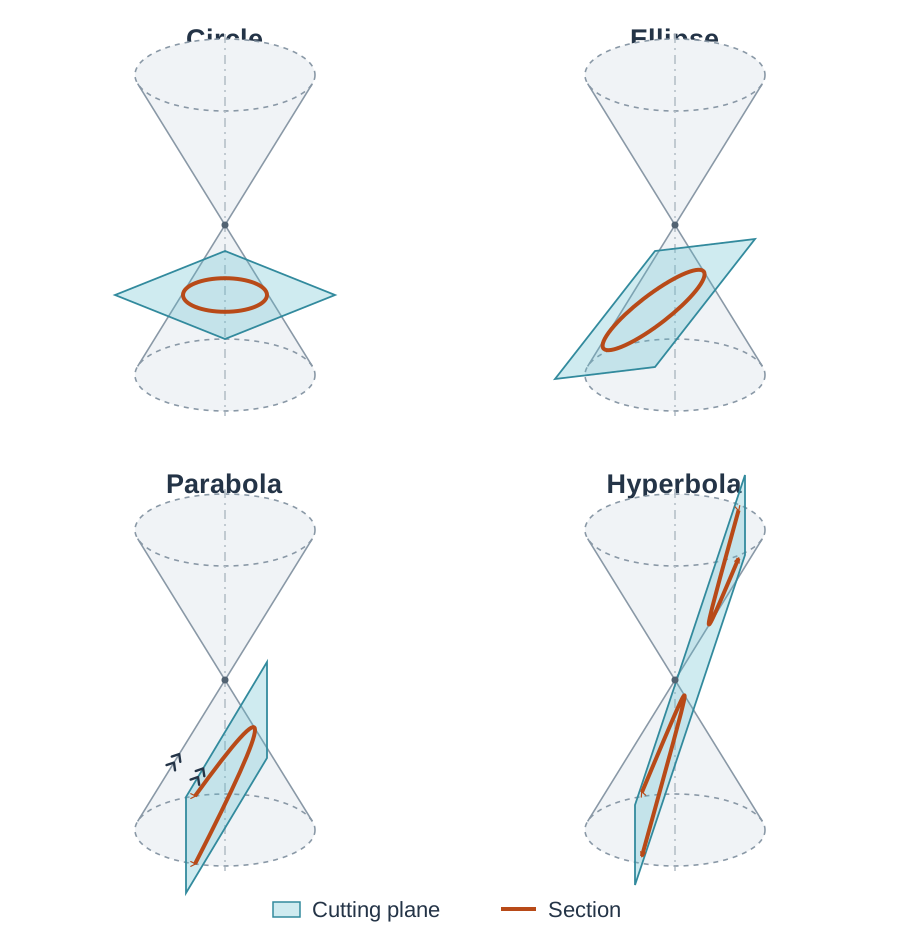
A right circular cone can be imagined as two conical sheets (nappes) meeting at a single apex point. When cut by a flat plane, the inclination of the plane relative to the cone generators determines the section:
- Circle: The cutting plane is parallel to the base (perpendicular to the cone axis).
- Ellipse: The cutting plane is inclined to the base at a smaller angle than the generators are, so it cuts right across the cone and crosses every generator without reaching the base.
- Parabola: The cutting plane is parallel to an extreme generator (inclined at the exact same angle to the base as the cone generators).
- Hyperbola: The cutting plane is steeper than the generators, cutting through the base. If extended across a double cone, it cuts both nappes to form two separate branches.
Drawing the True Shape of a Section of a Cone
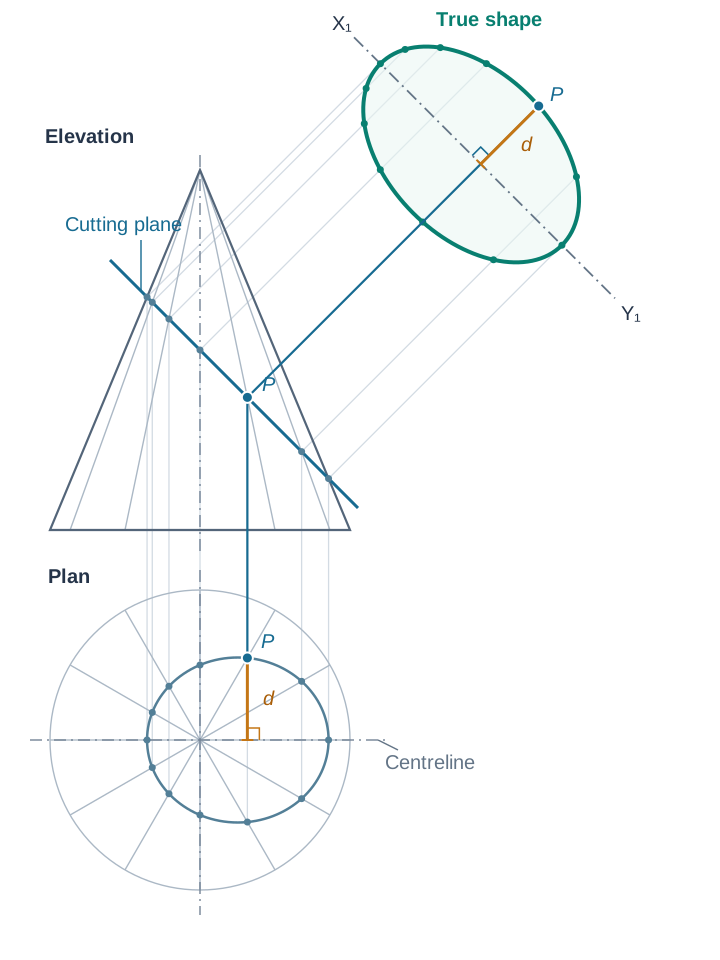
- Draw the plan and elevation of the cone. Divide the base circle in plan into 12 equal parts and draw the 12 generators in both plan and elevation (number them 1 to 12 to match).
- Draw the cutting plane in the elevation, where it appears as a single straight edge line.
- Mark every point where the cutting plane crosses a generator in elevation.
- Project each of these points straight down onto the corresponding numbered generator in plan. Joining these points gives the plan view of the cut.
- For the true shape, set up an auxiliary datum line parallel to the edge view of the cutting plane. Project each section point at across , and transfer the perpendicular distances of each point from the central axis in plan onto the new view.
- Draw a smooth curve through the plotted points to obtain the true ellipse, parabola, or hyperbola.
Alternative method for extra points: pass horizontal cutting planes at chosen heights in elevation. Each horizontal plane produces a true circle in plan. Project points from where the cutting line crosses each height in elevation down onto the corresponding circle in plan.
Deriving Foci, Directrices, and Eccentricity via Focal Spheres
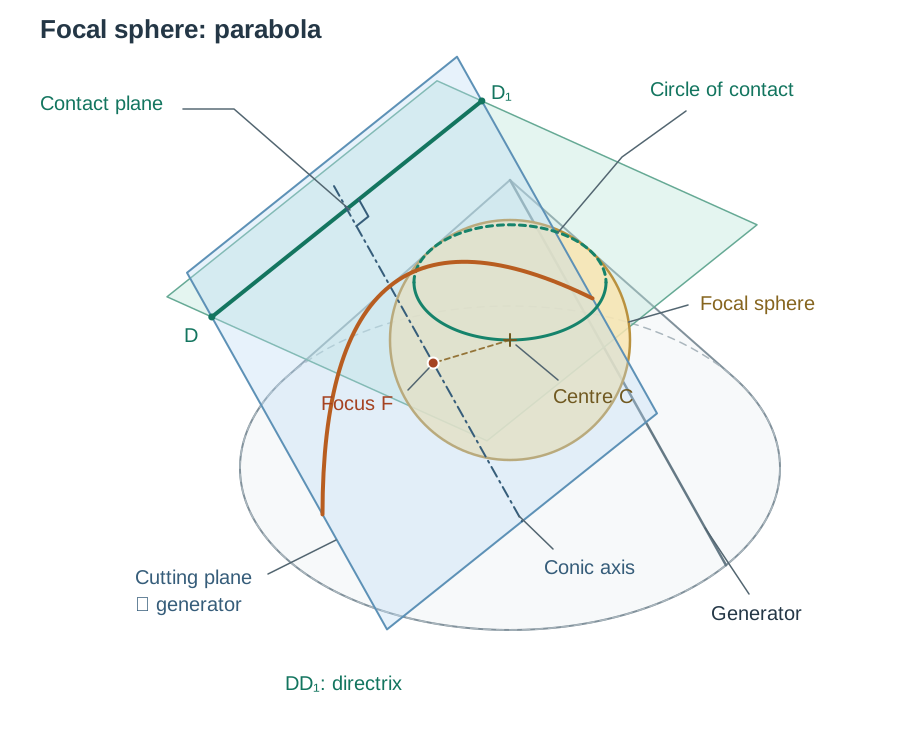
A focal sphere (Dandelin sphere) is an inscribed sphere that touches the internal surface of the cone along a horizontal circle of contact and rests tangentially against the cutting plane at a single point.
- In elevation, bisect the angle between the cutting-plane line and the outline generator. The intersection of this bisector with the cone axis gives the centre of the focal sphere.
- From this centre, draw a line perpendicular to the cutting plane. The point where this line meets the cutting plane is the exact focus ().
- The sphere touches the cone generators along a horizontal circle of contact. Extend this horizontal line in elevation until it intersects the cutting-plane line at point . In the true-shape view, the directrix passes through perpendicular to the conic axis.
- The eccentricity can be measured directly as , or calculated from the cutting-plane angle and generator angle to the horizontal base:
An ellipse section uses two focal spheres (one above, one below the plane), giving two foci and two directrices. A parabola uses one sphere. A hyperbola uses one sphere in each nappe.
Focus and Directrix in Elevation of a Hyperboloid of Revolution
The outline of a hyperboloid of revolution in elevation is a hyperbola whose transverse axis is horizontal, with vertices at the ends of the throat circle and centre at the throat level.
- Mark the centre and vertex at the end of the throat circle (, the throat radius).
- Construct the asymptote lines by drawing rays through at the true inclination of a generator to the axis of revolution.
- Draw a circle of radius about centre . Mark the point where an asymptote cuts this circle.
- At , construct a line perpendicular to the asymptote. Where this perpendicular cuts the horizontal transverse axis is the focus ().
- The directrix is the vertical line drawn through perpendicular to the transverse axis (parallel to the axis of revolution). The eccentricity is .
Planar Locus and Eccentricity Line Constructions
When the focus , directrix , and eccentricity are given, the curve is constructed using the line of eccentricity.
- Draw the directrix vertically and construct the principal axis perpendicular to it, meeting at point .
- From , measure any convenient distance along the axis, then erect a perpendicular whose height is times that distance. For example, if , measure along the axis and erect a perpendicular. The line drawn from through the top of this perpendicular is the line of eccentricity. It makes an angle less than for an ellipse, exactly for a parabola, and greater than for a hyperbola.
- From focus , draw a line at to the axis back toward the directrix until it meets the line of eccentricity at point . Drop a perpendicular from onto the axis to locate the principal vertex . For an ellipse, draw a second line at forward from to meet the line of eccentricity at , and drop a perpendicular to find the second vertex .
- Erect ordinates perpendicular to the axis at regular intervals through and beyond the vertex.
- For each ordinate, measure the vertical height from the axis up to the line of eccentricity with your compass. Place the compass needle on the focus and strike arcs to cut that same ordinate line above and below the axis.
- Plot at least six to eight points distributed on both sides of the axis, extending well beyond the latus rectum, and join them with a smooth, firm curve.
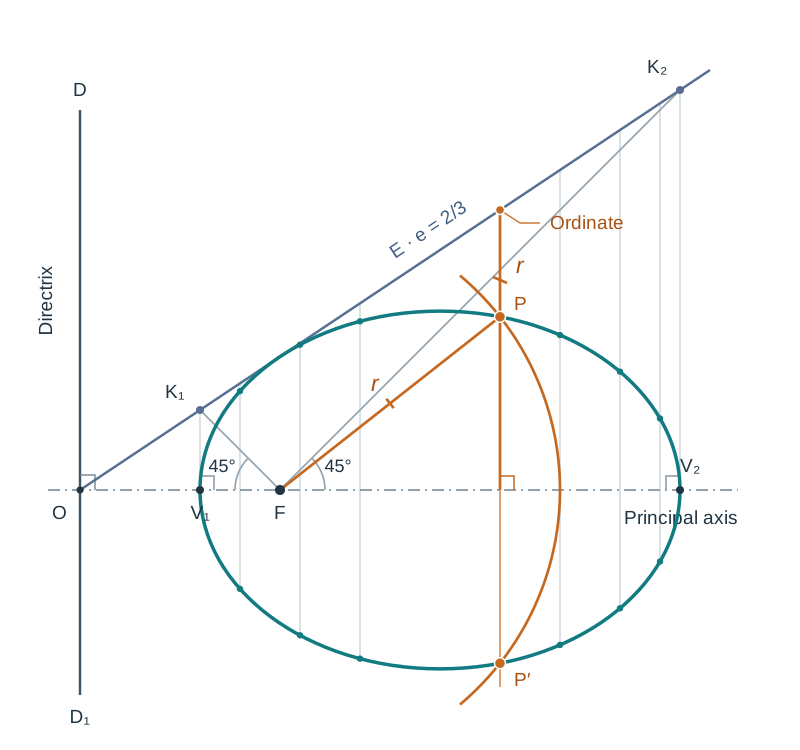
Locating Second Elements of an Ellipse
- The centre is the midpoint of the major axis .
- The second focus is located by setting compass radius to and stepping off the same distance on the opposite side of along the major axis.
- Alternatively, with compass set to the semi-major axis , strike arcs from a minor vertex across the major axis to pinpoint both and .
- The second directrix is the mirror image of the first across centre , situated at distance from .
The Rectangle Method, Auxiliary Circles, and Focal Arcs
Conjugate diameters are not on this syllabus. Use auxiliary circles, the trammel, intersecting focal arcs, or the rectangle method instead.
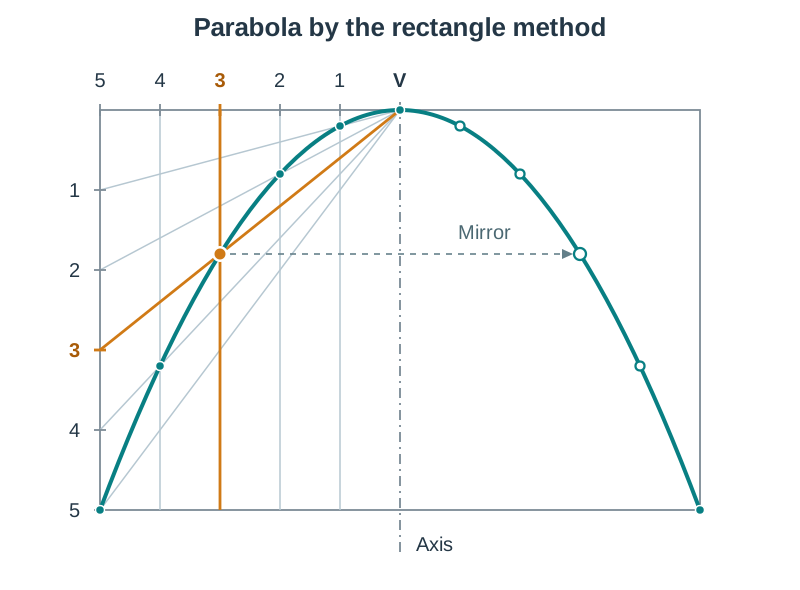
The Rectangle (Oblong) Method
- Parabola: Draw the bounding rectangle of width equal to the span and height equal to the rise, placing vertex at the top midpoint. Work in one half-span. Divide the top horizontal edge into equal parts (e.g. 5 divisions) and number them from outward. Divide the vertical side into the same number of equal parts and number them from the top corner downward. From each top division, drop a line parallel to the axis. From vertex , radiate lines to each side division. The intersections of matching lines (1 with 1, 2 with 2) locate points on the curve.
- Ellipse: Construct a rectangle matching the major and minor axes. In any quadrant, divide the semi-major axis into equal parts and the vertical outer edge into the same number of parts, counting both from the corner nearest the major vertex. Radiate lines from one minor vertex to the side divisions, and draw lines from the opposite minor vertex through the semi-major divisions. Intersect matching pairs to find points on the curve.
- Hyperbola: Given the two vertices and on the transverse axis and a point , draw the horizontal line through and the vertical from down to the axis. Divide the vertical from the axis up to into equal parts, and divide the horizontal line from the point directly above across to into the same number of parts. Join to each horizontal division and to each vertical division; matching pairs intersect on the hyperbolic branch.
Concentric Auxiliary Circles and Trammel Methods
- Concentric Auxiliary Circles: Draw concentric circles about centre with radii equal to the semi-major axis (major auxiliary circle) and semi-minor axis (minor auxiliary circle). Draw radial lines from cutting both circles (typically at or intervals). From each intersection on the major circle, draw a line parallel to the minor axis (vertical). From the corresponding intersection on the minor circle along the same radial line, draw a line parallel to the major axis (horizontal). The intersection of these two lines locates a point on the ellipse. Repeat for all radial lines and join the points with a smooth curve.
- Trammel Method: On a straight strip of paper (trammel), mark point at the end, point at distance (semi-minor axis) from , and point at distance (semi-major axis) from in the same direction. Keeping point on the major axis and point on the minor axis, move the trammel so they slide along their respective axes; point traces out points on the ellipse.
Minor Axis from Major Axis and One Point
- Draw the major axis with centre , and draw the major auxiliary circle on as diameter.
- From point , drop a perpendicular to the major axis meeting it at , and extend it upward to cut the auxiliary circle at .
- Join centre to .
- Through , draw a line parallel to the major axis to intersect at point .
- The length is the semi-minor axis . Step above and below on the minor-axis line to fix both minor vertices.
Plotting by Intersecting Focal Arcs
Once the semi-major axis and semi-minor axis are known:
- Strike arcs of radius from a minor vertex across the major axis to fix foci and .
- Pick reference points 1, 2, 3 on the major axis between and .
- With compass radius and centre , swing arcs above and below the axis. With radius and centre , strike arcs to intersect them.
- Repeat for points 2 and 3, then reverse the focal centres to plot the opposite half.
Tangents and Normals to Conic Sections
Focus–Directrix Method (Universal for Point on the Curve)
- Connect point to the focus .
- At , construct a line perpendicular () to .
- Extend this perpendicular until it meets the directrix at point .
- Draw a straight line through and . Line is the exact tangent at .
- Erect a line through at to to establish the normal.
Focal Angle Bisection (Point on the Curve)
- Ellipse: Join to both foci and . Extend line past . The line that bisects the exterior angle between the focal rays is the tangent. Bisecting the interior angle gives the normal.
- Hyperbola: Join to both foci and . The line that bisects the interior angle is the tangent. Bisecting the exterior angle gives the normal.
- Parabola: Join to focus , and from draw the ray towards the directrix perpendicular to it (parallel to the axis), meeting the directrix at . The bisector of angle is the tangent; the bisector of the supplementary angle is the normal.
Tangents from an External Point (Higher Level)
- Parabola: Join to focus . With centre and radius , swing an arc to cut the directrix at two points, and . Through and , draw lines parallel to the axis. Where these lines intersect the parabola are the exact points of contact and . Join to and to .
- Ellipse and Hyperbola: With centre and radius , draw an arc. With centre at the second focus , draw a circle with radius equal to the major axis (or transverse axis for a hyperbola). Let the arc and circle intersect at points and . Draw straight lines connecting through and through ; where these radial lines cross the curve are the points of contact and . Lines and are the required tangents. For a hyperbola, verify which branch the tangent touches, as rays from through may need extending.
Centres of Curvature and Evolutes (Higher Level)
At any point on a conic, you can draw the circle that fits the curve most closely at that point: it touches the curve, shares the same tangent, and bends by the exact same amount. The centre of this circle is the centre of curvature (), and its radius is the radius of curvature (). The locus traced by all centres of curvature along a curve is called the evolute.
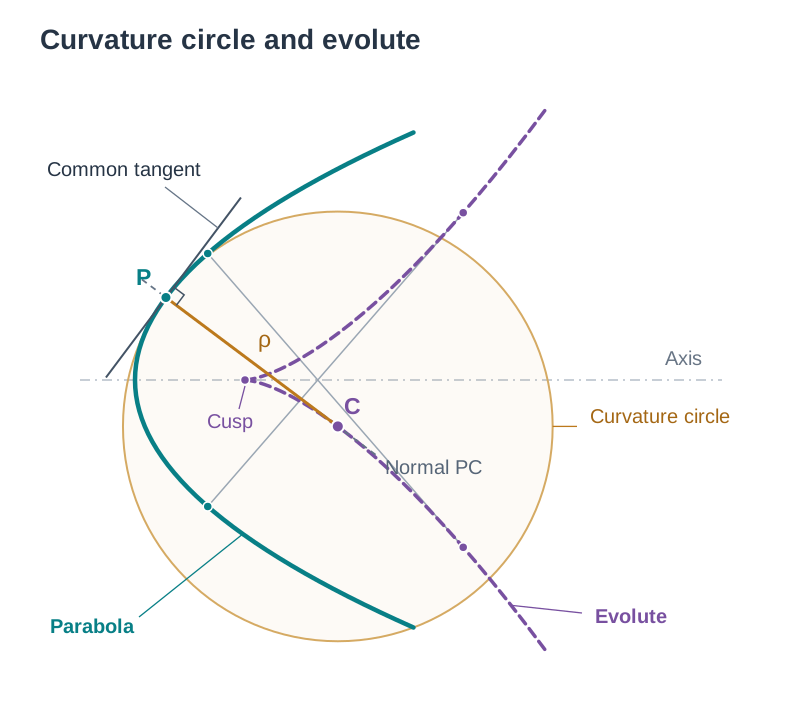
Centre of Curvature at Any General Point
- Construct the tangent and normal at point .
- Extend the normal until it intersects the principal axis at point .
- At point , erect a perpendicular to the normal line .
- Connect point to focus and find where the perpendicular from intersects line (extended if necessary) at point .
- At point , construct a line perpendicular to line .
- The intersection of this perpendicular with the normal line locates the exact centre of curvature .
Centre of Curvature at Principal Vertices
Because the normal at a principal vertex lies along the axis, the general construction collapses. Use these geometric relations:
- Parabola: . Measure twice the focal distance from vertex along the axis into the curve to locate .
- Ellipse / Hyperbola: , which is the same length as the semi-latus rectum , where is the distance from the focus to the directrix measured perpendicular to the directrix. For an ellipse, you can also construct the semi-axes rectangle (where is the major vertex and the minor vertex) and drop a perpendicular from corner onto chord . This perpendicular cuts the major axis at the centre of curvature for vertex , and cuts the minor axis extended at the centre of curvature for vertex .
Evolute Profiles
- Parabola Evolute: A symmetrical curve with a single sharp cusp at located from the vertex, opening away from the directrix.
- Ellipse Evolute: An astroid (four-cusped shape) centred at , with its cusps resting at the four vertex centres of curvature.
Key terms
- Conic Section
- A curve formed by cutting a right circular cone with a flat plane, or defined as the plane locus of a point moving with a constant ratio of distances from a focus and directrix.
- Focus
- A fixed reference point on the principal axis used to generate a conic section as a locus.
- Directrix
- A fixed reference line perpendicular to the principal axis from which perpendicular distances to points on the conic are measured.
- Eccentricity
- The constant ratio (e = PF / PD) of the distance from any point on a conic to the focus divided by its perpendicular distance to the directrix.
- Principal Axis
- The line of symmetry passing through the focus perpendicular to the directrix.
- Vertex
- The point where a conic section crosses its principal axis.
- Chord
- Any straight line segment connecting two points on a curve.
- Focal Chord
- A chord that passes directly through a focus.
- Ordinate
- A straight line segment drawn from a point on the curve perpendicular to the principal axis.
- Double Ordinate
- A chord drawn perpendicular to the principal axis, terminating at the curve on both sides.
- Latus Rectum
- The specific double ordinate that passes through a focus perpendicular to the principal axis.
- Transverse Axis
- The line segment connecting the two principal vertices of a double hyperbola, having a length equal to 2a.
- Auxiliary Circle
- A circle drawn on a principal axis of a conic as diameter, such as the major auxiliary circle of radius a on the major axis of an ellipse.
- Asymptote
- A straight line passing through the centre of a hyperbola that the curve approaches infinitely closely but never touches.
- Focal Sphere
- An inscribed sphere tangent internally to a cone and touching the cutting plane at a single point, which locates the focus of the conic section.
- Circle of Contact
- The horizontal circle where a focal sphere touches the inside surface of a cone; its plane extended intersects the cutting plane to form the directrix.
- Tangent
- A straight line that touches a curve at one point without crossing through it at that point.
- Normal
- A straight line drawn perpendicular to the tangent at the point of contact.
- Centre of Curvature
- The centre of the circle that matches the local sharpness and tangent of a curve at a given point.
- Evolute
- The curve formed by the locus of all centres of curvature along a conic section.
Check yourself
A point on a conic is 45 mm from the focus and 60 mm from the directrix. Identify the conic and state its eccentricity.
Eccentricity e = 45 / 60 = 0.75. Because e < 1, the curve is an ellipse.
An ellipse is drawn with major axis vertices V1 and V2, and focus F1 is marked. How do you locate the second focus F2?
Find the centre O at the midpoint of V1V2. Measure distance OF1 with a compass and step the exact same distance off along the major axis on the other side of O to mark F2.
A point Q is on a parabola with focus F and directrix DD1. Describe in three steps how to draw the tangent at Q using the focus-directrix method.
(1) Join Q to F; (2) at F, draw a line perpendicular to QF and extend it to cut the directrix at T; (3) join T to Q to give the tangent. The normal is drawn through Q perpendicular to TQ.
What is the radius of curvature at the principal vertex of a parabola having a focal distance VF of 20 mm?
The radius of curvature equals the semi-latus rectum: ρ_V = 2 × VF = 2 × 20 mm = 40 mm.
What formula relates the cutting plane angle θ and cone generator angle α to the base when finding the eccentricity of a conic section?
e = sin(θ) / sin(α).