Moisture, Psychrometry, Condensation, and MVHR
Air holds invisible water vapour, and warm air can hold far more moisture than cold air.
- Dry bulb temperature: Ambient air temperature measured by an ordinary shielded thermometer.
- Wet bulb temperature: Temperature measured by a thermometer whose bulb is wrapped in a damp fabric wick cooled by evaporating water. The drier the room air, the faster water evaporates, causing a greater difference between wet bulb and dry bulb readings.
- Relative humidity (RH): The ratio of actual moisture present in air compared to the maximum moisture it could hold at that temperature, expressed as a percentage.
- Dew point: The critical temperature at which air reaches 100% saturation. Any further cooling forces excess vapour to condense into liquid water.
Reading the Psychrometric Chart
To find relative humidity and dew point:
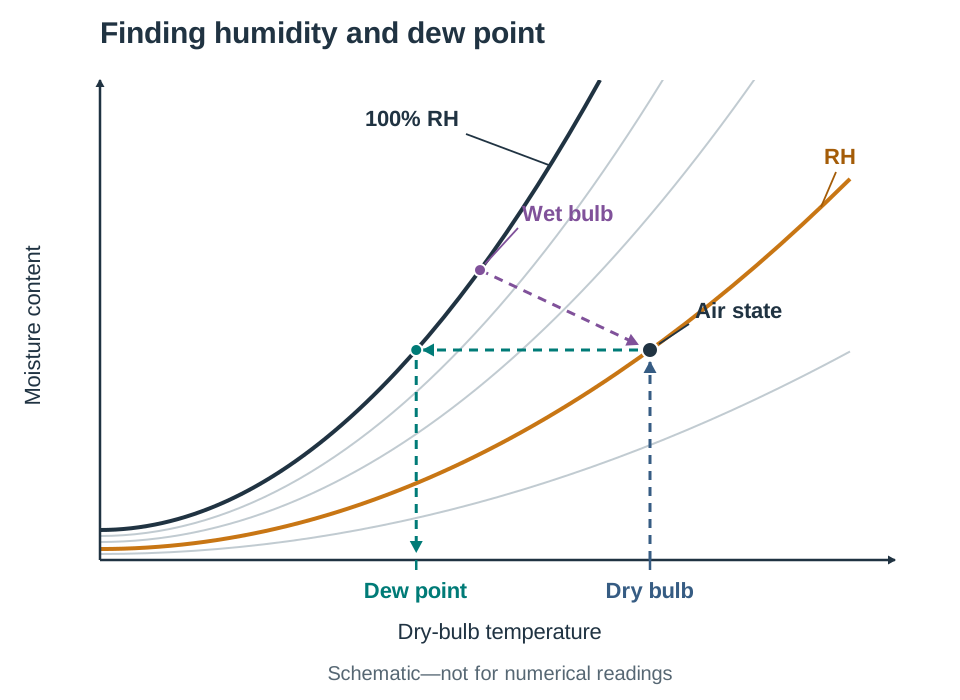
- Measure dry bulb and wet bulb temperatures using a whirling (sling) hygrometer.
- Locate the dry bulb temperature on the horizontal bottom axis and draw a vertical line upwards.
- Locate the wet bulb temperature on the outer curved saturation line and follow the diagonal wet-bulb line down to intersect the vertical dry-bulb line.
- Read the relative humidity from the curved percentage line passing through that intersection point.
- From that intersection point, move horizontally left to the outer saturation curve (100% RH). The temperature read there is the dew point.
Condensation Mechanisms and Mould
- Surface condensation: Warm, moist room air contacts a surface colder than the dew point of that air (such as single glazing or an uninsulated lintel), causing droplets to form on the surface.
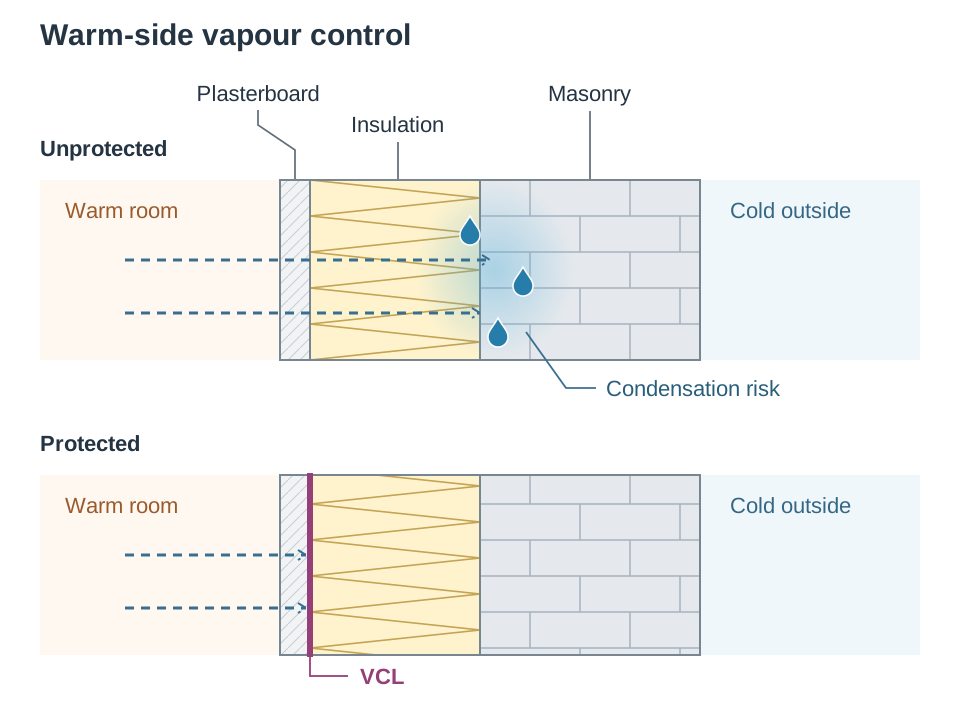
- Interstitial condensation: Water vapour diffuses outward through plasterboard and insulation into the structural layers of a wall or roof. As it encounters colder outer zones, it reaches its dew point and condenses invisibly inside the construction, saturating insulation, rotting timber, and corroding wall ties.
To prevent interstitial condensation, install a continuous vapour control layer (VCL), such as 500-gauge polythene or foil backing, strictly on the warm indoor side of the insulation. This stops moisture before it can reach the cold outer structure.
Mould spores germinate on organic building surfaces (plasterboard paper, timber, wallpaper) when the surface relative humidity remains at or above 70% for sustained periods.
Mechanical Ventilation with Heat Recovery (MVHR)
In an airtight house, natural ventilation is weather-dependent: strong winds cause over-ventilation and heat loss, while calm humid days lead to under-ventilation and condensation. An MVHR system provides balanced, controlled air exchange:
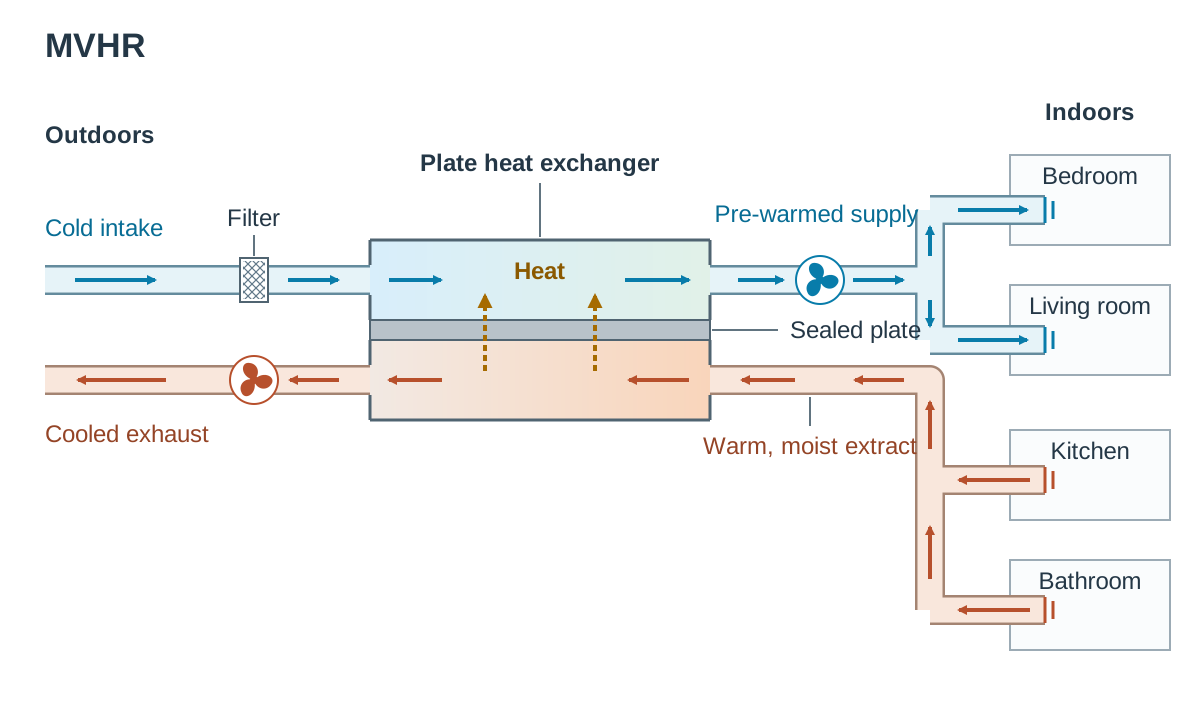
- Warm, moist air is continuously extracted through ducted ceiling terminals from wet rooms (kitchens, utility rooms, bathrooms).
- Fresh outdoor air is drawn into the building through a separate external intake duct.
- Both air streams pass simultaneously through a central counter-flow plate heat exchanger where outgoing heat conducts across thin plates into the incoming fresh air, without the two air paths ever mixing.
- Incoming fresh air is filtered to remove dust, pollen, and airborne particles before entering the rooms.
- Pre-warmed, clean fresh air is ducted continuously into habitable rooms (bedrooms and living areas).
Two principal advantages of MVHR are:
- Energy efficiency: It recovers up to 90% of heat that would otherwise be exhausted, substantially reducing space-heating demand.
- Indoor air quality: It provides continuous, draught-free fresh air, eliminates condensation and mould risks, and filters outdoor allergens.