

Strand 1: The World of Heroes explores ancient Greek and Roman conceptions of heroism, leadership, and society through Homer's Odyssey and Virgil's Aeneid. While the specification places its primary focus on Books 1 to 6 of the Aeneid, key episodes from Books 7 to 12—such as the Shield of Aeneas in Book 8 and the final duel with Turnus in Book 12—are essential for addressing warfare, leadership foils, and Augustan ideology. The strand examines what defines an epic hero, the social world they inhabit (including divine intervention, the human impact of war, the portrayal of women, and political propaganda), and the storytelling techniques, poetic devices and works of art through which these heroic stories were passed on. Evidence gathered across this strand also provides a foundation for the 20% Research Study report under the Literature or Material Culture briefs.
2. Heroic Characteristics: Prowess, Intelligence, and Verbal Skills
Epic heroes embody the defining virtues and anxieties of the societies that created them. The point of contrasting Odysseus and Aeneas is not to judge which hero is superior, but to realise that each epic measures its protagonist by what its own culture most feared losing: for Archaic Greeks, an honoured name; for Augustan Romans, a functioning, ordered state.
Odysseus: Cunning Intelligence and Individual Glory
Odysseus belongs to the Archaic Greek heroic world, driven by kleos (imperishable renown won through action and preserved in song). While Achilles won kleos through sheer battlefield violence in the Iliad, Odysseus relies on metis—cunning intelligence, deception, and tactical adaptability. Homer calls him polytropos ('of twists and turns') and polymetis ('of many wiles').
- Intelligence and Resourcefulness: In Book 9, trapped in Polyphemus's cave, Odysseus realises that slaying the sleeping giant immediately would leave the Greeks trapped behind the massive doorway boulder. Instead, he plies Polyphemus with unmixed wine, announces his name as 'Nobody' (Outis), blinds the giant's single eye with a fire-sharpened olive stake, and lashes his men beneath the bellies of rams to escape.
- Verbal Skill: Odysseus's rhetoric is cunning, flexible, and self-protective. In Book 6, washing ashore naked on Phaeacia, he refrains from clutching Nausicaa's knees as a suppliant, choosing instead a flattering speech from a respectful distance to win clothing and shelter. Across Books 13 to 19, he invents intricate false 'Cretan' autobiographies: to the disguised Athena in Book 13 out of sheer caution before she reveals herself, and to Eumaeus (Book 14) and Penelope (Book 19) to probe their loyalty before he risks revealing himself.
- Martial Prowess: Odysseus is not merely a schemer. In Book 21, he alone possesses the physical strength to string his great recurve hunting bow. In Book 22, he shoots the suitors down with the bow and then fights on with spear and sword alongside Telemachus.
Aeneas: Roman Pietas and Martial Rage
Aeneas personifies pietas—dutiful devotion that requires a Roman to subordinate personal happiness, love, and individual ambition to the will of the gods, obligations to family, and the destiny of the state.
- Visual Embodiment of Pietas: In Book 2, amid the sack of Troy, Aeneas abandons the search for individual glory in combat. He heeds divine portents, hoists his elderly father Anchises onto his shoulders, takes his young son Ascanius by the hand, and carries the ancestral household gods (penates). The tableau unites Roman past, present, and future.
- Controlled Verbal Skill: Aeneas's rhetoric is public, sober, and restrained. After the shipwreck in Book 1, he conceals his despair to rally his men ('Endure, and save yourselves for happier days'). In Book 4, confronted by Dido's fury, his reply is disciplined and formal, stating his divine obligation: 'Italiam non sponte sequor' ('I sail for Italy not of my own free will'). Homer rewards the speaker who talks his way out of danger; Virgil rewards the leader who maintains collective discipline with words that mask his own pain.
- Martial Prowess: Aeneas is a lethal warrior. In Books 10–12, Virgil grants him an aristeia (a sustained sequence of battlefield dominance). Goaded by the slaughter of young Pallas, Aeneas cuts down Magus and Tarquitus while deaf to their pleas for quarter, kills Lausus, slays Mezentius, and finally dispatches Turnus in single combat. Virgil deliberately allows Achilles-style ruthlessness to erupt within his dutiful hero.
| Virtue / Trait | Odysseus (Homeric Greek) | Aeneas (Virgilian Roman) |
|---|---|---|
| Supreme Ideal | Kleos (personal renown) and Metis (cunning) | Pietas (duty to gods, family, and homeland) |
| Primary Motivation | Restoring his household (oikos) and royal standing | Fulfilling divine destiny and founding a new nation |
| Flaw / Burden | Pride and hunger for personal recognition | Reluctance, grief, and moral exhaustion |
| Problem-Solving | Disguise, deception, and improvised tactics | Religious ritual, submission to fate, and force |
3. Good and Bad Leaders as Foils, Norms, and Modern Relevance
Both poets examine leadership by placing contrasting leaders beside their protagonists. Weak, corrupt, or exemplary secondary figures serve as deliberate foils.
Leadership Foils in the Odyssey
- Alcinous of Phaeacia (Books 7–8): The model host-king. He bathes and feeds the shipwrecked Odysseus, hosts athletic games and poetic performance in his honour, bestows rich guest-gifts, and arranges a convoy home before even asking the stranger's name.
- Polyphemus (Book 9): The monstrous anti-host. He flouts divine laws, imprisons his guests, eats them alive, and mocks xenia by promising that Odysseus's 'guest-gift' will be to be eaten last.
- Nestor and Menelaus (Books 3–4): Nestor is the pious elder whose household runs on flawless sacrifice and sound advice. Menelaus is generous, but his wealth cannot mask the trauma of the Trojan War.
- Agamemnon (Books 4, 11, 24): The cautionary tale of disastrous homecoming. Murdered at his own banquet table by Aegisthus and Clytemnestra, his shade in the Underworld warns Odysseus to land on Ithaca secretly and never trust a wife completely.
- Antinous and Eurymachus: Corrupt aristocratic elites. They devour another man's estate, mistreat a beggar, and plot to assassinate the young heir Telemachus. Their slaughter in Book 22 illustrates the destruction of predatory leadership.
- Eumaeus the Swineherd (Book 14): Demonstrates that honourable leadership and hospitality are not confined to kings. Though poor and enslaved, he shares his best food and lodging with a disguised beggar.
- Telemachus: A study in leadership being learned. Powerless in Book 1, he summons Ithaca's first assembly in twenty years in Book 2, endures mockery, and by Book 22 stands shoulder to shoulder with his father defending the threshold.
Leadership Foils in the Aeneid
- Latinus (Books 7 and 11): A well-meaning king who correctly reads divine omens favouring the Trojans, but lacks the personal authority to prevent Turnus and Queen Amata from plunging his kingdom into war.
- Evander (Book 8): The virtuous, impoverished ruler of Pallanteum. He welcomes Aeneas with simple hospitality, shows him the future site of Rome, and entrusts his only son Pallas to Aeneas's military care.
- Mezentius (Books 8 and 10): The archetypal tyrant, an exiled Etruscan ruler called a contemptor divum ('despiser of the gods') for his cruelty. Yet Virgil complicates him: Mezentius rides into battle to avenge his son Lausus and dies with courage, showing that even villainous leaders possess tragic dignity.
- Turnus: A brave, charismatic native prince, but governed by furor (war-madness and wounded pride) rather than devotion to the common good.
Conforming to versus Challenging Social Norms
- Odysseus conforms to the competitive ethos of Archaic Greece, yet challenges aristocratic norms by fighting through disguise, tactical retreats, and calculated lies rather than direct open confrontation.
- Penelope conforms outwardly to domestic expectations, yet subverts the authority of more than a hundred noble suitors through her intellectual stratagems.
- Aeneas conforms to Augustan ideals of filial respect and civic piety, yet briefly wavers in Carthage by wearing luxurious Tyrian dress and overseeing a foreign city's construction.
Modern Relevance
Odysseus looks familiar today as the leader who is good in a crisis: adaptable, practical, and resilient. But he is also a warning. He boasts when silence would have been safer, and he conceals critical dangers from those who depend on him—as when he hides the reality of Scylla from his crew. Aeneas models selfless public service, subordinating personal happiness to the long-term survival of his community. Yet his complete obedience to fate, and his sudden rage in Book 12, raise the question of where duty ends and blind vengeance begins—and whether a leader should ever spare a defeated enemy.
4. Divine Intervention, Fate, and Heroic Values
The relationship between gods and mortals reveals deep philosophical contrasts between Homeric Greece and Augustan Rome.
Homeric Polytheism: Anthropomorphic Deities and Moral Boundaries
Homer's gods are anthropomorphic, possessing human bodies, volatile tempers, and jealous rivalries.
- Divine Favouritism and Vendetta: Athena champions Odysseus because his tactical mind mirrors her own wisdom. In contrast, Poseidon pursues Odysseus with relentless vengeance for blinding Polyphemus.
- The Gods as Moral Guarantors: The Olympians uphold sacred social laws, especially xenia (hospitality), overseen by Zeus Xenios. Violations of hospitality by the suitors and Polyphemus receive divine retribution.
- Human Accountability: In Odyssey Book 1, Zeus insists that mortals blame the gods unfairly when their own reckless greed (atasthalia) brings misery beyond their allotted destiny, citing Aegisthus's murder of Agamemnon despite Hermes' warning. Similarly, Odysseus's crew perish because they slaughter the cattle of Hyperion Helios in Book 12 despite explicit prohibitions.
- The Phaeacian Qualification: Divine action is not always fair. In Book 13, after the Phaeacians provide Odysseus with flawless hospitality and convoy him to Ithaca, Poseidon turns their returning ship into stone to punish them for helping seafarers. Piety and virtue do not guarantee absolute protection against divine spite.
Virgilian Divine Machinery: Cosmic Fate and Furor
In the Aeneid, the gods operate as symbols of cosmic order and historical destiny.
- Jupiter and Fatum: Jupiter embodies cosmic destiny (fatum). In Book 1, he reassures Venus that Rome will enjoy 'empire without end' (imperium sine fine). Mortal agency cannot alter fate; it can only embrace it or be crushed by it.
- Juno and Furor: Juno embodies irrational frenzy (furor) and historical resentment. Driven by anger over the Judgement of Paris and love for Carthage, she stirs up the sea storm in Book 1 and sends the Fury Allecto in Book 7 to ignite war, knowing she cannot overturn destiny but seeking to delay it.
5. Comparing the Two Underworld Journeys
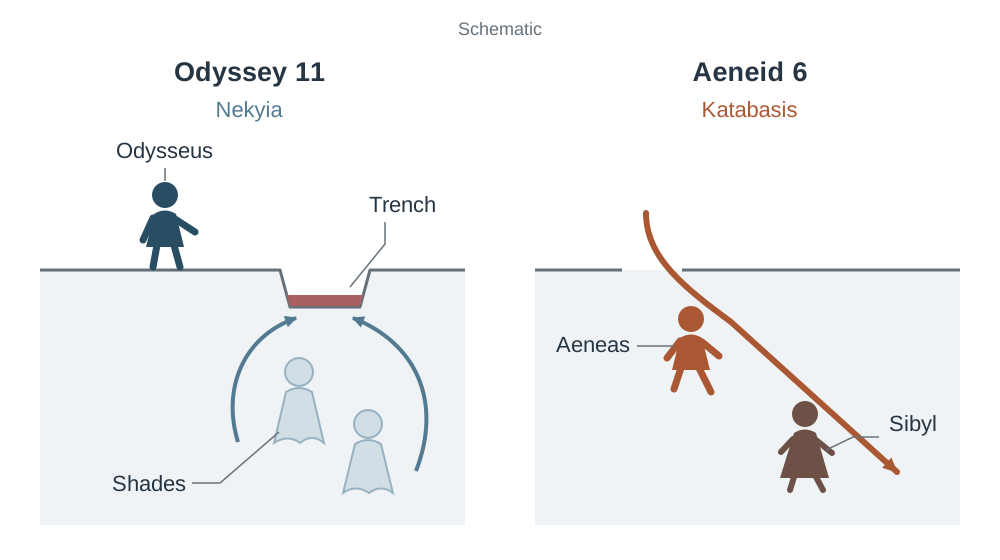
A direct comparison between Odyssey Book 11 and Aeneid Book 6 exposes how Virgil transformed Homer's ghost-raising into an ideological set-piece.
Homer's Nekyia (Odyssey Book 11)
- Character and Setting: Circe instructs Odysseus to consult the dead. He sails to the misty edge of the world across Oceanus, digs a trench, and pours libations of milk, honey, wine, water, barley, and the blood of two sacrificial sheep. The shades rise out of the earth to drink the blood; Odysseus never physically descends into an Underworld realm. The landscape remains shadowy and vague.
- Purpose and Encounters: Odysseus seeks private, practical instructions for getting home (nostos). Tiresias provides the route, warns against Helios's cattle, and predicts trouble in Ithaca. Odysseus then meets:
- Elpenor: His unburied crewman, who begs for proper burial rites at Circe's island.
- Anticleia: His mother, who died of heartbreak over his absence; Odysseus tries three times to embrace her phantom in vain.
- Agamemnon: Relates his murder and cautions Odysseus to return home without warning.
- Achilles: Utters the line that shatters Homeric warrior ideology: 'I would rather work the earth as a hired servant to a landless peasant than rule over all the dead.'
- Ajax: Silently turns away, nursing his bitter resentment over Achilles' armour.
Odysseus hears only about the past and present of his own generation.
Virgil's Katabasis (Aeneid Book 6)
- Ritual Quest and Geography: Aeneas undertakes a physical descent into an architecturally ordered Underworld. He must first consult the Cumaean Sibyl, bury his comrade Misenus, and pluck the magical golden bough from the deep forest. He crosses the Styx with Charon; the Sibyl throws Cerberus a honeyed, drugged sop so that Aeneas can pass the sleeping hound. He passes through the Fields of Mourning (where Dido listens to his apologies in stony silence before fleeing back to Sychaeus), views the tortures of Tartarus, and enters the sunlit Elysian Fields.
- Purpose and Ideology: Aeneas descends not for travel directions, but to understand his historic destiny. His father Anchises reveals the doctrine of reincarnated souls and presents the Pageant of Unborn Heroes, pointing out Romulus, the early kings, the great Republican generals, and Caesar Augustus himself, offspring of a god (divi genus), who will restore a Golden Age. Anchises defines the Roman mission: 'parcere subiectis et debellare superbos' ('to spare the conquered and war down the proud').
Exam distinction: Homer's Underworld is a personal consultation about surviving a journey home; Virgil's Underworld is an imperial initiation that transforms Aeneas from a grief-stricken Trojan refugee into the conscious founder of Roman civilization. Aeneas's troubling departure through the Gate of Ivory (the gate of false dreams) leaves the moral cost of that vision deliberately open to debate.
6. The Impact of War and the Anti-War Debate
Both Homer and Virgil capture the physical horror and psychological trauma of war, prompting debate over whether these epics question the heroic code.
Homer's Odyssey: The Scars of Post-War Reality
The Odyssey approaches warfare through its lingering aftermath on veterans and civilians.
- Psychological Trauma: In Book 8, when the Phaeacian singer Demodocus performs the tale of the Trojan Horse, Odysseus weeps. Homer uses an extended simile comparing the victorious general to a weeping woman throwing her arms over her dying husband on a battlefield, while enemy spearmen strike her back to march her into slavery. The victor's trauma is mirrored in the suffering of a conquered victim.
- Disillusionment with Glory: Achilles' rejection of kleos in Book 11 discredits the romantic idea that early death on the battlefield is worth eternal song.
- Non-Combatant Devastation: In Ithaca, Penelope endures two decades of anxiety, Telemachus grows up fatherless, and Anticleia dies of grief. The war's aftermath creates an unstable power vacuum that corrupts the local youth.
Virgil's Aeneid: The Human Cost of Imperial Mission
Virgil depicts warfare directly in Books 7 to 12 with vivid pathos (pathos).
- The Sack of Troy (Book 2): Virgil narrates the destruction through the eyes of the victims, lingering on the brutal slaughter of King Priam at his household altar and Aeneas's agonizing loss of Creusa.
- The Deaths of Nisus and Euryalus (Book 9): Virgil commemorates the young Trojan comrades Nisus and Euryalus, slain on a night raid after Euryalus's stolen helmet gleams in the moonlight. Their severed heads are paraded on Rutulian spears, and Euryalus's mother laments in public grief.
- The Death of Young Pallas (Book 10): Entrusted to Aeneas by King Evander, Pallas is cut down by Turnus, who strips his decorated sword-belt as a trophy. Pallas's death unleashes savage fury in Aeneas.
- The Killing of Turnus (Book 12): Turnus is an experienced Italian commander, not an innocent youth like Pallas or Euryalus. Yet when defeated and wounded, Turnus asks for his life. Aeneas hesitates, but catching sight of Pallas's belt on Turnus's shoulder, he kills the pleading prince in a flare of rage. The poem closes with Turnus's life fleeing with a groan to the shades below.
Evaluating the Anti-War Claim
- Supporting an Anti-War Reading: Both epics emphasize civilian devastation, the trauma of survivors, the hollow nature of martial glory, and the tragic waste of young lives.
- Opposing an Anti-War Reading: The Odyssey presents the execution of the suitors in Book 22 as legitimate justice. The Aeneid validates military conquest as the divine mechanism to impose order and peace under Rome's destiny.
7. Portrayal of Women: Agency, Conformity, and Social Roles
Female characters reflect ancient social structures while displaying surprising forms of authority.
Women in the Odyssey: Domestic Authority and Supernatural Power
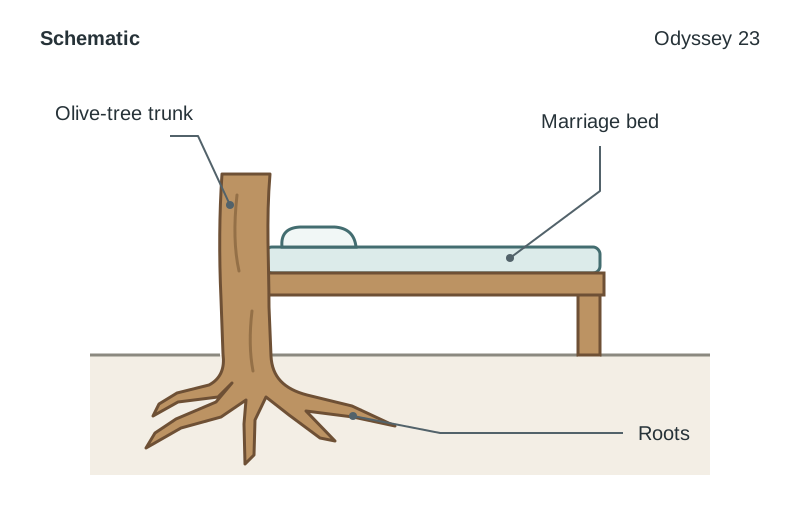
- Penelope: Embodying the Greek ideal of the loyal, chaste wife, Penelope endures patriarchal authority. In Book 1, Telemachus commands her: 'Go back to your quarters, attend to your work, the loom and the distaff... Speech will be the business of men.' Yet she displays formidable metis. She holds off the suitors for three years by weaving Laertes' funeral shroud by day and unravelling it by night. In Book 23, she tests Odysseus with the immovable olive-tree bed, proving herself his intellectual equal.
- Supernatural Autonomy: Calypso and Circe represent male anxieties regarding independent female power. In Book 5, Calypso delivers a biting critique of divine double standards, noting that male gods freely take mortal lovers, yet begrudge goddesses the same freedom.
- Enslaved Women and Household Power: In Book 22, the twelve disloyal maids are compelled to carry out the suitors' corpses and wash down the gore before being hanged by Telemachus on Odysseus's orders. This episode illustrates the absolute power wielded by the master of the oikos over female dependants.
Women in the Aeneid: Four Contrasting Archetypes
Virgil presents four contrasting models of female power:
- Dido: The capable ruler destroyed by passion. Initially an autonomous queen building Carthage, divine manipulation infects her with love. Her civic building halts, illustrating Roman anxieties that passion undermines governance. Her dying curse creates the mythical origin for the historical Punic Wars.
- Camilla (Books 7 and 11): The warrior-maiden (bellatrix). Dedicated to Diana, raised in the wild, and never kept within a household, she leads cavalry into battle and earns a magnificent aristeia in Book 11 before falling to Arruns. Camilla represents a woman completely outside traditional Roman domestic norms.
- Amata (Books 7 and 12): The mad queen. Infected by the Fury Allecto, she opposes Trojan settlement, incites the Latin women to frenzy, and hangs herself when she mistakenly believes Turnus is dead—an embodiment of female furor wrecking the state.
- Lavinia: The silent dynastic bride. She never speaks a word in Books 7–12, functioning purely as a political prize to unite Trojans and Latins, reflecting elite Roman marriage alliances where women served as dynastic bridges.
8. Augustan Ideology, Propaganda, and Daily Life
Propaganda refers to communication crafted to promote a political regime or ideology. The Aeneid provided mythical and divine legitimacy for Augustus's Principate following decades of civil bloodshed.
Three Core Propaganda Set-Pieces
- Jupiter's Prophecy (Book 1): Assures Venus that Ascanius (Iulus) will establish Alba Longa, linking the Julian clan (gens Iulia) to Venus. Jupiter promises that Augustus Caesar will lock the Gates of War, bind furor in bronze chains, and bring the Pax Romana.
- The Pageant of Heroes (Book 6): In the Underworld, Anchises identifies Augustus Caesar as offspring of a god (divi genus), destined to restore the Golden Age and expand Roman rule beyond the stars.
- The Shield of Aeneas (Book 8): Vulcan crafts armour featuring future Roman history. The central scene portrays the Battle of Actium (31 BC). Augustus stands on the high deck, backed by the Senate, people, and Olympian gods, routing Mark Antony and Cleopatra's foreign deities. When Aeneas hoists the shield, he shoulders the destiny of his descendants.
The Moral Complexity of Virgil's Poem
Answers in the top band do not treat the Aeneid as simple political advertising. Virgil constantly highlights the human grief demanded by empire: Dido's suicide, Pallas's death, the mourned young Marcellus in Book 6, Aeneas's exit through the Gate of Ivory (false dreams), and the unresolved rage of Turnus's execution.
Epic Values in Daily Ancient Life
- Xenia: Essential for survival in Archaic Greece, where travel was perilous and formal embassies did not exist.
- The Oikos: Maintained property, agricultural output, and inheritance in a fractured political landscape.
- Pietas: Reinforced civic obedience, state religion, and Augustus's moral legislation regarding family duty (patria potestas).
9. Storytelling Techniques: Voice, Perspective, Time, and Space
Both epics deploy advanced structural and storytelling methods to guide their audiences.
Narrative Voice and Perspective
Homer's narrator is an omniscient, detached presence who lets characters' speeches and actions unfold without editorial judgment. Virgil's narrator intervenes with emotional involvement and rhetorical questions, addressing characters directly (such as calling Dido infelix, 'unhappy Dido') and lamenting divine anger: 'tantaene animis caelestibus irae?'
Handling of Time
Both poems begin in medias res (in the middle of events):
- Homer's 'present' action occupies roughly forty days. The ten years of wandering are compressed into Odysseus's personal flashback to the Phaeacians in Books 9–12. Homer also synchronizes two plot lines: Telemachus's journey across Greece and Odysseus's return from Ogygia, bringing them together in Eumaeus's hut in Book 16.
- Virgil covers seven years of sea-wandering and several weeks of war across twelve books. He uses prophecy to leap forward a thousand years: Jupiter's speech in Book 1, Anchises' pageant in Book 6, and the Shield in Book 8 bring events that are in Aeneas's future—but the Augustan reader's past—directly into the narrative.
Handling of Space
- Homeric Space: Odysseus's wanderings occur in a fairy-tale Mediterranean (Ogygia, Aeaea, the floating island of Aeolus) that cannot be mapped realistically. However, once Odysseus reaches Ithaca, space becomes concrete and detailed: the harbour of Phorcys, Eumaeus's stone pig-pens, the palace threshold, and the Great Hall. The closer the hero gets to home, the more realistic the world becomes.
- Virgilian Space: Virgil charts real Mediterranean geography. In Book 8, King Evander walks Aeneas across the actual ground of future Rome: the Capitoline is a god-haunted, wooded cliff, and cows graze in what will become the Roman Forum. Augustan readers see their own monumental city in its rough pastoral beginnings.
Structural Devices
- Type-Scenes: Conventional recurring narrative patterns. Hospitality follows a strict sequence: greeting, seating on a fine chair, washing hands, serving food and wine, and asking identity only after the guest has eaten. Homer creates horror by having Polyphemus invert this ritual by interrogating and eating his guests.
- Ring Composition: A narrative envelope where a story departs into a digression and returns to its starting point. In Odyssey Book 19, when Eurycleia washes the beggar's feet and feels his scar, the narrative pauses for seventy lines to tell how young Odysseus was gored by a boar on Mount Parnassus with Autolycus, before snapping back to the basin where Eurycleia drops the foot in astonishment.
10. Poetic Devices and Material Culture
Epic style evolved from oral formulas in Homer to layered symbolic literary devices in Virgil, while inspiring ancient visual art.
Epithets and Epic Similes
- Formulaic Epithets: Homer uses stock epithets ('rosy-fingered Dawn', 'grey-eyed Athena', 'much-enduring Odysseus') as metric building blocks in dactylic hexameter during oral performance. Virgil uses epithets selectively and ironically: calling his hero pius Aeneas in Book 4 just as he prepares to abandon Dido underscores the harsh cost of Roman duty.
- Extended Similes: Homer draws comparisons from agriculture, hunting, and craft to make the fantastic world relatable (comparing the blinding of Polyphemus in Book 9 to a shipwright's drill, and the sizzling eye to a blacksmith quenching a hot axe in water). Virgil uses similes for political insight: in Book 1, Neptune calming the storm is compared to a respected statesman stepping forward to quiet an angry mob in civil unrest—an image recalling Augustus restoring order to Rome.
Ecphrasis and Material Culture
An ecphrasis is an extended, vivid verbal description of a work of visual art within literature.
- Temple of Juno at Carthage (Aeneid Book 1): Aeneas gazes at murals of the Trojan War, weeping as he utters: 'sunt lacrimae rerum et mentem mortalia tangunt' ('there are tears for these things, and human suffering touches the heart').
- The Shield of Aeneas (Aeneid Book 8): Vulcan's shield displays Roman triumphs culminating in the Battle of Actium.
External Material Culture
- The Eleusis Amphora (c. 650 BC): Proto-Attic neck-amphora depicting Odysseus blinding Polyphemus, with Odysseus painted in white to emphasize his leadership in the physical act.
- The Siren Vase by the Siren Painter (c. 480–470 BC): Attic red-figure stamnos in the British Museum showing Odysseus lashed upright to the mast while winged Sirens swoop, capturing the tension between intellectual curiosity and physical restraint.
- Denarius of Julius Caesar (47–46 BC): Silver coin showing Venus on the obverse and Aeneas carrying Anchises and the sacred palladium on the reverse, circulating propaganda claiming divine Trojan ancestry for the Julian family.
- Forum of Augustus Statue Group (Dedicated 2 BC): Augustus placed a marble group of Aeneas carrying Anchises and leading Ascanius in his forum opposite Romulus, legitimising himself visually as Rome's second founder.
Key terms
- Epic
- A long narrative poem in dactylic hexameter recounting heroic deeds, military conflicts, and divine interventions, reflecting the collective values of a civilization.
- Dactylic Hexameter
- The formal poetic metre of Greek and Latin epic, consisting of six metrical feet per line, traditionally composed of dactyls (long-short-short) and spondees (long-long).
- Oral Tradition
- The transmission of poetry and legend by word of mouth, composed and recited by professional singers (aoidoi) using formulaic language before being written down.
- Kleos
- Imperishable glory and renown achieved through heroic deeds, preserved in song and collective memory after death in ancient Greece.
- Metis
- Cunning intelligence, tactical resourcefulness, adaptability, and skill in deception, personified by Odysseus.
- Nostos
- The heroic journey of homecoming from war, representing personal survival and the social restoration of the household (oikos).
- Oikos
- The ancient Greek household unit, including the family, estate, physical property, and enslaved workers, serving as the core social and economic institution.
- Xenia
- The sacred Greek cultural custom of guest-friendship and hospitality, protected and enforced by Zeus Xenios.
- Pietas
- The supreme Roman virtue of dutiful devotion and moral obligation towards the gods, one's family, ancestors, and the state, prioritised above personal desires.
- Furor
- Uncontrolled passion, irrational frenzy, and destructive rage, represented in the Aeneid by Juno, Dido, and Turnus as the opposite of Roman pietas.
- Fatum
- Cosmic destiny or divine decree, embodied by Jupiter, which cannot be permanently altered by gods or mortals.
- In Medias Res
- The literary storytelling technique of beginning an epic in the middle of events, recovering prior plot through character flashbacks.
- Epithet
- A formulaic descriptive word or phrase attached to a character, deity, or setting (e.g. 'rosy-fingered Dawn' or 'pius Aeneas').
- Epic Simile
- An extended, detailed comparison using 'like' or 'as' that steps outside the immediate heroic action to describe a scene using imagery from nature, crafts, or civic life.
- Type-Scene
- A recurring narrative block in epic poetry constructed from conventional motifs, such as hospitality rituals, divine councils, or warrior arming.
- Ring Composition
- A narrative storytelling structure where a primary scene departs into an extended digression and subsequently returns to its initial starting point.
- Ecphrasis
- An extended, vivid verbal description of a work of visual art embedded within a literary text, such as the Shield of Aeneas in Aeneid Book 8.
- Pathos
- The emotional quality in literature that evokes profound pity, sorrow, or tenderness for a character's suffering or vulnerability.
- Pax Romana
- The era of imperial peace and political stability established across the Roman world under the rule of Emperor Augustus.
- Aristeia
- A narrative sequence in epic poetry where an individual warrior reaches their peak of martial prowess and dominates the battlefield.
Check yourself
What is the defining cultural distinction between Greek kleos and Roman pietas?
Kleos is individual martial glory preserved through song, whereas pietas is the dutiful subordination of personal desires to family, the gods, and the state.
Why does Poseidon petrify the Phaeacian ship in Odyssey Book 13 despite their flawless hospitality?
Poseidon is angry that the Phaeacians gave safe convoy to his enemy Odysseus; the episode shows that mortal virtue does not guarantee immunity from divine anger.
How do the opening lines (proems) of the Odyssey and Aeneid reveal contrasting authorial voices?
Homer calls upon the Muse to sing through him as a vessel ('Sing to me, Muse'), whereas Virgil claims personal authorship in his own voice ('Arma virumque cano' - 'I sing').
Name two female characters in the Aeneid other than Dido and explain their narrative functions.
Camilla is an Italian warrior-maiden who leads cavalry and dies in battle outside domestic norms; Amata is the Latin queen maddened by Allecto who drives the war against Trojan destiny.
What is the primary difference in purpose between Odysseus's visit to the Underworld in Book 11 and Aeneas's descent in Book 6?
Odysseus seeks practical directions home from Tiresias and hears about his own generation, whereas Aeneas undertakes a ritual quest to receive a vision of Rome's imperial future down to Augustus.
How does Homer's handling of space differ between Odysseus's wanderings and his return to Ithaca?
The wanderings take place in a fairy-tale, unmappable landscape, whereas Ithaca is described with realistic, concrete domestic details (the harbour, pig-pens, and palace hall).
Why does Aeneas kill Turnus at the end of Book 12 instead of sparing him?
Aeneas hesitates to spare Turnus until he catches sight of young Pallas's sword-belt worn as a trophy on Turnus's shoulder, triggering a flare of vengeful rage.
What visual evidence on the reverse of Julius Caesar's 47–46 BC denarius links his family to epic tradition?
The coin depicts Aeneas carrying his aged father Anchises on his shoulder and holding the sacred palladium, asserting the Julian clan's divine Trojan ancestry.