

Strand 3 explores power, conquest, and cultural identity during two transformative periods of ancient history: the late Classical to Hellenistic transition under Alexander the Great (336–323 BC) and the collapse of the Roman Republic into personal rule under Julius Caesar (100–44 BC). You study one commander in depth (including his historical background, life, military campaign, and literary characterisation) and examine the other through a comparative case study contrasting Alexander's interactions with the Persians against Caesar's interactions with the Gauls.
Course Structure, Historical Context, and Political Geography
How Strand 3 Works
You study one leader in depth: either Alexander (the Persian campaign) or Caesar (the Gallic campaign). For that leader, you must know his political background, a chronological outline of his life, key campaign moments, army tactics in at least one major battle, and his portrayal in the prescribed literary texts. The prescribed texts are Plutarch's Life of Alexander and Arrian's Anabasis of Alexander, or Plutarch's Life of Caesar and Caesar's Gallic War.
The other leader is studied through a comparative case study. You examine how Alexander treated the Persians compared with how Caesar treated the Gauls, investigating what their actions reveal about their cultural ambitions and their understanding of what it meant to be 'civilised' or 'barbarian'.
The Late Classical World and Philip II
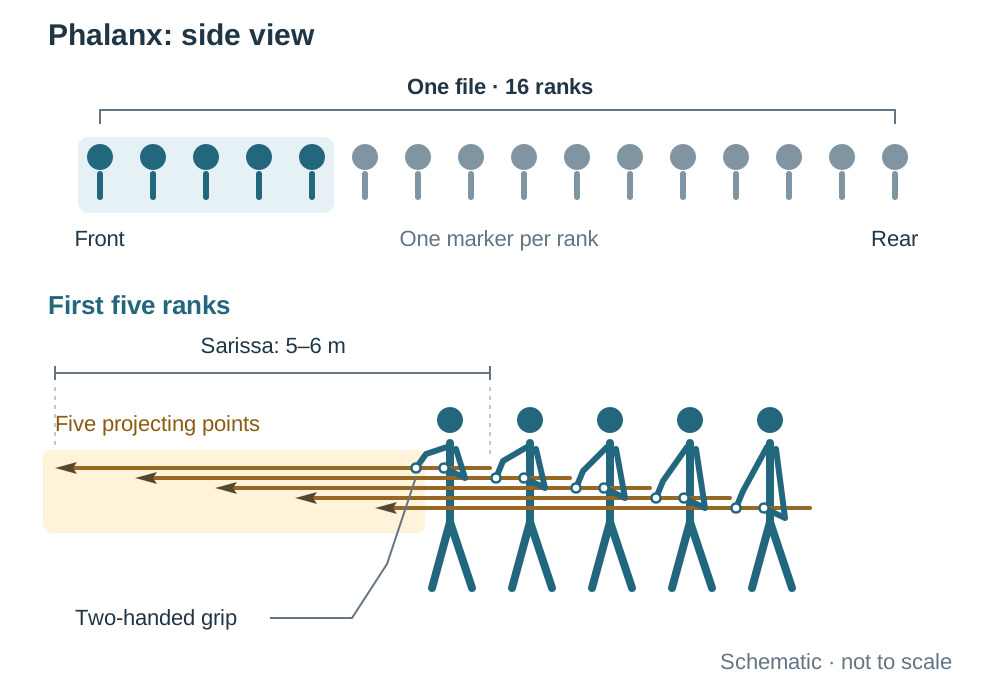
Decades of wars between the Greek city-states, starting with the Peloponnesian War (431–404 BC), left them exhausted and divided. Constant fighting between Athens, Sparta, and Thebes created a power vacuum. King Philip II of Macedonia (reigned 359–336 BC) exploited this disunity. He professionalised the Macedonian army, equipped his infantry with the sarissa (a long pike of 5 to 6 metres), and defeated Athens and Thebes at Chaeronea in 338 BC.
Philip bound the defeated Greek states into the League of Corinth (337 BC). This alliance gave Macedonia control over Greece under the official banner of leading a pan-Hellenic war of revenge against the Persian Empire for Xerxes' invasion in 480 BC. When Philip was assassinated in 336 BC, Alexander became king at just twenty. When Thebes rebelled in 335 BC, Alexander razed the city, sparing only the temples and the house of the poet Pindar, selling roughly 30,000 survivors into slavery to secure Greece before crossing into Asia.
The Late Roman Republic
Rome's conquests across the Mediterranean brought vast wealth to the senatorial elite while ruining small peasant farmers. Rome's city-state constitution could not manage an empire, producing deep social and political cracks.
Marius (consul 107 BC) recruited volunteers from the landless poor, ignoring the usual property qualification. These soldiers depended directly on their general for pay, booty, and retirement land, creating armies loyal to commanders rather than the Senate.
The Social War (91–88 BC) forced Rome to grant citizenship to Italian allies, but it normalised the use of military force in domestic politics. Sulla marched his legions directly on Rome twice, ruled as dictator (82–79 BC), and used proscriptions (posted death lists) to eliminate opponents.
Politics split into two factions: the Optimates, conservative senators defending senatorial authority, and the Populares, ambitious politicians appealing to citizen assemblies. In 60 BC, Julius Caesar formed an informal alliance, the First Triumvirate, with Pompey and Crassus to bypass senatorial obstruction. After his consulship in 59 BC, Caesar obtained the governorship of Gaul, giving him legions and military commands for a decade.
How the Map Changed
Before 334 BC, the Aegean world was separated into Macedonian-dominated Greece and the vast Achaemenid Persian Empire. By his death in 323 BC, Alexander had eliminated Persian borders, creating an empire reaching from mainland Greece and Egypt to the Indus River. After his death, this vast territory shattered into Hellenistic kingdoms ruled by his rival generals (the Diadochi), such as the Ptolemies in Egypt and the Seleucids in Asia.
In 60 BC, direct Roman rule in north-western Europe was confined to Gallia Narbonensis (southern coastal Gaul), while the interior remained divided among independent Celtic and Belgic tribes. By 50 BC, Caesar had extended Rome's provincial frontier across Transalpine Gaul right up to the Rhine and the English Channel, later organised into formal Roman provinces under Augustus.
Alexander the Great: Life, Persian Campaign, and the Macedonian Army
Chronological Outline of Alexander's Life
- 356 BC: Born at Pella to Philip II and Olympias; claims descent from Achilles and Heracles; tutored by Aristotle; tames the stallion Bucephalus.
- 338 BC: Commands the Companion cavalry wing at Chaeronea.
- 336 BC: Philip is assassinated; Alexander takes the throne aged twenty.
- 335 BC: Razes rebellious Thebes to terrorise Greece into submission.
- 334 BC: Crosses the Hellespont; visits Troy; wins the Battle of the Granicus.
- 333 BC: Cuts or unpins the Gordian knot; defeats Darius III at Issus; treats Darius's captured mother, wife, and daughters with honourable courtesy.
- 332 BC: Conducts the brutal seven-month siege of Tyre, followed by Gaza.
- 331 BC: Founds Alexandria in Egypt; consults the oracle of Ammon at Siwah; wins decisively at Gaugamela; enters Babylon and Susa.
- 330 BC: Burns the royal palace at Persepolis; Darius is murdered by Bessus; Philotas is executed for treason and his father Parmenio assassinated.
- 329 BC: Captures Bessus and has him mutilated in the Persian manner before execution.
- 328 BC: Murders his old friend Cleitus with a spear during a drunken brawl at Maracanda.
- 327 BC: Marries the Bactrian princess Roxana; fails to introduce proskynesis due to Callisthenes' open opposition; Callisthenes is imprisoned after the Pages' Conspiracy.
- 326 BC: Defeats King Porus at the Hydaspes; army mutinies at the Hyphasis River, refusing to march further east; Alexander sulks for three days before turning back.
- 325 BC: Wounded fighting the Malli; suffers terrible losses crossing the Gedrosian Desert.
- 324 BC: Holds mass weddings at Susa; faces mutiny at Opis over Persian favouritism; enters deep grief after Hephaestion dies.
- 323 BC: Enters Babylon despite ominous warnings from Chaldaean seers; dies in June aged 32.
Key Campaign Moments and Character Traits
- Granicus (334 BC): Alexander rejected Parmenio's cautious advice to wait until dawn and charged across the river. Cleitus saved his life. Afterwards, Alexander visited the wounded, granted tax exemptions to the families of his dead soldiers, and sent 300 suits of Persian armour to Athens. This shows boldness, care for his men, and political astuteness.
- Issus (333 BC): Darius chose a cramped plain between the sea and the mountains, neutralising his numerical superiority. Alexander charged on the right and wheeled into the Persian centre, causing Darius to flee. Alexander treated Darius's family with royal respect, showing nobility, yet wrote back arrogantly to Darius demanding to be addressed as 'King of all Asia'.
- Tyre (332 BC): Facing an island city half a mile offshore with walls 150 feet high and a strong fleet, Alexander built an enormous mole (causeway) from the mainland and gathered ships from Cyprus and Phoenicia. After a seven-month siege, Tyre was sacked: roughly 8,000 defenders were killed and 30,000 survivors enslaved (Arrian). This shows engineering tenacity and calculated cruelty.
- Siwah (331 BC): Alexander marched across the Libyan desert to visit the oracle of Ammon. He entered the inner shrine alone, later stating he had received the answer his heart desired. This fuelled rumours of his divine parentage, highlighting his skill at propaganda and his ambition to outdo Perseus and Heracles.
- Cleitus (328 BC): At a banquet in Maracanda, Cleitus attacked Alexander for adopting Persian customs, belittling Philip, and tolerating oriental flattery, reminding him: 'This hand of mine saved you at the Granicus.' In a drunken rage, Alexander ran Cleitus through with a spear. He immediately felt intense remorse, starving himself in his tent until the philosopher Anaxarchus comforted him by claiming that whatever a king does is just.
- Hydaspes and Porus (326 BC): Alexander crossed a swollen river during a storm at night behind an island screen, outflanking Porus. When Porus was defeated, Alexander asked how he wished to be treated. Porus replied, 'Like a king.' Alexander restored his territory and gave him additional lands, showing generosity toward an admired opponent alongside practical frontier management.
- Mutiny at Opis (324 BC): Resentment over Alexander wearing Persian dress, adopting eastern court etiquette, and creating the epigonoi (30,000 Asian youths trained in Macedonian arms) boiled over when Alexander announced that veteran and disabled Macedonians would be discharged home. The soldiers shouted that he should dismiss them all and campaign with his father Ammon. Alexander arrested thirteen ringleaders, locked himself away, and appointed Persians to top commands. His weeping troops begged for forgiveness, sealed by a grand reconciliation banquet for 9,000 guests.
Macedonian Combined-Arms Army and Gaugamela (331 BC)
Philip and Alexander built a combined-arms force:
- The Macedonian Phalanx: Foot companions (pezhetairoi) formed units 16 ranks deep armed with the sarissa. Held in two hands, these pikes presented a wall of five spear points per file to pin the enemy front.
- Hypaspists and Light Troops: The elite shield-bearing hypaspists guarded the vulnerable gap between the slow-moving phalanx and the cavalry. Agrianian javelin-throwers, Cretan archers, and Thracian skirmishers provided missile cover.
- Companion Cavalry (Hetairoi): Elite Macedonian heavy shock cavalry, armed with the xyston* (thrusting spear), deployed as the offensive hammer.
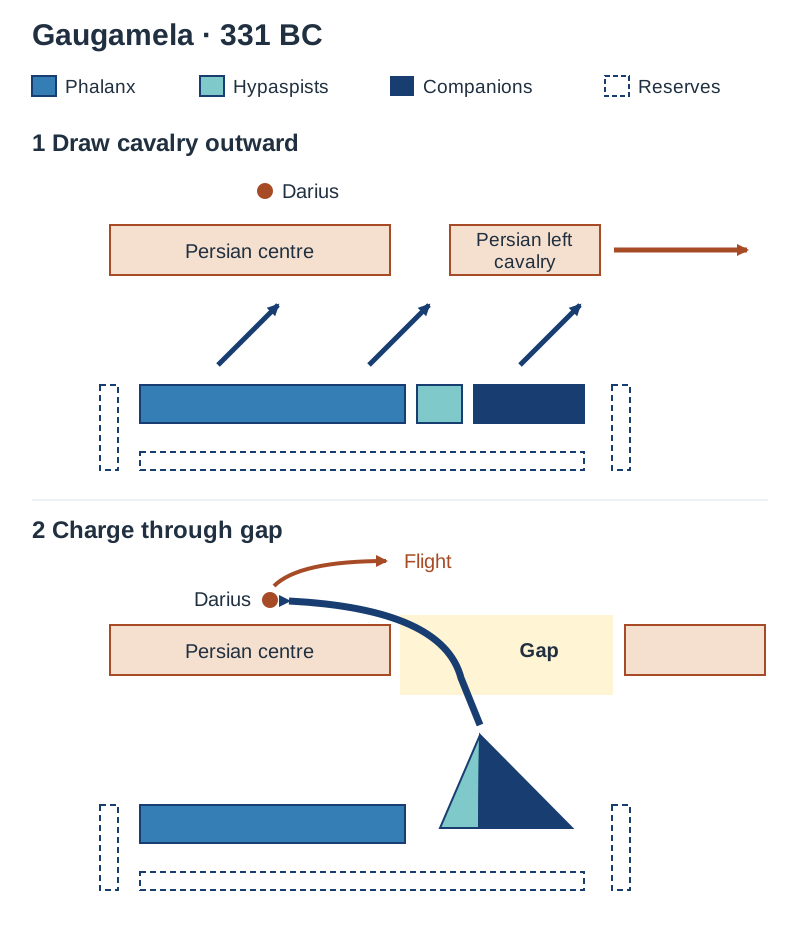
At Gaugamela (331 BC), Darius III levelled the battlefield to deploy scythed chariots and his superior cavalry numbers. Alexander posted reserve units on the flanks and rear to prevent encirclement, forming a defensive hollow square. He advanced his line obliquely to the right, luring the Persian left cavalry away from their centre. When a gap opened between the Persian left wing and centre, Alexander formed his Companion cavalry and hypaspists into a sharp wedge and charged directly into the breach toward Darius. Darius broke and fled, collapsing Persian resistance.
Julius Caesar: Life, Gallic Campaign, and the Roman Army
Chronological Outline of Caesar's Life
- 100 BC: Born into the patrician Julian clan, connected by marriage to Marius.
- c. 82 BC: Defies the dictator Sulla by refusing to divorce his wife Cornelia, fleeing Rome to avoid proscription.
- c. 75 BC: Captured by Cilician pirates; laughs at their ransom of 20 talents, demands they ask for 50, and upon release mans ships, captures them, and has them crucified (Plutarch).
- 69 BC: As quaestor in Spain, weeps before a statue of Alexander, lamenting that he has achieved nothing at the age Alexander had conquered the world.
- 65 BC: As curule aedile, runs up staggering debts staging lavish games to win popular support.
- 63 BC: Elected Pontifex Maximus; speaks against the death penalty for the Catilinarian conspirators in the Senate, urging constitutional restraint.
- 60 BC: Forms the First Triumvirate with Pompey and Crassus.
- 59 BC: Serves as consul; uses mob pressure and Pompey's veterans to ignore senatorial vetoes.
- 58–50 BC: Serves as proconsul in Gaul, winning military glory and veteran devotion.
- 54 BC: His daughter Julia (Pompey's wife) dies; personal ties between the triumvirs fracture.
- 53 BC: Crassus is killed at Carrhae fighting the Parthians.
- 49 BC: Ordered by the Senate to surrender his command, he crosses the Rubicon with the 13th Legion, declaring: 'The die is cast.'
- 48 BC: Defeats Pompey at Pharsalus; Pompey is murdered upon landing in Egypt.
- 47 BC: Defeats Pharnaces at Zela, summing up the campaign as 'Veni, vidi, vici' ('I came, I saw, I conquered').
- 44 BC: Named dictator for life (dictator perpetuo); Mark Antony offers him a royal diadem at the Lupercalia festival, which Caesar refuses amid popular unease.
- Ides of March (15 March), 44 BC: Ignores the warnings of the seer Spurinna and his wife Calpurnia's nightmare; stabbed 23 times in the Curia of Pompey by a senatorial conspiracy led by Brutus and Cassius.
Key Campaign Moments in Gaul (58–50 BC)
- Helvetii and Ariovistus (58 BC): Caesar blocked the migration of the Helvetii through Roman territory, routing them at Bibracte and forcing survivors to return to rebuild their homes. He then drove the Germanic king Ariovistus back across the Rhine, portraying both actions as defending Rome's allies, the Aedui.
- The Nervii at the Sambre (57 BC): The Belgic Nervii ambushed the Roman army while it was building a camp. The Roman lines were nearly shattered; Caesar grabbed a shield from a soldier in the rear and fought in the front line, rallying his men to victory.
- Naval War with the Veneti (56 BC): The seafaring Veneti of Brittany held tidal strongholds. Decimus Brutus used Roman rowed galleys equipped with bill-hooks on long poles to cut the rigging of the Veneti's leather-sailed ships, rendering them helpless. Caesar executed the Veneti council and sold the tribe into slavery.
- Usipetes and Tencteri, Rhine Bridge, Britain (55–54 BC): Caesar attacked the Germanic Usipetes and Tencteri during a truce, slaughtering men, women and children; Caesar's own figures put the migrating peoples at about 430,000, a number that cannot be checked. In Rome, Cato the Younger urged the Senate to hand Caesar over to the Germans to purge Rome of the sacrilege. Caesar built a timber trestle bridge across the Rhine in ten days to showcase Roman engineering, made an armed demonstration, dismantled it, and launched two reconnaissance invasions of Britain.
- Revolt of Ambiorix (54–53 BC): Ambiorix of the Eburones ambushed a Roman legion under Sabinus and Cotta, destroying it. Caesar relieved Quintus Cicero's besieged camp and systematically burned the territory of the Eburones, hunting them without mercy.
- Vercingetorix, Avaricum, and Gergovia (52 BC): Vercingetorix of the Arverni unified the Gallic tribes in revolt, using scorched-earth tactics to starve the Romans. Caesar besieged and stormed Avaricum. Caesar says that of about 40,000 people in Avaricum, barely 800 escaped; like his other figures, this cannot be checked. However, Caesar suffered a serious defeat trying to storm Vercingetorix's hilltop stronghold at Gergovia, losing 700 men and 46 centurions.
- Uxellodunum (51 BC): In the final mopping-up operation (recorded in Book 8 of the Gallic War, written by Caesar's officer Aulus Hirtius), Caesar cut off the water supply to the hill fort. When it fell, he chopped off the hands of all who had borne arms to serve as a living warning.
Roman Legionary Tactics and the Siege of Alesia (52 BC)
Caesar's army was built around disciplined heavy infantry legions:
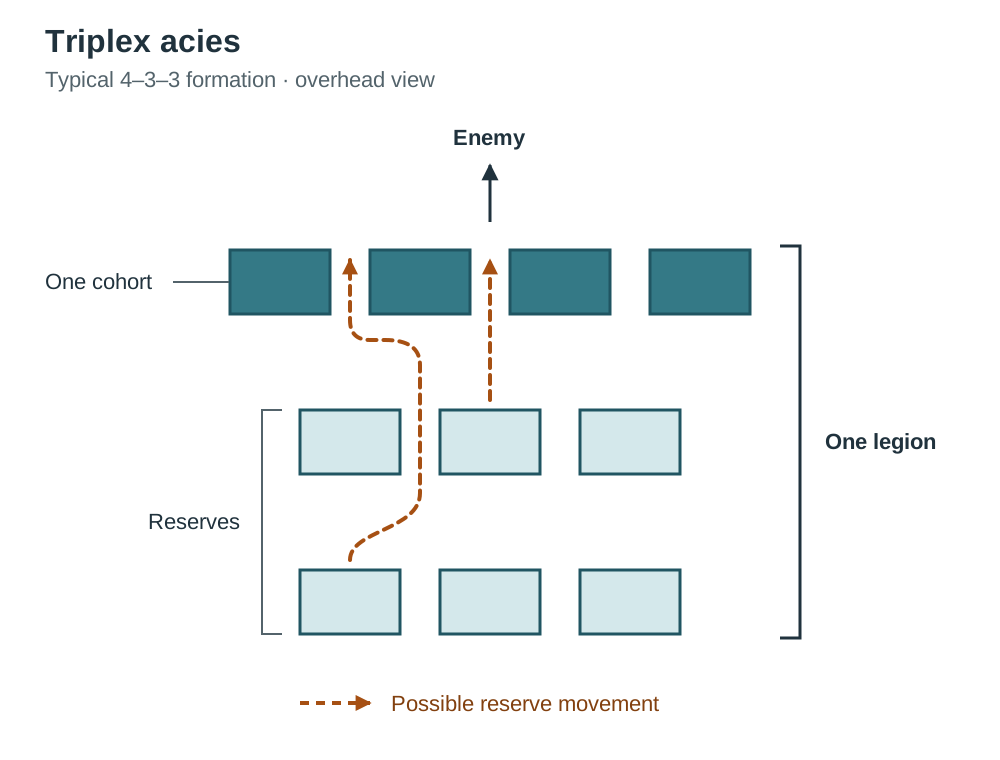
- Cohort Organisation and the Triplex Acies: Each legion of roughly 4,000–5,000 men was divided into ten cohorts. In battle, Caesar normally deployed them in the triplex acies (three lines of cohorts, typically arranged 4–3–3). The front line engaged the enemy; the second and third lines acted as flexible tactical reserves to plug gaps or counter-attack.
- Weapons: Legionaries threw the pilum (a heavy javelin designed to bend on impact, weighing down enemy shields) before drawing the gladius (a short, thrusting sword) behind large curved rectangular shields (scuta).
- Allied Cavalry: Caesar recruited Gallic, Germanic, and Spanish horsemen as auxiliaries (auxilia) to screen his flanks and pursue fleeing enemies.
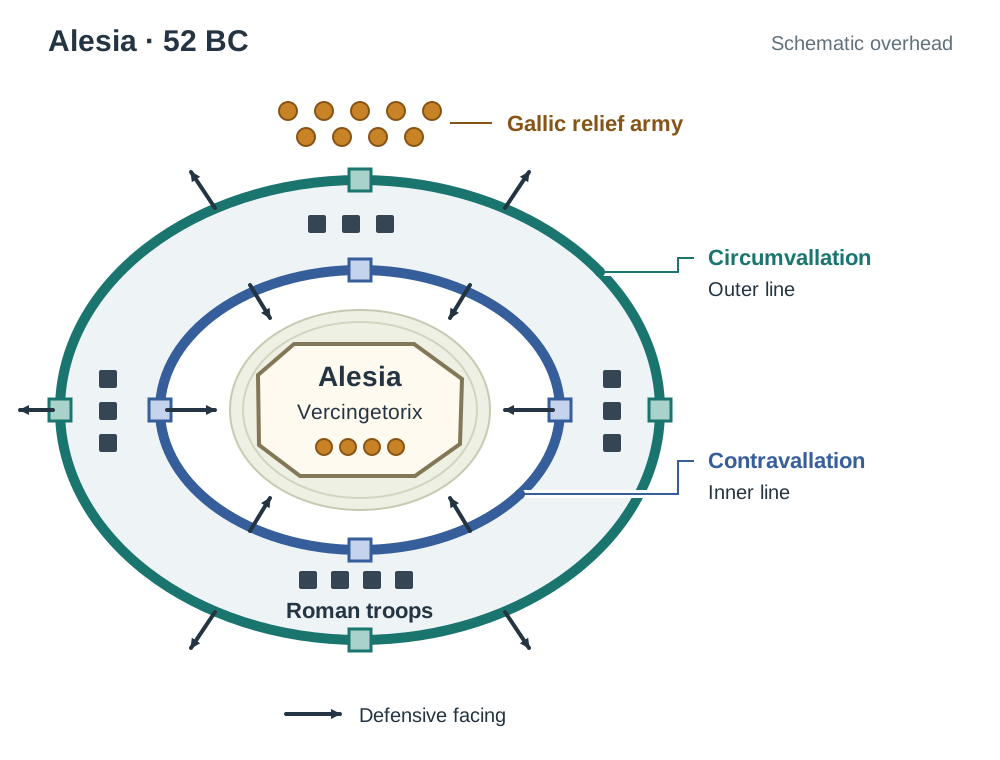
At Alesia (52 BC), Vercingetorix retreated into a hilltop fortress with 80,000 warriors. Caesar refused to launch a frontal assault and built an elaborate double siege system:
- Contravallation (Inner Line): An 11-Roman-mile (16 km) rampart with palisades, towers, trenches, hidden spiked pits (stimuli and cippi), facing inward toward the town to starve the garrison.
- Circumvallation (Outer Line): A 14-Roman-mile (21 km) rampart facing outward to protect against a massive Gallic relief army. Caesar claims the relief force had 250,000 infantry and 8,000 cavalry (an inflated figure to magnify his achievement).
- Tactical Command: When the relief army attacked the weak northern sector, Caesar sent Labienus to reinforce it and led the final counter-attack himself. In his account, Caesar notes that his scarlet cloak (paludamentum) made him instantly recognisable to his men. The relief force broke, and Vercingetorix rode out and surrendered his arms, ending organised Gallic resistance.
Literary Characterisation and Historiography
Understanding Ancient Text Types
Ancient authors did not write objective modern history. They selected, shaped, and evaluated events according to the conventions of their literary genre and political viewpoint.
Plutarch (Parallel Lives: Life of Alexander and Life of Caesar)
- Author and Date: Greek biographer and philosopher (c. AD 46–120), writing under the Roman Empire, roughly 400 years after Alexander and 150 years after Caesar.
- Genre: Moral Biography: Plutarch states his purpose in the opening lines of the Life of Alexander: 'It is not histories I am writing, but lives.' He explains that an incidental action, a brief phrase, or a witty jest often shows a person's character more clearly than bloody battles with tens of thousands of dead.
- Method: He pairs a famous Greek with a Roman (Alexander with Caesar) to compare their virtues and vices, drawing moral lessons for his readers.
- Portrait of Alexander: A heroic, generous conqueror whose character deteriorated under the corrupting influence of eastern flattery, unchecked ambition, and heavy drinking. In Life of Alexander 28, Plutarch explains that Alexander behaved haughtily towards barbarians as if convinced of his divine origin, but was moderate towards Greeks; he used belief in his divinity to subjugate others rather than being deluded himself.
- Portrait of Caesar: A charismatic genius of boundless ambition, extraordinary daring, and political shrewdness. Plutarch argues in Life of Caesar 60 that the open, fatal hatred against him was caused by his passion to be king (rex), underlined when Antony offered him a diadem at the Lupercalia.
Arrian (Anabasis of Alexander)
- Author and Date: Greek politician, military commander, and Roman citizen who governed Cappadocia under Emperor Hadrian in the 2nd century AD.
- Genre: Military History: Arrian focuses on military strategy, geography, logistics, and operational tactics.
- Method and Sources: Arrian states in his preface that he relies primarily on Ptolemy (Alexander's general and later King of Egypt) and Aristobulus (a military engineer on the campaign). He considers them reliable because both accompanied Alexander, wrote after his death when flattery was unnecessary, and Ptolemy, being a king himself, would find lying especially disgraceful. Arrian regularly records conflicting accounts, such as whether Alexander cut the Gordian knot with a sword or pulled out the linchpin.
- Portrait of Alexander: Admiring of his military genius, courage, and stamina. Arrian excuses Alexander's violent outbursts and adoption of Persian customs as the errors of youth, flattery, and unprecedented success, praising his genuine remorse after killing Cleitus.
Julius Caesar (Commentarii de Bello Gallico)
- Author and Date: Caesar himself, writing annual reports published in Rome between 58 and 50 BC. Note that Book 8 was written by his staff officer, Aulus Hirtius, to bridge the narrative to the Civil War.
- Genre: Commentarius (Military Dispatches / Propaganda): A commentarius* was nominally an unadorned general's notebook or dispatch, meant to provide raw material for future historians. In practice, Caesar crafted it as political propaganda to justify illegal wars, win popular favour in Rome, and counter senatorial enemies like Cato.
- Method: Caesar writes in the third person ('Caesar did this', 'Caesar ordered'), creating an impression of detached, objective reporting.
- Self-Presentation: Caesar portrays himself as decisive, rational, calm, and devoted to the safety of his soldiers. He describes the Gauls as fickle and constantly scheming for rebellion (mobiles, novis rebus studentes), thereby framing his military violence as legitimate defence of Roman allies and peace.
Comparing Alexander and Caesar: Empire-Building, 'Civilised', and 'Barbarian'
Thematic Comparison
When answering comparative essay questions, examine both commanders side by side across clear analytical themes.
| Theme | Alexander the Great (Persians) | Julius Caesar (Gauls) |
|---|---|---|
| Core Cultural Policy | Cultural Fusion: Blended Macedonian and Persian ruling classes into an integrated imperial elite. Challenged the traditional Greek view that all non-Greeks were natural barbarians and slaves. | Roman superiority: Caesar adopted nothing Gallic and treated the Gauls as subjects to be controlled through client nobles, hostages and selective citizenship. Fuller Romanisation (provinces, towns, Latin administration) followed under Augustus. |
| Administrative Rule | Retained Persian nobility in power. Confirmed Mazaeus as satrap of Babylon after Gaugamela and appointed eastern governors throughout Asia. | Replaced hostile chieftains with compliant local puppets. Granted Roman citizenship selectively to cooperative Gallic nobles to turn them into Roman clients. |
| Adoption of Customs | Adopted Persian royal dress (the diadem and sash) and tried to introduce proskynesis (prostration) in 327 BC, outraging his Macedonian officers. | Adopted no Gallic customs. Kept Roman magistrate's dress, spoke Latin, and governed strictly by Roman legal traditions. |
| Intermarriage | Married Roxana of Bactria and Stateira (daughter of Darius). Staged the Susa Weddings (324 BC), forcing 80 Macedonian officers to marry Persian noblewomen. | Never married a Gaul. Secured political obedience by taking the sons of Gallic chieftains as elite hostages. |
| Military Integration | Drafted Persian cavalry into the elite Companion cavalry and trained 30,000 Asian youths (epigonoi) in Macedonian tactics. This long-standing grievance fed the Opis Mutiny (324 BC), which was triggered by Alexander's announcement that older and unfit Macedonians would be sent home. | Recruited Gallic and Germanic cavalry as auxiliary units (auxilia), kept under Roman legionary command. |
| Violence and Terror | Razed Thebes (335 BC) and sacked Tyre (332 BC), enslaving about 30,000 survivors; burned the royal palace at Persepolis (330 BC); had Bessus mutilated and executed; yet protected Darius's family. | Massacred civilians at Avaricum (52 BC); chopped off the hands of defenders at Uxellodunum (51 BC); enslaved entire tribes like the Veneti. |
'Civilised' and 'Barbarian' in Their Own Words
- Caesar's Concept of Barbarism: In Gallic War 1.1, Caesar writes that the Belgae are the bravest of all Gauls 'because they are furthest from the civilisation and refinement (cultus atque humanitas) of the Roman Province' and merchants rarely bring them the luxury goods that soften the spirit. For Caesar, civilisation means Roman culture, but it brings moral softness; he admires barbarian toughness while using Gallic instability to justify Roman conquest.
- Caesar's Clemency (clementia)*: Caesar used mercy as a calculated political tool. He spared tribes that surrendered promptly, and after Alesia he returned Aeduan and Arvernian prisoners without ransom to win back their tribal loyalty, while giving every other captive soldier as a slave to his men.
- Evidence Against the 'Ideal Fusion' View of Alexander: Alexander's adoption of eastern customs was pragmatic statecraft, not humanitarian idealism. He burnt Persepolis in 330 BC to avenge Xerxes' burning of Athens; he had Bessus's nose and ears slit in 329 BC according to brutal Persian custom; and his restoration of King Porus after the Hydaspes (326 BC) was also practical frontier management, leaving a strong, grateful ally in control of the Indian border.
Character Traits with Supporting Evidence
Use this grid to pair character traits with concrete historical episodes in essays:
| Character Trait | Alexander the Great | Julius Caesar |
|---|---|---|
| Military Daring & Audacity | Attacking at the Granicus against Parmenio's advice; wedge charge into the gap at Gaugamela. | Crossing the Rhine on a wooden trestle bridge built in ten days; crossing the Rubicon in 49 BC. |
| Personal Bravery | Leading the cavalry charge across the river at the Granicus, where Cleitus saved his life; leaping into the Mallian fortress almost alone. | Grabbing a shield and fighting in the front rank against the Nervii at the Sambre (57 BC). |
| Ruthlessness & Terror | Razing Thebes (335 BC); enslaving 30,000 survivors of Tyre (332 BC); mutilating Bessus. | Sacking Avaricum (about 40,000 dead, by Caesar's own count); cutting off defenders' hands at Uxellodunum (51 BC). |
| Superstition vs Omens | Terrified by black birds falling and Chaldaean omens outside Babylon (Plutarch). | Dismissing the seer Spurinna and Calpurnia's dream on the Ides of March (44 BC). |
| Care for His Troops | Pouring out water in the Gedrosian Desert when his men had none; visiting wounded at Granicus. | Rallied his men personally at Alesia in his scarlet cloak; secured land and bonuses for veterans. |
| Arrogance & Hubris | Demanding proskynesis from Greeks; murdering Cleitus for criticising his Persian ways. | Refusing to stand for visiting senators; accepting life dictatorship; Lupercalia diadem incident. |
Key terms
- League of Corinth
- The confederation of Greek city-states founded by Philip II in 337 BC, establishing Macedonian control and organising a pan-Hellenic expedition against the Persian Empire.
- Sarissa
- A pike about 5 to 6 metres long, introduced by Philip II and held with two hands by Macedonian phalanx infantry.
- Companion Cavalry
- The elite Macedonian heavy shock cavalry (Hetairoi), deployed in an offensive wedge formation and led personally by Alexander.
- Proskynesis
- The Persian court ritual of bowing or prostrating before the king. Natural to Persians, but viewed by Greeks and Macedonians as blasphemous worship fit only for the gods.
- Satrap
- A provincial governor in the Persian Empire's administrative system. Alexander retained many existing Persian satraps, such as Mazaeus in Babylon, to preserve order.
- Epigonoi
- The 30,000 Persian and Asian youths trained in Greek language and Macedonian arms by Alexander, whose creation created resentment among Macedonian veterans.
- Susa Weddings
- A mass wedding ceremony organised by Alexander in 324 BC, where he and 80 Macedonian officers married high-born Persian and Median noblewomen to blend the ruling classes.
- Optimates and Populares
- Political approaches in the late Roman Republic: Optimates defended senatorial privilege, while Populares advanced policy through popular assemblies and tribunes.
- First Triumvirate
- An informal political alliance formed in 60 BC between Julius Caesar, Pompey the Great, and Marcus Licinius Crassus to bypass senatorial opposition.
- Triplex Acies
- Caesar's standard battlefield formation, deploying the ten cohorts of a legion in three lines (usually 4-3-3) to allow continuous tactical reserves.
- Circumvallation and Contravallation
- A double siege wall system: contravallation is the inner line facing the besieged town to prevent breakout; circumvallation is the outer line facing outward to repel a relief army.
- Commentarius
- A general's official campaign notebook or report. Caesar used this genre in the Gallic War, writing in the third person to project objective authority while promoting his achievements.
- Moral Biography
- The literary genre used by Plutarch in his Parallel Lives, focusing on character, moral virtues, and fatal flaws through anecdotes rather than exhaustive military history.
- Clementia
- The Roman concept of mercy shown by a conqueror to defeated enemies, used strategically by Caesar in Gaul and during the Civil War to secure political loyalty.
Check yourself
What famous statement does Plutarch make about his historical method at the start of the Life of Alexander?
He writes: 'It is not histories I am writing, but lives', explaining that a brief phrase or jest often reveals character more clearly than battles with thousands of dead.
Why did Alexander's army refuse to advance beyond the Hyphasis River in 326 BC?
The soldiers were exhausted, homesick, soaked by monsoon rains, and fearful of facing massive Indian armies equipped with hundreds of war elephants.
What did King Porus ask when Alexander questioned how he wished to be treated, and how did Alexander respond?
Porus asked to be treated 'like a king'. Alexander restored his kingdom, granted him additional territory, and ruled him as a trusted ally on the eastern frontier.
Who authored Book 8 of Caesar's Gallic War, and what brutal event does it recount at Uxellodunum?
It was written by Caesar's staff officer Aulus Hirtius, and it records that Caesar cut off the hands of all Gallic fighters who had borne arms to serve as a warning against rebellion.
In standard military siege terminology, what is the functional difference between contravallation and circumvallation at Alesia?
Contravallation is the inner wall facing the besieged town to prevent breakout, while circumvallation is the outer wall facing outward to defend against an incoming relief army.
How did Caesar characterize the bravery of the Belgae in Gallic War 1.1?
He stated they were the bravest because they were furthest from the civilisation and luxury of the Roman Province, which softened their fighting spirit.