

Roman emperors put on huge free shows to keep the people of Rome happy and loyal. The two most important venues were the Colosseum, which staged beast hunts, executions, and gladiator fights for about 50,000 spectators, and the Circus Maximus, an immense arena holding about 150,000 people for chariot racing. The satirist Juvenal mocked this political strategy as bread and circuses (panem et circenses), complaining that the Roman people had given up the political power they once held through voting in the Republic in exchange for free grain and entertainment. By studying the architecture, audience experience, organisation, and written records of these venues, we see how public spectacles reinforced imperial authority and reflected Roman social hierarchy.
The Colosseum: Architecture and Engineering
The Colosseum was officially known as the Flavian Amphitheatre. Emperor Vespasian started construction in AD 72, his son Titus inaugurated it in AD 80 with one hundred days of games, and Domitian completed the underground levels and top gallery. The building is an ellipse measuring roughly 189 metres by 156 metres, rising nearly 48 metres high. Its outer wall was built from durable travertine limestone held together with iron clamps, while the inner walls used tufa and brick, and the massive vaults were cast in Roman concrete (opus caementicium).
Vespasian chose the building site for political reasons. He placed the amphitheatre on the drained lake of Nero's hated Golden House (Domus Aurea). By handing land stolen by an autocrat back to ordinary citizens as a pleasure ground, the new Flavian dynasty advertised its generosity (liberalitas).
Facade and Crowd Circulation
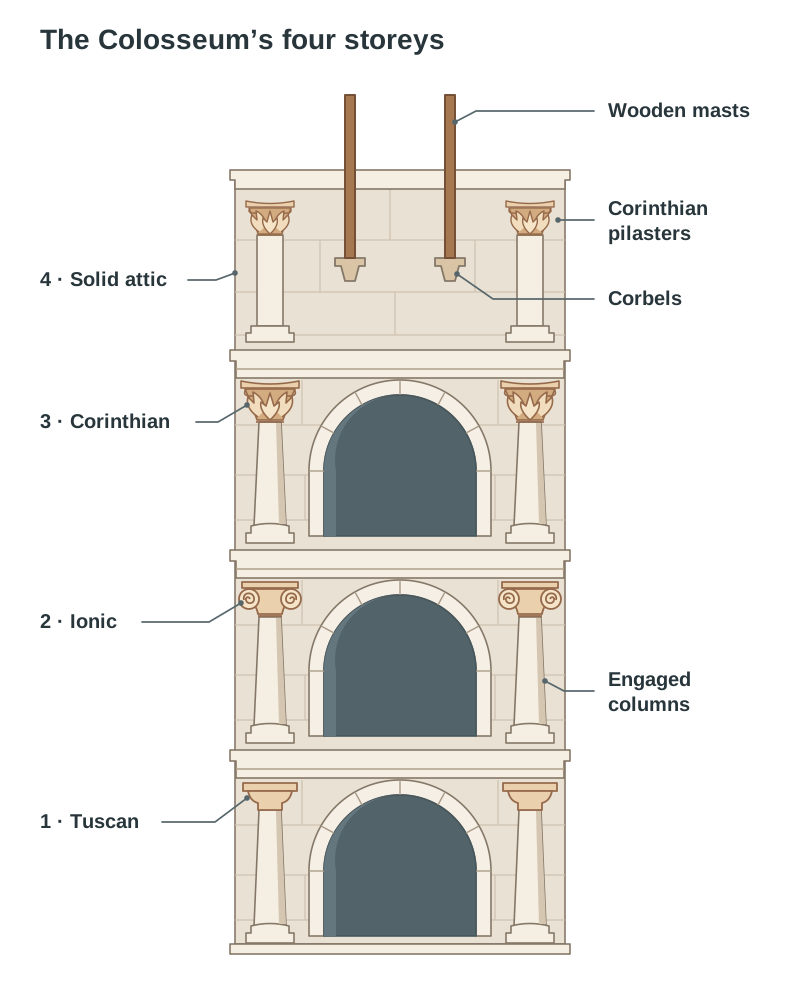
The exterior facade features four storeys. The first three storeys consist of open arcades framed by engaged columns of three different Classical architectural orders:
- Ground storey: Tuscan (a plain Roman version of the Greek Doric order).
- Second storey: Ionic, recognisable by its scroll-shaped volutes.
- Third storey: Corinthian, decorated with acanthus leaves.
- Fourth storey (attic): A solid wall with Corinthian pilasters and stone corbels supporting wooden masts.
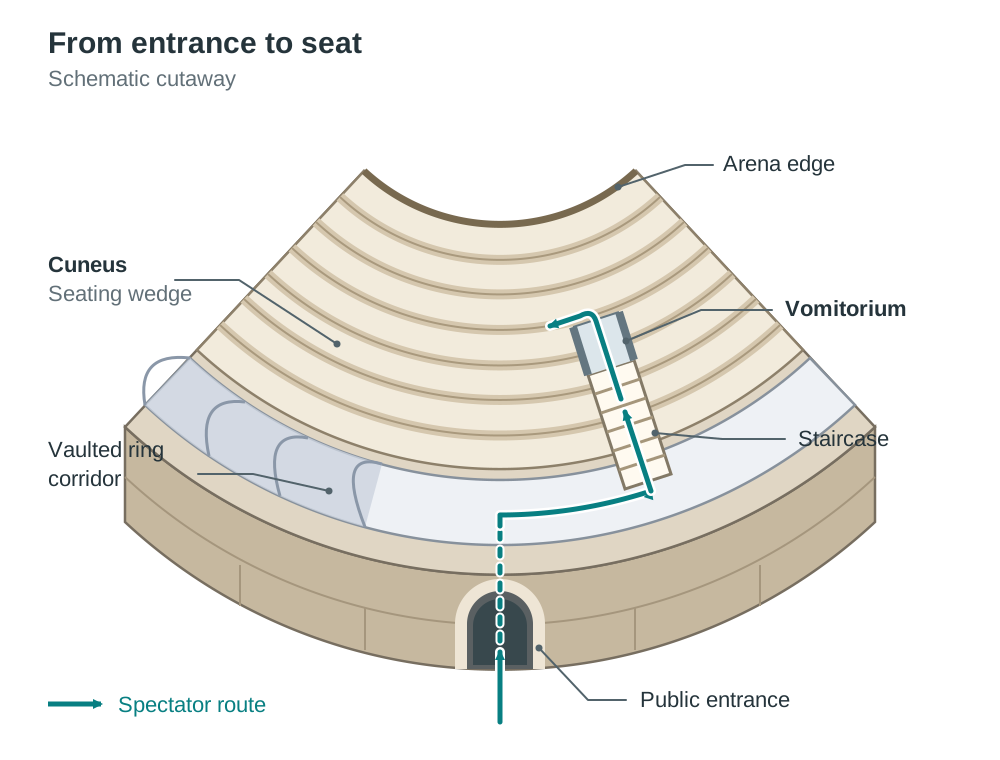
The ground floor contained eighty arches. Four unnumbered arches on the main axes were reserved for dignitaries and ceremonial entrances. The other seventy-six arches were numbered public entrances. Spectators carried clay tokens (tesserae) stamped with their designated arch number. These arches led into vaulted ring corridors and staircases. Short passages called vomitoria (from the Latin vomere, meaning to spew forth) opened from this circulation system into the seating wedges (cunei), helping disperse the crowd.
Hypogeum and Velarium
Two specialised engineering systems made the spectacles work:
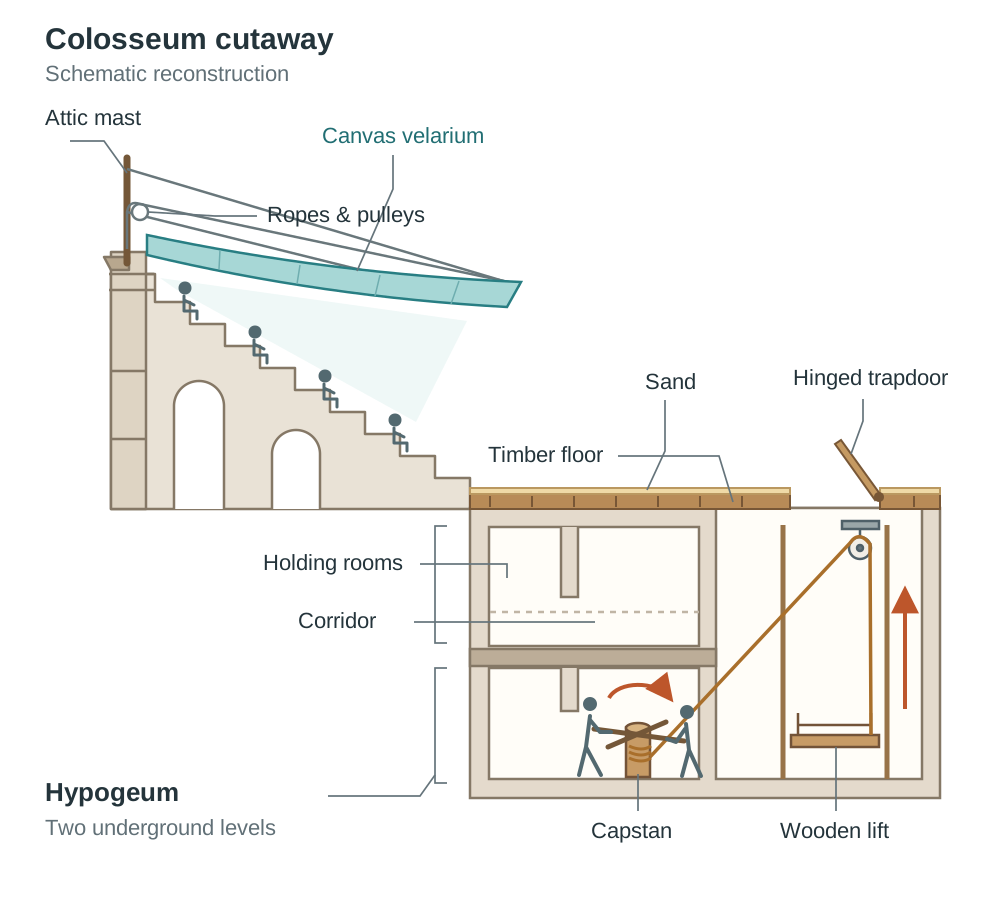
- The Hypogeum: Built by Domitian beneath the timber arena floor, this was a two-storey subterranean complex of masonry corridors, animal dens, and holding rooms. Wooden lifts were raised by capstans (winches) turned by teams of workers. These lifts and hinged trapdoors allowed gladiators, stage scenery, and exotic beasts to appear suddenly in the sand-covered arena.
- The Velarium: A colossal canvas awning hung from the attic masts using ropes and pulleys. It protected spectators from the hot sun. Sailors from the imperial fleet based at Misenum were stationed in Rome to rig and work the canvas.
Entertainment in the Amphitheatre: The Programme and Organisation
A full day of games followed an established three-part schedule that put Roman military might, imperial justice, and mastery over nature on display.
The Daily Programme
- Morning (Venationes): Wild beast hunts featured trained huntsmen (venatores*) fighting exotic animals captured from across the empire, such as lions, panthers, bears, elephants, and crocodiles. These hunts showed that Rome commanded the farthest boundaries of the known world.
- Midday Executions (Ludi Meridiani): At midday, convicted criminals (damnati*) and prisoners of war were put to death with no armour or defence. Some were exposed to beasts, while others were forced into lethal mythological reenactments. The poet Martial describes a criminal dressed as Daedalus being mauled by a bear when his artificial wings failed to lift him, and a criminal playing Laureolus being crucified and mauled by a bear. Martial compares Laureolus’s suffering to that of Prometheus; he does not describe a literal Prometheus-on-a-rock execution.
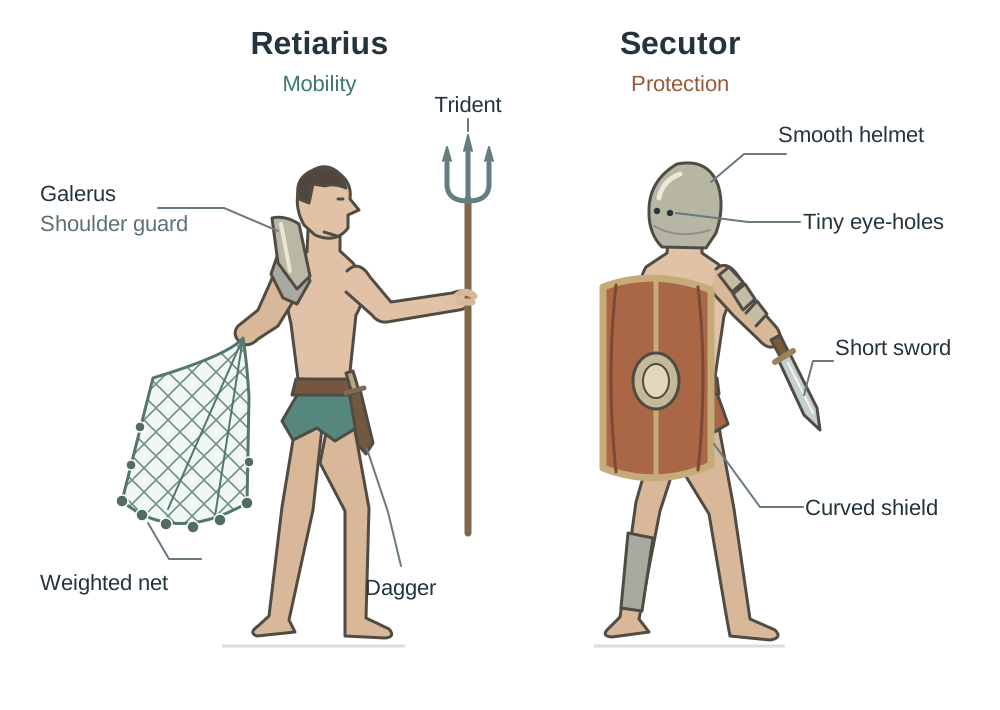
- Afternoon Combat (Munera): The afternoon brought paired gladiatorial duels. Gladiators were paired to balance armour against speed. The best-known pairing matched the lightly armed retiarius (equipped with a weighted net, trident, dagger, and a metal shoulder-guard or galerus, but no helmet) against the secutor (the 'chaser', who had a smooth, egg-shaped helmet with tiny eye-holes that gave the net nothing to catch on, along with a curved rectangular shield and short sword). Another common match was the murmillo (crested bronze helmet with a fish motif, large shield, and short thrusting sword or gladius) fighting a thraex (Thracian), who carried a small square shield and a curved scimitar (sica*).
When a gladiator fell wounded, he appealed to the sponsor (editor). The editor listened to the crowd's shouts and watched their thumb signals before granting mercy (missio) or ordering death. The exact gesture is debated; the phrase was pollice verso ('with turned thumb').
Funding and Event Organisation
Under the Empire, major games were controlled by the emperor or magistrates acting with his permission. Vespasian paid for the Colosseum from the spoils of war (manubiae) taken during the sack of Jerusalem in AD 70. The original bronze dedicatory inscription has been reconstructed from the holes left by its letters; it appears to describe funding from the spoils of war (ex manubiis). Gladiators were bought, trained, and hired out by a manager called a lanista, who operated a training school (ludus). In Rome, the emperors took control of these schools, the largest being the Ludus Magnus, which was linked directly to the Colosseum by an underground tunnel. A gladiator who earned his freedom received a wooden practice sword (rudis).
The Circus Maximus: Track Design, Racing, and Origins
The Circus Maximus was Rome's oldest and largest venue for chariot racing. It sat in the natural valley between the Palatine and Aventine hills, measuring roughly 600 metres long and 140 metres wide. Julius Caesar expanded it, and later emperors rebuilt it in stone and brick after repeated fires. Modern estimates calculate that it held about 150,000 seated spectators, although the ancient writer Pliny the Elder claimed it could hold up to 250,000.
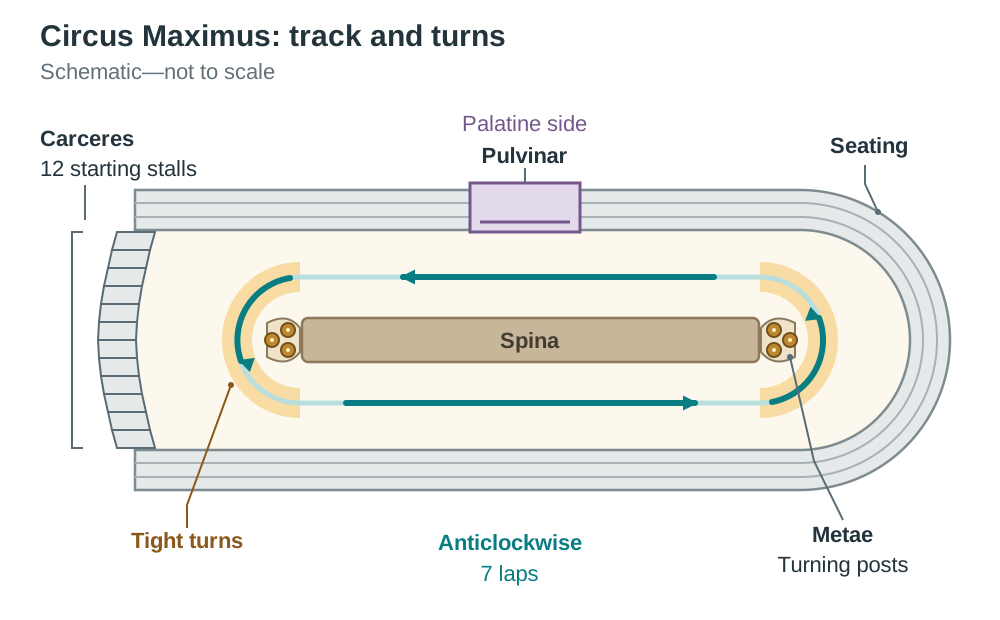
Key Architectural Features
- Carceres: Twelve starting stalls arranged on a shallow curve at the western end. When the presiding magistrate dropped a white cloth (mappa), a mechanical latch opened all twelve gates at once, giving every team an equal run to the white break-line where they could move out of their lanes.
- Spina (or Euripus): The broad central barrier dividing the racetrack. It was decorated with Egyptian obelisks, shrines, and mechanical lap-counters. Seven bronze dolphins (sacred to Neptune, patron of horses) and seven wooden eggs (honouring the twin gods Castor and Pollux) were tipped or lowered as the chariots finished each of the seven laps.
- Metae: Three tall, conical turning posts made of gilded bronze on stone bases at each end of the spina. Turning these posts at full gallop was dangerous. Charioteers hugged the posts to save ground, which frequently caused pile-ups (naufragia, literally 'shipwrecks') that smashed wooden chariots and trampled drivers.
- Pulvinar: Originally a sacred platform where images of the gods were placed to watch the races. Augustus expanded the pulvinar on the Palatine slope, linking it to the imperial palace so the emperor watched the races sitting beside the gods in full view of the public.
Chariot Racing and Religious Roots
Races were run anticlockwise over seven laps (about 5 kilometres). Charioteers drove two-horse (bigae) or four-horse teams (quadrigae). The driver (auriga) tied the leather reins securely around his waist and carried a curved knife to slash himself free during a crash. The sport was run by four commercial syndicates or factions (factiones), identified by colour: the Reds, Whites, Blues, and Greens. These companies owned the stables, bred the horses, and hired the charioteers.
Roman spectacles had religious and funerary roots. Chariot racing formed part of religious festivals (ludi), such as the Ludi Romani honoring Jupiter. Every race day began with a sacred procession (pompa circensis) that marched from the Capitoline Hill, through the Roman Forum, and into the Circus, carrying statues of the gods. Gladiatorial shows originated as funerary games (munera, meaning funeral duties or gifts) held in honour of deceased aristocrats. The first recorded contest in Rome took place in 264 BC, when three pairs of gladiators fought at the funeral of Junius Brutus Pera.
Comparison: The Colosseum vs The Circus Maximus
To prepare for exam questions that demand direct comparison, use this summary of both venues:
| Feature | The Colosseum | The Circus Maximus |
|---|---|---|
| Building Type | Amphitheatre (enclosed double theatre) | Circus (open stadium with a track) |
| Shape and Dimensions | Elliptical; roughly 189 m by 156 m; 48 m high | U-shaped with rounded end; roughly 600 m by 140 m |
| Capacity | About 50,000 spectators | About 150,000 seated (Pliny claims up to 250,000) |
| Main Spectacles | Beast hunts (venationes), executions, gladiator fights (munera) | Chariot races (ludi circenses), religious processions (pompa circensis) |
| Seating Regulations | Strict legal segregation by class and gender (lex Iulia theatralis) | Mixed-gender seating in the stands; special reserved rows for senators and knights |
| Key Engineering | Travertine piers, concrete vaults, hypogeum with winched lifts, velarium awning | Carceres (starting stalls), central spina with obelisks, metae, dolphin/egg lap-counters |
| Sponsor's Motivation | Flavian dynastic legitimacy; replacing Nero's palace; displaying military triumph | Maintaining civic calm; showing generosity (liberalitas); honouring gods |
| Key Primary Evidence | Martial (Liber Spectaculorum), dedicatory inscriptions; Seneca (Letter 7) for earlier Roman arena practice, not the Colosseum itself | Ovid (Ars Amatoria), Pliny the Younger (Letters 9.6), Diocles inscription |
Written Sources and Historical Evaluation
Our knowledge of Roman spectacle comes from two distinct types of written material: literary texts and documentary sources. When evaluating these in the exam, consider who wrote the source, when they wrote it, and what their motive was.
Literary Sources
- Martial (Liber Spectaculorum / Book of Spectacles): Epigrams celebrating Titus's opening games in AD 80. Strength: Eyewitness account describing the animals, water shows, and mythological executions. Limitation:* Flattering court poetry written directly to praise the emperor.
- Seneca the Younger (Letter 7): A Stoic philosopher who describes visiting midday arena executions before his death in AD 65. This predates the Colosseum’s opening in AD 80, so the letter is evidence for earlier Roman arena practice, not an eyewitness account of that building. He was disgusted by the slaughter of unarmed men and describes becoming more greedy, ambitious and cruel after exposure to the crowd. Strength: A rare critical contemporary view of the arena's violence. Limitation:* Written to teach a philosophical moral lesson, not to describe the games objectively.
- Pliny the Younger (Letters 9.6): An aristocrat who expresses boredom with chariot racing, complaining that spectators care nothing for the speed of the horses or the skill of the drivers, but only about the colour of the tunic. Strength: Shows the snobbish attitude of elite Romans towards popular pastimes. Limitation:* Disregards the genuine sporting and technical skills involved.
- Juvenal (Satires): Bitterly complains that the Roman public had abandoned political duty in exchange for panem et circenses ('bread and circuses'). Strength: Captures the political passivity of imperial Rome. Limitation:* Juvenal writes from the viewpoint of an embittered, poor client poet who exaggerates to make a point.
- Ovid (Ars Amatoria): Explains how to use the crowded, mixed seating of the Circus Maximus to chat up women. Strength: Provides vivid social detail about ordinary crowd behaviour. Limitation:* A lighthearted romantic guidebook rather than a factual commentary.
- Suetonius (Lives of the Caesars): Biographies of the emperors written in the early second century AD. They record, for example, Claudius reserving Circus seats for senators. Strength: draws on records and gives specific details. Limitation:* written long after the events and fond of gossip and anecdote.
Documentary and Material Sources
- Inscriptions on Seats: Incised names on the Colosseum podium prove that specific senatorial families and guilds held reserved seats.
- Painted Wall Notices (Edicta Munerum): Advertisements at Pompeii announce upcoming games, the number of gladiator pairs, whether awnings (vela*) would be provided, and if beast hunts would take place.
- The Diocles Inscription: A monumental inscription recording the career of the charioteer Gaius Appuleius Diocles, detailing his 4,257 race starts, 1,462 victories, and his earnings of over 35 million sesterces.
- Graffiti and Epitaphs: Everyday inscriptions scratched on plaster walls celebrate gladiator heroes (such as Celadus, the 'sigh of the girls') or record the burial of fallen fighters by their comrades.
Comparative Analysis: Rome, Athens, and Modern Sport
Learning outcome 2.12 asks you to compare the role of Roman spectacle with Athenian tragedy and with modern entertainment.
Roman Spectacle vs Athenian Tragedy
Both forms of entertainment were rooted in religion: Greek tragedy was staged at the City Dionysia in honour of Dionysus, while Roman races were part of religious games (ludi) that began with the pompa circensis, and gladiator bouts began as funeral rituals (munera).
However, their political purposes differed completely:
- Athenian Tragedy: Performed in the open-air Theatre of Dionysus for the citizen body of democratic Athens. The plays dealt with moral dilemmas, the abuse of power, fate, and civic duty, inviting the audience to experience emotional cleansing (catharsis).
- Roman Spectacle: Operated as an autocratic tool funded by the emperor. Instead of intellectual debate, it offered visual and sensory shock. It asserted the power of the state over criminals, foreign captives, and wild animals.
Roman Spectacle vs Modern Sport
Modern sports stadiums inherit Roman architectural solutions:
- Tiered bowl seating, numbered entrances and internal routes to seats echo the Colosseum’s entrance arches, ring corridors, stairways and vomitoria.
- A modern stadium like Croke Park or a Premier League football ground divides spectators into premium boxes, lower stands, and general admission, echoing the Roman seating hierarchy.
- Dedicated team colours in Formula 1 or football clubs resemble the loyalty felt by fans of the Blue and Green factions in the Circus Maximus.
The critical difference lies in ethics and human rights. Modern sport is a voluntary activity bound by strict safety regulations. Roman arena spectacles relied on enslaved fighters, condemned convicts, and bloodsport to demonstrate imperial dominance.
Section A Stimulus Drills
In Section A of the exam, 40% of the Higher Level marks come from questions based on images, plans, or source passages.
Drill 1: Circus Maximus Plan
- Prompt: Identify three features on a plan of the Circus Maximus and explain their function.
- Model Answer:
- Carceres: The twelve starting gates at the western end. They held the horses before the start and opened at the same instant using a mechanical release when the magistrate dropped the mappa, ensuring a fair race.
- Spina: The central barrier running down the middle of the track, separating the outward and return straights. It supported decorative obelisks and mechanical lap-counters (seven bronze dolphins and seven eggs) that showed drivers and spectators how many laps remained.
- Metae: The conical turning posts at each end of the spina. Drivers had to make hazardous, tight 180-degree turns around them, which was where crashes (naufragia) regularly occurred.
- Exam Tip: Past marking schemes (for example 2023 Q4) have rewarded both naming each feature and explaining how it was used in the races, so do both.
Drill 2: Colosseum Seating Hierarchy
- Prompt: List the social classes occupying the five main tiers of the Colosseum and write four lines describing the experience from the perspective of an ordinary citizen in the media cavea.
- Model Answer:
- Five tiers (bottom to top): 1. Senators, Vestal Virgins, and magistrates on the podium; 2. Equites in the ima cavea; 3. Respectable male citizens in the media cavea; 4. Poor citizens in the summa cavea; 5. Women, foreigners, and enslaved people in the summum maenianum in ligneis.
- Citizen's perspective: 'I sit in the middle tier in my clean white toga, looking down at the sand. I am far enough up to avoid the stench of blood, but close enough to see the secutor pursue the retiarius across the arena floor. Surrounded by fellow citizens, we shout advice to the editor, united in our pride as Romans.'
Key terms
- Flavian Amphitheatre
- The Colosseum in Rome: begun by Vespasian in AD 72, opened by Titus in AD 80, and completed under Domitian.
- Hypogeum
- The two-level underground maze of rooms, dens, and capstan-driven lifts beneath the Colosseum arena floor, built under Domitian.
- Velarium
- A large canvas awning mounted on attic masts and operated by imperial sailors from Misenum to shade spectators in the Colosseum.
- Vomitoria
- Short passages opening from the internal circulation system into the seating tiers of Roman arenas and stadiums, allowing spectators to reach and leave their seats quickly.
- Carceres
- The twelve curved starting stalls at the Circus Maximus that opened simultaneously when the magistrate dropped the white cloth (mappa).
- Spina
- The decorated central barrier dividing the racetrack of the Circus Maximus, holding obelisks, shrines, and mechanical lap-counters.
- Metae
- The conical turning posts at each end of the spina around which chariots made dangerous high-speed turns.
- Pulvinar
- A sacred shrine platform on the Palatine side of the Circus Maximus where statues of the gods sat to watch races; the emperor's box stood beside it.
- Panem et Circenses
- 'Bread and circuses': a phrase coined by the satirist Juvenal to mock the Roman public for trading political freedom for free grain and entertainment.
- Venatio
- A staged morning beast hunt in the amphitheatre where trained huntsmen (venatores) fought wild animals from across the empire.
- Editor
- The magistrate, sponsor, or emperor who organised and paid for the games, and who held the power of life and death over defeated gladiators.
- Missio
- The grant of mercy and release from death awarded to a defeated gladiator by the editor, based on the crowd's response.
- Infamia
- A legal condition of official dishonour under Roman law that marked gladiators and actors as dishonoured and limited their civic rights.
- Pompa Circensis
- The grand religious procession carrying statues of the gods from the Capitoline Hill into the Circus Maximus before the chariot races.
- Factiones
- The four commercial chariot-racing syndicates in Rome, named by their colours: Reds, Whites, Blues, and Greens.
- Naufragia
- Chariot crashes or pile-ups on the racetrack (literally 'shipwrecks'), most frequent at the sharp turns around the metae.
Check yourself
How was the construction of the Colosseum funded, and why was this politically significant?
Vespasian funded the building from the spoils (manubiae) of the Jewish War after the sack of Jerusalem in AD 70, turning a foreign military victory into a public gift for Roman citizens.
What were the two mechanical lap-counters mounted on the spina of the Circus Maximus?
Seven bronze dolphins (honouring Neptune) and seven eggs (honouring Castor and Pollux), which were lowered or tipped after each completed lap.
Give one strength and one limitation of Martial's Book of Spectacles as a historical source.
A strength is that Martial was an eyewitness who attended Titus's inaugural games in AD 80; a limitation is that his epigrams were court poetry written to flatter the emperor.
Why did the secutor wear a smooth, rounded helmet with tiny eye-holes?
To prevent the weighted net of his opponent, the retiarius, from snagging on his head during combat.
What was the original purpose of the pulvinar in the Circus Maximus?
It was a sacred shrine platform where statues of the gods were placed to watch the races, next to which Augustus placed the imperial viewing box.
What legal status marked gladiators as dishonoured despite their fame?
Infamia: a legal mark of public disgrace that barred gladiators (like actors) from public office and limited their legal rights, despite their popularity.
Social Hierarchy, Audience Experience, and Venue Comparison
Going to the arena was a sensory experience filled with trumpet blasts, shouting, bookmakers taking bets, the smell of wild beasts, and perfume sprays (sparsiones) misted over the crowd to mask bad odours.
Seating at the Colosseum
In the Colosseum, seating was strictly segregated by law under Augustus's theatre rules (lex Iulia theatralis). The seating tiers mirrored the social pyramid:
Seating at the Circus Maximus
Seating at the Circus was far less rigid than at the Colosseum. Men and women sat side by side, as the poet Ovid explains in his Ars Amatoria (The Art of Love), where he advises young men that the crowded Circus is an ideal place to flirt. However, social privileges were not completely absent: as the biographer Suetonius records, Emperor Claudius reserved front rows for senators and Nero set aside seats for the equites, and the emperor watched from the royal box by the pulvinar.
Gladiators and Charioteers: Status and Infamia
Gladiators and charioteers were adored celebrities whose portraits were painted on tavern walls and household lamps. Charioteers like Gaius Appuleius Diocles amassed immense fortunes. Yet gladiators, like actors, were legally branded with infamia, a mark of public disgrace that barred them from public office and limited their legal rights. Many performers were in any case enslaved.