

Greek tragedy in 5th-century BC Athens was not a private commercial entertainment, but a communal, religious, and political institution, organised by the democratic state and funded jointly by public revenue and wealthy citizens. Staged outdoors in the Theatre of Dionysus during the spring festival of the City Dionysia, tragedies used myth, masks, choral song, and stagecraft to debate pressing civic dilemmas. Playwrights explored autocratic power, collisions between family duty and civic law, and the treatment of women, the disabled, and outsiders. As Greek culture expanded, stone theatres spread across the eastern Mediterranean, becoming the essential architectural anchor of civic life in Hellenic cities.
Theatre Architecture and Seating Terminology
Fifth-century Athenian drama took place in the open air within the sanctuary of Dionysus Eleuthereus on the southern slope of the Acropolis. During the golden age of Aeschylus, Sophocles, and Euripides, spectators sat largely on wooden benches (*ikria*) arranged along the natural hillside. The monumental stone theatre visible on the Acropolis today dates to a later reconstruction overseen by the statesman Lycurgus around 330 BC, which held between 14,000 and 17,000 spectators. The 5th-century wooden auditorium was considerably smaller, holding perhaps several thousand.
Core Architectural Features
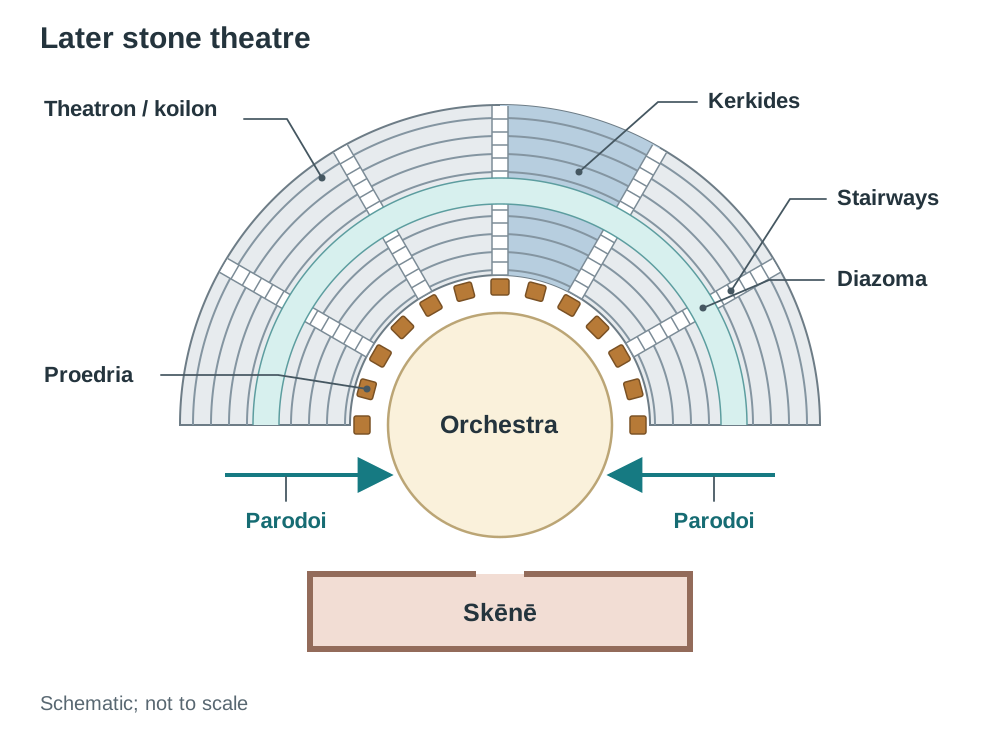
- Theatron / koilon: The auditorium or seating bowl carved into the natural slope (koilon means 'hollow'). The steep rake and circular floor reflected sound upward, so actors' unamplified voices carried clearly to the highest tiers.
- Kerkides: Wedge-shaped blocks of seats separated by radiating stairways. These allowed thousands of spectators to reach and leave their seats efficiently.
- Diazoma: A wide horizontal walkway that divided the lower and upper tiers of seating, easing crowd movement across the auditorium.
- Proedria: Carved stone seats of honour in the front row, reserved for the Priest of Dionysus, civic magistrates, honoured foreign dignitaries, and war orphans.
- Orchestra: The circular 'dancing space' at the base of the theatron where the Chorus sang and danced. It formed the physical and moral connection between the actors and the audience.
- Skēnē: A wooden stage building behind the orchestra. It acted as an acoustic sounding board, an offstage dressing room, and a scenic backdrop representing a palace, temple, or military camp. Its central doors marked the critical boundary between public civic space outside and private domestic space inside.
- Parodoi: Two wide lateral entrance passages between the seating bowl and the skēnē, through which the Chorus, entering actors, and spectators arrived.
Dating Ancient Theatrical Evidence
A classic exam trap is confusing 5th-century BC staging with later Hellenistic and Roman architecture. Keep these distinct:
- 5th century BC (The Golden Age): Wooden benches (*ikria), flat soft leather boots (kothornoi), naturalistic linen masks, simple wooden skēnē, the crane (mēchanē), and the wheeled platform (ekkyklēma*).
- 4th century BC and later: Monumental stone seating (Lycurgus at Athens, c. 330 BC; Epidaurus, mid-4th century BC), revolving triangular prisms (*periaktoi), elevated platform-soled boots, grotesque masks with towering forehead peaks (onkos), and state-managed welfare tickets under the Theoric Fund*.
Production Conventions and Stagecraft
Athenian tragedy operated under tight formal conventions designed for clear communication under the open sky.
Actors, Masks, and Music
Tragedy strictly limited speaking roles to three actors: the protagonist (first actor), the deuteragonist (second), and the tritagonist (third). Aeschylus introduced the second actor, and Sophocles added the third. All actors were citizen men. To manage a play with six or eight speaking parts, actors swapped masks and costumes behind the skēnē. Mute extras filled out scenes as guards, servants, attendants, and children. From around 449 BC, the state awarded an official annual prize for the best tragic actor, showing that individual performers carried immense public prestige alongside the poet.
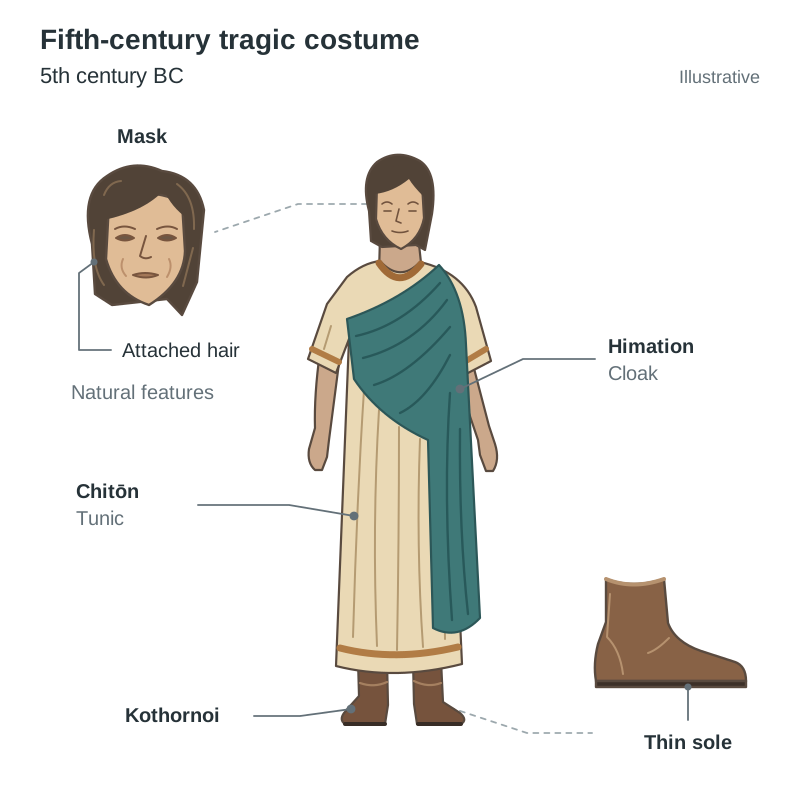
Fifth-century masks were made of stiffened linen, cork, or wood, with hair attached. They had fairly natural features rather than the gaping, grotesque mouths of later Hellenistic drama. Their large, clear expressions enabled distant viewers to identify a character's age, gender, and status immediately, while allowing a single performer to play multiple roles, including women. Performers wore decorated tunics (*chitōn), woollen cloaks (himation), and flat, thin-soled soft leather boots (kothornoi*). These flat boots allowed nimble movement across the dirt floor of the orchestra; elevated platform soles did not appear until centuries later.
The performance was thoroughly musical. The Chorus sang and danced to the accompaniment of the aulos, a double-reed pipe played live by an aulētēs. Actors spoke their dialogue in regular metres but also sang lyrical solos or laments during moments of intense grief.
Authentic Fifth-Century Stage Machinery
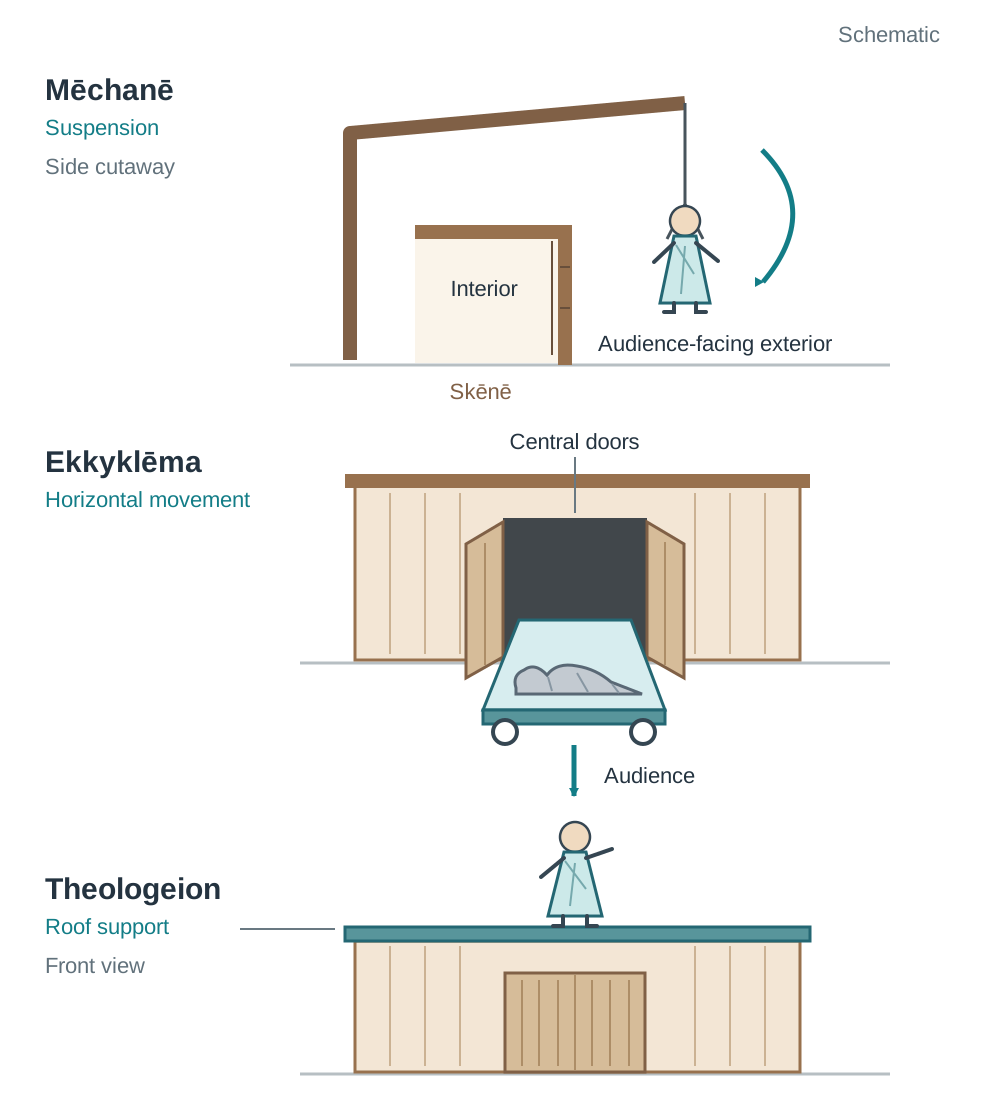
- Mēchanē: A wooden crane mounted behind the stage wall. It swung actors playing gods into the air, creating the deus ex machina ('god from the machine') to resolve an intractable deadlock by divine decree. In Sophocles' Philoctetes, the divine Heracles appears on high to command Philoctetes to sail to Troy. Euripides famously subverts this in Medea: he places a mortal, Medea, above Jason in the chariot of the Sun, visually claiming supernatural superiority while denying Jason access to his children's corpses.
- Ekkyklēma: A low, wheeled platform rolled out through the central doors of the skēnē. Violent deaths almost always occurred offstage, away from view (though Sophocles makes a rare exception with Ajax's visible suicide in Ajax). The audience heard screams from within, a messenger arrived to narrate the carnage, and the ekkyklēma was wheeled out to display the corpses to the audience.
- Theologeion: The flat roof of the wooden stage building, which served as a raised speaking platform for gods, watchmen, or spirits.
The City Dionysia: Sacred Ritual and Civic Identity
Tragedies were staged as part of the City Dionysia (or Great Dionysia), a major state festival held in spring during the month of Elaphebolion (March–April). The sailing season had just reopened, meaning the city was full of foreign allies, merchants, and ambassadors.
Civic Organisation and the Liturgy System
The festival was managed by the archōn eponymos, the chief civil magistrate of Athens. Costs were shared between public revenues and the wealthiest private citizens. Under the liturgy (*leitourgia) system, the archon appointed wealthy individuals as choregoi (singular: chorēgos). A chorēgos* paid for the costumes, training, rehearsal space, food, and musician for a competing playwright's Chorus. This compulsory public service was a main route to civic honour. Victorious choregoi often set up public dedications to commemorate their win. In the dithyramb contest the prize was a bronze tripod, which could be displayed on a monument such as the Monument of Lysicrates (334 BC), built for a boys' dithyramb victory.
Programme of the Festival
The exact sequence of days is reconstructed from fragmented sources, but the core events followed a defined sacred and civic pattern:
- The Proagōn: Held before the festival in the Odeion of Pericles, next to the theatre. Competing playwrights, actors, and choruses appeared unmasked on stage to announce the plots and themes of their plays to the public.
- The Eisagōgē: A torchlight procession re-enacting the original arrival of Dionysus from Eleutherae. The ancient wooden statue (xoanon) of Dionysus Eleuthereus was carried out to a shrine near the Academy and escorted back into the theatre sanctuary.
- The Pompē: A grand public procession featuring choregoi in brilliant robes, resident foreigners (metics) dressed in red carrying trays of offerings, citizen basket-bearers, and sacrificial bulls. It culminated in sacrifices at the altar of Dionysus and a public meat feast.
- The Competitions:
- Dithyrambs: Choral hymns honouring Dionysus, with each of the ten civic tribes entering a men's chorus and a boys' chorus (twenty choruses in total).
- Comedy: Five comic poets competed, each staging one play (reduced to three during the hardships of the Peloponnesian War).
- Tragedy: Three tragic poets presented their works across three days. Each presented a tetralogy: three tragedies followed by a satyr play—a rowdy mythological farce featuring satyrs (the half-beast followers of Dionysus) to conclude the day in honour of the god.
Pre-Play Ceremonies in the Theatre
Before tragic performances began, the orchestra hosted dramatic demonstrations of Athenian power and civic duty:
- Purification and Libations: The ten elected generals (*strategoi*) poured sacred offerings at the altar.
- Allied Tribute Display: Silver tribute brought by subject allies of the Delian League was paraded across the orchestra basket by basket, showcasing Athenian naval hegemony.
- Parade of War Orphans: Sons of citizens killed in battle, raised and educated at public expense, were presented in full bronze hoplite armour on reaching manhood. A herald proclaimed their fathers' courage, and according to the orator Aeschines, they were invited to seats of honour (*proedria*).
- Civic Honours: Heralds proclaimed the names of citizens and benefactors awarded gold crowns for outstanding service to the state.
The Audience and Democratic Judging
The audience sat primarily by tribe, with citizen men making up the vast majority. Metics, foreign ambassadors, and visiting allies were present. Whether women attended tragedy remains debated: ancient sources contain no explicit ban, and Plato implies women witnessed tragic spectacles, but the theatre was an overwhelmingly masculine civic space. Poorer citizens were eventually supported by the Theoric Fund (*theōrikon*), which paid the two-obol daily admission fee. While a later tradition attributed this fund to Pericles, secure historical evidence places its regular operation in the 4th century BC under the politician Eubulus, demonstrating that the democracy treated theatrical attendance as a civic duty rather than a luxury.
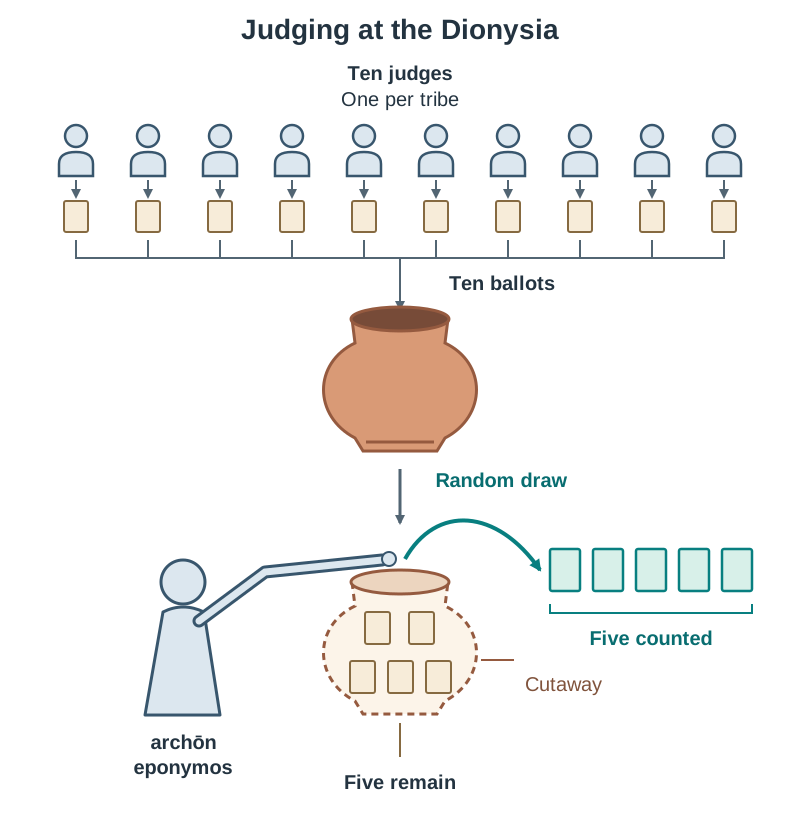
Ten judges, one from each tribe, placed their ballots in an urn, and the archōn eponymos drew only five at random. This made bribery and intimidation harder, since no judge knew whether his vote would count. It may also have left part of the result to chance, or to the gods.
Characters and the Chorus as Social Mirrors
(Note: In your exam, anchor your analysis directly to the prescribed tragedy you have studied. The examples below illustrate how tragic conventions reflect Athenian society.)
Tragedy used the distant world of Bronze Age myth to interrogate the urgent social and political anxieties of democratic Athens.
Prescribed Pairings Context
The Leaving Certificate specification rotates prescribed tragedies in pairings (such as Euripides' Medea and Sophocles' Philoctetes; Sophocles' Oedipus the King and Euripides' Trojan Women; or Aeschylus' Prometheus Bound and Sophocles' Antigone). Check with your teacher or the official circular for your examination cohort.
The Chorus as Civic Bridge
The tragic Chorus consisted of twelve (under Aeschylus) or fifteen (under Sophocles and Euripides) amateur Athenian citizen men. Although they played fictional characters—Corinthian women, Theban elders, or Neoptolemus' sailors—they were trained at the expense of a chorēgos. They danced and sang in the orchestra, representing ordinary community members caught in the catastrophe provoked by royal leaders, urging moderation and moral restraint.
| Character / Role | Role in Medea | Role in Philoctetes | What it Reflected in Athenian Society |
|---|---|---|---|
| The Ruler / Commander | Creon: Banishes Medea out of fear, but unwisely yields to her plea for a single day's delay. | Odysseus: Argues that deceit, pragmatism, and theft of the bow are justified to take Troy. | Athenian suspicion of autocratic pride (*hubris*) and unease over cynical demagogues in the Assembly who placed expediency before traditional morality. |
| The Marginalised / Sufferer | Medea: An abandoned foreign wife without civic rights or family protection in Corinth. | Philoctetes: A physically disabled, abandoned warrior festering in agony on Lemnos. | How the polis treated vulnerable non-citizens, women, the sick, and those cast aside once their utility had expired. |
| The Developing Citizen | Medea's Children: innocents caught between their parents; they are heard crying out from inside the house as they are killed. | Neoptolemus: A young noble torn between Machiavellian obedience to Odysseus and personal integrity. | The moral education of young citizen men: balancing personal honour against obedience to state military orders. |
| Slaves and Attendants | Nurse and Tutor: Open the play lamenting Jason's betrayal and fearing Medea's temper. | Merchant / Spy: An attendant disguised by Odysseus to deceive Philoctetes. | Showed that moral loyalty and practical wisdom were not exclusive to aristocrats, while exposing how masters manipulated dependents. |
| The Chorus | Corinthian Women: sympathise with Medea's grief after her speech on women's lot ('I would rather stand three times in battle than give birth once') but recoil from filicide. | Sailors: Subordinates who follow Neoptolemus' lead but express genuine pity for Philoctetes' suffering. | Reflected the civic collective: ordinary citizens who suffer the fallout of elite decisions while attempting to uphold communal piety and justice. |
The Spread of Theatres and Comparison with Roman Spectacle
From the 4th century BC, and especially after Alexander the Great's conquests, stone theatres spread throughout the eastern Mediterranean, the Aegean islands, Asia Minor, and southern Italy (Magna Graecia). Major examples survive at Epidaurus, Syracuse, Pergamon, and Priene, as well as the far eastern outpost of Ai Khanoum in modern Afghanistan, which seated around 6,000 spectators.
Theatres as the Heart of the Hellenic Polis
A theatre was not merely an entertainment venue; it was an indispensable marker of Greek urban civilisation. In the 2nd century AD, the travel writer Pausanias famously questioned whether Panopeus in Phocis could properly be called a polis at all, because it lacked government offices, a gymnasium, a market-place, and a theatre. Theatres expanded across the Hellenistic world for several defined reasons:
- Conquest and new cities: Alexander's conquests and the Greek cities founded by Hellenistic kings spread Greek settlers across Egypt, the Levant and Asia, and those settlers expected familiar civic buildings such as a theatre.
- Civic Assemblies: In many Greek cities, the citizen assembly (*ekklēsia*) met directly inside the theatre, using its tiered sightlines and acoustics for political debate and voting.
- Touring Guilds: Professional actors formed organised guilds, most notably the Artists of Dionysus (c. 3rd century BC), who toured plays to festivals across the Greek-speaking world.
- Religious Continuity: Many theatres were embedded within healing or sacred sanctuaries (such as the Theatre at Epidaurus in the sanctuary of Asclepius), maintaining the bond between choral performance and civic worship.
Comparing Athenian Tragedy with Roman Spectacle
Learning Outcome 2.12 requires students to compare Greek tragic drama with Roman mass spectacles in the Colosseum and Circus Maximus:
| Feature | Athenian Tragedy (City Dionysia) | Roman Spectacle (Colosseum & Circus Maximus) |
|---|---|---|
| Primary Setting | Open-air Theatre of Dionysus on the Acropolis slope. | Dedicated monumental arenas (amphitheatre, chariot circus). |
| Occasion | Sacred spring religious festival of Dionysus Eleuthereus. | State games (*ludi) and gladiatorial contests (munera*). |
| Performers | Citizen actors and amateur citizen chorus members. | Slaves, prisoners of war, condemned criminals, and professional gladiators/charioteers. |
| Civic Purpose | Communal self-scrutiny, moral questioning, and democratic debate. | Display of imperial power, military mastery, conquest, and civic order. |
| Funding | Joint funding: state magistrates and wealthy citizens via liturgy. | Financed by ambitious political magistrates or the Emperor to purchase popularity. |
| Shared Ground | Both provided massive public entertainment funded by elites seeking political prestige and honour. |
Key terms
- Theatron
- The semi-circular, tiered seating bowl of an ancient theatre (also termed the koilon), engineered into a hillside for sightlines and acoustics.
- Orchestra
- The circular performance area between the seating and the stage building where the Chorus danced, sang, and engaged with actors.
- Skēnē
- The wooden stage building behind the orchestra that provided dressing rooms, a scenic backdrop, acoustic resonance, and entrance doors.
- Kerkides
- Wedge-shaped seating compartments in the theatron separated by radiating stairways to facilitate crowd movement.
- Diazoma
- A wide horizontal cross-walkway dividing the lower and upper tiers of seating in a Greek theatre.
- Proedria
- Carved stone seats of honour in the front row of the theatre, reserved for priests, magistrates, and honoured citizens.
- Chorēgos
- A wealthy Athenian citizen appointed by the archon to fund, equip, and train a tragic or comic chorus as a state liturgy.
- Liturgy
- A compulsory public service (leitourgia) performed by wealthy Athenians who funded major state undertakings such as theatrical choruses or warships.
- Theōrikon
- The Athenian Theoric Fund, reliably organised by the 4th century BC, which provided poorer citizens with admission money to attend state festivals.
- Mēchanē
- A wooden stage crane behind the skēnē used to hoist actors playing deities into the air, creating the deus ex machina.
- Ekkyklēma
- A low wheeled platform rolled out through the central skēnē doors to display the corpses of characters killed offstage.
- Kothornoi
- Flat, thin-soled soft leather boots worn by 5th-century BC tragic actors, allowing free dancing and unhindered movement.
- Aulos
- A double-reed pipe played by an aulētēs that accompanied tragic choral singing and dancing throughout the performance.
- Artists of Dionysus
- A Hellenistic guild of professional touring actors, musicians, and performers who travelled the Mediterranean staging Greek drama.
Check yourself
What took place during the proagōn before the City Dionysia began?
Competing poets appeared in the Odeion alongside their unmasked actors and choruses to announce the subjects and plots of their upcoming plays.
Name the three speaking actors of classical Greek tragedy and the instrument that accompanied the Chorus.
The protagonist, deuteragonist, and tritagonist; accompanied by the aulos (double-reed pipe).
Which Athenian civil magistrate was responsible for selecting playwrights and assigning choregoi for the City Dionysia?
The archōn eponymos.
Describe how the winning tragic playwright was chosen at the City Dionysia.
Ten judges (one from each tribe) placed their ballots in an urn, and the archōn eponymos drew only five at random to decide the winner. This made bribery harder and left part of the result to chance.
Why did the ancient travel writer Pausanias cite a theatre when describing the town of Panopeus?
He argued that a settlement without government buildings, a gymnasium, an agora, and a theatre could not legitimately claim to be a true Greek polis.
State two key differences between Athenian tragedy and Roman spectacle in the Colosseum.
Athenian tragedy featured citizen actors and chorus in a sacred competition of ideas, while Roman spectacles featured slaves, criminals, and gladiators in violent displays of imperial dominance.