

Under Strand 4 of Leaving Certificate Classical Studies, students explore what ancient thinkers taught about mortality, human choice, and what it means to live well. This topic centres on two primary sources: Plato's dialogue Crito, depicting the Athenian philosopher Socrates awaiting execution in 399 BC, and selected poems from Horace's Odes and Epodes, written in the late first century BC as Rome moved from civil war to the rule of Augustus. Socrates argues that living well means maintaining absolute moral justice, caring for the soul, and fulfilling one's civic duty under the law, even when an unjust verdict costs a person their life. Horace confronts human mortality by urging us to embrace carpe diem (seizing the day), practise aurea mediocritas (the golden mean), and leave an enduring legacy through creative achievement. Together, they offer two contrasting yet complementary ancient perspectives on how human decisions operate within boundaries fixed by divine will and fate.
Socrates on Living Well: Justice and the Soul in Plato's Crito
In 399 BC, an Athenian jury condemned the seventy-year-old philosopher Socrates to death by hemlock on charges of impiety and corrupting the young. Plato's dialogue Crito opens inside Socrates' prison cell just days before the sentence is carried out. His wealthy friend Crito arrives before dawn, offering a funded escape to Thessaly. Crito appeals to common social instincts: escape will keep Socrates alive, allow him to raise his sons, save his friends from public embarrassment, and frustrate his enemies' malice.
Socrates calmly dismantles Crito's reasoning. He first attacks the idea that public opinion matters. Just as an athlete in training listens only to the praise and blame of his trainer or doctor, the one person with expert knowledge, not to the opinions of the many (47a–c), a thinker must follow reasoned argument rather than the unthinking majority.
For Socrates, mere biological survival has no value on its own. At Crito 48b, he lays down his foundational principle:
'The most important thing is not life, but the good life.'
In Greek, this is the distinction between mere existence and eu zēn / living well. In Socratic thought, living well is identical to living justly and honourably. This leads directly to his radical rejection of traditional Greek retaliatory justice (the popular code of helping friends and harming enemies). Socrates insists that doing wrong is always harmful to the person who does it. Therefore, an individual must never return wrong for wrong, nor repay injury with injury, even when subjected to an unjust legal verdict. Fleeing prison would commit a fresh injustice and ruin his own soul, which is far worse than undergoing physical death.
The Personification of the Laws and the Civic Agreement
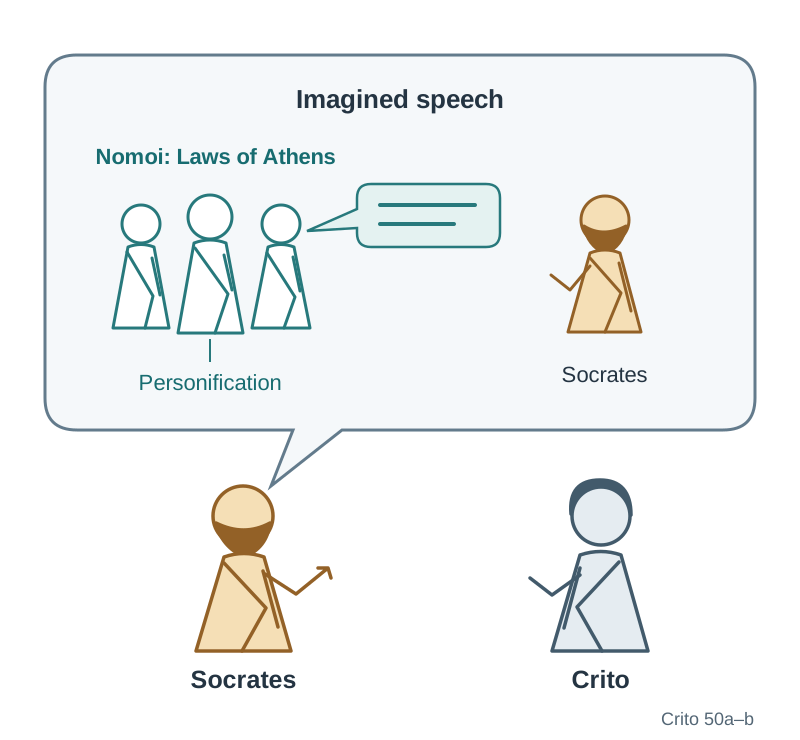
To prove why escaping would be unjust, Socrates introduces an imagined speech within the dialogue: the personification of the Laws of Athens (Nomoi). He asks Crito to imagine the city's Laws appearing before them to cross-examine their escape plan (50a–b). The Laws argue that every Athenian citizen enters into a binding relationship, a classical forerunner of the social contract, founded on three duties:
The Laws as Parents and Educators
The Laws permitted Socrates' parents to marry, protected his birth, and provided his civic education in physical training and cultural pursuits. Because the Laws formed and nurtured him, Socrates cannot claim equal standing with them. Just as a son cannot strike his father, a citizen cannot strike at the legal foundation of his city when a court judgment goes against him.
Tacit Consent Through Residence
Athens allowed any citizen who came of age to inspect the city's laws, take their property, and emigrate freely if they disapproved. Socrates lived in Athens for seventy years. He almost never left the city walls except on military service, fathered his children there, and explicitly rejected the option of exile during his trial. Through this voluntary lifelong residence, he gave tacit consent to honour the city's laws.
Persuade or Obey
The agreement between citizen and city requires that a person must either persuade the city that it is acting wrongly, or do what it commands (51b–c). This doctrine of persuade or obey gave Socrates his opportunity: he presented his defence before the jury at his trial and failed to convince them. Having exercised his right to persuade, he is now obliged to obey the penalty.
The Practical Consequences and the Children
When Crito argues that Socrates is abandoning his sons, the Laws offer a realistic reply (53a–54b). If Socrates flees to an orderly city like Thebes or Megara, he will arrive branded as an enemy of their laws, validating the jury's verdict that he destroys society. If he goes to lawless Thessaly, he will live as a degraded figure dressed in disguise, a hypocrite who preached virtue but fled for a few years of life. As for his children, his friends will educate and support them if he dies in Athens; they would do the same if he lived in Thessaly, unless he took his sons with him and stripped them of Athenian citizenship.
Socrates, the Divine, and Fate in the Crito
In Crito, Socrates does not view divine will as an abstract philosophical theory; specific dramatic and religious events anchor the dialogue:
- The Sacred Ship from Delos (43c–d): Athenian law forbade any public execution while the sacred ship was away on its annual religious mission to Delos. Crito enters the prison early to announce that the ship has been sighted near Sunium and will arrive that day, meaning Socrates must die tomorrow. The timetable of Socrates' life and death is dictated by a religious calendar beyond any human control.
- The Dream of the Woman in White (44a–b): When Crito arrives, Socrates is sleeping soundly (43b). Socrates tells him that execution will happen a day later than expected because he had a dream of a noble, beautiful woman wearing white robes who quoted Homer's Iliad to him: 'On the third day you would come to fertile Phthia.' Socrates takes the dream as a sign that he will die on the third day, a day later than Crito expects. Because Phthia was Achilles' homeland, many readers see a hint of going 'home'. He accepts this divine prophecy with complete composure.
- The Laws in Hades (54c): The Laws warn Socrates that if he breaks his agreements and escapes, 'our brothers, the Laws in Hades, will not receive you kindly.' His moral decisions in this life carry direct weight in the afterlife.
- The Closing Words (54e): Socrates concludes the dialogue by silencing Crito: 'Let us act in this way, since this is the way the god is leading us.'
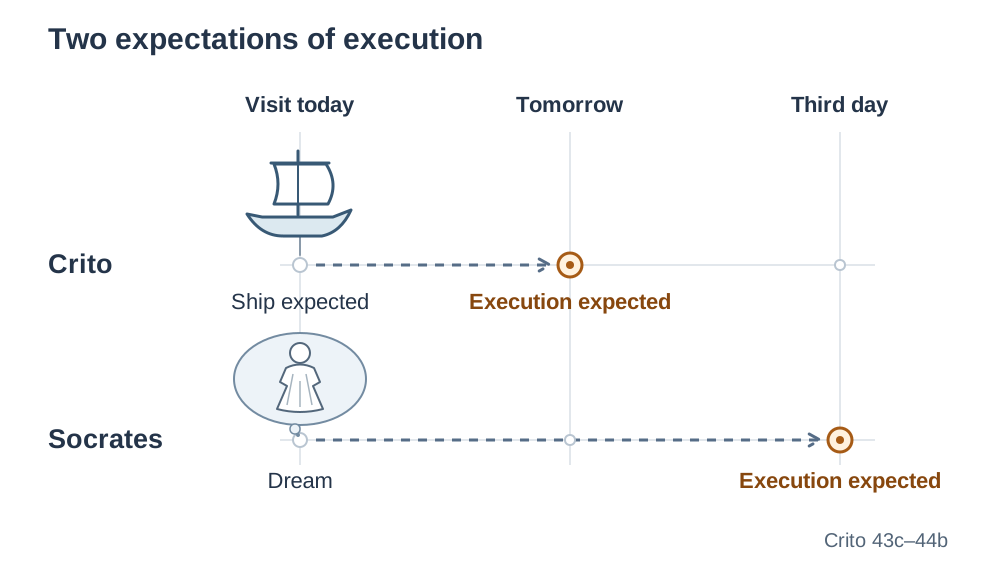
For Socrates, divine fate fixes the hour of physical death, but it leaves human agency intact. A person cannot control their lifespan, but they retain sovereign control over whether their conduct is just or unjust. Obeying reasoned moral principles aligns human choice with divine order.
Horace on Living Well and Fate in the Odes and Epodes
Horace approaches mortality from the perspective of an Augustan lyric poet influenced by Epicureanism and Stoicism. Rather than demanding absolute civic martyrdom, Horace urges us to accept mortal limits and savour the present hour with moderation. Check the current official prescribed list for the exact syllabus selection each year; the following poems illustrate Horace's essential ideas:
Odes 1.4 (To Sestius)
- Key line: Pallida Mors aequo pulsat pede pauperum tabernas regumque turres ('Pale Death knocks with impartial foot at the huts of the poor and the towers of kings').
- Core thought: Spring brings back warmth, green pastures, and dancing nymphs, but human life has no seasonal rebirth. Because death treats kings and beggars identically, the brief span of life forbids us to embark on distant hopes.
Odes 1.9 (The Soracte Ode, to Thaliarchus)
- Key line: Permitte divis cetera ('Leave the rest to the gods') and quid sit futurum cras, fuge quaerere ('Stop asking what tomorrow will bring').
- Core thought: Mount Soracte is covered in deep winter snow. Horace tells Thaliarchus to pile logs on the hearth, bring out the four-year-old wine, and let the gods calm the winds on the sea. The gods control the future; our duty is to accept whatever day Fortune grants and enjoy love, friendship, and youth while grey old age is distant.
Odes 1.11 (To Leuconoe)
- Key line: Carpe diem, quam minimum credula postero ('Seize the day, trusting as little as possible in tomorrow').
- Core thought: Horace warns Leuconoe against consulting Babylonian horoscopes. The gods keep the final day of our death hidden. This winter, which now wears out the Tyrrhenian sea against the rocks facing it, may be our last. The wise response is to strain the wine, cut back long hopes, and pluck the day as it passes.
Odes 2.3 (To Dellius)
- Key line: Aequam memento rebus in arduis servare mentem ('Remember to keep a level mind when things are hard').
- Core thought: We must maintain aequam mentem both in adversity and when fortune smiles. Dellius will die whether he spends his life weeping or drinking fine Falernian wine on a grassy lawn. Everyone's lot is shaken in the same urn; sooner or later it leaps out and puts us in Charon's boat, bound for eternal exile.
Odes 2.10 (To Licinius)
- Key line: Aurea mediocritas ('The golden mean').
- Core thought: Avoid reckless ambition and extreme deprivation. The giant pine tree is shaken hardest by the storm, high towers fall with the greatest crash, and lightning strikes the mountain peaks. A balanced, modest life—typified by Horace's beloved Sabine farm—shields a person from the disasters of public life.
Odes 2.14 (To Postumus)
- Key line: Eheu fugaces, Postume, Postume, labuntur anni ('Alas, Postumus, Postumus, the fleeting years slip by').
- Core thought: Piety cannot delay wrinkles, old age, or unconquered death. Rich and poor alike must cross the river Cocytus. You will leave your house, your land, and your pleasing wife; a worthier heir will drink the Caecuban you locked away and spill it on the floor.
Odes 3.30 (The Poetic Monument)
- Key line: Exegi monumentum aere perennius ('I have built a monument more lasting than bronze') and non omnis moriar ('I shall not wholly die').
- Core thought: Physical bodies perish, but great art conquers time. Horace's lyric achievement cannot be eroded by rain, wind, or the flight of centuries. His fame will endure as long as the Roman priest climbs the Capitol alongside the silent Vestal Virgin.
Epode 2 (Beatus Ille)
- Key theme: Rural simplicity versus urban greed.
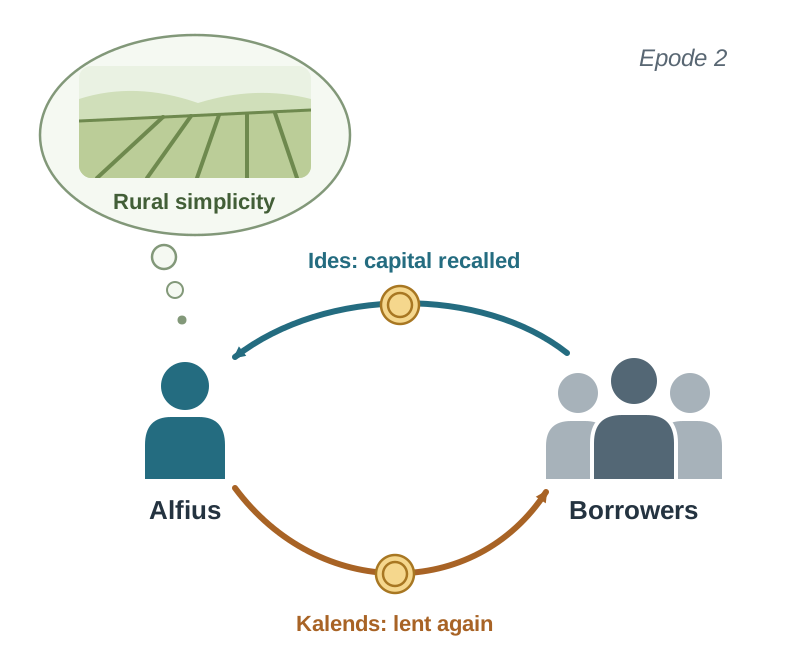
- Core thought: The poem opens with a lush praise of country life, free from loans, courts, and war. At line 67 comes the ironic twist: the speaker is Alfius, an urban moneylender. Having praised the simple life, he calls in all his capital on the Ides, only to lend it straight back out on the Kalends. Horace demonstrates that people long for simplicity but remain trapped by commercial ambition.
Epode 13 (Horrida Tempestas)
- Key line: Rapiamus, amici, occasionem de die ('Let us seize the chance, my friends, from the day').
- Core thought: A violent winter storm rages outside. Horace urges his companions to bring out vintage wine and let the god reverse their fortunes. He quotes the centaur Chiron's advice to his pupil Achilles: Achilles is fated to die at Troy and never return home, so he must lighten his unavoidable destiny with wine, music, and friendly talk.
Comparing Socrates and Horace
Both thinkers treat death as an absolute, natural boundary that no human wealth or plea can push aside. Their differences lie in how a human should exercise moral choice within that boundary.
| Point of Comparison | Socrates (Plato's Crito) | Horace (Odes and Epodes) |
|---|---|---|
| The Core of Living Well | Living justly, preserving moral integrity, and obeying civic commitments (48b). | Living moderately, enjoying simple rural pleasures, and avoiding ambition (aurea mediocritas). |
| View of Physical Death | An external physical event; secondary to the condition of the soul (47d–e). | An impartial leveller (Mors, Odes 1.4) that ends all earthly joys. |
| Ethical Rule | Never return wrong for wrong under any circumstances. | Follow the golden mean; steer between luxury and squalor (Odes 2.10). |
| Response to Fate and the Divine | Heeds divine signs (the Delos ship, the dream at 44a–b) and follows where 'the god leads' (54e) by keeping his soul pure. | Leaves the future to the gods (permitte divis cetera, Odes 1.9); focuses on carpe diem (Odes 1.11). |
| Defeat of Mortality | A just soul that has not wronged the Laws, avoiding the Laws in Hades' hostility (54c). | Secular immortality achieved through lasting lyric poetry (non omnis moriar, Odes 3.30). |
Contemporary Relevance: What Does It Mean to Live Well?
What does living well mean to you, and how would Socrates or Horace challenge your assumptions?
The Socratic view challenges modern careerism and expediency. Socrates insists that moral integrity must override personal comfort, wealth, and survival. Today, we recognise this attitude in whistleblowers who expose corporate wrongdoing or public corruption: they risk their livelihood, social standing, and safety rather than cooperate with injustice. At the same time, Socrates' strict insistence on obeying court verdicts sparks debate about civil disobedience. When a democratic court delivers an unjust judgment, should an ethical citizen follow Socrates and submit to preserve the legal system, or break the law publicly to highlight its corruption?
Horace speaks directly to modern anxiety, hyper-productivity, and consumer culture. In an economy driven by continuous forward planning and material competition, Horace's reminder that our time is short is a practical antidote to burnout. The ironic portrait of Alfius the moneylender in Epode 2 mirrors individuals who talk about escaping the corporate rat race while continuously postponing that freedom to pursue more wealth. Horace's counsel in Odes 2.10 reminds us that towering status invites catastrophic crashes, while simple companionship, moderation, and creative pursuits offer genuine mental stability.
Section A Exam Practice: Stimulus-Driven Questions
Section A of the Higher Level paper carries 40% of the total marks and tests your ability to interpret classical extracts.
Sample Stimulus: Plato, Crito 50a–b
'Consider it in this way. If, as we were planning to run away from here... the Laws and the Commonwealth of the city were to come and confront us and ask: "Tell me, Socrates, what are you intending to do? Do you intend anything other by this act of yours than to destroy us, the Laws, and the whole city, as far as in you lies? Or do you think it possible for a city to exist and not be overturned, in which the verdicts reached have no force, but are made null and void by private citizens?" What shall we say, Crito, to that and similar questions?'
Question 1 (Identify — 5 marks (sample allocation))
Identify the literary device Socrates uses in this extract.
Model Answer: Socrates uses the personification of the Laws (Nomoi), imagining the Laws and the Commonwealth of Athens appearing in bodily form to cross-examine him like speakers in a court dialogue.
Question 2 (Explain — 10 marks (sample allocation))
Explain the argument the Laws make about what would happen to the city if Socrates escaped.
Model Answer: The Laws argue that a state cannot survive if legal verdicts delivered by its courts carry no binding authority. If individual citizens choose to disobey judgments whenever an outcome displeases them, the authority of the legal system is destroyed. By fleeing, Socrates would be striking at the foundation of the Athenian community.
Question 3 (Evaluate — 15 marks (sample allocation))
How convincing do you find the argument that escaping would destroy the Laws and the city? Give reasons for your answer.
Model Answer: The argument is philosophically powerful because it relies on the principle of universal law: if one citizen is excused from obeying an inconvenient verdict, every citizen has the same right, leading to legal breakdown. Furthermore, Socrates has spent seventy years enjoying the benefits of Athens and by his conduct, not by formal words, agreed to persuade or obey (51b–c, 52d). However, modern critics often find the argument rigid: it treats a flawed, politically motivated trial as sacred, preventing a citizen from resisting an unjust death sentence when the court itself has failed the cause of justice.
Key terms
- Eu zēn (to live well)
- The ancient Greek philosophical ideal from Crito 48b ('not living, but living well'), defined by Socrates as living a just, honourable, and virtuous life rather than merely preserving physical existence.
- Never return wrong for wrong
- Socrates' foundational moral rule in Crito, explicitly overturning traditional Greek retaliatory justice by asserting that committing an injustice or repaying injury with injury is always morally ruinous to the soul.
- Personification of the Laws
- The dramatic literary device in Plato's Crito where the Laws of Athens (Nomoi) are given an imagined voice to cross-examine Socrates regarding his civic and contractual duties.
- Social contract
- The philosophical concept illustrated in Crito where a citizen enters an implicit, binding pact with the state, trading obedience to the laws for civic order, education, and protection.
- Tacit consent
- The implied agreement formed when an adult citizen freely chooses to remain in a city for decades, thereby voluntarily accepting its legal authority and obligations without a formal written signature.
- Persuade or obey
- The civic requirement in Crito 51b–c stating that a citizen must either convince the city of its error through lawful argument or submit obediently to its official rulings.
- Carpe diem
- Horace's famous phrase in Odes 1.11 ('pluck/seize the day, trusting as little as possible in tomorrow'), advising mindful, moderate enjoyment of the present hour in the face of uncertain mortality.
- Aurea mediocritas
- The 'golden mean' celebrated in Horace's Odes 2.10, an ethical ideal that avoids both the hazards of excessive wealth and political power and the squalor of poverty.
- Aequam mentem
- The 'level/equable mind' advocated in Horace's Odes 2.3 ('aequam memento rebus in arduis servare mentem'), urging emotional balance and composure in both misfortune and success.
- Exegi monumentum
- The opening words of Horace's Odes 3.30 ('I have built a monument more lasting than bronze'), asserting that lyric poetry outlasts physical architecture and grants the poet secular immortality.
- Non omnis moriar
- Horace's proud declaration in Odes 3.30 ('I shall not wholly die'), expressing how his creative identity will survive physical death through his poetry.
Check yourself
What core philosophical maxim does Socrates state at Crito 48b regarding the value of human life?
'The most important thing is not life, but the good life' (where the good life is identical to the just and honourable life).
What dream did Socrates experience in prison, and what did he take it to mean?
He dreamt of a noble woman in white robes who quoted Homer ('On the third day you would come to fertile Phthia'), which he interpreted as a divine sign that he would die in two days' time.
What is the three-part argument presented by the personified Laws of Athens against Socrates' escape?
The Laws acted as his parents and educators, he gave tacit consent to obey them by residing in Athens for seventy years, and his civic duty was to either persuade the city of its error or obey its rulings.
Who is the speaker in Horace's Epode 2, and why is the ending of the poem ironic?
The speaker is Alfius the moneylender; the ending is ironic because after eloquently praising the simple rural life, he immediately calls in his loans only to lend the money straight back out.
What image does Horace use in Odes 1.4 to show that death is the universal leveller?
Pale Death (Pallida Mors) knocking with impartial foot at the cottages of the poor and the towers of kings.
What Latin phrase in Odes 2.3 expresses Horace's ideal of keeping an emotionally balanced mind?
Aequam mentem ('aequam memento rebus in arduis servare mentem' — remember to keep a level mind when things are difficult).