

Visual Studies in Leaving Certificate Art investigates how human experience, culture, and ideas are expressed through visual forms across history and contemporary life. The specification connects Visual Studies directly to your practical studio work across three interdependent strands: Research, Create, and Respond. Whether you are analysing European art, examining local public sculpture, or developing studio work from an SEC brief, you use the Visual Studies Framework to investigate three core questions: What was created? How was it created? Why was it created? At Higher Level, questions expect you to go beyond describing: analyse, discuss, and justify your points with visual evidence.
The Three Interdependent Strands
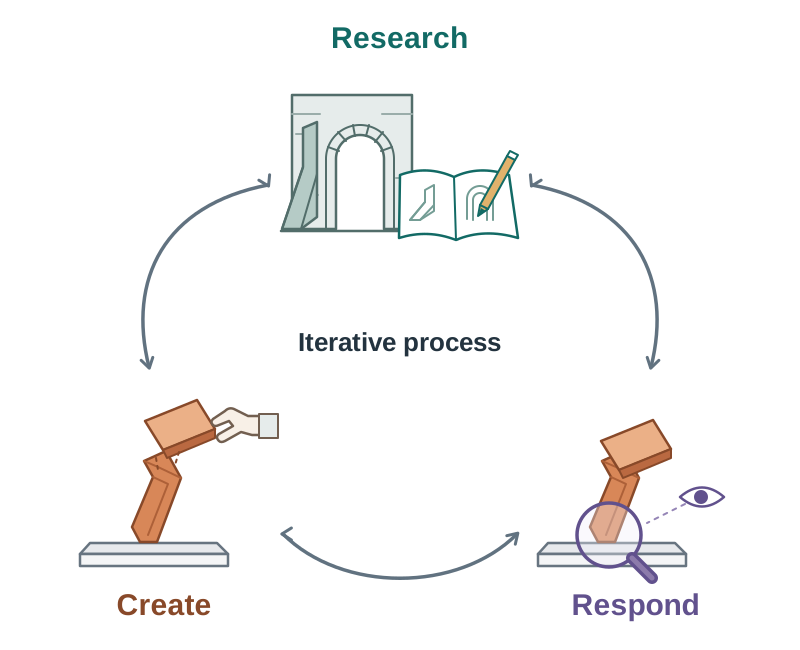
Senior cycle Art is built on three interlinked strands that support and inform one another throughout the artistic process. Rather than running in a rigid sequence, they operate in a continuous cycle where each strand feeds into the others.
- Research: You act as a visual investigator. You select a stimulus from the coursework brief and explore it using primary sources (direct observation of real objects, life drawing, local architecture, natural forms, or visits to original artworks in galleries and museums). You record drawings, visual experiments, and contextual reflections in your sketchpad. The research strand units are: Looking; Recording and documenting; Experimenting and interpretation; Contextual enquiries; Process.
- Create: You turn your research into realised work. This involves drawing from observation, the human figure (life drawing), and imagination. You test how materials behave, solve visual problems, and know when a piece is finished and when to stop, before curating and presenting it in a considered way. The create strand units are: Making; Contextual enquiries; Process; Realisation/Presenting.
- Respond: You reflect critically and objectively on your own work and the work of others. You can respond to a work emotionally, critically, aesthetically, or contextually, or through a combination of these. This reflection allows you to justify your creative decisions, edit your concepts, and evaluate visual culture. The respond strand units are: Analysis; Contextual enquiries; Impact and value; Critical and personal reflection; Process.
This cyclical rhythm is an iterative process: a repeating cycle of analysing previous work, testing new ideas, and refining outcomes. For instance, you might begin constructing a sculpture (Create), realise that its balance is unstable (Respond), and then sketch architectural supports at a local heritage site to resolve the structure (Research).
The Visual Studies Framework
The Visual Studies Framework provides a consistent method for examining any artwork, movement, architectural site, design artefact, or craft piece. It helps you investigate the three central questions: What was created? How was it created? Why was it created?
When studying any period or movement, you apply the framework across three chronological stages:
- Before the period/movement: The context and developments that led to it.
- The period/movement itself: The defining features, ideas, and benchmark works created during it.
- After the period/movement: The effects and legacy left on later artists and movements.
Across these stages, your analysis is built around six elements:
| Framework Element | Core Focus in Visual Studies |
|---|---|
| Context | Historical, social, political, economic, and ideological settings. Includes the role of patrons, the art market, agencies, and exhibition curation. |
| Artists and Artworks | Recognised practitioners and their key works, examined through their training, lived experiences, themes, genres, and techniques. |
| Analysis | Questioning the visual evidence: identifying subject matter, layout, and motifs, and backing up every observation with what you see. |
| Art Elements & Design Principles | The visual grammar used: how line, colour, tone, texture, and shape are organised through balance, contrast, rhythm, and emphasis. |
| Media & Areas of Practice | The materials and technical processes chosen (such as oil painting, bronze casting, stained glass, printmaking, ceramics, or digital design) and their impact on meaning. |
| Innovation & Invention | Discoveries in materials, tools, science, or ideas (such as linear perspective, portable paint tubes, or photography) that altered artistic possibilities. |
Seeing Art in Person and Recognised Artists
You must experience some of your Visual Studies first-hand, treating original work as a primary source. This includes visits to galleries, museums, heritage sites, or working with a visiting artist. Record these visits in your sketchpad with sketches and notes on scale, texture, surface, and display that photographs cannot capture.
For Content Areas 1 and 2, the artists you study must be recognised artists. Under the specification, this means acknowledged practitioners who meet at least three criteria: widely known within the art history canon; exhibited in solo or group shows; included in public or corporate collections; commissioned or purchased by public bodies; acknowledged by professional peers and curators; or members of accredited professional bodies.
Visual Language: Art Elements and Design Principles
High-scoring written answers rely on precise visual language rather than vague impressions. Distinguish clearly between the visual tools (art elements) and the way an artist organises them (design principles).
The Art Elements (Visual Building Blocks)
- Dot and Line: Marks that define edges, contours, directions, and movement.
- Shape and Form: Shape describes flat, two-dimensional boundaries (geometric or organic). Form describes three-dimensional volume and mass.
- Tone (Value): The gradation between light and dark, essential for showing volume, cast shadows, and light source.
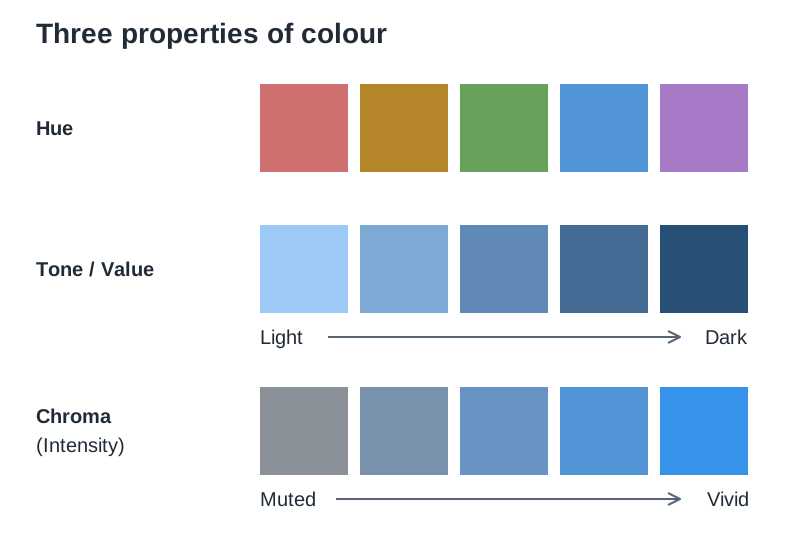
- Colour: Described through three properties:
- Hue: the name of the colour itself, such as red, blue, or yellow-green.
- Tone/Value: the relative lightness or darkness of a hue.
- Intensity / Chroma: the purity, saturation, or vividness of a colour.
- Texture: The tactile surface quality, either actual (such as thick impasto paint or polished marble) or simulated (the visual illusion of rough bark or glossy satin).
- Pattern: Repeated visual units or motifs arranged in regular or alternating sequences.
The Design Principles (Organisational Rules)
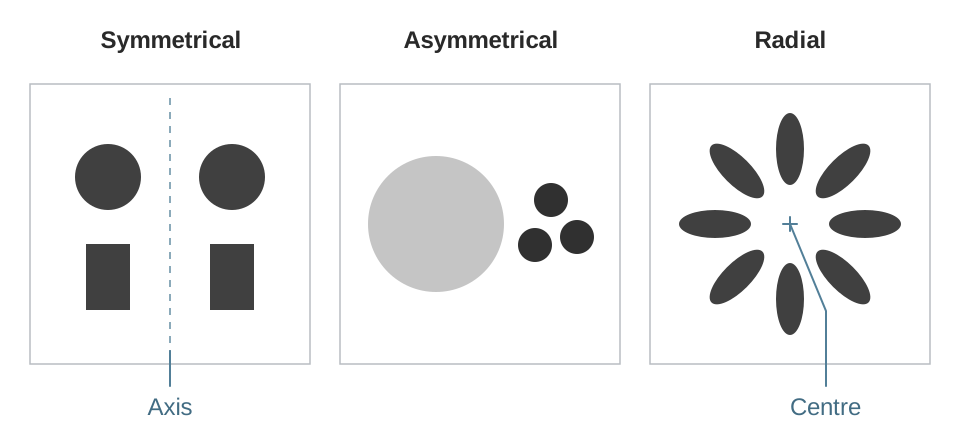
- Balance: The distribution of visual weight across a composition, whether symmetrical, asymmetrical, or radial.
- Harmony and Unity: The cohesive relationship between elements, ensuring the artwork feels complete rather than fragmented.
- Contrast and Tension: Placing opposing elements side by side (such as dark against light, rough against smooth, or complementary colours) to create visual energy.
- Emphasis (Focal Point): The part of the artwork that catches the viewer's attention first, often created by sharp contrast, strong colour, or converging lines.
- Rhythm and Movement: The path the viewer's eye follows around the artwork, guided by directional lines, repeats, or gestures.
- Scale and Proportion: The size relationships of parts within the work, or the scale of the artwork relative to the viewer.
- Space: The organisation of positive areas (subject) and negative areas (background). Note: some books list space as an art element and others as a design principle. What matters is that you describe accurately how the artist uses space.
Analysing Composition and Perspective in Unseen Images
The written paper can ask you to analyse an artwork you have not seen before, sometimes under given headings (for example, a 2024 question used composition, perspective and colour). Learn these terms so you can describe any image precisely.
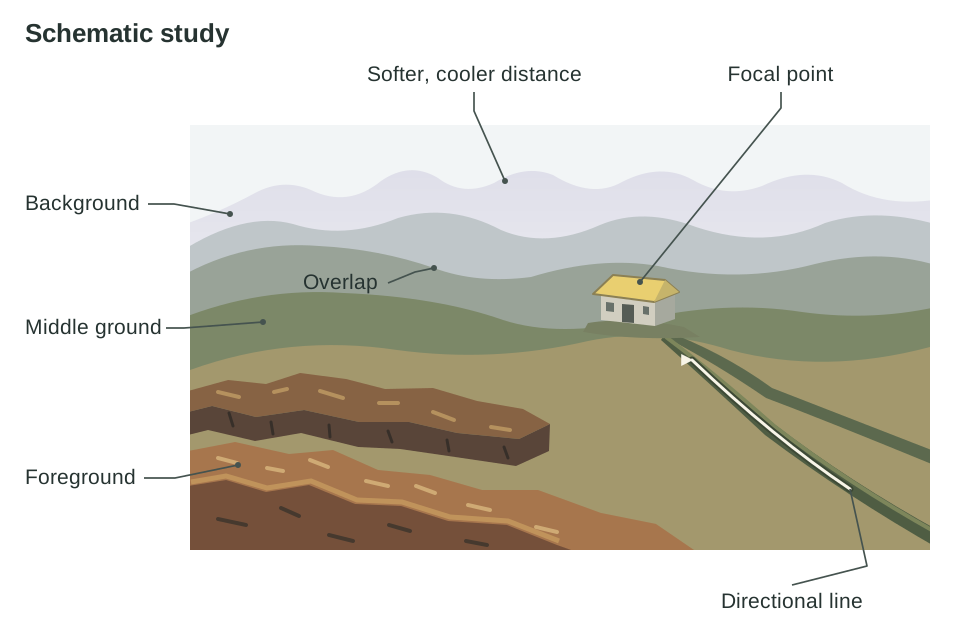
Perspective Terms
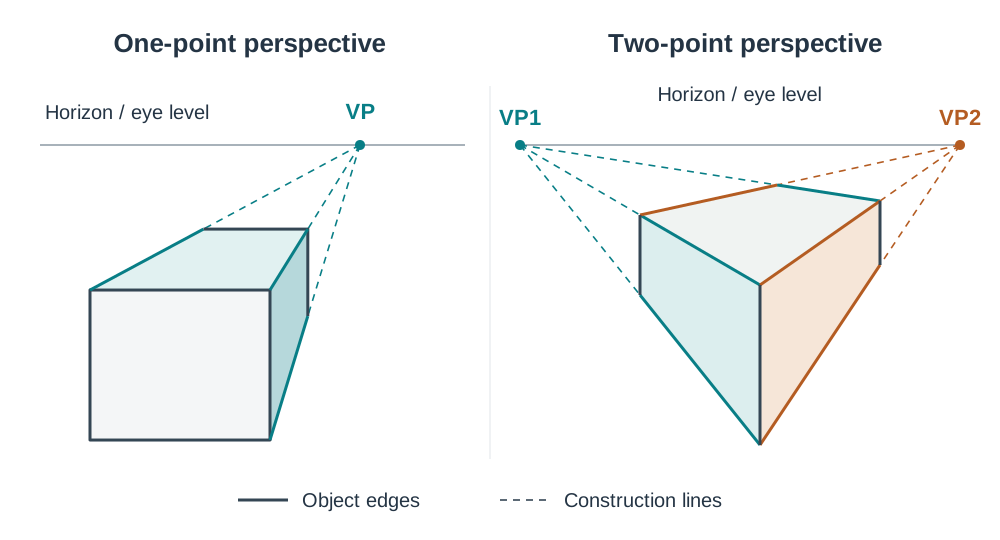
- Linear perspective: Parallel lines appear to converge at a vanishing point on the horizon line. One-point perspective has a single vanishing point (such as a straight road receding to the distance). Two-point perspective uses two vanishing points (such as the corner of a building viewed from an angle).
- Atmospheric (aerial) perspective: Distant objects appear paler, cooler (bluer), softer in detail, and lower in tonal contrast due to light scattering through the atmosphere.
- Overlapping: One shape covers part of another, establishing which is in front.
- Diminishing size and placement: Objects appear smaller and are placed higher up the picture plane as they recede into the distance.
- Flattened or tilted perspective: The artist deliberately avoids realistic depth to create an expressive, decorative, or claustrophobic effect.
Composition Terms
- Focal point: The primary area that draws the eye.
- Horizon line: The eye-level dividing line between land/sea and sky; a high horizon pushes the landscape forward to fill the picture, while a low horizon gives dominance to the sky.
- Planes: Foreground, middle ground, and background.
- Directional lines: Dominant diagonals create tension or action; strong verticals suggest stability or grandeur; horizontals create calm.
- Cropping: Slicing figures or scenery at the edges of the frame to suggest a wider scene or create intimacy.
- Viewpoint: The position from which the artist views the subject, such as a bird's-eye view (from above) or a worm's-eye view (from below).
Short Unseen-Image Analysis Example
(Based on an Irish landscape painting)
- Composition: The artist uses an asymmetrical layout with a high horizon line that compresses the sky into a narrow strip, making the rugged bogland dominate the frame. Diagonal hedgerows in the lower right pull the viewer's gaze toward the abandoned cottage, which serves as the principal focal point.
- Perspective: Depth is achieved through atmospheric perspective; the foreground turf banks display crisp, warm brown textures, whereas the distant mountains fade into pale, cool lilac tones with softened edges. Overlapping hills reinforce spatial recession.
- Colour: A palette of earthy ochres, moss greens, and slate greys dominates the foreground, contrasted by a single patch of pale cadmium yellow on the cottage roof. This sharp colour contrast reinforces the focal point.
- Interpretation (What it is about): The painting reflects isolation and the quiet endurance of rural life. The solitary, brightly lit cottage surrounded by vast, unyielding terrain suggests human vulnerability against the scale of nature.
Context: Curators, Patrons, and the Art Market
Artworks do not exist in a vacuum; they are shaped by institutions, money, and display settings. Understanding these forces is a key requirement of the Context element in the Visual Studies Framework.
The Role of the Curator
A curator selects, researches, cares for, and displays artworks in a public or private gallery, museum, or exhibition space. Their responsibilities include:
- Managing the collection: Acquiring new works, working with conservators to preserve fragile materials, and maintaining scholarly records.
- Conceiving exhibitions: Deciding on a theme or retrospective, selecting relevant works, and determining how they are arranged within the physical space.
- Writing interpretation: Composing wall texts, catalogue essays, and object labels that explain the context and guide how the public reads the work.
- Shaping artistic recognition: Deciding which artists, communities, and art forms receive public exposure, directly influencing cultural value.
Patrons and the Art Market
- Patrons: Individuals, religious institutions (such as the Catholic Church during the Counter-Reformation), royal courts, or modern state and corporate bodies that commission and fund artworks. Patrons frequently dictate the subject matter, scale, materials, and theological or political message.
- The art market: Commercial galleries, auction houses, art fairs, and private collectors that determine the monetary value and commercial popularity of art. An artist's reputation is often influenced by market demand and collector interest.
Course Structure and the Five Key Skills
The Five Key Skills
Five key skills are built into the Leaving Certificate Art learning outcomes. They are not marked separately on their own; instead, you demonstrate them through your coursework workbook, your realised pieces, and your written examination answers:
- Information Processing: Investigating primary sources, studying original artworks, and recording visual observations without uncritical copying.
- Critical and Creative Thinking: Asking probing questions about artworks, exploring alternatives, testing materials, and solving design problems.
- Communicating: Expressing your creative intentions clearly through visual work, structured written analysis, and concise artist's statements.
- Being Personally Effective: Managing your practical project timeline, acting independently, and learning from experimental mistakes.
- Working with Others: Participating in class critique sessions, group research, and engaging with visiting practitioners or gallery educators.
Design, Craft, and Wider Visual Culture
Your chosen historical periods in Content Areas 1 and 2 are not restricted to painting and sculpture. The specification requires you to study the wider visual culture of each era:
- Romanesque and Gothic: Cathedral architecture, portal relief carvings, and stained glass.
- Insular Art: Metalwork (such as the Ardagh Chalice) and illuminated manuscripts (such as the Book of Kells).
- Georgian period: Palladian architecture, domestic plasterwork, and furniture design.
- Modernism / Post-1960: Photography, film, graphic design, urban design, and digital media.
Assessment Structure and Content Areas
Leaving Certificate Art is assessed across three components at both Higher and Ordinary levels:
| Assessment Component | Weighting | Key Requirements |
|---|---|---|
| Practical Coursework | 50% | One realised work and a coursework workbook, developed over an extended period from a stimulus chosen from the SEC brief (issued at the start of Term 2 in Year 2). Includes an artist's statement. |
| Practical Examination | 20% | A second realised work, based on the same stimulus and on ideas developed during coursework, created within 5 hours on a single day shortly after coursework completion. Includes an artist's statement. |
| Written Examination | 30% | A written paper (envisaged as 2.5 hours; confirm with current SEC guidelines) assessing Visual Studies, critical analysis of familiar and unseen works, and contextual understanding. |
The Two Distinctly Different Areas of Practice Rule
The realised artwork produced for Practical Coursework (50%) and the second realised artwork produced during the Practical Examination (20%) must be completed in two distinctly different areas of practice. For example, you may complete a fine art painting for coursework and a ceramic sculpture or linocut print for the practical exam. Simply switching media within the same area of practice (such as moving from oil paint to acrylic paint) does not meet this requirement.
The Written Paper: Content Areas and Sections of Focus
- Content Area 1: Europe and the wider world: You must study one chosen section of focus from: Romanesque and Gothic (c. 1000–1500s); The Renaissance (c. 1300–1600s); Baroque (c. 1600–1700s); Realism, Impressionism and Post-Impressionism (c. 1850–1900s); Modernism (c. 1900–1960s); or Post 1960.
- Content Area 2: Ireland and its place in the wider world: You must study one chosen section of focus from: Pre-Christian (c. 4000 BCE–500 CE); Insular Art (c. 500–1100s); Late Medieval Architecture and Art (c. 1100–1550s); Georgian period (c. 1720–1800s); Irish Art and Modernism (c. 1880–c. 1960s); or Post 1960.
- Content Area 3: Today's world: You must study all four sections of focus:
- Artists: Theory and Thinking: Why artists make work, their rationale for an audience, patron, or site, and how art expresses personal identity or gives a voice to a community.
- Artists: Processes and Media: The technical choices and physical/digital materials artists use, and how an artist's identity can become synonymous with their medium.
- Art as Social Commentary or Commentator: How artists question social, political, cultural, and economic structures, inspire activism, or engage the public in debate.
- Art and the Environment: The natural or built environment as inspiration, subject matter, or medium itself, including Land Art, street art, public sculpture, sustainable design, and architecture.
Command Verbs in Examination Questions
At Higher Level, each learning outcome is assessed at the highest level of the action verb. Underline the verb in the question before writing:
- Describe: Build a detailed picture in words (and sketches where helpful) of what you see.
- Analyse: Break down the work into its visual parts, show how they relate, and draw conclusions.
- Discuss: Offer a considered, balanced review, presenting clear points supported by visual evidence.
- Evaluate: Make a reasoned appraisal or judgement backed by evidence from the work or context.
- Justify: Give valid reasons and evidence to defend a creative choice or conclusion.
- Compare: Address similarities and differences by referring to both artworks throughout your answer, rather than writing two disconnected mini-essays.
Key terms
- Visual Studies
- The study of visual culture across past, modern, and contemporary societies, encompassing fine art, design, craft, architecture, and digital media.
- Stimulus
- The starting theme or prompt chosen from the SEC coursework brief, which forms the basis for both practical assessment components.
- Primary Sources
- First-hand research material gathered through direct personal observation, such as life drawing, natural objects, local architecture, or original artworks seen in person.
- Iterative Process
- A cyclical approach to making art where ideas are tested, evaluated, modified, and refined through repeated cycles of research, creation, and response.
- Visual Studies Framework
- The official curriculum structure used to examine artworks across six elements: Context, Artists and Artworks, Analysis, Art Elements and Design Principles, Media and Areas of Practice, and Innovation and Invention.
- Recognised Artists
- Acknowledged practitioners who meet at least three criteria set out in the specification, including being established in art history, holding public exhibitions, or being represented in public collections.
- Chiaroscuro
- The stark contrast between light and dark tones in an artwork, used to model three-dimensional volume and create atmospheric depth.
- Tenebrism
- An extreme form of chiaroscuro where dark shadows dominate the composition and key subjects are illuminated by an intense, theatrical beam of light.
- Areas of Practice
- Distinct branches or disciplines of artistic making, such as painting, sculpture, printmaking, ceramics, embroidery, graphic design, or photography.
- Curator
- A specialist responsible for caring for, researching, acquiring, and displaying artworks in a gallery or museum, and writing interpretive texts for the public.
- Coursework Workbook
- The visual sketchpad documenting research, observational studies, material tests, and rationale developed from the stimulus during Practical Coursework.
- Artist's Statement
- A concise, written explanation accompanying a realised piece that clearly explains what was created, how it was created, and why it was created.
Check yourself
What are the three core questions that guide the Visual Studies Framework?
What was created? How was it created? Why was it created?
What are the percentage weightings of the three Leaving Certificate Art assessment components?
Practical Coursework: 50%; Practical Examination: 20%; Written Examination: 30%.
What is the rule regarding areas of practice for the two realised practical works?
They must be completed in two distinctly different areas of practice (e.g., painting and ceramics, or printmaking and graphic design).
What selection rules apply to the sections of focus across the three Content Areas for the written examination?
You must study one section of focus from Content Area 1 (Europe and the wider world), one section of focus from Content Area 2 (Ireland and its place in the wider world), and all four sections of focus from Content Area 3 (Today's world).
What is the difference between linear perspective and atmospheric perspective?
Linear perspective uses converging lines that meet at a vanishing point on the horizon line to construct depth, whereas atmospheric perspective creates depth by making distant objects paler, cooler in hue, and lower in contrast.
Name two core responsibilities of a curator in a public art gallery.
Managing and conserving the permanent collection, and conceiving exhibitions by selecting works, designing displays, and writing interpretive wall texts.
What is the difference between an art element and a design principle?
Art elements are the fundamental visual building blocks (dot, line, shape, form, tone, colour, texture, pattern), while design principles govern how those building blocks are arranged within a composition (balance, harmony, contrast, emphasis, rhythm, scale, space).