

The Baroque period (c. 1600–1700s) was a transformative era of visual theatre, dynamic space, and emotional intensity across Europe. Emerging in Rome as a visual weapon for the Catholic Counter-Reformation, the style used dramatic light and movement to reassert church authority and inspire religious awe. In the Protestant Dutch Republic, artists responded to a commercial art market funded by wealthy merchants, creating intimate genre scenes, landscapes, still lifes, and psychologically penetrating portraits. In Italy especially, Baroque art replaced the calm balance of the High Renaissance and the artificial elegance of Mannerism with diagonal compositions, extreme light, and direct realism, while northern painters applied these lessons with quiet, observational precision.
Context and Patronage: Rome and the Dutch Republic
To understand Baroque art, you have to look at the two very different religious and economic situations that fuelled it across seventeenth-century Europe.
The Catholic Counter-Reformation and Papal Rome
Following the Council of Trent (1545–1563), the Roman Catholic Church launched an energetic campaign to win back worshippers lost to Protestantism. Church authorities decreed that sacred art should teach biblical narratives clearly, stir deep emotion, and inspire personal piety without the confusing, artificial poses of Mannerism. In Rome, art functioned as public propaganda. Popes and their wealthy aristocratic families competed to outdo one another with magnificent architectural and artistic commissions that honoured God and advertised family status:
- Pope Urban VIII (Maffeo Barberini) appointed Gian Lorenzo Bernini as chief architect of St Peter's and commissioned the monumental bronze canopy, the Baldacchino (1624–1633), over the high altar.
- Cardinal Scipione Borghese was an early patron who commissioned Bernini's dynamic marble figures, including David and Apollo and Daphne.
- Cardinal Federico Cornaro funded the Cornaro Chapel in Santa Maria della Vittoria, turning a religious chapel into a private family memorial by installing portraits of his family witnessing a mystical vision.
The Protestant Dutch Republic and the Open Market
In northern Europe, the newly independent Dutch Republic followed a Calvinist faith. Calvinist churches stripped away painted altarpieces, crucifixes, and statues to prevent idolatry, which brought an end to traditional church patronage. However, booming global trade produced a prosperous middle class of merchants, burghers, and guild members eager to buy paintings to decorate their townhouses.
Calvinist churches removed religious images, so the Church stopped commissioning art. Private buyers still bought biblical paintings for their homes (Rembrandt painted many), but most of the market was for secular subjects: portraits, landscapes, still lifes, and genre painting (scenes of daily domestic life). Because artists no longer worked exclusively on direct commission, they began to paint for an open, speculative market, frequently specialising in one particular subject.
| Feature | Catholic Baroque (Italy, Spain, Flanders) | Protestant Baroque (Dutch Republic) |
|---|---|---|
| Primary Patrons | Roman Catholic Church, religious orders (Jesuits), absolute monarchs | Wealthy merchants, trade guilds, civic militias, private burghers |
| Primary Locations | Cathedrals, pilgrimage churches, public piazzas, palatial chapels | Domestic townhouses, civic guildhalls, municipal meeting rooms |
| Dominant Subjects | Martyrdoms, mystical visions, biblical miracles, papal portraits | Portraits, genre scenes, landscapes, still lifes, domestic biblical scenes |
| Lighting Approach | Tenebrism (harsh theatrical spotlights, pitch-black voids) | Atmospheric chiaroscuro, warm glowing shadows, cool window daylight |
| Core Purpose | To win people back to the Catholic faith through emotion and awe | Civic pride, moral reflection (vanitas), domestic enjoyment |
Note on Flanders: Flanders (modern Belgium) was ruled by Catholic Spain, so Flemish masters like Peter Paul Rubens worked in the grand, theatrical Catholic tradition despite living in northern Europe.
The Visual Language of Baroque Painting: Light, Space, and Realism
Baroque painters transformed the visual language of the Renaissance by making light active, space elastic, and subjects instantly human.
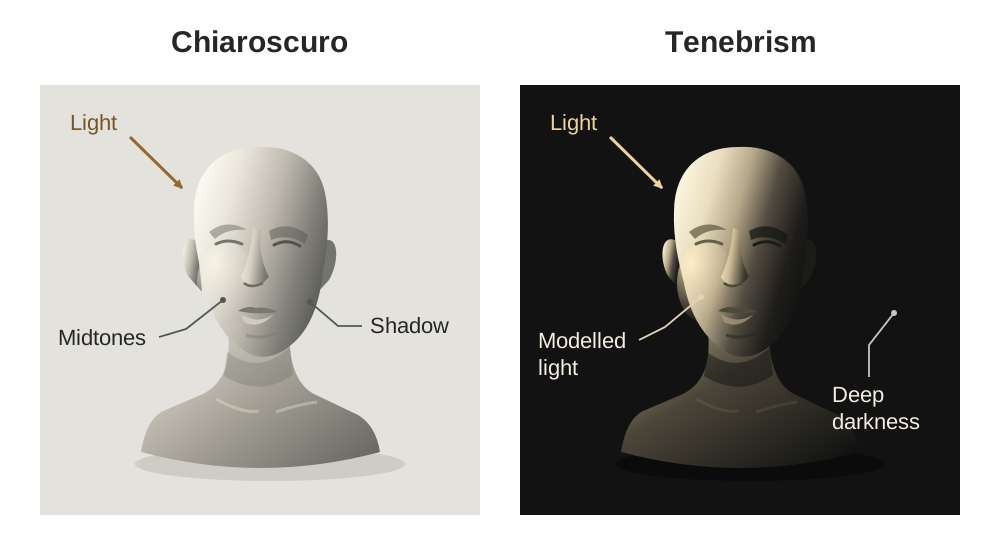
Chiaroscuro and Tenebrism
Renaissance painters used chiaroscuro (gradual tonal shading from light to dark) to give flat drawings three-dimensional roundness. Baroque artists turned light into intense theatre. Caravaggio developed tenebrism (from the Italian tenebroso, meaning murky or dark), where forms emerge from an opaque, near-black background into a piercing beam of raking light. This dramatic contrast isolates crucial narrative gestures and heightens emotional tension.
Dynamic Composition and Foreshortening
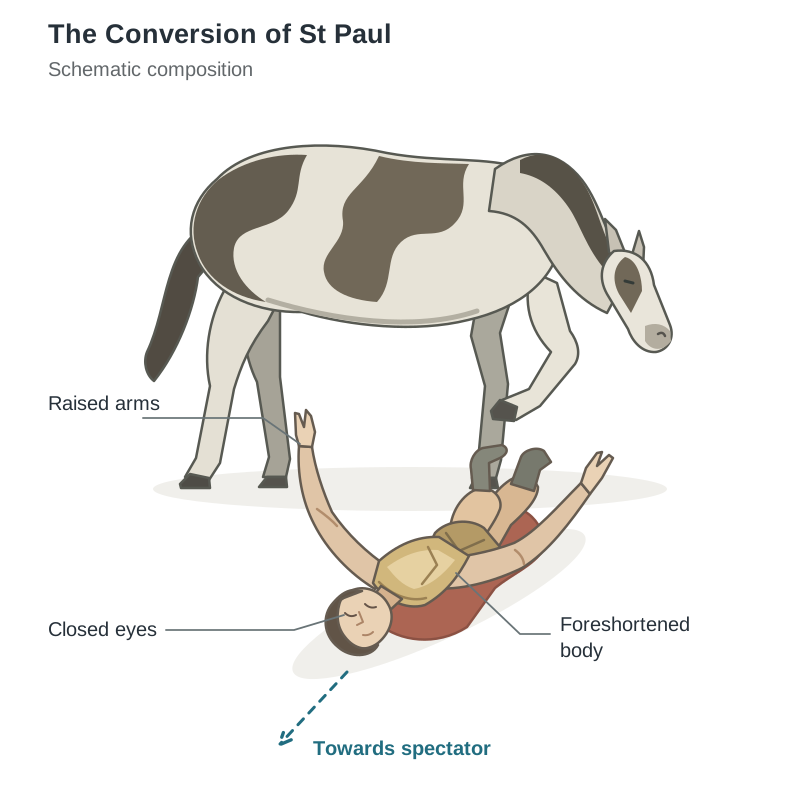
While High Renaissance compositions rested on calm, closed geometrical shapes like pyramids and symmetrical grids, Baroque compositions rely on sweeping diagonals, spirals, and sharp zigzags. Artists used aggressive foreshortening (drawing an object or limb so it appears to project directly forward toward the spectator) to thrust figures out of the canvas and pull the viewer straight into the action.
Unvarnished Naturalism
Instead of painting generalised, idealised beauties, painters such as Caravaggio worked directly from live models chosen from the streets. Wrinkled foreheads, torn garments, sunburnt skin, and dirt beneath fingernails brought sacred stories down to earth, helping ordinary worshippers identify with holy figures.
Specialised Dutch Genres and Vanitas
To appeal to middle-class domestic buyers, Dutch artists turned ordinary surroundings into fine art through four main categories:
- Genre scenes: Everyday life depicted inside kitchens, courtyards, and taverns.
- Landscapes: Expansive views of flat Dutch fields, windmills, and wide skies, perfected by painters such as Jacob van Ruisdael.
- Portraits: Individual likenesses and large group portraits for trade guilds and civic shooting companies.
- Still life and vanitas: Arrangements of tableware, food, flowers, and books. A vanitas is a symbolic still life warning the viewer of the shortness of earthly life and the pointlessness of worldly riches. Common symbols include a human skull, a guttering candle, an hourglass, wilting flower petals, and overturned glasses.
Italian Masters: Caravaggio and Gian Lorenzo Bernini
The dramatic visual style of seventeenth-century Rome was established in paint by Caravaggio and in marble and space by Bernini.
Caravaggio (1571–1610)
Caravaggio abandoned traditional preparatory line drawings on paper. Instead, he painted directly from posed live models onto a dark-toned canvas, occasionally scoring guide lines into the wet under-ground with the wooden tip of his paintbrush handle.
The Calling of St Matthew (c. 1599–1600, Contarelli Chapel, San Luigi dei Francesi, Rome)
- Subject matter: Christ enters a dim room where Matthew and his companions sit counting tax money at a table, calling Levi the tax collector to discipleship.
- Composition and light: A sharp beam of raking light enters from high on the right wall behind Christ, cutting diagonally across the darkness to illuminate Matthew's startled face. Christ's hand reaches forward in a relaxed gesture that deliberately mimics Michelangelo's Adam on the Sistine Chapel ceiling, showing divine grace waking a sinner. Art historians still debate Matthew's exact identity in the group: he is widely read as the bearded figure pointing to himself in disbelief, though some argue he is the young man hunched over the coins.
- Costume: Caravaggio dressed the tax collectors in the fashionable clothes of his own day (doublets and feathered hats), so Roman churchgoers saw the Bible story happening in their own world.
Caravaggio used this same raw immediacy in *The Conversion of St Paul* (1600–1601, Cerasi Chapel, Santa Maria del Popolo, Rome). Instead of a grand panoramic battle, Paul lies flat on his back, eyes shut and arms thrown wide, foreshortened so that his body projects directly forward while his massive piebald horse occupies the upper half of the canvas.
Gian Lorenzo Bernini (1598–1680)
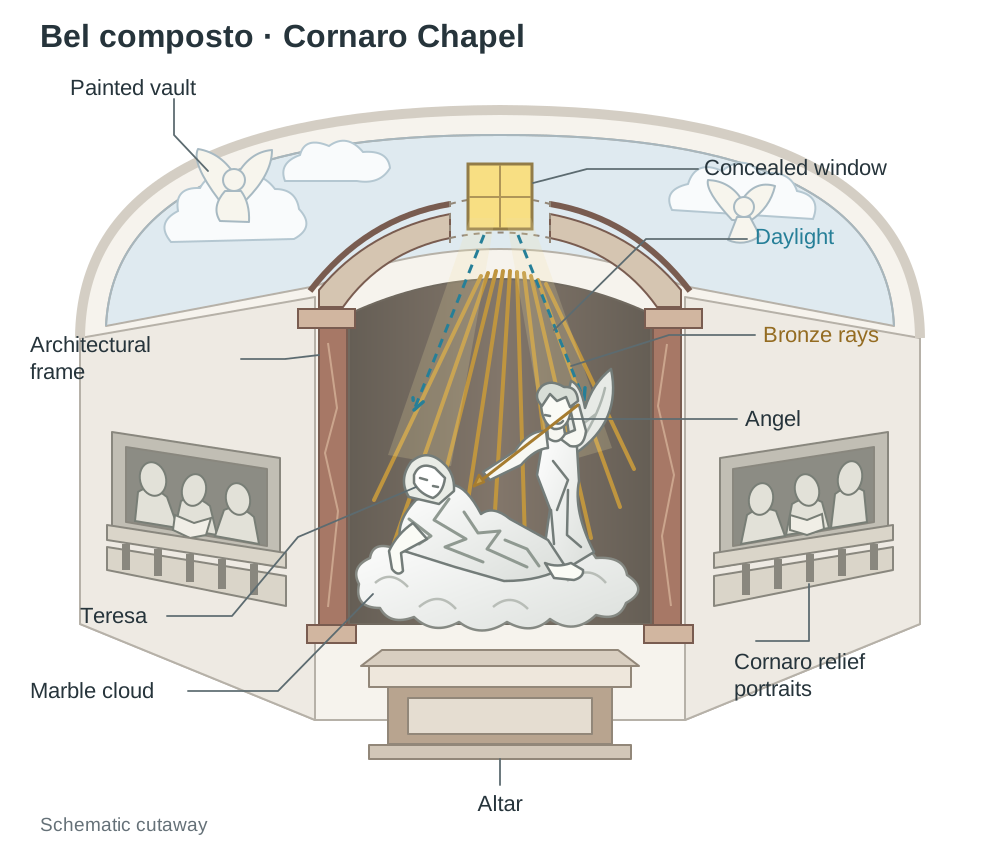
Bernini was a master sculptor, architect, and playwright who developed the bel composto—the complete artistic synthesis of architecture, sculpture, and painting into one theatrical setting.
The Ecstasy of St Teresa (1647–1652, Cornaro Chapel, Santa Maria della Vittoria, Rome)
- Carving and textures: Bernini carves marble so skilfully that it looks like different materials: soft flesh, fluffy cloud, deeply creased heavy cloth on Teresa, and thin clinging cloth on the angel.
- Theatrical lighting: Bernini placed the white marble group inside an architectural niche crowned by an elliptical pediment, framing it against a cascade of gilded bronze rays. These rays catch real daylight funnelled downward through a concealed window of yellow glass hidden in the upper pediment.
- Audience involvement: On the side walls of the chapel, Bernini carved marble opera boxes containing relief portraits of Cardinal Federico Cornaro and his family, who whisper, read prayer books, and watch the miracle unfold alongside the church visitor.
- Painted ceiling: The chapel vault is frescoed with painted clouds and angels, completing the unity of painting with the architecture and sculpture.
Bernini's David (1623–1624, Galleria Borghese, Rome)
Commissioned by Cardinal Scipione Borghese, this lifesize marble sculpture shows the biblical hero in the middle of combat. While Michelangelo's Renaissance David stands poised and still before the fight, Bernini shows David coiled like a spring, upper body twisted and toes gripping the rock ledge as he prepares to sling the stone. His face is locked in concentration, with furrowed brows and his lower lip bitten in effort. Bernini's David breaks through the invisible boundary between art and viewer: the missing giant Goliath is implied to stand directly behind the spectator, drawing the room into the battle.
Dutch Masters: Rembrandt van Rijn and Johannes Vermeer
In Amsterdam and Delft, northern masters used light not for theatrical shock, but to reveal human psychology and quiet domestic beauty.
Rembrandt van Rijn (1606–1669)
Born in Leiden, Rembrandt trained under Pieter Lastman, a history painter who had studied in Italy. Through Lastman and the Utrecht Caravaggisti, Rembrandt absorbed Caravaggio's light without ever travelling abroad. He found early fame in Amsterdam as a portraitist, but later suffered personal loss and bankruptcy in 1656, which deepened the emotional honesty of his art.
The Night Watch (1642, Rijksmuseum, Amsterdam)
Its formal title is Militia Company of District II under the Command of Captain Frans Banninck Cocq. Commissioned for the civic guard's guildhall, traditional group portraits arranged members in rigid, evenly lit rows so every paying patron looked equally important. Rembrandt tore up this convention:
- Composition: The company charges out of a shadowy arched gateway into daylight. The figures move along colliding diagonals, carrying muskets, drums, and unfurled banners.
- Selective lighting: Rather than lighting every face equally, Rembrandt used golden, atmospheric chiaroscuro to highlight key figures. Captain Cocq's outstretched left hand casts a physical shadow across Lieutenant van Ruytenburch's bright yellow tunic, visually stepping out toward the viewer. In the middle ground steps a brightly lit little girl with a dead chicken hanging from her belt; its claws refer to the company's emblem, since the Kloveniers (arquebusiers) used a claw as their symbol.
- Handling of media: Rembrandt contrasted thin, transparent dark glazes with rich, textured impasto on illuminated collars, metal gorgets, and gold embroidery, allowing gallery light to strike the physical ridges of paint.
Self-Portrait with Two Circles (c. 1665–1669, Kenwood House, London)
In this late masterpiece, Rembrandt stands in a white painter's cap and a dark fur-lined robe, holding his palette, brushes and maulstick against a plain background. On the wall behind him are two mysterious painted arcs, which scholars interpret either as a demonstration of freehand mastery (drawing a perfect circle without instruments) or as a stylised world map. Rembrandt uses thick, broken layers of impasto on his tired, lined face, while his hands remain loose and sketchy, capturing his ageing features with profound dignity and honesty.
Johannes Vermeer (1632–1675)
Vermeer worked in Delft, producing around thirty-five surviving paintings of serene, sunlit domestic interiors, usually featuring one or two figures beside a left-hand window.
The Milkmaid (c. 1658, Rijksmuseum, Amsterdam)
- Composition: Unlike the turbulent diagonals of Italian painting, Vermeer builds a stable composition on solid verticals and horizontals around a kitchen maid pouring milk into an earthenware basin.
- Light and pointillé: Cool daylight streams in from a window on the left, picking up tiny details across the whitewashed wall. Vermeer used pointillé (applying tiny dots of pale paint) to make bread crusts, copper pots, and ceramic glaze shimmer.
- Human figure: The woman is treated with dignity and respect, elevating ordinary household work into a moment of calm virtue.
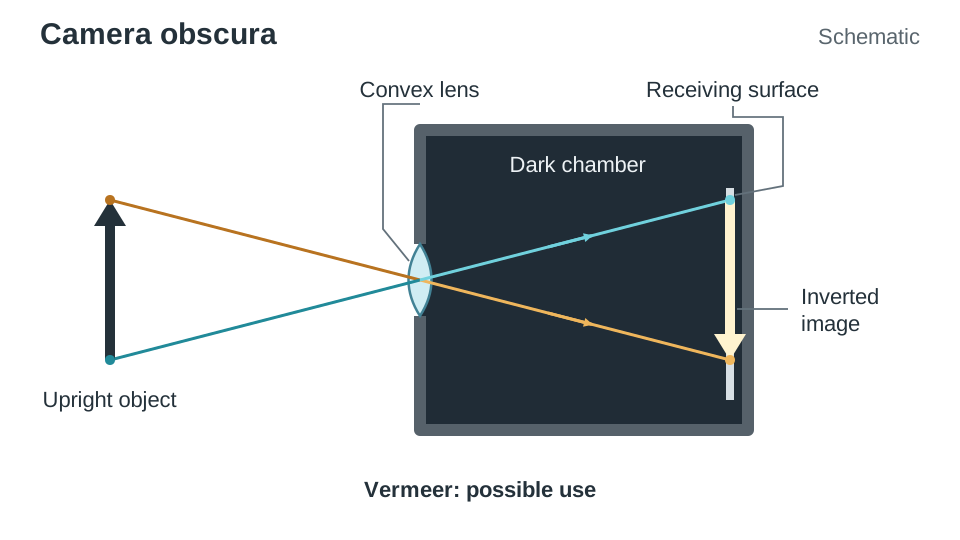
Vermeer may have used a camera obscura (an optical device with a lens that projects an image of an external scene onto an interior surface) to study optical focus, depth of field, and the soft halos of light on reflective surfaces.
Woman Holding a Balance (c. 1662–1663, National Gallery of Art, Washington)
A woman stands in quiet contemplation holding empty, perfectly level scales. Behind her hangs a painting of the Last Judgement. Vermeer links the earthly act of weighing gold or pearls with the spiritual judgment of the soul, creating a calm allegorical meditation on balance, greed, and conscience.
Baroque Architecture and Illusionistic Space
Baroque architecture abandoned flat Renaissance planes and rigid proportions in favour of undulating stone, sweeping oval plans, and optical illusions.
Classical Elements Adapted by Baroque Architects
Baroque architects kept classical architectural parts but altered their shapes and depths to create movement, light, and shadow:
- Pilaster: A flat, decorative column attached directly to a wall.
- Entablature: The horizontal band of mouldings resting above columns and pilasters.
- Pediment: The triangular or segmental gable found over doorways and façades. Baroque architects frequently used broken pediments, splitting them open at the top to insert urns or statues.
- Coffering: Sunken decorative panels in a ceiling or dome.
- Lantern: The small windowed turret perched on top of a dome to let in natural daylight.
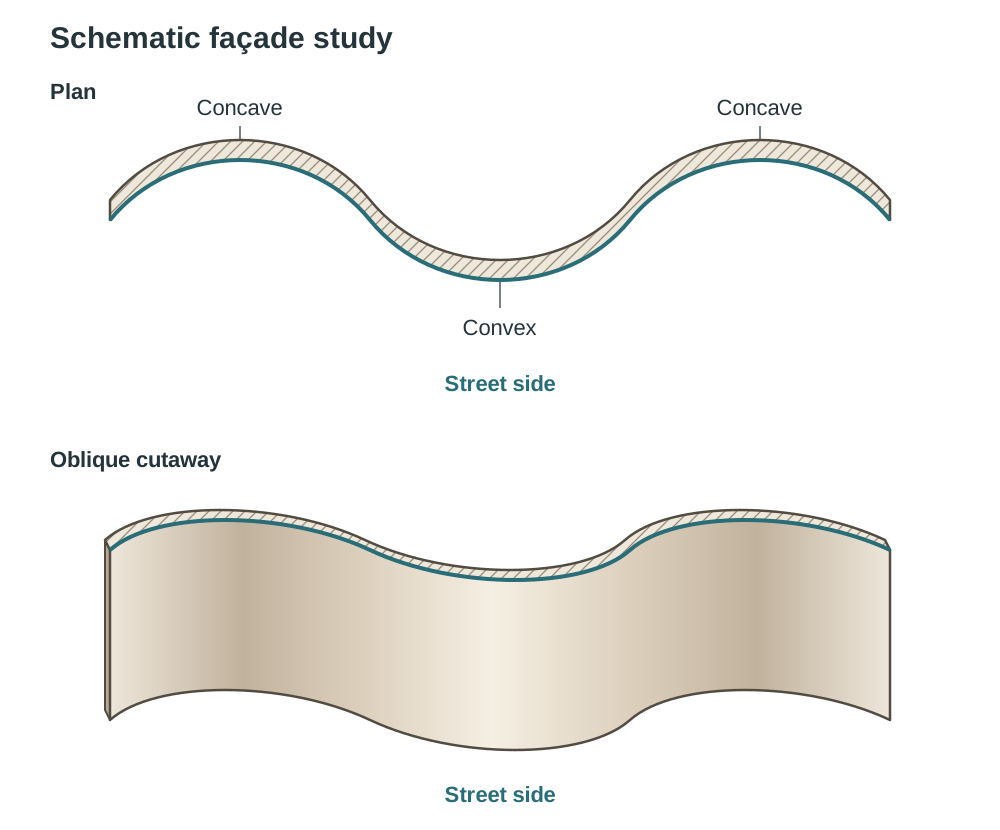
- Undulating façade: A wall that curves smoothly in and out with alternating concave and convex bays, producing ripples of shadow.
Francesco Borromini: San Carlo alle Quattro Fontane (Rome)
Borromini turned solid masonry into dynamic sculpture on an awkward, cramped street corner:
- Interior (1638–1641): Borromini built the church interior around an undulating oval rather than a traditional cross. Above, the coffered dome features interlocking crosses, octagons, and hexagons that shrink in scale as they rise toward the lantern, using forced perspective to make a small dome feel towering.
- Façade (c. 1665–1667): Completed after Borromini's death, the two-storey exterior wall ripples in alternating concave and convex curves, held together by giant Corinthian columns and deeply recessed niches that create shadows.
Ceiling Frescoes: Quadro Riportato vs Quadratura
Baroque artists transformed church and palace ceilings into spectacular optical illusions using two distinct techniques:
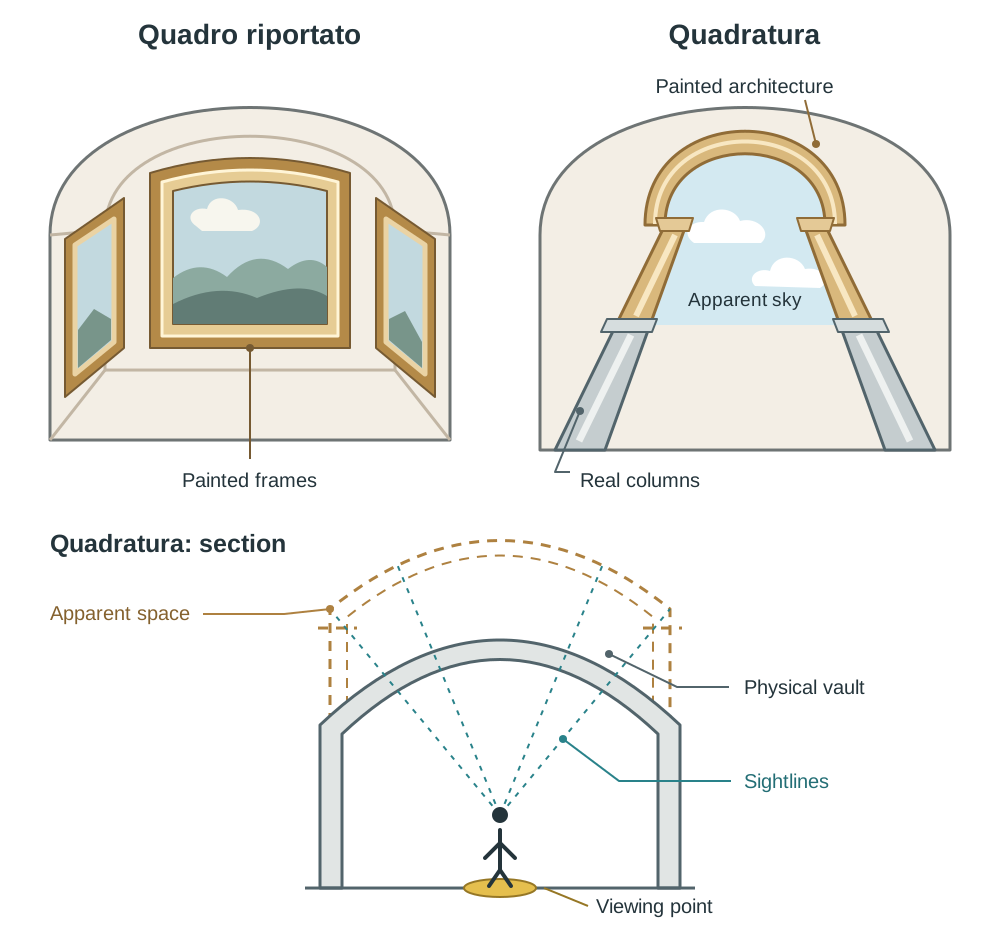
- Quadro riportato (carried-over picture):* Ceiling scenes painted to look like separate, framed easel canvases set into a vaulted ceiling, flanked by simulated bronze medallions and simulated marble figures. A prime example is Annibale Carracci's ceiling for the Galleria Farnese (The Loves of the Gods, 1597–1608), which uses trompe l'œil* (visual tricks that deceive the eye) to make flat plaster look like carved stone.
- Quadratura (architectural illusionism):* Painted architecture calculated with strict linear perspective to look like a genuine structural continuation of the real walls into an open sky. In Sant'Ignazio in Rome, Andrea Pozzo painted The Glorification of Saint Ignatius* (1691–1694). When a viewer stands on the yellow marble disc set into the nave floor, the real columns and the painted columns line up, making the church vault appear to dissolve into heaven.
After the Baroque: Legacy and Influence on Later Art
The innovations of seventeenth-century Baroque art transformed European visual culture and laid foundations for later movements.
- The Spread of Caravaggism: Caravaggio's dramatic tenebrism was carried across Europe by followers known as the Caravaggisti. Artemisia Gentileschi used his lighting to paint dramatic heroines such as Judith Slaying Holofernes, while painters in Utrecht brought the style home to Holland, where it inspired the young Rembrandt.
- Rococo (Early 18th Century): In France and southern Germany, the heavy theatricality and deep shadows of the Baroque softened into the playful, pastel-toned, decorative elegance of the Rococo, visible in the paintings of Antoine Watteau and Jean-Honoré Fragonard.
- Neoclassical Reaction (Late 18th Century): By the late 1700s, artists such as Jacques-Louis David reacted against Baroque extravagance, returning to the severe lines, archaeological accuracy, and moral restraint of ancient Greece and Rome.
- Influence on 19th-Century Realism and Modernism: Rembrandt's expressive impasto and emotional honesty directly inspired nineteenth-century realists such as Gustave Courbet. Johannes Vermeer, virtually forgotten for almost two centuries, was rediscovered in the 1860s by French critic Théophile Thoré-Bürger, and his treatment of daylight went on to influence the Impressionists.
Studio Link: Using Baroque Ideas in Your Coursework
You can apply Baroque techniques directly to your Leaving Certificate practical coursework and observational drawing. Experiment with tenebrism by illuminating a primary-source still life or portrait model with a single angled spotlight in a darkened room. Contrasting smooth glazes with thick impasto paint can also help you render different surface textures.
Key terms
- Chiaroscuro
- The gradation of light and dark tones in a drawing or painting to model three-dimensional volume and form on a two-dimensional surface.
- Tenebrism
- An exaggerated form of chiaroscuro popularised by Caravaggio, where figures are highlighted by a harsh directional beam of light against an impenetrable, dark background.
- Counter-Reformation
- The Catholic Church's 16th- and 17th-century revival following the Council of Trent, which enlisted dramatic and emotional art to re-engage worshippers and refute Protestantism.
- Bel Composto
- A concept championed by Gian Lorenzo Bernini that unifies architecture, sculpture, and painting into a single, cohesive theatrical environment.
- Trompe l'œil
- A French phrase meaning 'deceives the eye', describing visual techniques that create convincing optical illusions of three-dimensional reality on a flat surface.
- Quadratura
- Illusionistic ceiling painting where painted architecture is rendered in strict linear perspective to appear as an open continuation of the real walls into the sky.
- Quadro Riportato
- A ceiling fresco technique where scenes are painted within simulated frames to look like easel pictures hung on a curved vault, as seen in the Palazzo Farnese.
- Impasto
- The thick, physical application of paint that stands proud of the support, showing the ridges of brushstrokes or palette knives.
- Genre Painting
- Artworks depicting scenes of everyday life, ordinary domestic routines, markets, and tavern gatherings, which flourished in the Dutch Republic.
- Vanitas
- A symbolic still life common in Dutch painting that uses motifs like skulls, hourglasses, and wilting flowers to remind viewers of the brevity of life.
- Undulating Façade
- An exterior architectural wall designed with alternating convex and concave curves to create moving patterns of light and deep shadow, as seen in Borromini's work.
- Foreshortening
- The visual compression of an object, limb, or figure in perspective so that it appears to project forward or recede deeply into space.
- Pointillé
- A technique used by Vermeer involving small dots of pale, reflective oil paint applied to canvas surfaces to convey sparkling highlights on textures.
- Camera Obscura
- A darkened box or room with a pinhole or lens that projects an external image onto an interior surface, possibly used by Vermeer to study optics and light.
Check yourself
After the Council of Trent, what did Church authorities demand of religious art?
It should tell Bible stories clearly and powerfully, stir emotion and devotion, and avoid the confusing, artificial poses of Mannerism.
How did Gian Lorenzo Bernini achieve the bel composto in the Cornaro Chapel?
He unified architecture, sculpture, and painting by setting the marble figures under an architectural pediment lit by a concealed window, flanked by relief portraits of patrons in theatre boxes, and a painted ceiling fresco of clouds and angels above, so the heavenly vision seems to continue into the vault.
Why did Rembrandt's 'The Night Watch' break with traditional Dutch group portraiture?
He replaced static, evenly lit rows of militia members with a dynamic, selectively lit action scene where figures move forward along dramatic diagonals.
What is the key difference between quadratura and quadro riportato?
Quadratura paints illusionistic architecture continuing into an open painted sky using linear perspective, while quadro riportato paints simulated framed easel pictures set across a ceiling.
What is a vanitas painting and what was its moral purpose in seventeenth-century Dutch art?
It is a symbolic still life containing motifs such as skulls, hourglasses, and wilting flowers, designed to remind viewers of the brevity of life and the transience of earthly possessions.
What technique did Johannes Vermeer use in 'The Milkmaid' to make domestic surfaces sparkle?
He applied pointillé, dabbed specks of light-toned paint, across the bread, basket, and earthenware jug to capture natural reflections.