

Modernism (c. 1900–1960s) marks a radical break with the academic traditions that shaped Western art from the Renaissance onward. Rather than treating a painting as an illusionistic window into a three-dimensional world, modernist artists treated the canvas as a flat surface of line, tone, colour, and form. They responded to the psychological shocks of industrialisation, two World Wars, psychoanalysis, and consumer culture by inventing entirely new visual languages. In the Leaving Certificate written examination, Modernism is a designated section of focus in Visual Studies Content Area 1 ('Europe and the wider world'). Using the Visual Studies Framework, you study each movement across three temporal dimensions: what informed it before the period, what happened during the period, and how it shaped art and culture afterwards. You explore six core elements: Context, Artists and Artworks, Analysis, Art Elements and Design Principles, Media and Areas of Practice, and Innovation and Invention.
Roots and Revolution: The Before and the Visual Studies Framework
From the Renaissance until about 1900, most Western painters tried to make an artwork look like a window through which you observed the physical world. This tradition of illusionism depended on linear perspective, anatomical precision, and delicate shading. By the turn of the twentieth century, two major pressures undermined this approach:
- The rise of photography (from 1839): Cameras captured external likenesses with mechanical accuracy, freeing painters from the need to produce purely documentary records.
- Non-Western visual culture: Exhibitions of African woodcarvings and imports of Japanese woodblock prints introduced European artists to flat planes of colour, cropped compositions, and expressive distortion.
Modernism did not appear from nowhere; it grew out of the innovations of three late nineteenth-century Post-Impressionists:
- Paul Cézanne (1839–1906): Cézanne abandoned traditional perspective, constructing landscapes and still lifes out of small planes of modulated colour. In an influential 1904 letter to Émile Bernard, he advised treating nature by means of 'the cylinder, the sphere, and the cone'. In his Mont Sainte-Victoire series, he tilted planes and combined shifting viewpoints, giving Picasso and Braque the starting point for Cubism.
- Vincent van Gogh (1853–1890): Van Gogh used rhythmic brushwork, thick impasto (paint laid on thickly so brush or palette-knife marks remain visible), and intense, arbitrary colour (colour chosen for emotional impact rather than natural appearance), as seen in The Starry Night (1889). His work directly inspired Fauvism and German Expressionism.
- Paul Gauguin (1848–1903): Gauguin rejected naturalism in favour of flat patches of unshaded, symbolic colour bound by dark outlines (Vision after the Sermon, 1888). His search for spiritual meaning outside industrialised Europe encouraged the avant-garde (artists ahead of their time who experiment with new styles) to look beyond classical Greek and Roman models.
The Visual Studies Framework
When writing about any modern movement, examine it across three stages:
- Before: The artistic, social, or technological context that led up to it.
- During: The core artists, artworks, visual elements, media, and design principles.
- After: The lasting impact on subsequent artists, including links to Irish art.
Chronological Roadmap
- c. 1880s–1900s: Post-Impressionist foundations (Cézanne, Van Gogh, Gauguin).
- 1905–1914: Explosions of colour, form, and speed (Fauvism, Die Brücke, Der Blaue Reiter, Cubism, Futurism).
- 1914–1924: Wartime crisis, anti-art, and rational reconstruction (Dada, De Stijl, Bauhaus).
- 1924–1939: Exploring the subconscious and political trauma (Surrealism, New Objectivity, Entartete Kunst).
- 1940s–1960s: Post-war shift to New York and consumerism (Abstract Expressionism, Pop Art, Minimalism).
Liberating Colour and Form: Fauvism and German Expressionism
At the 1905 Salon d'Automne in Paris, art critic Louis Vauxcelles saw bright, aggressively coloured canvases hanging in the same room as a classical Florentine-style bronze sculpture. He exclaimed, 'Donatello chez les fauves!' ('Donatello among the wild beasts!'), accidentally naming Fauvism.
Led by Henri Matisse (1869–1954) and André Derain, the Fauves broke the centuries-old rule that colour must match nature. In Matisse's Woman with a Hat (1905), the sitter's face features vivid greens, turquoise patches, and brick-red strokes over a brushy background. In The Joy of Life (Le Bonheur de Vivre, 1905–1906), Matisse used sinuous arabesque lines (flowing, rhythmic, curving outlines) and flat planes of pure orange, yellow, and violet to generate a feeling of pastoral harmony.
The Vienna Secession: Gustav Klimt
In Vienna, Gustav Klimt (1862–1918) led a revolt against academic conservatism, co-founding the Vienna Secession in 1897 under the motto: 'To every age its art, to every art its freedom'. Trained in architectural decoration at the Vienna School of Arts and Crafts, Klimt turned from traditional murals to an ornamental, symbolic style.
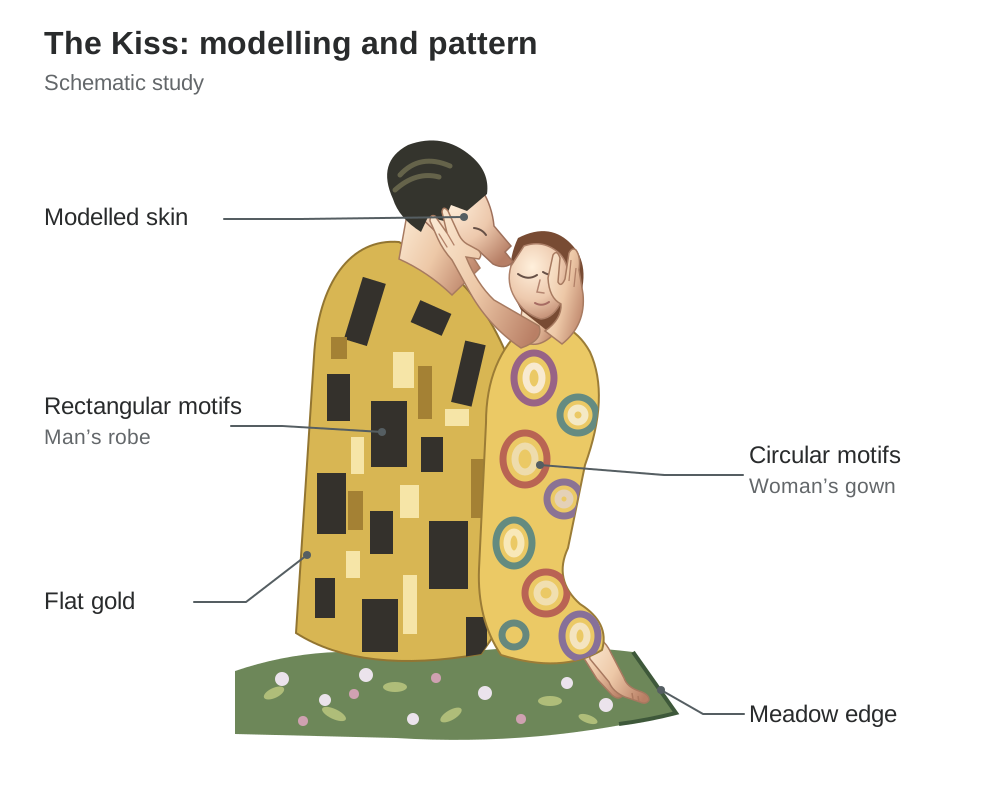
During his Golden Period (c. 1900–1910), inspired by the glittering sixth-century Byzantine mosaics he studied in Ravenna, Klimt painted The Kiss (1907–1908). The couple embraces at the edge of a flowery meadow, the woman kneeling as the man bends to kiss her, their bodies enveloped in gold leaf and oil paint. Klimt creates an intense visual tension between naturalistic modelling (the softly painted, three-dimensional faces, hands, and feet) and flat, abstract design. The man's robe features sharp, dark, angular rectangles, while the woman's gown is decorated with fluid, colourful concentric circles and floral spirals. These opposing design principles serve as visual metaphors for masculine and feminine energies.
German Expressionism: Die Brücke and Der Blaue Reiter
In Germany, Expressionism rejected realistic representation to communicate psychological tension, moral crisis, and spiritual yearning.
- Die Brücke (The Bridge): Founded in Dresden in 1905 by four architecture students—Ernst Ludwig Kirchner, Erich Heckel, Karl Schmidt-Rottluff, and Fritz Bleyl—this group saw their art as a bridge to a free, authentic future. They looked to tribal carvings and revived the medieval German woodcut. Gouging into wood blocks created jagged edges, stark black-and-white contrasts, and expressive distortions that transferred cleanly onto canvas and print.
- Kirchner, Street, Berlin (1913): Elongated, sharp-featured pedestrians crowd a steeply tilted pavement. Kirchner uses jarring, acidic pinks and toxic greens, applied with hurried, diagonal, feather-like brushstrokes, to convey the nervous alienation of the modern metropolis.
- Der Blaue Reiter (The Blue Rider): Formed in Munich in 1911 by Wassily Kandinsky and Franz Marc, this group sought spiritual renewal rather than urban critique. Marc associated colours with spiritual properties (blue stood for masculine spirituality, yellow for gentle femininity, and red for matter).
- Marc, The Large Blue Horses (1911): Three curving, muscular blue horses dominate the composition, their rhythmic contours echoed by the rolling red and green hills behind them.
- Kandinsky, Composition VII (1913): Influenced by music, Kandinsky believed painting could trigger emotional vibrations without depicting physical objects. In Composition VII, he eliminated recognisable figures completely, producing pure non-objective abstraction—an artwork containing no reference to real-world forms. He laid out this philosophy in his 1911 book, Concerning the Spiritual in Art.
- New Objectivity (Neue Sachlichkeit): Following the trauma of World War I, artists like Otto Dix and George Grosz turned away from romantic expressionism toward biting, satirical realism. Dix's The War (Der Krieg, 1929–1932), a massive four-panel triptych painted in the layered tempera and oil technique of Renaissance masters, records decaying corpses, gas masks, and trench ruins with unflinching precision.
Dismantling Perspective: Cubism and Futurism
Between 1907 and 1914, Pablo Picasso (1881–1973) and Georges Braque (1882–1963) carried out the most radical structural overhaul of European painting since the Renaissance.
Influenced by Cézanne's structural compositions and the simplified planes of ancient Iberian stone sculptures and African carvings that Picasso saw at the Trocadéro Museum in Paris, Picasso painted Les Demoiselles d'Avignon (1907). This proto-Cubist canvas depicts five prostitutes in a Barcelona brothel. The women's bodies are fractured into sharp, shard-like facets, with the two right-hand figures bearing angular, African mask-like features. Picasso rejected traditional depth, dragging the background drapery forward onto the same plane as the figures.
The Two Phases of Cubism
Picasso and Braque developed Cubism through two sequential phases:
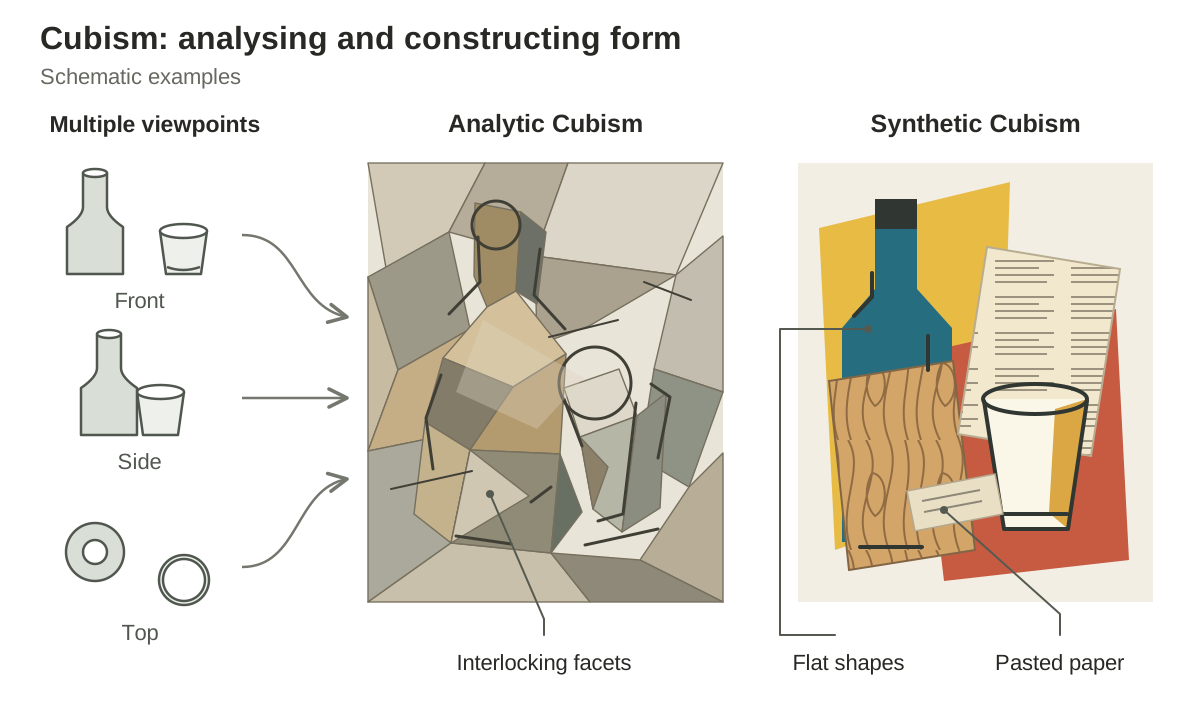
- Analytic Cubism (c. 1909–1912): The artists broke down physical objects into interlocking, semi-transparent facets seen from multiple viewpoints (showing the top, sides, and front of an object at the same time). They eliminated bright colour, working in a monochromatic palette of ochres, greys, browns, and dull greens so that tonal changes would highlight structure without decorative distraction.
- Picasso, Ma Jolie (1911–1912): The figure of a woman holding a zither or guitar dissolves into an intricate grid of shifting triangles and planes. Picasso stencilled the letters 'MA JOLIE' ('my pretty one') in flat commercial typeface across the bottom. These letters emphasise the literal flatness of the canvas, reminding the viewer that a painting is a painted surface rather than a real space.
- Synthetic Cubism (c. 1912–1914): The core phase ran c. 1912–1914, but Picasso kept using a flat, Synthetic Cubist style into the 1920s (e.g. Still Life with a Mandolin, 1924). Having taken objects apart, the artists began building images back up using flatter, simpler shapes, broader planes, and brighter colours.
- Picasso, Still Life with Chair Caning (spring 1912): Picasso invented fine-art collage by gluing a piece of commercially printed oilcloth (mimicking woven chair wicker) onto an oval canvas, framing the whole composition with an ordinary piece of rope. This bridged the divide between everyday industrial materials and 'fine art'.
- Braque, Fruit Dish and Glass (autumn 1912): Later that year, Braque invented papier collé (a specific form of collage using pasted strips of paper), pasting imitation oak wood-grain wallpaper alongside charcoal drawings.
Futurism (Italy, 1909–c. 1916)
In February 1909, Italian poet Filippo Tommaso Marinetti published the Futurist Manifesto on the front page of Paris's Le Figaro. Futurism demanded that Italian culture cast off its obsession with ancient Rome and the Renaissance to embrace speed, technology, motorcars, aeroplanes, and industrial energy.
Artists including Umberto Boccioni, Giacomo Balla, Gino Severini, and Carlo Carrà adapted the fractured planes of Cubism, adding bright colour and dynamic 'lines of force' to capture physical velocity.
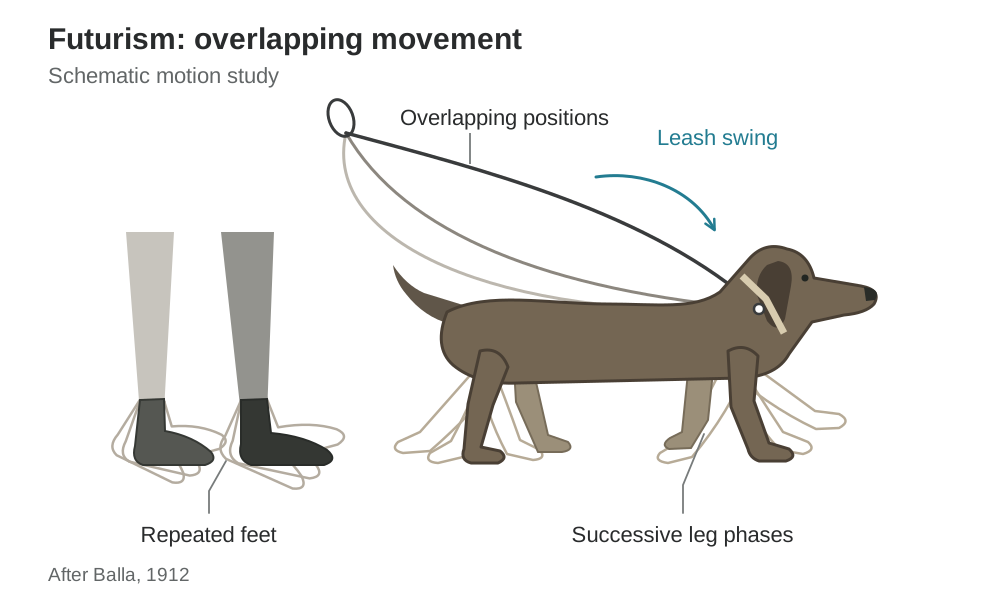
- Balla, Dynamism of a Dog on a Leash (1912): Influenced by the chronophotography of Étienne-Jules Marey (early photographic studies that recorded multiple phases of movement on a single plate), Balla depicted a dachshund, its leash, and its owner's feet as overlapping, fan-like blurs of motion.
- Boccioni, Unique Forms of Continuity in Space (1913; plaster, later cast in bronze): A helmeted, striding figure whose limbs dissolve into flowing, wing-like aerodynamic planes, showing how human motion interacts with surrounding space.
Subversion, Dreams, and Politics: Dada, Surrealism, and Suppression
Disgusted by the industrial slaughter of World War I, artists who had sought refuge in neutral Switzerland gathered at the Cabaret Voltaire in Zurich in 1916 to establish Dada. Figures such as Hugo Ball, Tristan Tzara, and Jean Arp rejected logic, reason, and aesthetic beauty, arguing that bourgeois rationalism was directly responsible for the war. They staged chaotic performances, created poems from random word clippings, and used chance to arrange collages.
In New York, French artist Marcel Duchamp (1887–1968) pursued parallel anti-art ideas. Duchamp created the readymade—taking a mass-produced, ordinary manufactured object, making a minor alteration or signing it, and presenting it in a gallery setting. Early examples include Bicycle Wheel (1913) and Bottle Rack (1914). In 1917, he submitted Fountain—an inverted porcelain urinal purchased from the J.L. Mott Iron Works, turned on its side, and signed with the pseudonym 'R. Mutt 1917'—to the exhibition of the Society of Independent Artists in New York. The board suppressed the work, refusing to display it. Duchamp proved that art is not about manual craftsmanship; it is about the conceptual choice of the artist, establishing the foundation for modern conceptual art.
Surrealism (Paris, 1924)
In 1924, writer André Breton published the Surrealist Manifesto, defining Surrealism as 'pure psychic automatism'. Deeply influenced by Sigmund Freud's theories of the subconscious, dreams, and repressed desire, the Surrealists sought to unite the conscious and unconscious realms. The movement divided into two primary working approaches:
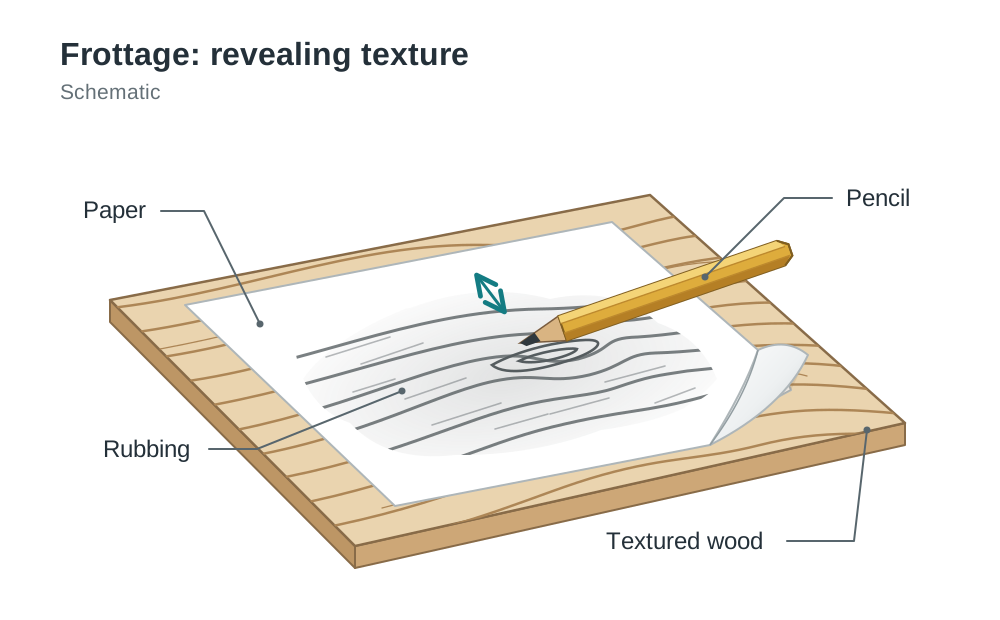
- Automatism: Letting the hand move freely across the paper or canvas without conscious mental control, releasing imagery directly from the subconscious. Examples include Joan Miró's fluid biomorphic signs, André Masson's spontaneous glue-and-sand paintings, and Max Ernst's frottage (making pencil rubbings over rough floorboards, leaves, or mesh to find accidental patterns).
- Illusionistic Dream Painting: Painting bizarre, impossible, and illogical scenes with academic draughtsmanship and smooth, photographic precision, making the dream world feel physically real.
- Salvador Dalí (1904–1989): Dalí developed what he called the paranoiac-critical method. He deliberately imitated the mindset of paranoia—where the brain makes irrational links and sees hidden identities across ordinary objects—and then painted these associations with minute, hyper-realistic detail. This method produced the double image, in which a single set of contours can be interpreted simultaneously as two or more completely different subjects.
- Apparition of Face and Fruit Dish on a Beach (1938): A pedestal fruit dish filled with pears doubles as the forehead and cheekbones of a girl's face, while the sand in the background forms the body of an alert dog whose collar is also a viaduct over the sea.
- The Persistence of Memory (1931): Limp, melting pocket watches drape over a dead olive branch, an architectural ledge, and an amorphous fleshy profile on a lonely Catalan coastline. Swarming ants on a copper watchcase suggest decay, transforming the rigid, mechanical certainty of time into something soft and subjective.
- René Magritte (1898–1967): The Belgian Surrealist favoured quiet, poetic contradictions over grotesque imagery. In The Treachery of Images (La Trahison des images, 1929), he painted a lifelike briar pipe with commercial clarity against a plain ground, accompanied by the painted text 'Ceci n'est pas une pipe' ('This is not a pipe'). Magritte's observation was literal: it was not a pipe, but a painted representation of one, forcing the viewer to question the relationship between language, images, and physical reality.
- Frida Kahlo (1907–1954): Breton championed Kahlo as an intuitive surrealist, but she firmly rejected the label: 'They thought I was a Surrealist, but I wasn't. I never painted dreams. I painted my own reality.' Following a catastrophic bus crash at age eighteen that left her with permanent spinal and pelvic trauma, Kahlo turned painting into an autobiographical diary. In The Two Fridas (1939), painted during her divorce from Diego Rivera, twin self-portraits sit on a bench beneath a stormy sky, holding hands and connected by an exposed artery running between their hearts. The Frida on the left wears a white Victorian wedding gown, her heart torn open as she clamps a severed artery with surgical forceps, blood dripping onto her white dress; the Frida on the right wears traditional Mexican Zapotec dress, her heart whole, holding a miniature portrait of Rivera. Kahlo fused Mexican folk tradition with sharp personal symbolism.
Totalitarian Suppression: Entartete Kunst
Modernist freedom met violent political opposition in the 1930s. In Germany, the National Socialist regime condemned modern art as morally corrupt, un-German, and racially inferior. In July 1937, the regime staged the Entartete Kunst (Degenerate Art) exhibition in Munich. Curators confiscated over 650 modernist works by artists including Kirchner, Nolde, Klee, Dix, and Marc, hanging them chaotically on narrow walls alongside defamatory slogans, graffiti, and psychiatric clinical photographs. Paradoxically, over two million people visited the exhibition, far outnumbering the audience for the concurrent, state-approved Great German Art Exhibition.
Modernism Beyond the Canvas: Architecture, Design, and Art Markets
Modernism extended far beyond easel painting, shaping architecture, industrial design, lens-based media, and exhibition networks.
The Bauhaus (1919–1933)
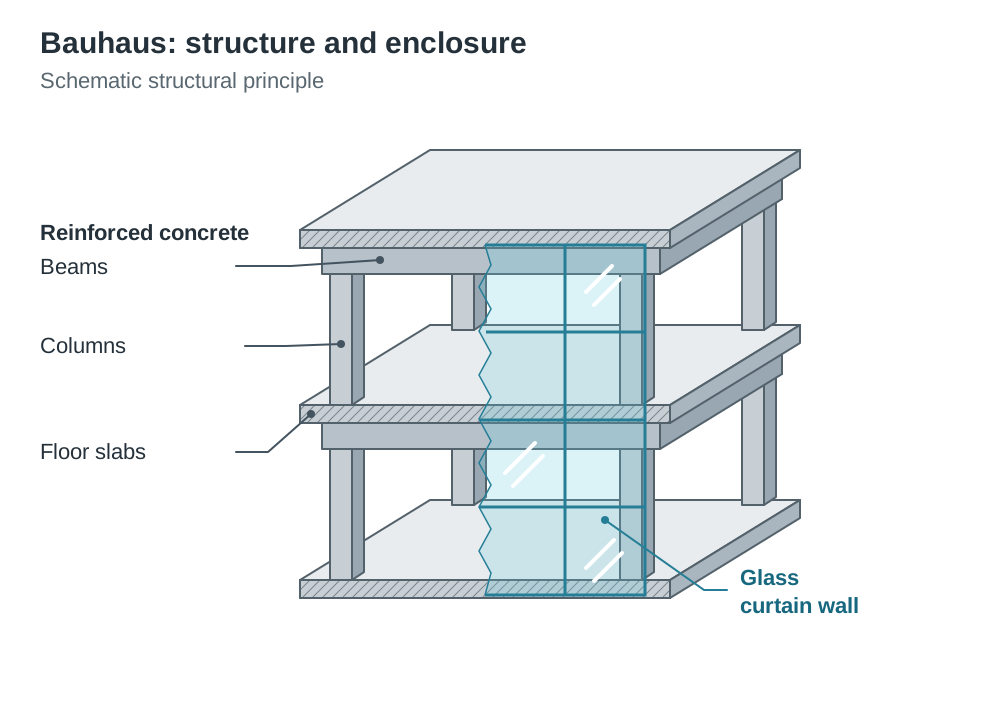
Founded in Weimar in 1919 by architect Walter Gropius, the Bauhaus school aimed to dissolve the historic boundary between the fine arts (painting, sculpture) and applied crafts (weaving, metalwork, carpentry, typography) to produce a Gesamtkunstwerk (a total work of art). The school adopted the functionalist maxim first stated by American architect Louis Sullivan: form follows function.
- Timeline: Weimar (1919) moved to Dessau (1925) moved to Berlin (1932) forced to close in 1933 under Nazi political pressure.
- Curriculum: Painters Paul Klee and Wassily Kandinsky taught core theories of line, form, and colour, while master craftsmen ran workshops in industrial prototyping.
- Design: Marcel Breuer designed the Wassily Chair (Model B3, 1925–1926). Inspired by the bent steel handlebars of his Adler bicycle, Breuer bent cold tubular steel into a continuous tubular-steel frame fitted with taut leather straps, creating a lightweight, hygienic chair ready for factory mass production.
- Architecture: Gropius designed the Bauhaus Building in Dessau (1925–1926) using a reinforced concrete structural skeleton wrapped in an expansive glass curtain wall, eliminating heavy load-bearing stone walls in favour of transparent, airy workspaces.
Modern Architecture, Photography, and Film
- Le Corbusier (1887–1965): In his Villa Savoye (Poissy, France, 1928–1931), Le Corbusier articulated his 'Five Points of a New Architecture': pilotis (slender reinforced concrete stilts lifting the building above the ground), a flat roof terrace, an open floor plan, ribbon windows running uninterrupted along walls, and a free facade.
- Photography: American expatriate Man Ray (1890–1976) invented the 'rayograph' (cameraless photogram) by placing everyday items—keys, funnels, combs—directly onto unexposed photographic paper and flashing it with light, producing ghostly, semi-abstract x-ray-like images.
- Film: In Un Chien Andalou (1929), director Luis Buñuel and Salvador Dalí combined dream imagery and illogical montage—opening with a razor blade slicing an eyeball—to shock cinema audiences out of passive viewing habits.
Patronage, Dealers, and the Art Market
As royal and church commissions vanished, modernist artists relied on progressive private collectors, independent commercial galleries, and new museums:
- Private Collectors: American writer Gertrude Stein and her brother Leo hosted Saturday evening salons at 27 rue de Fleurus in Paris, buying early canvases from Matisse and Picasso. Russian industrialist Sergei Shchukin commissioned Matisse's landmark decorative panels Dance and Music (1910) for his Moscow palace.
- Dealers: Daniel-Henry Kahnweiler opened a small Paris gallery in 1907, signing exclusive contracts with Picasso, Braque, and Juan Gris. His regular financial stipends allowed the Cubists to experiment freely in their studios without relying on public salon exhibitions.
- Landmark Exhibitions: The 1913 Armory Show (International Exhibition of Modern Art) in New York exposed the American public and press to European Modernism for the first time, causing a public scandal around Duchamp's Cubo-Futurist Nude Descending a Staircase, No. 2 (1912).
- Post-War Patrons: In New York, collector Peggy Guggenheim supported Jackson Pollock through her Art of This Century gallery, awarding him a monthly stipend and commissioning his monumental Mural (1943). The Museum of Modern Art (MoMA), founded in New York in 1929 under director Alfred H. Barr Jr., canonised modernist movements and helped establish New York as the new capital of international art.
See It in Ireland
You can examine authentic modernist works in Irish national collections:
- National Gallery of Ireland (Dublin): Houses Pablo Picasso's late Synthetic Cubist canvas Still Life with a Mandolin (1924) and Mainie Jellett's Decoration (1923), an early Irish non-objective abstract painting based on Cubist division of form.
- Hugh Lane Gallery (Dublin): Displays Francis Bacon's preserved London studio alongside works by Impressionist and early modern masters.
- Irish Museum of Modern Art (IMMA, Kilmainham): Features substantial post-war, conceptual, and contemporary international collections.
The Post-War Horizon and the Modernist Legacy
World War II shattered European infrastructure and dispersed artists across the Atlantic. European émigrés—including Breton, Ernst, Masson, Mondrian, and Léger—settled in New York, introducing young American painters to Surrealist automatism.
Abstract Expressionism (The New York School)
During the late 1940s and 1950s, Abstract Expressionism became the first American movement to achieve worldwide influence. It divided into two styles:
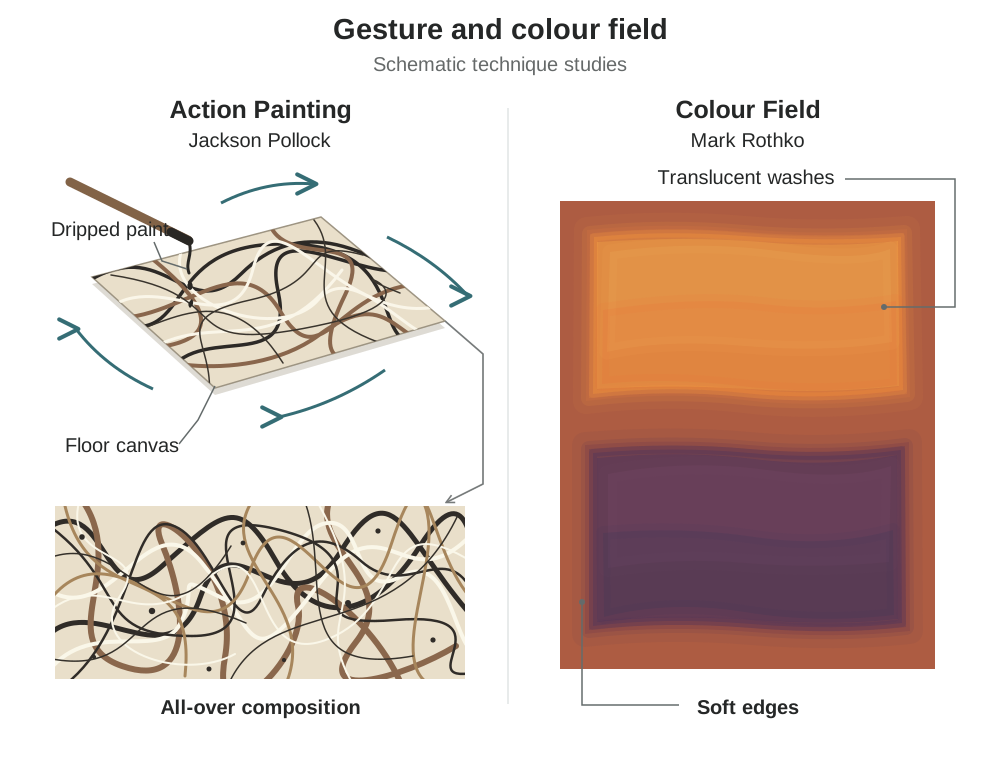
- Action Painting: Jackson Pollock (1912–1956) moved his raw canvas off the easel, tacking it flat onto his Long Island barn floor. Bypassing traditional brushes and palettes, he poured, flicked, and dripped household industrial enamel paint from sticks, hardened brushes, and cans while moving dynamically around all four sides. In Autumn Rhythm (Number 30) (1950), Pollock created an all-over composition where lines, splatters, and webs of pigment interlace without a top, bottom, or central focal point, recording the physical energy of the artist.
- Colour Field Painting: Mark Rothko (1903–1970) applied thinned, translucent washes of oil paint onto vast, unprimed or lightly sized canvases. In works like No. 14, 1960, luminous, soft-edged rectangles of saturated colour hover over flat grounds, designed to envelop the viewer's peripheral vision and induce contemplative, spiritual emotional states.
The Shift Toward Pop Art and Minimalism (c. 1955–1960s)
By the late 1950s, younger artists reacted against the intense, heroic emotionalism of Abstract Expressionism by turning to mass-produced consumer culture:
- Pop Art: Began in London in the mid-1950s with the Independent Group. Richard Hamilton's collage Just what is it that makes today's homes so different, so appealing? (1956) is widely considered the first Pop artwork. In the United States, Andy Warhol (1928–1987) hand-painted his 32 Campbell's Soup Cans (1962) to look machine-printed, then adopted commercial silkscreen printing for near-identical serial repetitions of celebrity icons (Marilyn Diptych, 1962). From late 1963, his studio, 'The Factory', functioned like an assembly line, breaking down barriers between commercial advertising and high art. Concurrently, Roy Lichtenstein magnified comic-strip panels into monumentally scaled canvases, imitating printer's Ben-Day dots with stencil templates and bold black outlines (Whaam!, 1963).
- Minimalism: In the early 1960s, sculptors such as Donald Judd and Dan Flavin abandoned artistic emotion, illusion, and metaphor entirely. Using industrial materials (galvanised steel, sheet aluminium, fluorescent light fixtures), they emphasised literal objecthood—the work was meant to be experienced simply as a three-dimensional physical presence in the room. As painter Frank Stella stated: 'What you see is what you see.'
The Modernist Legacy ('After the Period')
Modernism left clear structural legacies across late twentieth-century and contemporary art:
- Surrealist Automatism Action Painting: The unconscious, physical mark-making pioneered by Masson and Miró led directly to Pollock's gesture-driven drip canvases.
- Duchamp's Readymade Conceptual Art: Duchamp's insight that an artwork's core value lies in its concept rather than manual technique opened the door to Pop Art, 1960s Conceptual Art, and contemporary installation.
- Cubism Irish Modernism: Irish artists Mainie Jellett and Evie Hone studied Cubism in Paris under André Lhote and Albert Gleizes during the early 1920s. Jellett brought geometric abstraction home to Dublin (Decoration, 1923), championing modern art in Ireland and helping found the Irish Exhibition of Living Art (IELA) in 1943.
- Bauhaus Modern Architecture and Industrial Design: When the Bauhaus closed in 1933, masters including Walter Gropius, Ludwig Mies van der Rohe, and László Moholy-Nagy emigrated to the United States. Mies developed the steel-and-glass International Style skyscraper (such as the Seagram Building, New York), while Bauhaus product designs laid the ground for modern modular furniture and clean typography.
Key terms
- Illusionism
- The artistic tradition of using perspective, foreshortening, and chiaroscuro shading to make a flat picture surface look like a three-dimensional view into the physical world.
- Impasto
- Paint applied thickly to a surface, leaving the raised marks and textures of the brush or palette knife visible.
- Arbitrary Colour
- Colour chosen by the artist for emotional, decorative, or symbolic impact rather than to imitate the true natural appearance of the subject.
- Avant-Garde
- Artists whose ideas, styles, and techniques are experimental, unconventional, and ahead of prevailing public and academic conventions.
- Vienna Secession
- A group of progressive Austrian artists formed in 1897 under the leadership of Gustav Klimt, who broke away from the conservative academic establishment to exhibit modern international art.
- Multiple Viewpoints
- A Cubist device in which an object or figure is observed and depicted from several distinct angles simultaneously on a single picture plane.
- Analytic Cubism
- The early phase of Cubism (c. 1909–1912) where forms were broken down into interlocking geometric planes using a muted, monochromatic palette of ochres, browns, and greys.
- Synthetic Cubism
- The second phase of Cubism (core phase c. 1912–1914, with artists continuing the style into the 1920s) that constructed compositions out of simpler, flatter geometric shapes, brighter colours, and collaged everyday materials.
- Collage
- An artistic technique originated in modern fine art by Picasso in 1912, pasting real-world materials like oilcloth, paper, or fabric directly onto a flat composition.
- Papier Collé
- A specific branch of collage invented by Georges Braque in 1912 involving the pasting of printed or decorative paper strips into a drawing or painting.
- Readymade
- A mass-produced, commercially manufactured everyday object selected, titled, and displayed by an artist as an artwork, introduced by Marcel Duchamp to prioritise concept over manual craft.
- Automatism
- A Surrealist method of creating art by allowing the hand to draw, write, or paint freely without conscious mental intervention, designed to access the unconscious mind.
- Paranoiac-Critical Method
- Salvador Dalí's technique of deliberately imitating a paranoid mental state—in which the brain detects hidden connections and images in ordinary shapes—and painting those visions with academic realism.
- Double Image
- A visual device frequently used by Salvador Dalí where a single set of lines and forms can be interpreted by the viewer as two or more completely different images at the same time.
- Gesamtkunstwerk
- A German term meaning 'total work of art', describing an integrated creative design that harmoniously unites architecture, fine art, and applied craft.
- All-Over Composition
- A painting structure with no single focal point, top, or bottom, distributing visual weight evenly across the entire surface of the canvas, typical of Jackson Pollock.
- Non-Objective
- Art that makes no reference whatsoever to recognisable real-world objects, relying purely on lines, shapes, and colours, pioneered by Wassily Kandinsky.
- Ben-Day Dots
- A commercial printing process named after Benjamin Day that builds tone and colour through closely spaced coloured dots, magnified as a fine-art motif by Roy Lichtenstein.
Check yourself
What advice did Paul Cézanne give in his 1904 letter regarding the geometric breakdown of nature?
He advised treating nature by means of the cylinder, the sphere, and the cone, building form through small, modulated planes of colour.
How did Synthetic Cubism differ from Analytic Cubism in materials, palette, and method?
Analytic Cubism fractured objects into monochromatic geometric planes using earth tones. Synthetic Cubism built simpler shapes back up using brighter colours and collaged real-world materials like oilcloth, newspaper, and papier collé.
What is Salvador Dalí's paranoiac-critical method and what visual device does it produce?
It is the deliberate imitation of a paranoid state to find hidden associations between unrelated items, rendered with academic realism to produce double images where one form reads as two different things.
Which four artists founded Die Brücke in Dresden in 1905, and what historic printmaking technique did they revive?
Ernst Ludwig Kirchner, Erich Heckel, Karl Schmidt-Rottluff, and Fritz Bleyl; they revived the medieval German woodcut.
How did Jackson Pollock's technical approach challenge traditional methods of easel painting?
He tacked raw canvas to the floor, moved around all four sides, and poured, dripped, and flicked industrial enamel paint from sticks and hardened brushes, creating an all-over composition with no central focal point.
Name one Surrealist artist other than Salvador Dalí and describe how one of their works creates an unsettling effect.
René Magritte painted 'The Treachery of Images' (1929), depicting a realistic pipe with the caption 'Ceci n'est pas une pipe', unsettling the viewer by using calm academic realism to expose the contradiction between an image and reality.
How did Vincent van Gogh's technique influence early twentieth-century German Expressionism and Fauvism?
His use of thick impasto brushwork and arbitrary, non-naturalistic colour to express intense inner emotion provided the model for the expressive, non-naturalistic use of colour and paint in Fauvism and Die Brücke.