

Between 1850 and the early 1900s, European art broke decisively away from academic tradition. This transformation unfolded across three interconnected movements: Realism, which rejected mythological idealisation to document contemporary life and labour; Impressionism, which moved outdoors to capture shifting light and modern Parisian leisure; and Post-Impressionism, which reacted against Impressionism's fleeting focus by splitting into structural investigations of form (Paul Cézanne, Georges Seurat) and expressive, symbolic explorations (Vincent van Gogh, Paul Gauguin). In Leaving Certificate Higher Level Art, you study this section of focus through the Visual Studies Framework, analysing context, artworks, art elements, design principles, media, and legacy.
The Academy and the Rise of Realism (c. 1850s–1870s)
In the mid-nineteenth century, French art was strictly policed by the Académie des Beaux-Arts and its annual juried exhibition, the Salon. The Academy enforced a rigid hierarchy of genres, which ranked subjects from most to least noble:
- History Painting: Grand moral, biblical, and mythological subjects.
- Portraiture: Formal likenesses of aristocracy, clergy, and wealthy patrons.
- Genre Painting: Scenes of everyday domestic life, usually small in scale.
- Landscape: Idealised, balanced views of nature composed in the studio.
- Still Life: Arrangements of inanimate objects, ranked lowest.
Academic art required invisible brushwork, balanced classical composition, and gradual tonal shading (chiaroscuro) coated in dark varnish. Following the French Revolution of 1848, democratic ideas, working-class unrest, and industrial expansion led artists to reject idealised escapism in favour of contemporary truth.
Academic Convention vs Realist Challenge
- Academic art prioritised noble subjects, idealised nudes, polished glazes, and hidden brushwork.
- Realist art prioritised ordinary workers, contemporary settings, visible brushmarks, and honest, unidealised social truth.
Gustave Courbet (1819–1877) led this challenge, asserting that painting must deal only with real, physical things: "Show me an angel and I will paint one." In A Burial at Ornans (1849–1850, oil on canvas, 3.15 m × 6.68 m), Courbet recorded an ordinary provincial funeral on a scale normally reserved for history painting. Instead of an uplifting religious ceremony, he arranged local villagers in an undramatic frieze along a shallow grave cut into the foreground dirt, using heavy earth pigments applied with palette knives.
Courbet's second key work, The Stone Breakers (1849, oil on canvas; destroyed 1945), shows an old man and a boy breaking rocks on a roadside. Neither face is visible, turning the figures into symbols of a social class locked into brutal physical labour from childhood to old age. Courbet pushed them against a dark, closed hillside with almost no sky, creating a claustrophobic composition that denied any sense of escape.
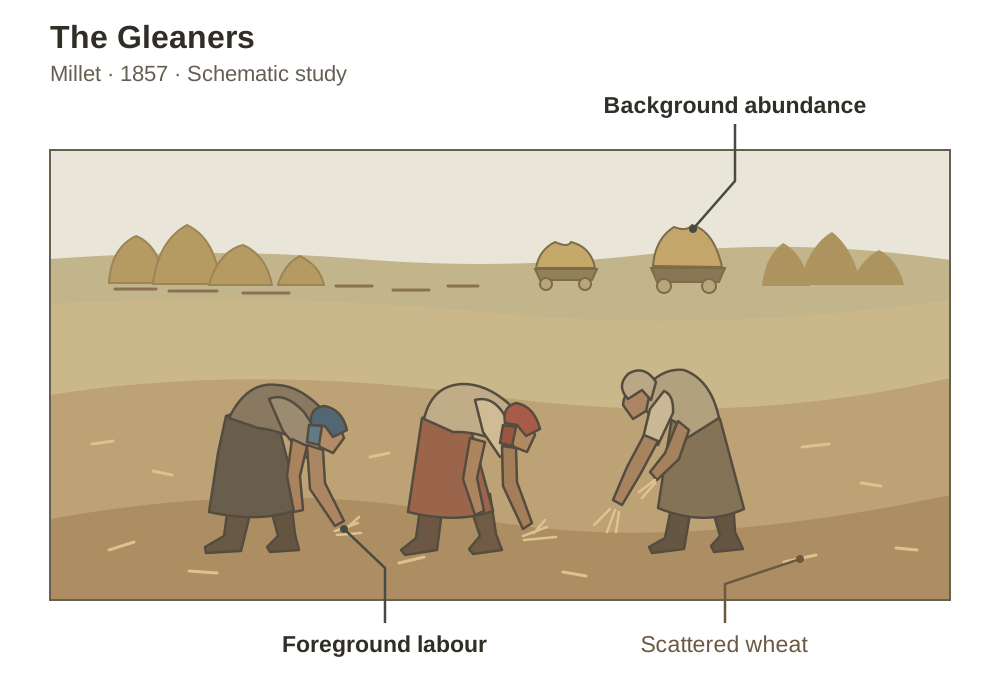
Jean-François Millet (1814–1875) examined rural labour with sober dignity. In The Gleaners (1857, oil on canvas, 84 × 111 cm), three impoverished peasant women bend double in the foreground to collect leftover wheat straws. In the far background, the landowner's loaded wagons and abundant harvest contrast sharply with the scavengers' poverty.
The Bridge to Modernity: Édouard Manet
During the 1860s, Édouard Manet (1832–1883) became the crucial link between Realism and Impressionism. He borrowed compositions from Renaissance masters in the Louvre but translated them into bold, unidealised pictures of modern Paris.
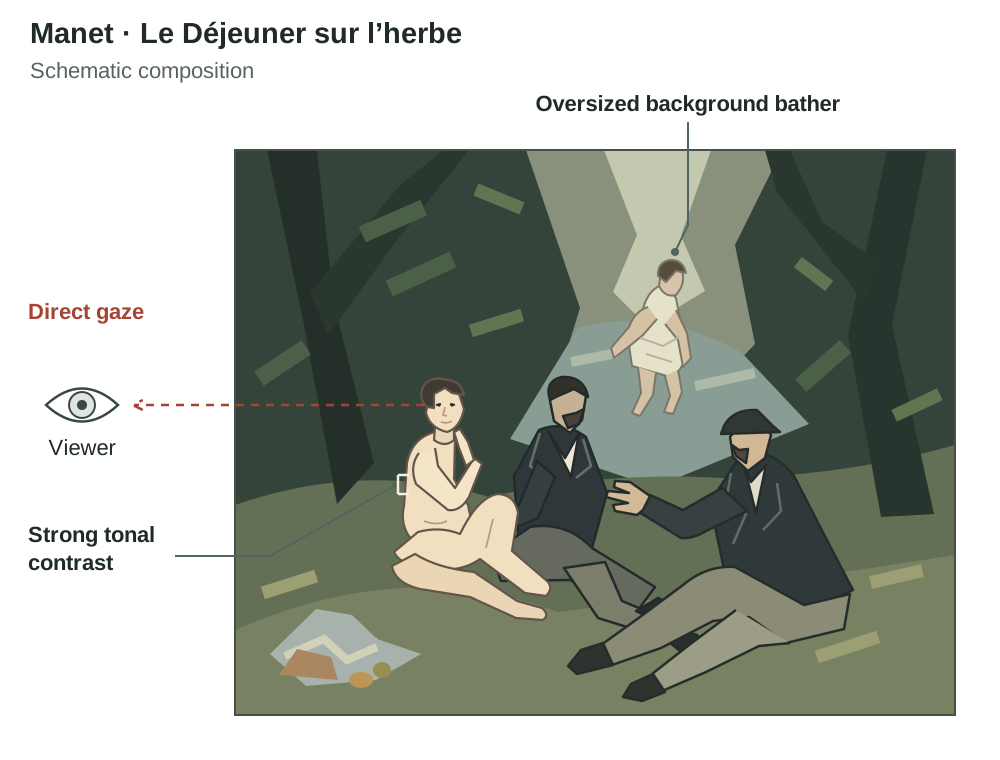
When the Salon jury rejected over half the submitted artworks in 1863, Napoleon III sanctioned the Salon des Refusés to display the rejected pieces. Manet's submission, Le Déjeuner sur l’herbe (1863, oil on canvas, 208 × 264 cm), caused a scandal. Classical painters depicted female nudes as remote nymphs or allegorical goddesses. Manet placed a recognised, contemporary nude model (Victorine Meurent) picnicking outdoors beside two fully dressed, middle-class men in contemporary lounge suits.
Key Visual Techniques in 'Le Déjeuner sur l'herbe'
- Direct gaze: The nude model looks directly out of the canvas at the viewer, challenging the passive role of the female nude.
- Flattened space: Classical linear perspective is broken. The woman bathing in the background is painted too large for her distance from the foreground group.
- Harsh frontal lighting: Strong light eliminates gradual chiaroscuro transitions, flattening the figures into crisp silhouette shapes.
- Visible brushwork: Broad, rapid brushstrokes call attention to the painted surface rather than creating an illusionistic window into space.
Manet provoked a similar outcry with Olympia (1863, oil on canvas, 130 × 190 cm). He subverted Titian's Venus of Urbino by presenting a modern courtesan reclining on a bed, staring out with a cool, transactional expression. In A Bar at the Folies-Bergère (1882, oil on canvas, 96 × 130 cm), Manet addressed modern alienation. A tired barmaid looks past the viewer while the mirror behind her reveals a bustling entertainment hall and a male customer leaning in close, questioning whether the barmaid herself is treated as a commodity for sale.
Impressionism: Plein Air, Light, and Broken Colour (c. 1870s–1880s)
In 1874, an independent group of artists calling themselves the Société Anonyme des Artistes Peintres, Sculpteurs, Graveurs staged their own exhibition in the former studio of the photographer Félix Nadar. A hostile critic, Louis Leroy, mocked Claude Monet's canvas Impression, Sunrise (1872) and labelled the whole group 'Impressionists', implying their works were unfinished sketches. The artists adopted the name.
Impressionism aimed to record the transient sensory impression of a single moment—the play of changing daylight, water, weather, and modern leisure.
Technological and Urban Context
- Collapsible paint tube: Patented in 1841 by John Rand, portable tin tubes replaced leaky animal bladders of pre-ground paint. Artists could take their paints outdoors to work en plein air directly in front of the motif.
- Synthetic pigments: Industrial chemistry produced intense, pure colours—cerulean blue, cobalt violet, viridian, and chrome yellow—allowing painters to bypass muddy umber glazes.
- Haussmann's Paris: Baron Georges-Eugène Haussmann demolished mediaeval alleys to construct broad boulevards, public parks, and squares that linked the city's railway stations, creating modern urban subjects.
- Photography: Invented in 1839, photography freed painting from factual recording and introduced cropping, blurred motion, and unusual vantage points.
- Ukiyo-e woodblock prints: Japanese prints by artists such as Hokusai and Hiroshige flooded Paris after ports opened in the 1850s, inspiring asymmetrical balance, bird's-eye views, and flat colour fields (Japonisme).
Monet and Broken Brushwork
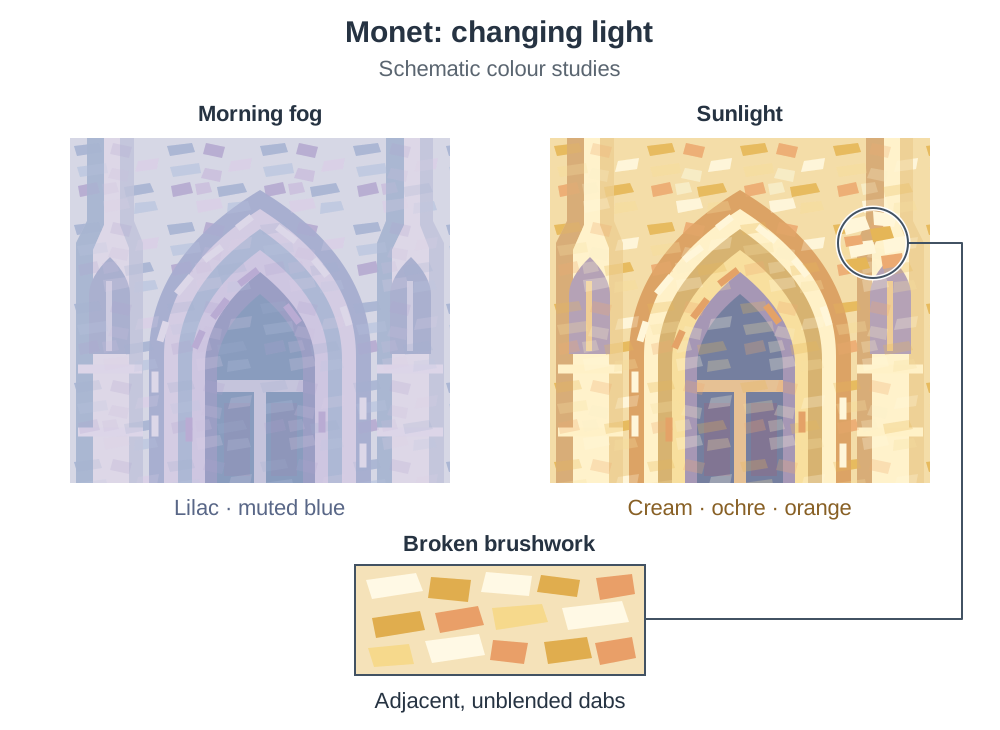
Claude Monet (1840–1926) developed the movement's core painting method. Instead of blending pigments on the palette, Monet used broken brushwork: short dabs of pure colour placed side by side. At a viewing distance, these strokes fuse through optical mixing, giving the painted surface vibrant luminosity.
Monet, Camille Pissarro, and Alfred Sisley largely removed pure black and earth browns from their shadow palettes. They observed that shadows are filled with reflected ambient light and complementary colours; for example, warm sunlight produces shadows tinged with blues and violets. However, this was not universal: Manet, Edgar Degas, and Pierre-Auguste Renoir continued to use black boldly throughout their careers.
Monet tested this technique through his series paintings. In the Rouen Cathedral series (begun 1892–1893, dated 1894), Monet observed the Gothic west portal from a second-floor window, working across multiple canvases as the sun moved. He later unified and reworked the canvases in his Giverny studio. Under morning light (Rouen Cathedral, the Portal, Morning Fog), the stone dissolves into cool lilacs and muted blues. Under full sunlight (Rouen Cathedral: The Portal, Sun), the facade becomes an encrusted impasto of creamy white, yellow ochre, and warm orange.
Class, Gender, and the Modern City
Nineteenth-century industrialisation, urban redevelopment, and rigid gender roles shaped how artists recorded Paris.
Depicting Class and Labour
- Gustave Caillebotte, The Floor Scrapers (1875, oil on canvas, 102 × 146 cm):* Three shirtless workmen scrape parquet in a Haussmann-style flat. The Salon jury rejected it as 'vulgar' because it presented urban manual labour without academic polish. A steep, tilted floor perspective and raking window light emphasise the labourers' physical exertion and wood shavings.
- Gustave Caillebotte, Paris Street; Rainy Day (1877, oil on canvas, 212 × 276 cm):* Wealthy bourgeois citizens stroll along wide pavements. A central lamppost divides the composition, and figures on the right are cropped off at the frame, mimicking an instantaneous photograph.
- Edgar Degas, L'Absinthe (In a Café, 1875–1876, oil on canvas, 92 × 68 cm):* An actress and a bohemian artist sit side by side in the Café de la Nouvelle-Athènes, both staring blankly ahead. A full glass of cloudy absinthe sits in front of the woman, hinting at urban isolation and addiction. Degas pushed the pair into the top right, filling the foreground with the sharp zigzagging edges of empty marble tables.
Women Artists and Gender Roles
Bourgeois women were barred from the École des Beaux-Arts until 1897 and could not move freely through cafés or city streets without a male chaperone. Women artists transformed these limitations by documenting private, domestic, and family life from an authentic female viewpoint.
- Berthe Morisot, The Cradle (1872, oil on canvas, 56 × 46 cm):* Shown at the first Impressionist exhibition in 1874, the painting depicts Morisot's sister Edma watching her sleeping baby, Blanche. A strong diagonal line runs from the mother's protective gaze to the infant. Morisot rendered the sheer white cradle veil with light, feathery strokes, bringing psychological intimacy to an everyday domestic scene.
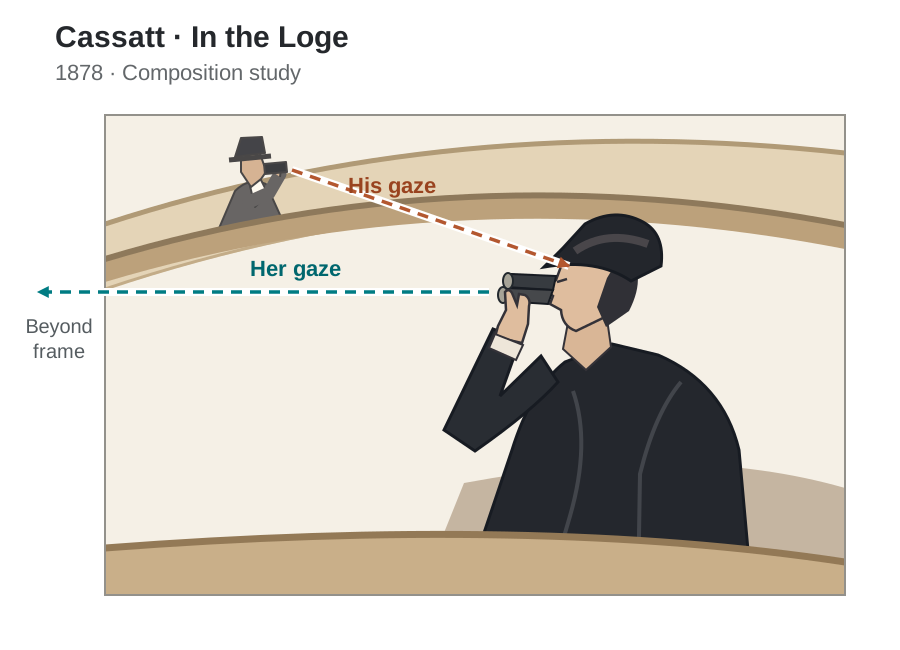
- Mary Cassatt, In the Loge (1878, oil on canvas, 81 × 66 cm):* A woman in black daytime dress holds opera glasses, actively looking across the theatre auditorium. In the distant background, a man leans forward to look at her. Cassatt presents the woman as an active spectator rather than a passive object of male display.
- Mary Cassatt, The Child's Bath (1893, oil on canvas, 100 × 66 cm):* A mother gently washes a child's feet. Influenced by Japanese woodblocks, Cassatt used a steep downward perspective, bold outlines, and contrasting decorative patterns in the striped dress and patterned rug.
Post-Impressionism: Structure and Expression (c. 1886–1905)
By the eighth Impressionist exhibition in 1886, artists recognised the limits of capturing momentary surface light. Impressionism had sacrificed permanent form, compositional order, and emotional depth. Post-Impressionism is an umbrella term coined by British critic Roger Fry for his 1910 London exhibition Manet and the Post-Impressionists. Rather than forming a unified movement, artists divided into two paths.
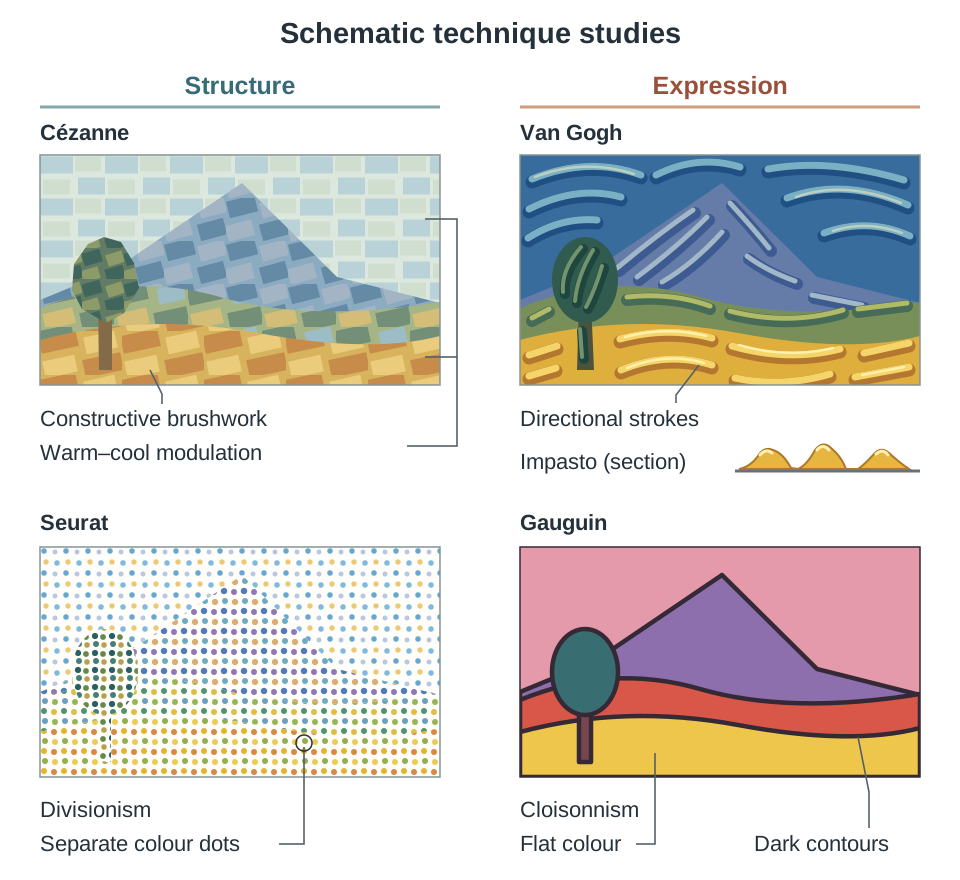
The Structural Path
- Paul Cézanne (1839–1906): Cézanne set out to "make of Impressionism something solid and durable, like the art of the museums." He advised treating nature through "the cylinder, the sphere, and the cone." Instead of linear perspective, he used constructive brushwork (disciplined, parallel, rectangular strokes) and colour modulation (warm ochres, yellows, and reds advance, while cool blues, slates, and greens recede). In Mont Sainte-Victoire (c. 1902–1904, oil on canvas, 73 × 92 cm), he flattened space into three zones—foreground plain, valley farms, and triangular peak—using repeated patches of sky blue in the valley to tie the surface together. In The Basket of Apples (c. 1893), he painted the table and fruit from multiple viewpoints simultaneously.
- Georges Seurat (1859–1891): Founder of Neo-Impressionism, Seurat applied the colour science of Michel-Eugène Chevreul (law of simultaneous contrast) and Ogden Rood. His method, Divisionism (often called Pointillism), used small dots of pure colour that mix optically in the eye. In A Sunday Afternoon on the Island of La Grande Jatte (1884–1886, oil on canvas, 207 × 308 cm), Seurat froze a mixed crowd—from a reclining working-class boatman to a fashionable bourgeois couple with a pet monkey—into classical profile and frontal poses along the Seine. In Bathers at Asnières (1884, oil on canvas, 201 × 300 cm), Seurat depicted working-class youths resting by the industrial riverbank opposite La Grande Jatte.
The Expressive Path
- Vincent van Gogh (1853–1890): Van Gogh used bold arbitrary colour and heavy impasto to express mental and spiritual states. In The Starry Night (June 1889, oil on canvas, 74 × 92 cm), painted from his asylum window in Saint-Rémy, a dark, flame-shaped cypress anchors the left foreground, bridging earth and sky. The invented village and Dutch-style spire sit below a turbulent sky filled with eleven glowing stars and a crescent moon. He applied paint in rhythmic, directional strokes, setting deep blues against glowing yellow-oranges. In Sunflowers (1888, oil on canvas, 92 × 73 cm), painted in Arles to decorate the Yellow House for Gauguin, he built flowers from fresh blooms to wilting seed-heads using pure chrome yellows on yellow ground.
- Paul Gauguin (1848–1903): Gauguin rejected surface realism in favour of Synthetism, blending outward appearance, memory, and spiritual feeling. He worked in Cloisonnism, applying flat areas of pure, non-naturalistic colour bordered by dark contours. In Vision after the Sermon (Jacob Wrestling with the Angel, 1888, oil on canvas, 73 × 92 cm), a diagonal tree trunk separates Breton women praying in white caps from a visionary red field where Jacob wrestles the angel.
Patrons, Markets, and Legacy
During this period, the art market shifted from academic state patronage to independent dealer networks.
The Changing Art Market
- The Salon: Historically, an artist's career relied on Salon jury approval to secure state commissions, purchases, and portrait clients.
- The Independent Exhibitions: Between 1874 and 1886, the eight Impressionist exhibitions showed that artists could self-finance, hang, and sell work without academic sanction.
- Commercial Dealers: Paul Durand-Ruel bought Impressionist works in bulk during the 1870s and mounted a landmark 1886 exhibition in New York, opening an American collector base that saved the group financially. Ambroise Vollard mounted Cézanne's first solo show in 1895 and went on to handle Gauguin and Van Gogh.
- Artist-Patrons: Gustave Caillebotte used his personal fortune to purchase paintings by Monet, Renoir, and Pissarro, paying exhibition hall rent. His 1894 bequest of 67 works to the French state met bitter academic opposition before its partial acceptance. Theo van Gogh financially supported his brother Vincent, who sold only one documented painting in his lifetime (The Red Vineyard).
Modernist Legacy
- Cézanne to Cubism: Cézanne's geometric reduction and multiple viewpoints directly inspired Pablo Picasso (Les Demoiselles d'Avignon, 1907) and Georges Braque (Houses at L'Estaque, 1908). Picasso is often quoted as calling Cézanne "the father of us all."
- Van Gogh to Expressionism and Fauvism: Henri Matisse and André Derain took up Van Gogh's intense colour and direct mark-making, while Ernst Ludwig Kirchner and the German Expressionist group Die Brücke built upon his emotional distortions.
- Gauguin to the Nabis and Primitivism: Gauguin's flat colour planes shaped Paul Sérusier (The Talisman, 1888) and the Nabis. Irish artist Roderic O'Conor worked alongside Gauguin at Pont-Aven and adapted Van Gogh's parallel, striped brushwork in works like The Farm at Lezaven, Finistère (1894).
- Seurat to Neo-Impressionism: Paul Signac codified Divisionism, and Henri Matisse used Divisionist dots in Luxe, calme et volupté (1904) before launching Fauvism.
- Monet to Abstraction: Monet's late, expansive Water Lilies (1914–1926) abandoned horizon lines and single viewpoints, anticipating mid-twentieth-century Abstract Expressionism.
Beyond Easel Painting
Visual culture expanded beyond canvas. In printmaking, Henri de Toulouse-Lautrec (1864–1901) revolutionised commercial graphic design with colour lithographic posters like Moulin Rouge – La Goulue (1891), using cropped silhouettes, flat tones, and bold lettering to advertise modern nightlife. In architecture, Haussmann's urban avenues and Gustave Eiffel's iron tower (1889) celebrated industrial materials.
Comparative Overview across the Visual Studies Framework
This table uses the Visual Studies Framework to compare the three movements side by side. Use it to plan answers that ask how one movement grew out of, or reacted against, another.
| Framework Element | Realism (c. 1850s–1870s) | Impressionism (c. 1870s–1880s) | Post-Impressionism (c. 1886–1905) |
|---|---|---|---|
| Core Philosophy & Aim | Record contemporary social truth; reject academic idealism and mythological subjects. | Capture the immediate sensory impression of natural light, weather, and modern urban leisure. | Rebuild solid compositional structure, or express internal emotion and spiritual symbolism. |
| Subject Matter | Rural peasants, urban manual labourers, provincial life, social inequality. | Boulevards, railway terminals, boating, cafés, middle-class leisure, domestic interiors. | Landscapes, structured still lifes, portraits, visionary religious scenes, cabaret nightlife. |
| Art Elements: Colour & Tone | Earthy, sombre palettes (ochres, umbers, siennas); chiaroscuro modelling. | Bright synthetic pigments; optical mixing; coloured shadows using complementaries. | Highly deliberate: colour modulation (Cézanne), scientific dots (Seurat), or arbitrary saturated hue (Van Gogh, Gauguin). |
| Art Elements: Space & Line | Shallow pictorial space; horizontal baselines; strong silhouette contours. | Asymmetrical cropping, high horizons, and diagonal viewpoints drawn from photography and ukiyo-e prints. | Flattened space, multiple viewpoints, geometric scaffolding, or dark Cloisonnist outlines. |
| Media & Technique | Heavy brushes, palette knives, thick oil paint on large-format canvases. | Broken brushwork, wet-on-wet paint application, portable tube oils painted en plein air. | Constructive rectangular dabs, Pointillist dots, rhythmic impasto strokes, or flat decorative planes. |
| Patrons & Exhibitions | Official Paris Salon; Courbet's self-funded Pavilion of Realism (1855). | Eight independent Impressionist group exhibitions (1874–1886); dealer Paul Durand-Ruel. | Independent Salons (Artistes Indépendants); dealer Ambroise Vollard; Roger Fry's 1910 London show. |
| Modernist Legacy | Social documentary art, everyday subjects treated with dignity. | Painting freed from storytelling; late works paved the way toward optical abstraction. | Cézanne inspired Cubism; Seurat inspired Neo-Impressionism; Van Gogh and Gauguin inspired Fauvism and Expressionism. |
Key terms
- Realism
- A mid-nineteenth-century art movement that rejected academic idealisation and mythological themes to depict contemporary life, everyday labour, and social conditions truthfully.
- Hierarchy of genres
- The official academic ranking of painting subjects based on moral prestige, running from history painting at the top, down through portraiture, genre scenes, and landscape, to still life.
- Salon des Refusés
- A special 1863 Paris exhibition sanctioned by Napoleon III to display artworks rejected by the official Salon jury, which included Manet's 'Le Déjeuner sur l’herbe'.
- En plein air
- The practice of painting outdoors directly in front of the motif, made practical by collapsible tin paint tubes and portable easels.
- Broken brushwork
- The technique of applying paint in small, unblended, distinct dabs side by side rather than smoothing transitions on the palette.
- Optical mixing
- The visual phenomenon where separate dabs of pure colour placed side by side fuse together on the viewer's retina when viewed from a distance, producing greater luminosity.
- Impressionism
- A nineteenth-century art movement originating in the 1870s that used pure colours, broken brushwork, and outdoor observation to record fleeting light and modern life.
- Post-Impressionism
- An umbrella term coined in 1910 by Roger Fry for diverse developments (c. 1886–1905) that moved beyond Impressionism's surface light toward solid structure or emotional expression.
- Constructive brushwork
- A methodical painting technique developed by Cézanne using disciplined, parallel, rectangular strokes to construct solid geometric form and spatial rhythm.
- Colour modulation
- Cézanne's method of creating three-dimensional form and spatial depth by juxtaposing warm advancing hues and cool receding hues instead of using dark chiaroscuro shading.
- Divisionism (Pointillism)
- A Neo-Impressionist technique pioneered by Georges Seurat that systematically applies small dots of pure colour based on optical and scientific colour theories.
- Impasto
- Paint applied thickly to canvas so that physical marks, ridges, and textures made by brushes or palette knives stand out in relief.
- Arbitrary colour
- Colour chosen for emotional, symbolic, or aesthetic effect rather than to imitate the true visual appearance of the subject.
- Synthetism
- A Post-Impressionist method associated with Paul Gauguin that synthesises outward observation, emotional memory, and aesthetic choices of line and colour.
- Cloisonnism
- A painting style developed by Gauguin and Émile Bernard featuring flat areas of bold, pure colour bounded by heavy, dark outlines, reminiscent of stained glass or cloisonné enamel.
- Japonisme
- The French term for the widespread influence of Japanese visual art, particularly ukiyo-e woodblock prints, on European artists in the late nineteenth century.
Check yourself
What 1841 invention made plein air painting practical for artists?
John Rand's patent of the collapsible metal paint tube, which replaced fragile animal bladders and kept pre-mixed oil paint fresh and easily portable outdoors.
Why did Gustave Courbet's 'A Burial at Ornans' shock the academic art establishment in 1850?
Courbet depicted an ordinary provincial country funeral on a colossal canvas (over six metres wide), a scale previously reserved by convention for grand history painting, religion, and mythology.
How did Mary Cassatt's 'In the Loge' challenge nineteenth-century gender conventions?
She showed an independent woman actively observing the theatre through opera glasses, turning her into an active spectator rather than a passive object of male admiration.
Which commercial art dealer helped the Impressionists survive financially, and how?
Paul Durand-Ruel, who bought their canvases in bulk and organised a landmark 1886 exhibition in New York, introducing them to wealthy American collectors.
What is the technical difference between Monet's broken brushwork and Cézanne's constructive brushwork?
Monet applied rapid, broken dabs of unmixed colour to capture fleeting atmospheric light through optical mixing. Cézanne applied disciplined, parallel, rectangular strokes to build enduring geometric form and spatial structure.
How did Paul Gauguin use Synthetism and Cloisonnism in 'Vision after the Sermon'?
He synthesised direct observation, memory, and religious feeling by using Cloisonnism—applying flat planes of arbitrary red and bold forms enclosed by strong, dark outlines.