

Art as social commentary or commentator explores how visual artists actively question, critique, and challenge prevailing political regimes, social inequalities, conflict, and cultural norms. Situated within Content Area 3 (Today's World) of the Leaving Certificate Art specification, this topic examines both the artwork as a critique (commentary) and the artist speaking out directly as an activist (commentator). Using the six elements of the Visual Studies Framework, students learn to analyse how artists combine subject matter, symbolism, art elements, design principles, materials, and display sites to expose injustice, spark communal debate, and inspire change.
Understanding Commentary, the Artist as Commentator, and the Visual Studies Framework
Art as social commentary is art that points at a problem in society and wants the viewer to think about it. Instead of painting a scene neutrally or creating purely decorative craft, the artist adopts a clear stance to expose injustice, poverty, war, state violence, or corporate greed. The official title of this section of focus is Art as Social Commentary or Commentator, which recognises two related roles:
- Commentary: The visual artwork itself carries the social or political critique, such as Picasso's Guernica.
- Commentator: The artist takes on an active public role, campaigning, speaking out, or using their public profile to champion a cause, such as Keith Haring producing posters for ACT UP rallies.
The Visual Studies Framework: Six Elements
The Leaving Certificate Visual Studies Framework sets out to answer three core questions about any artwork: What was created? How was it created? Why was it created? To answer these questions thoroughly, especially in written examination responses, you investigate an artwork through six structured elements:
- Context: The historical, political, social, economic, and ideological circumstances of the time. This includes who commissioned, promoted, or displayed the work (patrons and agencies).
- Artists and Artworks: The artist's background, training, personal motivations, key influences, and major recognised artworks.
- Analysis: Interrogating the artwork by asking what is going on, then backing every observation with concrete visual evidence.
- Art Elements and Design Principles: Analysing how the building blocks of art (line, tone, colour, shape, texture) and compositional principles (balance, contrast, emphasis, rhythm, scale) construct meaning.
- Media and Areas of Practice: The physical materials, tools, and branch of practice chosen (such as painting, printmaking, street art, lens-based media, or participatory art), and how that medium affects the viewer's reading.
- Innovation and Invention: New materials, technologies, or conceptual strategies that transformed how art was produced or viewed, such as spray-paint stencils, offset lithography, or mechanical interventions.
The Framework also asks what came before the work or movement, the work itself, and its effects afterwards (such as exhibition history, public reaction, legal challenges, or resale value).
Choose Your Examples Strategically
Rather than memorising partial facts for dozens of artists, master three works in full depth: one historical work (Guernica or Der Krieg), one contemporary or public work (such as Banksy's stencil interventions or Maser's Repeal the 8th mural), and one Irish work (such as Willie Doherty's video installations). This combination equips you for single-work analyses, comparative questions, and Irish cultural links.
Wartime Critique and Conflict: Picasso and Otto Dix
The wars of the twentieth century led many artists to stop glorifying war and instead show its brutal reality, especially the catastrophic damage done to human bodies by machine guns, poison gas, and aerial bombing.
Pablo Picasso – Guernica (1937)
- Artist: Pablo Picasso (1881–1973) | Title: Guernica | Date: 1937 | Medium: oil on canvas | Size: 3.49 m × 7.76 m | Original setting: Spanish Republican Pavilion, Paris International Exposition, 1937 (now Museo Reina Sofía, Madrid).
- Context: In April 1937, during the Spanish Civil War, the German Condor Legion and Italian air forces, backing General Francisco Franco's fascist forces, carried out a daytime saturation bombing of the Basque town of Guernica. The attack deliberately targeted civilians gathered on a market day. Commissioned by the legitimate Spanish Republican government to create a mural for their pavilion in Paris, Picasso channelled his fury into an anti-fascist statement.
- Art Elements and Composition: Picasso eliminated all colour, working entirely in grisaille (a monochrome scale of black, white, and intermediate greys). This severe tonal choice strips away visual warmth, echoes the urgent, black-and-white photographic reportage of contemporary newspapers, and forces the viewer to confront raw violence. The composition relies on a dominant pyramidal composition, with an expansive central triangle anchored by the fallen warrior at the base and rising to the apex at the ceiling lamp. Spatial depth is radically flattened through overlapping, fractured planes influenced by Cubism, trapping the figures in an inescapable, claustrophobic room.
- Iconography: Picasso avoided depicting aircraft, tanks, or military uniforms, choosing symbolic figures to convey civilian agony:
- The Horse: Pierced by a lance and screaming upward, with a dagger-like tongue; it embodies tortured innocent humanity.
- The Bull: Standing wide-eyed and impassive on the left, representing brute force and darkness.
- The Weeping Mother: Cradling her dead infant with head thrown back in a silent wail, borrowing the sacred visual structure of the Christian Pietà.
- The Fallen Soldier: Dismembered across the bottom of the canvas, clutching a snapped sword from which a single flower sprouts, offering the sole motif of hope.
- The Lightbulb: Enclosed within an eye-shaped sunburst, representing modern industrial technology turned into an instrument of terror.
Otto Dix – Der Krieg (The War, 1929–1932)
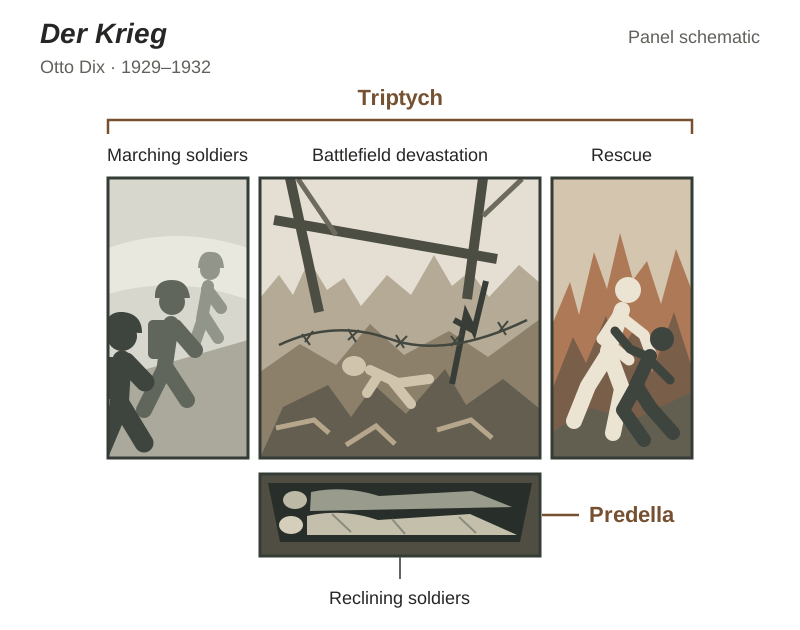
- Artist: Otto Dix (1891–1969) | Title: Der Krieg | Date: 1929–1932 | Medium: mixed technique (tempera and oil) on wood panels | Size: central panel c. 2.04 m × 2.04 m; each wing c. 2.04 m × 1.02 m; predella c. 0.60 m × 2.04 m (four panels in total) | Location: Galerie Neue Meister, Dresden.
- Context and Subversion: Dix served as a machine-gun unit leader on the Western Front during World War I and suffered recurring nightmares. A decade after the war, alarmed by rising German militarism, he painted Der Krieg to record trench carnage truthfully. He subverted a sacred Northern Renaissance format: a triptych (three main vertical panels) with a predella (a long horizontal base panel beneath), directly modelled on Matthias Grünewald's Isenheim Altarpiece.
- Visual Analysis: The left wing shows soldiers in helmets marching away into toxic morning fog. The central panel presents a chaotic wasteland choked with impaled bodies, rotting flesh, barbed wire, and gas masks, presided over by a skeletal corpse dangling from ruined iron beams. The right wing depicts a soldier dragging a wounded comrade through fire, while the predella shows soldiers lying side by side under a cloth in a dugout that looks like an open grave. By using slow, meticulous tempera glazes to depict putrefaction across an altarpiece format, Dix presented industrial slaughter as an absolute human catastrophe devoid of patriotic redemption.
Comparing Guernica and Der Krieg
When an exam question asks you to compare two commentary artworks, contrast their visual methods point by point across the same paragraph:
- Context and Experience: Both artists confront mechanised mass slaughter, yet Picasso responded from afar within weeks of the bombing using secondhand reports, whereas Dix drew directly from his own traumatic frontline memories a decade after combat.
- Visual Style and Structure: Picasso strips away colour into stark, flattened grisaille and fractures forms using Cubism, making the civilian agony universal. In contrast, Dix employs luminous Northern Renaissance tempera glazes to render visceral, hyper-detailed textures of decomposing flesh and mud.
- Religious Motifs: While Picasso incorporates an isolated sacred motif—the Pietà pose of the mother mourning her child—Dix adopts the entire architectural structure of a sacred Christian triptych and predella, substituting the martyred Christ with rotting, nameless conscripts.
Civil Rights, Marginalisation, and Activism: Basquiat and Haring
During the 1980s in New York, artists took street-level visual forms into galleries, public transport, and street protests to confront racial discrimination, police violence, and government inaction during the HIV/AIDS epidemic.
Jean-Michel Basquiat – Defacement (The Death of Michael Stewart) (1983)
- Artist: Jean-Michel Basquiat (1960–1988) | Title: Defacement (The Death of Michael Stewart) | Date: 1983 | Medium: acrylic and marker on drywall | Size: 63.5 cm × 77.5 cm | Original setting: painted directly on the studio wall of Keith Haring (later cut out and preserved; privately owned, exhibited at the Guggenheim, New York, in 2019).
- Context: Basquiat first gained recognition tagging conceptual SAMO epigrams across Manhattan before entering the commercial gallery world. In September 1983, Michael Stewart, a young African-American street artist, died of severe spinal trauma and brain damage following his arrest by New York Transit Police for writing graffiti on a subway wall. Deeply affected, Basquiat recognised that his own race made him equally vulnerable, famously remarking that it could have been him.
- Visual Analysis: Basquiat painted the work directly onto raw drywall rather than prepared canvas, retaining the physical texture and immediacy of the street. Stewart is rendered as a black silhouette head surrounded by an aura of red and black paint, indicating life slipping away. Two transit officers flank him as cartoonish, fanged caricatures brandishing batons. The scrawled title '¿DEFACEMENT©?' frames the scene, posing a provocative question: does writing graffiti constitute defacement, or is the lethal brutalisation of a young human body the true defacement?
Keith Haring – Ignorance = Fear / Silence = Death (1989)
- Artist: Keith Haring (1958–1990) | Title: Ignorance = Fear / Silence = Death | Date: 1989 | Medium: offset lithograph poster | Size: 61 cm × 109 cm | Commission: produced for ACT UP (AIDS Coalition to Unleash Power).
- Context: Diagnosed with AIDS in 1988, Haring dedicated his final years to visual campaigning against the homophobic prejudice and government inaction surrounding the crisis. He worked directly with the activist group ACT UP to make art that functioned as an agitational weapon.
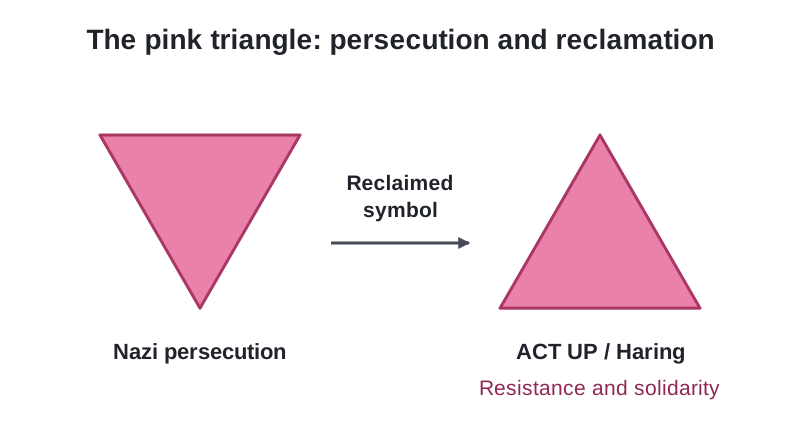
- Symbols and Visual Design: Haring adapted commercial poster design: bold black contour lines, bright primary yellow backgrounds, and clear typography to grab attention instantly in crowded public spaces. At the upper centre sits a large, upright pink triangle. During the Holocaust, Nazi concentration camps forced gay prisoners to wear a downward-pointing pink triangle badge. ACT UP and Haring inverted this symbol to point upward, transforming a mark of persecution into an international emblem of militant resistance, solidarity, and empowerment.
- The Figures: Three stylised figures below the triangle act out the proverb 'see no evil, hear no evil, speak no evil' by covering their eyes, ears, and mouths. Their crossed-out torsos and radiating action lines convey panic and suffocation. Haring's composition makes a direct argument: turning a blind eye and refusing to discuss the public health emergency actively cost lives.
Subversion, Street Art, and Institutional Critique: Banksy
Contemporary commentary often uses irony, wit, and unexpected public locations to bypass commercial galleries and communicate directly with everyday audiences.
Banksy – Girl with Balloon (2002/2004)
- Artist: Banksy (anonymous, born c. 1974) | Title: Girl with Balloon | Date: 2002 | Medium: aerosol stencil on masonry wall | Original location: South Bank, Waterloo Bridge, London.
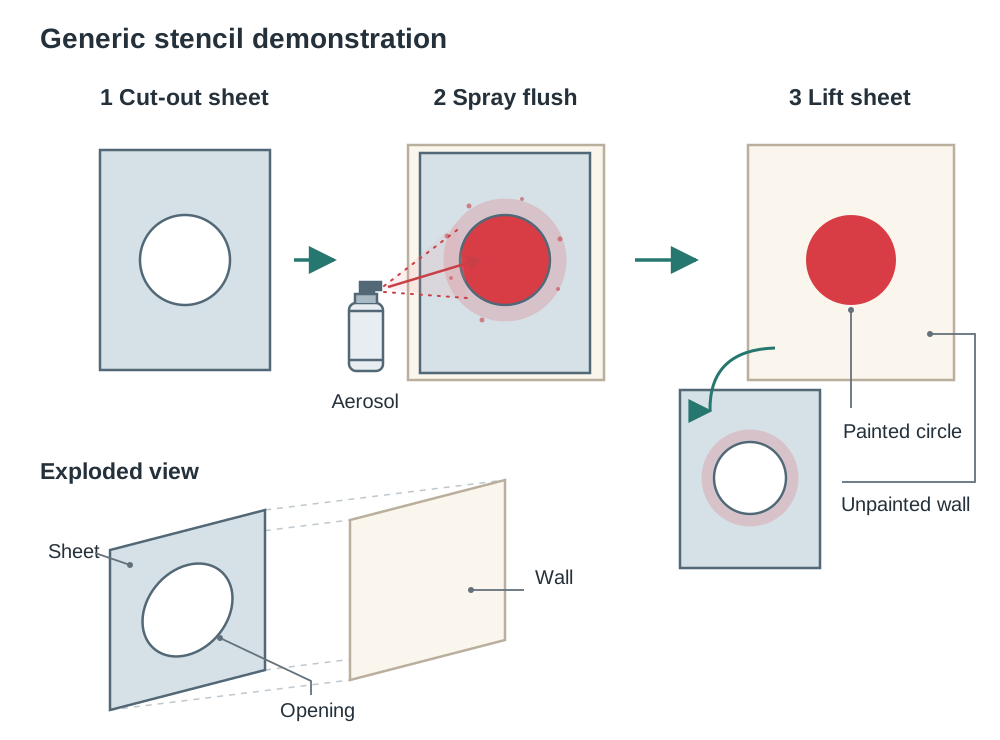
- Technique and Meaning: Spraying through a pre-cut stencil allows a street artist to execute crisp, multi-layered imagery in seconds, reducing the risk of arrest. The artwork depicts a silhouette of a young girl reaching towards a bright red, heart-shaped balloon slipping away in the wind, beside the sprayed words 'There is always hope'. The high contrast between the monochrome figure and the vivid red balloon creates an immediate focal point. The image functions as an open metaphor for lost innocence, childhood vulnerability, or fragile hope.
- Campaign Repurposing: In 2014, Banksy adapted the motif by cloaking the girl in a headscarf to mark the third anniversary of the Syrian war. Projected onto landmarks like the Eiffel Tower and Nelson's Column with the hashtag #WithSyria, the image demonstrated how street commentary can be rapidly repurposed for international human rights campaigns.
Banksy – Love is in the Bin (2018): Institutional Critique
- The Action: Immediately after a canvas version of Girl with Balloon was auctioned at Sotheby's in London for £1.04 million in October 2018, a hidden remote-controlled shredder inside the heavy Victorian frame activated, slicing the bottom half of the canvas into ribbons before jamming.
- Institutional Critique: Banksy executed a piece of institutional critique, attacking the way art is treated as an expensive product to be bought and sold (commodification) and mocking wealthy collectors who buy prestige. However, the stunt also revealed how the art market works: Banksy's authentication body (Pest Control) certified the shredded remains as a new work titled Love is in the Bin, and the sale went ahead; it later resold at auction in 2021 for roughly £18.6 million. This outcome provides compelling evidence for evaluating whether institutional critique can truly disrupt the commercial art world or simply gets absorbed by it.
Art as Action: Participatory Art and Irish Social Commentary
Some social commentary is not a static object hanging in a gallery. The artist instead sets up an event, a campaign, or a public intervention in which ordinary people take part. The communal conversation and the public action become the artwork itself. This is known as socially engaged art or participatory art.
Irish Public Commentary: Maser, Repeal the 8th Mural (2016)
- Artist: Maser | Title: Repeal the 8th mural | Date: 2016 | Medium: exterior wall paint | Location: Project Arts Centre, Temple Bar, Dublin.
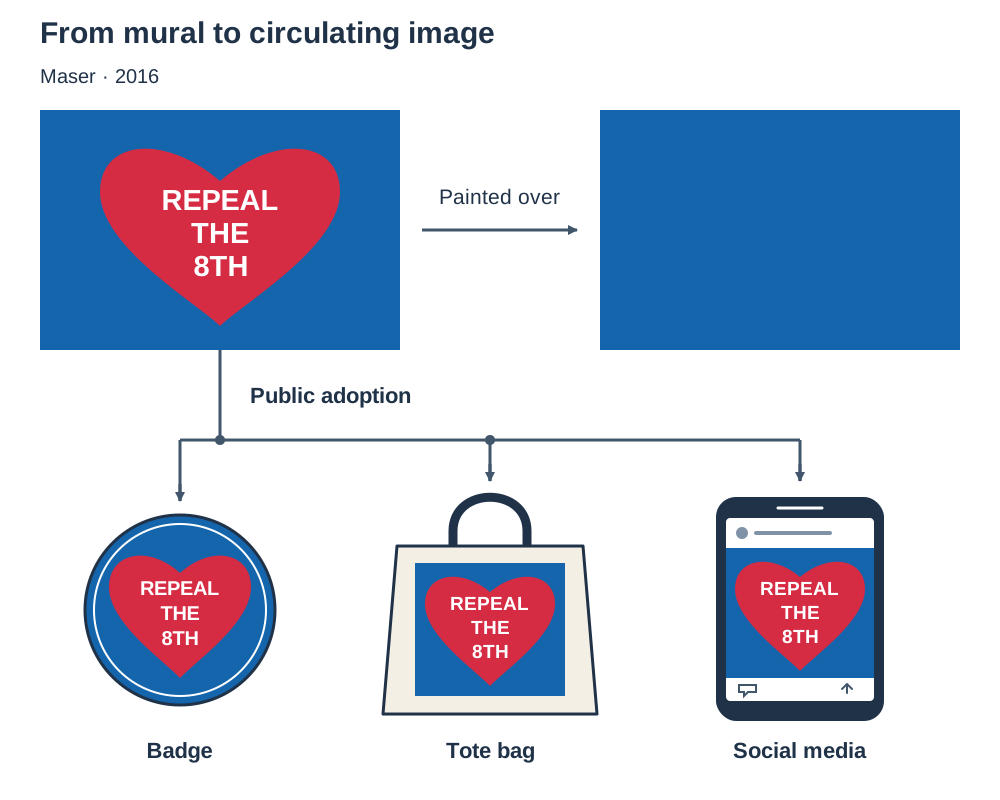
- What: A bold, two-storey mural showing a graphic red heart enclosing the phrase 'Repeal the 8th' painted on the blue outer wall of an independent arts centre.
- How: Maser used flat graphic colour and bold typographic lettering, readable from a distance on a crowded pedestrian street.
- Why: The mural supported the grassroots civil campaign to remove the Eighth Amendment from the Irish Constitution, asserting reproductive rights.
- Public Reaction and Removal: Following complaints, the Charities Regulator warned the arts centre that its charitable status forbade political advocacy, forcing the centre to paint over the mural. This removal generated major national news coverage and heated debate, prompting crowds to gather at the site. The graphic was reproduced across thousands of badges, tote bags, t-shirts, and social media posts, transforming a temporary wall painting into one of the images most closely associated with the 2018 referendum campaign.
- Exam Significance: The mural itself was painted by one artist, but its censorship and the public's adoption of the image on badges, posters and social media show how commentary can spill into communal debate and action, as the specification describes. The public site, the official censorship, and the public's active adoption of the image are all part of how the work functioned as social commentary.
Historical and Contemporary Irish Contexts
The specification says Today's World should not be studied in isolation: links can be made with Content Areas 1 and 2, including Ireland and its Place in the Wider World:
- Nineteenth-Century Famine Art: Daniel Macdonald's An Irish Peasant Family Discovering the Blight of their Store (1847) used realistic oil painting to capture the raw panic and horror of an impoverished rural family discovering blackened potatoes. By exhibiting the piece in London and Dublin during the crisis, Macdonald made the human cost of the disaster visible to urban viewers.
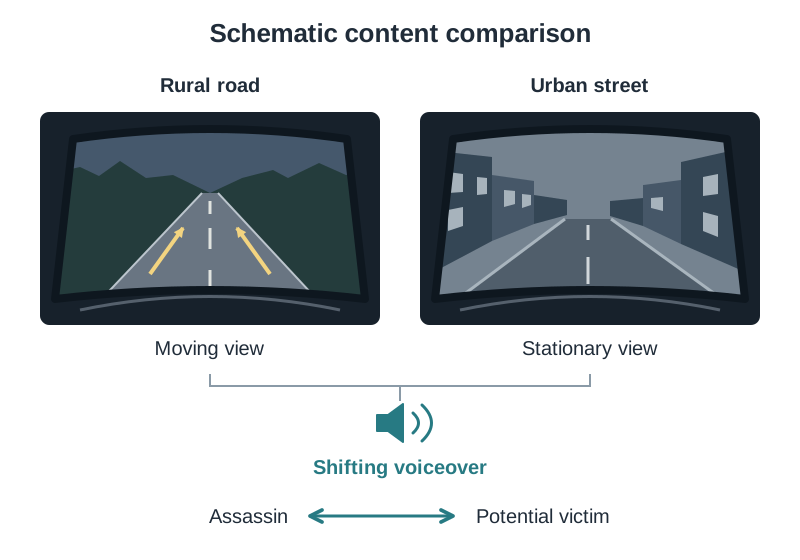
- The Troubles in Northern Ireland: Post-1960 artists confronted conflict and political division. Willie Doherty (born Derry, 1959) produced The Only Good One is a Dead One (1993), an unsettling two-screen video installation. One screen presents a moving view through a car windscreen along a dark rural road; the other shows a stationary urban street from a parked car. An audio voiceover shifts between the anxious thoughts of an assassin stalking a target and an ordinary citizen terrified of being assassinated. Doherty exposes the pervasive psychological paranoia and surveillance that dominated daily life during the Troubles.
In-Person Experience Prompt
The syllabus explicitly requires you to experience visual studies in person. Select one artwork or public monument in your locality or viewed on a gallery visit (such as a political mural, a sculpture in a public park, or an exhibition at IMMA or your regional arts centre). Record its title, artist, site, medium, and your personal evaluation of how it communicates its social message.
Judging a Work: Evaluating Merit and Long-Term Impact
At Leaving Certificate Higher Level, examiners look for more than descriptive recall. You must be able to argue the merit of a work and evaluate whether it succeeded as social commentary.
Three Evaluative Criteria
When concluding an analysis or comparison, evaluate the artwork against three specific questions:
- Did it reach its intended audience? Consider the physical setting. A billboard, street mural, or widely distributed print communicates with working communities, whereas an easel painting in a commercial gallery reaches an elite audience.
- Is the visual message clear or open to interpretation? Pinpoint the visual choices that clarify the issue (such as Haring's direct slogans and graphic contouring) or deliberately leave it ambiguous (such as Banksy's balloon metaphor).
- What was its lasting impact and legacy? Look at what happened after the work was made. Did it raise funds, alter public debate, get censored, or become an international symbol used by later protest movements?
Sample Evaluative Conclusion: Guernica
Guernica succeeds as social commentary because it elevates a specific wartime atrocity into a universal indictment of civilian suffering. By stripping out military insignia, flags, and aircraft, Picasso ensured the work could never function as one-sided battlefield propaganda; any community scarred by aerial bombing can recognise its weeping mother and shrieking horse. The monumental canvas and newspaper-like grisaille palette gave the work the urgency of eyewitness reportage. Its subsequent world tour raised substantial funds for Spanish Republican refugees, and its reproduction at the United Nations during international crises confirms its enduring power as an anti-war statement.
Sample Evaluative Conclusion: Love is in the Bin
Banksy's staged shredding provided a spectacular critique of the auction house, transforming a luxury commodity into ruined strips before the eyes of the bidders. However, its long-term critical merit remains deeply conflicted. Rather than bankrupting or subverting the system, the shredded artefact was certified by Banksy's team as a new work and resold three years later for £18.6 million. While this outcome underscores the sheer power of the art market to turn rebellion into something valuable to sell, it arguably proves Banksy's central satirical point.
Key terms
- Art as Social Commentary or Commentator
- Visual art that critiques social, economic or political issues (commentary), or an artist taking on an active public role to speak out on such issues (commentator).
- Status Quo
- The existing state of political, social, or economic affairs, which commentary and protest art aims to expose, challenge, or alter.
- Grisaille
- A monochrome painting executed entirely in grey, black, and white tones, used in Guernica to strip warmth and mimic documentary newspaper print.
- Iconography
- The visual imagery, symbols, and motifs employed in an artwork, along with their conventional cultural or political meanings.
- Triptych
- A three-panel work of art, historically hinged as a church altarpiece, subverted by Otto Dix to depict the brutal realities of trench warfare.
- Predella
- The long, narrow horizontal base panel beneath an altarpiece, used in Der Krieg to show dead or exhausted soldiers lying in a trench dugout.
- Pietà
- A sacred Christian motif depicting the Virgin Mary cradling the dead body of Christ, adapted by Picasso in Guernica to express maternal grief.
- Cubism
- An early twentieth-century art movement that fragmented forms and flattened space, used in Guernica to convey violent rupture and claustrophobia.
- Stencil
- A sheet of card, acetate, or metal with cut-out designs through which spray paint is applied, enabling rapid and repeatable public execution.
- Site-specific
- Art designed for and tied to a particular public location, where the surrounding architectural and cultural environment forms part of the artwork's meaning.
- Institutional Critique
- An artistic practice that challenges the commercialism, power dynamics, and financial motives of galleries, museums, and auction houses.
- Socially Engaged Art
- Artistic practice focused on public participation, social activism, and direct community dialogue, where the collaborative action itself constitutes the artwork.
- Pyramidal Composition
- A structural design principle where major figures and lines converge toward a triangular peak, used in Guernica to bring order to violent subject matter.
- Visual Studies Framework
- The official Leaving Certificate structure for studying visual culture across six elements: Context, Artists and Artworks, Analysis, Art Elements and Design Principles, Media and Areas of Practice, and Innovation and Invention.
Check yourself
What six elements make up the official Leaving Certificate Visual Studies Framework?
Context, Artists and Artworks, Analysis, Art Elements and Design Principles, Media and Areas of Practice, and Innovation and Invention.
What is grisaille, and what effect does it achieve in Picasso's Guernica?
Grisaille is painting executed entirely in monochrome shades of grey, black, and white. In Guernica, it removes decorative warmth, evokes the documentary urgency of newspaper photographs, and highlights the stark tragedy of civilian slaughter.
Why did Otto Dix adopt the format of a Christian altarpiece triptych with a predella for Der Krieg?
Dix subverted a sacred Northern Renaissance devotional format (traditionally reserved for the Passion of Christ) to present an uncompromising, unheroic record of trench carnage, rotting corpses, and industrial slaughter.
Why did Banksy use an aerosol stencil for Girl with Balloon rather than freehand spray painting?
A pre-cut stencil allows an artist to execute a crisp, complex image in seconds in public spaces, minimising the risk of arrest and allowing the motif to be accurately repeated across different sites.
How does an artist's choice of display location alter the message of social commentary?
Placing work on a public street wall or mass-printing posters bypasses elite gallery spaces, democratising access and directly addressing everyday citizens who may never visit a museum.
How did Keith Haring and ACT UP invert the historical meaning of the pink triangle?
The downward-pointing pink triangle used by the Nazis to persecute gay prisoners in concentration camps was inverted to point upward, converting a badge of oppression into an emblem of defiance, solidarity, and AIDS activism.