

Pre-Christian Ireland covers four thousand years of visual and material culture, from the arrival of the first farming communities around 4000 BC to the dawn of the Christian era around AD 500. This era divides into the Neolithic Stone Age, the Bronze Age, and the Iron Age. Across these millennia, artistic expression transformed from communal megalithic architecture and pecked stone motifs to delicate sheet goldwork, sophisticated bronze casting, and the organic curvilinear La Tène style. In the Leaving Certificate Art written examination (Visual Studies), Pre-Christian Ireland is a section of focus within Content Area 2 (Ireland and its place in the wider world). It is examined through the six elements of the Visual Studies Framework: Context, Artists and Artworks, Analysis, Art Elements and Design Principles, Media and Areas of Practice, and Innovation and Invention. These elements must be applied to what happened before the period, the period itself, and its lasting legacy in later Irish art.
Framework, Timeline, and What Came Before the Megaliths
How This Section is Examined
When writing about Pre-Christian Ireland in the Visual Studies paper, you must address the broader context rather than simply describing an object. The Visual Studies Framework assesses your understanding across three stages: what came before the period, the developments within the period itself, and how those ideas influenced later art.
- Context: Social organisation, communal beliefs, ancestor veneration, elite patronage, votive deposits, and modern curation.
- Artists and Artworks: Named masterworks including passage tombs, sheet gold collars, cast bronze trumpets, and carved boulders.
- Analysis: Evaluating subject matter, symbolic motifs, visual composition, and the handling of space.
- Art Elements and Design Principles: The shift from rigid bilateral symmetry and geometric repetition to fluid curvilinear rhythm, balance, and the interplay of positive and negative space.
- Media and Areas of Practice: Monumental architecture, stone sculpture, lapidary carving, goldworking, bronzeworking, and defensive engineering.
- Innovation and Invention: Engineering advances such as corbelled vaulting, astronomical roof-boxes, fire-setting mining, bivalve moulds, lost-wax casting, and compass-drawn decoration.
Chronological Timeline of Pre-Christian Ireland
- Mesolithic (c. 8000–4000 BC): Nomadic hunter-gatherers, flint microliths, seasonal hut sites such as Mount Sandel, Co. Derry. No monumental structures.
- Neolithic (c. 4000–2500 BC): First farming communities, forest clearance, Céide Fields, porcellanite axe trade, megalithic tombs including Poulnabrone, Newgrange, and Knowth.
- Copper Age (c. 2500–2200 BC): Beaker pottery culture, early copper smelting at Ross Island, Co. Kerry, and earliest cold-hammered sheet gold.
- Early Bronze Age (c. 2200–1500 BC): Tin bronze alloying, flat stone moulds, gold lunulae, Tedavnet sun discs, open-air rock art.
- Middle Bronze Age (c. 1500–1000 BC): Two-piece bivalve moulds, flange-twisted bar torcs such as the Tara Torcs.
- Late Bronze Age (c. 1000–500 BC): Hollow casting, repoussé sheet gold, the Gleninsheen Gorget, Mooghaun Hoard, and early defences at Dún Aonghasa. Its richest stage, the Dowris Phase (c. 900–600 BC), is named after the Dowris Hoard, Co. Offaly.
- Iron Age (c. 500 BC–AD 500): Bog iron smelting, continental La Tène style from c. 300 BC, Turoe Stone, Broighter Collar, Loughnashade Trumpet, and Petrie Crown.
- Post AD 500 (Legacy): La Tène motifs and metalworking techniques absorbed into Early Christian monastic manuscripts and metalwork.
Before the Neolithic: Setting the Foundations
Before agriculture, Ireland was inhabited by small Mesolithic hunter-gatherer bands. The earliest known settlement site in Ireland, at Mount Sandel in Co. Derry (dating from c. 8000 BC), revealed flint scrapers and post-holes of circular huts, but no pottery, stone monuments, or permanent burials.
Around 4000 BC, Neolithic settlers arrived by sea from Britain and Continental Europe, bringing domesticated cattle, sheep, seed grains, pottery fabrication, and polished stone axes. The production of polished porcellanite stone axes at quarries such as Tievebulliagh, Co. Antrim, illustrates organized industry; these axes were traded extensively across Ireland and Britain. At the Céide Fields in Co. Mayo (c. 3700–3500 BC), kilometres of stone walls preserved beneath blanket bog reveal a settled, co-operative farming community with divided pastureland. Building monumental tombs required this agricultural stability: communities needed a reliable food surplus, settled territories, and leadership capable of organising communal labour over decades.
The Stone Age (c. 4000–2500 BC): Megalithic Architecture and Engineering
Neolithic communities expressed their collective identity and spiritual beliefs through stone tombs termed megaliths. Rather than solitary graves for individuals, these monuments functioned as communal ossuaries and sacred territorial markers.
Types of Megalithic Monuments
- Portal tomb (dolmen): One of the earliest monument types, typified by Poulnabrone in the Burren, Co. Clare (c. 3800–3200 BC). Two tall upright portal stones and a lower back stone support a massive sloping capstone, creating a box-like chamber originally covered by a small stone cairn. Excavations at Poulnabrone uncovered the remains of over thirty people buried over centuries. Eastern examples demonstrate extraordinary engineering scale; the portal tomb at Brownshill, Co. Carlow, features a granite capstone estimated at over one hundred tonnes.
- Court tomb: Characterised by an open, unroofed stone courtyard leading into covered burial galleries divided by stone jambs, seen at Creevykeel, Co. Sligo. The semicircular court provided ceremonial space for communal gathering, cremation deposits, and ritual feasting.
- Passage tomb: The most architecturally and astronomically complex monuments, consisting of a narrow stone-lined passage leading to a burial chamber beneath a vast circular mound of stone and earth.
- Later monument types: Towards the end of the Neolithic and into the Early Bronze Age, monument building shifted to wedge tombs (narrow stone galleries that slope downward from a wider western entrance, such as Labbacallee, Co. Cork) and free-standing stone circles (such as Drombeg, Co. Cork, aligned to the midwinter sunset, and the Grange stone circle at Lough Gur, Co. Limerick).
Megalithic Construction and Transport
Neolithic builders possessed no metal tools, draught horses, or wheeled transport. Megaliths were gathered or quarried using fire, water, and stone mauls, then transported across land and water:
- Sourcing and transport: Most of the massive greywacke kerbstones and orthostat wall slabs at Newgrange were not quarried inland; they were glacial boulders gathered along the Irish Sea coast near Clogherhead, roughly twenty kilometres away. They were likely floated along the coast and up the River Boyne on timber rafts, then dragged overland using log rollers, greased timber rails, and ropes woven from hide or plant fibre.
- Raising the stones: Upright stones were slid into socket holes dug into the subsoil and packed with packing stones. To raise a dolmen capstone or roof slab, builders constructed an inclined earthen ramp over the uprights, levered the stone upward with timber beams, slid it into position, and then cleared away the ramp.
Architectural Engineering at Newgrange
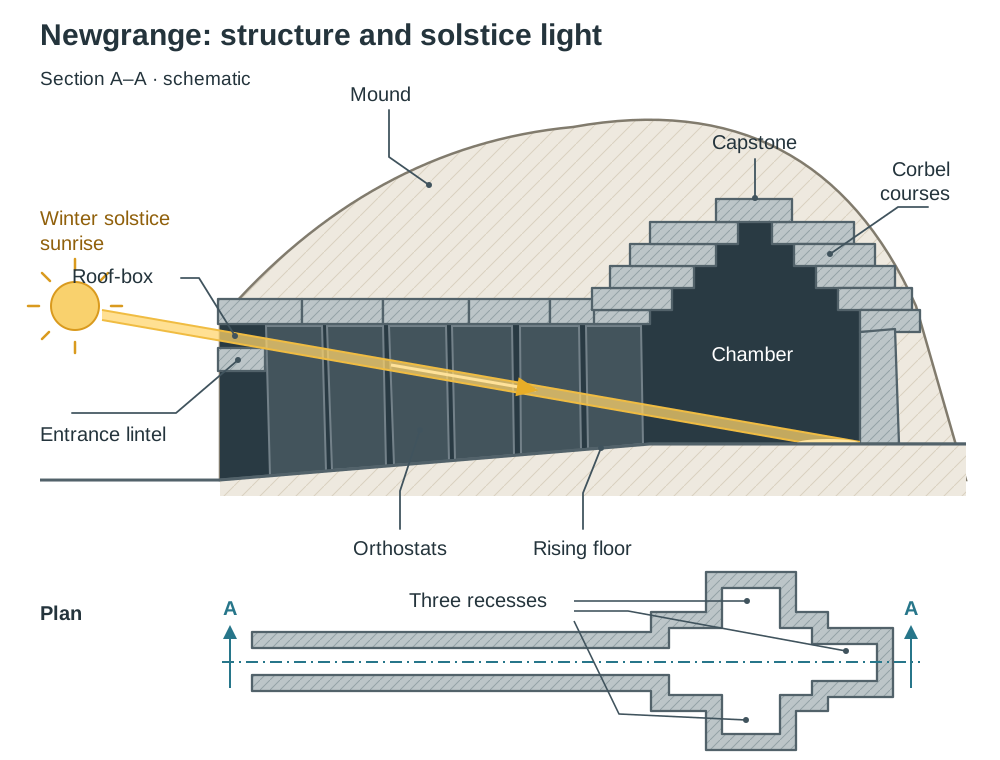
Constructed around 3200 BC in the Brú na Bóinne cemetery in Co. Meath, Newgrange is an immense passage tomb measuring approximately eighty metres in diameter and eleven metres high, surrounded by ninety-seven perimeter kerbstones. A nineteen-metre passage lined with standing orthostats leads to a high cruciform chamber with three sub-recesses, each containing shallow stone basins for cremation deposits.
- Corbelling: The chamber roof is a self-supporting vault built without mortar using corbelling. Horizontal layers of flat stone slabs are laid on top of the walls, each course projecting slightly inward over the one below until the opening narrows to a small gap closed by a single capstone six metres above the floor. The weight of the overlying earthen cairn locks the cantilevered slabs tightly together.
- Weatherproofing: To protect the interior from water damage, Neolithic masons cut drainage channels into the upper surfaces of the roof slabs to divert rainwater sideways. They packed burnt soil, moss, and sea sand between the stones as caulking, keeping the chamber dry for over five millennia.
- The roof-box: Above the entrance lintel sits an engineered aperture called the roof-box. At dawn during the winter solstice (around 21 December), the rising sun aligns directly with this opening. A narrow shaft of light penetrates the nineteen-metre passage floor, illuminating the rear recess of the dark burial chamber for about seventeen minutes. This joined ancestor veneration with solar rebirth, marking the turn of the farming year.
Other Passage-Tomb Centres and Portable Art
- Knowth, Co. Meath: Containing two passages facing east and west, Knowth holds over two hundred decorated stones, comprising roughly one third of all megalithic art in western Europe. While some researchers suggest alignment with the spring and autumn equinoxes, this remains debated.
- The Knowth macehead (c. 3300–2900 BC): Discovered in the eastern passage, this ceremonial macehead carved from hard, polished flint features miniature carved spirals, lozenges, and a stylised face, proving that Neolithic carvers executed fine lapidary work in hard stone alongside monumental architecture.
- Loughcrew, Co. Meath: Cairn T features radiating petroglyphs illuminated by the equinox sunrise.
- Carrowmore and Carrowkeel, Co. Sligo: Extensive passage-tomb complexes overlooking the western landscape.
Curation and Context: Newgrange was excavated and partly reconstructed in the 1960s–70s. The white quartz front wall is a modern reconstruction whose original arrangement is debated, so what visitors see is partly an interpretation. When visiting Newgrange, observe the immense scale of the kerbstones and how the natural gradient of the passage floor rises upward toward the chamber, perfectly matching the angle of the solstice light beam.
Megalithic Stone Carving: Techniques and Motifs
Megalithic art was carved directly into structural stone surfaces, including kerbstones, passage orthostats, and chamber roofs. Crucially, some designs were carved onto the hidden backs of slabs, sealed forever against the earth. This demonstrates that megalithic carving was not merely decorative ornament for an audience, but carried ritual, symbolic, or sacred significance for the community and its ancestors.
Stoneworking Techniques
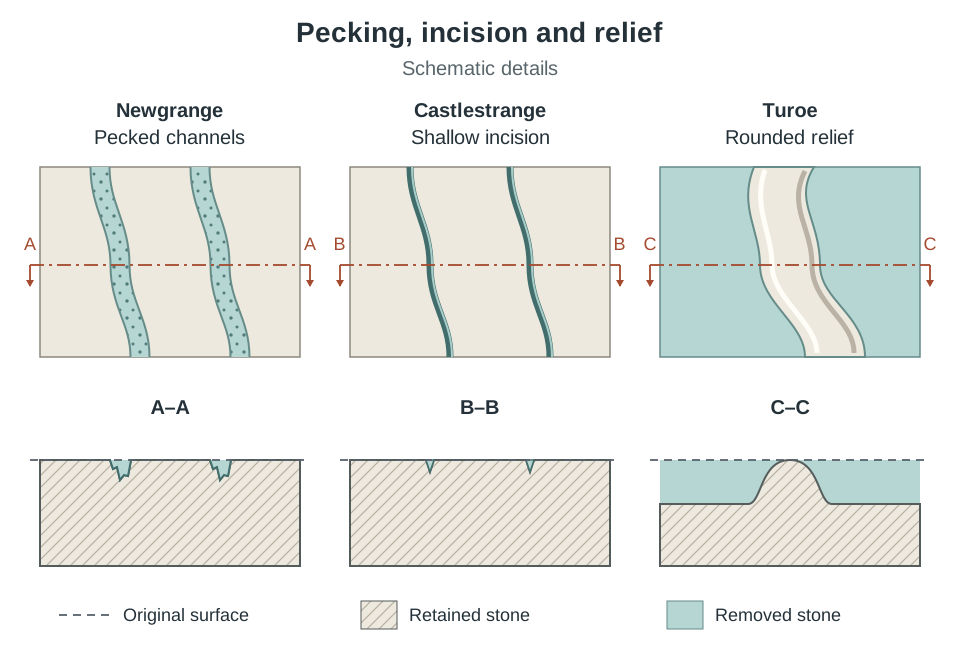
- Pecking: The primary carving method. A mason struck a hard chisel point of flint, quartz, or diorite using a heavy stone maul, pitting the rock surface to crush out sunken grooves or chip away areas of stone.
- Pick-dressing: Pecking applied across a wide section of stone to produce an even, textured ground. At Newgrange, pick-dressing was sometimes applied later than the initial carved motifs, occasionally cutting across and partially erasing earlier designs, which shows that stones were altered over time.
- Smoothing: Pecked grooves were sometimes rubbed down using abrasive sandstone blocks and wet sand, refining the contours and sharpening the shadow edges under natural sunlight.
Visual Vocabulary of Megalithic Motifs
| Motif Style | Shape Vocabulary | Visual Effect and Symbolic Meaning |
|---|---|---|
| Curvilinear (Curved) | Single, double, and triple spirals; concentric circles; gapped circles; serpentine wavy lines. | Imparts organic movement and cyclical rhythm. Spirals are widely interpreted as symbols of the sun, seasons, or cosmic journeys. |
| Rectilinear (Straight) | Lozenges (diamonds); chevrons (V-shapes); zigzags; parallel lines; radiating sunbursts. | Creates structured geometric rhythms. Lozenges and chevrons may represent cultivated fields, weaving patterns, or territorial emblems. |
Kerbstone 1: The Entrance Stone at Newgrange
Kerbstone 1 is a massive oval slab of greywacke positioned directly in front of the tomb portal. The artist divided the composition with a subtle vertical line down the centre. On the left, three large, interconnected spirals dominate the field; on the right, double spirals, concentric arcs, and lozenges flow across the surface.
The design was produced by pecking deep, smooth channels into the stone with a hand-held point and hammerstone. The grooves create dark shadows under raking sunlight, causing the raised unpecked bands between them to read as thick, rounded ribbons. This is an intaglio or grooved technique; the design was not carved by chiselling away the entire background field into raised relief.
The Bronze Age (c. 2500–500 BC): Metallurgy, Sheet Gold, and Casting
The Stone Age and Bronze Age overlapped through the Copper Age (c. 2500–2200 BC), when metalworking arrived alongside the Beaker pottery culture. Metalworkers combined copper with roughly 10% tin to produce bronze, an alloy far harder than pure copper, capable of taking a sharp cutting edge and flowing smoothly when molten.
Sourcing and Extracting Raw Materials
- Copper: Extracted from native rock veins, notably at Ross Island, Killarney, Co. Kerry (c. 2400–1900 BC), Ireland's earliest recorded mine, and later at Mount Gabriel, Co. Cork. Miners used fire-setting, lighting roaring wood fires against the rock face to heat the ore, then dousing the hot stone with cold water. The sudden thermal shock fractured the rock, allowing miners to extract the copper ore using stone hammers and wooden wedges.
- Tin: Extremely scarce in Ireland. Geological evidence suggests tin was imported by sea from Cornwall, pointing to long-distance maritime exchange networks across the Irish Sea.
- Gold: Traditionally believed to have been panned from alluvial gravels in rivers such as the Avoca valley in Co. Wicklow. Recent geochemical analysis indicates that some early Irish gold artefacts share chemical signatures with Cornish alluvial gold, suggesting that Bronze Age goldsmiths may have imported raw gold alongside tin.
Evolution of Casting Techniques
- Open one-piece stone moulds: Molten copper or bronze was poured into a flat cavity carved into a stone block. This technique was limited to objects with one flat face, such as early flat axes.
- Two-piece (bivalve) moulds: Two matching carved stone halves (and later fired clay moulds) were pinned together and filled with molten metal through an entry gate. This permitted fully rounded, three-dimensional implements such as palstaves, socketed spearheads, and dagger blades.
- Lost-wax casting (cire perdue): A model was sculpted in beeswax, encased in clay, and fired. The heat baked the clay and melted the wax out through drainage vents, leaving a hollow cavity. Molten bronze was poured in to replace the wax. This technique allowed complex, under-cut forms such as the hollow horns of the Dowris Hoard and cauldron handles.
Early Bronze Age Sheet Gold (c. 2200–1500 BC)
Early goldsmiths melted alluvial gold into ingots and hammered them thin on stone anvils, repeatedly annealing (heating and slowly cooling the metal) to restore ductility and prevent brittle cracking.
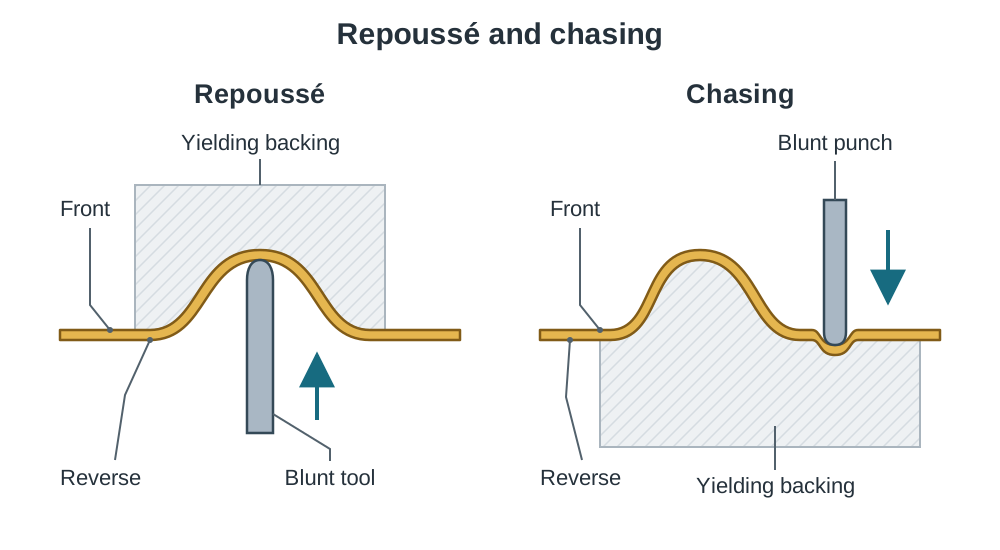
- Sun discs (e.g. Tedavnet, Co. Monaghan): Cut from beaten sheet gold measuring approximately 11 cm in diameter. The surface is decorated in repoussé (embossing designs by hammering or pressing from the reverse side against a soft backing). Motifs feature concentric circles, crosses, and zigzag bands. Two small holes near the centre suggest they were sewn or pinned onto ceremonial garments as badges of rank or solar emblems.
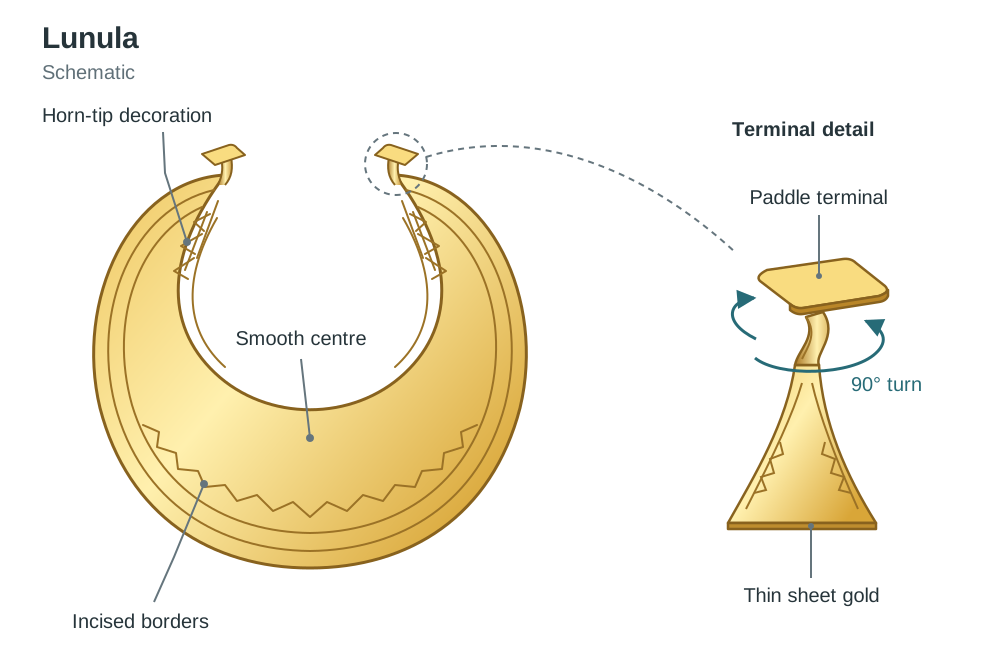
- Gold lunulae (e.g. Blessington Lunula): Thin, crescent-shaped collars cut from sheet gold, worn around the neck. The paddle-shaped terminals are twisted at right angles to the body, allowing them to hook together securely at the back of the neck. Decoration is restricted to the outer edges and horn tips, featuring delicate geometric patterns (chevrons, lozenges, cross-hatching) incised using a sharp bronze scribe, leaving the broad central crescent smooth and reflective.
Middle and Late Bronze Age: Torcs, Gorgets, and Hoards
During the Middle and Late Bronze Age, Irish goldsmiths moved beyond flat sheet metal to three-dimensional ornaments, flange manipulation, and mechanical assembly.
Middle Bronze Age: Flanged and Ribbon Torcs
A torc is an ornament formed by twisting gold into a spiral. Middle Bronze Age smiths developed two distinct types:
- Flanged (bar) torcs: Made by casting a solid gold bar with a square or cruciform cross-section, hammering the ridges out into four raised thin wings (flanges), and twisting the heated bar corkscrew-fashion, as seen in the Tara Torcs (c. 1200 BC, Co. Meath). One measures 1.67 metres in length and weighs over one kilogram, with recurved terminals designed to hook together. Its massive proportions indicate it was worn diagonally across the chest or around the waist during elite ceremonies.
- Ribbon torcs: Formed simply by twisting a thin, flat strip of beaten gold into an elastic spiral ending in small button or hook terminals. These were lighter and remained in use into the Iron Age.
Late Bronze Age (c. 1000–500 BC)
Its richest stage, the Dowris Phase (c. 900–600 BC), is named after the Dowris Hoard, Co. Offaly. This phase represents prehistoric Ireland's peak of metallurgical craftsmanship.
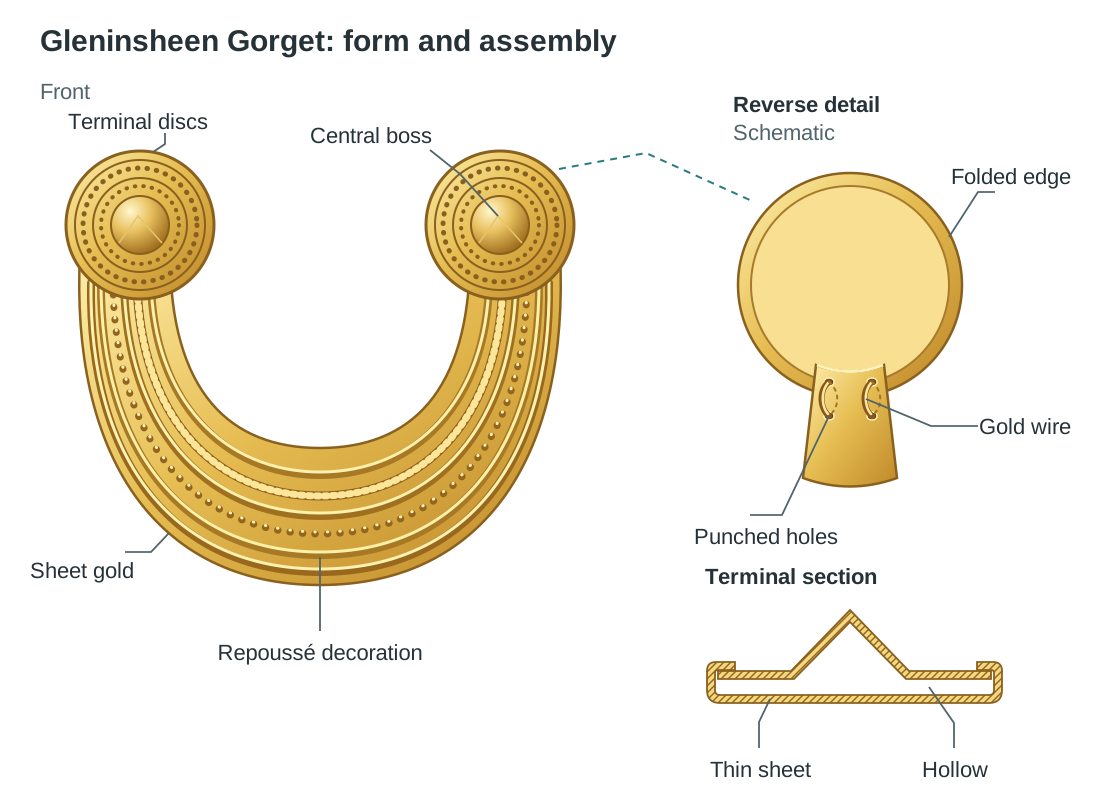
- The Gleninsheen Gorget (Co. Clare, c. 800–700 BC): A gorget is a wide U-shaped gold collar worn flat across the upper chest. Hammered from a single gold sheet, the crescent body features repoussé decoration of concentric rounded ribs, raised beads, and simulated rope mouldings. Two circular terminal discs, each featuring a raised conical central boss surrounded by concentric repoussé beading, are attached to the collar ends. The terminals were mechanically assembled: the back-plate edges were folded over, and fine gold wire stitches were passed through punched perforations. Its fragile sheet construction and lavish decoration point to ceremonial display by a high-ranking chieftain.
- Dress fasteners and hair ornaments: Solid cast gold dress fasteners (such as the Clones Fibula, Co. Monaghan) feature bow handles joining trumpet-like cups; its immense mass suggests it was a prestige emblem rather than an everyday cloak fastener. In contrast, hollow split-cone lock rings (such as Gorteenareagh, Co. Clare) were worn in the hair, assembled from hundreds of hair-thin gold wires soldered side by side onto a hollow sheet core.
- Castlederg Cauldron, Co. Tyrone: A large feasting vessel constructed from curved bronze plates hammered to shape and riveted together with conical rivets, fitted with corrugated ring handles cast using the lost-wax method.
Hoards and Votive Offerings
Much Bronze Age and Iron Age metalwork survives because it was deliberately buried in bogs, lakes, and rivers. These deposits were not accidental losses, but votive offerings to deities, ritual deposits accompanying burials, or emergency caches hidden by an elite warrior class during times of conflict.
- The Mooghaun Hoard, Co. Clare (c. 800 BC): Unearthed in 1854 during railway construction, this was one of the largest prehistoric gold hoards discovered in western Europe, containing over one hundred and fifty gold bracelets, collars, and ingots. While most pieces were melted down at the time, surviving examples in the National Museum demonstrate the sheer concentration of wealth held by Late Bronze Age leaders.
Museum Display and Curation: Much of the goldwork discussed here, including the Broighter Hoard, is displayed in the National Museum of Ireland, Kildare Street. Seeing the objects lit behind glass as treasures shapes how we read them today, differently from how they were buried or worn. In the 'Ór – Ireland's Gold' gallery, examine the paper-thin cross-sections of the lunulae and inspect the tiny wire stitching visible on the reverse of the Gleninsheen Gorget's terminal discs.
The Iron Age (c. 500 BC–AD 500): The La Tène Style and Stone Carving
Iron technology reached Ireland from Continental Europe between 600 and 500 BC. Abundant native bog iron ore allowed craftsmen to forge hard, durable tools, weapons, and ploughshares. The artistic style associated with the Iron Age—the La Tène style, named after an archaeological site on Lake Neuchâtel in Switzerland—appeared in Ireland around 300 BC, reaching its zenith between the 1st century BC and the 1st century AD.
Hallmarks of the La Tène Style
In sharp contrast to the rigid, symmetrical geometric bands of the Bronze Age, La Tène art is organic, curvilinear, and fluidly balanced. It adopted classical Mediterranean motifs (such as Greek palmettes and lotus buds) and transformed them into abstract, energetic forms:
- Trumpet curves and pelta shapes: Sweeping curves that widen into rounded, trumpet-like terminations, and crescent shield shapes.
- S-scrolls and swelling lobes: Flowing lines that taper and expand organically across curved planes.
- Triskeles: Three curved legs or spirals radiating from a common centre, suggesting perpetual rotary motion.
- Asymmetrical balance: Dynamic, freeform arrangements that achieve visual harmony without mirroring halves.
- Contrast of positive and negative space: Smooth, raised ribbons contrasted against textured, hatched, or cut-away backgrounds.
Defensive Stone Architecture: Dún Aonghasa
Promontory and ring forts provided defensible strongholds for chieftains. Excavations at Dún Aonghasa on Inis Mór in the Aran Islands show that its earliest fortifications date to the Late Bronze Age (c. 1100–800 BC), but the site was significantly modified and occupied throughout the Iron Age.
- Perched on the edge of a sheer one-hundred-metre Atlantic sea cliff, the fort features three concentric semi-circular drystone walls up to five metres high and six metres thick, equipped with internal terraces and stairs.
- Outside the middle rampart lies an engineered chevaux-de-frise: a defensive apron of jagged limestone pillars set upright in the earth to break cavalry charges and entangle approaching warriors.
Iron Age Stone Carving: The Turoe Stone and Corleck Head
The introduction of hardened iron chisels revived monumental stone carving, enabling sculptors to tackle tough igneous boulders.
- The Turoe Stone (Co. Galway, c. 50 BC): A dome-shaped glacial granite boulder standing 1.68 metres high. A carved ribbon of stepped fretwork (Greek-key pattern) circles its circumference, separating the rough, unworked base from the sculpted upper dome. The upper surface is divided into four distinct design zones (two D-shaped and two triangular panels) that knit together over the apex. The carver used iron chisels to cut away the tough granite background, leaving swelling trumpet curves, leaf lobes, and an off-centre triskele standing out in smooth, rounded relief carving. Its likely function was a sacred ritual focus or boundary monument.
- The Castlestrange Stone (Co. Roscommon): An egg-shaped granite boulder featuring continuous flowing La Tène spirals and trumpet curves. Unlike Turoe's raised relief, the decoration here was created by incision, shallow lines carved directly into the surface.
- The Corleck Head (Co. Cavan, c. 1st–2nd century AD): A three-faced stone head carved in the round from local limestone. Each face features simple almond-shaped eyes, a wedge nose, and a small slit mouth with a hole drilled beneath. This piece represents Celtic figurative sculpture, reflecting the veneration of the human head as the seat of the soul and the ritual significance of the number three.
Iron Age Metalwork and the Christian Legacy
Iron Age metalworkers applied the La Tène style to luxury ceremonial items, combining sheet-metal raising, chasing, and precision casting.
Masterpieces of Iron Age Metalcraft
- The Broighter Collar (Co. Derry, c. 50 BC): Found in 1896 as part of the Broighter Hoard near the shores of Lough Foyle, this hollow tubular gold torc is a pinnacle of Celtic goldsmithing. The hoard also held two gold neck chains, a bowl, and a miniature gold boat complete with oars, mast, and rudder, likely deposited as a votive offering to Manannán mac Lir, the Irish sea god. The collar was fabricated from sheet gold hammered into two curved hollow tubes and soldered along an inner seam. It opens and closes via a cast mortise-and-tenon buffer clasp secured by a locking pin. The surface decoration was pushed out in repoussé from within the open tubes, then refined from the exterior by chasing (depressing backgrounds and defining contours with blunt punches). To heighten contrast, the carver engraved the sunken background with fine, compass-drawn concentric arcs. This micro-textured ground absorbs light, making the polished, raised trumpet curves and S-scrolls stand out clearly.
- The Loughnashade Trumpet (Co. Armagh, 1st century BC): A curved ceremonial horn about 1.9 m long, found in 1798 in the small lake of Loughnashade beside the royal site of Emain Macha (Navan Fort). Human skulls were reported with it, which suggests a ritual deposit. Made from two hammered sheet-bronze tubes joined with an internal bronze strip and secured by hundreds of tiny rivets. The terminal disc around the mouth is divided into four repoussé quadrants displaying lotus buds and trumpet curves arranged with fourfold balance.
- The Petrie Crown (c. 1st–2nd century AD): A bronze ceremonial headdress consisting of a curved brow band holding two circular openwork discs and a small, hollow conical horn. The discs feature delicate chased running spirals that terminate in stylised bird profiles with pierced eye holes. One disc retains a central stud of red enamel, exemplifying the Ultimate La Tène style.
The Legacy of Pre-Christian Art in Early Christian Ireland
When Christianity took hold in Ireland after AD 500, native craftworkers did not discard their ancestral visual language. Instead, they translated the pagan La Tène vocabulary into Christian monastic art:
- Trumpet curves, triskeles, pelta shapes, and complex spirals were incorporated directly into Gospel manuscripts such as the Book of Durrow (7th century) and the Book of Kells (c. 800).
- High-status liturgical metalwork, including the Ardagh Chalice and the Tara Brooch (8th century), used the red champlevé enamel and compass-drawn spirals developed on works like the Petrie Crown.
- Stylised zoomorphic bird and beast terminals from Iron Age metalwork evolved into the intricate animal interlace of the Insular monastic tradition.
- Note that while older Neolithic spirals at Newgrange remained visible in the landscape, the spiral ornament in Insular Christian art derived from Iron Age La Tène models, not directly from Stone Age tombs.
The Evolution of Decorative Motifs Across Pre-Christian Ireland
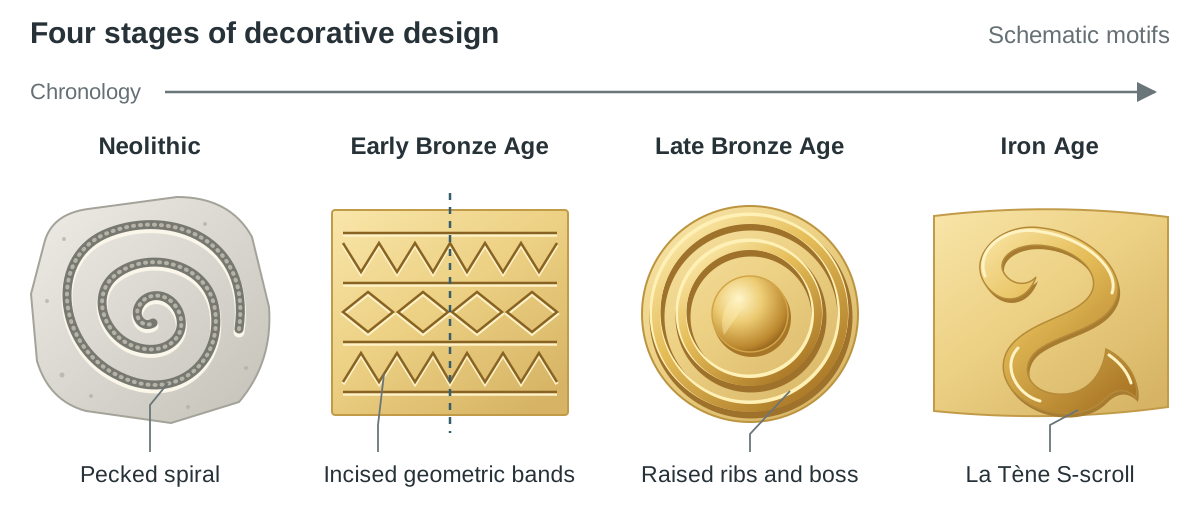
Past questions (e.g. 2024 Q14) have asked you to trace how motifs developed, so practise tracing the changes chronologically across stone and metalwork.
Chronological Development of Motifs
- Neolithic Stone Age (c. 4000–2500 BC): Pecked Abstract Motifs
Carvers worked on structural stones using flint points and hammerstones. The motif vocabulary consists of abstract geometric forms: spirals, concentric circles, lozenges, chevrons, and radials. Compositions were arranged freely across the natural contours of boulders (as on Kerbstone 1 at Newgrange). Some motifs were hidden from human sight, serving a sacred, cosmological purpose.
- Early Bronze Age (c. 2200–1500 BC): Incised and Repoussé Geometric Bands
The same geometric vocabulary (lozenges, chevrons, triangles, and concentric rings) moved from stone onto beaten sheet gold. Decoration was organized in rigid, disciplined bands characterized by strict bilateral symmetry (such as the incised borders of the Blessington Lunula and repoussé crosses on the Tedavnet sun discs).
- Late Bronze Age (c. 1000–500 BC): Raised Three-Dimensional Relief
Decoration became sculptural, tactile, and raised. Craftsmen used repoussé to create alternating concentric bands of smooth ribs, rope mouldings, and conical bosses (exemplified by the Gleninsheen Gorget). Organisation remained disciplined, repetitive, and symmetrical.
- Iron Age (c. 500 BC–AD 500): Organic Curvilinear La Tène Fluidity
Rigid geometric symmetry was abandoned in favour of fluid, asymmetrical, organic balance. Motifs adopted continental plant and trumpet forms: S-scrolls, leaf lobes, pelta shapes, and triskeles, often mapped out using compass geometry. Motifs were raised in sheet metal (the Broighter Collar) and revived on stone in rounded relief using iron chisels (the Turoe Stone).
Summary Formula
Remember the motif sequence: Pecked abstract spiral (Neolithic) Ordered geometric band (Early Bronze Age) Raised concentric boss and rib (Late Bronze Age) Flowing asymmetrical La Tène scroll (Iron Age).
Key terms
- Megalith
- A massive stone structure built by Neolithic communities for communal burial, ritual assembly, and territorial marking.
- Portal tomb (dolmen)
- An early Neolithic tomb consisting of two or more upright portal stones and a back stone supporting a heavy, sloping stone capstone.
- Orthostat
- A large, upright structural stone slab set into a foundation trench to form the side walls of a passage tomb or chamber.
- Corbelling
- An engineered roofing technique where horizontal stone slabs are layered inward in overlapping courses until they meet and are sealed by a capstone.
- Roof-box
- A specially engineered opening above the entrance lintel at Newgrange that permits the rising sun on the winter solstice to illuminate the inner burial chamber.
- Pecking
- A Stone Age carving technique in which a hard pointed stone or flint tool is struck with a hammerstone to pit out sunken grooves or background areas.
- Pick-dressing
- Evenly pecking across an entire stone surface to create a uniform, textured finish, occasionally cutting across earlier carved motifs.
- Fire-setting
- A prehistoric mining technique where rock faces were heated with roaring wood fires and quenched with cold water to crack the ore through thermal shock.
- Annealing
- The process of repeatedly reheating hammered metal and allowing it to cool slowly, restoring its ductility and preventing brittle cracking.
- Lunula
- An Early Bronze Age crescent-shaped collar cut from beaten sheet gold, with twisted paddle terminals and incised geometric border patterns.
- Repoussé
- A technique in which designs are hammered or pressed from the reverse side of thin sheet metal, against a soft backing, so they stand out in raised relief on the front.
- Chasing
- A metalworking technique executed on the front face using blunt punches to depress backgrounds, define outlines, and refine relief without cutting the metal.
- Flange-twisting
- A Middle Bronze Age technique where a cast gold bar was hammered into four raised longitudinal wings (flanges) and twisted into a spiral torc.
- Gorget
- A prestigious Late Bronze Age U-shaped gold collar with alternating repoussé ribs and rope motifs, fastened by two circular disc terminals.
- Lost-wax casting (cire perdue)
- A casting method where a wax model is encased in clay, baked until the wax drains away, and filled with molten bronze to produce complex shapes.
- Chevaux-de-frise
- A defensive barrier of sharp, upright limestone pillars planted closely in the ground outside a fort wall to obstruct cavalry charges and foot soldiers.
- La Tène
- A Celtic art style originating in Continental Europe, characterised by curvilinear S-scrolls, trumpet curves, triskeles, and asymmetrical balance.
- Triskele
- A Celtic motif formed of three curved branches or spirals radiating outward from a shared centre, conveying rotational movement.
- Relief carving
- A sculptural method where the carver cuts away the surrounding background stone, leaving the design standing proud above the surface.
- Incision
- A decorative technique where lines are grooved or scored directly into stone or sheet metal using a sharp point or blade.
Check yourself
What is the structural role of corbelling at Newgrange, and how was it weatherproofed?
Corbelling creates a self-supporting stone roof by stepping flat slabs inward layer upon layer until a single capstone closes the top. Masons cut drainage channels into the upper stone surfaces to direct water away and packed joints with sand, soil, and moss.
How does the stone carving technique of the Newgrange Entrance Stone differ from that of the Turoe Stone?
Kerbstone 1 at Newgrange features pecked intaglio grooves pounded into the rock with stone tools, leaving unpecked stone reading as bands; the Turoe Stone features true raised relief, where iron chisels were used to systematically cut away the tough granite background.
Where did Bronze Age Irish metalworkers source their copper, tin, and gold?
Copper was mined locally at Ross Island (Co. Kerry) and Mount Gabriel (Co. Cork); tin was probably imported from Cornwall; gold was panned from rivers such as the Avoca in Co. Wicklow, though geochemical evidence suggests some gold was also imported from Cornwall.
What is a chevaux-de-frise, and what was its defensive function at Dún Aonghasa?
A chevaux-de-frise is a band of sharp, upright limestone slabs planted closely in the earth outside the fort wall, engineered to break up cavalry charges and impede charging infantry.
Name two visual characteristics that distinguish an Early Bronze Age lunula from a Late Bronze Age gorget.
A lunula is a flat, thin sheet collar with incised geometric border patterns and twisted paddle terminals; a gorget is a broader U-shaped collar with raised repoussé concentric ribs, rope mouldings, and separate stitched circular terminal discs with conical bosses.
How did Iron Age craftworkers influence Early Christian monastic art after AD 500?
They passed on the curvilinear La Tène vocabulary (trumpet curves, triskeles, pelta shapes) and metalworking techniques (red champlevé enamel, zoomorphic terminals) to monastic gospel manuscripts such as the Book of Kells and metalwork like the Ardagh Chalice.
Image identification drill: What artefact is characterised by a flat crescent of thin gold, unworked centre, incised geometric border bands, and twisted paddle ends?
A gold lunula (Early Bronze Age).
Image identification drill: What artefact is characterised by a wide U-shaped gold collar with alternating repoussé ribs and two circular discs with raised conical bosses?
A gold gorget, such as the Gleninsheen Gorget (Late Bronze Age).