

The Renaissance (c. 1300–1600s) was a transformative cultural movement that originated in late mediaeval Italy and spread throughout Northern Europe. Meaning 'rebirth', the era was driven by humanism, empirical observation, and the rediscovery of classical Greco-Roman antiquity, replacing the flat, hieratic (formal, rigid and symbolic rather than lifelike) conventions of Byzantine and Gothic art. The Leaving Certificate Visual Studies Framework analyses this transformation across three temporal phases (before, during, and after) through six core lenses: Context, Artists and Artworks, Analysis, Art Elements and Design Principles, Media and Areas of Practice, and Innovation and Invention. The study encompasses Proto-Renaissance naturalism, Florentine mathematical perspective and disegno, Roman High Renaissance harmony, Venetian atmospheric colorito, Northern European oil glazing and printmaking, Mannerist tension, and the sweeping legacy that shaped Western art and architecture for centuries.
Before the Period: Context and the Proto-Renaissance Shift (c. 1300–1400)
Under the Visual Studies Framework, every topic enquiry is grounded in three essential questions: What was created? How was it created? and Why was it created? Investigating the period begins with understanding what existed before.
Before the 14th century, European painting was dominated by Byzantine and Gothic conventions. Artists used hierarchical scale, where the size of a figure reflected its spiritual importance rather than its position in space. Heavenly backgrounds were rendered in flat gold leaf rather than earthly landscapes, presenting sacred figures as remote and symbolic.
The shift towards naturalism was propelled by humanism. Rooted in the studia humanitatis (grammar, rhetoric, history, poetry, and moral philosophy), humanism revived classical Greco-Roman literature and philosophical enquiry. It did not reject Christianity; rather, it viewed human intellect, physical nature, and worldly observation as manifestations of divine harmony. Franciscan spirituality encouraged this outlook by celebrating God's presence in the physical world, prompting artists to observe nature directly.
Giotto di Bondone (c. 1267–1337)
Giotto led this transition in Florence and Padua. In his fresco cycle for the Scrovegni (Arena) Chapel in Padua (c. 1305), Giotto broke decisively away from the Byzantine maniera greca (the flat, gold-ground, stylised style of icon painting):
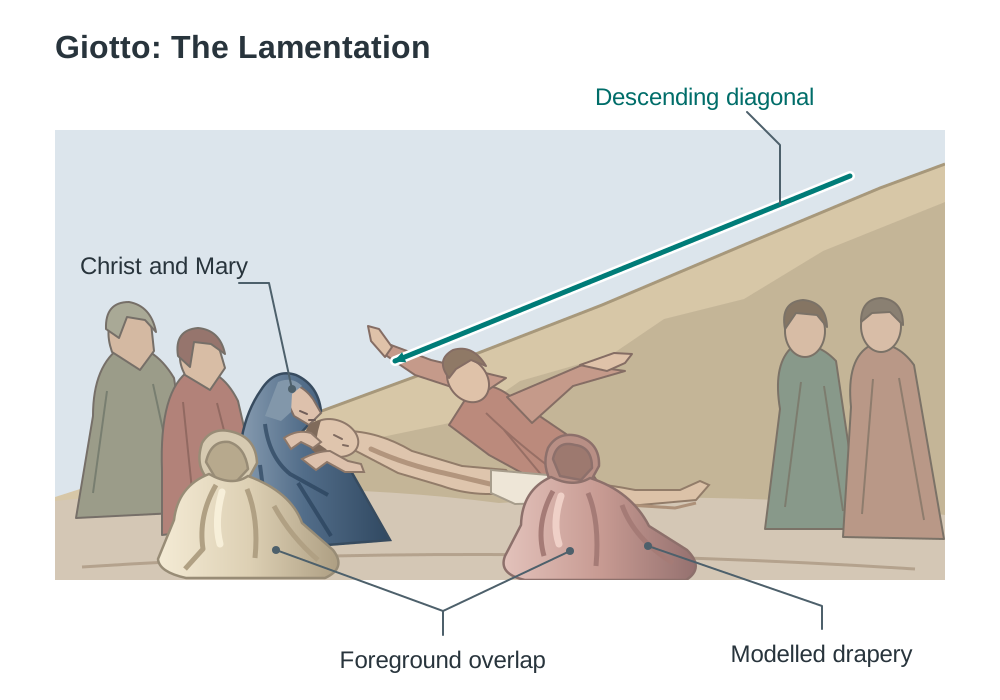
- Mass and Volume: In The Lamentation, Giotto used rudimentary chiaroscuro (gradations of light and tone) to give figures tangible weight and sculptural mass beneath heavy drapery.
- Emotional Realism: Facial expressions and physical gestures convey genuine human grief. The contorted, weeping angels above contrast with Mary cradling Christ's dead body in intimate sorrow.
- Compositional Direction: A sloping diagonal rock formation leads the viewer's eye towards the focal point of Christ and Mary. Two seated mourners with their backs turned create a foreground layer, establishing believable spatial depth.
The Early Renaissance in Florence: Perspective, Architecture, and Disegno (1400s)
Fifteenth-century Florence (the Quattrocento) fostered rapid artistic innovation. Wealth from the wool guild (Arte della Lana) and international banking houses, led by the Medici family, financed major civic and ecclesiastical commissions. Patrons used art to proclaim civic virtue and prestige, while competitive guild commissions drove technical rivalry.
In 1401, a public competition was held to design the bronze North Doors of the Florence Baptistery. Lorenzo Ghiberti won against Filippo Brunelleschi, demonstrating superior narrative continuity, classical drapery, and technical command of bronze casting. Ghiberti later received the commission for the Baptistery's East Doors (1425–1452), which Michelangelo praised as The Gates of Paradise.
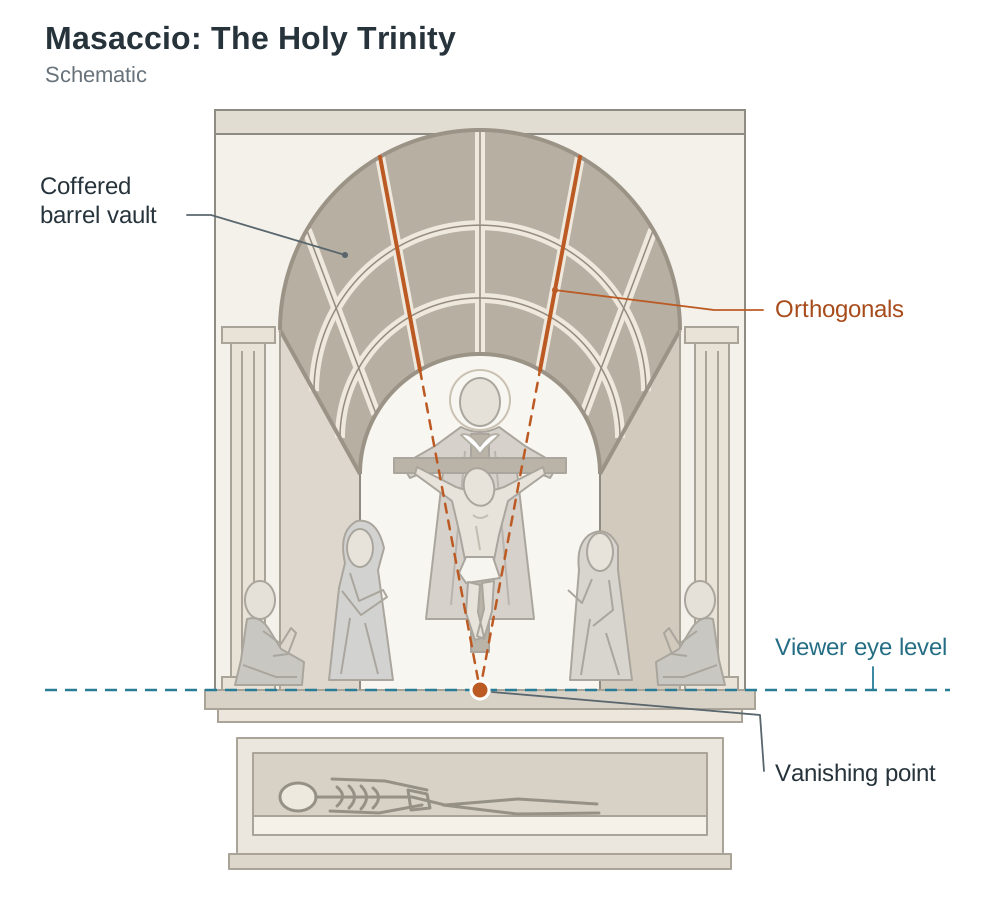
Following his defeat, Brunelleschi visited Rome to measure classical ruins. Around 1415, he formalised one-point linear perspective: an optical system where receding parallel lines (orthogonals) converge at a single vanishing point on a horizontal eye-level line. Leon Battista Alberti codified this system in his 1435 treatise On Painting (Della Pittura), defining the picture surface as an open window looking onto the world.
Masaccio (1401–1428)
Masaccio applied Brunelleschi's perspective directly to painting:
- The Holy Trinity (c. 1427): Painted on the left aisle wall of the nave of Santa Maria Novella, Florence, this fresco is one of the earliest surviving paintings to apply Brunelleschi's perspective systematically. Masaccio scored orthogonals into wet plaster to construct a coffered barrel vault, creating a convincing trompe-l'œil** stone chapel.
- The Tribute Money (c. 1425, Brancacci Chapel): Features a consistent single light source from the right that casts realistic shadows, atmospheric perspective** that hazes the distant Tuscan hills, and standing figures whose drapery reveals their anatomical weight.
Donatello and Botticelli
- Donatello (c. 1386–1466): His bronze David (c. 1440s) is generally regarded as the first freestanding nude male statue since antiquity. It revived classical contrapposto (a relaxed stance with the weight on one leg, causing hips and shoulders to tilt in opposite directions), symbolising Florentine independence.
- Sandro Botticelli (c. 1445–1510): Worked within Medici circles influenced by Neoplatonism (a philosophy that saw physical beauty as a reflection of divine, spiritual beauty, allowing pagan figures to embody Christian virtues). Works such as The Birth of Venus (c. 1485) and Primavera (c. 1482) prioritise lyrical contour lines over strict perspective.
Perspective Across the 15th Century
- Paolo Uccello, The Battle of San Romano (c. 1438–1440)*: Placed fallen soldiers and broken lances along rigid orthogonal grids, showing an intense fascination with perspective geometry.
- Piero della Francesca, The Flagellation of Christ (c. 1455–1460): Balanced background architectural proportions and foreground figures with exact mathematical intervals, later authoring the treatise De prospectiva pingendi*.
- Andrea Mantegna, Lamentation over the Dead Christ (c. 1480): Mastered foreshortening* (drawing a form shortened as it recedes or projects in space) by showing Christ's body feet-first, subtly reducing the size of the feet to prevent them blocking the torso.
Early Renaissance Architecture
Brunelleschi revolutionised architecture by combining Roman engineering with mathematical proportion:
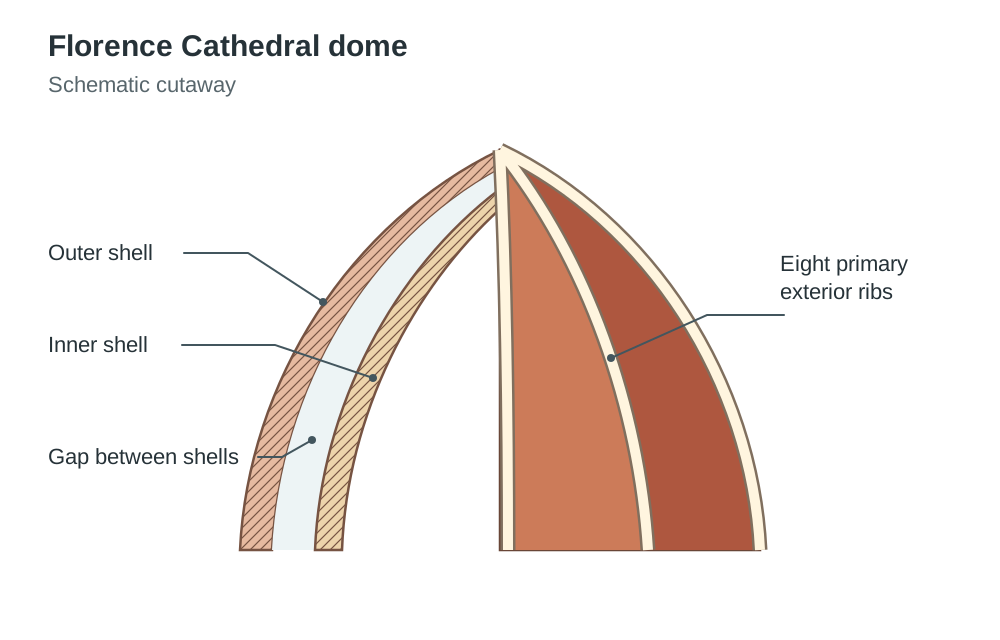
- Dome of Florence Cathedral (Santa Maria del Fiore, 1420–1436): The largest masonry dome built since antiquity, erected without wooden centering (the temporary wooden framework used to support arches during construction). Brunelleschi devised a double-shell design, locking courses of herringbone brickwork, eight primary white marble exterior ribs, and an ox-driven reversible hoist.
- Ospedale degli Innocenti (begun 1419): Florence's Foundling Hospital used classical columns, semicircular arches, and clear geometric proportion based on an exact modular unit of measurement.
- Leon Battista Alberti: Adapted the Roman triumphal arch to church facades, as seen at Sant'Andrea in Mantua (designed 1472).
The High Renaissance in Rome and Milan (c. 1490s–1527)
At the turn of the 16th century, the artistic focus shifted to Rome and Milan, fuelled by ambitious papal commissions under Pope Julius II (1503–1513) and Pope Leo X (1513–1521). Central Italian art was anchored in disegno (intellectual design, preparatory drawing, and clear linear contours).
Leonardo da Vinci (1452–1519)
Leonardo integrated scientific observation, dissection, and optics into painting:
- Sfumato: The subtle, smoky blending of tone and colour without abrupt borders, creating psychological depth around the eyes and mouth of the Mona Lisa (c. 1503–1506).
- Pyramidal Composition: A stable triangular grouping that provides structural balance, seen in The Virgin of the Rocks (c. 1483–1486).
- The Last Supper (c. 1495–1498, Santa Maria delle Grazie, Milan)**: Orthogonals along the coffered ceiling and wall tapestries converge directly on Christ's right temple. The twelve apostles are organised into four animated triplets reacting to Christ's announcement of betrayal.
Michelangelo Buonarroti (1475–1564)
Michelangelo viewed subtractive marble carving as freeing a living form from raw stone:
- Pietà (1498–1499)**: Carved from a single Carrara marble block, Mary's youthful features signify purity while her drapery forms a stable pyramid supporting Christ's anatomically detailed, lifeless form.
- David (1501–1504)*: Carved from a discarded marble block (Il Gigante*), David is captured before battle. His furrowed brow, tense neck tendons, and dynamic contrapposto turned him into a symbol of Florentine liberty.
- Sistine Chapel Ceiling (1508–1512): Pope Julius II commissioned this vast fresco cycle. Michelangelo painted over 300 energetic figures illustrating Genesis. In The Creation of Adam, the tiny gap between Adam's and God's fingertips expresses the transfer of life.
Raphael (1483–1520)
Raphael balanced Leonardo's soft modelling with Michelangelo's dynamic anatomy:
- The School of Athens (1509–1511, Vatican Stanze)**: Commissioned for Julius II's papal library, this fresco depicts classical philosophers beneath soaring barrel vaults. Every orthogonal in the floor pavement and ceiling architecture converges at the vanishing point situated directly between Plato (pointing to heaven) and Aristotle (gesturing to earth).
- Madonna of the Goldfinch (c. 1505–1506)**: Unites Leonardo's pyramidal grouping with calm, graceful figures set in an open, pastoral landscape.
High Renaissance Architecture
- Donato Bramante: Designed the Tempietto (Rome, c. 1502), a small circular domed temple referencing classical Roman tholos shrines. Bramante drew up the original centralised Greek-cross plan for the new St Peter's Basilica, an idea later adapted by Michelangelo, who designed its soaring ribbed dome.
The Venetian School: Colorito and Atmospheric Light
Venice developed an approach distinct from Central Italian disegno. Centred on colorito (building form, spatial depth, and mood directly through layered colour, oil glazes, and atmospheric light), Venetian art responded to its environment as a maritime empire.
Because the humid lagoon climate caused wet wall plaster to blister, Venetian painters largely abandoned fresco in favour of oil paint on stretched linen canvas. Woven canvas resisted moisture, offered flexibility on large scales, and provided a textured surface that caught the light.
- Giovanni Bellini (c. 1430–1516): The leading master of early Venetian Renaissance painting, who established its warm light and oil technique, visible in the San Zaccaria Altarpiece (1505).
- Giorgione (c. 1477–1510): Emphasised lyrical landscapes and poetic moods where human figures harmonise with the weather, seen in The Tempest (c. 1508) and Sleeping Venus (c. 1510).
- Titian (c. 1489–1576): Mastered expressive brushwork and rich oil glazes. In the Assumption of the Virgin (1516–1518), dynamic red robes create an ascending triangular rhythm from the earthbound apostles up to God the Father. In Bacchus and Ariadne (1520–1523), vibrant ultramarine lapis lazuli and warm flesh tones define the action through luminous colour.
- Tintoretto and Paolo Veronese: Tintoretto used plunging diagonals and dramatic lighting in Miracle of the Slave (1548). Paolo Veronese staged theatrical, monumental banquets set among classical columns, as in The Feast in the House of Levi (1573, originally titled The Last Supper).
In architecture, Andrea Palladio (1508–1580) built villas across the Venetian mainland (such as the Villa Rotonda, c. 1567), combining classical temple fronts with strict mathematical symmetry.
The Northern Renaissance: Oil Glazing, Printmaking, and Reformation (1400s–1500s)
Lacking direct access to classical ruins, artists in Flanders, Germany, and the Netherlands turned to empirical observation and microscopic surface realism, supported by a rising merchant class.
Oil Glazing and Disguised Symbolism
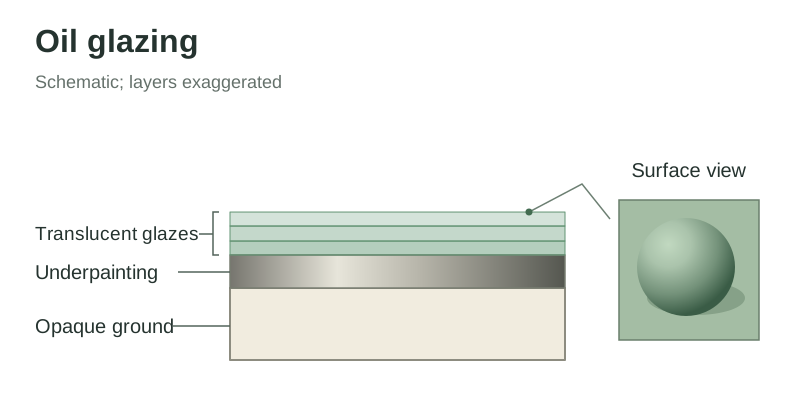
Netherlandish painters, led by Jan van Eyck (c. 1390–1441), refined oil painting by mixing ground pigments with drying oils (such as linseed or walnut oil). Applied in multiple thin, translucent glazes over an opaque ground, oil dried slowly, enabling artists to blend tones seamlessly and depict how light interacts with varied textures like velvet, brass, fur, and jewels.
- The Arnolfini Portrait (1434)**: A double portrait rich in domestic detail. In one well-known interpretation, the removed pattens (clogs) suggest the room is treated as sacred ground. The painting has traditionally been read as recording a marriage or betrothal, though historians still debate this. Other symbols include the single burning candle (God's presence), the dog (marital fidelity), and a convex wall mirror reflecting two figures entering the doorway.
- The Ghent Altarpiece (1432)**: A monumental polyptych displaying radiant colour, intricate textiles, and luminous natural landscapes.
Printmaking Innovations and the Art Market
Johannes Gutenberg's movable-type printing press (c. 1440) revolutionised the spread of images. Two main techniques developed:
- Woodcut (Relief print): The artist draws on a wooden block and carves away the negative space. The raised surface is inked and pressed. Example: Albrecht Dürer's Apocalypse series (1498) and The Rhinoceros (1515).
- Engraving (Intaglio print): The artist cuts fine grooves into a copper plate using a steel tool called a burin. Ink is worked into the incisions, the surface is wiped clean, and the plate is passed through a high-pressure press onto damp paper. This allows delicate cross-hatching and subtle tonal shifts, seen in Dürer's Melencolia I (1514) and Knight, Death, and the Devil (1513).
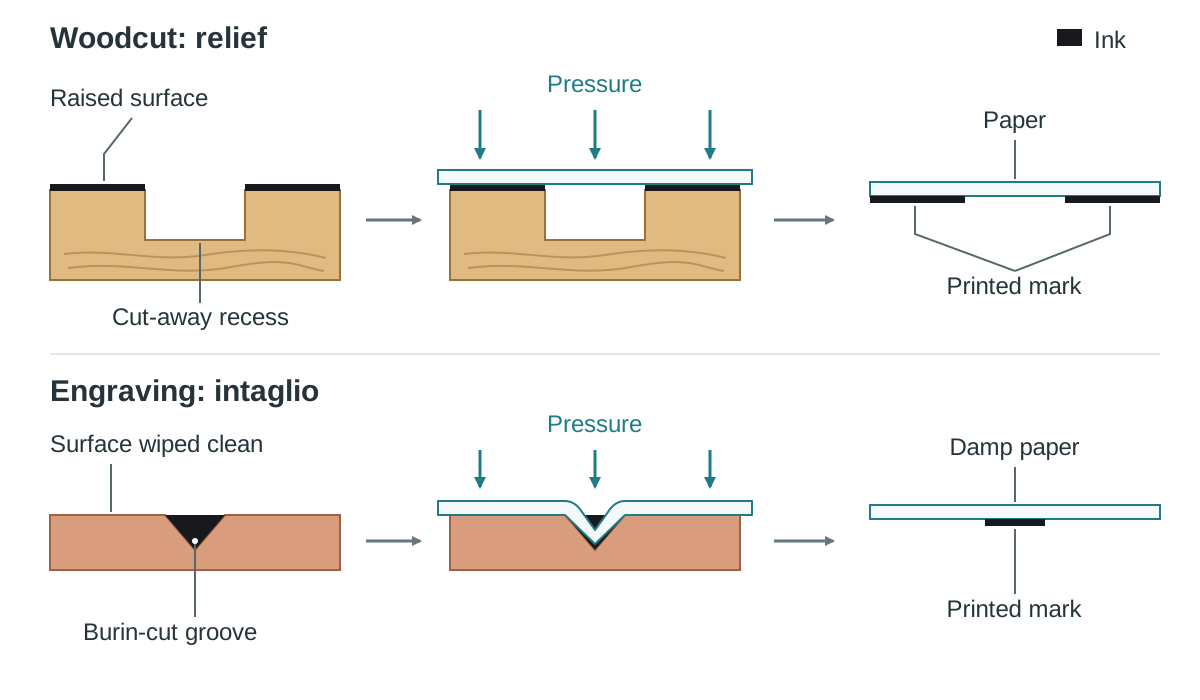
Printmaking enabled images to be produced in hundreds of identical impressions. It allowed classical Italian design to spread across Europe, provided artists with independent income from the open market, and served as a powerful vehicle for Reformation ideas.
Other Northern Masters
- Hans Holbein the Younger (1497–1543): Court painter to King Henry VIII. In The Ambassadors (1533), Holbein painted an intricate double portrait featuring mathematical and musical instruments. On the upper shelf, a celestial globe and astronomical instruments show the men's learning. On the lower shelf, a lute with a broken string suggests discord, often linked to the religious divisions of the Reformation. Stretched across the bottom is an anamorphic skull (a distorted image that resolves into correct proportion only from an acute viewpoint), functioning as a memento mori (a symbolic reminder of mortality).
- Pieter Bruegel the Elder (c. 1525–1569): Shifted focus from religious imagery towards sweeping landscape and peasant genre painting, depicting seasonal activities in The Hunters in the Snow (1565).
Mannerism, Counter-Reformation, and Media Failures (c. 1520s–1600)
Following Raphael's death in 1520, the religious upheaval of the Protestant Reformation (1517), and the catastrophic Sack of Rome (1527), younger artists felt that Leonardo, Michelangelo, and Raphael had perfected natural, balanced art. Rather than repeat it, they looked for new ways to impress: elegance, complexity, and deliberate strangeness, giving rise to Mannerism (maniera):
- Elongated Anatomy: Bodies were stretched and arranged in winding, S-shaped postures known as figura serpentinata.
- Irrational Space: Measurable linear perspective was abandoned in favour of crowded foregrounds and ambiguous depth.
- Artificial Colour: Harmonious palettes were replaced with acidic shades and iridescent cangiante (colour shifts mimicking shot-silk fabrics).
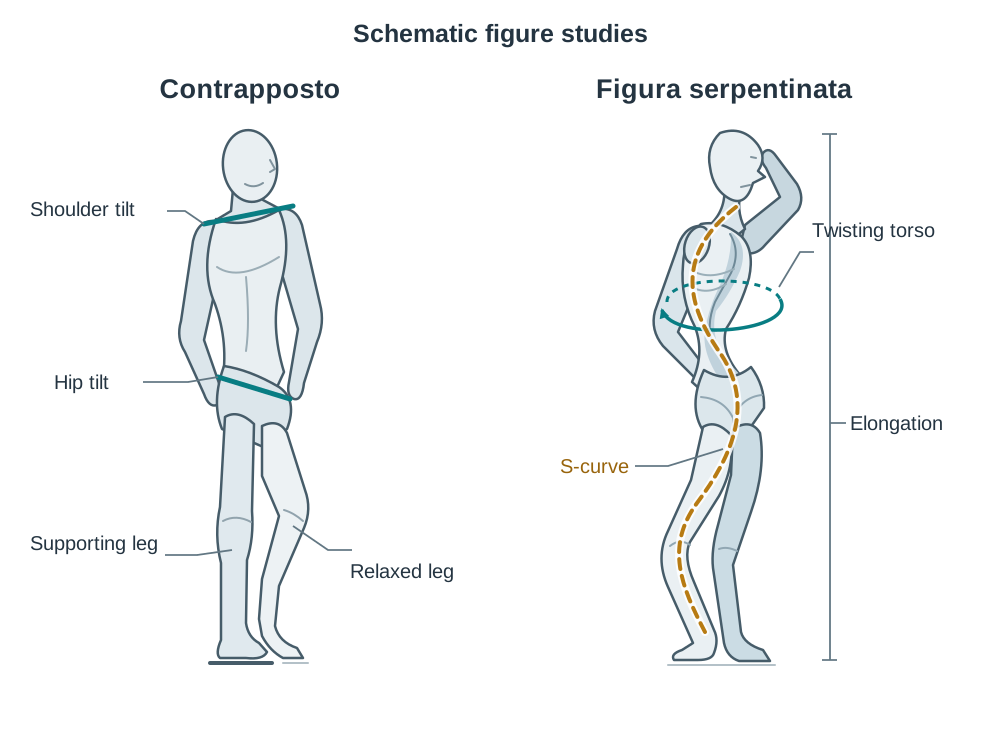
Key Mannerist Works
- Parmigianino, Madonna with the Long Neck (c. 1535)*: Mary's swan-like neck and elongated fingers create aristocratic elegance. In the background, an oversized column supports no ceiling, beside a tiny, out-of-scale prophet.
- Michelangelo, The Last Judgement (1536–1541, Sistine Chapel altar wall)*:
- Subject: The Second Coming of Christ, where the blessed rise on the left and the damned tumble towards hell on the right.
- Composition: A swirling vortex circling a powerful, beardless, Apollo-like Christ, abandoning rational linear perspective.
- Symbolism: St Bartholomew holds a flayed skin bearing Michelangelo's self-portrait, while Charon ferries souls to Hades.
- Figure: Heavy, muscular, twisting nudes expressive of spiritual turmoil.
The Counter-Reformation Impact
The Catholic Church addressed the Protestant crisis at the Council of Trent (1545–1563), decreeing that sacred art must be clear, doctrinally sound, and free from worldly excess. This had direct results:
- In 1565, Daniele da Volterra was hired to paint drapery over nudes in Michelangelo's Last Judgement, earning the moniker Il Braghettone (the breeches-maker).
- In 1573, Paolo Veronese was summoned before the Inquisition over the inclusion of dwarves, dogs, and German soldiers in his Last Supper. Veronese altered the title to The Feast in the House of Levi rather than alter the painting.
Media and Their Limitations: Buon Fresco, Tempera, and Oil
- Egg Tempera: Ground pigments mixed with egg yolk on gesso-primed wooden panels. Dries rapidly into a crisp, matt finish. Because colours cannot be blended wet-in-wet on the surface, tonal modelling requires fine hatching strokes (e.g. Botticelli's Primavera).
- Buon Fresco: Water-ground pigments applied onto freshly laid wet lime plaster in daily patches (giornate). Chemical carbonation permanently locks the pigment into the drying plaster wall. However, artists must work before the plaster sets, corrections are difficult, and certain pigments (like ultramarine blue) had to be painted a secco (on dry plaster) and remain vulnerable to flaking.
- Oil Paint: Pigment bound in drying oil, drying slowly to allow seamless blending, sfumato, and translucent glazes.
- The Failure of The Last Supper (c. 1495–1498)*: Leonardo wanted to work slowly and build subtle sfumato layers, which the rapid drying of buon fresco prevented. He devised an experimental mix of tempera and oil on a dry, double-primed masonry wall. The paint failed to bond with the plaster and began flaking during Leonardo's lifetime, necessitating centuries of restoration.
After the Period: Legacy and Influence on Later Art
The Visual Studies Framework requires understanding the impact of a movement on later art and design:
- The Baroque Era (c. 1600–1700s): Counter-Reformation patronage demanded emotionally direct art. Caravaggio adapted Renaissance chiaroscuro into tenebrism (intense spotlights surrounded by deep black shadows), seen in The Calling of St Matthew (c. 1599–1600). Gian Lorenzo Bernini developed Michelangelo's muscular contrapposto into dynamic, theatrical sculptures.
- The Academic Tradition: The founding of institutions like the French Académie Royale (1648) and the British Royal Academy (1768) codified High Renaissance principles as the 'Grand Manner'. Life drawing, anatomical study, and the balanced compositions of Raphael were taught as the universal standard for over two centuries.
- Neoclassicism (late 1700s): Artists such as Jacques-Louis David reacted against Rococo frivolity by returning to Renaissance clarity, geometric perspective, and classical moral themes.
- Architecture and Ireland: Palladio's classical temple facades directly shaped Georgian architecture in Britain and Ireland. Irish country houses, including Castletown House in Co. Kildare (begun 1722, designed by Alessandro Galilei and Edward Lovett Pearce) and Russborough House in Co. Wicklow (designed by Richard Cassels), showcase Palladian symmetry and classical colonnades.
- Reactions Against the Renaissance: In 1848, the Pre-Raphaelite Brotherhood rejected academic rules derived from Raphael, returning to the bright colours, complex detail, and sincerity of art before him. In the 20th century, modern movements like Cubism rejected single-point perspective entirely, depicting subjects from multiple viewpoints at once.
- Venetian Legacy: Titian's painterly brushwork and reliance on colorito served as a model for Peter Paul Rubens, Diego Velázquez, and Rembrandt, directly anticipating 19th-century Impressionism.
Overview Summary of Phases
| Phase | Core Visual Shift | Representative Work |
|---|---|---|
| Before (Proto) | Mass, human emotion, and diagonal space replace flat Byzantine icons | Giotto, The Lamentation (c. 1305) |
| During (Early/High/North) | Linear perspective, classical anatomy, oil glazing, and atmospheric light | Masaccio, The Holy Trinity (c. 1427) |
| After (Legacy) | Renaissance perspective and anatomy pushed into theatrical drama and Palladian building | Caravaggio, The Calling of St Matthew (c. 1600) |
Key terms
- Humanism
- A Renaissance intellectual movement based on the study of classical Greek and Roman texts, emphasising human reason, empirical observation, and individual agency alongside Christian doctrine.
- Linear Perspective
- A mathematical optical system formalised by Brunelleschi where parallel receding lines (orthogonals) converge at a single vanishing point on an eye-level horizon line to create spatial depth on a flat surface.
- Orthogonals
- Receding diagonal lines drawn at right angles to the picture plane that converge towards the vanishing point in a linear perspective system.
- Vanishing Point
- The point on the horizon line in a perspective drawing where orthogonals converge and parallel lines appear to meet in the distance.
- Foreshortening
- The visual effect where an object or human figure appears compressed or shortened when projecting towards or receding away from the viewer.
- Atmospheric Perspective
- A technique for suggesting distance in painting by rendering distant landscapes paler, cooler in colour, and less distinct to simulate the haze of air and moisture.
- Chiaroscuro
- The use of strong contrasts and smooth gradations between light and dark to model three-dimensional form and volume on a flat surface.
- Sfumato
- Derived from the Italian for 'smoky', a painting technique developed by Leonardo da Vinci where tone and colour transitions blend imperceptibly without hard outlines.
- Disegno
- The Central Italian (Florentine and Roman) tradition that prioritised structured preparatory drawing, linear precision, and intellectual design before applying colour.
- Colorito
- The Venetian method of building pictorial form, light, and emotional atmosphere directly on canvas through expressive brushwork and layered oil glazes.
- Contrapposto
- A classical standing pose where weight rests on one supporting leg, causing a counter-balancing tilt between the hips and shoulders that gives figures an organic, relaxed stance.
- Buon Fresco
- A mural technique where water-ground pigments are painted onto fresh, wet lime plaster in daily sections (giornate), chemically bonding into the wall as the plaster cures.
- Giornate
- The Italian term ('days') for the individual patch of wet lime plaster an artist could finish painting in a single day during buon fresco work.
- Neoplatonism
- A Renaissance philosophical system combining Plato's philosophy with Christian theology, viewing physical beauty as an earthly reflection of divine truth and goodness.
- Oil Glazing
- The technique of layering thin, transparent films of pigment bound in drying oils over an underpainting to produce optical depth, lustrous light reflections, and fine texture.
- Engraving
- An intaglio printmaking technique where an image is incised into a metal plate with a steel burin, inked into the grooves, wiped clean on the surface, and printed under high pressure.
- Woodcut
- A relief printmaking method where negative areas are cut away from a wooden block, leaving raised lines to be inked and printed.
- Figura Serpentinata
- A twisting, spiral S-curve body pose characteristic of Mannerist art, designed to suggest dynamism and encourage viewing from multiple angles.
- Memento Mori
- A symbolic motif (such as a skull, extinguished candle, or hourglass) incorporated into an artwork to remind viewers of human mortality and the transience of life.
- Cangiante
- A painting technique where an artist shifts to a different hue to render highlights or shadows, mimicking iridescent fabrics like shot silk.
Check yourself
What is the primary technical difference between buon fresco and painting a secco?
Buon fresco applies water-ground pigments directly onto wet lime plaster so the pigment chemically bonds with the wall as it cures. Painting a secco applies pigments onto dry plaster using an organic binder, leaving the colour layer on the surface where it is more vulnerable to flaking over time.
Where does the perspective vanishing point converge in Raphael's 'The School of Athens'?
The vanishing point converges directly in the open space between the central philosophers Plato and Aristotle, anchoring the visual balance and drawing the viewer's eye to the ideological centre of the fresco.
How do woodcuts differ from engravings in printmaking?
Woodcut is a relief technique where areas meant to stay white are cut away from a wooden block, leaving raised lines to be inked. Engraving is an intaglio process where fine lines are incised into a copper plate using a steel burin; ink is wiped into the grooves and transferred under heavy pressure, permitting much finer detail.
Why did Mannerist artists abandon the balanced naturalism of the High Renaissance?
Mannerists felt that High Renaissance masters had reached the limits of naturalistic harmony. Their shift was also prompted by the political turmoil of the Sack of Rome (1527) and the religious uncertainty of the Reformation, leading artists to explore complexity, emotional tension, and artificial elegance.
Identify two symbolic objects on the upper shelf in Holbein's 'The Ambassadors' and explain what they represent.
The celestial globe and astronomical instruments (such as the sundial and quadrants) represent the sitters' humanist education and command of the quadrivium (arithmetic, geometry, astronomy and music), while the lute with a broken string on the lower shelf symbolises religious discord caused by the Reformation.
Name two Irish architectural landmarks designed in the Palladian style inspired by Andrea Palladio.
Castletown House in Co. Kildare (begun 1722, designed by Alessandro Galilei and Edward Lovett Pearce) and Russborough House in Co. Wicklow (designed by Richard Cassels).