
Work, power, energy, and linear momentum offer two complementary approaches to solving dynamical problems under Newton's laws. When forces act over a distance, we track work done and mechanical energy transformations. When forces act over an interval of time, we track impulse and momentum. This topic covers constant and variable forces, Hooke's law for elastic strings and springs, vehicle power against resistance, and direct and oblique collisions governed by the Principle of Conservation of Momentum and Newton's Experimental Law.
Selecting the Right Model and Setting Out Solutions
Before writing equations, determine what physical quantities are given and what needs to be found. A typical Leaving Certificate question often links two distinct stages governed by different physical principles:
| Given / Required Quantities | Primary Model | Governing Equation |
|---|---|---|
| Force, displacement, change in speed | Work–Energy Principle | |
| Heights, spring extensions, no friction | Mechanical Energy Conservation | |
| Heights, motion with friction or drag | Energy Balance with Work Done | |
| Engine driving force, velocity, time rate | Power Relation | |
| Impact force, short contact time | Impulse–Momentum Theorem | |
| Sphere collision, rebound velocities | Momentum & Restitution | PCM: with NEL along line of centres |
Remember that work, kinetic energy, gravitational potential energy, and power are scalars, whereas linear momentum and impulse are vectors. Always define a positive coordinate direction before writing down vector equations.
How to set out a collision answer
Examiners award method marks line by line. Structure your working in this exact order:
- Draw a clear diagram showing the velocities before and after impact, marking an arrow for the positive direction.
- Write "PCM:" followed by the conservation of momentum equation using signed velocities.
- Write "NEL:" followed by Newton's experimental law, ensuring subscripts appear in the same order on both sides.
- Solve the simultaneous equations.
- State each final velocity with units and direction (for example, "in the original direction of motion" or "turned back").
Work Done by Constant and Variable Forces
Work is the measure of energy transferred when a force acts on an object over a displacement. For a constant force acting at an angle to the displacement :
Work is a scalar measured in joules (J), where .
- When , work is positive and kinetic energy increases.
- When , the force is perpendicular to the displacement and does zero work. The normal reaction on an inclined plane and the tension in an inextensible pendulum string do zero work during motion because . If you push against a stationary rigid wall, displacement is zero, so no work is done on the wall ().
- When , work is negative; opposing forces such as friction or aerodynamic drag remove mechanical energy from the system.
Work against gravity and lifting power
To raise a mass vertically through a height at steady speed, the work done against gravity is:
If the mass is lifted at a steady vertical speed , the power required is:
For example, an electric hoist lifting a crate at a steady speed of requires a continuous power output of .
Work done by a variable force
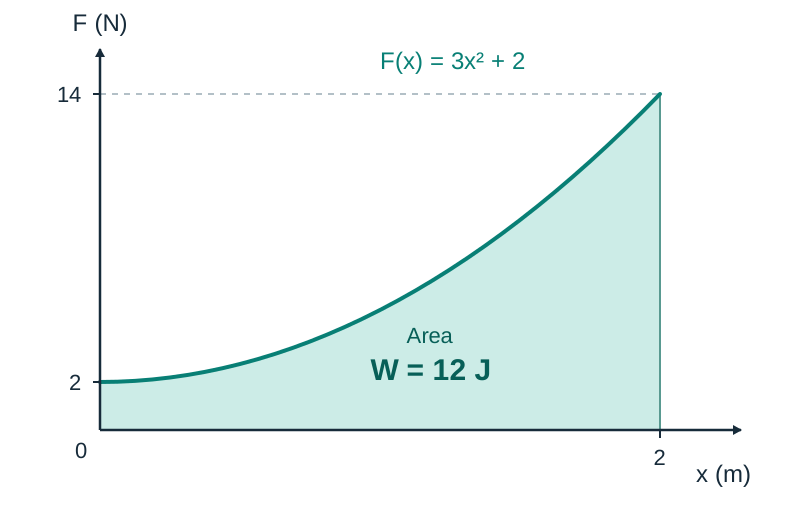
When a force changes with position , work cannot be computed by simple multiplication. Instead, integrate the force with respect to displacement:
This integral equals the area under the force–displacement graph between and . For instance, if a force acts on a particle moving along the -axis from to , the total work done is:
Height dropped on a string or circular arc
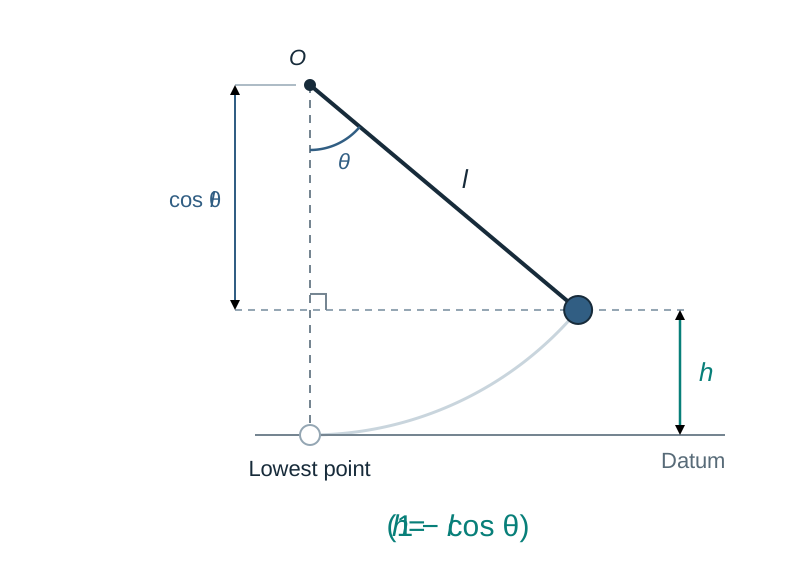
Many dynamic questions begin with a particle swinging on a light inextensible string or circular arc of radius . Measure heights from the lowest point of the circular arc. If the string makes an angle with the downward vertical, the vertical height above the lowest point is:
Two specific release cases arise regularly:
- String released from the horizontal (): .
- Inverted at the top of a vertical circle (): .
Because string tension acts perpendicular to the velocity at every instant, it does zero work. With no air resistance, energy conservation gives:
When a sphere hanging on a () string is released from the horizontal, , giving .
Kinetic Energy, Potential Energy, and Conservation
Kinetic energy is the energy possessed by an object due to its motion, defined as . Doubling the speed quadruples the kinetic energy.
The Work–Energy Principle states that the net work done by all acting forces equals the change in kinetic energy:
A force is a conservative force if the work it does in moving a particle between two points depends only on the starting and finishing positions, not on the path taken. Gravity and ideal elastic forces are conservative forces.
Gravitational potential energy (GPE)
In a uniform gravitational field , the gravitational potential energy of a particle of mass elevated to a height above a chosen horizontal datum line is:
Select a convenient horizontal datum (usually the lowest point of motion) and maintain it consistently throughout the calculation. For motion along a plane inclined at angle , travelling a distance up the slope yields a vertical gain .
Elastic potential energy (EPE)
An ideal spring or elastic string of natural length obeys Hooke's Law: , where is the extension. Examination papers present elastic properties in two equivalent ways:
- An elastic constant in (also called stiffness).
- A modulus of elasticity (in newtons) alongside natural length .
These are related by . Always determine first. The work done in stretching the spring from extension to extension stores elastic potential energy:
An elastic spring stores energy in both extension () and compression (). An elastic string, however, can only support tension. When an elastic string is compressed or shorter than its natural length (), it becomes slack, exerting zero tension and storing zero elastic energy.
Mechanical energy balance
When only conservative forces act, mechanical energy is conserved:
When non-conservative forces such as friction or resistance act over a distance , mechanical energy is dissipated into heat. Express this balance as:
where .
Power and Vehicle Dynamics
Power is the instantaneous rate of doing work or transferring energy, measured in watts (W), where and :
In vehicle dynamics, is the forward tractive driving force exerted by the engine, and is the instantaneous forward speed.
Steady speed and acceleration
Always set up the full equation of motion along the plane and then substitute the acceleration condition:
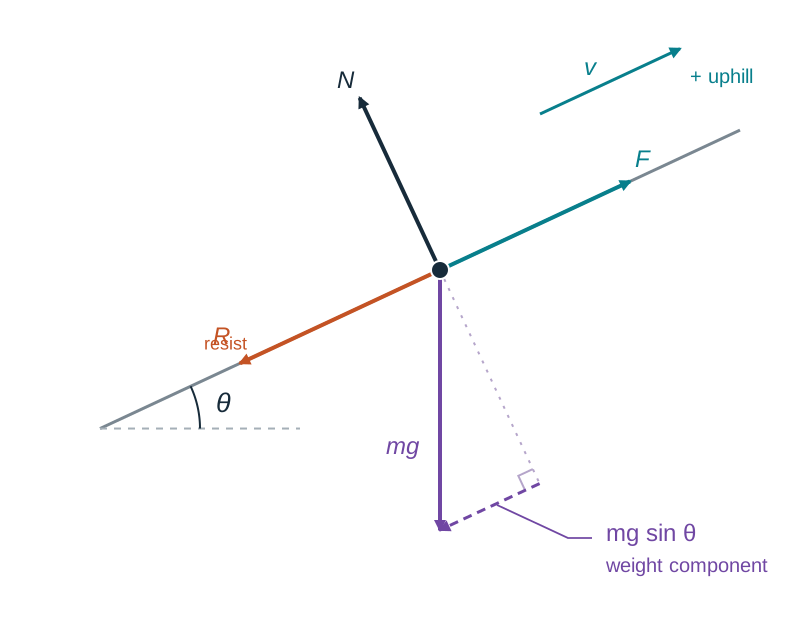
- At constant (or maximum) speed, acceleration is zero (), so Newton's second law becomes . The steady power output is:
- When accelerating, find the forward tractive force from , then substitute into the equation of motion to solve for acceleration .
Aerodynamic drag scaling
Fluid drag is modelled as . For vehicles moving at moderate to high speeds through air, aerodynamic drag is quadratic: . On level horizontal ground () at top speed, . Doubling the top speed against aerodynamic resistance alone therefore requires an eightfold () increase in engine power.
Impulse, Direct Collisions, and String Jerks
Linear momentum is a vector defined as , with units or . Impulse is the effect of a force acting for an interval of time. For a constant force, ; in general, it is the time integral of force. Whichever way you find it, the impulse on a body equals the change in its momentum:
By Newton's third law, colliding bodies exert equal and opposite impulses on one another. The magnitude of the impulse imparted to sphere B can be calculated directly as .
Direct collisions in one dimension
When two spheres collide along their line of motion with no external impulsive forces, the Principle of Conservation of Momentum (PCM) applies:
Pair PCM with Newton's Experimental Law (NEL):
where is the coefficient of restitution ().
To avoid sign errors in NEL, use this retention rule: relative approach speed is ; relative separation speed is . Restitution is defined as . Writing this as keeps sphere 1 first on both sides of the equation.
- When , the collision is perfectly elastic, and total kinetic energy is conserved across impact.
- When , the collision is inelastic, and kinetic energy is always lost across the impact. Use PCM and NEL across the collision itself; apply conservation of energy only to the stages before and after contact.
- When , the collision is completely inelastic; the two bodies coalesce and move together with a shared velocity .
Rebound from a fixed wall
If a particle hits a fixed smooth wall head-on (perpendicular to the wall), the wall does not move (). NEL simplifies to , giving . The particle rebounds along its line of approach with speed .
Subsequent collisions and velocity exchange
Immediately after a direct impact, NEL gives , meaning the leading sphere moves at least as fast as the trailing one. Two spheres cannot collide a second time unless an external boundary (such as a fixed wall) reflects one of them back.
To prove whether a second collision occurs:
- Find and using PCM and NEL.
- Apply the wall condition to the sphere striking the wall ().
- Establish whether the trailing sphere now closes the gap on the leading sphere: a second collision occurs if relative velocity brings them together.
Special result: if two identical spheres () collide directly with , solving PCM and NEL yields and . The spheres simply exchange velocities.
Jerk in an inextensible string
When a slack inextensible string connecting two particles suddenly becomes taut, an equal and opposite impulsive tension acts along the string on each particle:
- Components of velocity perpendicular to the string are unchanged.
- Along the string, the inextensible connection forces both particles to adopt the same final velocity component (equivalent to an impact along the line of the string).
- Momentum along the string is conserved: .
- The impulsive tension is in magnitude, and kinetic energy is dissipated during the jerk.
Oblique Collisions and Impacts with Walls
An oblique collision occurs when the velocities of colliding spheres are angled relative to the line connecting their centres at impact. Resolve velocities into two mutually perpendicular directions:
- -direction (line of centres): the axis passing through the centres of both spheres at the moment of contact.
- -direction (common tangent): the direction perpendicular to the line of centres, along the surfaces where the spheres touch.
Mark and clearly on your diagram before resolving velocity vectors.
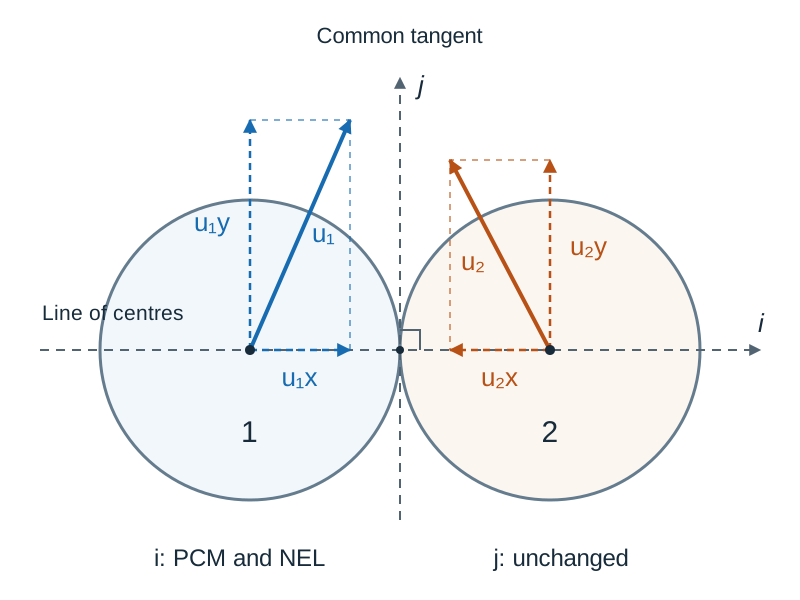
Fundamental rules for smooth spheres
- Tangential components (-direction): because the contacting surfaces are smooth, they cannot exert frictional impulses parallel to the common tangent. Each sphere's tangential velocity component remains unchanged:
- Normal components (-direction): contact forces act entirely along the line of centres. Apply PCM and NEL exclusively to the -components:
Finding speed, direction, and perpendicular motion
Once the post-collision velocity vector is determined:
- Speed is .
- Direction is given by , where is the angle made with the line of centres.
- If two spheres move perpendicularly to each other after impact, their velocity vectors have a dot product of zero:
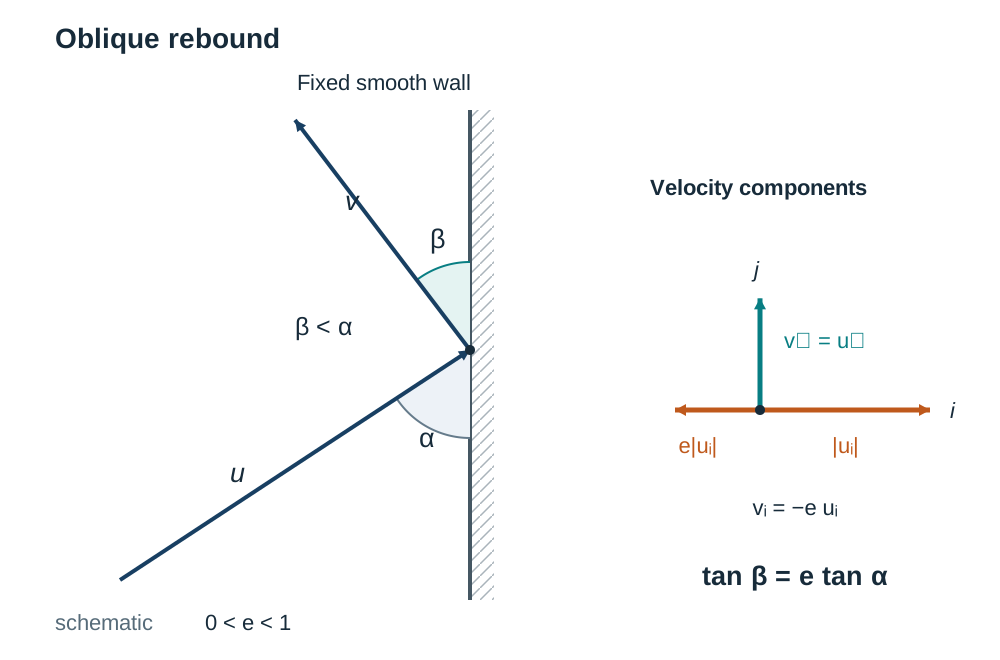
Oblique impact with a fixed smooth wall
When a sphere hits a fixed smooth wall:
- Parallel to the wall (): with no friction, the velocity component along the wall is unchanged ().
- Perpendicular to the wall (): the wall does not move, so NEL gives .
If the incoming path makes an angle with the wall and rebounds at an angle to the wall:
Because , , meaning the rebound trajectory flattens out closer to the wall.
Kinetic energy loss identity
Because tangential velocity components () are unaffected, tangential kinetic energy cancels when subtracting final from initial energy. Kinetic energy loss occurs exclusively along the line of centres:
Dimensional Analysis and Mathematical Modelling
Every dynamic relationship must be dimensionally homogeneous. Checking dimensions provides a robust safeguard against algebraic slips:
| Quantity | Fundamental Dimensions | Base SI Unit |
|---|---|---|
| Work / Energy () | (J) | |
| Power () | (W) | |
| Momentum / Impulse () | (or ) | |
| Elastic Constant () | (or ) |
Verifying equations by dimensions
- Velocity formula :
This matches the dimensions of velocity. The factor 2 is dimensionless.
- Stored energy :
This correctly matches the dimensions of work and kinetic energy.
Modelling vertical bounces
In Strand 1 mathematical modelling, simple collision laws are evaluated against physical tests. For a ball dropped from rest at height , impact speed is . Rebounding with speed gives a rebound height of:
A plot of against should be a straight line through the origin of slope . If empirical measurements curve downwards at larger drop heights, the assumption of a constant coefficient of restitution breaks down, requiring the model to be refined and iterated.
Key terms
- Work
- The measure of energy transfer that occurs when a force acts on an object over a displacement: W = F · s = |F||s|cos(θ).
- Kinetic Energy
- The mechanical energy possessed by an object due to its motion: KE = (1/2)mv².
- Gravitational Potential Energy
- The energy stored in an object due to its vertical elevation in a gravitational field: GPE = mgh relative to a specified datum.
- Elastic Potential Energy
- The energy stored in a stretched or compressed elastic body obeying Hooke's Law: EPE = (1/2)kx² or (λx²)/(2l).
- Conservative Force
- A force for which the work done in moving a particle between two points is completely independent of the path taken.
- Work–Energy Principle
- The principle stating that the net work done by all acting forces on a particle equals the change in its kinetic energy: W_net = ΔKE.
- Power
- The instantaneous rate of doing work or transferring energy: P = dW/dt = F · v.
- Impulse
- The time integral of an applied force, equal to the resulting change in linear momentum: I = ∫ F dt = Δp = mv - mu.
- Principle of Conservation of Momentum
- The principle stating that the total linear momentum of an isolated system remains constant when no external impulsive force acts.
- Newton's Experimental Law
- The empirical relationship governing impacts: separation speed equals the coefficient of restitution multiplied by approach speed along the line of centres: v₁ - v₂ = -e(u₁ - u₂).
- Coefficient of Restitution
- A dimensionless ratio e ∈ [0, 1] describing collision elasticity, defined as relative separation speed divided by relative approach speed along the line of centres.
- Line of Centres
- The normal axis passing through the centres of two colliding spheres at the point of contact, along which all normal collision impulses act.
- Common Tangent
- The direction perpendicular to the line of centres at the point of contact, along which smooth contacting surfaces exert zero impulse.
- Slack
- The physical state of a flexible string when the distance between its ends is less than or equal to its natural length, producing zero tension and zero stored energy.
- Perfectly Elastic
- A collision model where e = 1, meaning no mechanical kinetic energy is lost.
- Inelastic
- A collision model where 0 ≤ e < 1, resulting in a loss of mechanical kinetic energy dissipated as heat, sound, or deformation.
Check yourself
A 2 kg sphere moving at 5 m s⁻¹ collides directly with a 3 kg sphere moving at 1 m s⁻¹ in the same direction. The coefficient of restitution is e = 0.4. Find the velocity of each sphere after impact.
Let positive be the direction of motion. PCM: 2(5) + 3(1) = 2v₁ + 3v₂ ⇒ 2v₁ + 3v₂ = 13. NEL: v₁ - v₂ = -0.4(5 - 1) = -1.6 ⇒ v₁ = v₂ - 1.6. Substitute: 2(v₂ - 1.6) + 3v₂ = 13 ⇒ 5v₂ - 3.2 = 13 ⇒ 5v₂ = 16.2 ⇒ v₂ = 3.24 m s⁻¹. Then v₁ = 3.24 - 1.6 = 1.64 m s⁻¹. Both move in the original direction.
A particle on a light string of length 0.5 m is held with the string taut at 60° to the downward vertical and released from rest. What is its speed at the lowest point?
Height dropped is h = l(1 - cos 60°) = 0.5(1 - 0.5) = 0.25 m. By conservation of energy: (1/2)mv² = mgh ⇒ v = √(2gh) = √(2 × 9.8 × 0.25) = √4.9 ≈ 2.21 m s⁻¹.
A ball strikes a smooth vertical wall with speed 10 m s⁻¹ at an angle of 30° to the wall. The coefficient of restitution is e = 0.5. Find the speed and rebound angle.
Component parallel to wall is unchanged: u_j = 10 cos 30° = 8.66 m s⁻¹. Component into wall is u_i = 10 sin 30° = 5 m s⁻¹, so rebound component is v_i = eu_i = 0.5(5) = 2.5 m s⁻¹. Rebound speed is √(8.66² + 2.5²) = √(75 + 6.25) = √81.25 ≈ 9.01 m s⁻¹. Rebound angle satisfies tan β = e tan α = 0.5 tan 30° ≈ 0.2887 ⇒ β ≈ 16.1° to the wall.
A 3 kg body moving at 4 m s⁻¹ collides directly with a 2 kg body moving at 1 m s⁻¹ in the opposite direction. If they coalesce (e = 0), what is their common velocity and how much kinetic energy is lost?
PCM with 3 kg body's direction as positive: 3(4) + 2(-1) = (3 + 2)v ⇒ 10 = 5v ⇒ v = 2 m s⁻¹ in the original direction of the 3 kg body. Initial KE = (1/2)(3)(16) + (1/2)(2)(1) = 24 + 1 = 25 J. Final KE = (1/2)(5)(4) = 10 J. Loss in KE = 25 - 10 = 15 J.
A car cruises at a steady 20 m s⁻¹ on a horizontal road against an aerodynamic drag force modelled as R = 2.5v². What engine power is required?
At steady speed, a = 0, so driving force equals drag: F = R = 2.5(20)² = 1000 N. Power is P = Fv = (1000)(20) = 20,000 W = 20 kW.
Show using base SI units that the expression (1/2)kx² has the dimensions of work.
From Hooke's law k = F/x, so [k] = [Force]/[Length] = [M][L][T]⁻² / [L] = [M][T]⁻². The extension squared has dimensions [x²] = [L]². Therefore [kx²] = [M][T]⁻² × [L]² = [M][L]²[T]⁻², which matches [Work] = [Force] × [Displacement] = [M][L]²[T]⁻².