
Circular motion is the study of a particle moving along a circular path. Even at a constant speed, the particle continually changes direction, so it experiences an inward centripetal acceleration. At Leaving Certificate Higher Level, circular motion is examined in two core dynamical settings: horizontal circles, where vertical forces balance in equilibrium while horizontal components provide the inward acceleration, and vertical circles, where speed changes continuously with height, requiring the simultaneous application of conservation of mechanical energy and Newton's second law along the radial direction.
Kinematics, Angular Velocity, and Vector Calculus Derivation
A particle travelling along a circular path of radius has an instantaneous velocity vector directed along the tangent to the circle. Even if its speed remains constant, the continuous change in direction means the particle accelerates. This inward acceleration always points towards the centre of the circle and is termed the centripetal acceleration, .
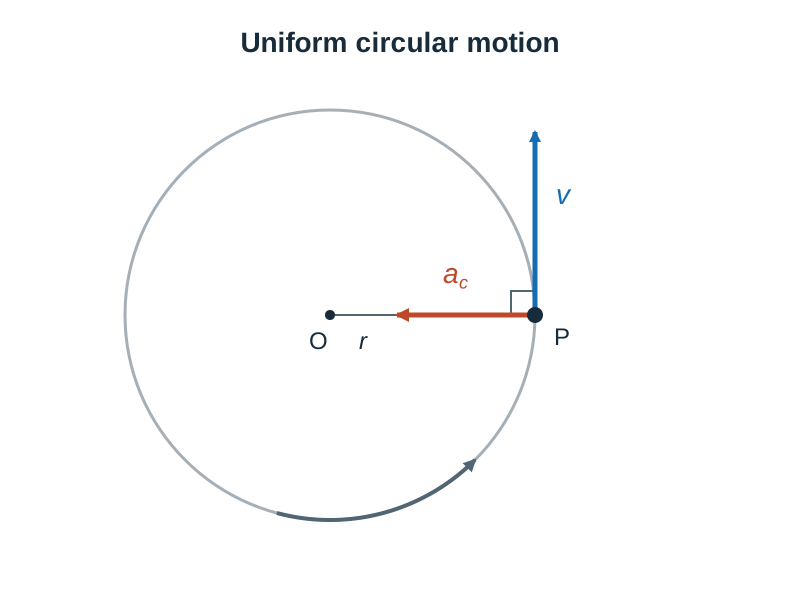
Angular velocity, , measures the rate at which the radius vector sweeps out an angle in radians per second (rad s). Since an arc length , differentiating with respect to time yields the relationship between linear speed and angular velocity:
The periodic time taken to complete one full revolution of radians is:
If rotation is specified as revolutions per minute (rev/min), convert to radians per second using .
Vector Calculus Derivation of Centripetal Acceleration
We can prove the formula for centripetal acceleration using elementary vector calculus. Set the origin at the centre of the circle. At any time , the position vector of a particle moving at constant angular speed is:
Differentiating with respect to time gives the velocity vector :
The magnitude of velocity is .
Differentiating a second time yields the acceleration vector :
The negative sign confirms that the acceleration vector points in the exact opposite direction to , directed straight inward towards the centre. Its magnitude is:
When the Speed is Not Constant
The derivation above assumes a constant angular speed . In a vertical circle the speed changes as the particle rises and falls, so the acceleration has two parts: a component towards the centre (because the direction of motion is turning) and a tangential component along the tangent (because the speed is changing). In examinations we resolve forces along the radius, so the tangential component does not appear and remains the exact radial equation. The changing speed is handled separately using conservation of energy.
Dynamics of Horizontal Circles, Conical Pendulums, and Bowls
Centripetal force is not an independent physical force; it is simply the net inward radial force provided by real forces such as tension, friction, gravity, or normal reaction. Applying Newton's second law along the inward radial line gives:
In horizontal circular motion, the particle remains at a constant vertical height. Because there is no vertical acceleration, forces in the vertical direction balance in static equilibrium, while horizontal components provide the inward acceleration:
Drawing and Labelling the Diagram
In SEC examinations, method marks are awarded for clear free-body diagrams:
- Draw the string or contact surface with tension or normal reaction clearly directed.
- Draw the weight acting vertically downwards from the particle.
- Mark the radius horizontally from the particle to the vertical axis of rotation.
- State your angle explicitly. If is the angle between the string and the vertical, the components are and . If is measured from the horizontal, the trigonometric ratios reverse ( and ). Never draw an extra arrow labelled 'centripetal force'.
The Conical Pendulum
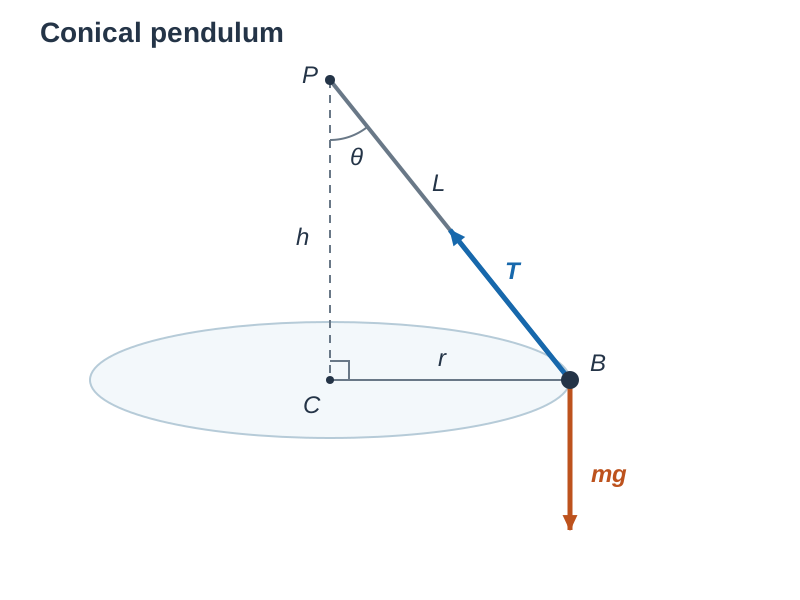
For a bob of mass on a string of length making angle with the vertical:
- Radius:
- Vertically:
- Radially:
Dividing the radial equation by the vertical equation eliminates both tension and mass :
If the vertical depth of the circle below the suspension point is , then substituting gives:
Inside a Smooth Hemispherical Bowl or Cone
A particle moving in a horizontal circle on the smooth inside surface of a hemispherical bowl of radius is supported by the normal reaction , which points along the radius of the bowl towards its centre . If the radius from to the particle makes an angle with the downward vertical:
- Radius of the circular path:
- Vertically:
- Radially:
Dividing gives . Since the depth of the circle below the centre is , we obtain the identical shortcut:
For any horizontal circle held by a single contact force pointing towards a fixed axis point, , where is the vertical depth below that point. The required angular speed does not depend on the mass of the particle.
Rotating Rides with Suspension Offsets
In amusement park rides such as a chairoplane, chains are hung from the rim of a rotating disc of radius rather than from a central point. If a chain of length hangs at angle to the vertical, the horizontal displacement from the pivot is . Adding the disc offset gives the total orbit radius:
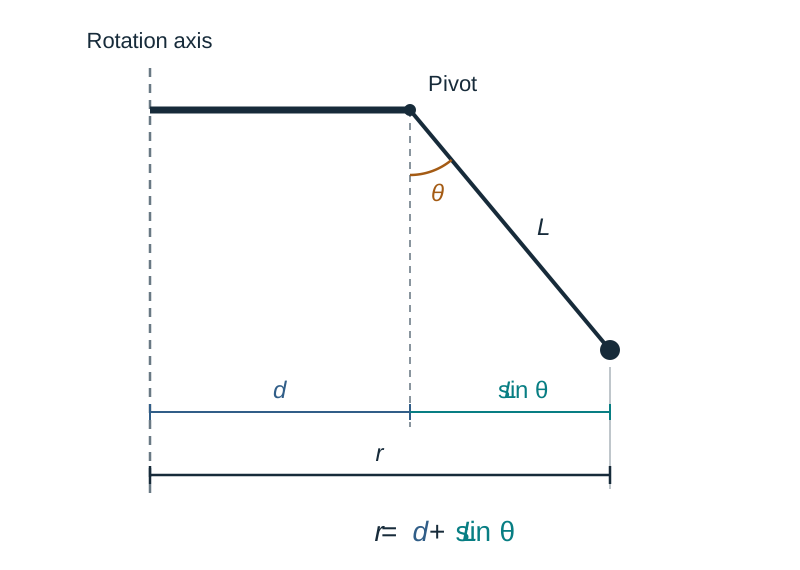
The resolved equations remain and , leading to:
Banked Tracks and Lateral Friction Limits
When a vehicle rounds a bend of radius , centripetal acceleration must be supplied horizontally.
Unbanked Level Bend
On a flat horizontal road, the normal reaction is . The only horizontal force available is sideways static friction directed towards the centre of the turn:
Because static friction has an upper limit , where is the coefficient of friction, the maximum safe cornering speed is:
Smooth Banked Track
To eliminate reliance on tyre friction, tracks and roads are banked at an angle to the horizontal. With zero friction, the normal reaction tilts inward:
Dividing the radial equation by the vertical equation gives the speed at which no friction is required (often referred to as the design speed):
Rough Banked Track with Friction
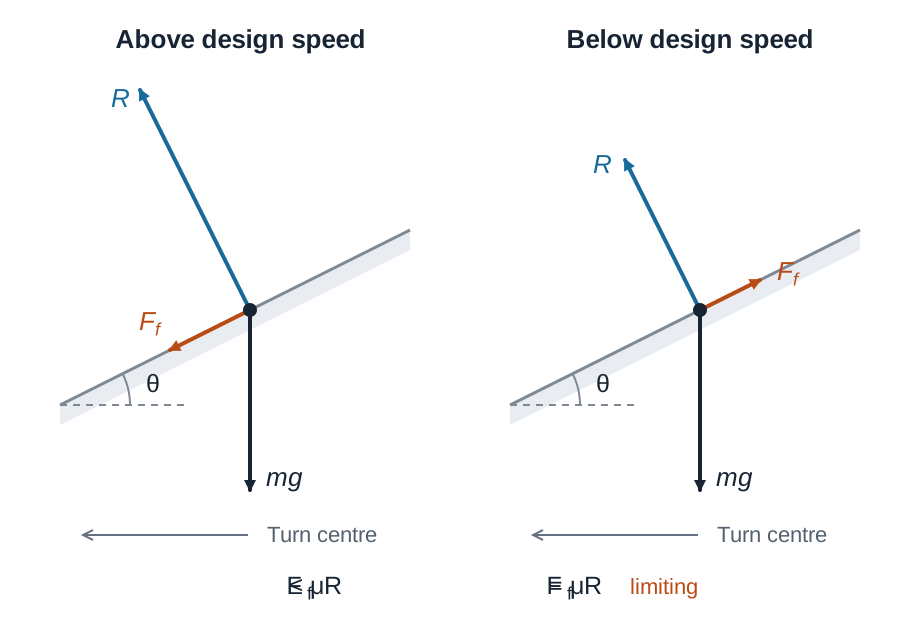
When a vehicle travels faster than the no-friction speed, it tends to slide up the banking, so limiting friction acts down the slope:
Dividing the equations eliminates and , giving the maximum speed before slipping outward:
When travelling below the no-friction speed, the vehicle tends to slip down the incline, so friction acts up the slope. Changing the sign of yields the minimum speed:
If , the numerator in the minimum speed formula becomes zero or negative. This means friction alone can hold the car on the slope even at rest, so no minimum speed exists.
Hooke's Law in Circular Motion
Hooke's law states that the tension in an elastic spring or string is proportional to its extension: , where is the natural length and is the elastic stiffness in N m.
When a particle of mass attached to an elastic string rotates on a smooth horizontal table, the extended string forms the radius of the circle: . The tension supplies the centripetal force:
Rearranging to isolate the orbit radius :
The stiffness must be greater than , otherwise the string cannot hold the particle in a circle at that rate of rotation. For example, if , , , and , then , yielding .
Dynamics of Vertical Circular Motion
In a vertical circle, gravity acts in the plane of motion, meaning the particle's speed changes continuously with height. The constant-acceleration formulae (, ) cannot be used here, because neither the size nor the direction of the acceleration is constant.
The Four-Step Solution Method
- State your datum level and angle convention clearly on your sketch.
- Apply conservation of mechanical energy from the launch point to the point of interest to express in terms of the angle.
- Formulate Newton's second law along the inward radius to express tension or normal reaction .
- Apply the required physical condition (, , or ) to solve for the unknown angle or speed.
Writing the Radial Equation: One Rule, Four Geometries
Add up all force components pointing towards the centre, subtract those pointing away from the centre, and set the resultant equal to :
| Situation | Radial equation (inward) | Contact or slack condition |
|---|---|---|
| Particle on a string, at angle to the downward vertical | String slacks when | |
| Inside a loop or bowl, at angle to the upward vertical (above centre) | Leaves track when | |
| Inside a concave track or valley, at angle to the downward vertical (below centre) | is greatest at bottom; cannot leave track here | |
| Outside a convex surface (sphere, hill crest), at angle to upward vertical | Leaves surface when () |
At the crest of a humpback bridge of radius (), , so wheels leave the road once . At the base of a valley, , so an occupant feels heavier than normal.
General Tension Formula for a String
Taking the lowest point as the reference datum (), the height at an angle from the downward vertical is :
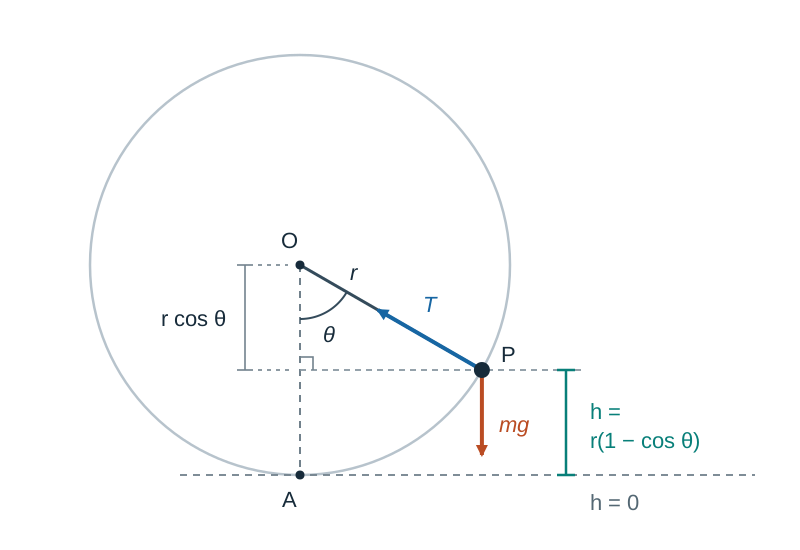
Substituting this into the radial equation :
Evaluating tension at the bottom (, ) and top (, ):
Subtracting gives the standard relationship:
$$
Projectile Motion After the String Goes Slack
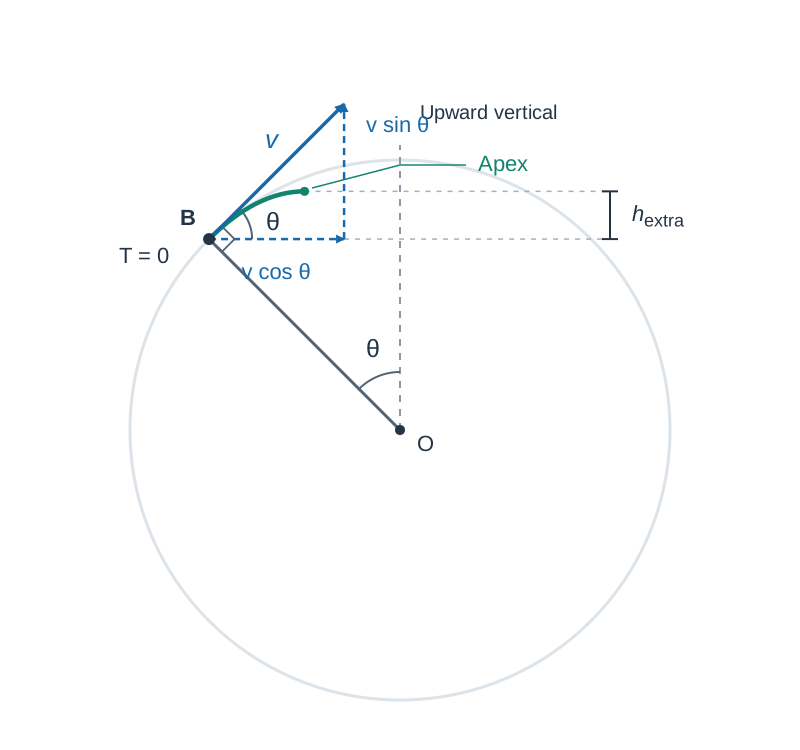
When , the particle leaves the circular path. Its velocity at that instant is tangential (perpendicular to the radius). If the radius makes an angle with the upward vertical, the tangent makes the same angle with the horizontal. The velocity components at departure are:
- Horizontal component:
- Vertical component (upward):
From that point onward, the particle moves as a free projectile under gravity. Its maximum additional height above the slack point is found using :
Critical Boundary Conditions: Loops, Rods, and Dimensional Checks
Depending on the launch speed at the lowest point, a particle on a string exhibits three distinct behaviours:
| Launch speed | Motion regime | What actually happens |
|---|---|---|
| Oscillation | Particle comes to rest () at or below the horizontal equator. The string stays taut () throughout; in the limiting case the particle comes to rest level with the centre, where momentarily and the particle swings back. | |
| Slack / departs circle | Tension vanishes () above the equator while speed . The particle enters parabolic projectile motion. | |
| Complete circle | The particle maintains tension right over the top () and completes full revolutions. |
Deriving the Full Loop Conditions
- Flexible String or Inside a Smooth Loop: At the summit, both tension (or normal reaction) and gravity act downwards:
By conservation of energy, , giving .
- Light Rigid Rod or Threaded Wire Ring: A rigid rod can support compression, and a bead threaded on a wire cannot leave the path. The particle keeps going as long as all the way round. Since , the particle just reaches the top when (arriving with zero speed) and completes the circle for .
Dimensional Analysis and Model Verification
You are expected to be able to check whether an answer is sensible by looking at its dimensions in terms of mass , length , and time :
- (acceleration)
- (force in newtons)
- (speed in m s)
In energy equations, check each term separately: every term must carry dimensions of energy, . Terms like , , and all balance. Cancelling across every term is mathematically correct; an error occurs only if one term lacks a factor present in the others.
Key terms
- Centripetal Acceleration
- The inward radial acceleration of a particle moving in a circular path, directed towards the centre of curvature, with magnitude v²/r or ω²r.
- Angular Velocity
- The rate of change of angular displacement with respect to time, measured in radians per second (rad s⁻¹), linked to linear speed by v = rω.
- Centripetal Force
- The resultant net inward force acting towards the centre of a circular path, equal to mv²/r or mrω²; supplied by real forces like tension, friction, or gravity.
- Conical Pendulum
- A particle suspended by a light string from a fixed point that sweeps out a horizontal circle while the string describes the surface of a cone.
- Banked Track
- A curved road or track inclined at an angle to the horizontal, allowing the horizontal component of the normal reaction to provide centripetal acceleration.
- Coefficient of Friction
- The dimensionless ratio μ between the maximum limiting static frictional force and the normal reaction force between two contacting surfaces.
- Conservation of Mechanical Energy
- The principle that the sum of kinetic energy and gravitational potential energy remains constant in a conservative system with no work done against dissipative forces.
- Slack Condition
- The physical state in vertical circular motion where string tension drops to zero (T = 0), causing the particle to leave the circular path and enter projectile motion.
- Hooke's Law
- The physical principle stating that the tension in an elastic spring or string is directly proportional to its extension beyond natural length: T = k(l - l₀).
- Dimensional Analysis
- The algebraic verification of physical equations by comparing the fundamental base units of mass [M], length [L], and time [T] across all terms.
Check yourself
A 0.2 kg ball on a string of length 0.8 m swings in a horizontal circle 0.5 m below the fixed suspension point. Find its angular velocity ω and the tension in the string. (Take g = 9.8 m s⁻²)
Using the shortcut ω² = g/h: ω² = 9.8 / 0.5 = 19.6, so ω = √19.6 ≈ 4.43 rad s⁻¹. For tension, cos θ = h/L = 0.5 / 0.8 = 5/8. Resolving vertically: T cos θ = mg gives T(5/8) = (0.2)(9.8) = 1.96 N, so T = 1.96 × (8/5) = 3.14 N.
A particle moves in a horizontal circle 0.45 m below the centre of a smooth hemispherical bowl. Find its angular velocity.
For a smooth bowl, the normal reaction points towards the centre, giving ω² = g/h. With h = 0.45 m: ω² = 9.8 / 0.45 ≈ 21.78, so ω ≈ 4.67 rad s⁻¹.
What is the difference between the tension at the bottom and the tension at the top for any particle completing a full vertical circle on a string?
T_bottom - T_top = 6mg. This difference is constant and independent of the initial projection speed.
A car negotiates an unbanked circular bend of radius 80 m on a flat road where μ = 0.5. Calculate the maximum safe speed without skidding. (Take g = 9.8 m s⁻²)
v_max = √(μgr) = √(0.5 × 9.8 × 80) = √392 ≈ 19.8 m s⁻¹.
Use dimensional analysis to test whether the expression v = √(5gr) is dimensionally consistent.
[√(5gr)] = ([g][r])^(1/2) = (LT⁻² · L)^(1/2) = (L²T⁻²)^(1/2) = LT⁻¹, which matches the dimensions of velocity [v].