
On this course, Hooke's Law is one of the standard models you are expected to use alongside Newton's Laws, and it is the main example of a force that varies with position but still stores energy (a variable conservative force). In Leaving Certificate Applied Mathematics, you will apply it to static equilibrium, free-body force diagrams on horizontal and inclined planes, conservation of energy, circular motion where tension supplies centripetal force, and differential equations of motion using .
Principles of Hooke's Law and Elastic Systems
Hooke's Law states that the tension or restoring force in an elastic material is directly proportional to its extension, provided it remains within its elastic limit.
Mathematically, the magnitude of the force is modelled as:
where:
- is the tension or restoring force in Newtons (N).
- is the elastic constant (stiffness factor) in . A higher means a stiffer elastic body.
- is the natural length (unstretched length) in metres (m).
- is the actual stretched or compressed length in metres (m).
- (or ) is the extension or compression: .
Some textbooks give the stiffness as a modulus of elasticity instead, with . The two are equivalent: if a question gives you and the natural length, work out first and then use .
When writing Newton's Second Law along the axis of extension, the direction of the restoring force opposes displacement: . Stating this minus sign reflects that the elastic force always pulls or pushes the particle back towards its unstretched position.
Springs versus Strings: The Slack Condition
A fundamental modelling decision in mechanics is choosing whether an elastic component can push as well as pull.
Light Elastic Springs
A light elastic spring can experience both tension when extended () and compressive thrust when shortened below natural length (). When compressed by an amount , it pushes outward on the particle with thrust .
Light Elastic Strings
A light elastic string can only support tension; it pulls when stretched (). The instant its length becomes less than or equal to its natural length (), the string becomes slack. A slack string exerts zero force (); it can never push.
In both cases, describing a component as light means its own mass is neglected (), so the tension is uniform throughout its length.
Once the string is back to its natural length it stops pulling altogether, and from that instant the particle is in free flight under gravity alone. The only force acting is the weight, so the particle has an acceleration of directed vertically downwards. Taking upwards as positive, ; it therefore decelerates on the way up, stops instantaneously, and falls back.
Free-Body Diagrams and Equations of Motion
Before writing down algebra, sketch the particle and mark every acting force with an arrow and a label:
- The weight , acting vertically downwards.
- The tension , pointing along the string away from the particle towards the fixed attachment point.
- For a compressed spring, the thrust , pushing the particle away from the fixed point.
- The normal reaction perpendicular to any supporting surface, and the friction force opposing the direction of slipping or motion.
Beside your diagram, list , , and extension . Always state your positive direction clearly. For instance, writing "Taking downwards as positive: " secures method marks before any values are inserted.
Elastic Systems on an Inclined Plane
On a plane inclined at angle to the horizontal, resolve forces parallel and perpendicular to the plane. The component of weight acting down the slope is , and the normal reaction is .
For a particle held in equilibrium on a smooth slope by an elastic string running up the incline:
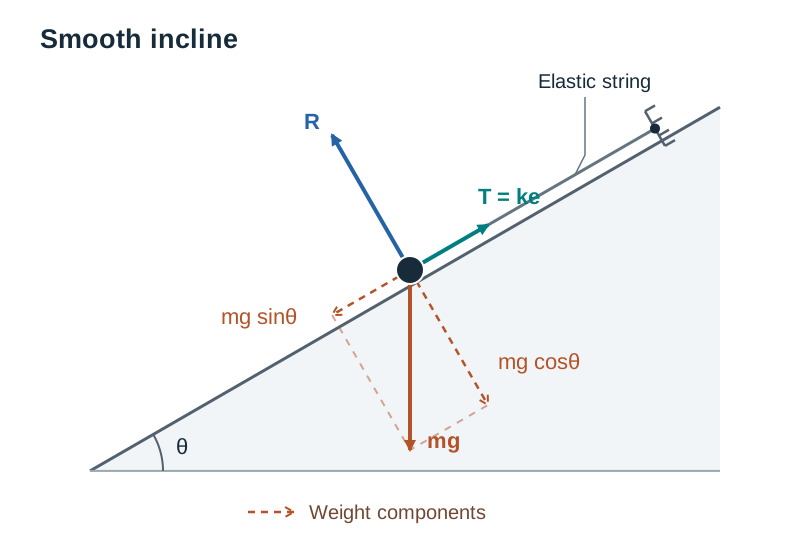
If the slope is rough with coefficient of friction , friction acts up or down the slope to oppose motion. Consequently, the string extension at equilibrium is not a single point but a range of values where lies between and .
Work Done and Elastic Potential Energy
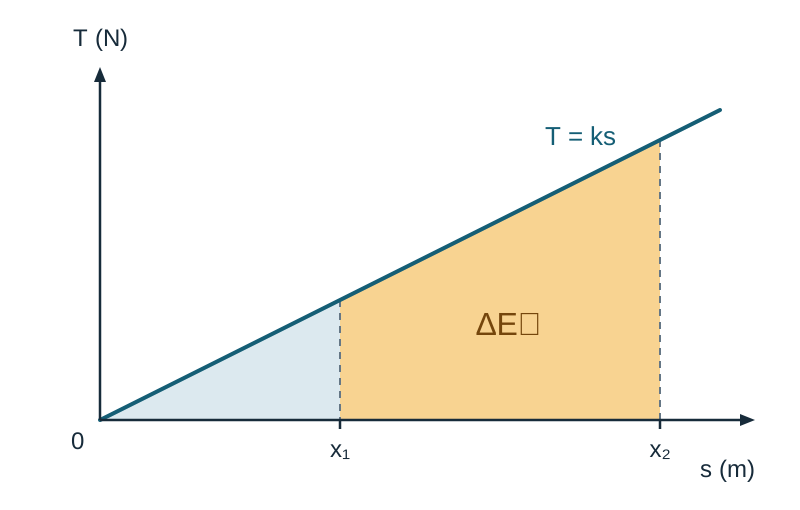
Because the restoring force varies linearly with extension, calculating the work done to stretch a spring from natural length () to an extension requires integration:
Geometrically, this represents the area of the triangular region under the linear tension-extension graph (base , height ).
Because the elastic restoring force is a conservative force, the work done against it is stored as elastic potential energy ():
When extending an already stretched spring from extension to , the change in stored energy is the difference between the two states:
Do not calculate this as . Because the force increases continuously, stretching from to takes three times as much work as stretching from to .
Conservation of Energy and Non-Conservative Work
When only conservative forces (gravity and elastic restoring forces) do work, total mechanical energy is conserved:
When a non-conservative force like friction is present, mechanical energy is converted into thermal energy. The work done by friction depends directly on distance travelled along the surface:
where .
Systematic Method for Vertical Elastic String Problems
- Find the equilibrium position extension by setting net force to zero: .
- Determine whether the string is taut () or slack () at each stage, using separate models for each regime.
- To find speed at any height, choose a gravitational datum () and apply energy conservation. Always measure elastic extension strictly from , regardless of datum placement.
- Remember that the lowest point is an instantaneous turning point (), not an equilibrium position; net upward force acts on the particle at this point.
Measuring Displacement from Equilibrium and Differential Equations
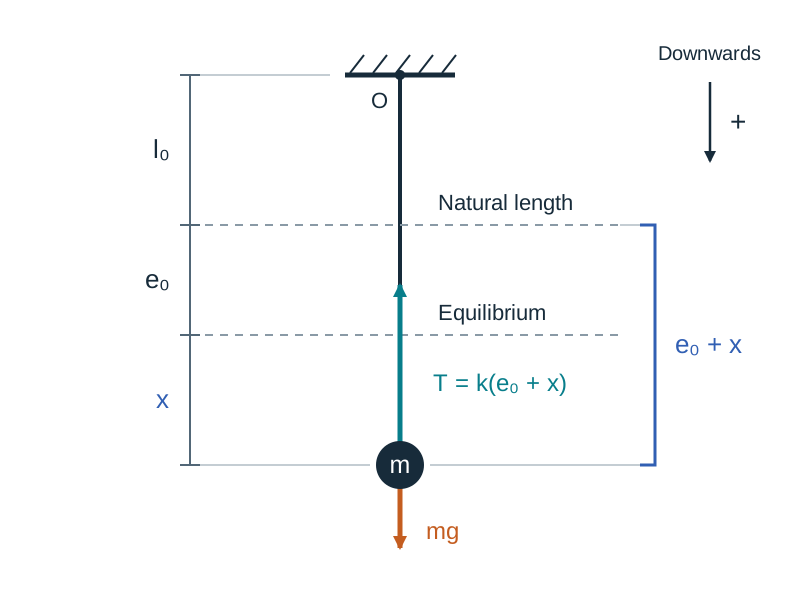
A particle of mass hangs at rest on an elastic string of stiffness . At equilibrium the extension is , where:
Pull the particle a further distance below this equilibrium position, so total extension is . Taking downwards as positive:
since . The weight cancels out completely. Measuring from the equilibrium position simplifies the equation of motion to , or . The minus sign shows that the net force always pulls the mass back towards equilibrium.
Finding Speed Using
Because the net force depends on position rather than time, replace acceleration with (reducing the second-order equation of motion to first order):
If the particle is released from rest at (where ), then , giving:
Maximum speed occurs at (the equilibrium position), where . Notice that integrating the equation of motion gives exactly the same equation as conservation of mechanical energy. If an exam question asks for a differential equation method, you can verify your final expression with an energy balance.
Hooke's Law in Circular Motion and Model Limitations
When a particle attached to a fixed peg by an elastic string or spring rotates in a horizontal circle on a smooth table, tension supplies the centripetal force directed toward the centre.
The radius of the circle is the stretched length of the string: , so the extension is .
Applying Newton's Second Law along the radial direction:
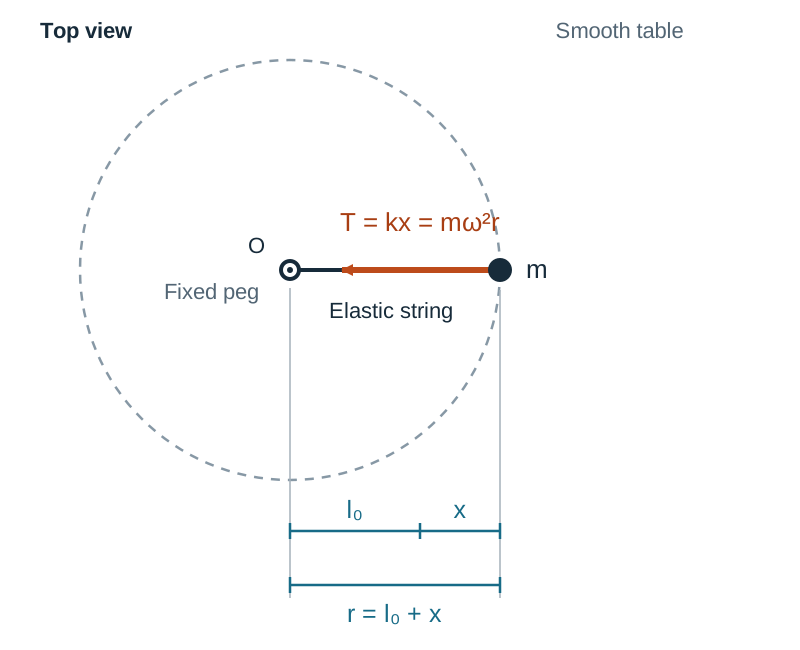
Rearranging to express the orbital radius in terms of angular speed :
This algebraic result illustrates model breakdown: as , the denominator approaches zero and the theoretical radius approaches infinity. If , the elastic restoring force cannot keep pace with the centripetal demand, and the circular motion model collapses.
Core Modelling Assumptions and Evaluation
Every elastic problem is built on simplifications that you may be asked to state and evaluate in written questions:
- Elastic limit: The linear relationship holds only within the elastic limit. Beyond this limit, deformation is permanent and the formula fails.
- Light string or spring: The mass of the elastic body is neglected, ensuring tension is uniform throughout.
- Particle model: The moving body is treated as a point mass, neglecting air resistance, rotational energy, and physical dimensions.
- Constant gravity: Acceleration due to gravity is taken as uniform ( vertically downwards).
Dimensional Analysis
Strand 3 requires using dimensional analysis to evaluate whether dynamic expressions are reasonable. Using fundamental dimensions of Mass (M), Length (L), and Time (T):
- Force:
- Stiffness constant : Since ,
- Elastic potential energy ():
This matches the dimensions of kinetic energy and work done .
Checking Dimensional Consistency
To check if the speed formula is dimensionally consistent:
Because is the dimension of speed, the expression is dimensionally consistent. Dimensional consistency does not prove the formula is right — it only rules out formulas that must be wrong.
Key terms
- Hooke's Law
- The principle stating that the restoring tension or thrust in an elastic body is directly proportional to its extension or compression, provided the elastic limit is not exceeded.
- Natural Length ()
- The unstretched length of an elastic string or spring when no external forces or loads act upon it.
- Extension ( or )
- The increase in length beyond the natural length when stretched: .
- Elastic Constant ()
- The stiffness factor of an elastic body, defined as the restoring force per unit extension and measured in Newtons per metre ().
- Elastic Potential Energy ()
- The potential energy stored in an elastic body as a result of its deformation, equal to .
- Slack
- The state when the length of an elastic string drops below or equals its natural length (), causing tension to drop instantly to zero.
- Thrust
- The outward pushing force exerted by an elastic spring when compressed below its natural length. Strings cannot exert thrust.
- Equilibrium Position
- The position at which the net resultant force on a particle is zero. For a vertically hanging mass, this occurs where upward tension balances downward weight ().
- Conservative Force
- A force for which the work done in moving a particle between two points is independent of the path taken, allowing potential energy to be defined.
Check yourself
A light spring of natural length 0.5 m has elastic constant k = 140 N m⁻¹. What thrust does it exert when compressed to 0.42 m?
Compression . Thrust .
A 1.5 kg particle hangs at rest from an elastic string with k = 49 N m⁻¹. What is its equilibrium extension? (Take g = 9.8 m s⁻²).
At equilibrium, upward tension balances weight: .
How much work is required to stretch a spring with k = 100 N m⁻¹ from an extension of 0.2 m to 0.4 m?
.
A particle hanging from an elastic string bounces upwards past the natural-length point. Describe its acceleration while above this point.
Once the string goes slack (), tension is zero. The particle moves solely under gravity, so it has a constant acceleration of directed vertically downwards (taking upwards as positive, , so it decelerates until it reaches its highest point).
A spring with k = 400 N m⁻¹ is compressed 0.1 m and released, projecting a 0.5 kg block along a rough horizontal floor with μ = 0.2. How far does the block travel in total before stopping? (Take g = 9.8 m s⁻²).
Energy stored in spring: . Normal reaction . Friction force . Work done against friction equates to initial energy: .
In horizontal circular motion with an elastic string, why does the model break down if ω ≥ √(k/m)?
Centripetal demand is . When , the restoring tension cannot match for any finite radius, so no steady circular orbit can exist.