
Collisions and impacts describe the brief, intense interactions that occur when particles strike one another or collide with a fixed barrier such as a floor, cushion, or wall. In Leaving Certificate Applied Mathematics, every collision problem is solved by pairing two core physical laws: the Principle of Conservation of Momentum (PCM) and Newton's Experimental Law of Restitution (NEL). In direct collisions, motion takes place along a single straight line. In oblique collisions between smooth spheres, velocities are resolved into components along the line of centres (where contact impulses act) and along the common tangent (where zero contact force acts, leaving tangential velocity components unchanged).
1. Momentum, Impulse, and Collision Modelling
A collision occurs over a brief time interval during which interacting bodies exert high mutual contact forces. Linear momentum is the vector quantity defined as the product of mass and velocity:
Momentum is measured in or newton-seconds (). The impulse () of a resultant force measures the overall effect of that force acting over time and equals the change in momentum:
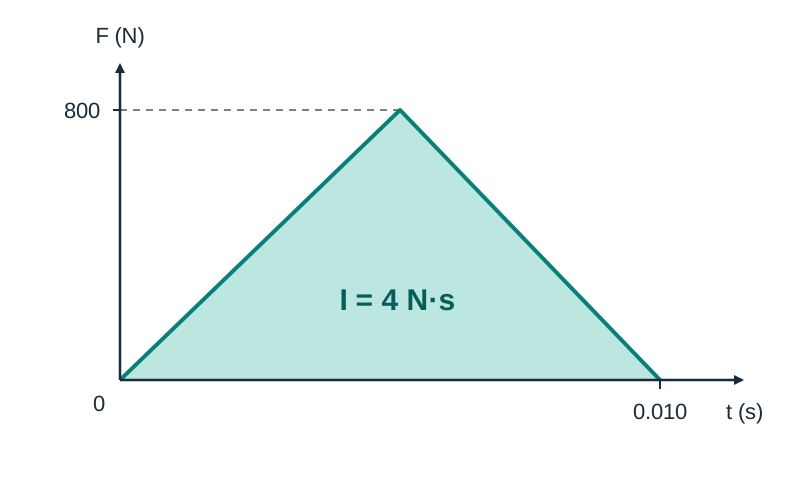
On a force–time graph, impulse equals the area under the curve. For example, a triangular force pulse lasting with a peak force of delivers an impulse of .
Modelling Assumptions
When modelling impacts in Strand 3, we make several standard assumptions:
- We model the bodies as smooth spheres whose whole mass acts at the centre. Because they are smooth there is no friction at the point of contact, so the contact force acts along the line joining their centres, and we ignore any spin.
- The impact occurs over such a short duration that displacements during contact are negligible, and external impulses from forces such as gravity or friction are negligible compared with the normal contact impulse.
- By Newton's third law, the contact force exerted by sphere A on sphere B is equal in magnitude and opposite in direction to that exerted by B on A. Internal impulses sum to zero: .
Commenting on the Model
If asked to evaluate the mathematical model in an authentic context (such as snooker balls or vehicle impacts), state the main simplifications: real objects deform, air resistance and surface friction operate, and impact duration is non-zero. For example, a snooker ball develops topspin or backspin through cloth friction, so post-collision angles will deviate slightly from the ideal frictionless model.
2. The Principle of Conservation of Momentum (PCM)
Because internal contact impulses are equal and opposite, the total linear momentum of an isolated system remains constant in any direction free from external impulses. This is the Principle of Conservation of Momentum:
For two free spheres colliding on a smooth horizontal table, momentum is conserved in all planar directions. However, momentum is not conserved for a single particle colliding with a fixed barrier (such as a floor or wall). The barrier provides an external impulse to the particle, so PCM cannot be applied to the particle alone.
Completely Inelastic Collisions
In a completely inelastic collision (), colliding particles coalesce or move with a common normal velocity after impact. For two particles moving along a straight line that coalesce upon impact:
For example, a trolley travelling at that collides with and couples to a stationary trolley moves forward at .
3. Newton's Experimental Law (NEL) and Restitution
Conservation of momentum gives only one equation for the two unknown post-collision velocities. Newton's Experimental Law of Restitution supplies the second equation. It states that the relative speed of separation along the line of impact equals times the relative speed of approach:
Using signed velocities along the line of impact, NEL is written as:
The coefficient of restitution is a dimensionless scalar governed by the physical materials, satisfying :
| Value of | Collision Type | Kinetic Energy | Physical Description |
|---|---|---|---|
| Perfectly elastic | Conserved (zero loss) | Relative separation speed equals relative approach speed. | |
| Inelastic | Partially dissipated | Separation speed is less than approach speed; energy is lost to heat, sound, and deformation. | |
| Completely inelastic | Maximum loss | Separation speed along the normal is zero; particles coalesce or share normal velocity. |
Kinetic energy can never increase in a collision. The best case is that it stays the same, and that only happens when .
4. Direct Collisions: Step-by-Step Method and Inequalities
In a direct collision, all motion occurs along the line of centres. Always draw a clear diagram showing before and after states with labelled arrows, declare a positive direction, and set up a Before-Mass-After table:
| Sphere | Mass | Velocity Before () | Velocity After () |
|---|---|---|---|
| A | |||
| B |
Keep and as signed velocities throughout, so the approach speed is always . If B moves left while positive is to the right, enter B's velocity as , giving an approach speed of .
Set up and solve the two governing simultaneous equations:
- PCM:
- NEL:
Presentation of Answers
Examination questions usually ask for the speed of each sphere. If an algebraic velocity expression evaluates to a negative quantity, state the final speed as a positive magnitude together with its direction (for example, 'sphere A reverses direction and moves with speed ').
Sanity-Check Tool for Collisions with a Stationary Target
When mass at speed strikes mass at rest:
Notice that sphere 1 is brought to rest () exactly when . Use this relationship to check your working.
Direction Reversal and Subsequent Collision Conditions
- Direction Reversal: A sphere moving in the positive direction reverses its motion if and only if .
- Trailing-Sphere Test: Two spheres that have just collided can never collide again on their own, because NEL forces the rear sphere's velocity to be less than or equal to the front sphere's velocity (). A subsequent collision requires an external intervention, such as a barrier or a third sphere.
- Three Spheres in a Line: If A and B collide, and B moves towards a third sphere C moving with velocity , B catches C if and only if . If B rebounds from C with new velocity , B collides with A again only if overtakes ( in the shared direction of travel). Always intersect any derived bounds on with .
5. Impulse and Kinetic Energy Loss in Direct Collisions
Impulse in a Two-Sphere Collision
The impulse imparted to one sphere is that sphere's own change in momentum along the line of centres:
By Newton's third law, the impulse exerted on B by A is equal and opposite to that exerted on A by B (). Calculate the impulse using whichever sphere has simpler algebra, then report its magnitude and direction.
Because expressions for impulse contain the factor , substituting the physical limits and establishes minimum and maximum bounds on the impulse.
Kinetic Energy Lost in a Direct Collision
The loss of kinetic energy is:
Because speeds are squared, directional signs do not affect the kinetic energy evaluation. However, you must substitute the algebraic velocities determined by PCM and NEL. The resulting expression regularly simplifies to the standard form:
The factor confirms that kinetic energy loss is zero when (perfectly elastic) and reaches its maximum when .
Energy-Transfer Problems
When a problem states that 'a given percentage of the kinetic energy lost by A is transferred to B', formulate the energy relationship as an independent equation:
Combine this energy equation with PCM to find the unknown speeds before applying NEL to find .
6. Oblique Collisions Between Smooth Spheres
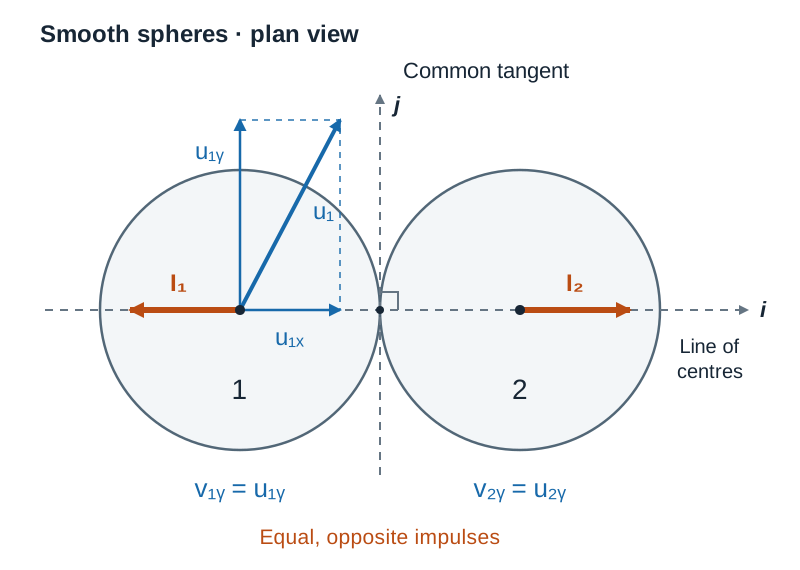
In an oblique collision between two smooth spheres, each velocity is split into two perpendicular parts: one along the line joining their centres at the moment of impact (the line of centres, chosen as the -axis), and one along the common tangent plane at right angles to it (the -axis).
Always write this core justification in your exam answer: Since the spheres are smooth, there is no force along the common tangent, so the -components of velocity are unchanged.
The Four-Relationship Framework
- Tangential velocity of sphere 1 is unaltered:
- Tangential velocity of sphere 2 is unaltered:
- PCM along the line of centres (-axis):
- NEL along the line of centres (-axis):
Once and are found, reassemble the vectors: and .
Geometric Conditions and Deflection
- Perpendicular Paths: Two final velocity vectors are perpendicular if their scalar dot product is zero: . Alternatively, their direction slopes satisfy where . The dot product is safer because it remains valid if a sphere moves purely along a coordinate axis.
- Deflection Angle: The angle through which an individual sphere is deflected is found from , or by comparing trajectory angles before and after impact: , where and .
Kinetic Energy Loss in Oblique Collisions
Because tangential components are unchanged, they subtract to zero when calculating the absolute energy lost:
However, when computing the fraction or percentage of kinetic energy lost, the denominator must include the entire initial kinetic energy of the system across both and components:
7. Impacts with a Fixed Plane: Floors, Walls, and Bouncing
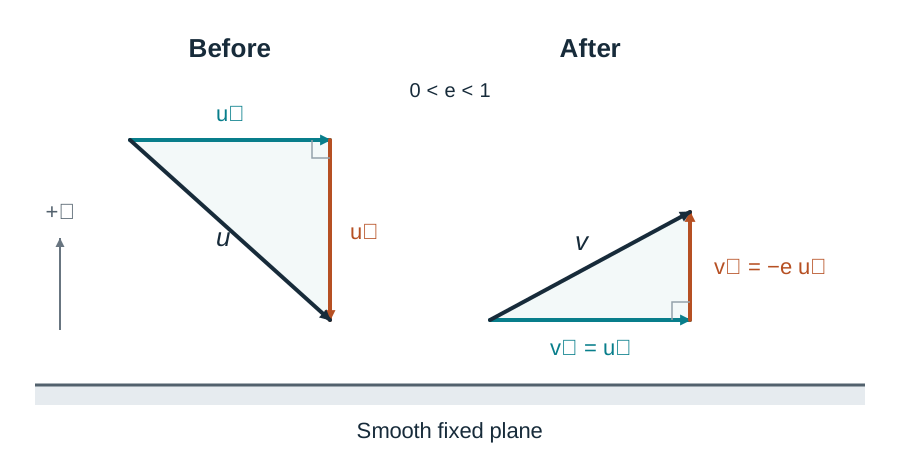
When a smooth particle collides with a fixed surface, set up coordinate axes parallel and perpendicular to the surface. Because the barrier is fixed and smooth:
- Velocity parallel to the plane is unchanged:
- Velocity perpendicular to the plane reverses and scales by :
Impulse on the Plane
The velocity change is entirely perpendicular to the surface: . The magnitude of the impulse on the particle is:
By Newton's third law, the particle delivers an equal and opposite impulse of magnitude directly into the plane.
Successive Vertical Bounces as a Geometric Sequence
A particle dropped vertically from height strikes a horizontal floor with impact speed .
- Rebound speed after bounce :
- Height reached after bounce :
- Time of flight between bounce and :
For , the total vertical distance travelled before the ball comes to rest forms an infinite geometric series:
Successive Hops Down an Inclined Plane
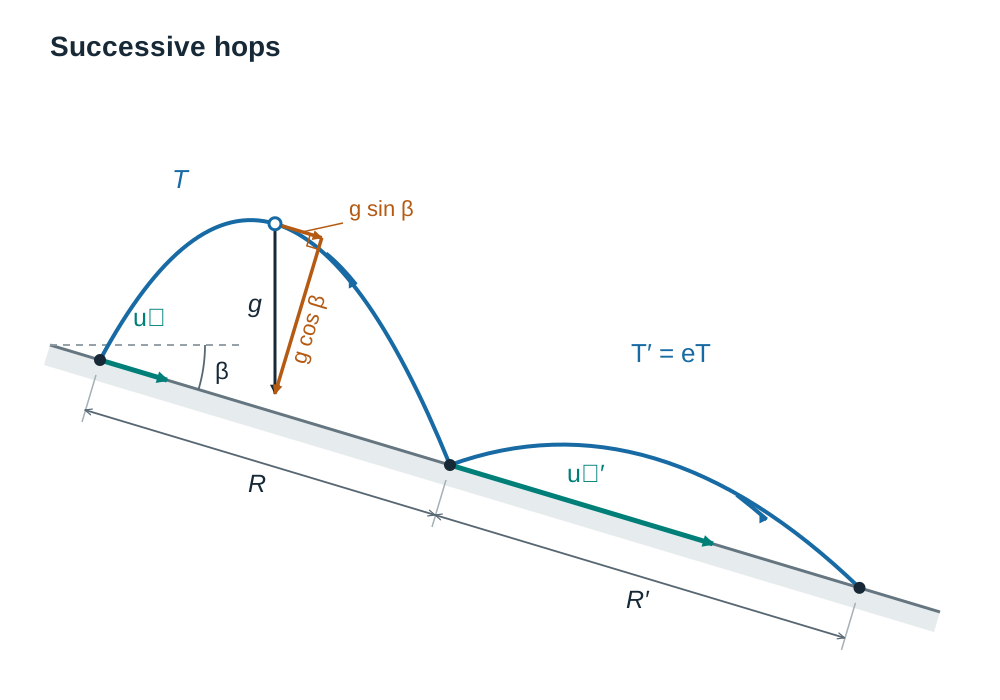
For a particle hopping down a plane inclined at angle , resolve gravity into down the plane and into the plane. For each hop:
- Time of flight:
- Range along the plane:
The impact itself leaves u∥ unchanged and multiplies u⊥ by e, so the next time of flight is T′ = eT. But during a hop gravity's component g sin β along the plane speeds the particle up, so the parallel velocity entering the next hop is u∥′ = u∥ + (g sin β)T, not u∥. Recompute the next range from R′ = u∥′T′ + ½(g sin β)T′² using these new values — the range does not simply scale by e or e², which is why questions ask you to find the ratio k rather than quoting it.
Key terms
- Linear Momentum
- The vector quantity p = mv, measuring the quantity of motion of a body in kg m s⁻¹ or N s.
- Impulse
- The time integral of resultant force, equivalent to the change in momentum (I = Δp = mv - mu) imparted to a body during a collision.
- Principle of Conservation of Momentum (PCM)
- The fundamental law stating that the total linear momentum of an isolated system remains constant along any direction free from external impulses.
- Newton's Experimental Law (NEL)
- The empirical collision law stating that relative speed of separation along the line of centres equals e times the relative speed of approach: v₁ - v₂ = -e(u₁ - u₂).
- Coefficient of Restitution (e)
- A dimensionless measure of elasticity (0 ≤ e ≤ 1) governing the ratio of separation speed to approach speed along the line of impact.
- Line of Centres
- The normal axis passing through the geometric centres of two colliding spheres at the point of contact, along which all contact impulses act.
- Common Tangent
- The interface direction perpendicular to the line of centres at the point of impact, along which smooth bodies exert zero contact force.
- Direct Collision
- An impact where particle velocities lie entirely along the line of centres before and after the collision.
- Oblique Collision
- An impact where initial velocities are inclined at an angle to the line of centres, requiring resolution into normal and tangential components.
- Perfectly Elastic
- An ideal collision with e = 1 in which no kinetic energy is lost.
- Completely Inelastic
- A collision with e = 0 where colliding bodies have zero relative separation velocity along the line of impact, dissipating maximum kinetic energy.
- Deflection Angle
- The angle through which a particle's trajectory turns as a result of an impact, calculated using the scalar dot product cos θ = (u · v) / (|u||v|).
Check yourself
Sphere A of mass 3m moving with speed 2u collides directly with sphere B of mass m at rest. If e = 1/2, what is the magnitude of the impulse imparted to B?
Apply PCM: 3m(2u) + 0 = 3mv_A + mv_B => 6u = 3v_A + v_B. Apply NEL: v_A - v_B = -(1/2)(2u) = -u. Adding the two equations gives 4v_A = 5u, so v_A = 5u/4 and v_B = v_A + u = 9u/4. The impulse on B is I = m(v_B - 0) = 9mu/4 N s in A's initial direction.
Two spheres have just collided directly. Explain why they cannot collide with each other again unless another body or barrier intervenes.
By NEL, v_rear - v_front = -e(u_rear - u_front) ≤ 0 for any physical e ≥ 0, which means v_rear ≤ v_front. The rear sphere is never moving faster than the front sphere after impact, so it can never catch up on its own.
A particle strikes a smooth fixed floor with velocity 4i - 6j m s⁻¹, where j is vertically upwards. If e = 2/3, what is its rebound velocity?
The component parallel to the floor is unchanged (4i). The perpendicular component reverses and scales by e: -(-6)(2/3)j = +4j. The rebound velocity is 4i + 4j m s⁻¹.
A ball dropped vertically from height h onto a horizontal floor rebounds to height h'. How is the coefficient of restitution e related to h and h'?
The impact speed is u = √(2gh) and the rebound speed is v = eu = √(2gh'). Squaring gives 2gh' = e²(2gh), which simplifies to h' = e²h, meaning e = √(h'/h).
Two spheres collide obliquely. After impact, their velocities are v_A = -2i + 3j and v_B = 6i + 4j. Are their post-collision trajectories perpendicular?
Calculate their scalar dot product: v_A · v_B = (-2)(6) + (3)(4) = -12 + 12 = 0. Because their dot product is zero, their paths are perpendicular.