
In this topic you will learn to write any quantity that has a direction as a pair of components along two fixed perpendicular directions, to add, scale, and multiply such quantities, to differentiate and integrate them to move between displacement, velocity, and acceleration, and to use them to analyse forces, projectiles, and collisions. Under Strand 3 of Leaving Certificate Applied Mathematics, vectors provide the fundamental language for modelling mechanics in two dimensions, from inclined planes to oblique collisions.
Scalars, Vectors, and Cartesian Representation
A scalar is a quantity defined entirely by its magnitude, which is its numerical size together with an appropriate unit. Common examples include mass (), time (), and speed (). A vector has both a size (magnitude) and a direction; you have not described it fully until you have given both. Displacement, velocity, acceleration, and force are the four primary vectors in mechanics.
To analyse motion systematically in two dimensions, we set up two fixed perpendicular axes and define two orthogonal unit vectors, each having a length of exactly 1 unit:
- points horizontally to the right (typically East).
- points vertically upwards (typically North).
Any two-dimensional vector can be written uniquely in terms of its scalar components:
The magnitude of , written or , represents its physical length or speed and is calculated using Pythagoras' theorem:
A unit vector in the direction of any non-zero vector is denoted and is found by dividing the vector by its magnitude:
The position vector specifies the location of a point relative to a fixed origin . The displacement vector from to depends only on the endpoints:
Polar Form, Bearings, and Resolving Vectors
In polar form, a vector is specified by its magnitude and an inclination angle relative to a reference axis. When is measured anticlockwise from the positive -axis, the components are:
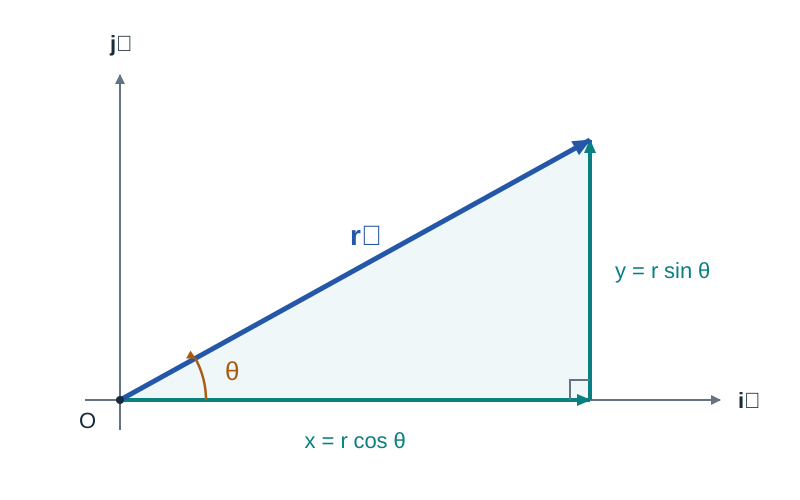
If an angle is measured from the vertical axis or given as a navigation bearing, the sine and cosine swap roles. Always sketch a right-angled triangle so that the component adjacent to the angle gets the cosine and the opposite component gets the sine.
Converting Bearings and Components
For example, express a velocity of on a bearing of in Cartesian components. Because the angle is measured from North (the positive -axis) towards East (the positive -axis), the horizontal component is opposite the angle:
To convert a vector such as back to polar form, first find the magnitude:
Then find the acute reference angle . Because and , the vector lies in the second quadrant, giving from the positive -axis, which corresponds to a bearing of .
Resolving Along a Given Direction
The scalar component of any vector in the direction of a unit vector is simply . For example, the component of along the direction is found by multiplying by the unit vector :
Vector Algebra and Relative Velocity
Vector operations in component form are calculated independently along each axis.
Addition, Subtraction, and Scaling
To add or subtract vectors, combine corresponding components:
Multiplying a vector by a scalar multiplies each component:
The resultant is the vector sum of two or more individual vectors, such as the total force acting on a body.
Relative Velocity
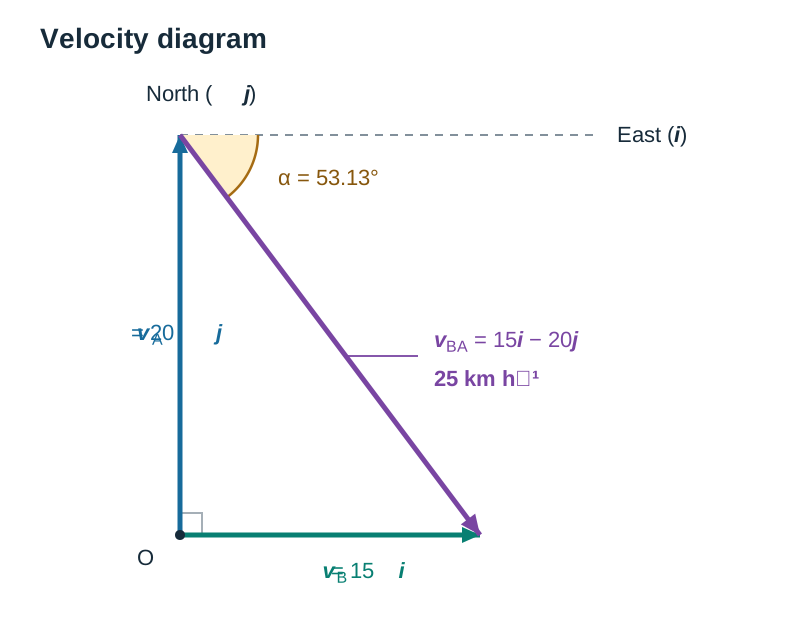
The velocity of object relative to object is what appears to be doing to an observer who is moving with :
Rearranging gives the relation frequently used for wind or water currents: the true velocity equals the relative velocity plus the velocity of the carrier:
For example, suppose Ship sails North at and Ship sails East at . Taking East and North:
The relative speed is . The direction has , giving South of East (or ).
The Scalar (Dot) Product, Angles, and Work
The dot product (or scalar product) is a way of multiplying two vectors that produces a single real number, never a vector:
where is the angle between the vectors when placed tail-to-tail ().
Because and are perpendicular unit vectors:
Finding the Angle Between Two Vectors
Rearranging the dot product formula gives the angle between two vectors:
- If , the angle is acute ().
- If , the angle is obtuse ().
- If for non-zero vectors, the vectors are perpendicular (orthogonal) ().
For example, after a collision, sphere has velocity and sphere has velocity . The angle between their paths is found directly:
Work Done by a Constant Force
When a constant force in newtons () acts through a displacement in metres (), the work done is the scalar product:
Work is measured in joules (). Any force acting perpendicular to the displacement does zero work.
Vector Calculus and Constant-Acceleration Kinematics
Because and never change direction or length, you can differentiate or integrate the -part and the -part completely separately and then put the answer back together.
Rates of Change and Integration
For a position vector :
Speed is the scalar magnitude of velocity: . When integrating acceleration to recover velocity or position, add an independent constant of integration to each component:
Constant Acceleration and Projectile Motion
When acceleration is constant, you do not need to integrate from scratch. The familiar kinematic equations hold directly in vector form:
Here is the initial velocity vector, is the constant acceleration vector, and is the displacement vector from the release point.
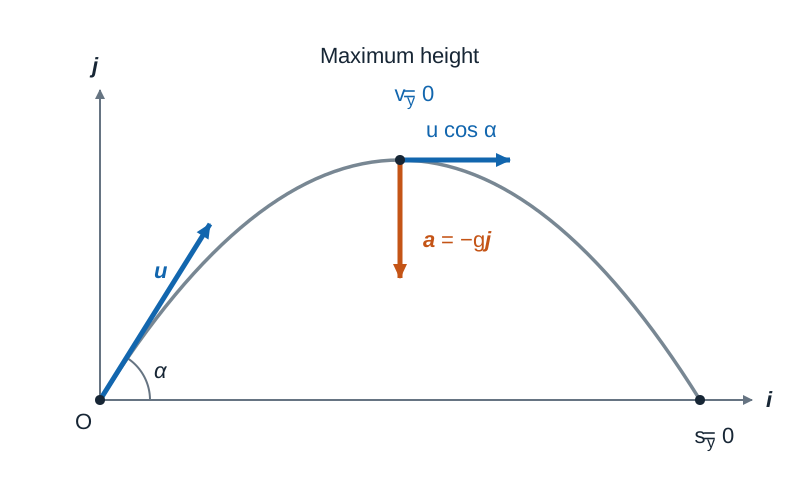
For a projectile launched from the origin with speed at an angle to the horizontal:
Substituting these vectors into the kinematic formulae gives the motion at any time :
The projectile reaches its maximum height when the vertical velocity component is zero (), and returns to ground level when the vertical displacement is zero ().
Dynamics and Resolving Forces on Inclined Planes
Newton's Second Law applies directly in vector form: . Equating components gives two independent scalar equations: and .
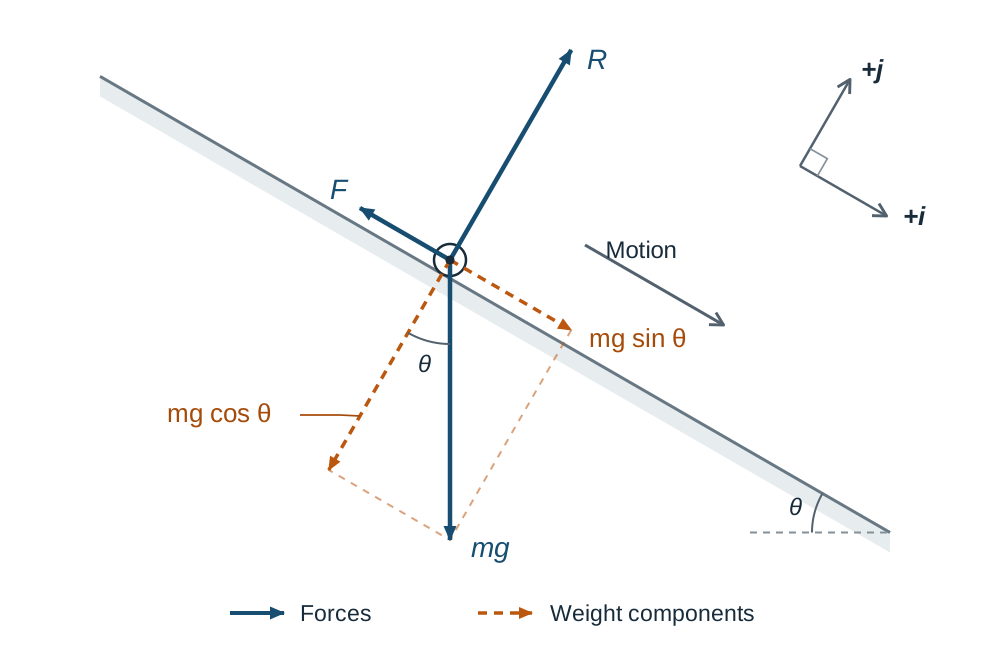
On an inclined plane tilted at an angle to the horizontal, resolving forces horizontally and vertically creates unnecessary trigonometry. Instead, align your axes with the slope:
- Choose parallel to the plane (pointing down or up the slope).
- Choose perpendicular to the plane, pointing outwards.
With this coordinate choice, only the weight of the particle requires resolution:
- The component of weight acting down the slope is .
- The component of weight acting into the slope is .
The normal reaction acts in the positive -direction. Because there is no motion perpendicular to the plane, acceleration in the -direction is zero:
Friction acts along the plane, directly opposing the direction of motion. On a rough surface with coefficient of friction , the limiting frictional force is . On a smooth plane, and friction vanishes.
Applying Newton's Second Law down the plane gives:
Oblique Collisions and Impacts
In two dimensions, collisions between smooth spherical particles or impacts with fixed barriers are solved by breaking the motion into two distinct directions.
The Standard Method for Oblique Collisions
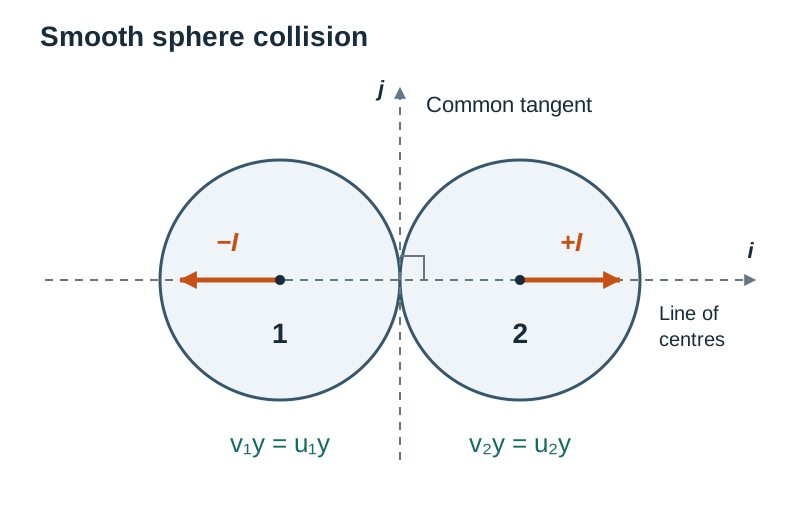
- Set the -axis along the line of centres connecting the spheres at the instant of impact.
- Set the -axis along the common tangent — that is, perpendicular to the line of centres, along the contacting surfaces.
- Because the spheres are smooth, no frictional force can act parallel to the tangent. Therefore, the -components of velocity are completely unchanged for both spheres:
- Along the line of centres (the -axis), apply the Principle of Conservation of Momentum:
- Along the line of centres, apply Newton's Experimental Law using the coefficient of restitution (where ):
- Solve these two equations simultaneously for and , then write the full velocity vectors.
Impulse and Impact with Fixed Surfaces
The impulse received by a body is its vector change in momentum: . For smooth collisions, impulse acts exclusively along the line of centres (the -direction).
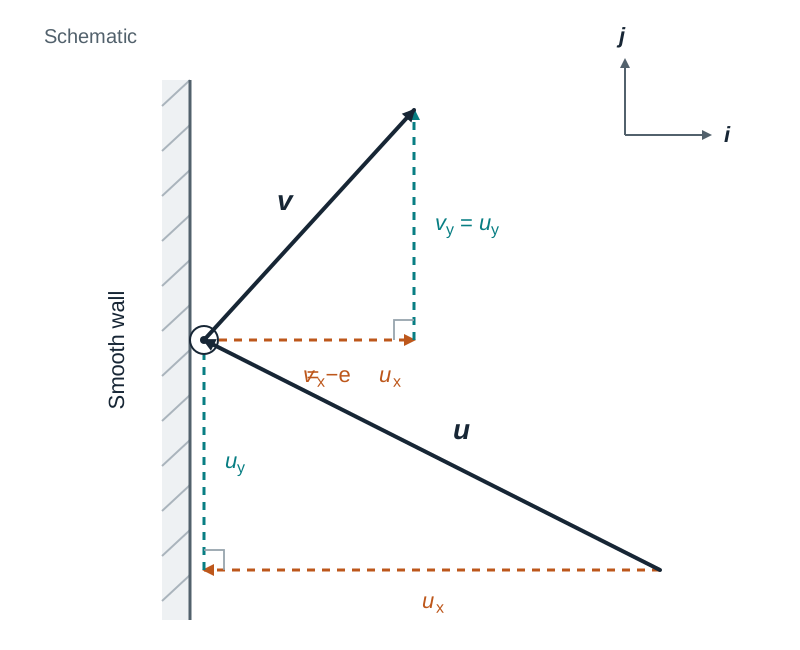
When a smooth particle strikes a fixed smooth plane or wall, take perpendicular to the wall (along the normal) and parallel to the wall. The wall cannot move, so conservation of momentum does not apply to the wall. Instead:
- The velocity component parallel to the wall is unchanged: .
- The velocity component perpendicular to the wall is reversed and multiplied by : .
Key terms
- Scalar
- A physical quantity defined entirely by its magnitude (size and units), such as mass, time, speed, or distance.
- Vector
- A physical quantity possessing both a magnitude and a direction, such as displacement, velocity, acceleration, or force.
- Unit Vector
- A vector of length exactly 1 unit pointing in a specified direction, calculated as .
- Polar Form
- The representation of a vector by its magnitude and direction angle relative to a reference axis or compass bearing.
- Resultant
- The single vector produced by combining two or more vectors through vector addition: .
- Scalar Product (Dot Product)
- An algebraic multiplication of two vectors producing a real number: .
- Perpendicular (Orthogonal)
- The geometric condition where two vectors meet at ; for non-zero vectors, this occurs if and only if .
- Work Done
- The scalar quantity of energy transferred by a constant force moving through a displacement: , measured in joules ().
- Normal Reaction
- The contact force exerted by a surface on an object perpendicular to the contact plane, preventing interpenetration.
- Coefficient of Friction
- A dimensionless ratio between the limiting frictional force and the normal reaction across contacting surfaces: .
- Line of Centres
- The straight line connecting the centres of two colliding spheres at the instant of impact, along which normal contact forces act.
- Common Tangent
- The direction perpendicular to the line of centres at the point of contact; for smooth bodies, no force acts along this line.
- Principle of Conservation of Momentum
- The principle stating that the total linear momentum of an isolated system remains constant: .
- Newton's Experimental Law
- The empirical relationship governing impacts: , where is the coefficient of restitution.
- Coefficient of Restitution
- A dimensionless ratio (with ) measuring the elasticity of an impact along the line of centres: .
- Impulse
- The vector change in momentum delivered by a force over time: , measured in .
Check yourself
Two vectors are given by a = 6i - 2j and b = ki + 9j. Find the value of k such that a and b are perpendicular.
For perpendicular vectors, their dot product equals zero: a · b = 0. Therefore, (6)(k) + (-2)(9) = 0 ⇒ 6k - 18 = 0 ⇒ 6k = 18 ⇒ k = 3.
A constant force F = 8i - 5j N acts on a particle, causing a displacement s = 3i + 4j m. Calculate the work done by the force.
Work done is the scalar dot product: W = F · s = (8)(3) + (-5)(4) = 24 - 20 = 4 J.
A particle moves such that its position vector is r(t) = 3cos(4t)i + 3sin(4t)j metres. Determine its speed.
Differentiate r(t) component by component to find velocity: v(t) = -12sin(4t)i + 12cos(4t)j m s⁻¹. The speed is |v(t)| = √((-12sin(4t))² + (12cos(4t))²) = √(144(sin²(4t) + cos²(4t))) = √144 = 12 m s⁻¹.
Sphere A of mass 2m with velocity 3ui + 4uj collides with sphere B of mass m with velocity -4ui + 3uj, where i is along the line of centres. If e = 5/7, find the velocity of each sphere after impact.
The j-components remain unchanged: v_Ay = 4uj, v_By = 3uj. Along i, PCM gives 2m(3u) + m(-4u) = 2m v_Ax + m v_Bx ⇒ 2v_Ax + v_Bx = 2u. NEL gives v_Ax - v_Bx = -(5/7)(3u - (-4u)) = -5u. Adding gives 3v_Ax = -3u ⇒ v_Ax = -u, which yields v_Bx = 4u. Thus v_A = -ui + 4uj and v_B = 4ui + 3uj.
A ball moving with velocity 6i - 8j m s⁻¹ strikes a fixed smooth wall whose normal is directed along the i-axis. If e = 0.5, find its velocity vector immediately after the rebound.
Because the wall is smooth, the tangential j-component is unchanged: v_y = -8j m s⁻¹. The normal i-component reverses and is scaled by e: v_x = -e(u_x) = -0.5(6) = -3i m s⁻¹. The velocity after rebound is -3i - 8j m s⁻¹.