
Uniform accelerated motion describes a particle moving in a straight line or plane with a constant rate of change of velocity. In Leaving Certificate Applied Mathematics (Strand 3), this topic bridges the gap between pure calculus and physical mechanics. Mastery requires selecting the correct kinematic formulae, deriving them from first principles using single-variable calculus, interpreting displacement–time and velocity–time graphs, connecting constant resultant forces to acceleration via Newton's second law, and translating real scenarios—such as vertical free fall, collision avoidance, and delayed pursuit—into solvable mathematical models.
The Particle Model and Straight-Line Motion
In Applied Mathematics, moving bodies like cars, trains, and falling stones are simplified using the particle model. Treating the body as a particle means we only have to track one position and one velocity: we ignore spin, bending, and the fact that different parts of an extended body move differently.
Straight-line motion is governed by five core kinematic quantities, often remembered by the acronym UVATS:
- : initial velocity at the start of the timing interval ()
- : final velocity at the end of the interval ()
- : constant acceleration ()
- : displacement from the starting reference point ()
- : elapsed time ()
Displacement, velocity, and acceleration are vector quantities. Direction is just as critical as magnitude. Always declare which direction is positive before writing down numbers. Any vector pointing the opposite way carries a minus sign.
Displacement () is the change of position of the particle relative to a chosen origin (). It is not the same as distance travelled. If a runner starts at , runs to , and walks back to , the displacement is , while the total distance travelled is .
Average Velocity versus Average Speed
Average velocity is total displacement divided by total time. Average speed is total distance divided by total time. For uniform acceleration only, average velocity equals . That symmetry is why the formula holds true. Never average the first and last speeds across a multi-stage journey; calculate the displacement and time for each individual stage and divide the totals.
Describing Motion in Words
When an exam question asks you to describe the motion from a graph or equation, state the initial velocity, each distinct phase with its acceleration and duration, the velocity reached, any reversal of direction, and the total displacement.
Model answer: "The particle starts from rest and accelerates uniformly at for , reaching a speed of and covering . It then travels at a constant for , covering . Finally, it decelerates uniformly at , coming to rest after a further and covering . It moves forward throughout, with a total displacement of ."
The Kinematic Equations for Uniform Acceleration
Uniform acceleration means velocity changes by equal amounts in equal time intervals. If a sports car increases its velocity from to over , it gains every second, giving an acceleration of . If the acceleration acts against the velocity, the body slows down; this is deceleration (retardation).
When acceleration is constant, four algebraic equations describe the motion:
Each equation omits exactly one of the five kinematic variables. This makes formula selection straightforward:
| Equation | Variable Omitted |
|---|---|
| Displacement () | |
| Final velocity () | |
| Time () | |
| Acceleration () |
Quick Example: A lorry travelling at brakes uniformly to rest over . To find its deceleration, note , , and . Since time is neither given nor requested, choose :
The acceleration is , so the deceleration is .
Units and Conversions
Exam questions sometimes present speeds in and times in minutes. To convert:
- . To convert to , multiply by .
- .
You have two safe strategies: either convert all quantities into metres and seconds at the very beginning, or keep the problem in kilometres and convert minutes to fractions of an hour ().
Checking by Dimensions
Using length and time , we have , , and . Checking :
Every term has dimensions , confirming dimensional consistency. A dimensional check can expose an impossible formula, though it cannot verify dimensionless numerical coefficients like .
Where Constant Acceleration Comes From
Uniform acceleration occurs when the resultant force on a particle is constant, because Newton's second law states that , giving . Several common mechanics setups yield constant acceleration:
- Free fall under gravity (no air resistance): The only force is weight downwards, so , regardless of mass.
- Sliding on a rough horizontal surface: The normal reaction is . Friction opposes motion with limiting value . Applying in the direction of motion gives . Mass cancels out.
- Smooth inclined plane of angle : Resolving gravity parallel to the slope gives down the plane.
- Rough inclined plane sliding down: .
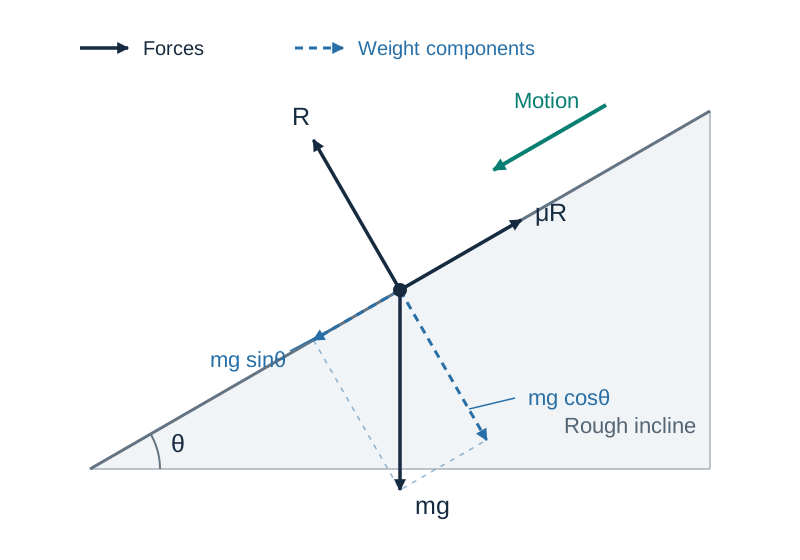
Worked Example (Rough Surface Deceleration): A parcel rests on the horizontal floor of a van travelling at . The coefficient of friction between the parcel and the floor is . Show that the parcel is on the point of sliding forward if the van is brought uniformly to rest in .
For the van: . The van decelerates at .
For the parcel: the only horizontal force acting on it is friction with the floor. The maximum deceleration friction can provide without slipping is:
Because the van's required deceleration exactly matches the maximum available frictional deceleration, friction is at its limiting value. The parcel is on the point of sliding forward.
Calculus Derivations from First Principles
The Higher Level syllabus requires deriving the kinematic equations using calculus. Velocity is defined as and acceleration as .
1. Deriving
Start from the definition of acceleration:
Separate variables with constant :
Integrate from (where velocity is ) to time (where velocity is ):
2. Deriving
Substitute into the definition of velocity:
Integrate with at :
3. Deriving
To eliminate time, apply the chain rule to rewrite acceleration with respect to displacement:
Separate variables:
Integrate from (velocity ) to displacement (velocity ):
4. Deriving Average Velocity
From , rearrange to get . Substitute this into :
Graphical Analysis: Velocity-Time and Displacement-Time Graphs
Motion graphs provide visual structure and geometric shortcuts for solving multi-stage kinematics problems.
Displacement–Time (–) Graphs
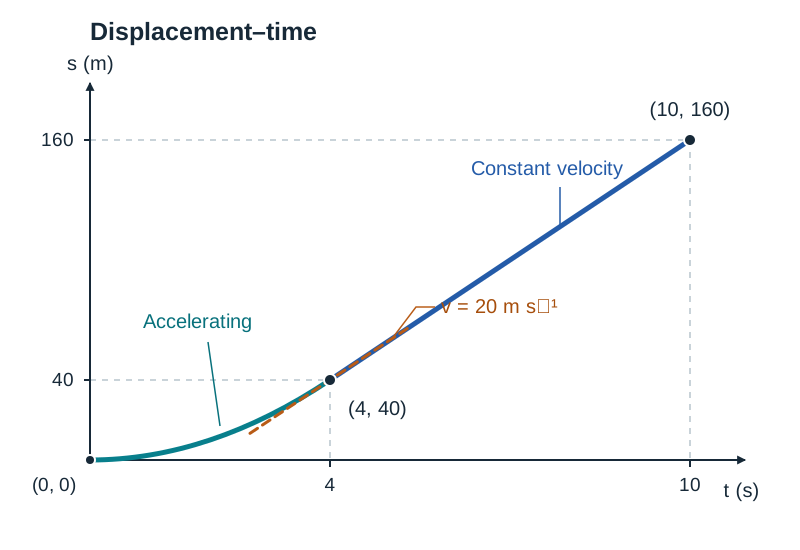
On an – graph, the slope of a displacement–time graph = velocity (). There is no physical meaning to the area under an – graph.
- A horizontal line means the particle is at rest ().
- A straight, sloped line represents constant velocity.
- A curve indicates changing velocity (acceleration). For uniform acceleration, the curve is a parabola (), bending upwards for and downwards for .
- A local maximum or minimum is the instant the particle is momentarily at rest while reversing direction.
- Where two – curves intersect, both bodies occupy the same position at the same time—an overtake or collision.
Reading an – graph: If a particle traces a parabolic path from to and then follows a straight line to , its average velocity over the first is . If it started from rest, at , giving . The slope of the straight segment is , confirming smooth transition from acceleration to constant velocity.
Velocity–Time (–) Graphs
- Slope of a velocity–time graph = acceleration (). Horizontal lines mean zero acceleration.
- Area under a velocity–time graph = displacement (). Areas above the time axis represent positive forward displacement; areas below represent negative displacement.
Journey Profiles: Trapezoidal vs Triangular
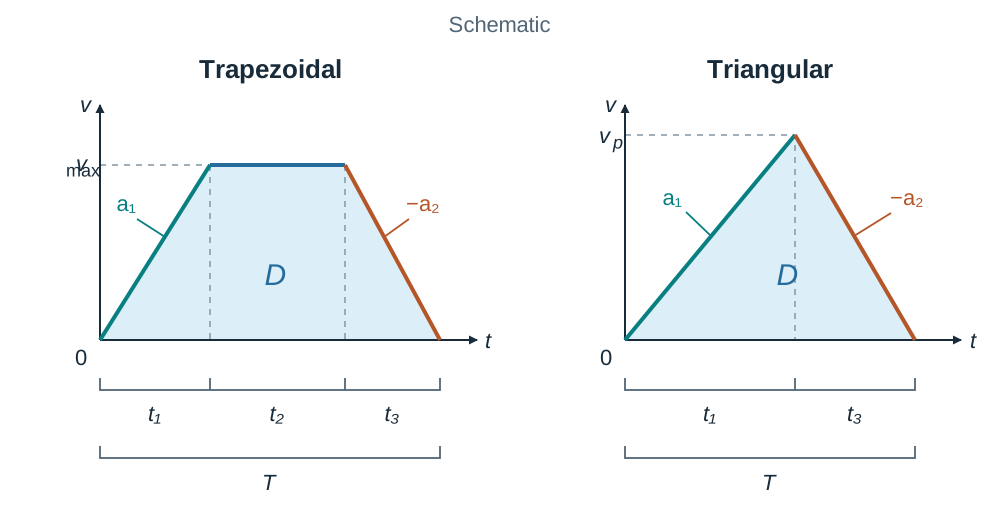
Under exam conditions, sketching the – graph first saves time. Mark on the vertical axis, label time intervals on the horizontal axis, and write an area equation for distance alongside gradient equations ().
- Trapezoidal Profile (Speed Limit Imposed): The vehicle accelerates at to top speed , cruises for time , and decelerates at to rest. Total distance is the area of the trapezium:
where , , and total duration is .
- Triangular Profile (Unconstrained Journey): Without a speed limit, minimum transit time between two stops occurs when the vehicle accelerates at straight to a peak speed and immediately brakes at to rest (). Here , , and:
Vertical Motion Under Gravity and 2D Extensions
Near the surface of the Earth, when air resistance is neglected, freely falling bodies experience a downward acceleration of g = 9.8 m s⁻².
Upwards as Positive Convention
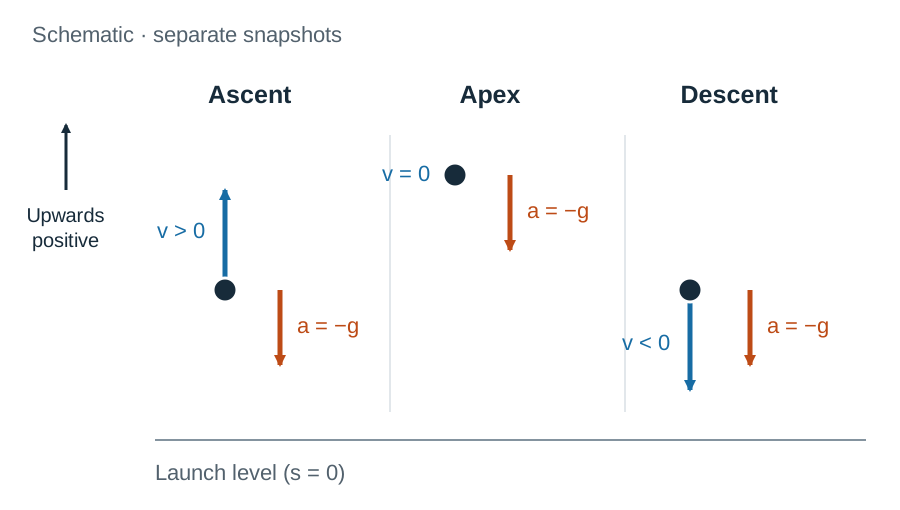
When projecting a particle upwards, declare upwards as positive:
- Acceleration is throughout the ascent, at the top, and during descent.
- At maximum height, instantaneous vertical velocity is .
- Velocity on return to launch level: Setting in yields . The particle returns with equal speed in the opposite direction.
- If an object lands below its launch height (such as a ball thrown off a cliff into the sea), the final displacement is negative ().
Passing a height twice: A ball thrown upwards at passes a height of twice. Setting in gives . Using the quadratic formula yields (on the way up) and (on the way down). Both roots are physically valid.
The Same Formulae in Two Dimensions
When acceleration is constant as a vector, the kinematic equations apply directly in vector form:
There is no vector equivalent of because that equation arises from a scalar chain rule. For projectile motion, , meaning horizontal acceleration is zero while vertical acceleration is . Resolve motion into orthogonal directions at the outset. Time is the only scalar connecting the two independent 1D problems:
Assumptions in the Constant Acceleration Model
Exam questions regularly ask you to evaluate model assumptions:
- The body is modelled as a particle (dimensions, aerodynamic lift, and spin are ignored).
- Air resistance is neglected. In real air, a projectile reaches a lower peak, takes longer to fall than to rise, and strikes the ground with less than its launch speed.
- is constant at , valid only near Earth's surface over modest height changes.
- Accelerations and retardations are instantaneous and uniform, whereas real engines and brakes vary continuously.
To improve the model, add a drag force proportional to velocity or velocity squared ( or ). The resulting acceleration is variable, meaning the constant acceleration formulae fail and a differential equation must be solved.
Two Bodies on the Same Line: Overtaking, Collisions, and Maximum Separation
Tracking two bodies moving along the same straight path requires setting up coordinated position equations.
Overtaking Principle
Two bodies meet or overtake when they are in the same place at the same time, measured from a shared origin () and a universal clock ():
Distances travelled from their starting points are equal only if both bodies started at the very same location.
If body B starts moving or alters its acceleration seconds after body A (at ), its new acceleration applies only for seconds, valid for . During the initial interval , body B continues under its prior motion regime (such as moving at constant velocity or remaining at rest). Its position at any time is the sum of its position at and the displacement gained during the subsequent seconds:
Condition for Maximum Separation
Let the gap between a leading vehicle B and a trailing vehicle A be . Setting the derivative to zero gives:
While both bodies are moving under constant accelerations, their separation is greatest when their velocities equal at maximum separation (). When the lead vehicle is faster, the gap grows. The instant the trailing vehicle matches its speed, the gap stops widening and begins to close. If their velocities never equalise during that motion phase, check the phase boundary—such as the moment an accelerating vehicle hits its top speed or a braking vehicle halts.
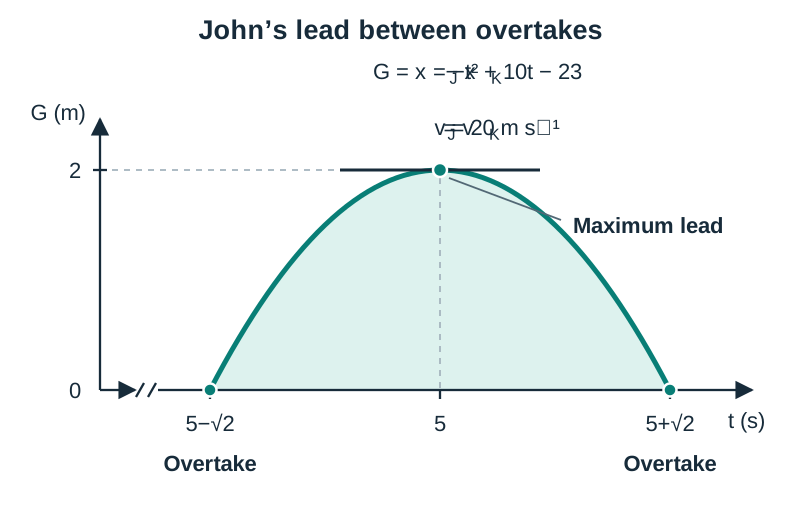
Worked Example (Delayed Pursuit and Maximum Lead): John cycles at a constant , behind Kevin, who cycles at a constant in the same direction. At , John accelerates at . One second later (), Kevin accelerates at .
- Find when John and Kevin overtake each other.
Measuring position from John's starting position at :
Kevin starts at . Over , Kevin travels , reaching . For , Kevin accelerates at for seconds:
Setting for an overtake:
Using the quadratic formula:
Both roots ( and ) exceed , so both are valid: John overtakes Kevin at , and Kevin overtakes John back at .
- Verify the maximum separation rule.
Between these two overtakes, John leads Kevin by gap . John's lead is greatest when . At :
- John's velocity is .
- Kevin's velocity is .
Because , the lead is confirmed to be maximum () at the exact instant their velocities match.
Collision Avoidance
When a trailing vehicle brakes behind a slower vehicle moving at steady speed , the critical threshold to prevent a crash requires the trailing vehicle to reduce its speed to match the leader () at the exact instant the gap between them narrows to zero.
Key terms
- Uniform Acceleration
- A constant rate of change of velocity over time, producing a straight line on a velocity–time graph and a parabola on a displacement–time graph.
- Particle Model
- An idealisation that treats an object as a point mass, ignoring its shape, volume, rotational motion, and internal structure.
- Displacement
- The change of position of a particle: a vector quantity with magnitude and direction, measured from a chosen origin (s = x - x₀).
- Velocity
- The rate of change of displacement with respect to time (v = ds/dt), possessing both magnitude and direction.
- Speed
- The scalar magnitude of velocity, measuring distance covered per unit time regardless of direction.
- Acceleration
- The rate of change of velocity with respect to time (a = dv/dt = v dv/ds), acting in the direction of the resultant force.
- Deceleration (Retardation)
- An acceleration directed opposite to the instantaneous direction of motion, reducing the speed of the body.
- Slope of a Velocity–Time Graph
- The derivative dv/dt, which represents the instantaneous acceleration of the particle.
- Area Under a Velocity–Time Graph
- The definite integral ∫ v dt, which equals the net displacement of the particle over the timed interval.
- Slope of a Displacement–Time Graph
- The derivative ds/dt, which represents the instantaneous velocity of the particle.
- Acceleration due to Gravity (g)
- The downward acceleration of an unsupported body in free fall near Earth's surface, taken as exactly 9.8 m s⁻² in Applied Mathematics.
- Frictional Deceleration (a = -μg)
- The constant deceleration experienced by a mass sliding freely across a horizontal surface with coefficient of friction μ, where mass cancels out.
Check yourself
What physical quantity is represented by the slope of an s–t graph, the slope of a v–t graph, and the area under a v–t graph?
The slope of an s–t graph is instantaneous velocity (ds/dt); the slope of a v–t graph is instantaneous acceleration (dv/dt); the area under a v–t graph is net displacement (∫ v dt).
How do you express acceleration in terms of velocity and displacement using the chain rule, and which equation of motion does it derive?
Using the chain rule, a = (dv/dt) = (dv/ds)(ds/dt) = v(dv/ds). Separating variables and integrating ∫ v dv = ∫ a ds yields v² = u² + 2as.
A block slides from rest down a smooth plane inclined at 30° to the horizontal. What is its acceleration down the plane?
Resolving gravity down the incline gives a = g sin 30° = 9.8 × 0.5 = 4.9 m s⁻².
A block slides to rest in 18 m from an initial speed of 12 m s⁻¹ across a rough horizontal floor with no other horizontal forces. Find the coefficient of friction μ.
Using v² = u² + 2as: 0 = 12² + 2a(18) yields a = -4 m s⁻². Since deceleration on a rough horizontal floor is a = -μg, we have -μ(9.8) = -4, giving μ = 4 / 9.8 ≈ 0.41.
An arrow is fired vertically upwards at 29.4 m s⁻¹. Taking g = 9.8 m s⁻², how long does it take to reach its highest point, and what is its maximum height?
At peak height v = 0. Using v = u - gt: 0 = 29.4 - 9.8t gives t = 3.0 s. Using v² = u² - 2gs: 0 = 29.4² - 2(9.8)s gives s = 864.36 / 19.6 = 44.1 m.
A car travelling at 48 km h⁻¹ brakes uniformly to rest in 5 minutes. Calculate its deceleration in km h⁻² and in m s⁻².
Time in hours is 5/60 = 1/12 h. Deceleration is 48 ÷ (1/12) = 576 km h⁻². Converting to SI: 576 ÷ 12 960 = 2/45 ≈ 0.044 m s⁻².