
The whole topic rests on one idea: sideways, nothing slows the particle down, so it travels at a steady speed; up and down, gravity acts on it exactly as if it had been thrown straight up. Time is the only link between the two. Once you can set up the four component equations, the same method solves every question on the paper: level-ground derivations, launches from cliffs, hitting or clearing a target, and two particles colliding in mid-air.
The Core Idea, Setup Routine, and Equations of Motion
Imagine rolling a marble off the edge of a flat desk at from a height of . Gravity pulls it down with acceleration , taking to hit the floor. In that exact half-second, it continues moving forward at , landing out from the base of the desk. The horizontal motion does not alter how fast it falls, and gravity does not alter how fast it moves sideways.
The Standard Setup Routine
Before writing down numbers or formulas on the exam, always establish your coordinate frame:
- Sketch the path, marking the launch point, the angle of projection , ground level, and any cliff height or barrier.
- Place the origin at the launch point and take up and right as positive.
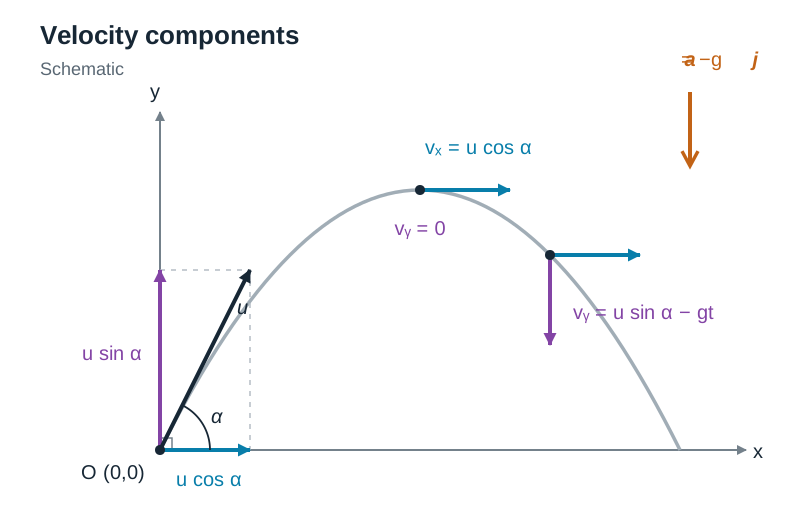
- Resolve initial velocity into perpendicular components: and .
- State constant accelerations: and (unless is left as a symbol).
- Write down the four governing equations for .
Derivation Using Calculus
By Newton's second law, . The only force in the baseline model is downward weight , so .
Integrating acceleration with respect to time gives the velocity vector:
Integrating velocity gives the displacement vector :
This gives our four fundamental tools:
Using the chain rule, . Integrating with initial speed gives . This links vertical speed directly to vertical displacement without calculating time.
Vectors, Polar Form, and the Dot Product
Working from a Velocity Given as a Vector
Exam questions often specify the launch velocity directly in unit-vector form: . You do not need to resolve angles first:
- and
- Launch speed
- Launch angle
For example, if , the speed is at an elevation of . After seconds, velocity is and displacement is . If asked for velocity at a specific point, state it in format or give the speed and angle.
Direction of Motion
At any point in flight, the direction of motion makes an angle with the horizontal where . Calculate the magnitude and state clearly in words whether the particle is travelling above the horizontal (ascending, ) or below the horizontal (descending, ).
Perpendicular Velocity Vectors via the Dot Product
Two vectors are perpendicular if and only if their dot product is zero. This provides a direct method to find when a projectile moves at right angles to its launch direction: set .
This instant occurs before landing only if , meaning . If , the projectile strikes level ground before turning through .
Standard Derivations on Level Ground
When a projectile launches and lands on the same horizontal plane, the flight path is symmetrical.
Greatest Height
The particle reaches its highest point when the vertical component of velocity momentarily drops to zero: at greatest height.
Substitute this time into vertical displacement to derive the greatest height ():
At this apex, the particle still has horizontal velocity .
Time of Flight
The particle lands when vertical displacement returns to zero ():
Ignoring gives the total time of flight ():
Horizontal Range and Maximum Range
The horizontal range () is the distance covered horizontally during flight time :
Using the identity :
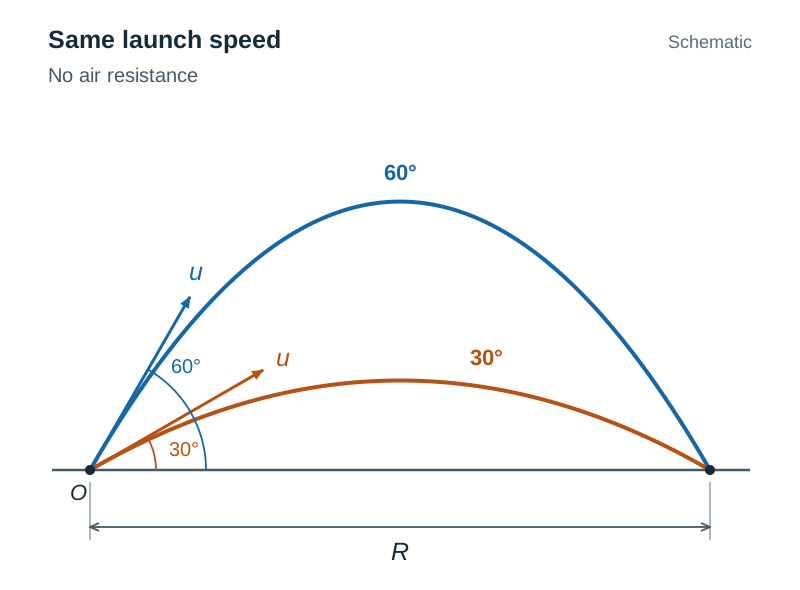
For a fixed speed , the range is greatest when is as large as possible. The maximum value of sine is , so . The maximum range is:
Complementary angles (angles summing to , like and ) yield identical ranges because . The lower angle gives a flatter, faster flight; the higher angle creates a steep, high lob.
Launches from Cliffs, Heights, and Depressions
Greatest Height Above the Ground Versus Rise Above the Launch Point
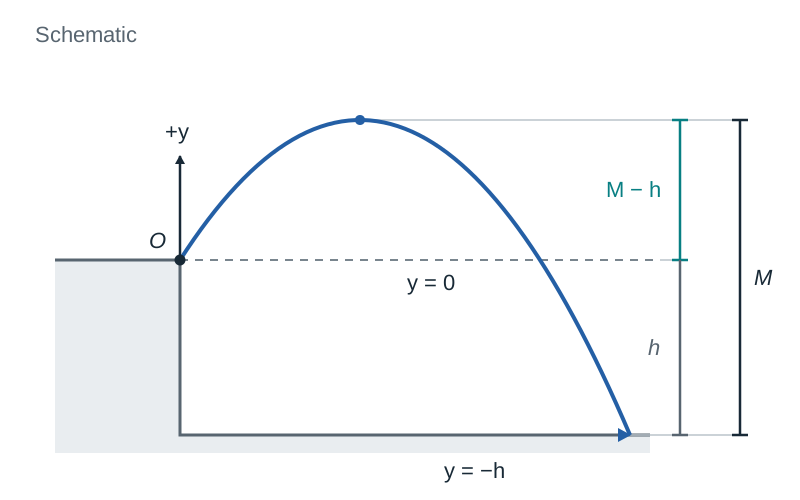
The formulas and calculate the vertical rise relative to the point of projection. If a particle is launched from a cliff of height and reaches a maximum height above the ground, the rise above the launch point is . Always subtract the platform height before calculating or .
Landing Below the Launch Point
Taking the origin at launch and up as positive, ground level situated a vertical drop below the launch point corresponds to for a launch from a cliff.
This quadratic yields one positive root for flight time. Level-ground formulas like cannot be used here.
Conservation of energy confirms the final impact speed: . This speed depends purely on and drop height , completely independent of the launch angle.
Projection Below the Horizontal
When an object is thrown downwards at an angle below the horizontal, keep up as positive. The only adjustment is the sign of the vertical velocity:
- Target ground level remains
A horizontal launch is simply , giving and .
The Trajectory Equation, Targets, and Obstacles
The Parabola and the Trajectory Equation
Eliminating time gives the path coordinates directly. From horizontal motion, . Substituting into vertical displacement:
Using the identity , we obtain the trajectory equation:
Because this has the algebraic form where and are constants with , the path of a projectile in free flight is a parabola opening downwards.
Target Quadratics in tan α
Rearranging the trajectory equation for a target yields a quadratic in :
- Two positive roots give two projection angles: a low drive (rapid flight) and a high lob.
- A negative root indicates an angle below the horizontal, valid when aiming downward.
- If the discriminant is negative, no real angle exists: the target is out of range at speed .
Two Times at the Same Height and Clearing Obstacles
Setting gives . The smaller root is the time on the way up; the larger root is on the way down. The duration spent above height is .
To prove a projectile clears an obstacle of height at distance :
- Find the time to reach the barrier: .
- Calculate at this time.
- Compare: if , the projectile clears it by . State this comparison explicitly in words to secure the conclusion mark.
Mid-Air Collisions and Staggered Launches
Two projectiles collide when their spatial coordinates match at the same instant: and .
Simultaneous Launch from Opposite Sides
If particles and are fired at toward each other from two points on the same horizontal level, separated by distance :
- Horizontal:
- Vertical:
Cancelling reveals that their vertical velocities must match: . Both particles rise and fall in synchrony throughout flight. If the launch points are at different heights, equate absolute heights instead: , and the gravity terms still cancel.
Staggered Launches
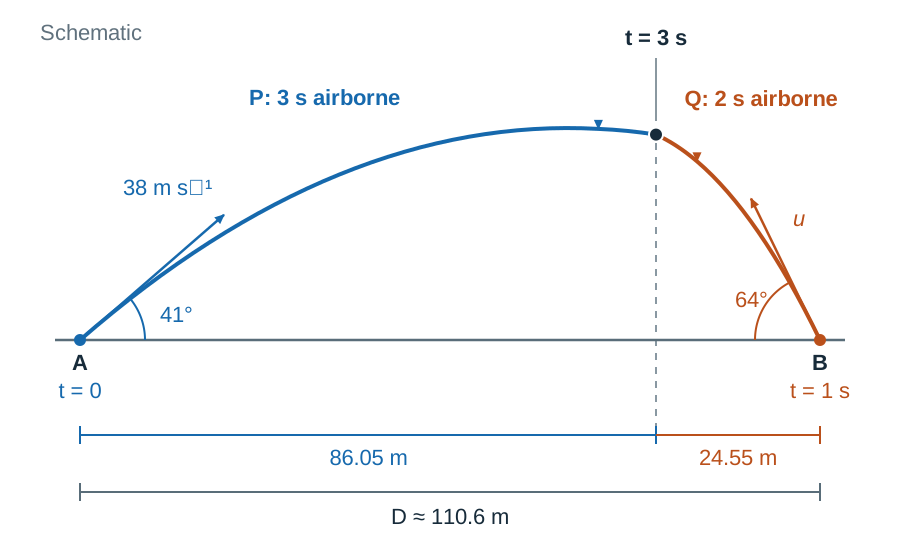
If projectile launches seconds after projectile , and collision occurs at time (measured from 's release), then particle has been airborne for only seconds. The gravity terms do not cancel because . Set up and solve with the given time delay.
Worked illustration: is projected at from with speed at to ; is projected from one second later with speed at to ; they collide at . Equating heights: , giving , so ; then .
Mathematical Modelling in Context
Every projectile formula relies on idealised assumptions. The examination contextualises questions within Strand 1, frequently asking candidates to evaluate assumptions, consider limitations, or suggest model refinements.
Model Assumptions and Physical Effects
- Assumption: The object is a point particle. Neglecting dimensions means shape, orientation, and aerodynamic spin (such as backspin generating Magnus lift) are omitted from the equations.
- Assumption: Air resistance is negligible. In reality, fluid drag acts opposite to velocity (). Drag reduces horizontal velocity continuously, lowers maximum height and range, steepens the descent relative to ascent, and lowers the optimal range angle below .
- Assumption: Gravitational acceleration is constant (). This holds accurately near the surface of the Earth over typical sports trajectories.
Sample Answers for the Modelling Question
- Assumptions: "I assumed the ball acts as a particle, ignoring its size and spin. I assumed air resistance is negligible, meaning gravity is the sole force acting during flight. I also assumed is uniform."
- Effect on real performance: "Air resistance opposes motion, so a real ball travels a shorter distance and reaches a lower peak than the calculated model predicts. The model over-estimates range, and the true trajectory is asymmetric with a steeper drop."
- Model refinement: "Refine the model by introducing a resistive drag term proportional to velocity or velocity squared ( or ), solving the resulting differential equations analytically or numerically."
Note on curriculum scope: Projectiles launched onto inclined planes appeared in pre-2023 examinations. The current specification focuses on horizontal planes and targets.
Key terms
- Time of Flight
- The total elapsed time from release until the projectile reaches ground or target level.
- Greatest Height
- The maximum vertical displacement attained above the launch position, occurring when vertical velocity .
- Horizontal Range
- The total horizontal displacement achieved over the flight time on level ground.
- Maximum Range
- The greatest horizontal distance achievable for a given launch speed, occurring at a angle of projection on level ground.
- Angle of Projection
- The angle between the initial velocity vector and the horizontal reference plane.
- Trajectory Equation
- The cartesian relation defining the path in space independent of time.
- Parabola
- The downward-curving quadratic path followed by any particle in uniform free-fall kinematics.
- Dot Product
- The algebraic product , which evaluates to zero when vectors are perpendicular.
- Complementary Angles
- Pairs of launch angles summing to that yield identical ranges on flat ground for the same initial speed.
Check yourself
A stone is thrown horizontally at 8 m s⁻¹ from a bridge 19.6 m above a river. How far from the bridge does it land?
With sy = -19.6 m and uy = 0, -19.6 = -4.9t² gives t = 2.0 s. Horizontal distance is sx = 8(2.0) = 16 m.
A ball is launched from a 25 m tower at 21 m s⁻¹ at 30° above the horizontal. What is its greatest height above the ground?
Vertical rise is (21 sin 30°)² / (2 × 9.8) = (10.5)² / 19.6 = 5.625 m. Greatest height above ground is 25 + 5.625 = 30.6 m.
Why do launch angles of 35° and 55° achieve identical horizontal ranges on level ground?
Horizontal range is proportional to sin(2α). Since sin(2 × 35°) = sin 70° and sin(2 × 55°) = sin 110° = sin(180° - 70°) = sin 70°, complementary angles produce identical ranges.
How do you prove mathematically that a projectile clears an obstacle of height h at distance d?
Calculate time t = d / (u cos α), find vertical displacement sy at this time, and check whether sy > h. State in words that the projectile clears the obstacle by sy - h.
Under what condition can a projectile's velocity become perpendicular to its launch velocity before landing on level ground?
The dot product u · v = 0 yields t = u / (g sin α). Comparing this to the total flight time 2u sin α / g requires sin²α > 0.5, which means the launch angle α must exceed 45°.