
Newton's laws tell you how the forces on an object decide its acceleration. In this topic the forces are gravity (weight), the push of a surface (the normal reaction), the pull of a string (tension), friction, and air or fluid resistance. Once you know the acceleration you can use the kinematics formulae — or calculus, if the acceleration is not constant — to find speeds, distances, and times. By isolating each body on its own free-body diagram, establishing string constraints, and setting up equations of motion along the direction of travel, you can solve connected particles over fixed or movable pulleys, particles on movable wedges, and bodies moving against speed-dependent resistive forces.
Newton's Laws and Vector Dynamics
Classical mechanics models the physical world using three laws formulated by Sir Isaac Newton:
- Newton's First Law: A body remains at rest or continues to move with constant velocity in a straight line unless acted upon by a non-zero resultant external force. The natural tendency of a body to resist changes in its velocity is termed inertia.
- Newton's Second Law: The rate of change of momentum of a body is proportional to the resultant applied force and takes place in the direction of that force. Since linear momentum is , for a particle of constant mass this gives:
In component form with unit vectors and along orthogonal axes:
- Newton's Third Law: When body exerts a force on body , body exerts an equal and opposite force on body (). These action–reaction forces act on different bodies, so they never cancel each other out on the free-body diagram of a single particle.
In Applied Mathematics, macroscopic bodies are modelled as point particles, concentrating all mass at a single point and ignoring the fact that a real object can spin or tumble.
Newton's Second Law in Component Form
If forces are given as vectors in and form, add them together and divide by the mass. There is no need to resolve angles.
For example, if forces and act on a particle of mass initially at rest:
The magnitude of the acceleration is . Because this acceleration is constant, standard vector kinematics equations apply directly: and .
Free-Body Diagrams and What the Examiner Looks For
A free-body diagram isolates a single body and displays every external force acting directly upon it. Leaving Certificate examination papers regularly award distinct marks in part (i) for drawing these diagrams before any algebra is written.
What the Examiner Wants in Part (i)
For each body, draw and name every force and its direction:
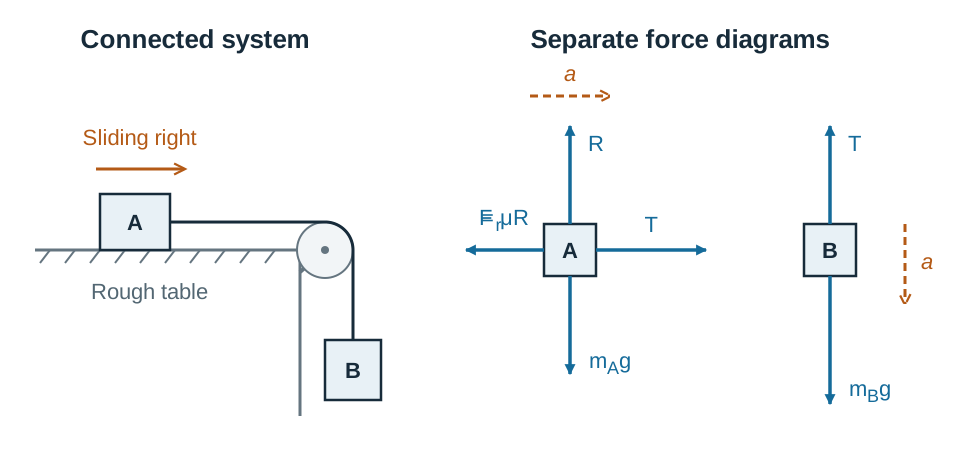
- Block on a rough horizontal table pulled by a string: weight vertically down; normal reaction vertically up; tension along the string; friction along the surface, opposing the direction of sliding.
- Block on a rough inclined plane: weight vertically down (never along the slope); normal reaction perpendicular to the plane; tension along the plane; friction along the plane opposing motion.
- Freely hanging block: weight vertically down; tension vertically up (plus a second downward tension if another block hangs beneath it).
- Movable pulley of mass : weight vertically down; two upward tension forces , one for each string segment supporting it.
- Block resting in a scale pan: weight down; normal reaction from the floor of the pan upwards. The cable tension supports the pan, not the block directly.
Beside each body, draw a separate single arrow labelled showing the chosen positive direction of acceleration. Never draw as a force touching the body.
Determining the Normal Reaction
The normal reaction force adjusts to balance all forces pressing into the surface. It only equals on a level, unaccelerated surface with no angled pulls. If an external pulling force acts at an angle above a horizontal floor:
An upward pull means the block presses less hard on the floor, so is smaller and the available friction is smaller too.
Friction, Limiting Equilibrium, and Slopes
Friction is a contact force that opposes sliding between rough surfaces. The roughness is measured by the dimensionless coefficient of friction (). At Leaving Certificate level, a single coefficient is used for both static and sliding friction. Once a body slides, write immediately.
Friction operates across three stages:
- Static friction: when an applied force does not cause movement, friction balances the applied force exactly (), where .
- Limiting friction: when a body is on the verge of slipping, friction reaches its peak value: .
- Kinetic friction: while sliding occurs, friction opposes motion with magnitude .
On an idealised smooth surface, .
The Preliminary Static Check
Friction always opposes the direction of actual or impending motion. Before writing equations of motion from rest, compare the net driving force along the surface with the maximum static friction (). If the driving force is less than or equal to , the system does not move, and .
Resolving Forces on an Inclined Plane
On a plane inclined at to the horizontal, take your two directions along the slope and perpendicular to the slope, rather than horizontal and vertical. This is the single most useful habit in this topic because the particle accelerates along one axis only.
Resolving weight into components:
- Perpendicular to the plane: , directed into the surface.
- Along the plane: , directed down the slope.
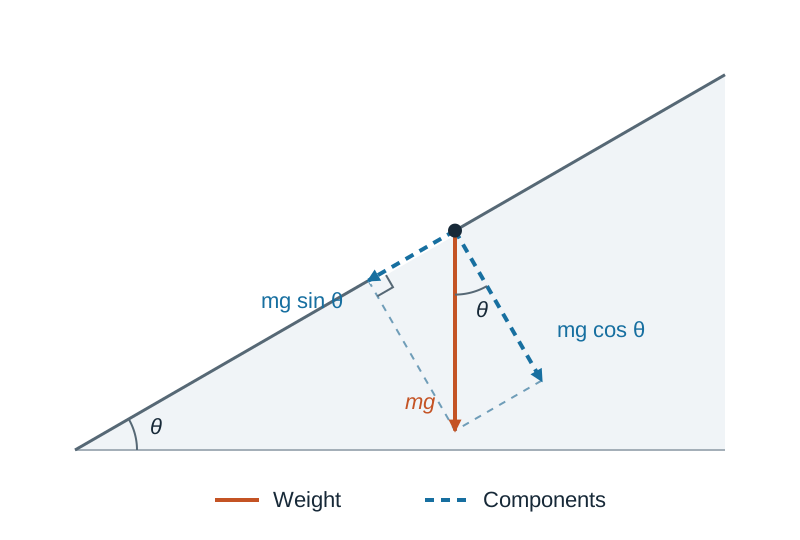
Because there is no motion perpendicular to the plane, . The limiting friction available is .
For a solitary block on a rough slope with no strings, the downward slope force is . At the point of slipping down:
If , the block stays at rest. If , it accelerates down the slope at .
Friction as the Only Driving Force
If a parcel rests on the floor of a van, or a block rests on top of another accelerating block, the only horizontal force that can accelerate or decelerate it is friction from the contact surface. For a parcel of mass :
The parcel can match the vehicle's acceleration only while . If the vehicle brakes harder than , the parcel slides forward relative to the floor.
Connected Particles: Fixed Pulleys, Slack Strings, and Connectors
In connected systems, particles interact through strings, rods, or contact faces. Examination problems rely on three standard idealisations:
- Light string: The string has zero mass, so tension is uniform throughout its continuous length.
- Inextensible string: The string does not stretch, meaning connected bodies share linked accelerations.
- Smooth pulley: The pulley's bearings are frictionless, so string tension is identical on both sides. Note that a pulley can be smooth without being light; if a smooth pulley has mass, its weight appears in its own equation of motion.
Universal Method for Connected Particles
- Label tensions (), with one tension symbol per separate continuous string.
- Mark the positive direction of acceleration for each body with an arrow labelled .
- Resolve perpendicular to the contact surface for each body to find .
- On rough surfaces, check limiting friction against the net driving force.
- Write one equation per body along its direction of motion.
- State the kinematic constraint relating the accelerations.
- Solve simultaneously, then check that your tension lies between the competing weights and .
Write a separate equation of motion for each body because tensions and reactions only appear when you isolate a body. If a question asks only for acceleration, you may add the equations together to eliminate the internal tensions, which gives a quick check on your answer.
Multi-Stage Motion: Slack Strings
A common Leaving Certificate problem involves a hanging mass accelerating downwards until it hits the floor:
- Stage 1 (taut string): The system accelerates under tension . Find the speed just before impact using .
- Stage 2 (slack string): Once the descending mass hits the floor and does not rebound, the string instantly loses tension (). The remaining body continues moving with initial velocity , decelerating under friction and gravity alone until coming to rest.
On a rough incline, a body still travelling up after the string goes slack decelerates under both gravity and friction acting down the slope:
When it comes to rest momentarily, check if it stays there: if , it remains at rest; if , it slides back down with acceleration , where friction has reversed to oppose downward motion.
Force Exerted on a Pulley
A smooth pulley is pulled along both string segments leaving it, each with tension . The force on the pulley is the vector resultant of these two pulls:
- Both segments vertical (masses hanging on each side): resultant force is vertically downwards.
- One segment horizontal and one vertical (pulley at a table corner): resultant force is acting at below the horizontal.
- Segments at an angle apart: resultant is along the angle bisector.
Rigid Connectors and Tow-Bars
A light rigid rod or tow-bar transmits the same magnitude of force to each connected body, just like a string. However, while a string can only pull (tension), a rigid connector can also push (thrust or compression). Thrust occurs when a leading vehicle decelerates and the trailing mass pushes against it from behind.
Movable Pulleys and Kinematic Constraints
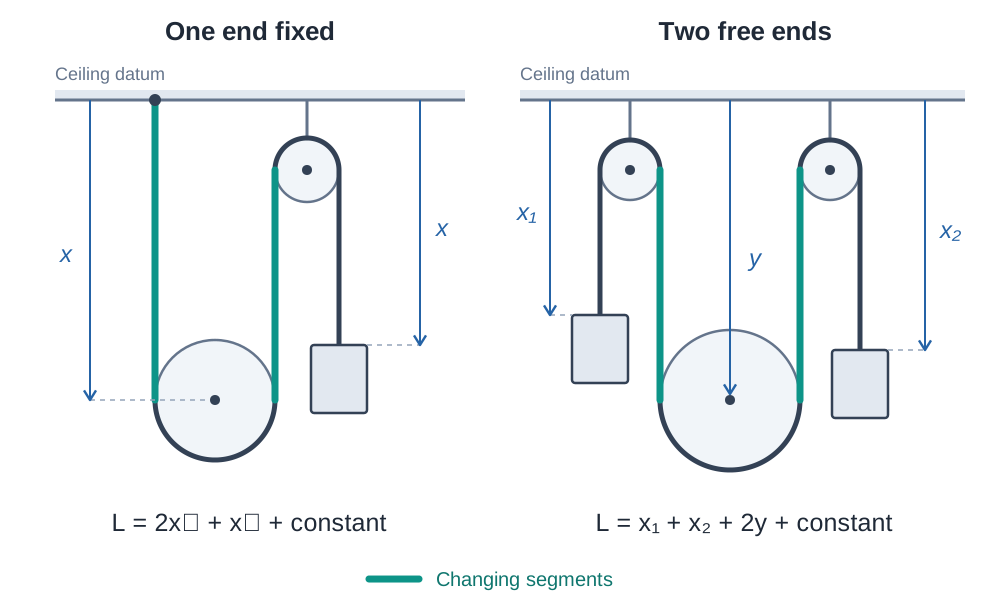
When a pulley moves linearly with the load, the connected masses do not share identical accelerations. Their accelerations are linked by the conservation of string length.
Case 1: One String End Fixed to a Rigid Support
Consider a string with one end tied to the ceiling, looping under a movable pulley of downward position , passing over a fixed overhead pulley, and attached to a hanging mass at downward position . Measure every position downwards from ceiling level as a fixed reference line:
Differentiating twice with respect to time:
In magnitude, . If the movable pulley descends with acceleration , the hanging mass ascends with acceleration .
Case 2: Movable Pulley Between Two Fixed Pulleys
A string passes over a fixed pulley, down under a movable pulley (position ), and over a second fixed pulley, connecting two free end masses (positions and ). The length of the string is:
If the two end masses accelerate upwards with accelerations and , the movable pulley accelerates downwards with acceleration given by:
Force Balance on a Movable Pulley
A movable pulley suspended in a loop of string is supported by two distinct string segments. Each segment pulls with tension , giving a total upward force of . For a movable pulley of mass accelerating downwards at :
Worked Example: Movable Pulley System
A light inextensible string passes over a smooth fixed pulley, under a smooth movable pulley of mass , and over a second smooth fixed pulley. Masses of and are attached to the ends of the string. The system is released from rest. (i) Find the tension in the string in terms of . (ii) Find the acceleration of each mass and of the movable pulley.
1. Set up equations of motion: Let upward acceleration be positive for the mass () and the mass (). Let downward acceleration be positive for the movable pulley ().
- mass (upwards):
- mass (upwards):
- movable pulley (downwards):
2. Relate accelerations using the string constraint: From Case 2, the accelerations are linked by :
3. Solve for tension and accelerations: Multiply across by to clear denominators:
Substitute into each acceleration expression:
- (upwards)
- (downwards)
Interpreting the negative sign: Because we defined upward acceleration as positive for the mass, the negative result means the mass actually accelerates downwards at . The mass accelerates upwards at , and the movable pulley descends at .
Scale Pans, Lifts, and Movable Wedges
Scale Pans and Lifts
When an object rests inside an accelerating container, such as a person in a lift or a block in a suspended scale pan, you must distinguish between the external cable tension and the internal normal reaction.
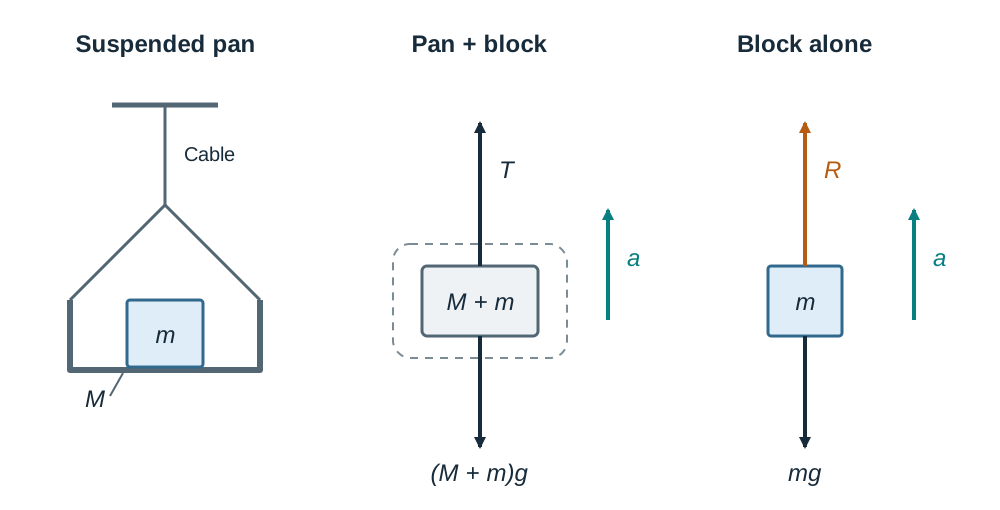
Consider a block of mass resting on the floor of a scale pan of mass suspended by a light cable:
- External cable tension: treat the pan and block as a combined mass . If accelerating upwards at :
- Internal normal reaction: isolate the block alone. The only vertical forces acting on the block are its weight downwards and the reaction from the pan floor upwards:
If accelerating downwards at , isolating the block gives . If the pan is described as light (), then . If the pan has mass, , and you must isolate the block to find .
Proving a Condition for Motion
When an examination question asks you to show that an unknown parameter satisfies an inequality (such as ), express the acceleration in terms of that parameter and impose the condition that acceleration must be positive in the stated direction of motion.
Particle on a Smooth Movable Wedge
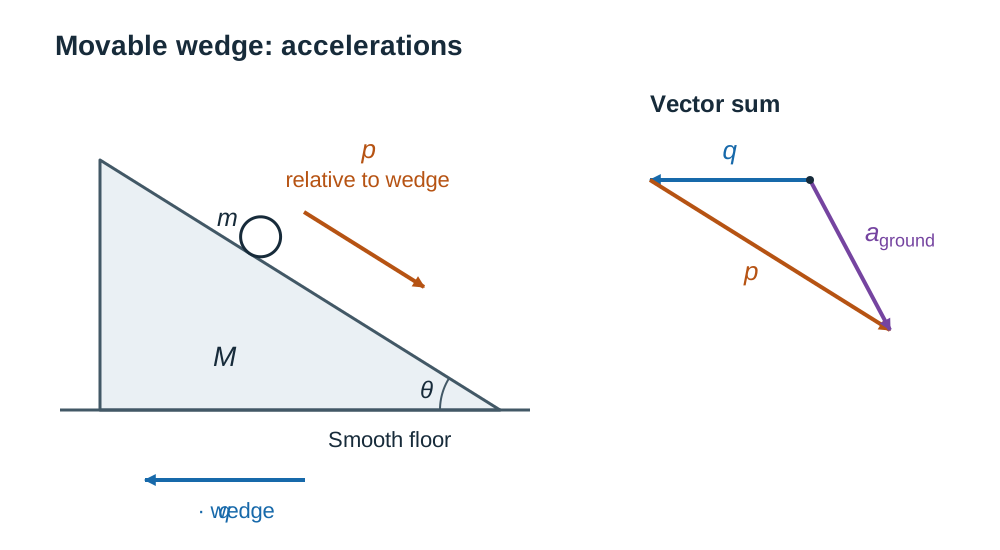
If a wedge of mass rests on a smooth horizontal floor, the wedge slides sideways when a particle of mass is released on its smooth inclined face (angle ). The two bodies are connected solely by the normal reaction between them.
Set up two acceleration unknowns:
- = acceleration of the wedge horizontally.
- = acceleration of the particle relative acceleration down the inclined face.
The particle's true acceleration relative to the ground is the vector sum of horizontally and down the face. This produces three equations of motion:
- Wedge, horizontally: the particle pushes into the wedge face with normal reaction . The horizontal component drives the wedge:
- Particle, perpendicular to the face: along the face, relative acceleration contributes nothing perpendicular, so only the wedge's horizontal motion contributes:
- Particle, along the face (down the slope):
Eliminating between equations (1) and (2) gives:
Speed-Dependent Resistive Forces and Terminal Speed
Strand 3 includes dynamic problems where resistive forces (aerodynamic drag or fluid resistance) depend on velocity: , where is a drag constant and .
Differential Equations of Motion
Because resistive force changes with speed, acceleration is not constant. Standard kinematic formulae () cannot be used. You must use calculus and separate variables:
- Use when relating velocity and time ():
- Use when relating velocity and displacement ():
Rising and Falling Under Gravity with Resistance
Careful attention to signs is essential:
- Rising particle (upwards positive): gravity and drag both act downwards, so their effects add:
- Falling particle (downwards positive): drag opposes gravity:
Terminal Speed
For a falling object, drag increases as speed increases until it balances weight. The net force becomes zero, acceleration vanishes, and the body reaches a constant terminal speed ():
Dimensional Analysis of the Drag Constant
By equating dimensions in :
For linear resistance (), . For quadratic drag (), .
Key terms
- Free-Body Diagram
- An isolated sketch of a single body displaying every external force acting directly upon it, with labels and directions clearly indicated.
- Normal Reaction
- The perpendicular contact force exerted by a supporting surface on an object to prevent it from passing through the surface.
- Coefficient of Friction
- The dimensionless ratio (μ) between the maximum limiting frictional force and the normal reaction force between two contacting surfaces.
- Limiting Friction
- The maximum possible static frictional force (F = μR) that develops just before sliding commences between two surfaces.
- Light Inextensible String
- A modelling idealisation where the string has zero mass (uniform tension throughout) and fixed length (connected bodies share linked accelerations).
- Smooth Pulley
- A pulley with frictionless bearings that changes the direction of a string without altering the tension magnitude on either side.
- Movable Pulley
- A pulley that translates linearly with a moving load, supported by multiple string sections that provide mechanical advantage.
- Slack String
- The state of a string that has lost all tension (T = 0), typically occurring when a connected descending mass strikes the floor.
- Relative Acceleration
- The acceleration of one body measured with respect to a moving reference frame, such as a particle sliding down the face of an accelerating wedge.
- Terminal Speed
- The steady maximum velocity reached by a body when speed-dependent resistive forces exactly balance the driving gravitational force, resulting in zero acceleration.
Check yourself
A 10 kg crate rests on a rough horizontal floor where μ = 0.4. A horizontal push of 25 N is applied. Does the crate accelerate, and what is the friction force?
Normal reaction R = mg = 10(9.8) = 98 N. Limiting friction F_limit = μR = 0.4(98) = 39.2 N. Because the applied push (25 N) is less than limiting friction (39.2 N), the crate remains at rest (a = 0) and static friction matches the push exactly at 25 N.
A movable pulley of mass 5 kg hangs in a loop of string in which the tension is 20 N. Is the pulley accelerating up or down, and at what rate?
Upward force from the two string segments is 2T = 2(20) = 40 N. Downward weight is mg = 5(9.8) = 49 N. Net downward force is 49 - 40 = 9 N. Using F = ma: 9 = 5a_p, giving a_p = 1.8 m s⁻² downwards.
In a movable pulley system with one end fixed to the ceiling, the movable pulley ascends 0.4 m. How far does the hanging mass fall?
Because both supporting loop segments shorten by 0.4 m, 0.8 m of string is released, causing the hanging mass to descend 0.8 m (x_m = 2x_p).
Two scale pans A and B, each of mass m, hang over a smooth fixed pulley. A mass of 3m is placed on pan A and released. What is the reaction force on the 3m mass in terms of m and g?
Descending side has mass 4m (pan + 3m), ascending side has mass m. Combined equation: 4mg - mg = (4m + m)a, so 3mg = 5ma, giving a = 3g/5. Now isolate the 3m mass alone: 3mg - R = 3m(3g/5) = 9mg/5. Therefore R = 3mg - 9mg/5 = 6mg/5.
A particle of mass m falls vertically under drag force D = kv². What is its terminal speed in terms of m, g, and k?
At terminal speed, acceleration is zero, so drag balances weight: kv_t² = mg, which gives v_t = √(mg / k).