

Many sole traders do not keep a complete double-entry bookkeeping system. An owner might retain only cheque stubs, bank statements, supplier invoices, and an informal till roll. Incomplete Records requires you to act as an investigative accountant, taking these partial source records to deduce missing figures such as sales, purchases, and drawings. At Leaving Certificate Higher Level, you must master two approaches: the Net Worth method (calculating profit through changes in capital) and the full Control Account and Cash Book reconstruction method (Type B). You will also apply mark-up and margin ratios in both directions, handle long-term liabilities with accrued interest, adjust for bad debts and provisions, and draft complete final accounts that balance.
Incomplete Records and Examinable Theory
A business has incomplete records when it fails to maintain a comprehensive double-entry ledger system. This situation typically arises because small business owners lack formal bookkeeping training, want to avoid the cost of hiring an accountant, or have lost primary records through fire, flood, or theft. Many retail sole traders record only immediate cash transactions or bank balances, omitting credit sales, credit purchases, and detailed ledger balances.
Preparing accounts from incomplete records allows a sole trader to establish annual profit for tax assessments and support loan applications. However, this approach carries severe limitations that frequently appear on the examination paper:
- No trial balance can be extracted: Arithmetical accuracy cannot be verified independently, leaving mathematical errors undetected.
- Absence of a complete audit trail: Transactions cannot be systematically cross-checked, significantly increasing the risk of undetected fraud, theft, and clerical error.
- Heavy reliance on estimates: Figures for cash takings, stock, and drawings are often approximate, making final net profit figures less reliable.
- Insufficient data for decision-making: Management lacks detailed expense breakdowns and revenue trends to evaluate commercial performance.
When asked to advise a sole trader on improving their financial records, recommend introducing a full double-entry bookkeeping system. Specifically, the business should maintain a detailed analysed cash book and a general ledger, supported by subsidiary day books (sales, purchases, and returns day books). This practice ensures accurate final accounts, establishes internal control, and removes the need to estimate trading profit.
The Net Worth Method: Profit from Capital Movements
The net worth method is used when trading records are too scarce to reconstruct individual ledger accounts. Net worth is the financial value of a business to its owner, defined as total business assets minus total business liabilities. Under the fundamental accounting equation, net worth is identical to owner's capital:
If the trader originally bought the business as a going concern, any excess of the purchase price over the fair value of the identifiable net assets acquired represents goodwill. This is an intangible fixed asset listed first in the balance sheet and is not normally depreciated.
Only four factors alter capital over an accounting period: trading profit increases capital, a net loss reduces it, drawings reduce capital, and capital introduced increases it. Rearranging these relationships gives the formula for net profit:
Drawings are added back because they reduced closing capital without being a business operating expense. Capital introduced is subtracted because it increased capital without being generated by trading activities. A negative result represents a net trading loss for the year.
Always present this calculation as a formal Statement of Profit or Loss, clearly displaying opening capital, closing capital, and each itemised adjustment.
Reconstructing Sales and Purchases Using Control Accounts
In Type B questions, sales and purchases must be reconstructed using control accounts. Both accounts can carry opening and closing balances on both sides.
Debtors Control Account (Credit Sales)
A customer who overpays, pays in advance, or returns goods after settling their invoice becomes a temporary creditor inside the debtors ledger. These balances must never be netted off against trade debtors in the balance sheet; show trade debtors under current assets and the credit balance under current liabilities.
| Debit | € | Credit | € |
|---|---|---|---|
| Balance b/d (debtors) | X | Balance b/d (credit balances) | X |
| Credit Sales (balancing figure) | ? | Bank / Cheques received | X |
| Dishonoured cheques | X | Discount Allowed | X |
| Interest charged on overdue accounts | X | Bad debts written off | X |
| Balance c/d (credit balances) | X | Sales returns | X |
| Contra (offset against creditors) | X | ||
| Balance c/d (debtors) | X |
A contra entry reduces both accounts without moving cash: debit Creditors Control and credit Debtors Control. A dishonoured cheque is debited back to Debtors Control. Interest charged on overdue accounts is debited to Debtors Control and credited as income in the Profit and Loss Account.
Creditors Control Account (Credit Purchases)
A supplier who is overpaid becomes a temporary debtor inside the creditors ledger. Closing debit balances must be shown separately under current assets in the balance sheet.
| Debit | € | Credit | € |
|---|---|---|---|
| Balance b/d (debit balances) | X | Balance b/d (creditors) | X |
| Bank / Cheques paid to creditors | X | Credit Purchases (balancing figure) | ? |
| Discount Received | X | Balance c/d (debit balances) | X |
| Purchases returns | X | ||
| Contra (offset against debtors) | X | ||
| Balance c/d (creditors) | X |
Discounts and Carriage in the Final Accounts
Once extracted from the control accounts, enter these items in the final statements:
- Discount allowed: An expense in the Profit and Loss Account.
- Discount received: A gain added immediately below Gross Profit in the Profit and Loss Account.
- Carriage inwards: Added to Purchases in the Trading Account because it is a direct cost of bringing stock into the business.
- Carriage outwards: An operational expense in the Profit and Loss Account.
Reconstructing Cash Takings, Till Receipts, and Bank Balances
Retailers routinely pay expenses and take personal drawings directly from the till before banking the remainder.
Cash Account and Till Takings
Check carefully where receipts from debtors are placed. If debtors pay by cheque and these are lodged directly, they appear only in the Bank Account. If debtors pay cash into the till, that cash must be debited to the Cash Account. Leaving it out causes the balancing figure to overstate cash sales by that exact amount.
| Debit | € | Credit | € |
|---|---|---|---|
| Balance b/d (opening cash) | X | Bank lodgements from till | X |
| Cash received from debtors | X | Cash wages and expenses | X |
| Cash Sales (balancing figure) | ? | Cash drawings | X |
| Balance c/d (closing cash) | X |
Bank Account and Closing Bank Balance
Enter all cheque and direct bank transactions to establish the closing bank balance:
- Debit Side (Inflows): Opening balance (if an asset) + Till takings lodged + Debtor cheques lodged directly + Capital introduced + Investment income received.
- Credit Side (Outflows): Payments to trade creditors + Expenses paid by cheque + Fixed asset purchases + Drawings paid by cheque.
Balance the account at the end. If receipts exceed payments, the closing balance is a bank asset and is entered as balance c/d on the credit side, then shown under Current Assets. If payments exceed receipts, the closing balance is a bank overdraft, entered as balance c/d on the debit side and shown under Current Liabilities.
Mark-Up and Margin: Two Directions of Calculation
Confusing mark-up with margin will distort both your trading account and balance sheet.
- Mark-up expresses gross profit as a percentage of Cost of Sales:
- Margin (Gross Margin) expresses gross profit as a percentage of Sales Turnover:
| Mark-Up (on Cost) | Margin (on Sales) | Cost of Sales % | Gross Profit % | Sales % |
|---|---|---|---|---|
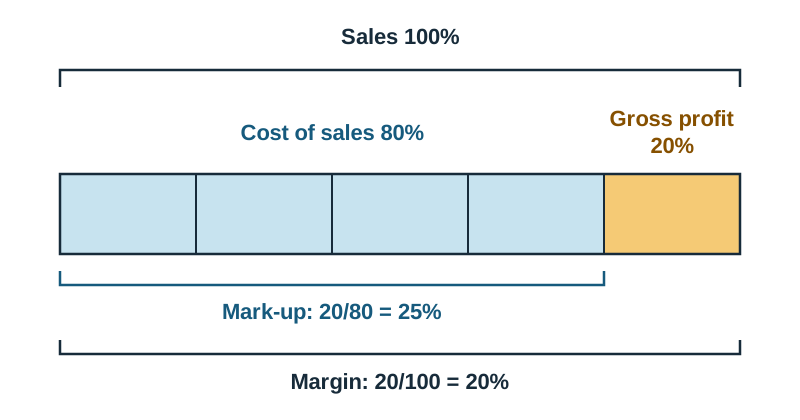
Direction 1: Finding Missing Closing Stock (Sales Known)
Direction 2: Finding Sales (Cost of Sales Known)
If opening stock, purchases, and closing stock are all given, calculate Cost of Sales directly. Then apply the percentage to find Sales:
Worked demonstration: Opening stock €14,000, purchases €96,000, closing stock €16,000, margin 25% on sales.
- Cost of sales = €14,000 + €96,000 - €16,000 = €94,000
- Sales = €94,000 ÷ 0.75 = €125,333 (or using a 33⅓% mark-up: €94,000 × 1⅓ = €125,333)
- If credit sales from Debtors Control are €78,000, Cash Sales = €125,333 - €78,000 = €47,333.
- Insert €47,333 into the Cash Account; the missing balancing figure then becomes cash drawings or bank lodgements.
Decision rule: Look for the single figure the question does not give you. You can only use the percentage once to find one unknown.
Accruals, Long-Term Loans, Bad Debts, and Drawings
The Accruals Formula
Adjust every nominal expense line using the standard formula:
Long-Term Liabilities and Accrued Loan Interest
In the balance sheet, present long-term finance separately after working capital:
Calculate the full year's interest charge on the loan. Charge this full figure to the Profit and Loss Account. Deduct any interest already paid; any unpaid balance is loan interest due, shown as a current liability. Loan repayments reduce the loan principal and do not enter the Profit and Loss Account.
Bad Debts and Provision for Bad Debts
- Bad debts written off: Credited in Debtors Control and debited as an expense in the Profit and Loss Account.
- Provision for bad debts: Calculated on the closing debtors figure after deducting bad debts written off. Only the movement in the provision is entered in the Profit and Loss Account: an increase is an expense, while a decrease is a gain.
- Balance sheet presentation: Show trade debtors under current assets less the closing provision for bad debts.
- Bad debt recovered: Income in the Profit and Loss Account (gain). Debit Bank and credit Bad Debts Recovered; do not put it through the Debtors Control Account.
Goods Taken at Selling Price
Goods taken by the owner must always be valued at cost price. If quoted at selling price, convert to cost using the mark-up or margin fraction before recording. Deduct this cost figure from Purchases in the Trading Account and add it to Total Drawings. Never add these goods to sales.
Standard Workflow for Type B Final Accounts
Follow this sequence to ensure figures flow logically. The core rule is to solve an account only when every item in it except one is known. If the amount lodged from the till is given, do the Bank Account first; if it is not given, do the Cash Account first and carry the lodgement across.
- Statement of Capital (01/01): List all opening assets and subtract all opening liabilities to establish opening capital.
- Bank Account: Calculate the closing bank balance (or bank overdraft).
- Cash Account: Solve for cash sales (or cash drawings / lodgements) as the balancing figure.
- Debtors Control Account: Solve for credit sales as the balancing figure.
- Total Sales: Combine cash sales and credit sales.
- Creditors Control Account: Solve for credit purchases, add cash purchases, and deduct stock drawings at cost.
- Closing Stock: Calculate via margin or mark-up if uncounted.
- Nominal Expense Adjustments: Adjust each expense for opening and closing accruals, prepayments, and private use.
- Fixed Asset Schedule & Depreciation: Calculate the annual charge, accounting for purchase dates on additions.
- Total Drawings Working: Gather cash drawings, bank drawings, stock at cost, and private overhead portions into one total.
- Draft Final Accounts: Compile the Trading, Profit and Loss Account and vertical Balance Sheet.
Key terms
- Incomplete Records
- An accounting state where a business has not maintained a complete double-entry bookkeeping system, requiring missing figures to be reconstructed from available evidence.
- Net Worth
- The total value of all business assets minus all business liabilities at a specific date, which represents the owner's capital.
- Goodwill
- An intangible fixed asset representing the excess purchase price paid for an established business over the net asset value of its identifiable assets and liabilities.
- Debtors Control Account
- A summary general ledger account recording total transactions with trade customers, used in incomplete records to determine credit sales.
- Creditors Control Account
- A summary general ledger account recording total transactions with trade suppliers, used in incomplete records to determine credit purchases.
- Contra Entry
- An accounting entry that sets off an agreed balance where an entity is simultaneously a trade debtor and a trade creditor, debiting Creditors and crediting Debtors.
- Mark-Up
- Gross profit expressed as a percentage of the cost of sales.
- Margin
- Gross profit expressed as a percentage of sales turnover.
- Accruals Concept
- The accounting principle requiring revenues and costs to be recognised in the period in which they are earned or incurred, rather than when money is received or paid.
- Provision for Bad Debts
- An estimated allowance deducted from trade debtors to reflect debts unlikely to be collected, with annual changes charged or credited to the profit and loss account.
- Drawings
- The total value of cash, stock at cost, private bills paid by the firm, or private overhead proportions withdrawn by the owner for personal use.
- Capital Introduced
- Additional personal assets or private funds injected into the business bank account by the proprietor during the trading period.
Check yourself
Opening stock is €20,000, purchases are €140,000, sales are €200,000, and margin is 30% on sales. What is closing stock?
Cost of sales = €200,000 × (1 - 0.30) = €140,000. Closing stock = Opening Stock (€20,000) + Purchases (€140,000) - Cost of Sales (€140,000) = €20,000.
The owner took goods with a selling price of €2,000 for private use. The business operates a 33⅓% mark-up on cost. What accounting entries are made?
Cost = €2,000 × 100/133⅓ = €1,500. Deduct €1,500 from Purchases in the Trading Account and add €1,500 to Total Drawings in the balance sheet financing section.
If cost of sales is €120,000 and the business operates on a 25% mark-up on cost, what is the sales figure?
Gross profit = €120,000 × 25% = €30,000. Sales = €120,000 + €30,000 = €150,000 (or €120,000 × 1.25 = €150,000).
A business achieves a gross margin of 20% on sales. What is the equivalent mark-up on cost?
Mark-up = Margin ÷ (1 - Margin) = 0.20 ÷ (1 - 0.20) = 0.20 ÷ 0.80 = 25% (or 1/4 on cost).
Opening capital was €45,000, closing capital is €54,000, drawings were €12,000, and capital introduced was €4,000. What is the net profit?
Net profit = Closing Capital (€54,000) - Opening Capital (€45,000) + Drawings (€12,000) - Capital Introduced (€4,000) = €17,000.
A customer pays cash of €1,500 into the till to settle an account. How is this recorded in the incomplete records workings?
Debit the Cash Account (as cash received from debtors) and credit the Debtors Control Account. If omitted from the Cash Account, cash sales will be overstated by €1,500.